Author: Inteyoga Editorial Team
Millions of people search for pranayama instruction online because they want a calmer mind and better sleep, but don’t have a yoga school nearby. Pranayama is one of the few yoga practices you genuinely can learn well through a screen, as long as the instruction is structured, safety-checked, and paced correctly for your body.
This guide covers what pranayama is, how to do it step by step, the techniques taught most often, a ready-to-use 15-minute routine, who should avoid certain techniques, and every question people commonly ask about it.
Quick Answer: Pranayama instruction online means learning yogic breath-control techniques through live video classes or structured, teacher-guided programs instead of an in-person studio. Good instruction teaches correct posture, breath ratios, safety limits, and a clear order of progression, the way a real teacher would in person. Beginners should start with 10 to 15 minutes a day under a qualified teacher.
New to this? Inteyoga’s Teacher Training Courses build pranayama into a full, guided practice rather than a one-off video.
1. What is pranayama?
Pranayama is the yogic practice of controlling the breath to influence the body’s energy, nervous system, and mental state. The word comes from two Sanskrit roots: prana (life force) and ayama (to extend or regulate). In plain terms, it’s breathing on purpose, with a method, instead of breathing on autopilot.
Pranayama is the fourth limb of the eight-limbed yoga path in Patanjali’s Yoga Sutras, placed right after physical postures (asana) and before meditation. That order matters: pranayama is the bridge between moving the body and quieting the mind.
Every pranayama technique works with four elements: the length of inhalation, the length of exhalation, the pause after inhaling (antar kumbhaka), and the pause after exhaling (bahya kumbhaka).
Change these ratios and the practice changes with it. Some techniques energize you. Others calm you down within minutes.
2. How to do pranayama step by step
Begin in a comfortable supported position and notice the natural breath. Do not force inhalation, exhalation or a hold. A few comfortable breaths are enough for an initial trial. Stop if dizzy, breathless or distressed; persistent symptoms require appropriate assessment.
3. What are the 5 basic types of pranayama?
There is no universally agreed list of five basic techniques. Nadi Shodhana, Ujjayi and Bhramari are commonly discussed alongside forceful techniques such as Bhastrika and Kapalabhati, but these are not equivalent beginner exercises. Forceful breathing and retention require individual instruction and suitability checks.
4. Which pranayama is best for beginners?
Start with natural breath awareness or gentle, unforced breathing taught by a suitable teacher. Alternate-nostril breathing or gentle humming may be options when comfortable, without retention. No technique is best or suitable for everyone.
5. What are the 10 most powerful pranayama techniques?
“Most powerful” is not a scientifically established ranking. The following names describe different traditional practices, not a sequence every beginner should attempt.
| Technique | Important distinction |
|---|---|
| Nadi Shodhana | Alternate-nostril breathing; begin gently without retention |
| Bhastrika | Forceful breathing; obtain individual instruction |
| Kapalabhati | Forceful breathing/cleansing practice; not proven detoxification |
| Ujjayi | A traditional breath technique; do not strain the throat |
| Bhramari | Gentle humming may be comfortable; no guaranteed anxiety treatment |
| Sheetali | Traditionally called cooling; not treatment for fever or heat illness |
| Sheetkari | Traditional technique; avoid uncomfortable or strained breathing |
| Surya Bhedana | Traditional right-nostril practice; no guaranteed heating or alertness effect |
| Chandra Bhedana | Traditional left-nostril practice; no guaranteed calming effect |
| Kumbhaka | Breath retention; do not learn prolonged holds from this written guide |
Do not perform breathing exercises while driving, swimming or where dizziness could cause injury. NCCIH’s yoga safety guidance advises beginners to avoid forceful breathing.
6. Which pranayama is most powerful?
There is no single most powerful technique. Strong sensation is not evidence of a better result. Choose comfortable instruction that suits your health and experience, rather than increasing speed or force.
7. Who is called the “king of pranayama”?
“King of pranayama” is a promotional or traditional description, not a validated clinical status. Names such as Nadi Shodhana and Anulom Vilom are used differently by teachers; ask what the specific practice involves.
8. What is the Baba Ramdev pranayama method?
Public programmes associated with Baba Ramdev include several breathing and chanting practices. Sequences vary. Popularity does not establish safety for every person, and forceful breathing or retention should not be copied from a public demonstration without individual guidance.
9. Which pranayama increases memory power?
No breathing technique has been established as a universal memory booster. Research on particular breathing programmes cannot be generalised to every pranayama technique. A 2023 trial of structured breathing measured mood and respiratory outcomes; it does not demonstrate that Bhramari or Nadi Shodhana improves memory.
10. The 15-minute pranayama practice
This is an optional framework, not a therapeutic dose. Beginners can use a shorter session and stop at any time. It does not include forceful breathing or retention.
| Part | Optional activity |
|---|---|
| Settle | Find a comfortable supported position |
| Observe | Notice natural breathing without changing it |
| Practise | A short, gentle technique already learned with suitable guidance |
| Pause | Return to natural breathing and check comfort |
| Finish | Rest or resume ordinary activity |
Do not force the activity to fill 15 minutes. Stop for dizziness, pain, breathlessness or distress.
11. How many minutes of pranayama is good each day?
There is no universal number of minutes that is best for everyone. Start with a short comfortable period and discuss progression with a qualified teacher. More time, faster breathing or longer holds do not necessarily improve results.
12. Who should not do pranayama? (Safety and contraindications)
Suitability depends on the technique and the individual. Pregnancy, heart or lung conditions, blood-pressure problems, glaucoma, recent surgery and relevant mental-health concerns may require modification or avoidance of forceful breathing and retention. Obtain appropriate clinical and teaching advice. This article is educational and does not prescribe treatment.
13. Benefits of pranayama instruction online
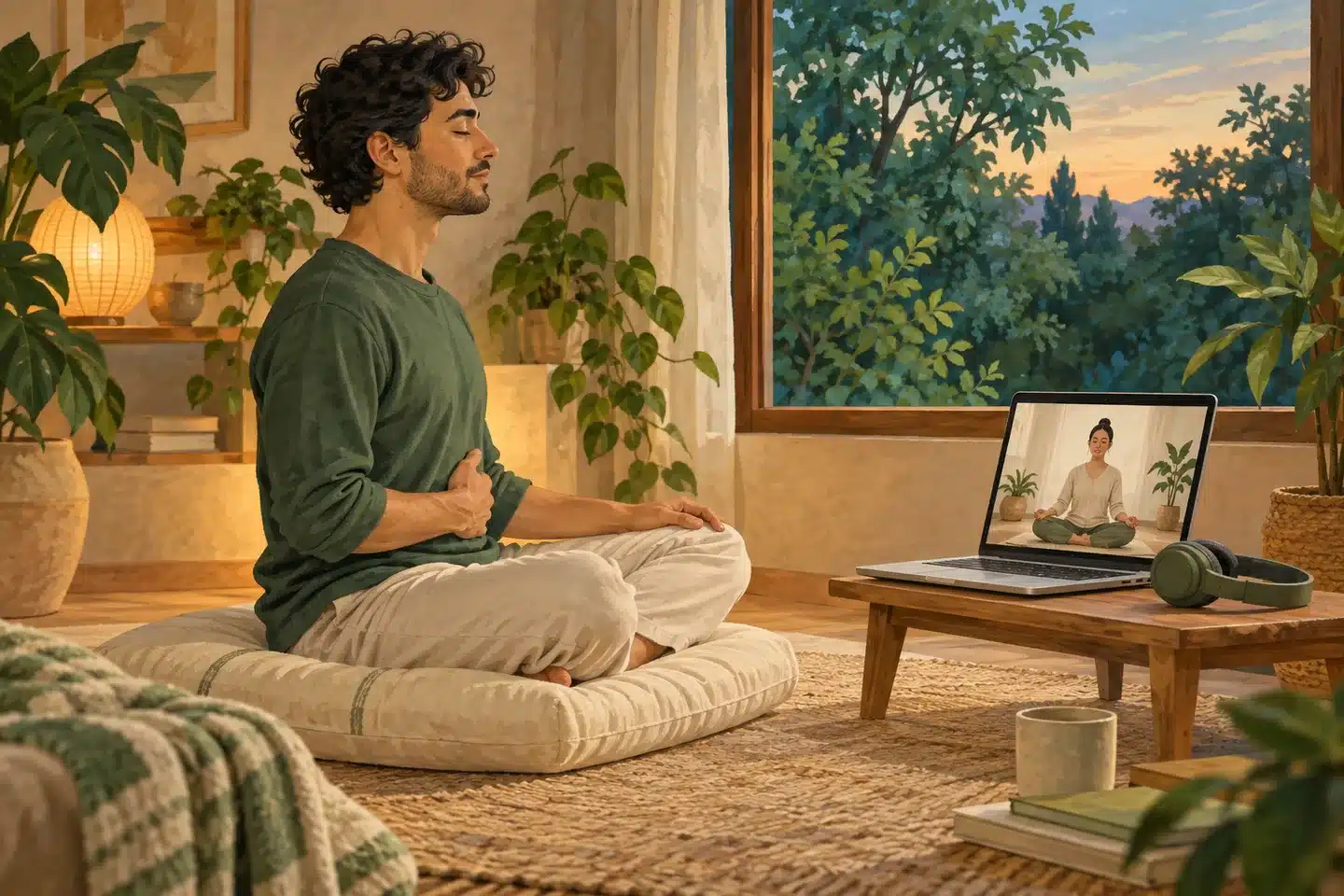
Learning pranayama through structured online instruction, whether live classes or teacher-guided programs, has real advantages over piecing it together from random videos.
- Access to a qualified teacher regardless of location, so you don’t need a yoga school in your city to learn correct technique.
- Real-time correction, since live online classes let a teacher catch posture and breath-ratio mistakes before they become habits.
- Flexible scheduling that fits around a full-time job.
- Safer progression, because a structured program introduces breath retention and advanced techniques only when you’re ready.
- Easier consistency. A structured program is easier to stick with daily than a single video you found once.
- A path into deeper study, for anyone who wants to go beyond daily practice into Kriya Yoga and Prana Vidya later on.
14. Pranayama instruction online vs. in-person pranayama training
Compare online and in-person instruction by observation, feedback, individual adaptation and assessment. Neither format is automatically superior. A recording cannot replace individual guidance for unfamiliar forceful breathing, retention or cleansing practices.
15. What is the best online pranayama course?
Choose a programme with a named teacher, clear prerequisites, suitable progression, safety teaching and meaningful live feedback. Check the actual curriculum and assessment rather than a certificate logo.
Inteyoga’s current Advanced TTC 300-Hour Integrated Restorative Yoga (Including Yoga Nidra, Chakra Sadhana, and Prana Vidya Intensive) is residential advanced training for applicants with a completed 200-hour TTC or an accepted equivalent. Inteyoga is registered with Yoga Alliance as RYS 200, RYS 300 and RYS 500; registration is not accreditation. The planned 200-hour programme has no confirmed final dates, prices or format.
Conclusion
Begin with comfortable practice and seek guidance for anything unfamiliar. Pranayama is not proven detoxification or treatment for a medical condition.
For Inteyoga’s current 300-hour programme, no payment is required to apply or participate. After completion, Gift-it-Forward support is voluntary, with no obligation. Use the direct application form and confirm current suitability with the team.
Frequently asked questions
How to do pranayam step by step?
Sit comfortably and observe a few natural breaths. Practise gently, without force or retention, and stop for dizziness or distress. Learn unfamiliar techniques with appropriate individual guidance.
What is the best online pranayama course?
Choose a named, suitably qualified teacher, clear prerequisites, safety teaching, meaningful feedback and assessment. Confirm the actual curriculum and credentials directly.
What are the 5 basic pranayama?
There is no universal list of five basic techniques. Some common lists include forceful practices, which are not appropriate unsupervised beginner exercises.
What are the 10 most powerful pranayamas?
Nadi Shodhana, Bhastrika, Kapalabhati, Ujjayi, Bhramari, Sheetali, Sheetkari, Surya Bhedana, Chandra Bhedana and Kumbhaka are traditional names, not a scientific ranking of power. They require different precautions.
Which pranayama is best for beginners?
Natural breath awareness or gentle breathing with suitable guidance is a reasonable starting point. No named technique is best or suitable for everyone; avoid force and retention.
What is the 15-minute pranayama practice?
Use the time as an optional framework for settling, natural breathing, a familiar gentle practice and rest. Do not include forceful breathing or retention as a standard beginner routine, and do not force yourself to complete 15 minutes.
Who should not do pranayama?
Suitability depends on the technique and health. Relevant conditions, pregnancy or surgery may require individual advice. Forceful breathing and retention need particular care.
Which pranayama is most powerful?
There is no validated universal ranking. Strong sensation, force and long holds do not establish benefit or suitability.
Who is the king of pranayama?
This is a promotional or traditional description rather than a clinical designation. Ask what practice is actually taught and whether it is appropriate for you.
How many minutes of pranayama is good?
There is no universal duration. Begin briefly and comfortably; obtain guidance on progression instead of treating a fixed number of minutes as a therapeutic dose.
What is the Baba Ramdev Pranayam?
Public programmes associated with Baba Ramdev include breathing and chanting, with varying sequences. Their popularity does not establish that every technique is safe for every person.
Which pranayama increases memory power?
No pranayama technique is established as a universal memory booster. Evidence about mood or stress cannot be treated as proof of improved memory.