
Author: Inteyoga Editorial Team
Searching for the best yoga classes in Goa can be confusing because the results mix together very different experiences: a one-hour holiday class, a week-long retreat, a residential teacher training and an individual session adapted around a health concern. The best option depends first on what you want from the practice.
North Goa generally has a denser seasonal market for drop-in classes and short workshops, especially around Assagao, Arambol, Mandrem and Anjuna. South Goa has established drop-in centres around Agonda, Palolem, Patnem and Colomb, as well as quieter residential programmes in areas such as Colva and Sernabatim. These are broad tendencies, not rules. The exact neighbourhood, teacher, schedule and accommodation matter more than the label “North Goa” or “South Goa”.
This guide does not rank schools from first to last. It explains how to choose and gives examples whose current official pages could be checked in August 2026. No centre paid to be included. Schedules, fees and teaching teams can change, so confirm the details directly before booking.
Quick answer
The best yoga classes in Goa fall into four practical categories:
| Format | Typical commitment | Best suited to | Main limitation |
|---|---|---|---|
| Drop-in class | One class, usually 60-90 minutes | Travellers, beginners and anyone testing a teacher | Limited continuity and individual follow-up |
| Residential retreat or yoga holiday | About 5-28 days | Rest, routine and guided personal practice | Not automatically a teaching qualification |
| Yoga teacher training | Usually 200 or 300 hours | Structured study and teaching preparation | Intensive schedule, assessment and eligibility requirements |
| Private or small-group instruction | One or more individually arranged sessions | People who need closer attention or adapted practice | Quality depends heavily on the teacher’s scope and qualifications |
Before paying, check the teacher’s name and qualifications, the style and level, the group size, the current timetable, the refund policy, the approach to hands-on adjustments and, for teacher training, the school’s current registration status.
What Kind of Yoga Class do you Actually Need?
Drop-in classes
A drop-in class is the simplest way to practise while travelling. You attend one session, usually without committing to a full programme. It is also the most practical way to test whether a teacher’s pace, language and approach suit you.
Ask whether the class is genuinely open to beginners. “All levels” can sometimes mean that the teacher leads one sequence while students are expected to modify independently. A beginner-friendly class should include clear alternatives and should not assume familiarity with Sanskrit names or fast transitions.
Residential retreats and yoga holidays
A retreat normally combines accommodation, meals and scheduled practice. Some programmes include meditation, pranayama, philosophy, chanting or workshops. The word “retreat” does not indicate a common curriculum, intensity or teacher qualification, so compare the actual daily schedule rather than the marketing title.
A retreat is usually the better choice when the goal is rest, routine or personal study rather than a teaching credential.
Yoga teacher training
Teacher training is a full educational programme, not simply a longer retreat. A Registered Yoga School may offer an RYS 200, RYS 300 or RYS 500 training track. Yoga Alliance distinguishes the school credential, RYS, from the individual teacher credential, RYT. Graduates apply separately for the relevant RYT registration after completing eligible training and meeting the current requirements.
A 300-hour training is advanced study and normally follows a qualifying 200-hour foundation. Before booking, verify the school in the Yoga Alliance directory and ask which approved training track will appear on the completion certificate.
Private or health-informed instruction
A private session allows the teacher to adjust pace, props and sequence more closely than a large group class. It can be useful for older adults, beginners who feel anxious in groups, or people returning to practice after illness or injury.
However, a private yoga session is not automatically medical treatment. A teacher should not diagnose a condition or promise a cure outside their professional scope. People with significant pain, recent surgery, pregnancy complications, uncontrolled blood pressure, glaucoma, serious osteoporosis or other medical concerns should obtain appropriate medical advice and tell the teacher before practising.
North Goa or South Goa?
| Consideration | North Goa | South Goa |
|---|---|---|
| Areas commonly associated with yoga | Assagao, Arambol, Mandrem, Anjuna, Vagator and Morjim | Agonda, Palolem, Patnem, Colomb, Canacona, Colva, Benaulim and Sernabatim |
| Common format | Dense seasonal choice of drop-ins, workshops and retreats | Drop-ins in beach areas plus retreats and residential teacher training |
| Social environment | Often more concentrated around cafes, markets and nightlife | Often more spread out, with several quieter residential areas |
| Seasonal pattern | Many centres operate mainly from October to May | Beach-based centres may be seasonal; permanent centres can operate beyond the beach season |
| Better question to ask | Is the exact address quiet enough for early practice? | Is the programme close enough to the services and transport you need? |
Do not choose only by district. Assagao can be quiet while parts of central North Goa can be busy. Palolem can be lively while nearby Colomb or Sernabatim may feel more residential. Check the exact location on a map, ask about nearby nightlife and road noise, and read recent comments about sleep rather than relying on the words “North” or “South”.
Many Goa practice spaces are naturally ventilated or semi-open rather than climate-controlled studios. That can be pleasant, but it also means heat, humidity, insects and outside sounds. Ask directly about fans, flooring, mosquito control and whether the shala is enclosed if these details matter to you.
Yoga Centers in Goa to Compare
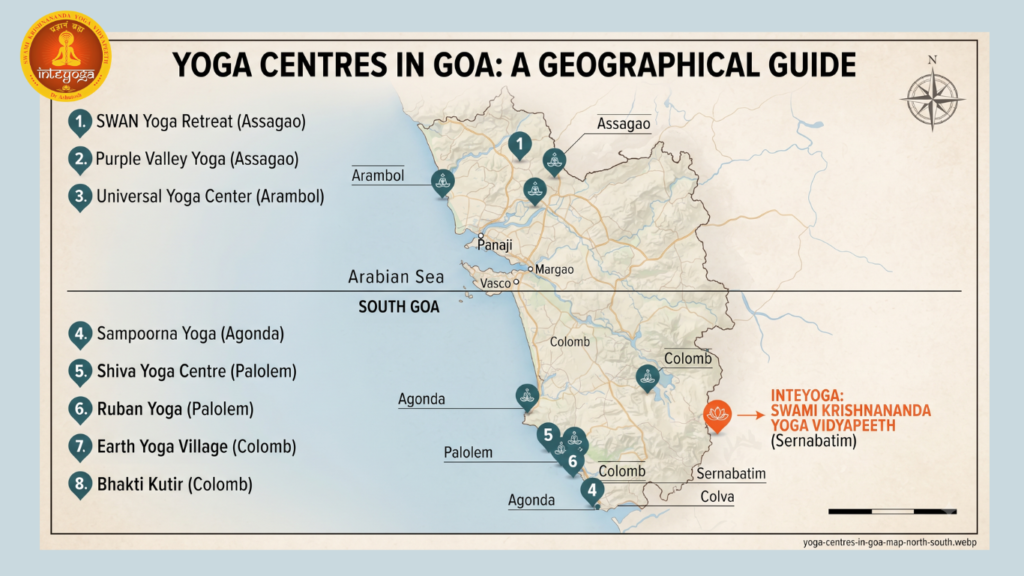
The centres below are examples, not a ranking. They are included because their official websites published identifiable locations and current or seasonal offerings when this guide was reviewed. Confirm the timetable before travelling to any class.
South Goa
1. Sampoorna Yoga, Agonda
Sampoorna Yoga publishes seasonal drop-in classes in Agonda from 1 October to 15 May, with morning Vinyasa Flow and an evening Gentle Vinyasa or Hatha class. Its official website also describes a dedicated Mysore-style Ashtanga space beginning in October 2026. This may suit travellers who want either a single class or a more structured Ashtanga stay.
Check before going: the daily schedule, the exact property for the class and whether advance booking is recommended.
2. Shiva Yoga Centre, Palolem
Shiva Yoga Centre states that it operates from around mid-October to the end of May and publishes several daily Hatha Yoga sessions plus an evening meditation class. Its current page also lists a free Sunday midday Hatha class.
Check before going: seasonal opening date, class language, class size and whether the listed free session is running that week.
3. Earth Yoga Village, Colomb between Palolem and Patnem
Earth Yoga Village publishes a 2026-27 drop-in season from 8 November 2026 to 28 March 2027, with a morning Hatha/Vinyasa Flow class from Sunday to Friday. The centre also offers yoga holidays, longer retreats and teacher training from its permanent village in Colomb.
Check before going: current drop-in fee, whether outside guests need to register and which teacher is leading the class.
4. Bhakti Kutir, Colomb
Bhakti Kutir describes four yoga shalas and a changing weekly programme open to residents and outside visitors. It hosts daily classes, guest teachers and retreat groups rather than presenting one fixed style throughout the year.
Check before going: the weekly schedule, teacher biography, style and level. A changing programme can offer variety, but it makes advance checking especially important.
5. Ruban Yoga, Palolem
Ruban Yoga advertises drop-in classes, short retreats and 200-hour teacher training near Palolem Beach. Separate pages on its website publish workshops and training details, but current schedules and prices should be confirmed directly because programme information can vary between pages.
Check before going: the exact timetable, the teacher assigned to the class, what is included in the quoted price and the written cancellation terms.
North Goa
6. SWAN Yoga Retreat, Assagao
SWAN Yoga Retreat publishes drop-in classes in classical Hatha Yoga with Sivananda and Satyananda influences. Its current page lists a price of INR 600 per class or INR 3,000 for six classes, morning and evening sessions on most days, and Friday as the weekly rest day. The retreat states that its Goa season runs from October to May.
Check before going: same-day confirmation, the current teacher and whether the session is a general drop-in or part of a residential programme.
7. Purple Valley Yoga, Assagao
Purple Valley Yoga specialises in Ashtanga Vinyasa retreats and publishes one-, two- and four-week immersions with visiting teachers for 2026-27. It is better understood as a retreat and study centre than as a general daily drop-in studio.
Check before booking: the visiting teacher, practice prerequisites, retreat duration, accommodation and whether the programme is suitable for newer Ashtanga practitioners.
8. Universal Yoga Center, Arambol
Universal Yoga Center publishes 200-, 300- and 500-hour teacher training in Arambol and identifies its lead teacher and training background. Its website listed 2026 Goa training dates and a private-room fee for the 200-hour course, but students should request a current 2026-27 quotation and verify the school’s live Yoga Alliance directory entry before paying.
Check before booking: current dates, RYS designation, accommodation details, lead-teacher contact hours and refund or transfer policy.
These are not the only credible yoga centres in Goa. The purpose of the list is to show the range: casual drop-ins, seasonal Hatha centres, Ashtanga immersions, eco-retreats and teacher training. The right comparison is between programmes serving the same goal.
What does a Yoga Class in Goa Cost in 2026?
There is no reliable statewide tariff. Some centres publish prices, some quote by message and some change rates between the quieter months and the Christmas-New Year period.
A current published example is SWAN Yoga Retreat’s INR 600 drop-in class and INR 3,000 six-class package. Shiva Yoga Centre currently lists a free Sunday midday class. Many other official pages publish a schedule without displaying a drop-in fee.
Teacher-training and retreat prices vary much more because room type, meals, course length and taxes may be bundled differently. For example, Universal Yoga Center listed a US$1,200 private-room price for its January and February 2026 Arambol 200-hour courses, while Ruban Yoga published separate residential and training-only prices for its 2026 200-hour courses. These are dated reference points, not current market quotations.
Before comparing prices, ask for a written total showing:
- Tuition or class fee
- Accommodation type and occupancy
- Number of meals and days off
- Taxes and payment-processing charges
- Airport or railway transfer
- Course manual and use of props
- Laundry and excursions
- Deposit, refund and date-transfer rules
- Any single-room supplement
A lower price is not proof of poor teaching, and a higher price is not proof of quality. For a long course, compare the teacher’s actual contact hours, group size, curriculum and assessment process before comparing room comfort.
How to Verify a Teacher or Yoga School
Yoga Alliance
Yoga Alliance is a voluntary international registry, not a government licensing authority. Schools hold RYS credentials and individuals hold RYT credentials. The official credential options include RYS 200, RYS 300 and RYS 500. Yoga Alliance also requires RYS programmes to assess trainee knowledge and skills before issuing a training certificate.
Use the official Yoga Alliance directory rather than relying on a logo. Search the exact school name and confirm the location and designation. A school’s RYS status does not remove the need to check the individual teacher who will actually teach you.
Yoga Certification Board, Ministry of AYUSH
The Yoga Certification Board was established by the Ministry of AYUSH to certify yoga professionals and accredit yoga institutions. Its professional categories include Yoga Protocol Instructor, Yoga Wellness Instructor, Yoga Teacher and Evaluator, Yoga Master and several yoga-therapy and yogasana roles.
YCB certification is voluntary. The Board states that it does not itself conduct yoga courses; it conducts or oversees assessment and certification, while accredited institutions and approved bodies operate within its framework. Check the professional or institution on the official YCB website rather than accepting a general claim that a course is “AYUSH certified”.
Qualifications are not interchangeable
An academic yoga degree, an RYT registration, a YCB professional certificate, traditional ashram training and clinical qualifications each indicate different things. No single badge proves that a teacher is suitable for every class or health condition.
For a drop-in class, the most useful questions are often simple: Who is teaching today? How long have they taught this style? Is the class beginner-friendly? How are injuries and hands-on adjustments handled?
Questions to ask before booking
- Who will teach the class or most of the course, by name?
- What style is taught, and what does “all levels” mean in practice?
- How many students are usually in the room?
- Does the teacher ask about injuries, pregnancy and relevant medical conditions?
- Are hands-on adjustments optional and based on explicit consent?
- What happens if the programme changes, the teacher is replaced or the student becomes ill?
- What is the complete price and written refund or transfer policy?
- For teacher training, what is the exact RYS designation and registration name?
- How is trainee competence assessed before a certificate is issued?
- Can the school provide recent graduates or participants who are willing to describe their experience?
A clear school should be able to answer these questions without pressure or vague spiritual language.
What Should Happen in a Good Yoga Class?
There is no single correct 60- or 90-minute format, but several quality markers are consistent:
- The teacher identifies the class level and asks about relevant limitations.
- The warm-up and sequence match the advertised style.
- Instructions are clear enough to follow without copying the person beside you.
- Alternatives and props are offered without embarrassment.
- The teacher does not force range of motion or treat pain as progress.
- Physical adjustments occur only with consent.
- The class allows time to settle the breath and finish safely rather than ending abruptly.
Yoga Alliance’s Ethical Commitment specifically includes consent-based touch, respect for student-teacher relationships and honest communication. These are basic professional expectations, not optional extras.
Stop if you experience sharp, electric, hot or shooting pain, sudden dizziness, chest pain, faintness or unusual shortness of breath. Seek appropriate medical care when symptoms require it. Yoga instruction should complement, not replace, diagnosis or treatment from a qualified healthcare professional.
When is the Best Time for Yoga in Goa?
| Period | General conditions | What to expect from yoga centres |
|---|---|---|
| October to March | Generally clearer and more comfortable; Goa Tourism lists typical temperatures around 20-32 C | Widest choice of drop-ins, retreats and teacher training |
| April to May | Hotter and more humid; daytime temperatures can reach about 36 C | Morning practice remains available at some centres; seasonal programmes begin to reduce |
| June to September | Southwest monsoon, with most annual rainfall concentrated in these months | Some beach-based centres close or reduce activity; permanent and residential centres may continue |
Official Goa Tourism guidance describes October to March as the most popular visitor season and December-New Year as especially busy. Goa recorded 1,08,02,410 tourist arrivals in 2025, so accommodation and popular programmes should be booked early for peak dates.
Monsoon does not mean that yoga stops across Goa. It means the available options change. Confirm whether the shala is permanent, whether travel routes are practical during heavy rain and whether the programme is genuinely operating before booking accommodation.
Are YouTube Yoga Classes Enough?
Online classes can be useful for consistency, learning basic terminology and maintaining a familiar sequence while travelling. They are less effective when a student needs individual correction, does not recognise pain or compensation, or is learning strong pranayama, breath retention, cleansing practices or advanced postures.
A practical combination is to use reputable online instruction for routine practice and attend live classes periodically for feedback. Anyone with an injury or medical concern should avoid relying on a generic video as a personalised prescription.
Red Flags when Choosing a Yoga Class or School

- The teacher’s background is described only as “Himalayan trained” or “internationally certified” with no verifiable name or institution.
- A school claims Yoga Alliance or YCB status but cannot be found in the relevant official directory.
- The website guarantees a cure, weight loss, enlightenment or a specific medical result.
- There is no written schedule, price breakdown or refund policy for a long programme.
- The teacher discourages questions about qualifications or health precautions.
- Physical adjustments are assumed rather than consented to.
- A teacher-training course issues a certificate automatically without assessment.
- The address, accommodation or shala shown online does not match the booking documents.
- Reviews appear only within one short time window or use identical language.
Where Inteyoga Fits
Inteyoga, also known as Swami Krishnananda Yoga Vidyapeeth, is based at Plot No. 6, Novo Vaddo, Sernabatim, Colva, Salcete, South Goa. It is a residential yoga school rather than a daily drop-in studio.
Inteyoga is registered with Yoga Alliance as a Registered Yoga School at the RYS 200, RYS 300 and RYS 500 levels. Its current residential offering is the Advanced TTC 300-Hour Integrated Restorative Yoga with Yoga Nidra, Chakra Sadhana, and Prana Vidya Intensive, offered under the RYS 300 registration. Applicants are expected to have completed a qualifying 200-hour yoga teacher training or equivalent foundational study.
The programme consists of 43 training days plus 1 arrival day and 1 departure day, for a total residential period of 45 days. Published start dates are:
- 13 December 2026
- 5 February 2027
- 24 May 2027
- 16 July 2027
- 7 September 2027
- 1 November 2027
The course is taught in English and includes residential accommodation and vegetarian, dairy-free meals with herbal tea and fruit. Teaching is led by Dr. Ashutosh and follows an integrated Hatha and Raja Yoga approach with reference to traditional source texts.
Gift-it-Forward
No payment is required to apply for or participate in the 300-hour programme. After the course, a participant may voluntarily support the Gift-it-Forward initiative, but there is no obligation to contribute.
Visa position for Inteyoga’s 300-hour programme
Visa requirements depend on the participant’s nationality and the nature of the programme. India’s e-Tourist Visa permits attendance at certain short-term yoga programmes lasting no more than six months. Official guidance distinguishes these from formal or structured courses that issue qualifying certificates or diplomas, which may require a different visa category. Participants should apply through the official Indian Visa Online portal and comply with the conditions applicable to their nationality.
Inteyoga’s 300-hour programme is conducted as a short-term yoga programme for personal growth and deeper yogic study. It consists of 43 training days plus 1 arrival day and 1 departure day, making a total of 45 days – well below six months. Participants receive a certificate of participation or successful completion, not an academic degree, diploma or government-recognised professional qualification. The programme can therefore be attended under an eligible Indian e-Tourist Visa, and a Student Visa is not required for Inteyoga’s programme.
For programme details, visit Courses and Fees, the Arrival Guide, Frequently Asked Questions or the Booking page.
Contact: info@inteyoga.org | +91 93547 37240 (WhatsApp available) | 8:00 AM to 8:00 PM IST, all seven days.
Frequently asked questions
How much does a yoga class cost in Goa?
There is no fixed statewide price. SWAN Yoga Retreat currently publishes INR 600 for a drop-in class and INR 3,000 for six classes, while Shiva Yoga Centre lists a free Sunday midday session. Other centres ask visitors to enquire. Confirm the current fee, mat charge and cancellation policy before travelling.
Which is better for yoga, North Goa or South Goa?
North Goa generally offers a denser choice of seasonal drop-ins and workshops. South Goa offers beach-area drop-ins as well as quieter retreats and residential teacher training. The exact neighbourhood and teacher matter more than the broad region.
Do I need experience to join a yoga class in Goa?
Many drop-in classes welcome beginners, but ask what “all levels” means. Teacher training has separate eligibility rules. A 300-hour programme normally requires prior 200-hour training.
Can I practise yoga in Goa during the monsoon?
Yes. Some seasonal beach centres close or reduce operations, while permanent and residential schools may continue. Confirm the centre’s operating dates and transport conditions before booking.
Is Yoga Alliance registration necessary?
Not for attending a general yoga class. It may matter when choosing teacher training and when a graduate plans to apply for RYT registration. Yoga Alliance is a voluntary registry, so also assess the individual teacher, curriculum, ethics and assessment process.
What does YCB certification mean?
The Yoga Certification Board, established by the Ministry of AYUSH, certifies yoga professionals and accredits institutions under defined categories. Its certification is voluntary. Verify a professional or centre on the official YCB website.
How long is yoga teacher training in Goa?
Course length varies by school and timetable. Many 200-hour residential programmes run for about three to four weeks, while 300-hour programmes often run for four to six weeks. Check the actual instructional hours, rest days and arrival or departure days rather than relying only on the headline duration.
Are yoga classes in Goa suitable for seniors or people with injuries?
Some are, but not every group class can be adapted safely for every person. Speak to the teacher before attending and obtain medical advice when a condition requires it. A private session can offer more individual attention, but it is not automatically medical treatment.
What is the best time of year for yoga in Goa?
October to March provides the widest range of programmes and generally more comfortable weather. April and May are hotter. During June to September, check which permanent centres remain active.
Can I visit Inteyoga for a single class?
Not currently. Inteyoga operates residential programmes rather than public daily drop-ins. Its current offering is the Advanced TTC 300-Hour Integrated Restorative Yoga.
Can Inteyoga’s international participants use an e-Tourist Visa?
Yes, eligible international participants can attend Inteyoga’s 45-day short-term yoga programme under the Indian e-Tourist Visa. It is intended for personal growth and deeper yogic study and provides a participation or completion certificate rather than an academic degree, diploma or government-recognised professional qualification. Participants must still satisfy the e-Visa rules applicable to their nationality.