
Quick Answer
| Question | Practical answer |
|---|---|
| What is Ashtanga yoga teacher training in Goa? | A yoga teacher-training course held in Goa that may focus on Ashtanga Vinyasa, classical Patanjali Ashtanga, or a combination of Ashtanga, Hatha and Vinyasa. Read the syllabus rather than relying on the title. |
| Is a 100-hour course a full teaching qualification? | Usually not. It is commonly a foundation, immersion or part of a longer pathway. Yoga Alliance does not offer an RYT 100 credential. |
| What is the standard entry-level format? | A 200-hour programme is the most common foundation. A school registered as RYS 200 may issue a 200-hour completion certificate that an eligible graduate can use when applying separately for RYT 200 registration. |
| What is a 300-hour course? | An advanced programme that normally builds on prior 200-hour training. Do not assume that any 300-hour certificate automatically creates an RYT 500 pathway; confirm the school’s registration and the registry’s current rules. |
| How long do courses last? | There is no fixed number of days. Current Goa examples range from about two weeks for some 100-hour courses to three or four weeks for many 200-hour courses. Advanced programmes may be longer. |
| How much do they cost? | Prices vary considerably by school, room type, season, currency, meals and early-booking terms. Current published examples are compared later in this guide. |
| When is Goa’s main training season? | October to March generally has clearer, drier weather. June to September is the southwest monsoon. Individual schools may operate outside the main season. |
| Which airport should I use? | Dabolim Airport is GOI. Manohar International Airport at Mopa is GOX. Check the school’s location before booking because Goa is long from north to south. |
| Do I need advanced postures? | Not automatically. Entry requirements vary. Some schools accept beginners; others expect an established Ashtanga practice. Ask for the written prerequisite and modification policy. |
| Does a certificate guarantee employment? | No. A certificate documents completed training. Registration, insurance, local rules, studio hiring standards and actual teaching readiness are separate questions. |
Key Takeaways
- The words certified, accredited, registered and internationally recognised are often used loosely in yoga marketing. They do not all mean the same thing.
- A trustworthy syllabus should be specific enough that you can understand the balance between personal practice and teacher preparation.
- There is no dependable single “average fee” for Ashtanga yoga teacher training in Goa. Schools use different currencies, room categories, discount deadlines, tax treatment and inclusions. Some pages advertise an early-bird figure more prominently than the standard fee.
Ashtanga yoga teacher training in Goa can mean two different things. Some schools teach Ashtanga Vinyasa – the physically demanding, sequence-based method associated with K. Pattabhi Jois and Mysore. Others use ashtanga in its classical meaning: Patanjali’s eight-limbed path of ethical discipline, posture, breath regulation, sensory withdrawal, concentration, meditation and samadhi.
These approaches overlap, but they are not interchangeable. A course centred on the Primary Series will feel very different from a Hatha-Raja programme built around the eight limbs. Before paying a deposit, confirm exactly which system the school teaches, what certificate it issues, which registry it belongs to, how assessment works, and whether the daily physical load suits your body.
This guide explains the distinction, the common 100-, 200-, 300- and 500-hour formats, current Goa price examples, Yoga Alliance and Yoga Certification Board terminology, safety considerations, visa questions, and the checks worth completing before you book.
First, Understand the Two Meanings of Ashtanga
Classical Ashtanga: Patanjali’s eight limbs
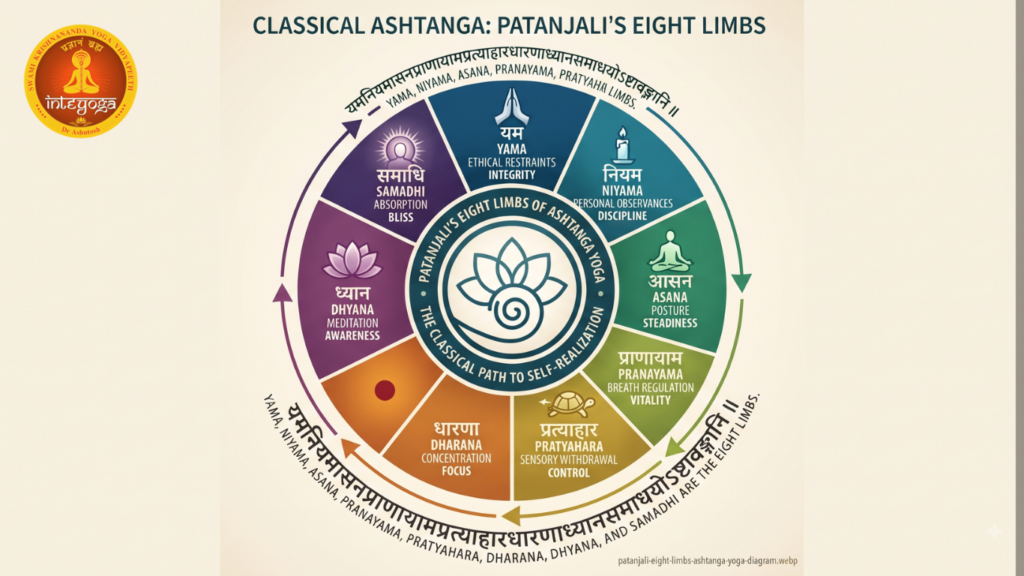
In Yoga Sutra 2.29, Patanjali lists eight limbs:
- Yama – ethical restraints
- Niyama – personal observances
- Asana – posture
- Pranayama – regulation of breath
- Pratyahara – withdrawal or management of sensory attention
- Dharana – concentration
- Dhyana – meditation
- Samadhi – absorption
In this framework, asana is one part of a larger discipline. A course organised around classical Ashtanga may devote substantial time to philosophy, ethical conduct, pranayama, concentration and meditation rather than to one fixed posture series.
Ashtanga Vinyasa: the modern Mysore-associated method
Ashtanga Vinyasa is a modern posture system associated with K. Pattabhi Jois, who taught in Mysore after studying with T. Krishnamacharya.
It uses set sequences, coordinated movement and breathing, specific gazing points, and progressive learning of postures. Classes may be led as a group or taught in a self-paced Mysore format with individual guidance.
A course may legitimately include both classical philosophy and Ashtanga Vinyasa practice. The problem arises when a school uses the word Ashtanga without explaining which part is central.
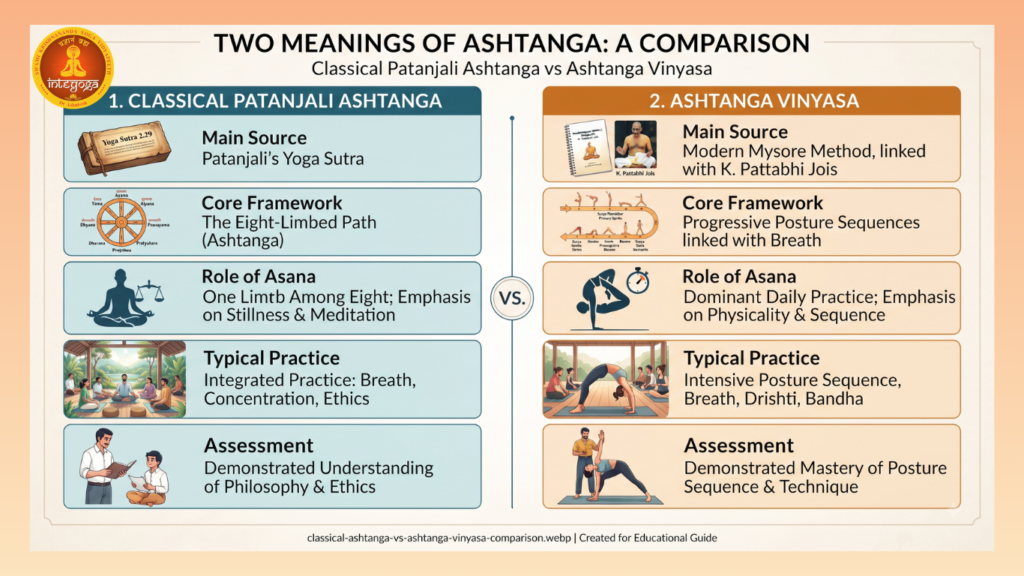
| Feature | Classical Patanjali Ashtanga | Ashtanga Vinyasa |
|---|---|---|
| Main source or association | Patanjali’s Yoga Sutra, especially 2.29 | Modern Mysore-associated method linked with K. Pattabhi Jois |
| Primary emphasis | The complete eight-limbed path | Progressive posture sequences linked with breath and movement |
| Role of asana | One limb among eight | The dominant daily practice, supported by philosophy and breath work |
| Typical physical demand | Depends on the school’s asana method | Often repetitive and physically demanding, especially in intensive training |
| Common class formats | Hatha practice, pranayama, philosophy, concentration and meditation | Led sequence and/or Mysore-style self-practice |
| Ask the school | How are all eight limbs taught and assessed? | Which sequence is taught, how is it modified, and is Mysore practice included? |
A clear school should be able to explain its approach without relying on vague phrases such as “traditional and authentic”.
What the Certificate and Registry Actually Mean
The words certified, accredited, registered and internationally recognised are often used loosely in yoga marketing. They do not all mean the same thing.
Yoga Alliance
Yoga Alliance registers schools and teachers under designations such as RYS 200, RYS 300, RYS 500, RYT 200 and RYT 500. The school delivers and assesses the training, then issues its completion certificate. Yoga Alliance does not personally teach or examine every trainee.
An eligible graduate of an RYS programme may apply separately for the corresponding teacher registration, subject to Yoga Alliance’s current documentation, membership and experience requirements. Registration is voluntary. It is not a government teaching licence and does not by itself guarantee employment or legal permission to work in every country.
Yoga Certification Board, Ministry of AYUSH
The Yoga Certification Board is a Government of India body that certifies yoga professionals and accredits eligible institutions or centres. Its own FAQ states that it does not conduct yoga courses; it conducts or oversees assessment and certification through its system. YCB professional certification is voluntary and is separate from Yoga Alliance registration.
A school should not imply that an ordinary school certificate automatically becomes a YCB professional certificate. Ask whether the programme includes an actual YCB assessment, which level is involved, which approved body conducts it, and whether the quoted fee includes that process.
Yoga Alliance International and similarly named organisations
Several independent organisations use names containing “Yoga Alliance”. Yoga Alliance International is separate from Yoga Alliance. Their registration systems, standards, fees and market familiarity differ.
Before booking, write down the exact legal name and website of the registry. Then check whether employers, insurers or studios in the country where you plan to teach recognise or request it.
Course formats: 100, 200, 300 and 500 hours
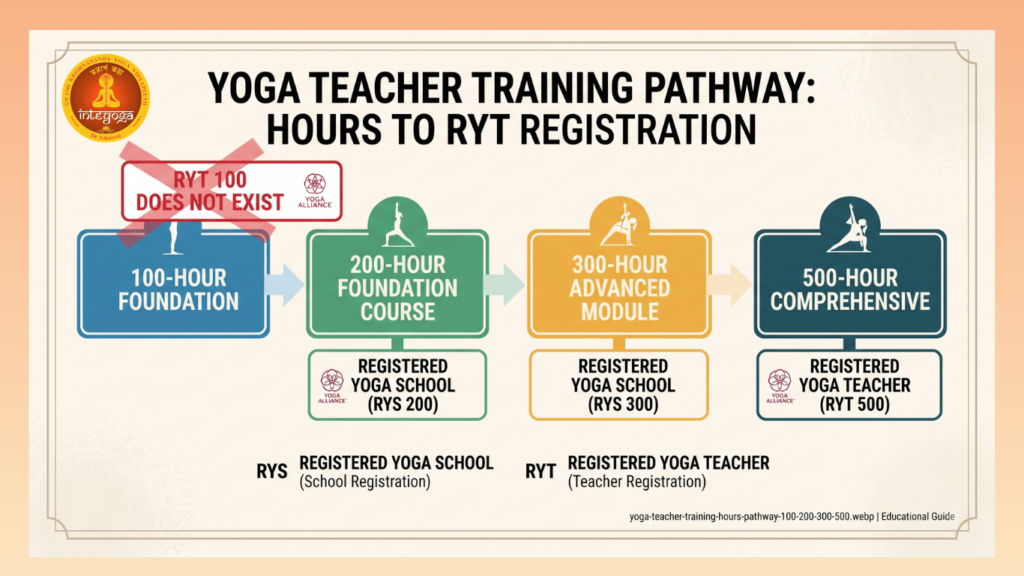
Training hours describe the intended curriculum volume, not a universal number of nights. Two schools may both advertise 200 hours while using different daily schedules, online components, assessment systems and residential lengths.
| Format | What it commonly means | Important limitation |
|---|---|---|
| 100 hours | Foundation, immersion, specialist module or the first part of a longer course | It is not an RYT 100 pathway because Yoga Alliance does not have an RYT 100 designation. Ask whether the hours can later be combined and under what written policy. |
| 200 hours | Foundational teacher training covering practice, anatomy, yoga humanities and professional essentials | Completing a school certificate is not the same as being automatically registered as RYT 200. The graduate applies separately if eligible. |
| 300 hours | Advanced training intended to deepen prior foundational study | Normally requires qualifying 200-hour training. Confirm whether the school is RYS 300 and how the hours relate to any RYT 500 application. |
| 500 hours | A comprehensive programme or a 200-plus-300 pathway, depending on the school and registry | Do not assume that every advertised 500-hour course uses the same structure or produces the same registration eligibility. |
Current Goa schedules illustrate the variation. Sampoorna Yoga lists 100-hour Ashtanga Vinyasa courses lasting 13 nights. Kranti Yoga describes a 200-hour Ashtanga Vinyasa course over 21 nights. Himalaya Yoga Valley lists a residential 200-hour Goa course over 24 nights. These are examples, not universal standards.
What a Serious Ashtanga Vinyasa Curriculum Should Explain
A trustworthy syllabus should be specific enough that you can understand the balance between personal practice and teacher preparation.
Asana and sequence study
The course should state whether it teaches the full Primary Series, a modified Primary Series, selected postures, or a multi-style programme combining Ashtanga with Vinyasa or Hatha. It should explain how postures are introduced, when students stop at an appropriate point, and how injuries or limitations are accommodated.
Led practice and Mysore-style practice
A led class moves the group through a sequence together. Mysore-style practice is self-paced: students work through the sequence at their own level while a teacher gives individual guidance.
Not every course includes substantial Mysore practice. Ask how many sessions are included, how many teachers supervise the room, whether complete beginners are supported, and whether physical adjustments require active consent.
Breath, gaze and bandha
Ashtanga Vinyasa courses usually discuss coordinated breathing, drishti or gazing points, and bandha concepts. The syllabus should distinguish traditional terminology from anatomical or physiological claims. It should also avoid presenting forceful breathing practices as suitable for every participant.
Anatomy and movement education
Useful anatomy teaching connects structure to practice. For example:
- Weight-bearing through the hands in repeated transitions
- Shoulder positioning in plank and chaturanga variations
- Hamstring load in repeated forward folds
- Knee and hip relationships in lotus-related positions
- Spinal loading and individual variation in backbends
- Hypermobility, fatigue and recovery during daily practice
Ask who teaches anatomy, what their qualifications are, and how the module influences actual modifications in class.
Philosophy and ethics
A course using the word Ashtanga should explain Patanjali’s eight limbs, not only the posture sequence. It should also cover professional boundaries, scope of practice, honest advertising, confidentiality, cultural context and the limits of a teacher’s role.
Teaching methodology and practicum
Look for documented practice in:
- Observation and clear verbal instruction
- Demonstration without turning the class into a performance
- Sequencing and timing
- Offering options without diagnosing students
- Consent-based touch and hands-on assistance
- Responding to pain, dizziness or distress
- Teaching peers and receiving structured feedback
- Final assessment criteria
A certificate should reflect demonstrated learning, not attendance alone. Yoga Alliance’s school standards state that RYS programmes should assess trainees before issuing completion certificates.
Goa price examples for 2026-27
There is no dependable single “average fee” for Ashtanga yoga teacher training in Goa. Schools use different currencies, room categories, discount deadlines, tax treatment and inclusions. Some pages advertise an early-bird figure more prominently than the standard fee.
The examples below were taken from schools’ own published pages available on 5 August 2026. They are market references, not rankings or endorsements.
| School and programme | Published residential price example | Important context |
|---|---|---|
| Ekam Yogashala – 200-hour Goa training | US$1,199 twin sharing; US$1,499 private | The published page includes tuition, accommodation and meals. Confirm the exact style, dates, taxes, transfer terms and airport arrangements before payment. |
| Mantra Yoga School – 200-hour Ashtanga/Vinyasa in Goa | US$1,400 sharing; US$1,600 private, with lower advance-booking figures shown | The page describes a 24-day residential course. Confirm which figure applies to your date and room because discounted and standard rates are both displayed. |
| Himalaya Yoga Valley – 200-hour residential Goa training | From EUR 1,899 triple; EUR 2,199 twin; EUR 2,499 private under the displayed early-booking offer | The course is a broader 200-hour teacher training rather than a purely Ashtanga-specific comparison. The packages list 24 nights, meals, training and materials. |
These examples alone show why a universal claim such as “$1,100 to $2,000” can mislead. The total can move above or below that range depending on the original currency, accommodation, course structure and promotion.
Compare the total cost, not the headline
Before transferring money, ask for an invoice or written quotation showing:
- Tuition
- Room type and number of nights
- Meals and excluded days
- Taxes
- Course manual and required books
- Assessment or registry fees
- Airport transfer
- Laundry
- Extra nights
- Excursions
- Payment-processing charges
- Refund and transfer terms
Do not assume that a deposit is refundable. Read the policy before paying and keep a copy of the version that applied on the payment date.
What is usually included – and what may not be
Many residential courses include tuition, accommodation, scheduled meals, basic props and a course manual. That pattern is common, but it is not guaranteed.
Items frequently excluded include flights, visa costs, insurance, airport transfers, laundry, medical care, optional excursions, treatments, extra nights and personal purchases. Meal service may also change on rest days or arrival and departure days.
Ask about the practical details that affect a month-long stay:
- Is drinking water provided?
- Is there reliable hot water and power backup?
- Is the room air-conditioned, fan-cooled or naturally ventilated?
- Are meals suitable for allergies or medically necessary diets?
- How far is the accommodation from the shala?
- Are towels, bedding and cleaning included?
- Is there a quiet-hours policy?
- What happens if you become ill and miss required hours?
North Goa or South Goa?
Neither region is universally better. The useful question is whether the location supports your course schedule.
| North Goa | South Goa |
|---|---|
| Training locations include areas such as Arambol and Mandrem. | Training locations include areas such as Agonda, Palolem, Patnem, Polem and Colva. |
| May suit students who want more cafes, classes and social activity nearby. | May suit students who prefer a more residential setting or a quieter evening routine. |
| Manohar International Airport at Mopa (GOX) is often more convenient for northern locations. | Dabolim Airport (GOI) is often more convenient for central and southern locations. |
| Noise varies greatly by exact property, road and season. | Quietness also varies; do not assume every South Goa property is secluded. |
Ask the school for its exact map location, not only the beach or village name. Check the distance between accommodation and classes, nearby construction, road noise, and whether late-night venues operate close to the property.
Goa has two operating airports. Dabolim Airport uses the IATA code GOI. Manohar International Airport at Mopa uses GOX. Travel time can vary substantially with location and traffic, so arrange transport using the exact airport code on your ticket.
When to take a teacher training in Goa
Goa Tourism describes October to March as the generally pleasant period with clearer skies and temperatures commonly around 20-32 degrees Celsius. June to September is the southwest monsoon, with most annual rainfall concentrated in those months. April and May are hotter and more humid.
| Period | General conditions | Training consideration |
|---|---|---|
| October to November | Post-monsoon transition, warm and increasingly dry | Often a practical balance of weather and pre-peak travel demand |
| December to January | Dry season and peak tourism | Comfortable for many students, but accommodation and transport demand can be high |
| February to March | Warm and generally dry | Common training period; afternoon heat may increase later in March |
| April to May | Hotter and more humid | Check ventilation, hydration planning and the intensity of the daily timetable |
| June to September | Southwest monsoon | Some schools continue, but transport, humidity, drying clothes and coastal conditions require planning |
A school calendar is not proof that the climate suits you. Ask whether the practice room is enclosed or open, how the programme handles heat, and whether accommodation has adequate ventilation.
What a daily schedule may look like
There is no standard Goa timetable. An intensive residential day may include an early practice, breakfast, anatomy or philosophy, lunch and rest, teaching methodology, a second practice or workshop, dinner and self-study.
A sample structure might be:
| Approximate time | Possible activity |
|---|---|
| 06:00 | Meditation, pranayama or preparation |
| 07:00 | Led Ashtanga or Mysore-style practice |
| 09:00 | Breakfast |
| 10:30 | Anatomy, philosophy or yoga humanities |
| 12:30 | Lunch and rest |
| 15:00 | Teaching methodology, alignment or practicum |
| 17:00 | Workshop, lighter practice or supervised teaching |
| 19:00 | Dinner |
| Evening | Reading, chanting, discussion or rest |
Treat any sample schedule as illustrative. Ask for the actual weekly timetable, total contact hours, days off, assessment dates and attendance policy.
Also ask whether the advertised hours include meal breaks, unsupervised study, online preparation or homework. The word intensive should not be used to hide inadequate sleep or recovery.
Is Ashtanga Vinyasa suitable for your body?
Ashtanga Vinyasa can involve repeated weight-bearing through the hands, frequent transitions, forward folds, externally rotated hip positions and progressive backbending. The effect depends on the sequence taught, the student’s conditioning, the teacher’s judgement and the availability of modifications.
A systematic review of epidemiological studies found that most reported yoga-related adverse events were musculoskeletal and that sprains and strains were common. Another review of yoga injury literature found that lower-extremity injuries formed a substantial share of reported cases, although the available evidence was limited and heterogeneous. These studies do not prove that a particular Goa course is unsafe, but they do support sensible screening, gradual progression and qualified supervision.
Before booking, disclose relevant conditions in writing
A training application should give you space to report injuries, pain, surgery, pregnancy, cardiovascular concerns, eye conditions, neurological symptoms and other relevant health issues. The school should explain what it can safely accommodate and when medical clearance is required.
Do not rely on a generic statement that “yoga is suitable for everyone.” A responsible school may decline, postpone or modify participation when the programme cannot safely meet a student’s needs.
During training
- Stop for sharp, radiating, unstable or escalating pain.
- Do not let another person force you deeper into a posture.
- Ask for non-touch instruction whenever you prefer it.
- Reduce repetitions when fatigue changes joint control or breathing.
- Treat dizziness, fainting, chest pain, new neurological symptoms or acute injury as medical concerns, not spiritual obstacles.
- Keep prescribed treatment and medical advice separate from a yoga teacher’s scope.
This article is general education and does not replace individual medical assessment.
Consent and hands-on adjustments
A modern teacher training should have a written approach to touch. Consent should be specific, voluntary and reversible. Agreeing to hands-on help once does not create permanent consent for every teacher, posture or day.
Ask:
- How is consent obtained before touch?
- Can students choose a no-touch option without explanation?
- Are intimate areas explicitly excluded?
- Are adjustments demonstrated and supervised?
- Is there a confidential complaint process?
- What happens if a student reports inappropriate conduct?
A school’s response to these questions is part of teacher-training quality, not an optional administrative detail.
What are the realistic benefits of teacher training?
A well-run course can provide structured study, sustained personal practice, feedback, supervised teaching experience and a clearer understanding of yoga’s philosophy and professional responsibilities.
It cannot guarantee that you will:
- Be ready to teach every population immediately
- Obtain employment
- Earn a particular income
- Resolve pain or a medical condition
- Master the Primary Series
- Become registered with every organisation
- Be legally permitted to work in another country
The strongest outcome is usually a foundation for continued study. Teaching skill develops through practice, observation, feedback, continuing education and experience after graduation.
How to choose the right programme
1. Confirm which Ashtanga is being taught
Ask the school to describe the course in one paragraph. Does it centre on the Ashtanga Vinyasa Primary Series, a modified sequence, classical eight-limb study, or a multi-style syllabus?
2. Verify the school independently
Search the relevant registry directory using the school’s exact registered name. Do not rely only on a logo displayed on the school’s website. Confirm the designation – for example, RYS 200 or RYS 300 – and whether it is current.
3. Read the full curriculum
Look for a clear allocation of practice, anatomy, philosophy, methodology, practicum and assessment. Marketing phrases are not a syllabus.
4. Identify the actual teaching team
Ask who will lead each module and whether the advertised lead trainer will be present for most of the programme. Review qualifications relevant to the module being taught.
5. Ask about group size and supervision
There is no universal ideal number. What matters is the ratio of students to qualified teachers, especially during Mysore practice, adjustments and practicum assessment.
6. Review prerequisites and modification policy
A school that accepts beginners should explain how it teaches beginners. A school requiring prior practice should define what that means.
7. Review the attendance and assessment rules
Ask what happens after illness, missed hours or an unsuccessful assessment. A certificate should not be assumed simply because the fee was paid.
8. Read the refund and transfer policy
Get the policy in writing before paying. Note deadlines, administrative deductions, medical exceptions, course cancellation terms and whether a transfer has an expiry date.
9. Speak with recent graduates
Ask for graduates from the same course format and location, not only general testimonials. Useful questions include teacher availability, room conditions, food consistency, actual group size, injuries, assessment and post-course support.
Twelve questions to ask before paying a deposit
- Does the programme teach classical Patanjali Ashtanga, Ashtanga Vinyasa, or both?
- Which exact sequence or syllabus is taught?
- Is the school currently registered, and under which organisation and designation?
- What certificate is issued by the school?
- What separate registration, examination or membership fee may apply after graduation?
- What prior practice is required?
- Who teaches anatomy, philosophy, practice and practicum?
- How many students and qualified teachers were in the most recent comparable batch?
- How are touch and adjustment consent handled?
- What happens if illness or injury prevents full attendance?
- What is included in the total residential price?
- What are the refund, transfer and school-cancellation terms?
Keep the answers with your payment receipt.
Visa considerations for international students
Visa requirements depend on the participant’s nationality and the nature of the programme. India’s e-Tourist Visa permits attendance at certain short-term yoga programmes lasting no more than six months. Official guidance distinguishes these from formal or structured courses that issue qualifying certificates or diplomas, which may require a different visa category. Participants should always apply through the official Indian Visa Online portal and comply with the conditions applicable to their nationality.
Inteyoga’s 300-hour programme is conducted as a short-term yoga programme for personal growth and deeper yogic study. It consists of 43 training days plus 1 arrival day and 1 departure day, making a total of 45 days – well below six months. Participants receive a certificate of participation or successful completion, not an academic degree, diploma or government-recognised professional qualification. The programme can therefore be attended under an eligible Indian e-Tourist Visa, and a Student Visa is not required for Inteyoga’s programme.
Travel, insurance and practical planning
Check that travel insurance covers the activities included in the programme. Policies may distinguish ordinary yoga from teacher training, intensive practice or pre-existing conditions.
Bring copies of prescriptions and enough regular medication for the stay. Do not discontinue medication for cleansing practices, fasting or advice from an unqualified person.
Other useful checks:
- Passport validity and visa documentation
- Exact airport code: GOI or GOX
- Arrival time and late-night transfer arrangements
- Local currency access and card acceptance
- Mobile connectivity
- Mosquito protection
- Laundry and drying arrangements
- Heat and monsoon clothing
- Emergency contact and nearest appropriate clinic or hospital
Where Inteyoga fits
Inteyoga does not offer an Ashtanga Vinyasa Primary Series teacher training. Students specifically seeking a Mysore-style Ashtanga Vinyasa certification should choose a school whose published curriculum and teaching team specialise in that method.
Inteyoga teaches the classical Ashtanga framework of Patanjali within an integrated Hatha and Raja Yoga approach. Inteyoga, also known as Swami Krishnananda Yoga Vidyapeeth, is based in Sernabatim, Colva, South Goa. It is registered with Yoga Alliance as a Registered Yoga School at the RYS 200, RYS 300 and RYS 500 levels.
Current residential programme
The current offering is the Advanced TTC 300-Hour Integrated Restorative Yoga, delivered under Inteyoga’s RYS 300 designation.
- Duration: 43 training days plus 1 arrival day and 1 departure day – 45 days in total
- Format: Residential
- Language: English
- Location: Plot No. 6, Novo Vaddo, Sernabatim, Colva, Salcete, Goa 403708, India
- Entry level: Advanced training requiring qualifying 200-hour teacher training or equivalent foundational study
Published arrival dates are:
- 13 December 2026
- 5 February 2027
- 24 May 2027
- 16 July 2027
- 7 September 2027
- 1 November 2027
The 200-hour Integrated Restorative Yoga teacher training is planned for mid-2027, with details to be announced.
Gift-it-Forward
The 300-hour programme follows Inteyoga’s Gift-it-Forward model. No payment is required to apply for or participate. A participant may voluntarily support the initiative after the course, but there is no obligation to contribute.
Successful graduates receive the school’s 300-hour training certificate. Eligible training hours may be used toward an RYT 500 pathway when the graduate also holds qualifying 200-hour training and meets Yoga Alliance’s current requirements.
Course information: Advanced TTC 300-Hour Integrated Restorative Yoga
Teacher profile: Dr. Ashutosh
Enquiries: info@inteyoga.org | +91 935-473-7240 (WhatsApp available) | 8:00 AM to 8:00 PM IST, all seven days
Frequently asked questions (FAQ)
What is Ashtanga yoga teacher training in Goa?
It is a teacher-training programme held in Goa that uses the word Ashtanga in its curriculum. The course may teach Ashtanga Vinyasa, Patanjali’s classical eight-limbed framework, or a multi-style combination. Confirm the exact syllabus before booking.
How much does Ashtanga yoga teacher training in Goa cost?
There is no universal 2026-27 fee. Current published Goa examples vary by currency, room and course structure. In the examples reviewed for this guide, a 200-hour residential programme was advertised from US$1,199 at one school, while another school’s displayed 200-hour residential packages reached EUR 2,499 for a private room. Compare the original currency and complete inclusions rather than relying on a converted headline.
Is a 100-hour Ashtanga course enough to become an RYT?
Not by itself through Yoga Alliance. Yoga Alliance does not offer an RYT 100 credential. A 100-hour programme may be useful as an immersion or as part of a clearly documented longer pathway.
Do I need to complete the full Primary Series before joining?
Not always. Requirements differ. Some courses accept students with limited experience, while others require regular Ashtanga practice. Ask what movements are expected and how the programme supports students who do not perform advanced postures.
How long is a 200-hour course in Goa?
The hours do not dictate one fixed number of days. Current residential examples include about 21 to 25 nights, while hybrid courses may use fewer in-person days plus online study. Review the actual contact hours and timetable.
Is a Yoga Alliance certificate valid internationally?
The school issues the completion certificate. An eligible graduate of an RYS may then apply for Yoga Alliance registration. Yoga Alliance is widely known, but registration is not a universal government licence and does not guarantee employment or legal teaching rights in every country.
What is the difference between Ashtanga and Ashtanga Vinyasa?
Classical Ashtanga refers to Patanjali’s eight limbs. Ashtanga Vinyasa is a modern Mysore-associated posture method using progressive sequences linked with breath and movement. Many teacher trainings include elements of both but emphasise one more strongly.
What is Mysore-style practice?
It is a self-paced class format in which students practise an assigned sequence at their own level while a teacher provides individual guidance. It is not the same as practising without supervision.
When is the best time for teacher training in Goa?
October to March generally offers clearer and drier weather. December and January are peak tourism months. Courses also run at other times, but heat, humidity and monsoon conditions should be considered.
Is North Goa or South Goa better for training?
Choose the exact school and property rather than the region label. North Goa may provide more social activity in some areas. South Goa may provide quieter residential options in some areas. Both regions contain busy and quiet locations.
Can I teach immediately after a 200-hour course?
A 200-hour course can provide a foundation and, when completed at an RYS 200, may support an application for RYT 200 registration. Actual readiness depends on the graduate’s competence, scope, continuing study, insurance, local requirements and the populations being taught.
Which visa should an international student use?
Visa requirements depend on the participant’s nationality and the nature of the programme. India’s e-Tourist Visa permits attendance at certain short-term yoga programmes lasting no more than six months. Official guidance distinguishes these from formal or structured courses that issue qualifying certificates or diplomas, which may require a different visa category. Participants should always apply through the official Indian Visa Online portal and comply with the conditions applicable to their nationality.
Inteyoga’s 300-hour programme is conducted as a short-term yoga programme for personal growth and deeper yogic study. It consists of 43 training days plus 1 arrival day and 1 departure day, making a total of 45 days – well below six months. Participants receive a certificate of participation or successful completion, not an academic degree, diploma or government-recognised professional qualification. The programme can therefore be attended under an eligible Indian e-Tourist Visa, and a Student Visa is not required for Inteyoga’s programme.