
Quick Answer
Yoga poses for 2 people are postures two people do together, using each other for support, balance, or a deeper stretch. The easiest are Back-to-Back Breathing, Seated Partner Twist, Partner Seated Forward Fold, and Double Tree Pose. Hold each for 5 to 8 slow breaths, keep talking, and stop at any sharp pain.
Key Takeaways
- Start on the floor. Seated poses come first because nobody can fall and nobody carries weight.
- The 15 poses come in levels. Six easy, four intermediate, and three hard, plus two for cooling down.
- Hard poses need a teacher and a spotter. Anything that lifts or stacks one person on another is not a living-room experiment.
- Talk to your health care provider first if you’re pregnant, injured, recovering from surgery, or living with severe high blood pressure or glaucoma.
About one in six American adults practices yoga. The CDC’s 2022 National Health Interview Survey puts the figure at 16.9%. Most of us picture it as a solo thing: one mat, eyes closed, nobody around when you tip over.
Yoga poses for 2 people change that. You share weight, balance, and breath with a partner, so a pose only works when both of you pay attention. It’s part stretch and part trust exercise, and plenty of people find it more fun than practicing alone.
This guide comes from Inteyoga, a yoga school in Goa, India, that is registered with Yoga Alliance as a Registered Yoga School. It walks you through 15 partner poses in order of difficulty. Each one has numbered steps, a hold time, and a safety note. You’ll also get a 20-minute routine, a look at what the research does and doesn’t show, and a plain list of who should skip or modify these poses.
You don’t need to be flexible. You don’t need to be a couple, either. A best friend, a sibling, a roommate, or a gym buddy works just as well.
Curious how a traditional yoga school in India works? The Inteyoga FAQ answers the common questions.
What Are Yoga Poses for 2 People?
Yoga poses for 2 people are yoga postures that two people practice at the same time, in physical contact, with each person supporting, balancing, or stretching the other. Contact is the difference. Two people doing yoga side by side are just sharing a room.
Most of these poses are solo postures you may already know, adapted for a pair. Tree Pose (Vrikshasana) becomes Double Tree. Boat Pose (Navasana) becomes Partner Boat. The partner versions are modern adaptations. The solo postures they borrow from are taught in Hatha yoga, the tradition most closely associated with asana (posture) and pranayama (breath practices).
Partner poses come in three types:
- Mirrored poses. Both people make the same shape and meet at the hands, feet, or back. Double Tree Pose is the classic example.
- Counterbalance poses. Each person leans away, and the other person’s weight holds them up. Back-to-Back Chair Pose works this way.
- Supported poses. One person is the stable base and the other rests or balances on them, as in Double Downward Dog.
Mirrored and counterbalance poses are beginner territory. Supported poses, where one body carries part of another, take more strength and more care.
What Is Two-Person Yoga Called?
Two-person yoga is most often called partner yoga. You’ll also see couples yoga, duo yoga, and two person yoga. Searches for “duo yoga poses” and “yoga poses for two people” all lead to the same practice. Once one partner is lifted off the ground, it becomes acro yoga, short for acrobatic yoga.
What Yoga Poses Can Two People Do Together?
Two people can do seated twists, forward folds, standing balances, shared strength holds, and, with training, lifts. The 15 poses in this guide run from easy to hard and end with two wind-down poses. Pick your level in the table, then follow the steps in each section.
| No. | Pose | Solo Pose It Adapts (Sanskrit) | Level | Type | Hold |
|---|---|---|---|---|---|
| 1 | Back-to-Back Breathing | Sukhasana | Easy | Mirrored | 2 to 3 minutes |
| 2 | Seated Partner Twist | Parivrtta Sukhasana | Easy | Mirrored | 5 breaths per side |
| 3 | Seated Cat-Cow for Two | Marjaryasana-Bitilasana | Easy | Counterbalance | 8 to 10 rounds |
| 4 | Partner Seated Forward Fold | Paschimottanasana | Easy | Counterbalance | 5 breaths each |
| 5 | Double Tree Pose | Vrikshasana | Easy | Mirrored | 5 to 8 breaths per side |
| 6 | Temple Pose | None (modern partner pose) | Easy | Mirrored | 5 to 8 breaths |
| 7 | Back-to-Back Chair Pose | Utkatasana | Intermediate | Counterbalance | 5 breaths |
| 8 | Partner Boat Pose | Navasana | Intermediate | Counterbalance | 3 to 5 breaths |
| 9 | Partner Warrior III | Virabhadrasana III | Intermediate | Mirrored | 3 to 5 breaths per side |
| 10 | Double Dancer Pose | Natarajasana | Intermediate | Mirrored | 3 to 5 breaths per side |
| 11 | Double Downward Dog | Adho Mukha Svanasana | Hard | Supported | 3 to 5 breaths |
| 12 | Double Plank | Phalakasana | Hard | Supported | 3 breaths |
| 13 | Front Bird | None (acro yoga lift) | Hard | Supported | 3 to 5 breaths |
| 14 | Child’s Pose With Supported Backbend | Balasana and Matsyasana | Wind-down | Supported | 5 to 8 breaths each |
| 15 | Side-by-Side Savasana | Savasana | Wind-down | Side by side | 3 to 5 minutes |
What Should You Do Before Trying Two Person Yoga Poses?
Warm up on your own for 5 to 10 minutes, agree on a stop word, and clear enough floor for both of you to step out of a pose safely. Those three habits cost nothing, and they make every pose below easier to exit. The full checklist has seven points:
- Warm up separately. A few rounds of Cat-Cow, gentle neck rolls, and Surya Namaskar (Sun Salutation) will do, so you’re not going into a shared stretch cold.
- Agree on a stop word. “Down” or “stop” means you both release slowly. No questions asked.
- Share your injuries. Mention sore knees, wrists, shoulders, or backs before you begin.
- Clear the floor. Lay two mats side by side and keep about 3 feet free on every side. Move the coffee table.
- Dress for grip. Fitted clothes, bare feet, no watches or jewelry.
- Match the pose to the newer person. A pair is only as steady as its less experienced member.
- Breathe together. Move on the exhale, and count breaths out loud for the first few sessions.
If one of you is pregnant, recovering from surgery, or managing a health condition, read the section on who should avoid these poses and talk to your health care provider first.
What Are the Easiest Yoga Poses for 2 People?
The easiest yoga poses for 2 people are seated or standing mirrored poses in which neither person carries the other’s weight. If you searched for easy yoga poses for 2, start with these six. They work for complete beginners and for partners of different heights.
1. Back-to-Back Breathing (Partner Sukhasana)
Back-to-Back Breathing is the simplest partner pose there is, and a good way to open any session. Sukhasana is known in English as Easy Pose.
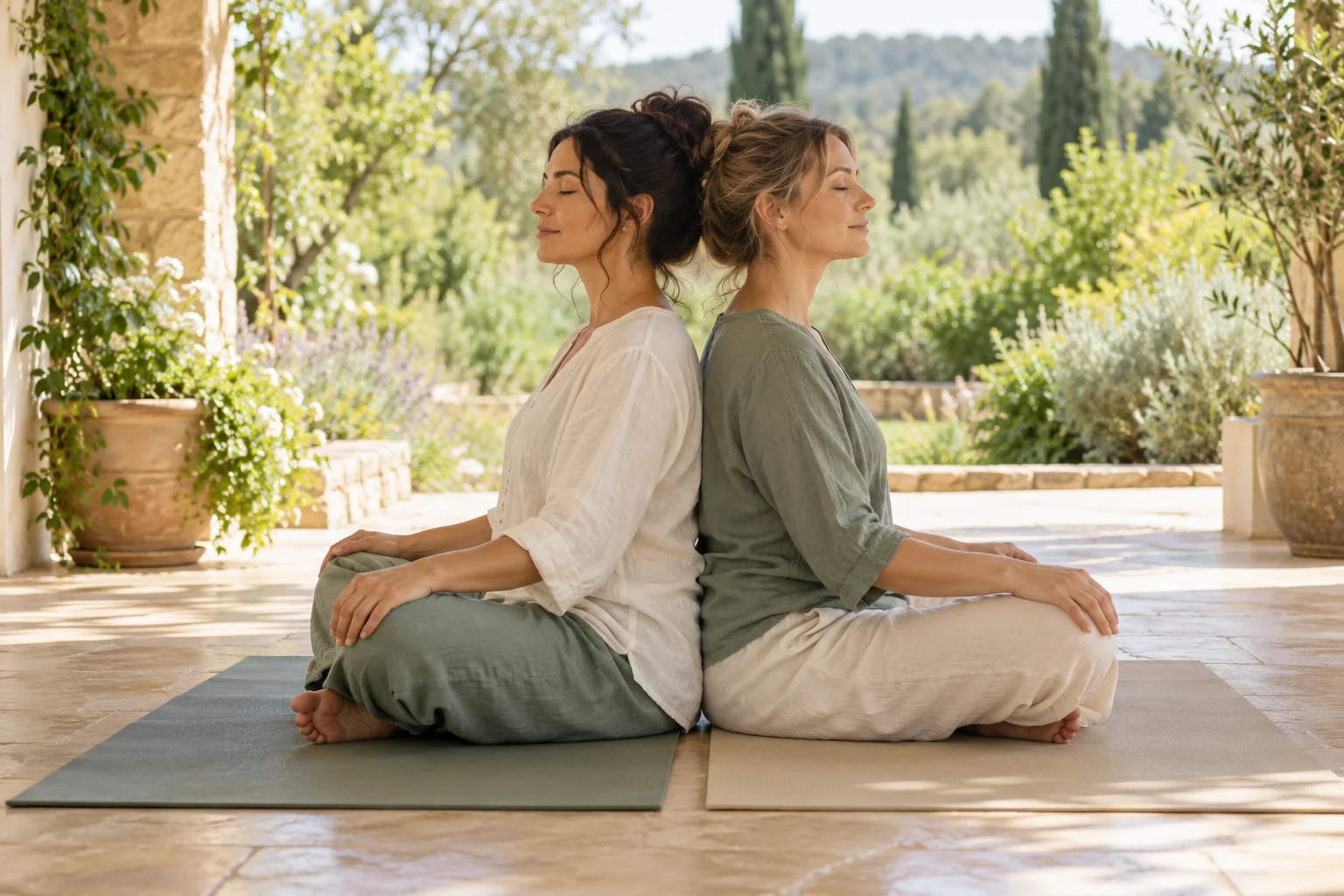
- Sit cross-legged, back to back, with your spines touching from the tailbone to the shoulder blades.
- Rest your hands on your knees and close your eyes.
- Breathe in through your nose for a count of four and out for a count of four.
- Feel your partner’s ribs expand against your back, then match their rhythm.
Hold: 2 to 3 minutes. Focus: breath awareness and matching your partner’s pace. Take care: sit on a folded blanket if your knees ride higher than your hips.
2. Seated Partner Twist (Parivrtta Sukhasana)
Seated Partner Twist is a gentle spinal twist in which your partner’s back keeps you upright.
- Stay seated back to back with your legs crossed.
- Inhale and lengthen your spine.
- Exhale and both turn to your own right. Place your right hand on your partner’s left knee and your left hand on your own right knee.
- Lengthen on each inhale and turn a little further on each exhale.
- Come back to center and repeat to the left.
Hold: 5 breaths per side. Focus: rotation through the mid and upper back. Take care: turn from the ribs. Don’t haul on your partner’s knee.
3. Seated Cat-Cow for Two (Marjaryasana-Bitilasana)
Seated Cat-Cow for Two is a moving warm-up for the spine, done face to face.
- Sit cross-legged facing each other, knees touching, and hold each other’s forearms.
- Lean back slightly until your partner’s weight balances yours.
- Inhale, lift your chest, and arch your back (Cow).
- Exhale, round your spine, and drop your chin (Cat).
- Keep moving together for 8 to 10 rounds.
Focus: moving the spine and learning to trust each other’s grip. Take care: hold forearms, not fingers, so the grip can’t slip.
4. Partner Seated Forward Fold (Paschimottanasana)
In Partner Seated Forward Fold, one person folds forward while the other leans back and offers a steady pull.
- Sit facing each other with your legs straight and the soles of your feet pressed against your partner’s. For an inner-thigh stretch, take your legs wide instead (Upavistha Konasana).
- Hold each other’s forearms.
- Partner A leans back slowly with a long spine. Partner B folds forward from the hips.
- Stay for 5 breaths, then swap roles.
Focus: hamstrings and lower back. Take care: the person folding sets the depth, and the person leaning back never pulls past it. Bend your knees a little if your hamstrings feel tight.
5. Double Tree Pose (Vrikshasana)
Double Tree Pose is a standing balance done side by side. Two wobbly trees hold each other up.
- Stand hip to hip, about a foot apart, facing the same way.
- Wrap your inner arms around each other’s waists, or raise them and press your palms together overhead.
- Stand on the leg nearest your partner. Place the sole of your outer foot against the calf or inner thigh of your standing leg, never on the knee joint.
- Bring your outer hands together in front of your chests in a shared Anjali Mudra (prayer position).
- Fix your eyes on one point ahead.
Hold: 5 to 8 breaths, then switch sides. Focus: balance and concentration. Take care: keep the toes of the lifted foot on the floor if you feel unsteady.
6. Temple Pose
Temple Pose is a standing forward lean for the chest and shoulders. It’s a modern partner pose with no classical Sanskrit name.
- Stand facing each other, about 3 feet apart, with your feet hip-width apart.
- Inhale and raise your arms overhead.
- Exhale, hinge forward from the hips, and rest your palms, forearms, and elbows against your partner’s.
- Let your chest sink toward the floor while your arms press evenly into theirs.
- To come out, walk your feet toward each other and rise together.
Hold: 5 to 8 breaths. Focus: shoulders, chest, and upper back. Take care: press with equal effort. If one person leans harder, you both tip.
Which 2 Person Yoga Poses Suit Intermediate Partners?
Intermediate 2 person yoga poses add counterbalance and core strength: Back-to-Back Chair, Partner Boat, Partner Warrior III, and Double Dancer. Move on to them once the six easy poses feel steady and you trust each other’s grip.
7. Back-to-Back Chair Pose (Utkatasana)
In Back-to-Back Chair Pose, two people lean into each other’s backs and lower into a squat, as if sharing an invisible chair. Think of a wall sit where your partner is the wall.
- Stand back to back and link arms at the elbows.
- Lean into each other and walk your feet forward about two foot-lengths.
- Bend your knees together until your thighs are close to parallel with the floor, knees above ankles.
- Press your backs together to stay up.
- To come out, press back, straighten your legs, and walk your feet in.
Hold: 5 breaths. Focus: thighs, glutes, and timing. Take care: count “three, two, one” out loud before lowering and again before rising.
8. Partner Boat Pose (Navasana)
Partner Boat Pose is a seated balance in which your hands and the soles of your feet meet your partner’s.
- Sit facing each other, knees bent, toes touching.
- Reach outside your legs and hold each other’s wrists.
- Press the soles of your right feet together and lift them, straightening your legs as far as is comfortable.
- Do the same with your left feet.
- Lift your chests and balance on your sitting bones.
Hold: 3 to 5 breaths. Focus: core and hamstrings. Take care: keep your knees bent if your lower back starts to round.
9. Partner Warrior III (Virabhadrasana III)
Partner Warrior III is a one-legged standing balance. Both partners tip forward and steady each other at the shoulders.
- Stand facing each other, about two arm’s lengths apart.
- Raise your arms, hinge at the hips, and rest your hands on each other’s shoulders or upper arms.
- Step back until your torsos are parallel to the floor.
- Each lift your right leg straight behind you to hip height.
- Lower the leg, then repeat on the left.
Hold: 3 to 5 breaths per side. Focus: balance, hamstrings, and back muscles. Take care: keep a soft bend in the standing knee.
10. Double Dancer Pose (Natarajasana)
In Double Dancer Pose, each person balances on one leg in Dancer Pose and uses the other’s shoulder for support.
- Stand facing each other, about an arm’s length apart.
- Each bend your right knee and catch the inside of your right foot with your right hand.
- Reach your free left hand forward and rest it on your partner’s shoulder.
- Kick your right foot back and up into your hand as your chest tips forward.
- Release slowly and change sides.
Hold: 3 to 5 breaths per side. Focus: balance, thighs, and chest. Take care: skip this pose if you have a current knee or lower back injury.
Want to go beyond poses? Inteyoga runs an advanced residential yoga teacher training in Colva, South Goa, India. See the courses overview, or send your questions to info@inteyoga.org or to +91 935-473-7240 on WhatsApp.
What Are the Hard Yoga Poses for 2 People?
Hard yoga poses for 2 people are supported poses and lifts in which one partner, the base, carries part or all of the other partner’s weight. Double Downward Dog, Double Plank, and Front Bird are the usual starting points.
These are the ones that look great on Instagram, and they deserve respect. Learn them from a qualified teacher, on a soft surface, with a third person standing by as a spotter. The National Center for Complementary and Integrative Health (NCCIH), part of the US National Institutes of Health, advises practicing yoga under the guidance of a qualified instructor. It notes that learning yoga on your own without supervision has been associated with increased risks.
11. Double Downward Dog (Adho Mukha Svanasana)
In Double Downward Dog, one partner holds Downward-Facing Dog and the other stacks a second Downward Dog on top, with their feet resting on the base’s hips.
- Partner A, the base, comes into Downward-Facing Dog with hands shoulder-width apart and hips high.
- Partner B stands in front of A’s hands, facing away, and places both palms on the floor about a foot ahead of A’s hands.
- B lifts one foot at a time onto the back of A’s pelvis. The feet never rest on the lower spine.
- B straightens the legs and lifts the hips to make an upside-down L shape.
- B steps down one foot at a time. Rest, then swap roles.
Hold: 3 to 5 breaths. Focus: shoulders and hamstrings for the base, and weight on the hands for the top partner. Take care: the base says “down” the moment the weight feels wrong.
12. Double Plank (Phalakasana)
Double Plank is one plank stacked on another, with the two partners facing opposite directions.
- Partner A, usually the stronger partner, holds a high plank with wrists under shoulders and a firm core.
- Partner B stands astride A’s lower legs, facing A’s feet, and takes hold of A’s ankles.
- B places one foot, then the other, on A’s shoulder blades.
- Both hold a straight line from head to heels.
- B steps down one foot at a time.
Hold: 3 breaths. Focus: core and shoulders for both partners. Take care: try it only if each of you can hold a solo plank comfortably for 30 seconds. Skip it if you have wrist, shoulder, or lower back pain.
13. Front Bird (Acro Yoga)
Front Bird is the entry-level acro yoga lift. The base lies on the floor and raises the second person, the flyer, into the air on their feet. If you played “airplane” as a kid, you already know the shape.
- The base lies on their back with legs raised and knees bent.
- The flyer stands close to the base’s hips, facing them. The base places both feet on the flyer’s hip bones, toes turned slightly out.
- They clasp hands with straight arms.
- The flyer leans forward and keeps the body firm. The base takes the weight, then straightens the legs until the feet are stacked over the hips.
- To come down, the base bends the knees and lowers the flyer’s feet to the floor.
Hold: 3 to 5 breaths. Focus: legs and core for the base, back muscles and body control for the flyer. Take care: always use a spotter, and learn the lift from a qualified teacher before trying it at home.
What Are the Hardest Yoga Poses for Two People?
The hardest yoga poses for two people are acro yoga balances in which the flyer is held on the base’s hands or is fully upside down. Three well-known examples sit well beyond the poses in this guide:
- Hand-to-Hand. The flyer holds a handstand on the base’s raised hands.
- Foot-to-Hand. The flyer stands upright on the base’s hands.
- Star. The flyer balances upside down with the shoulders resting on the base’s feet.
All three are learned step by step in acro yoga classes, with a teacher and a spotter. They are not poses to copy from a photo.
How Should You Wind Down After Partner Yoga Poses?
Finish every session of partner yoga poses with one supported restorative pose and a shared Savasana, about five minutes in total. A slow finish gives you both a calm transition before you stand up and get on with your day.
14. Child’s Pose With Supported Backbend (Balasana and Matsyasana)
One partner rests in Child’s Pose (Balasana) while the other lies back over them in a supported version of Fish Pose (Matsyasana).
- Partner A kneels and folds forward into Child’s Pose with arms stretched ahead. A folded blanket under the shins helps.
- Partner B sits lightly on the back of A’s pelvis, facing away, with weight still in the feet.
- B slowly lies back along A’s spine and lets the arms open to the sides.
- Stay for 5 to 8 breaths. B then plants the feet and sits up using the core, not by pushing down on A.
- Swap roles.
Focus: hips and lower back for A, chest and shoulders for B. Take care: A decides how much weight is comfortable. Skip the pose if A has knee pain.
15. Side-by-Side Savasana (Corpse Pose)
Lie on your backs next to each other with your arms relaxed and palms up. Let your near hands touch if you like. Close your eyes, let your breath return to its natural pace, and stay quiet for 3 to 5 minutes. Many yoga classes end in Savasana, so don’t skip it.
What Does a 20-Minute Routine of Yoga Poses for 2 Look Like?
A balanced 20-minute routine moves from seated breathing to standing balance, peaks with one strength pose, then cools down. The sequence below uses only easy poses plus Back-to-Back Chair, so two beginners can follow it on day one.
| Order | Pose | Time | Focus |
|---|---|---|---|
| 1 | Back-to-Back Breathing | 2 minutes | Breath and attention |
| 2 | Seated Cat-Cow for Two | 2 minutes | Spine warm-up |
| 3 | Seated Partner Twist | 2 minutes | Spinal rotation |
| 4 | Partner Seated Forward Fold | 3 minutes | Hamstrings |
| 5 | Temple Pose | 2 minutes | Shoulders and chest |
| 6 | Double Tree Pose | 2 minutes | Balance |
| 7 | Back-to-Back Chair Pose | 2 minutes | Legs |
| 8 | Child’s Pose With Supported Backbend | 2 minutes | Release |
| 9 | Side-by-Side Savasana | 3 minutes | Rest |
Short on time? Do rows 1, 3, 6, and 9 for a 9-minute version that still covers breath, twist, balance, and rest.
Once the full routine feels easy, swap Back-to-Back Chair for Partner Boat or Partner Warrior III. Change one pose at a time. That way, if something feels off the next day, you know which pose to look at.
What Mistakes Do Beginners Make With Yoga Poses for Two?
The beginner mistake to watch most closely in yoga poses for two is pulling a partner deeper into a stretch than their body is ready for. Force and silence are the usual culprits: one person pushes, and the other says nothing. Watch for these five habits.
- Pulling instead of supporting. In a forward fold, the person leaning back offers steady weight. They don’t tug.
- Holding your breath. If either of you stops breathing evenly, the pose is too hard. Back off one step.
- Gripping fingers or joints. Hold forearms or upper arms. Fingers slip, and pressure on a wrist or elbow can strain it.
- Skipping straight to lifts. Acro photos are all over social media, but those poses sit at the end of a long progression.
- Coming out too fast. Exits are where pairs tend to lose balance. Agree on how you’ll come out before you go in.
What Are the Benefits of Yoga Poses for 2 People?
The likely benefits of yoga poses for 2 people are practice for your balance, more motivation to keep showing up, a sense of connection with your partner, and a calmer few minutes in your day. Direct research on partner yoga is thin. Most of what follows comes from studies of solo yoga or of exercising with a partner, so each point names its source and its limits.
Does Practicing With a Partner Improve Balance?
No study we found has tested partner poses specifically. For yoga in general, the evidence is encouraging. According to NCCIH’s review of yoga effectiveness and safety, a 2014 review found that 11 of 15 studies, covering 688 participants, showed improvement in at least one balance-related outcome in healthy people.
Double Tree Pose and Partner Warrior III practice the same skill, with a partner’s hand as a light support while you learn. Whether the partner version adds anything beyond solo practice hasn’t been studied.
Does a Yoga Partner Make You More Consistent?
It may. In a 2012 study in Annals of Behavioral Medicine, Brandon Irwin and colleagues asked participants to ride a stationary bike on six separate days. People paired with a virtually present partner exercised significantly longer than people riding alone.
The study used cycling and an on-screen partner, not yoga, so treat it as a hint and not as proof. The everyday version is familiar to anyone with a gym buddy. When someone is waiting on the mat for you, you show up.
Does Moving in Sync Build Connection?
Research on synchronized movement suggests it can. A 2015 study in Biology Letters by Bronwyn Tarr and colleagues at the University of Oxford tested 60 groups of three students who danced in full or only partial synchrony. Synchronized movement was followed by higher pain thresholds and higher ratings of social bonding.
That study looked at dance in small groups, not yoga in pairs. Partner yoga does share the ingredients, matched breath and matched movement, and Seated Cat-Cow for Two is a simple place to try it.
Can Partner Yoga Help With Stress?
Yoga may help people manage stress. NCCIH cites a 2020 review of 12 studies, with 672 participants in total, that found beneficial effects of yoga on measures of perceived stress in healthy adults. Those studies covered many yoga styles, and none focused on partner practice.
The calming side is already part of how Americans practice. In the CDC’s 2022 survey, 57.4% of US adults who do yoga said meditation is part of their practice. Back-to-Back Breathing is the partner version: two or three minutes of slow, even breathing before anything else. If stress or anxiety is affecting your daily life, yoga is not a substitute for care from a health professional.
What Other Practical Benefits Do Partner Poses Offer?
Three more benefits are practical, not clinical. They come from how the poses work, and no trial backs them:
- A steadier forward fold. A partner’s steady weight can take you a little further into a fold than you’d go alone. The person stretching always sets the depth.
- Clearer communication. You have to say “more,” “less,” and “stop” out loud. That’s a useful habit for any two people.
- Instant posture feedback. With a partner’s back against yours, you feel right away when you slump or lean to one side.
Yoga Poses for 2 People vs Acro Yoga: What Is the Difference?
Yoga poses for 2 people keep both partners on the ground and share weight lightly, while acro yoga lifts one partner into the air on the other’s feet or hands. Acro yoga blends yoga with acrobatics and uses three roles: base, flyer, and spotter.
| Feature | Yoga Poses for 2 People (Partner Yoga) | Acro Yoga |
|---|---|---|
| Main aim | Stretch, balance, and connection | Lifts, balances in the air, and transitions |
| Roles | Two equal partners | Base, flyer, and spotter |
| People needed | 2 | 3, including the spotter |
| Who stays on the floor | Both partners in most poses | The base only |
| Strength needed | Low to moderate | Moderate to high |
| Good for beginners | Yes, from the first session | After solo foundations, with a teacher |
| Risk of falls | Lower, because both partners stay grounded | Higher, because one partner is off the floor |
| Example poses | Double Tree, Partner Boat, Seated Partner Twist | Front Bird, Throne, Folded Leaf |
The two overlap. Double Downward Dog and Double Plank sit in between, and many lists of hard two person yoga poses are really acro yoga poses.
So which one is for you? If you want to stretch and unwind with someone, stay with partner yoga. If you want to fly, find an acro yoga class near you.
Who Are Yoga Poses for 2 People Good For?
Yoga poses for 2 people suit any two people who trust each other: couples, best friends, kids with an adult watching, workout partners, and coworkers. The poses stay the same. Only the choice of poses changes.
What Are the Best Poses for Couples?
The best couples yoga poses involve shared breathing or eye contact: Back-to-Back Breathing, Seated Cat-Cow for Two, Partner Seated Forward Fold, and Partner Boat Pose. They’re slow enough to talk through, which matters more than how the pose looks. A 20-minute session at home makes an easy, phone-free date night.
What Is the Most Romantic Pose?
The most romantic yoga pose for two is face-to-face Easy Pose (Sukhasana) with joined hands. Sit cross-legged with your knees touching, hold hands, keep soft eye contact, and breathe in time for two to three minutes. There’s no stretch to manage and no balance to hold, so your full attention goes to the other person.
Which BFF 2 Person Yoga Poses Are the Most Fun?
Best friends usually enjoy the balance challenges: Double Tree Pose, Partner Warrior III, and Double Dancer Pose. Each one turns a solo balance into a shared test of focus. They also photograph well, if that’s part of the plan.
What Are Some Funny Yoga Poses for Two People?
The funniest yoga poses for two people are the ones with awkward entries and exits. Three reliable picks:
- Partner Boat Pose. Lifting the second pair of feet often ends in a slow topple.
- Back-to-Back Chair Pose. Standing up together without unlinking arms takes a few tries.
- Temple Pose. Lean unevenly and you both stagger forward.
Laughing is fine. Stick to easy and intermediate poses when you’re goofing around, and keep lifts for focused practice.
Are There Safe Yoga Poses for 2 Kids?
Kids can try the six easy poses with an adult watching. Keep sessions short and playful, and leave out every lift and stacked pose. An adult paired with a child should avoid counterbalance poses such as Back-to-Back Chair, because the difference in weight makes them unstable. If a child has a health condition or an injury, ask their doctor first.
How Can Workout Partners and Coworkers Use Partner Stretches?
Running buddies and gym partners can use two of these poses as partner stretches after a workout: Partner Seated Forward Fold for the hamstrings and Seated Partner Twist for the back. Five minutes is enough.
Coworkers have options too. Temple Pose and Back-to-Back Chair Pose need no mat and work in regular clothes, which makes them a quick break after a long stretch at a desk.
Who Should Avoid or Modify Yoga Poses for 2 People?
Anyone who is pregnant, injured, recovering from surgery, or living with a condition such as severe high blood pressure or glaucoma should talk to a health care provider first and then modify or skip certain poses.
NCCIH lists preexisting knee or hip injuries, lumbar spine disease, severe high blood pressure, balance issues, and glaucoma among the conditions that may call for modifications. It also advises pregnant women and older adults to discuss their needs with their provider and their yoga instructor.
The table below is a cautious starting point for that conversation. It is not a medical assessment, and your provider’s advice comes first.
| Situation | Poses to Skip or Modify Until You’ve Asked | Lower-Load Place to Start |
|---|---|---|
| Pregnancy | Lifts and stacked poses, deep twists, pressure on the abdomen, long periods lying on the back or holding still | Back-to-Back Breathing and gentle seated poses, once your provider has cleared you to exercise |
| Severe high blood pressure or a heart condition | Head-down poses and long strength holds | Seated poses with steady breathing |
| Glaucoma | Head-down poses such as Double Downward Dog and deep forward folds | Upright seated and standing poses |
| Knee or hip injury | Back-to-Back Chair, Child’s Pose, Double Tree with a high foot | Back-to-Back Breathing, Seated Partner Twist |
| Lower back condition | Deep forward folds, backbends, acting as the base | Back-to-Back Breathing, small Cat-Cow movements |
| Wrist or shoulder injury | Double Downward Dog, Double Plank, Temple Pose | Seated poses |
| Balance problems | One-legged poses such as Double Tree, Partner Warrior III, and Double Dancer | Seated poses |
| Recent surgery | All partner poses until your surgeon clears you | Breathing practice only, if cleared |
Two rows rest on specific published guidance. On pregnancy, NCCIH says to avoid yoga poses that involve long periods of being still or lying on your back.
On glaucoma, the American Academy of Ophthalmology advises people with the condition not to keep the head below the heart for long periods and to ask their doctor about head-down positions. The other rows are precautions based on which joints and positions each pose loads.
NCCIH reports that sprains and strains are the most common yoga injuries, most often at the knee or lower leg, and that serious injuries are rare. Stop right away if either of you feels sharp pain, dizziness, numbness, or shortness of breath.
Where Can You Build the Foundation for Partner Yoga?
Partner yoga is only as steady as each person’s solo practice, and that practice is best built with a qualified teacher. A stable Tree Pose on your own makes a stable Double Tree.
Inteyoga (Swami Krishnananda Yoga Vidyapeeth) is a yoga school in Colva, South Goa, India, managed by Inteyoga Shala LLP. It is registered with Yoga Alliance as a Registered Yoga School at the RYS 200, RYS 300, and RYS 500 levels.
Founder-Director: Dr. Ashutosh, MBBS, M.Sc. (Yoga), Yoga Master Level 6 (Yoga Certification Board, Ministry of AYUSH, Government of India), Swami Krishnananda Yoga Vidyapeeth and Inteyoga, Colva, South Goa.
To be clear about what’s on offer, Inteyoga’s current program is not a partner yoga class. It is the Advanced TTC 300-Hour Integrated Restorative Yoga (Including Yoga Nidra, Chakra Sadhana, and Prana Vidya Intensive). This is an advanced residential teacher training taught in English, not a beginner retreat. It runs for 43 training days plus one arrival day and one departure day (43+2 days).
Applicants need a completed 200-Hour Yoga Teacher Training Course (TTC 200) or an equivalent qualification, and must be 21 to 60 years old. The program follows a Gift-it-Forward model: no payment is required to apply or to participate. After completing it, participants may voluntarily support the Gift-it-Forward initiative to help future aspirants, with no obligation to contribute.
Still building your foundation? Inteyoga’s 200-hour program is planned for approximately mid-2027. Already hold a 200-hour certificate? Read about the 300-hour yoga teacher training in Goa, meet the faculty, or see what past students say on the testimonials page. If you’re weighing training overseas, our guide to choosing a yoga teacher training abroad is a good next read.
Which Yoga Poses for Two People Should You Start With?
Start with the four seated poses, add Double Tree Pose and Temple Pose in your second week, and save the hard poses for a class with a teacher. Yoga poses for 2 people reward patience more than flexibility. Ten steady minutes with a partner who listens will do more for you than one impressive photo.
Keep the stop word. Keep talking. And keep building your own practice underneath it all.
Ready for advanced training in India? If you already hold a 200-hour certificate, read about Inteyoga’s advanced 300-hour program in Colva, South Goa, where batches are confirmed from December 2026. You can apply through the application form, email info@inteyoga.org, or message +91 935-473-7240 on WhatsApp.
How This Guide Was Put Together. Pose names follow common usage in modern yoga. Health statements were checked against the sources listed below, and the limits of that research are stated where they apply. Nothing here promises a health outcome.
Frequently Asked Questions About Yoga Poses for 2 People (FAQ)
What Are the Easiest Yoga Poses for 2 People?
The easiest yoga poses for 2 people are Back-to-Back Breathing, Seated Partner Twist, Seated Cat-Cow for Two, and Partner Seated Forward Fold. All four are done sitting on the floor, so there’s no balance to lose and neither person carries the other’s weight. Hold each for about five slow breaths and swap roles where the pose has two sides.
Can Beginners Do Yoga Poses for 2 People?
Yes. Beginners can start with seated mirrored poses on day one, because these need no strength or flexibility beyond sitting upright. Warm up on your own for 5 to 10 minutes first and agree on a stop word. Leave the hard poses, which involve carrying a partner’s weight, until a qualified teacher has shown you how.
Can You Do Yoga Poses for 2 People at Home?
Yes. The easy and intermediate yoga poses for 2 people need only two mats and about 6 by 8 feet of clear floor, so a living room works. Move the coffee table, warm up first, and agree on a stop word. Keep the hard poses for a studio class, where a teacher and a spotter can step in.
How Often Should You Practice Partner Yoga?
There’s no official rule. Two or three short sessions a week is a manageable place to start. A 20-minute routine you both show up for will serve you better than a 90-minute session once a month. Skip practice if either of you is sore or injured, and check with a health care provider if pain lingers.
How Long Should You Hold Two Person Yoga Poses?
Hold most two person yoga poses for 5 to 8 slow breaths, which is roughly 30 to 45 seconds. Strength poses such as Back-to-Back Chair or Double Plank need only 3 to 5 breaths. Breathing poses and Savasana can last 2 to 5 minutes. Come out early if either partner’s breathing becomes strained.
Do Two People Need to Be the Same Height or Weight for Partner Yoga?
No. Seated poses and most standing poses work with any height or weight difference. In Double Tree Pose, the taller partner can hold the other’s forearm instead of the palm. For supported poses and lifts, the heavier or stronger person is usually the base, and a large weight difference calls for a teacher’s guidance.
Are There 100 Yoga Poses for Two People?
There’s no fixed number. Almost any solo asana can be adapted for a pair, which is why lists of 50 or even 100 yoga poses for two people exist. Most entries on those lists are variations of the same three types: mirrored, counterbalance, and supported poses. A beginner pair can get plenty out of about ten poses, and the 15 in this guide cover every type.
What Are the 7 Basic Poses of Yoga?
There is no official list of seven basic yoga poses. Poses that beginner classes commonly teach first include Mountain Pose (Tadasana), Downward-Facing Dog (Adho Mukha Svanasana), Warrior I (Virabhadrasana I), Tree Pose (Vrikshasana), Cobra Pose (Bhujangasana), Child’s Pose (Balasana), and Corpse Pose (Savasana). Several of these have partner versions in this guide.
What Are the 12 Asanas With Names?
The best-known set of 12 asanas is the Sivananda Yoga sequence: Headstand (Sirsasana), Shoulderstand (Sarvangasana), Plough (Halasana), Fish (Matsyasana), Seated Forward Bend (Paschimottanasana), Cobra (Bhujangasana), Locust (Salabhasana), Bow (Dhanurasana), Half Spinal Twist (Ardha Matsyendrasana), Crow (Kakasana) or Peacock (Mayurasana), Standing Forward Bend (Pada Hastasana), and Triangle (Trikonasana). Surya Namaskar, the Sun Salutation, is a separate sequence commonly taught in 12 steps.
What Is the Warrior 2 Pose in Yoga?
Warrior 2, or Virabhadrasana II, is a standing pose with the feet wide apart, the front knee bent over the ankle, the back leg straight, and both arms stretched out at shoulder height. Your gaze rests over the front hand. Two people can practice it facing away from each other, with the outer edges of their back feet pressed together for grounding.
Is There a Split Pose in Yoga?
Yes. The front split in yoga is Hanumanasana, also called Monkey Pose. The side split is Samakonasana, and the seated wide-legged forward bend is Upavistha Konasana. All three take long, patient preparation of the hamstrings and hips. A partner should never push you into a split. Use Partner Seated Forward Fold as preparation instead.
What Is a Cleopatra Pose?
Cleopatra pose is not a classical asana, and we couldn’t find it defined in any authoritative yoga reference. Some teachers and fitness apps use the name informally. In the examples we found, it describes a side-reclining shape in which you lie on one side and prop yourself up on the lower forearm or hand. It resembles Anantasana, the Side-Reclining Leg Lift. The name isn’t standardized, so ask your teacher what they mean by it.
Which Pose Is Best for a Girl?
No yoga pose is best for one gender. Girls and women can practice every pose in this guide, and the right choice depends on the goal: Tree Pose for balance practice, Cat-Cow for moving the spine, Child’s Pose for rest. In a pair of different sizes, the lighter person is usually the flyer in lifts, whatever their gender. Pregnancy calls for the changes in the safety table and a conversation with your provider.