
Quick Answer
Most yoga poses ask you to wait two or three hours after eating. Vajrasana is the exception. Yoga tradition recommends sitting in it straight after a meal, and many people say their stomach feels lighter for it.
Key Takeaways
- Vajrasana is a seated kneeling posture associated with the Hatha Yoga tradition. The name joins two Sanskrit words. Vajra means diamond, thunderbolt or mace (gada). Asana means posture or seat.
- You only need a yoga mat or a folded blanket. Choose a surface that is soft but firm, and move slowly.
- Vajrasana is widely practised for comfort after meals, upright posture, a gentle stretch through the thighs and ankles, and a calmer, more focused state of mind. Research on this single pose is limited, so most of these benefits are traditional or commonly reported rather than clinically proven.
Most yoga poses ask you to wait two or three hours after eating. Vajrasana is the exception. Yoga tradition recommends sitting in it straight after a meal, and many people say their stomach feels lighter for it.
That is part of what makes this simple kneeling pose so useful. You don’t need flexibility to start, and you need no equipment beyond a mat. A few minutes a day is enough.
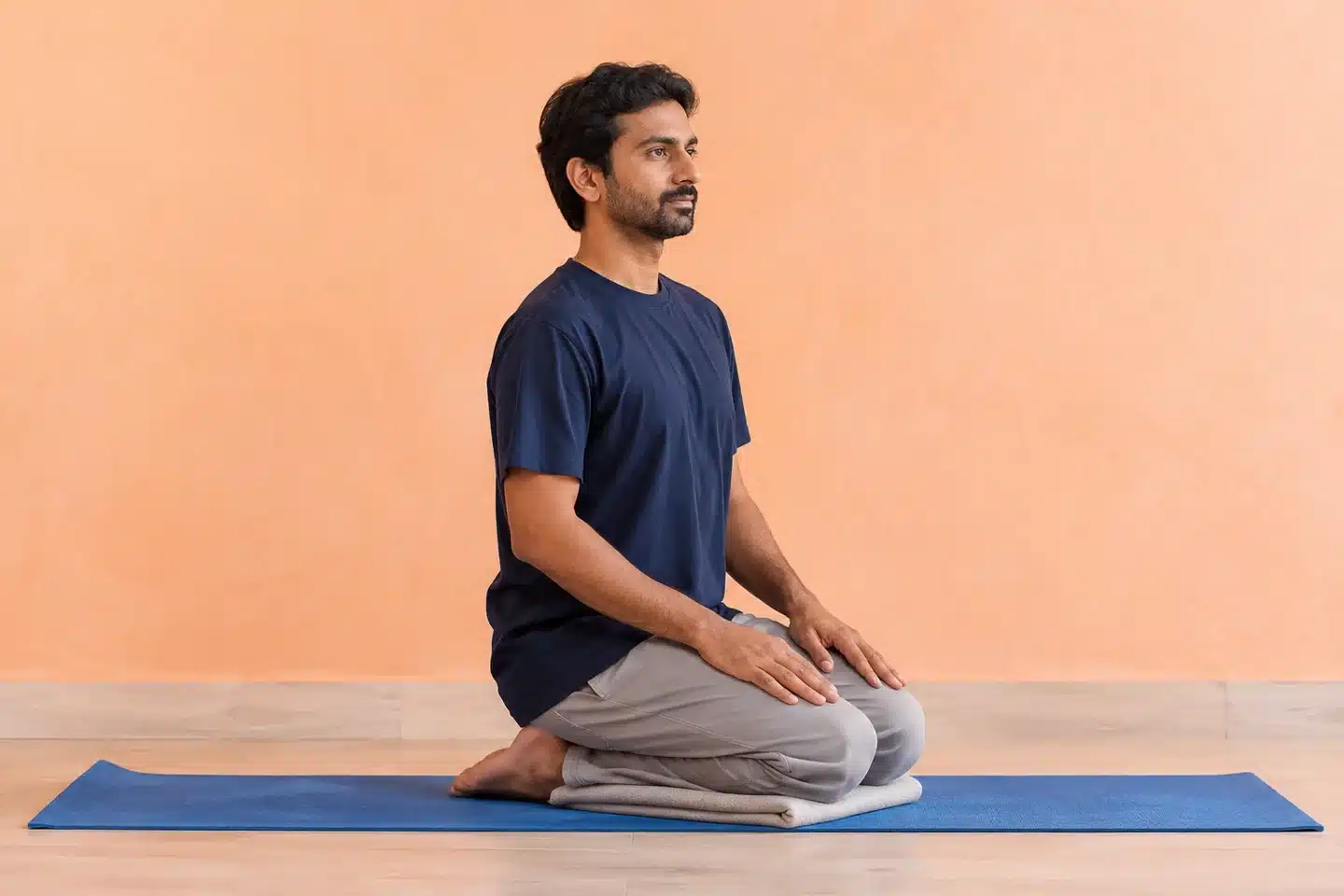
Vajrasana, also called Thunderbolt Pose or Diamond Pose, is a kneeling yoga posture in which you sit back on your heels with your knees together and your spine upright. It is traditionally practised after meals, used as a steady seat for breathing and meditation, and suitable for most beginners.
Yoga is now part of everyday life for millions of people. In 2022, 16.9% of adults in the United States practised yoga, according to the CDC’s National Center for Health Statistics. Vajrasana is one of the easiest places to begin.
Vajrasana at a glance
- Sanskrit: वज्रासन (Vajrāsana)
- English names: Thunderbolt Pose, Diamond Pose, Adamantine Pose
- Level: Beginner
- Best time: Straight after a meal, or in the morning on an empty stomach
- How long: 1–3 minutes to start, building to 5–10 minutes
- Commonly reported benefits: Comfort after meals, upright posture, gentle stretching of the thighs and ankles, a calmer state of mind
- Take care if: You have knee pain, an ankle injury, piles or a hernia. Seek medical advice first.
This guide covers how to do Vajrasana correctly, what it can and cannot do, and how to make it comfortable, even if your knees are stiff.
What Is Vajrasana? Meaning and Origin
Vajrasana is a seated kneeling posture associated with the Hatha Yoga tradition. The name joins two Sanskrit words. Vajra means diamond, thunderbolt or mace (gada). Asana means posture or seat.
In yoga, the vajra stands for something that cannot be broken: steady, strong and clear. The name Vajrasana appears in medieval Hatha Yoga texts. However, the postures described there do not always match the modern kneeling form. Today the name almost always refers to the kneeling seat described in this guide.
The pose is less a workout and more a firm, upright base from which to breathe and focus.
Why Is It Called Thunderbolt Pose?
In Indian mythology, the vajra is the thunderbolt weapon of Indra, king of the gods. It was said to be as hard as a diamond and impossible to destroy.
The pose borrows the name for two reasons:
- Steadiness: traditional teachings say that regular practice makes the body firm and steady, like the vajra.
- Shape: the posture is compact and grounded. Sitting on your heels with a tall spine, you are very hard to topple.
Yoga tradition also links Vajrasana with the abdomen and digestion. That is one reason it became the classic seat after meals.
Vajrasana vs Other Seated Poses
| Pose | How you sit | Often used for |
|---|---|---|
| Vajrasana (Thunderbolt) | On your heels, knees together | Sitting after meals, posture, short meditation |
| Sukhasana (Easy Pose) | Cross-legged on the floor | Beginners with stiff knees |
| Virasana (Hero Pose) | Between the feet, hips on the floor | A deeper thigh and knee stretch |
| Padmasana (Lotus) | Each foot on the opposite thigh | Long meditation (advanced) |
How to Do Vajrasana: Step-by-Step Guide for Beginners
You only need a yoga mat or a folded blanket. Choose a surface that is soft but firm, and move slowly.
- Start in Dandasana (Staff Pose): Sit on your mat with both legs straight out in front of you. Keep your spine tall and place your palms on the floor beside your hips.
- Start kneeling: Bend your right knee and fold the leg back so the foot rests beside your right hip. Do the same with the left leg. You are now kneeling, with your knees together and your upper body upright.
- Align your feet: Point your toes straight back so the tops of your feet lie flat on the floor, soles facing up. Let your big toes touch and your heels sit slightly apart.
- Sit back: Breathe out and slowly lower your buttocks onto your heels. Your thighs now rest on your calves.
- Maintain posture: Lengthen your spine from tailbone to crown. Let your shoulders drop away from your ears. Keep your chin level and look straight ahead, or close your eyes.
- Rest your hands: Place your palms on your thighs or knees, with your arms relaxed.
- Breathe: Breathe slowly through your nose, about 4–6 seconds in and 4–6 seconds out. Stay for 1–3 minutes to begin with.
To come out: Lean forward a little, lift your hips and swing your legs out to one side. Stretch them out in front of you and roll your ankles a few times.
How Should Your Back and Spine Be?
Think tall, not stiff. Picture a string gently lifting the crown of your head towards the ceiling.
- Keep the natural curve in your lower back. Don’t slump, and don’t push your belly forward.
- Stack your head, shoulders and hips in one line.
- Draw your shoulder blades slightly down and back to open the chest.
- Tuck your chin a touch so the back of your neck stays long.
Alignment check: A common error is leaning back without noticing, which loads the lower back. Every minute or so, check that your ears are over your shoulders and your shoulders are over your hips.
Where Should You Place Your Hands?
Both positions are correct. Pick whichever keeps your shoulders soft.
- On the thighs: Palms rest flat on the middle of the thighs. This is easiest for beginners and longer sits.
- On the knees: Palms rest on the kneecaps, with your arms straight but relaxed. This opens the chest a little more.
- Palms down or up: Many practitioners find palms down grounding and palms up more open. You can also join your thumb and index finger in Chin Mudra.
How Should You Breathe?
- Breathe in slowly through your nose. Let your belly and lower ribs widen.
- Breathe out slowly through your nose. Let your belly draw gently in.
- Keep it smooth and even. If you find yourself holding your breath, the pose is too intense, so ease off or add a prop.
Benefits of Vajrasana
Vajrasana is widely practised for comfort after meals, upright posture, a gentle stretch through the thighs and ankles, and a calmer, more focused state of mind. Research on this single pose is limited, so most of these benefits are traditional or commonly reported rather than clinically proven.
Top 10 Key Benefits of Vajrasana
- May ease heaviness after meals. Many people find that sitting upright after eating reduces bloating and the feeling of fullness.
- Encourages upright posture. The pose stacks your spine over your pelvis and helps you learn to sit tall without strain.
- Gives a steady seat for slow breathing. An upright spine leaves room for your belly and ribs to move as you breathe.
- Can feel calming. Many practitioners find that a still seat and slow breathing reduce restlessness.
- Works as a focus break. A few quiet minutes can help you reset between tasks.
- Stretches the front of the body’s lower half. It gently stretches the front of the thighs, the shins, the ankles and the tops of the feet.
- Builds comfort for meditation. Regular practice makes it easier to sit still for longer.
- Supports a mindful after-meal habit. It replaces slumping on the sofa with a short, intentional pause.
- Is accessible. It needs no equipment or flexibility, and props make it workable for most beginners.
- Prepares you for other kneeling poses. Comfort in Vajrasana makes poses such as Hare Pose and Camel Pose easier to approach.
The Four Main Benefits Explained
1. Digestion: Gas and Acidity After Meals
Digestive discomfort is very common. A large Rome Foundation study surveyed more than 73,000 adults in 33 countries. More than 40% of people who answered online met the criteria for at least one functional gut disorder, such as functional dyspepsia (indigestion) or IBS (Gastroenterology, 2021).
Vajrasana is not a treatment for these conditions. It can, however, be a helpful habit for ordinary heaviness after eating:
- Sitting upright stops you from slumping over a full stomach.
- Slow breathing gives you a few quiet minutes to settle.
- Many people report less bloating, gas or acidity when they sit for 5–10 minutes after lunch or dinner.
- Yoga tradition also teaches that the pose supports digestion.
Clinical studies focused on Vajrasana alone are scarce.
2. Flexibility: Thighs, Shins and Ankles
Vajrasana gives a slow, steady stretch to the front of the thighs (quadriceps), the shins, the ankles and the tops of the feet.
Your calves are gently compressed under your thighs rather than stretched. This is why they may feel tight or tingly at first.
If you sit on chairs all day, these areas can stiffen. A few minutes daily may gradually make kneeling and other seated poses more comfortable.
3. Back and Spine: Better Posture
Your pelvis rests on your heels, so your spine stacks upright more easily than in many cross-legged seats. Practising that position builds awareness of good alignment. Many people find that awareness carries over into how they sit at a desk.
Vajrasana is not a treatment for back pain. If you have a spinal condition, check with a doctor or physiotherapist first.
4. Mental Calm: Meditation and Concentration
A steady seat makes slow, unhurried breathing easier. Many people find this calming, which is why Vajrasana is a traditional seat for meditation and pranayama.
It also fits a wider pattern. Among US adults who practised yoga in 2022, 57.4% included meditation in their practice (CDC, 2024).
What Does the Research Say?
Most yoga research looks at whole programmes, not Vajrasana on its own. Small studies have reported links between Vajrasana-based practice and outcomes such as attention, anxiety and blood pressure (Healthline summary). That evidence is preliminary.
Treat the pose as a helpful daily habit, not a cure. It should support, never replace, medical care for digestive problems, high blood pressure, diabetes or back pain.
| Benefit | What we know | Strength of evidence |
|---|---|---|
| Comfort after meals | Traditional recommendation; widely reported | Limited clinical data |
| Upright posture | The pose places the spine over the pelvis | Practical, widely observed |
| Calmer breathing and focus | Slow breathing in a steady seat is commonly used for relaxation | Preliminary (general yoga research) |
| Leg and ankle mobility | Gentle, sustained stretch | Practical, widely observed |
| Blood pressure and anxiety | Small studies, usually as part of wider practice | Early and limited |
Can You Do Vajrasana After Eating?
Yes. Vajrasana is traditionally the one yoga pose recommended straight after a meal. Sit in it for 5–10 minutes after lunch or dinner, breathing slowly through your nose.
Most poses involve bending, twisting or lying down, which can feel uncomfortable on a full stomach. Vajrasana involves none of that. You simply sit upright, so your abdomen isn’t squashed and your breathing stays relaxed.
To make the most of it:
- Sit down within a few minutes of finishing your meal.
- Stay for 5–10 minutes, breathing slowly and evenly.
- Keep the posture relaxed rather than rigid.
- Skip forward bends and strong twists until your food has settled.
If you often have acidity, bloating, heartburn or constipation, see a doctor. Vajrasana can support healthy habits, but it does not treat digestive disorders.
When and How Long Should You Do Vajrasana?
Best Time to Practise
You can practise Vajrasana right after a meal or in the morning on an empty stomach. The two times serve different purposes:
- After meals: Sit for 5–10 minutes after lunch or dinner for comfort and to ease feelings of gas or acidity.
- In the morning: Include it in your yoga session on an empty stomach, especially before breathing practice or meditation.
- During the day: Use it as a short reset between meetings or study sessions.
How Long Should You Sit?
Beginners should start with 1–3 minutes and slowly build up to 5–10 minutes. If your knees or ankles feel strained, start with 30–60 seconds instead. Comfort and good alignment matter far more than time.
| Stage | Hold time | How often |
|---|---|---|
| Week 1 | 1–3 minutes (30–60 seconds if your knees feel strained) | 1–2 times a day |
| Week 2 | 3–5 minutes | 1–2 times a day |
| Week 3 onwards | 5–10 minutes | Daily, including after meals |
| Regular practitioners | 10+ minutes, if comfortable | As a seat for breathing or meditation |
Pins and needles in your feet are a signal to come out. Stretch your legs, wait a minute and try a shorter hold next time.
Easy Vajrasana Modifications for Beginners
If sitting on your heels hurts, don’t force it. A cushion or towel in the right place makes Vajrasana comfortable for most people.
| Problem | What to use | Where to place it |
|---|---|---|
| Pain in the knees | Soft pillow or rolled towel | Behind the knees, between thighs and calves |
| Pressure on the kneecaps | Folded towel or blanket | Under the knees |
| Pain sitting on the heels | Cushion, folded towel or yoga block | Under the hips, between the heels |
| Sore ankles or feet | Folded blanket | Under the shins, toes hanging off the edge |
| Tight thighs or hips | Higher yoga block | Under the hips; lower it over a few weeks |
| Hard floor | Extra mat or blanket | Under the whole body |
Still uncomfortable? Sit on a chair with your feet flat and your spine tall, or try Sukhasana (Easy Pose). You will still have an upright seat for slow breathing.
A simple progression: If your knees feel tight, begin by sitting on a yoga block between your heels for two minutes after dinner. When that feels easy, switch to a folded blanket. Then try sitting on your heels.
Vajrasana Precautions and Contraindications: Who Should Avoid It?
Avoid Vajrasana, or practise only with medical advice, if you have any of the following:
- knee pain or arthritis
- an ankle injury
- piles
- a hernia
- intestinal ulcers
- a lower-spine condition
- recent knee, ankle or abdominal surgery
If you are pregnant, check with your doctor first. More detail on each:
- Knee pain or arthritis: The deep knee bend can make pain and stiffness worse. Use a cushion or block under your hips, sit on a chair, or choose a cross-legged seat.
- Ankle injury: Sitting on your heels puts direct pressure on your ankles. Wait until the injury has healed, or practise only with a folded blanket under your shins and your doctor’s approval.
- Piles (haemorrhoids): Yoga sources commonly advise avoiding Vajrasana with piles, as sitting on the heels puts pressure on the pelvic area. Ask your doctor before practising.
- Hernia, ulcers or other intestinal problems: Speak to a doctor before practising.
- Recent surgery: Wait for medical clearance after knee, ankle or abdominal surgery.
- Lower back or spinal conditions: Sit only if you can keep your spine neutral without pain.
- Pregnancy: Avoid long holds and any pressure on the abdomen, and follow your doctor’s advice.
- Circulation or nerve problems in the legs: Keep holds short and stop at the first sign of tingling.
Common Vajrasana Mistakes to Avoid
| Mistake | Why it matters | Simple fix |
|---|---|---|
| Slumping or over-arching the back | Loads the lower back | Lengthen from tailbone to crown |
| Knees apart or feet turned out | Stresses the knee and ankle joints | Keep your knees together and toes pointing straight back |
| Pushing through knee pain | Risks injury | Use a block, blanket or another seat |
| Holding the breath | Creates tension | Breathe slowly through your nose |
| Sitting through numbness | Restricts circulation | Come out, stretch your legs, try a shorter hold |
Vajrasana Variations and a Simple Sequence
Once the basic pose feels easy, these variations add a little more. Practise them on an empty stomach; only the basic seated pose suits the time straight after a meal.
| Variation | What it adds | Level |
|---|---|---|
| Vajrasana with Chin Mudra | A steady hand position for breathing and meditation | Beginner |
| Shashankasana (Hare Pose) | A forward fold that relaxes the back | Beginner |
| Ushtrasana (Camel Pose) | A backbend that opens the chest and front of the body | Intermediate |
| Supta Vajrasana (Reclined Thunderbolt) | A deep stretch for the thighs, chest and abdomen | Intermediate to advanced |
A 10-Minute Beginner Sequence
- Warm-up (2 minutes): Cat–Cow and gentle ankle circles.
- Vajrasana (3 minutes): Slow nasal breathing, hands on thighs.
- Shashankasana (1 minute): Fold forward from Vajrasana, forehead towards the mat.
- Vajrasana with breathing (3 minutes): Try Anulom Vilom (alternate nostril breathing) or Bhramari (humming bee breath).
- Release (1 minute): Sit in Dandasana, shake out your legs, then rest in Child’s Pose.
How to Fit Vajrasana Into Your Day
You don’t need a full class to make Vajrasana part of your routine. A few practical options:
- After a heavy dinner: Sit in Vajrasana for 5–10 minutes before you head to the sofa.
- At a desk job: Take a 3-minute break at lunch to reset your posture and stretch stiff ankles and thighs.
- Before meditation: Use it as your seat for five minutes of quiet breathing in the morning. The upright spine can help you stay alert rather than drowsy.
- While winding down: Sit on a folded blanket in the evening while you read or listen to music.
- Between study sessions: Pause for a few minutes to refocus.
Consistency matters more than duration. A few minutes every day is more useful than an occasional long session.
Final Thoughts: Make Vajrasana a Daily Habit
Vajrasana shows that useful yoga doesn’t have to be complicated. A few minutes a day, especially after meals, can become a steady habit for posture, slow breathing and a calmer end to the day. Start small, use props when you need them, and let comfort guide your progress.
If you want to study postures like this in depth, Inteyoga offers residential teacher training in South Goa. That includes alignment, breath and how each posture fits into a complete practice.
- For qualified teachers: The Advanced TTC 300-Hour Integrated Restorative Yoga (Including Yoga Nidra, Chakra Sadhana, and Prana Vidya Intensive) runs for 43+2 days. It is for applicants aged 21–60 who have completed a 200-hour TTC or equivalent. See the 300-hour yoga teacher training in Goa or apply here.
- For newer practitioners: Inteyoga’s 200-hour programme is planned for approximately mid-2027.
- Questions: Read the FAQs or write to info@inteyoga.org.
Frequently Asked Questions (FAQ)
What Is Vajrasana in English?
Vajrasana is called Thunderbolt Pose or Diamond Pose in English, and sometimes Adamantine Pose. The name comes from the Sanskrit vajra (diamond or thunderbolt) and asana (posture).
What Are the Benefits of Vajrasana?
Vajrasana is commonly practised for comfort after meals, upright posture, a gentle stretch of the thighs and ankles, and a calmer, more focused mind. Most of these benefits are traditional or commonly reported. Research on the pose alone is limited.
Can I Do Vajrasana After Eating?
Yes. Vajrasana is traditionally the one yoga pose recommended straight after a meal. Sit for 5–10 minutes with slow nasal breathing.
How Long Can You Sit in Vajrasana?
Beginners should start with 1–3 minutes, or 30–60 seconds if the knees feel strained. Build up to 5–10 minutes over a few weeks. Stop if you feel pain, numbness or tingling.
Is It Okay to Do Vajrasana Every Day?
Yes, for most healthy people. Vajrasana is gentle enough for daily practice, as long as it stays pain-free and you use props when needed.
Is Vajrasana Better Than Walking?
Neither is better; they do different jobs:
Walking is aerobic exercise that uses energy and strengthens the heart and legs.
Vajrasana is a still, seated pose for calm breathing, posture and comfort after meals.
Many people do both: a few minutes of Vajrasana after eating, then a gentle walk later.
Who Should Avoid Vajrasana?
People with any of the following should avoid Vajrasana or practise only with medical advice:
knee pain or arthritis
an ankle injury
piles
a hernia
intestinal ulcers
lower-spine conditions
recent knee, ankle or abdominal surgery
Pregnant women should check with their doctor first.
Is Vajrasana Good for Knee Pain?
Only if it feels pain-free for you. If you have knee pain, try a cushion or yoga block under your hips, or switch to a chair or cross-legged seat. Speak to a doctor or physiotherapist if the pain persists.
Can Vajrasana Reduce Belly Fat?
No. No single yoga pose burns fat from one area. Fat loss depends on overall activity, diet and sleep.
Why Do My Feet Go Numb in Vajrasana?
Sitting on your heels puts pressure on your lower legs and feet, and numbness is common for beginners. Come out of the pose and stretch your legs. Next time, use a cushion under your hips or a shorter hold. If numbness lingers, see a doctor.
Can I Do Vajrasana on My Bed?
Yes, a firm mattress is fine when you’re starting out. A yoga mat on the floor gives better support for alignment.
What Is the Difference Between Vajrasana and Virasana?
In Vajrasana, you sit on your heels. In Virasana (Hero Pose), your feet rest outside your hips and you sit on the floor between them, which bends the knees more deeply.