
Quick Answer
Bhramari pranayama, or humming bee breath, is a yogic breathing technique. You inhale through the nose and exhale slowly with a steady, closed-mouth humming sound like a bee. Practised seated for 5–10 rounds, it helps calm the nervous system, ease stress and prepare the mind for meditation.
Key Takeaways
- Bhramari pranayama is a yogic breathing technique in which you exhale slowly through the nose while making a steady humming sound, with the mouth closed. The sound resembles the buzz of a bee. In English it is called humming bee breath, bee breath or bhramari breathing.
- To practise bhramari pranayama, sit upright, close your eyes and ears, inhale slowly through the nose, then exhale with a soft, steady humming sound. Repeat for 5–10 rounds. Here is the whole practice at a glance. The detailed steps follow below.
- To do bhramari pranayama, sit tall, close your eyes, inhale gently through the nose, then exhale slowly while making a soft, even “hmmm” sound with your lips closed. Repeat for 5–10 rounds. One inhale plus one humming exhale counts as one round. The basic version below is safe for most healthy beginners.
Your mind is racing, your shoulders are tight, and you have five minutes. Bhramari pranayama, the “humming bee breath”, is one of the simplest yoga breathing practices you can use in that moment. You breathe in through the nose, then breathe out slowly while making a soft, steady hum, like a bee. That buzzing sound gives the practice its name: bhramari comes from bhramara, the Sanskrit word for the large black bee of India.
Bhramari pranayama is described in the Hatha Yoga Pradipika, a 15th-century yoga text. Today it is also one of the most researched pranayama techniques. A 2024 review in the Indian Journal of Physiology and Pharmacology looked at 46 studies on it.
This guide explains what bhramari pranayama is, how to do it step by step, what the research really says, who should avoid it, and how to build a daily habit. It is written by the Inteyoga Team, who teach bhramari as part of the pranayama module of the 300-hour yoga teacher training in Goa.
New to pranayama? Bhramari is taught in Inteyoga’s residential training in South Goa. See all courses, dates and the Gift-It-Forward fee model.
What is bhramari pranayama?
Bhramari pranayama is a yogic breathing technique in which you exhale slowly through the nose while making a steady humming sound, with the mouth closed. The sound resembles the buzz of a bee. In English it is called humming bee breath, bee breath or bhramari breathing.
The practice joins three things at once: slow breathing, sound and vibration. That mix is what makes bhramari pranayama different from silent techniques such as Nadi Shodhana. You do not just hear the hum. You feel it in the face, skull and throat.
What does the word “bhramari” mean?
“Bhramari” comes from the Sanskrit bhramara, a large black bee found across India. Bhramari is the feminine form, often translated as “female bee”. The name describes the sound you make, not a posture or a hand position. A common English pronunciation is bhrah-mah-ree, with a light stress on the last syllable.
Where does bhramari pranayama come from?
Bhramari pranayama is one of the eight classical kumbhakas (breath practices) listed in the Hatha Yoga Pradipika, written by Swami Swatmarama in the 15th century. It also appears in the Gheranda Samhita, a later Hatha yoga manual.
The key verse is Hatha Yoga Pradipika 2.68:
vegād ghoṣaṃ pūrakaṃ bhṛṅga-nādaṃ bhṛṅgī-nādaṃ recakaṃ manda-mandam | yogīndrāṇām evam abhyāsa-yogāc citte jātā kācid ānanda-līlā ||
In plain English (Inteyoga’s own rendering): inhale quickly with a resonant sound like the male bee, and exhale very slowly with the soft sound of the female bee. Through steady practice, a playful bliss arises in the mind of the yogi.
Most modern teachers simplify this. They keep the slow humming exhale and use a quiet, natural inhale. The humming inhale described in the text is treated as an advanced variation.
Is bhramari a breathing exercise or a meditation?
Bhramari is both: it is a pranayama that leads naturally into pratyahara (withdrawal of the senses) and meditation. When the ears are closed and the hum fills the head, outside noise fades. Classical Hatha yoga links this to Nada yoga, the yoga of inner sound. That is why many teachers place bhramari at the end of a pranayama sequence, just before sitting in silence.
How to practise bhramari pranayama: quick guide
To practise bhramari pranayama, sit upright, close your eyes and ears, inhale slowly through the nose, then exhale with a soft, steady humming sound. Repeat for 5–10 rounds. Here is the whole practice at a glance. The detailed steps follow below.
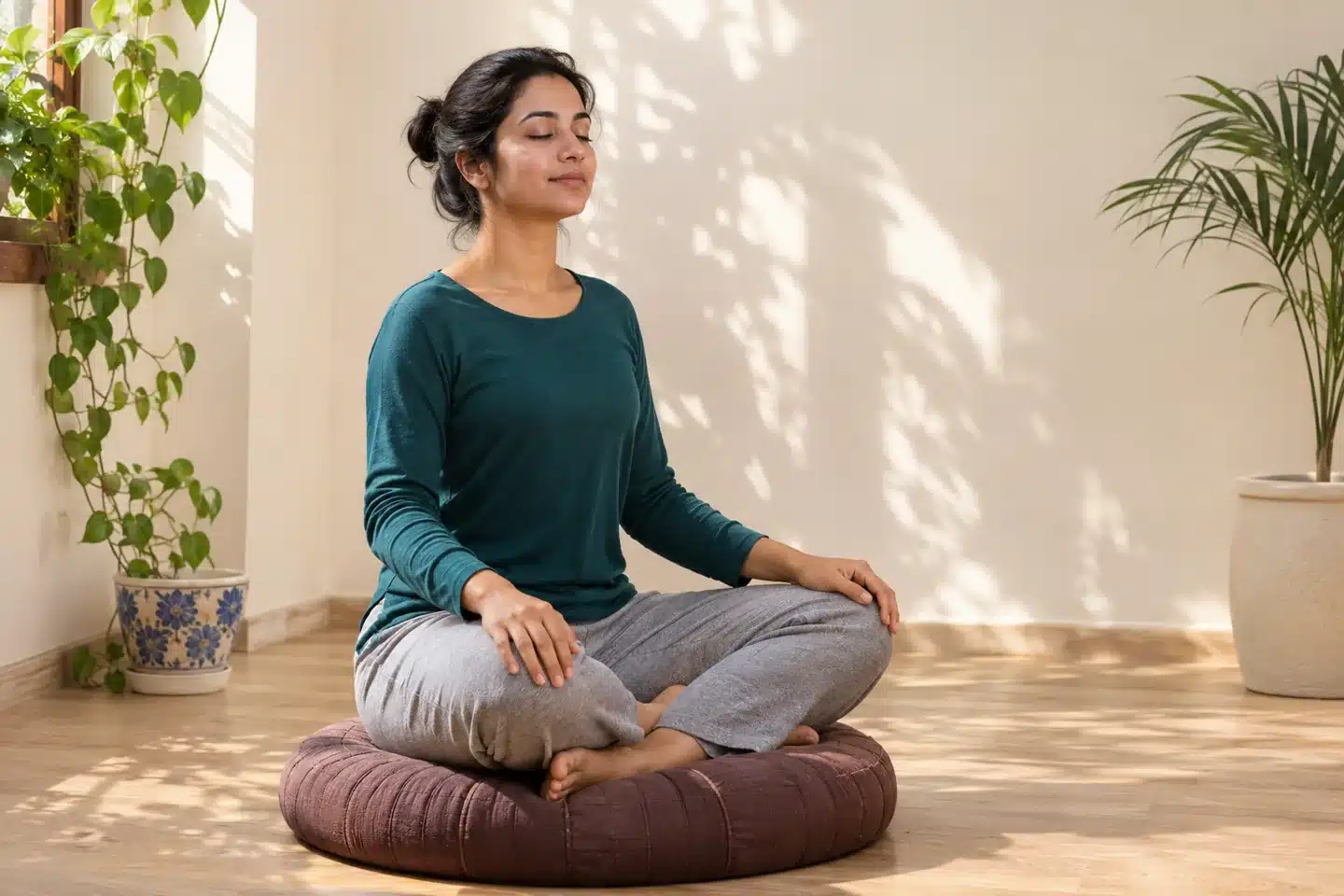
- Posture: Sit tall in a comfortable seat such as Sukhasana (easy cross-legged pose), Vajrasana or a firm chair with feet flat. Keep the spine upright, shoulders relaxed, eyes closed, lips gently closed and teeth slightly apart.
- Mudras (optional – Shanmukhi Mudra): Place the thumbs on the tragus of each ear, the index fingers lightly on the closed eyelids, the middle fingers beside the nose, the ring fingers above the upper lip and the little fingers below the lower lip. Beginners can simply rest the index fingers on the ear cartilage or keep the hands on the knees.
- Inhalation: Breathe in slowly and quietly through both nostrils for about 3–4 seconds. Fill the belly and ribs without strain.
- Exhalation: Breathe out slowly through the nose while making a steady, low “Mmm” sound like a bee (the makara, or “M” sound, in Sanskrit). Keep one even tone, make the exhale two to three times longer than the inhale, and feel the vibration in the head and face.
- Reps: Start with 5 rounds (about 3–5 minutes) and build gradually to 10 rounds, or 10–15 minutes with experience. Finish with one to two minutes of silent sitting.
- Key benefits
- Nervous system regulation: The long, humming exhale helps shift the body toward the parasympathetic “rest and digest” state. A 2024 review of 46 studies linked bhramari with higher parasympathetic and lower sympathetic activity, though heart rate may briefly rise during the hum itself (2017 study).
- Mental calm: The same review found lower stress, anxiety and depression scores, plus better attention. A 2023 randomised trial of 100 adults recorded a highly significant drop in reaction time after bhramari.
- Nitric oxide boost: Humming increased nasal nitric oxide 15-fold compared with quiet exhalation in a 2002 Karolinska Institute study, improving airflow between the sinuses and the nose.
- Physical relief: Regular practice is associated with lower blood pressure, better sleep quality and a release of tension in the face, jaw and shoulders. Early evidence suggests it may also ease tinnitus symptoms for some people.
- Contraindications & precautions
- Ear infections: Avoid bhramari pranayama with an active ear infection, ear pain or discharge, or after recent ear surgery. Do not close the ears until fully healed.
- Pressure limits: Press only the tragus (the cartilage flap), never inside the ear canal. Rest the fingers on the eyelids without pressing, and skip eye placement with glaucoma, eye surgery or contact lenses. Keep the hum soft, never force the exhale and never hold the breath.
- Caution needed: Get medical advice first if you are pregnant or have a heart condition, uncontrolled high or low blood pressure, epilepsy, an acute sinus infection, a migraine attack or a serious mental health condition. Practise seated rather than lying down, and stop at once if you feel dizzy or unwell.
How do you do bhramari pranayama step by step?
To do bhramari pranayama, sit tall, close your eyes, inhale gently through the nose, then exhale slowly while making a soft, even “hmmm” sound with your lips closed. Repeat for 5–10 rounds. One inhale plus one humming exhale counts as one round. The basic version below is safe for most healthy beginners.
What you need: a quiet room, a cushion or chair, and an empty or light stomach. Allow 5–10 minutes.
- Sit comfortably. Choose a cross-legged seat such as Sukhasana, a kneeling seat like Vajrasana, or a firm chair with feet flat. Keep the spine upright and the shoulders soft.
- Settle the breath. Close your eyes. Take three or four natural breaths through the nose. Relax the jaw, but keep the lips gently closed.
- Rest the teeth apart. Let the upper and lower teeth separate slightly. This lets the vibration spread through the skull instead of buzzing only in the lips.
- Close the ears (optional). Place your index fingers or thumbs on the tragus, the small flap of cartilage at the front of each ear. Press it lightly over the ear opening. Never push a finger into the ear canal.
- Inhale slowly. Breathe in through both nostrils for about 3–4 seconds. Fill the belly and ribs without strain.
- Hum on the exhale. Breathe out slowly through the nose while making a steady, low “hmmm” sound. Aim for an exhale two or three times longer than the inhale. Keep one even tone. Do not hum a tune.
- Feel the vibration. Notice where the sound resonates: the forehead, cheeks, throat or crown. Keep your attention there.
- Repeat. Breathe in quietly and hum again. Do 5 rounds at first. Build to 10 rounds over a week or two.
- Sit in silence. Lower the hands to your knees. Stay still for one to two minutes with the eyes closed. Notice the quiet after the sound.
Key takeaway: comfort beats volume. A soft, smooth hum that you can hold without effort works better than a loud one.
How do you practise bhramari with Shanmukhi Mudra?
Shanmukhi Mudra is the classical hand seal used with bhramari pranayama: the fingers gently close the ears, eyes, nose and mouth so that attention turns fully inward. Shanmukhi means “six gates”. It is also called Yoni Mudra. Use it only once the basic version feels easy.
- Raise your elbows to shoulder height, out to the sides.
- Place the thumbs on the tragus of each ear.
- Rest the index fingers lightly on the closed eyelids or just above the eyebrows.
- Place the middle fingers at the sides of the nose, without blocking the nostrils.
- Rest the ring fingers above the upper lip and the little fingers below the lower lip.
- Breathe in through the nose and hum on the exhale, exactly as in the basic version.
- After each round, you may lower the arms to rest, then raise them again.
If your shoulders or arms tire, return to the basic version. The mudra deepens focus, but the hum is what matters. Keep the pressure on the eyes extremely light, or skip the eye placement if you wear contact lenses or have eye problems.
What are the variations of bhramari pranayama?
Bhramari pranayama has five common variations: basic (no mudra), with Shanmukhi Mudra, high-pitch, low-pitch, and silent or mental bhramari. Each one shifts where you feel the vibration and how strong the effect is.
| Variation | How it differs | Best for |
|---|---|---|
| Basic bhramari | Hands on knees or ears lightly closed; soft hum | Beginners, group classes, quick stress relief |
| With Shanmukhi Mudra | Six “gates” closed with the fingers | Deeper focus before meditation |
| High-pitch hum | Higher tone, felt in the forehead and crown | Alertness, mental clarity |
| Low-pitch hum | Deeper tone, felt in the throat and chest | Calming down, evening practice |
| Silent (mental) bhramari | Hum is imagined, not voiced | Offices, travel, after throat strain |
| Ujjayi inhale variation | Inhale with a slight throat contraction, as in Ujjayi | Experienced practitioners |
Can you do bhramari pranayama lying down?
Most classical teachers advise practising bhramari pranayama seated, not lying down. The Bihar School of Yoga manual Asana Pranayama Mudra Bandha (Swami Satyananda Saraswati) lists lying down as a contraindication. Other schools, such as the Art of Living, teach a lying version without the fingers in the ears.
Inteyoga’s guidance for beginners: practise seated first. Lying down makes it easy to fall asleep, and the posture changes how freely the breath moves. If you use bhramari in bed to wind down, keep it to a few soft rounds and treat it as a relaxation aid rather than formal pranayama.
How many rounds of bhramari should you do?
Beginners should start with 5 rounds of bhramari pranayama, about 3–5 minutes, and build gradually to 10 rounds or 10–15 minutes. The Bihar School manual recommends 5–10 rounds at the start, slowly increasing to 10–15 minutes. More is not better. Stop if you feel dizzy, light-headed or uncomfortable.
The bhramari dose ladder (Inteyoga starter guide)
| Stage | Rounds | Approx. time | Version |
|---|---|---|---|
| Week 1 | 5 | 3–5 min | Basic, hands on knees or ears lightly closed |
| Weeks 2–4 | 7–10 | 5–8 min | Basic, ears closed at the tragus |
| Month 2 onward | 10–15 | 8–12 min | Add Shanmukhi Mudra if comfortable |
| Experienced | 15+ | 10–15 min | Shanmukhi Mudra, followed by silent sitting |
When is the best time to practise bhramari pranayama: morning or night?
The best time to practise bhramari pranayama is early morning or late evening, on an empty stomach, in a quiet place. B.K.S. Iyengar wrote in Light on Pranayama that the quiet of night suits it best. Many teachers also favour the early morning, when the mind is fresh.
Good moments to use bhramari:
- After asana practice, to settle the body before meditation
- Before meditation, to turn attention inward
- In the evening, to unwind before sleep
- During a stressful day, for 2–3 minutes of reset
Wait at least two to three hours after a heavy meal. A full stomach makes deep, slow breathing uncomfortable.
What are the benefits of bhramari pranayama?
The main benefits of bhramari pranayama are a calmer mind, lower stress and anxiety, better focus, easier sleep and preparation for meditation. Early research also links it to lower blood pressure and better sinus ventilation. A 2024 literature review of 46 studies found bhramari practice associated with better attention, sleep quality and parasympathetic (“rest and digest”) activity, and with lower stress, anxiety and blood pressure (Chetry et al., Indian Journal of Physiology and Pharmacology, 2024).
Here is what each benefit means in practice.
1. Does bhramari pranayama reduce stress and anxiety?
Yes. Calming the mind is the best-known benefit of bhramari pranayama, and research reviews support it. The 2024 review above found lower stress, anxiety and depression scores across studies. The long, slow exhale and the steady sound give the mind one simple thing to follow. Many students describe the effect within a single session. That is why bhramari is one of the most recommended practices in yoga for stress relief.
2. Can bhramari pranayama help control high blood pressure?
Bhramari may help lower blood pressure, but it should support medical care, never replace it. A 2023 systematic review and meta-analysis of randomised trials (2017–2022), which included bhramari among other breathing exercises, found an average drop of 7.06 mmHg systolic and 3.43 mmHg diastolic. That figure covers breathing exercises as a group, not bhramari alone.
3. Does bhramari improve focus and memory? (Useful for students)
Bhramari appears to sharpen attention. In a 2023 randomised trial of 100 adults with hypertension at SDM Nature Cure Hospital, India, 20 minutes of bhramari produced a highly significant drop in auditory reaction time (p < 0.00001), published in the Journal of Ayurveda and Integrative Medicine. A faster reaction time suggests a more alert, focused mind.
For students, bhramari is a quick way to settle the mind before study or exams. Bihar School of Yoga manuals describe it as a technique for improving memory and concentration. Current research measures attention and reaction time rather than memory itself, so treat the memory benefit as traditional and promising, not proven. Try 5 rounds before a study session.
4. Can bhramari pranayama help with insomnia and sleep?
Bhramari is a popular wind-down practice, and the 2024 review linked regular practice with better sleep quality. A few soft rounds in the evening can quieten mental chatter before bed. For ideas to pair it with, see Inteyoga’s guide to 17 relaxing yoga poses for beginners.
Bhramari is not a cure for insomnia, but it can be a helpful part of a bedtime routine. The long humming exhale slows the breath, and the steady sound gives a busy mind one simple thing to follow. If sleeplessness lasts more than a few weeks, see a doctor: chronic insomnia often has medical or psychological causes that need proper treatment.
5. Does bhramari help with sinus problems and migraine?
Humming increases airflow between the sinuses and the nasal cavity, which raises nasal nitric oxide. In a 2002 study by Weitzberg and Lundberg at the Karolinska Institute, humming raised nasal nitric oxide 15-fold compared with quiet exhalation (American Journal of Respiratory and Critical Care Medicine). The study had 10 healthy participants. It shows a real physical effect of humming, but it did not test bhramari as a treatment for sinus disease.
For migraine, bhramari is best used between attacks, not during a severe one. Some yoga schools, such as the Art of Living, report relief from mild headaches and migraine, and many people find the practice eases tension in the head and neck. There are no strong clinical trials on migraine yet. During a severe attack, sound and vibration can make symptoms worse, so rest instead and follow your doctor’s treatment plan.
6. Can bhramari help with tinnitus?
The 2024 review notes that bhramari may help some people with tinnitus reduce their symptoms, possibly because the self-made sound shifts attention away from the ringing. Evidence is still limited. Anyone with tinnitus should see an ear specialist first.
7. Does bhramari prepare you for meditation?
Yes. Bhramari is traditionally used as a bridge from breathing practice into meditation. Closing the ears turns attention inward, and the silence after the last hum is a natural starting point for sitting still. This is its classical role in Hatha yoga.
8. Is bhramari pranayama good for the voice and throat?
Bhramari gently warms up the vocal cords and is traditionally said to support a clear voice. Singers and speakers often use humming as a vocal warm-up. This is a traditional and practical claim rather than a researched one.
What does the research say? Bhramari evidence scorecard
Bhramari pranayama has more research than most pranayama techniques, but most studies are small and short. The 2024 review counted only 6 randomised controlled trials among its 46 studies. Inteyoga’s scorecard below rates each claim honestly so you know what to expect.
| Claimed benefit | Evidence strength | What the research shows |
|---|---|---|
| Calmer mind, less stress and anxiety | Moderate | Consistent findings across multiple studies (2024 review, 46 studies) |
| Lower blood pressure | Moderate (as part of breathing exercises) | −7.06 / −3.43 mmHg average for breathing exercises in RCTs (2023 meta-analysis) |
| Better attention and reaction time | Early–moderate | Highly significant drop in reaction time in a 100-person RCT (2023) |
| Better sleep quality | Early | Linked to better sleep in the 2024 review; few dedicated trials |
| Sinus ventilation (nitric oxide) | Strong for the mechanism | 15-fold rise in nasal NO during humming (2002, 10 people); no treatment trials |
| Tinnitus relief | Early | Possible symptom reduction noted in the 2024 review |
| Heart rate variability (HRV) | Mixed | Some studies show more parasympathetic activity; a 2017 study found the opposite during practice |
| Thyroid, migraine, “detox” | Traditional only | Claimed on many websites; no solid clinical evidence found |
Key takeaway: bhramari is a useful, low-risk self-care practice with real early evidence for calm and focus. It is not a cure for any disease.
How does bhramari pranayama work in the body?
Bhramari pranayama works mainly through slow breathing, a long exhale, sound and vibration, which together shift the nervous system toward a calmer state. Researchers are still testing the exact mechanism. Four explanations are commonly proposed.
- Slow, long exhalation. Breathing slowly, with an exhale longer than the inhale, is linked to greater parasympathetic activity. Each hum naturally lengthens the out-breath.
- Vagus nerve stimulation. The vagus nerve runs near the throat and ear. Many teachers suggest the vibration of humming may stimulate it. This is a plausible idea, but not yet proven.
- Sinus ventilation and nitric oxide. Humming moves air in and out of the sinuses, raising nasal nitric oxide, as the 2002 Karolinska study showed.
- Sound as a point of focus. Closing the ears and listening to one tone blocks out distractions. This is the yogic idea of pratyahara, the turning inward of the senses.
Why does humming calm the nervous system? Nitric oxide and the vagus nerve
Humming affects the body in two well-discussed ways: it raises nitric oxide in the nose and sinuses, and it may stimulate the vagus nerve.
- Nitric oxide (NO) is a gas molecule that helps widen blood vessels and supports the airway’s natural defences. The 2002 Karolinska study measured a 15-fold rise in nasal nitric oxide during humming. This rise happens in the nose and sinuses, not inside the brain.
- The vagus nerve is the main nerve of the parasympathetic (“rest and digest”) nervous system, with branches near the throat and ear. Slow breathing with a long exhale is linked to greater vagal activity, and the humming vibration is thought to add to this effect. Direct proof of vagus nerve stimulation by bhramari is still limited.
Together, the slow exhale, the vibration and the inward focus help explain why the nervous system feels calmer after practice.
Does your heart rate go down during bhramari?
Not always: one study found heart rate briefly rises during bhramari and returns to normal afterwards. In a 2017 study in the International Journal of Yoga, 16 healthy volunteers practised for 5 minutes. Heart rate and low-frequency HRV rose during practice and high-frequency HRV fell, which the authors read as a brief parasympathetic withdrawal. Values returned to normal right after.
This is a useful reminder: the calming effect people feel is often strongest in the minutes after practice, during the silent sitting. Skipping that rest step means missing part of the practice.
Bhramari pranayama vs Nadi Shodhana: what is the difference?
Bhramari pranayama uses a humming exhale through both nostrils to calm the mind through sound and vibration, while Nadi Shodhana (alternate nostril breathing, often called Anulom Vilom) is a silent practice that alternates the breath between the left and right nostrils to balance the system. Both are calming, both suit beginners, and they work well together.
| Feature | Bhramari pranayama | Nadi Shodhana |
|---|---|---|
| English name | Humming bee breath | Alternate nostril breathing |
| Sound | Steady humming on the exhale | Silent |
| Nostrils used | Both together | One at a time, alternating |
| Hand position | Optional: fingers on ears or Shanmukhi Mudra | Vishnu or Nasagra Mudra to close each nostril |
| Main felt effect | Quick calm, inward focus, vibration in the head | Balance, steadiness, mental clarity |
| Typical time | 5–10 rounds, 3–10 minutes | 5–10 minutes |
| Learning curve | Very easy | Easy, needs some coordination |
| Research example | Highly significant drop in reaction time (2023 RCT, n = 50 per group) | Significant drop in reaction time (same 2023 RCT) |
| Main precaution | Avoid with an active ear infection | Avoid with a fully blocked nose |
| Place in a sequence | Usually near the end, before meditation | Often first, to settle the breath |
Which is better? Neither is better overall. In the 2023 trial of 100 adults with hypertension, both techniques helped balance the nervous system, and bhramari showed the stronger effect on reaction time. A simple combination works well: 5 minutes of Nadi Shodhana, then 5 rounds of bhramari, then 2 minutes of silence.
Should you do bhramari after Anulom Vilom?
Yes. Doing bhramari after Anulom Vilom is a common and effective sequence. Anulom Vilom first steadies and balances the breath. Bhramari then deepens the calm and turns attention inward, ready for meditation or rest. A simple routine: 5 minutes of Anulom Vilom, 5–10 rounds of bhramari, then 2 minutes of silence.
Is bhramari the same as Om chanting or just humming?
Bhramari, Om chanting and casual humming all use vocal vibration, but they differ in technique and purpose. Bhramari keeps the mouth closed throughout and focuses on the internal sound. Om chanting opens the mouth for the “A” and “U” sounds before closing on “M”.
| Practice | Mouth | Sound | Main purpose |
|---|---|---|---|
| Bhramari pranayama | Closed | One steady “hmmm”, ears often closed | Breath regulation and inward focus |
| Om (Aum) chanting | Opens, then closes | A–U–M, then silence | Mantra meditation |
| Casual humming | Closed | Any tune | Relaxation, vocal warm-up |
If you already enjoy Om chanting, bhramari will feel familiar. The difference is that bhramari is a structured breathing technique with a set rhythm and a longer exhale.
Who should not do bhramari pranayama?
Bhramari pranayama is one of the gentlest pranayama techniques, but people with an active ear infection, ear pain or a recent ear or eye surgery should avoid it until they recover. Others should practise only with medical advice or expert guidance. Use the table below as a quick safety check.
| Condition | Guidance |
|---|---|
| Active ear infection, ear pain or discharge | Avoid until fully healed; do not close the ears |
| Recent ear, eye or nasal surgery | Avoid until your doctor clears you |
| Acute sinus infection with severe pain | Wait until the acute phase passes |
| Pregnancy | Traditional texts consider bhramari gentle; skip pressure on the eyes and ears, never strain, and check with your doctor and a qualified prenatal teacher |
| Heart conditions or uncontrolled high blood pressure | Consult your doctor first; keep the hum soft and short; never hold the breath |
| Low blood pressure or dizziness | Practise seated, keep rounds few, stop if light-headed |
| Glaucoma or eye conditions | Skip the eye placement in Shanmukhi Mudra |
| Epilepsy | Practise only under expert supervision |
| Severe migraine during an attack | Rest instead; try gentle practice between attacks |
| Severe depression or a history of psychosis | Practise only with guidance from your mental health professional |
Stop at once if you feel dizziness, headache, ear pressure, nausea or breathlessness. Return to normal breathing and rest. For safe practice during pregnancy more broadly, read Inteyoga’s trimester guide to yoga in pregnancy.
Should you do bhramari pranayama on an empty stomach?
An empty stomach is best, but because bhramari is gentle, a light stomach is acceptable. Ideally practise before breakfast, or wait about two to three hours after a heavy meal and 30–60 minutes after a light snack. A full stomach makes slow, deep breathing uncomfortable. Bhramari has no breath holding or forceful breathing, so it is more forgiving than Kapalbhati or Bhastrika.
Can pregnant women practise bhramari, and can it be done lying down?
Pregnant women should practise bhramari only with advice from their doctor and a qualified prenatal yoga teacher, using the basic version without pressure on the eyes or ears. Classical schools also advise against practising bhramari lying down. Sit upright instead, as explained in the variations section above.
What are the most common bhramari mistakes?
The most common bhramari pranayama mistakes are humming too loudly, pushing fingers into the ear canal, clenching the jaw, forcing the exhale and skipping the silent rest at the end. Each one reduces comfort and the calming effect.
- Humming too loudly. Volume creates tension in the throat. Aim for a sound only you can clearly hear.
- Fingers inside the ear. Press only the tragus, the cartilage flap. Never insert a finger.
- Clenched jaw or teeth together. Keep the teeth slightly apart and the tongue relaxed.
- Forcing a long exhale. Stop the hum before you run out of air. Gasping on the next inhale means the exhale was too long.
- Hunched posture. A collapsed chest limits the breath. Sit tall, on a cushion if needed.
- Pressing on the eyeballs. In Shanmukhi Mudra the index fingers rest, they do not press.
- Changing pitch mid-hum. Keep one steady tone. Wavering sound scatters attention.
- Rushing off afterwards. The minute of stillness after the last hum is part of the practice.
Bhramari pranayama do’s and don’ts
For safe bhramari pranayama, sit upright, hum softly and press only the ear cartilage. Never put fingers in the ear canal, force the breath or practise with an ear infection. Use this table as a quick checklist.
| Do’s | Don’ts |
|---|---|
| Sit upright with a straight spine | Do formal practice lying down |
| Keep lips closed and teeth slightly apart | Clench the jaw or press the teeth together |
| Press only the tragus (ear cartilage), lightly | Put fingers inside the ear canal |
| Hum softly in one steady tone | Hum loudly or change pitch mid-breath |
| Make the exhale comfortably longer than the inhale | Force the exhale or hold the breath |
| Practise on an empty or light stomach | Practise straight after a heavy meal |
| Start with 5 rounds and build slowly | Push for long sessions on day one |
| Sit silently for 1–2 minutes afterwards | Jump up right after the last round |
| Get medical advice if pregnant or living with a heart, blood pressure or ear condition | Practise with an active ear infection or during a severe migraine attack |
A 7-day bhramari pranayama plan for beginners
This 7-day plan takes you from 5 rounds to a full 10-minute bhramari practice, adding one small step each day. Practise at the same time daily, seated, on an empty or light stomach.
| Day | Practice | Time | Focus |
|---|---|---|---|
| 1 | 5 rounds, hands on knees, soft hum | 3 min | Learn the sound; keep lips closed, teeth apart |
| 2 | 5 rounds, ears lightly closed at the tragus | 4 min | Notice the vibration inside the head |
| 3 | 7 rounds, ears closed | 5 min | Make the exhale about twice the inhale |
| 4 | 7 rounds + 1 min silent sitting | 6 min | Notice the quiet after the sound |
| 5 | 3 min Nadi Shodhana + 7 rounds bhramari | 8 min | Combine two techniques |
| 6 | 10 rounds, try a low pitch, then a high pitch | 8 min | Feel where each pitch resonates |
| 7 | 3 min Nadi Shodhana + 10 rounds bhramari + 2 min silence | 10 min | Your full daily routine |
Tip: keep a one-line journal after each session, such as “mind busy / calm / sleepy”. After a week you will see your own pattern.
How is bhramari pranayama taught at Inteyoga?
At Inteyoga, bhramari is part of the pranayama module of the Advanced 300-Hour Integrated Restorative Yoga teacher training in South Goa, India. The course is registered with Yoga Alliance USA (RYS 300) and the Indian Yoga Association.
The pranayama list in the curriculum covers yogic breathing, pre-pranayama techniques, Nadi Shodhan, Surya Bhedan, Chandra Bhedan, Ujjayi, Bhastrika, Bhramari, Seetkari and Sitali. Pranayama sits beside related modules such as Pratyahara (Yoga Nidra, Ajapa Japa, Antar Mauna) and Prana Vidya, an intensive and progressive study of pranic awareness. Asana and pranayama are practised every morning from 08:00 to 10:30.
Key facts about the course (from inteyoga.org):
- Format: fully residential, 43 + 2 days, up to 24 participants per cohort
- Location: Swami Krishnananda Yoga Vidyapeeth, Sernabatim, Colva, South Goa
- Fees: no course fee under the Gift-It-Forward model; accommodation and vegetarian meals included
- Eligibility: a completed 200-hour TTC or equivalent, age 21–60, good physical and mental health
- Next batch: 13 December 2026 – 26 January 2027
- Track record: 1,137+ students from 25+ countries over 12+ years
The training is led by Inteyoga’s founder and principal teacher. You can read more on the teacher page.
Ready to go deeper than a home practice? Apply for the 300-hour advanced yoga teacher training, or join the 200-hour TTC waitlist for the planned mid-2027 course.
Conclusion: start your bhramari pranayama practice today
Bhramari pranayama is a simple, low-risk breathing practice that can calm your mind in a few minutes. You inhale through the nose, hum softly on a long exhale, and rest in the quiet that follows. The research is still growing, but early studies support its use for stress, focus, sleep and as a natural lead-in to meditation.
Start small: 5 rounds a day for a week, using the 7-day plan above. Keep the sound soft, the jaw relaxed and the spine tall. Most importantly, never skip the silent minute at the end.
Want to learn bhramari and the full range of classical pranayama from experienced teachers? Inteyoga’s residential 300-hour advanced yoga teacher training in Goa covers pranayama, Prana Vidya, Yoga Nidra and meditation, with no course fee. View the 2026–27 batch dates, contact the team, or message Inteyoga on WhatsApp at +91 9354737240.
Frequently Asked Questions (FAQ)
What is bhramari pranayama good for?
Bhramari pranayama is mainly used to calm the mind, ease stress and anxiety, improve focus and prepare for meditation. A 2024 review of 46 studies also linked regular practice with better sleep quality and lower blood pressure. Humming raises nasal nitric oxide, which supports sinus ventilation. It is a self-care practice, not a medical treatment.
How long should you do bhramari pranayama?
Beginners should do 5 rounds of bhramari pranayama, which takes about 3 to 5 minutes. Over two to four weeks, build up to 10 rounds or 5 to 10 minutes. Experienced practitioners may practise for 10 to 15 minutes. Always finish with one or two minutes of silent sitting, and stop early if you feel dizzy.
Can I do bhramari pranayama every day?
Yes. Bhramari pranayama is gentle enough for daily practice for most healthy adults. A short daily session of 5 to 10 minutes is more useful than a long session once a week. Keep the hum soft, practise on an empty or light stomach, and take a break if you develop an ear infection or a sore throat.
Is it good to do bhramari pranayama before sleep?
Many people use bhramari pranayama in the evening to quieten the mind before bed, and a 2024 research review linked it to better sleep quality. Practise seated a little before bedtime, do 5 to 7 soft rounds, then sit quietly. Classical schools advise against formal practice lying down, so treat any in-bed humming as a light relaxation aid.
Can beginners do bhramari pranayama?
Yes. Bhramari pranayama is one of the easiest breathing techniques for beginners. It needs no special flexibility and no breath holding. Start with the basic version, hands resting on the knees or fingers lightly on the ear cartilage. Add Shanmukhi Mudra only after a few weeks, once the soft, steady hum feels natural and comfortable.
Who should not do bhramari pranayama?
Avoid bhramari pranayama if you have an active ear infection, ear pain or discharge, or a recent ear, eye or nasal surgery. People with heart conditions, uncontrolled blood pressure, epilepsy, glaucoma or a serious mental health condition, and anyone who is pregnant, should get medical advice first. Stop at once if you feel dizzy, light-headed or uncomfortable.
Is bhramari pranayama good for high blood pressure?
Bhramari pranayama may help. A 2023 meta-analysis of randomised trials found breathing exercises, including bhramari, lowered blood pressure by about 7 mmHg systolic and 3 mmHg diastolic on average. However, it is not a replacement for medication or medical care. If you have high blood pressure, ask your doctor before starting, and never hold the breath.
Can children do bhramari pranayama?
Children can usually practise a simple version of bhramari pranayama, often taught as “bee breathing”, with an adult present. Keep it short, around 3 to 5 soft rounds, and skip closing the eyes or pressing the ears. Make it playful rather than strict. Check with a paediatrician if the child has ear problems or any medical condition.