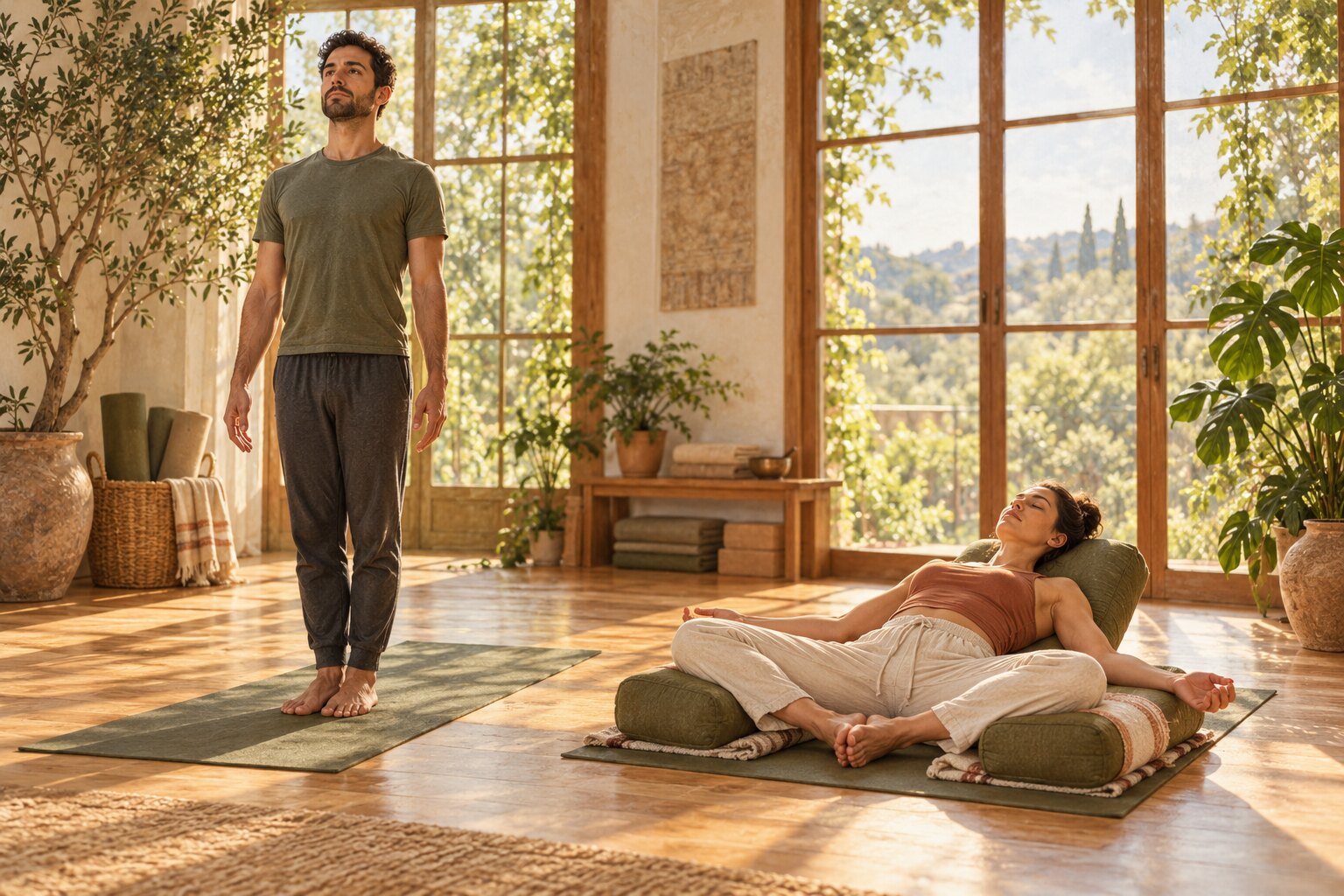
Hatha vs Yin yoga: if you’ve ever stared at a studio schedule and wondered which class to book, this guide is for you. Both styles are slow, both say “all levels,” and both promise calm. They work your body in very different ways, though.
Plenty of people face this choice. In 2022, 16.9% of US adults practiced yoga at some point in the past year, according to the National Center for Health Statistics. That is close to 1 in 6 Americans. Most beginners still have to guess what the class names on a schedule actually mean.
The short version: Hatha is active and balanced, and Yin is slow and still. The rest of this guide explains what that means for your muscles, joints, stress levels and weekly routine, using published research, classical yoga texts and the way we teach at Inteyoga.
Key Takeaways
- Hatha yoga uses active poses held for a few breaths, up to about a minute. Yin yoga uses relaxed floor poses held for about three to five minutes.
- Hatha mainly trains muscles, balance and posture. Yin mainly places gentle load on joints and connective tissue and asks you to stay still.
- For most beginners, Hatha is the easier place to start. Yin works well as a second practice for stress and recovery.
- Research on both styles is promising but mostly small. Neither style is a medical treatment.
- People with very flexible joints, osteoporosis, a recent injury or pregnancy should adapt or avoid long Yin holds and talk to a doctor first.
Choose Hatha If… Choose Yin If…
| Choose Hatha if you… | Choose Yin if you… |
|---|---|
| Are brand new to yoga | Already know the basic poses |
| Want to build strength and balance | Want to slow down and unwind |
| Want one class that covers poses, breathing and relaxation | Already get plenty of active exercise |
| Find it hard to stay still | Want to practice being still |
| Want better posture after long desk days | Feel stiff in the hips and lower back |
What Is the Difference Between Hatha and Yin Yoga?
The main difference in Hatha vs Yin yoga is effort. In Hatha yoga, you engage your muscles and hold each pose for a few breaths, up to about a minute.
In Yin yoga, you relax your muscles and hold floor poses for three to five minutes to place gentle load on deep connective tissue. Hatha builds strength; Yin builds stillness.
Here is a side-by-side comparison of Yin vs Hatha yoga:
| Feature | Hatha Yoga | Yin Yoga |
|---|---|---|
| Pose hold time | A few breaths, up to about 1 minute | Usually 3 to 5 minutes |
| Muscles | Engaged | Relaxed |
| Main focus | Strength, balance, alignment | Connective tissue, joints, stillness |
| Types of poses | Standing, seated, balancing, twists, backbends, inversions | Mostly seated and lying down |
| Pace | Slow to moderate | Very slow |
| Best for | Beginners and a complete practice | Stress, recovery and deep release |
| Breathing | Pranayama is a core part of practice | Natural, slow breathing |
| How you feel after | Balanced and alert | Calm and quiet |
| Props | Sometimes (blocks, straps) | Often (bolsters, blocks, blankets) |
| Origin | Indian tradition going back many centuries | Modern style from the late 20th century, with Indian and Chinese roots |
Want to learn the traditional Hatha foundation? See our courses and fees to understand how we teach Hatha yoga in Goa, India.
How We Put This Guide Together
The Inteyoga Editorial Team works at Swami Krishnananda Yoga Vidyapeeth in Colva, South Goa, India, where we teach traditional Hatha and Raja yoga.
Our school is registered with Yoga Alliance as a Registered Yoga School (RYS 200, RYS 300 and RYS 500). For this guide, we checked peer-reviewed studies on Hatha and Yin yoga,
US government health data, official clinical guidelines and the Hatha Yoga Pradipika, a classical Hatha text. We kept health claims cautious and listed every source at the end.
What Is Hatha Yoga?
Hatha yoga is the traditional physical branch of yoga. It combines postures (asanas), breath control (pranayama), hand and body gestures (mudras), energy locks (bandhas), cleansing practices and meditation. In the classical view, its purpose is to prepare the body and mind for deeper meditation.
The word “hatha” is explained in two common ways. In one, “ha” stands for the sun and “tha” for the moon, so Hatha is the practice of balancing two opposite energies. In the other, “hatha” means “force” or “effort,” which points to the steady discipline the practice asks for.
In the US, the word gets used in two ways:
- As a tradition: the classical system described in texts like the Hatha Yoga Pradipika.
- As a class label: at many American studios, “Hatha” on the schedule means a slower, balanced class where you hold each pose for a few breaths, with short rests in between.
In a typical Hatha class, you move through standing, seated, twisting, balancing, backbending and inverted poses. Your muscles do real work. You pay attention to alignment and breathing, and the class usually ends with Shavasana (final relaxation), sometimes followed by breathwork or a short meditation.
Bottom line: Hatha yoga is the parent system. Most modern physical yoga styles grew out of it.
What Is Yin Yoga?
Yin yoga is a slow, quiet style in which you hold mostly seated and lying-down poses for several minutes with your muscles relaxed. The aim is to place gentle, steady load on the deeper tissues of the body, such as fascia, ligaments and joints.
The name comes from the Chinese idea of yin and yang. Yin describes qualities that are still, cool, soft and inward. Yang describes qualities that are active, warm, fast and outward.
Yin yoga borrows from Traditional Chinese Medicine, which describes energy (qi) moving through channels called meridians. These are traditional concepts, not structures that modern anatomy has confirmed, but they shape how many Yin teachers plan their classes.
In a Yin class, you usually:
- Ease into a pose until you feel mild, comfortable sensation, not your deepest stretch.
- Let your muscles relax and let gravity do the work.
- Stay still for several minutes.
- Come out slowly and rest before the next pose.
Bottom line: Yin yoga is slow, passive and meditative. It is a modern style with roots in both Indian yoga and Chinese philosophy.
How Long Do You Hold Poses in Hatha vs Yin Yoga?
In Hatha yoga, you usually hold a pose for three to eight breaths, which is about 30 seconds to one minute. In Yin yoga, you hold a pose for three to five minutes, and experienced students sometimes stay longer.
Hold time is the biggest practical difference between the two styles, and it changes what the pose does.
Short holds in Hatha make your muscles contract to keep you steady. You build strength, balance and body awareness, and you move between poses with control.
Long holds in Yin give your muscles time to let go. The sensation moves deeper, toward the joints and the tissue around them. Your mind has time to settle or to wander, and noticing that wandering is part of the practice.
Think of it this way: Hatha is a set of short, focused efforts with rest in between. Yin is one long, quiet pause.
How Long Should You Hold a Yin Yoga Pose?
Hold most Yin poses for three to five minutes. If you are new, start with one to three minutes and add time slowly over a few weeks. Experienced students sometimes stay five to ten minutes in a pose, but only while it stays comfortable.
A simple way to build up:
| Stage | Hold time per pose | Rest between poses |
|---|---|---|
| First 2 to 4 weeks | 1 to 3 minutes | 3 to 5 breaths |
| After about a month of regular practice | 3 to 5 minutes | 5 to 10 breaths |
| Experienced practice | 5 minutes or more | 1 minute or more |
Treat the timer as a guide. If your leg goes numb, you feel tingling, or the sensation turns sharp, come out of the pose even if the time isn’t up.
What Does Each Style Do for Your Body?
Hatha yoga mainly works your muscles, including your legs, glutes, core, back and shoulders, along with balance and posture. Yin yoga mainly targets connective tissue such as fascia, ligaments and joint capsules, especially around the hips, pelvis and lower spine.
Hatha Yoga and Your Muscles
When you hold Warrior II or Chair Pose, your thighs and hips work hard. When you balance in Tree Pose, small stabilizing muscles in your feet, ankles and core switch on. That is why teachers often call Hatha a “yang” practice.
Yin Yoga and Your Connective Tissue
Connective tissue is the web that wraps and links muscles, bones and organs. It includes fascia, ligaments and tendons. Yin teachers use long, relaxed holds because they believe this tissue responds better to gentle, steady load than to quick force.
You will often hear that Yin “remodels” fascia or lengthens ligaments. Direct evidence for these claims in people doing Yin yoga is limited.
Laboratory findings about how tissue cells respond to stretch do not prove that a yoga pose changes human fascia in a lasting way. The research is clearer for Yin’s effects on stress and mood, which we cover later in this guide.
Where Each Style Focuses
| Body area | Hatha yoga | Yin yoga |
|---|---|---|
| Legs and glutes | Strong focus (standing poses) | Gentle release (hip openers) |
| Core | Active work | Little active work |
| Hips and pelvis | Mobility and strength | Main focus |
| Lower back | Strength and length | Gentle release |
| Shoulders and upper back | Strength and opening | Some release |
| Balance | Strong focus | Very little |
Put simply, Hatha trains the engine (muscles and balance), and Yin looks after the frame (joints and deeper tissue).
Where Do Hatha and Yin Yoga Come From?
Hatha yoga comes from Indian traditions that developed over many centuries. Its best-known text, the Hatha Yoga Pradipika by Svatmarama, is usually dated to around the 15th century.
Yin yoga is a modern style that took shape in the West in the late 20th century, drawing on Taoist ideas and Indian yoga.
The Roots of Hatha Yoga
The Hatha Yoga Pradipika describes asanas, pranayama, mudras, bandhas and cleansing practices called shatkarmas. It presents Hatha as preparation for Raja yoga, the path of meditation and mastery of the mind. In the classical view, then, Hatha was never meant to be only exercise.
In this tradition, the aim is to balance the sun and moon energies in Sushumna, described as the central channel along the spine. Yin yoga has a similar aim, though it uses the Chinese language of meridians instead of nadis, and describes balance as yin and yang. Both are traditional frameworks rather than findings of modern anatomy.
The Roots of Yin Yoga
Yin yoga’s history is usually told through three teachers. Paulie Zink taught a Taoist style of yoga that included long, passive holds. Paul Grilley studied with Zink and combined that approach with anatomy and ideas about meridians.
Sarah Powers helped spread the style and the name “Yin Yoga” in the late 1990s and 2000s. This is the most commonly told version; the exact order of influence is described a little differently from source to source.
Is Yin Yoga Harder Than Hatha Yoga?
Yin yoga is easier on your body than Hatha yoga, but many people find it harder on the mind. Hatha asks your muscles to work. Yin asks you to stay still for several minutes with mild discomfort. Which one feels harder depends on whether effort or stillness is your weak spot.
When people compare Hatha vs Yin yoga, “hard” can mean two things. Hatha is harder on your muscles, because standing poses, balances and core work build heat and fatigue. Yin is harder on your patience, because you can’t power through a Yin pose. You have to wait it out.
Why Is Yin Yoga So Hard?
Yin feels hard because it removes the things that usually make effort feel easy. There is no movement, no upbeat music and no quick change of pose. You stay with a deep, steady sensation and with your own thoughts.
Common reasons people struggle with Yin:
- Most of us rarely sit still. Phones, work and notifications keep the mind busy all day.
- The sensation is deep and slow, and long holds reach stiff spots in the hips and lower back.
- Around minute two or three, boredom and impatience often show up.
- Emotions can surface. Some people feel sad, irritated or teary in long holds.
- If you are used to pushing hard in workouts, letting go of effort can feel strange.
Which Is Easier, Yin or Hatha Yoga?
Yin is easier on the body, and Hatha is usually easier for a restless mind. If you are learning yoga from scratch, Hatha is typically easier because the teacher walks you through each step.
| What kind of “easy”? | Easier style |
|---|---|
| Physical effort | Yin |
| Staying focused | Hatha |
| Learning poses and alignment | Hatha |
| Winding down after a long workday | Yin |
| Practicing when your energy is low | Yin |
What Are the Benefits of Hatha Yoga?
Hatha yoga may help improve strength, flexibility, balance, posture, breathing and focus. Because one class combines movement, breathwork and relaxation, it gives you a well-rounded practice for body and mind.
The main benefits of Hatha yoga include:
- Functional strength, because standing poses, balances and core work use your own body weight as resistance.
- Better balance, because one-leg poses train the small muscles that keep you steady.
- More flexibility and mobility, as poses move your joints through a wide range of motion.
- Better posture and body awareness, which helps if you sit at a desk for most of the day.
- Breath training, since pranayama is built into Hatha. Slow, controlled breathing may help you feel calmer.
- Sharper concentration, because holding a pose with steady breath trains attention.
- A complete practice that covers standing, seated, twisting, backbending, inverted and resting poses, plus breathwork and relaxation.
- A path to meditation. In the classical view, a steady body and calm breath make it easier to sit and meditate.
Bottom line: If you want one style that covers body, breath and mind, Hatha is the best all-round choice.
What Are the Benefits of Yin Yoga?
Yin yoga may help reduce stress, support relaxation, improve joint mobility, and teach patience and mindfulness. Many people use it to balance active training like running, lifting or fast-paced yoga.
The main benefits of Yin yoga include:
- Less perceived stress and anxiety. This is the most studied benefit of Yin, though the studies are small.
- A calmer state of mind, as long, still holds and slow breathing help many people relax.
- More comfortable movement in the hips and lower back, since many Yin poses target the hips, pelvis and spine.
- Recovery time for runners and gym-goers on rest days.
- Mindfulness, as you learn to notice sensations and thoughts without reacting to them.
- Practice with acceptance, because staying with mild discomfort for several minutes teaches you to let go.
- An easy lead-in to seated meditation, since Yin sessions are quiet by design.
Bottom line: Yin yoga is best for slowing down, releasing tension and learning to be still.
Can Yin Yoga Reduce Belly Fat?
No. Yin yoga cannot directly reduce belly fat, and research does not support “spot reduction” from exercising one area. In a 2011 randomized trial, six weeks of abdominal exercises improved core endurance but did not reduce belly fat compared with a control group. Fat loss depends on your overall habits: food, sleep, daily activity and stress.
Yin may support some of those habits in indirect ways:
- Stress: long-term stress is linked with poor sleep and emotional eating, and Yin may help some people manage stress.
- Sleep: better rest supports steadier appetite and energy.
- Awareness: a mindful practice can help you notice habits like snacking when you are stressed.
If belly fat or weight is your goal, a more active routine works better, such as Hatha yoga, brisk walks, strength training, balanced meals and good sleep. For personal advice, talk to your doctor or a registered dietitian.
Does Yin Yoga Count as Exercise?
Yin yoga counts as movement and mobility work, but it does not count as moderate aerobic exercise or strength training. It is low in intensity, so add it to an active routine rather than using it as a replacement.
The Physical Activity Guidelines for Americans recommend that adults get 150 to 300 minutes of moderate aerobic activity each week, plus muscle-strengthening activity on at least 2 days.
Yin does not raise your heart rate or load your muscles enough to meet either target. A Hatha class with standing poses and balances can help with the muscle-strengthening part, depending on how demanding it is.
Think of Yin as care for your joints and your mind, not as a calorie burner.
Does Yin Yoga Release Trauma?
There is no strong scientific evidence that Yin yoga “releases” trauma stored in the body. Long, quiet holds can bring up strong emotions, and some studies suggest yoga in general may help reduce trauma-related symptoms when it is used alongside proper care. Yin is not a replacement for therapy.
You may hear the phrase “issues in the tissues” in Yin classes. It describes something many students report: feeling sad, angry or teary during long hip openers or twists. Feeling an emotion is not the same as releasing trauma, and the science here is still early.
The research that exists is modest. In one randomized trial, 94 women with post-traumatic stress symptoms were assigned either to a control group or to a yoga group that attended six 45-minute sessions over 12 weeks. The yoga group ended up with lower scores for trauma symptoms, anxiety and depression. This study looked at yoga in general, not Yin specifically.
For diagnosed PTSD, the 2023 VA/DoD clinical practice guideline recommends trauma-focused psychotherapies such as Cognitive Processing Therapy, Prolonged Exposure and EMDR as first-line treatment. Yoga may support that care, but it does not replace it.
It also helps to know the difference between ordinary discomfort and a trauma response. Feeling restless or a little emotional in a long hold is common.
Feeling detached from your body, losing track of where you are, or having vivid flashbacks is different, and it is a sign to stop the practice and reach out to a mental health professional.
If you have a history of trauma:
- Work with a licensed mental health professional first.
- Look for a trauma-informed teacher who offers choices and asks before any hands-on adjustment.
- Keep your eyes open if closing them doesn’t feel safe.
- Come out of any pose if you feel overwhelmed. That is always allowed.
What Does the Research Say About Hatha and Yin Yoga?
Research on Hatha vs Yin yoga suggests that Hatha may improve balance, strength, flexibility and mobility, and that Yin may reduce perceived stress and anxiety. Most of these studies are small, so treat the results as promising rather than settled.
Why Americans Practice Yoga
The same CDC data brief also looked at why people practice. Among US adults who did yoga in 2022, 80.0% used it to restore overall health, 57.4% included meditation, and 28.8% used it to treat or manage pain.
These goals line up with the Hatha vs Yin choice: Hatha leans toward overall fitness, and Yin leans toward stillness and meditation.
Hatha Yoga Studies
- Functional fitness in older adults (Gothe and McAuley, 2016): In an 8-week randomized trial of Hatha yoga, 118 sedentary adults with an average age of 62 did either Hatha yoga or stretching and strengthening exercises, three times a week for an hour. Balance, strength, flexibility and mobility improved over time, and Hatha yoga performed about as well as the conventional exercise program.
- Knee osteoarthritis (Ebnezar and colleagues, 2012): In a trial in Bengaluru, India, 250 people aged 35 to 80 with knee osteoarthritis received either Hatha yoga therapy or therapeutic exercise, 40 minutes a day for 3 months, after standard physiotherapy. The yoga group showed greater improvements on the measured outcomes. This was supervised therapy for a specific condition, not a general class.
Yin Yoga Studies
- Stress and biomarkers (Daukantaitė and colleagues, 2018): In this trial published in PLOS ONE, 105 stressed adults were randomly assigned to five weeks of Yin yoga, five weeks of Yin yoga plus psychoeducation and mindfulness (the YOMI program), or a control group. The authors reported that the Yin-based programs appeared to lower both physical and psychological risk markers linked with chronic disease, and the YOMI group saw bigger drops in stress and depression than the control group.
- Stress and worry (Hylander and colleagues, 2017): This randomized trial tested the five-week YOMI program, which combines Yin yoga and mindfulness, on stress, worry and mindfulness in adults without a clinical diagnosis.
- Pharmacy faculty and students (Lemay and colleagues, 2021): Participants who did Yin yoga and guided meditation for six weeks reported more mindfulness and less stress and anxiety.
| Goal | Stronger evidence for | Notes |
|---|---|---|
| Strength and balance | Hatha | Supported by a randomized trial in older adults |
| Flexibility and mobility | Both | More studies on Hatha; Yin evidence is limited |
| Perceived stress and anxiety | Yin (and Hatha) | Small Yin studies show promising results |
| Joint conditions | Hatha (supervised) | Only with qualified guidance |
One more point matters here. A yoga teacher is not the same as a yoga therapist. Yoga therapy is a separate field with its own training standards, such as those set by the International Association of Yoga Therapists. A 200-hour or 300-hour teacher training does not qualify anyone to treat medical conditions.
What Happens in a Hatha Class vs a Yin Class?
A Hatha class usually includes a warm-up, standing and balancing poses, seated poses, breathwork and final relaxation. A Yin class usually includes a short centering, five to eight long floor poses with rest in between, and a long final relaxation.
The Hatha vs Yin yoga difference is easy to see in a class plan. Here is what a typical 60-minute class can look like in each style:
| Time | Hatha class | Yin class |
|---|---|---|
| 0 to 5 min | Centering, breath awareness | Centering, settling on the mat |
| 5 to 15 min | Joint warm-ups, Sun Salutation | First long pose, such as Butterfly |
| 15 to 35 min | Standing poses, balances, twists | Two or three long poses, such as Dragon and Sphinx |
| 35 to 45 min | Seated poses, forward bends, inversions | One or two more poses, such as Caterpillar and a twist |
| 45 to 52 min | Pranayama, such as alternate nostril breathing | Short rests between poses |
| 52 to 60 min | Shavasana and short meditation | Long Shavasana |
A Hatha class might include 15 to 25 poses, while a Yin class might include only 5 to 8. Classes vary by teacher, so treat this as a general picture.
What Are Common Hatha and Yin Yoga Poses?
Hatha yoga uses a wide range of standing, seated, balancing, twisting, backbending and inverted poses. Yin yoga mostly uses seated and lying-down poses, often with different names for shapes that look like Hatha poses.
Some Yin poses look almost the same as Hatha poses. The difference is in how you hold them:
| Hatha pose (Sanskrit / English) | Similar Yin pose | What changes in Yin |
|---|---|---|
| Baddha Konasana / Bound Angle | Butterfly | The back rounds and the head relaxes |
| Paschimottanasana / Seated Forward Bend | Caterpillar | You fold softly without reaching |
| Bhujangasana / Cobra | Sphinx or Seal | You rest on forearms or hands and relax the back muscles |
| Anjaneyasana / Low Lunge | Dragon | You stay for minutes and sink in slowly |
| Balasana / Child’s Pose | Child’s Pose | You hold it much longer |
| Supta Matsyendrasana / Reclined Twist | Reclined Twist | You are fully supported and stay longer |
| Upavistha Konasana / Wide-Legged Forward Bend | Dragonfly | The spine rounds and relaxes |
| Malasana / Garland | Squat | Often supported on a block |
Hatha also includes poses that Yin does not use, such as Tadasana (Mountain Pose), Vrikshasana (Tree Pose), Trikonasana (Triangle Pose), Virabhadrasana (the Warrior poses) and Dhanurasana (Bow Pose).
Which Asana Is the Queen of Yoga?
Sarvangasana, or Shoulder Stand, is often called the “queen of asanas” in modern yoga teaching, while Sirsasana, or Headstand, is often called the “king.” Both are Hatha inversions, and neither is used in Yin yoga.
Sarvangasana means “all-limbs pose,” because tradition says it benefits the whole body. In Hatha practice, it is usually followed by a counterpose such as Matsyasana (Fish Pose).
It is not a beginner pose. Learn it only with a qualified teacher, and skip it if you have neck problems, high blood pressure, glaucoma or a heart condition, or if you are pregnant, unless your doctor and teacher say otherwise. Some traditions also advise avoiding inversions during menstruation. A gentler option is Viparita Karani (Legs-Up-the-Wall).
What Is a Simple Hatha and Yin Yoga Sequence for Beginners?
A good beginner sequence is short, simple and easy to adjust. The two 20-minute routines below show how differently the same amount of time is used in each style. Skip any pose that causes pain, and check with your doctor first if you have a health condition.
A 20-Minute Beginner Yin Yoga Sequence
- Butterfly: 2 minutes, sitting on a folded blanket.
- Sphinx: 2 minutes, resting on your forearms.
- Dragon (low lunge): 2 minutes per side, with the back knee padded.
- Reclined Twist: 2 minutes per side.
- Shavasana: 5 minutes.
Between poses, rest for a few breaths lying on your back or on your belly. Yin teachers often call this pause a “rebound.”
A 20-Minute Beginner Hatha Yoga Sequence
- Mountain Pose with slow breathing: 1 minute.
- Warrior II: 5 breaths per side.
- Tree Pose: 5 breaths per side, with a hand on a wall if needed.
- Seated Forward Bend: 5 to 8 breaths.
- Bridge Pose: 5 breaths, done twice.
- Shavasana: 5 minutes.
What Props Do You Need for Hatha and Yin Yoga?
Props are another practical Hatha vs Yin yoga difference. You can practice Hatha with just a mat, though a block and strap help. Yin relies more on props, because support helps you stay relaxed during long holds.
| Prop | Use in Hatha | Use in Yin |
|---|---|---|
| Bolster | Rarely | Often, to support the chest, hips or knees |
| Blocks (2) | To bring the floor closer in standing poses | To support knees, hips or the head |
| Blanket | For kneeling or seated comfort | For padding and warmth |
| Strap | To reach the feet in seated poses | Rarely |
If you don’t own a bolster, a firm pillow or a rolled blanket works well at home.
Is Hatha or Yin Yoga Better for Beginners?
For most beginners weighing Hatha vs Yin yoga, Hatha is the better place to start. It teaches the basic poses, alignment and breathing that every other style builds on. Yin yoga is open to beginners too, but it works best once you know how your body responds to stretching.
Here is why we usually suggest Hatha first:
- You learn the basics of poses, alignment, breath and relaxation in one class.
- Teachers give more cues on how to enter, hold and leave each pose safely.
- You build muscle strength first, which helps support your joints before long, passive holds.
- You learn your limits. In Yin, it is easy to sink too deep without noticing.
Can a Beginner Do Yin Yoga?
Yes. A beginner can do Yin yoga safely by using props, keeping holds shorter at first, and staying at mild sensation. A class with a qualified teacher is safer than learning Yin on your own from videos.
Yin can be a good first class if:
- You feel very stressed and need to slow down.
- You can’t do standing work for health reasons, after checking with your doctor.
- You already train hard, for example for a half marathon, and want gentle recovery.
For your first Yin class, tell the teacher you are new and mention any injuries. Use a bolster, two blocks and a blanket, choose the easier version of each pose, and follow the beginner hold times from the table earlier in this guide.
Who Is Hatha Yoga Best For?
Hatha yoga is best for beginners, anyone who wants one complete practice, people building strength and balance, and students who want to explore yoga beyond exercise, including breathwork, meditation and philosophy.
Hatha is a strong fit if you are:
- A complete beginner who wants a safe, step-by-step start.
- Short on time and want strength, flexibility and relaxation in one session.
- An older adult working on balance and mobility, with your doctor’s okay.
- A desk worker who wants better posture and body awareness.
- A future yoga teacher who wants the traditional base that other styles grow from.
- Curious about pranayama, meditation and classical yoga texts.
Ready to build a real foundation? Traditional Hatha is at the center of everything we teach. Meet our founder-director on our teacher page to see how we approach it.
How Do Hatha and Yin Compare With Other Yoga Styles?
On a scale from calm to intense, Restorative and Yin yoga sit at the calm end, Hatha sits in the middle, Vinyasa is more dynamic, and Ashtanga or Power yoga sit at the intense end. Where a style falls on this scale tells you a lot about who it suits.
| Style | Pace | Physical intensity | Best for |
|---|---|---|---|
| Restorative | Very slow | Very low | Deep rest, recovery, fatigue |
| Yin | Very slow | Low, with deep sensation | Stillness, mobility, stress |
| Hatha | Slow to moderate | Low to moderate | Foundations, balance, a full practice |
| Vinyasa | Moderate to fast | Moderate to high | Flow, cardio, variety |
| Ashtanga / Power | Fast | High | Discipline, strength, stamina |
What Is the Hardest Yoga Style?
Ashtanga yoga is often described as one of the hardest styles, especially its advanced series. Power yoga and hot yoga are also demanding. Any style can be tough, though. An advanced Hatha class with long inversions and pranayama can challenge fit students too.
Ashtanga follows a set, fast sequence with many transitions, arm balances and deep binds. Power yoga focuses on strength and moves quickly with little rest.
Hot yoga takes place in a heated room, which adds heat stress, so people with heart conditions, low blood pressure or heat sensitivity should check with a doctor first. The teacher and class level matter as much as the style’s name.
Also read: Ashtanga Vinyasa Yoga Teacher Training: 200 Hour Certificate
Is Hatha or Vinyasa Harder?
For most people, Vinyasa is physically harder than Hatha, because you move from pose to pose with each breath and your heart rate climbs. Hatha can feel harder in a different way, since you hold poses longer and your muscles have to stay steady.
Vinyasa gives you more cardio, more transitions and more sweat. Hatha gives you more static strength and more attention to alignment and breathing.
Should I Do Vinyasa or Yin Yoga?
Pick Vinyasa if you want energy, movement and a workout. Pick Yin if you want to slow down, recover and calm your mind. Because the two are close to opposites, many students do both, using Vinyasa for effort and Yin for recovery.
| If you… | Choose |
|---|---|
| Feel sluggish and want to move | Vinyasa |
| Feel stressed, wired or worn out | Yin |
| Train hard in a sport or at the gym | Yin on rest days |
| Want a sweaty workout | Vinyasa |
| Want something in between | Hatha |
What Is the Calmest Form of Yoga?
Yin yoga, Restorative yoga and Yoga Nidra are among the calmest forms of yoga. All three keep the body still and slow the mind down, each in its own way.
Yin uses still, long holds with some deep sensation. Restorative yoga uses fully supported poses with almost no stretch, and its only goal is rest.
Yoga Nidra is a guided practice done lying down, often called “yogic sleep,” in which you rest deeply while staying aware. It is not a replacement for sleep.
Yoga Nidra is one of the core practices in our Advanced TTC 300-Hour Integrated Restorative Yoga (Including Yoga Nidra, Chakra Sadhana, and Prana Vidya Intensive).
What Is the Gentlest Type of Yoga?
Restorative yoga is the gentlest type of yoga. You rest in poses fully supported by bolsters, blankets and blocks, with little or no stretching. Chair yoga and gentle Hatha are also very gentle options.
Gentle and calm are not the same thing:
- Restorative is the gentlest on the body, with no strain.
- Yin is calm but not always gentle, since long holds can feel intense in tight areas.
- Chair yoga is gentle and helpful for people who have trouble getting down to the floor.
- Gentle Hatha uses slow, simple poses with plenty of rest.
Is Yin Yoga the Same as Restorative Yoga?
No. Yin and Restorative yoga both use long, quiet holds, but Yin aims for mild stretch sensation in deeper tissue, while Restorative uses full prop support so there is almost no stretch. Yin trains patience; Restorative is pure rest.
| Feature | Yin Yoga | Restorative Yoga |
|---|---|---|
| Goal | Gentle load on connective tissue | Deep rest and recovery |
| Sensation | Mild to moderate stretch | Little or none |
| Props | Some support | Full support |
| Hold time | Usually 3 to 5 minutes | Often 5 to 20 minutes |
| Best for | Stiff hips, stress, athletes | Fatigue, recovery, very low energy |
What Is the Easiest Yoga to Learn?
Gentle or basic Hatha yoga is usually the easiest yoga to learn. The poses are simple, the pace is slow, and teachers explain each step. Once you know the basics, trying Yin, Vinyasa or any other style becomes much easier.
Which Style Fits Your Goal?
In the Hatha vs Yin yoga decision, choose Hatha for strength, balance, posture and a complete practice. Choose Yin for deep release, recovery and stillness. Choose both if you want balance.
| Your main goal | Best choice | Why |
|---|---|---|
| Learn yoga from the basics | Hatha | Covers poses, breathwork and relaxation |
| Build strength | Hatha | Muscles actively engage |
| Improve balance | Hatha | Includes standing and one-leg poses |
| Improve posture | Hatha | Focus on alignment |
| Recover from sports or the gym | Yin | Passive, low effort |
| Prepare for meditation | Both | Both lead to stillness |
| Only have time for one style | Hatha | Most complete in one session |
Three Common Scenarios
These are illustrations of typical situations, not client stories:
- You work at a desk from 9 to 5 and feel stiff and weak by Friday. Start with two Hatha classes a week to build strength and posture, then add one short Yin session on the weekend.
- You are training for a half marathon and your hips feel tight. Keep your running plan and use a 30-minute Yin session on one or two rest days.
- You are a busy parent who feels wired at night. A 20-minute Yin routine in the evening may help you wind down, while a short Hatha practice on weekday mornings keeps you moving.
Can You Practice Both Hatha and Yin Yoga?
Yes, and they work well together. Hatha builds strength and balance, and Yin adds rest and release. Many students practice Hatha on most days and add one or two Yin sessions a week.
Classical Hatha already includes both active and restful elements, so adding Yin simply gives more time to the quiet side.
Can Yin Yoga Be Done Daily?
Yes. Many healthy adults can do Yin yoga every day, especially in short sessions of 15 to 30 minutes. Balance it with active movement, rotate the body areas you work on, and never force depth.
To keep a daily Yin habit safe:
- Rotate your focus, for example hips one day, spine the next, shoulders the day after.
- Keep it short. A few poses a day is enough.
- Pair it with active work like Hatha, walking or strength training so your joints stay stable.
- Watch for joint aches that last into the next day. They mean you need less depth or more rest.
If your joints are very flexible, read the safety section below before practicing Yin every day.
A Simple Weekly Plan for Beginners
This is a general example for healthy adults. Adjust it to your schedule and energy.
| Day | Practice | Time |
|---|---|---|
| Monday | Hatha (full class) | 45 to 60 min |
| Tuesday | Rest or a short walk | None |
| Wednesday | Hatha (full class) | 45 to 60 min |
| Thursday | Yin (evening) | 30 to 45 min |
| Friday | Shorter Hatha plus pranayama | 30 to 40 min |
| Saturday | Yin or rest | 30 to 45 min |
| Sunday | Rest, meditation or light breathwork | 10 to 20 min |
If you practice both on the same day, do Hatha in the morning and Yin in the evening. Avoid jumping into Yin right after a hard workout while your muscles are very warm, because you may sink deeper than is safe. Give yourself a short rest first, and keep one full rest day each week.
What Are the Most Common Mistakes in Hatha and Yin Yoga?
Whichever side of the Hatha vs Yin yoga choice you land on, the most common mistakes are pushing too hard, holding your breath, ignoring pain and comparing yourself with others. In Yin, the big one is going too deep too fast. In Hatha, it is rushing through poses without paying attention to alignment.
Common Hatha Yoga Mistakes
- Rushing from pose to pose without settling in.
- Holding your breath instead of keeping it slow and steady.
- Locking your knees and elbows. Straight is fine; jammed is not.
- Skipping Shavasana, which is part of the practice.
- Forcing flexibility instead of letting strength and length build over time.
Common Yin Yoga Mistakes
- Going to your deepest stretch. Many teachers suggest working at about 60 to 70% of your range, then waiting.
- Ignoring sharp or burning pain. Mild sensation is fine; sharp, electric or burning pain means come out.
- Fidgeting. Stillness is the point, though you can adjust if something hurts.
- Coming out too fast. Release slowly and rest before the next pose.
- Skipping props, which help you stay safe and relaxed for longer.
Who Should Not Practice Yin Yoga?
People with very loose joints (hypermobility), a recent joint or ligament injury, osteoporosis, or nerve pain should avoid Yin yoga or practice only a modified version with a qualified teacher and their doctor’s approval. Pregnant women should also avoid deep, long holds.
Be careful with Yin, or skip it, if you have:
- Hypermobility: long passive holds can push loose joints too far, so use less depth and more support.
- Pregnancy: pregnancy hormones affect the ligaments, so avoid deep holds and look for a prenatal class.
- A recent joint or ligament injury: long holds can stress healing tissue.
- Osteoporosis: avoid deep, rounded forward folds and strong twists.
- Sciatica or nerve pain: tingling or numbness means come out of the pose.
- Low blood pressure: get up slowly after long floor poses to avoid dizziness.
Who Should Be Careful With Hatha Yoga?
Hatha is safe for most people, but if you have high blood pressure, a heart condition, glaucoma, a neck or back injury, or recent surgery, avoid certain poses and get medical clearance first.
- High blood pressure or heart conditions: skip inversions and breath retention unless your doctor clears you.
- Glaucoma or eye pressure problems: avoid head-down poses.
- Neck or back injuries: avoid Shoulder Stand, Headstand and deep backbends without guidance.
- Recent surgery: wait for your doctor’s okay.
Both styles are gentle compared with many workouts, but gentle does not mean risk-free. Work with a qualified teacher and tell them about any health issues.
How Many Hours Is Yin Yoga Training?
Yin yoga teacher training has no single official length. Most courses are short specialty trainings taken after a 200-hour yoga teacher training, and providers set their own hours.
For example, when we checked provider websites in September 2026, Arhanta Yoga’s online Yin training was listed at 75 hours, Loka Yoga School’s at 50 hours, and Devi Daly’s at 50 hours. These are examples of what is on offer, not an industry standard or a minimum requirement.
Here is how it fits into yoga teacher education:
- A 200-hour training is the usual starting qualification for teaching yoga. At Inteyoga, this is a Hatha-based foundation.
- A 300-hour advanced training builds on the 200-hour base.
- A Yin training is a specialty add-on.
Many teachers take a Yin course toward continuing education. Yoga Alliance asks Registered Yoga Teachers to complete 45 teaching hours and 30 training hours every three years.
Also read: 500 Hour Yoga Teacher Training In Goa: A Complete 2026 Guide
Where Can You Study Traditional Hatha Yoga With Inteyoga?
At Inteyoga, we teach an integrated approach to traditional Hatha and Raja yoga at Swami Krishnananda Yoga Vidyapeeth in Colva, South Goa, India. Our training connects asana, pranayama, meditation and yogic philosophy, with a focus on the preventive and restorative side of yoga.
Our founder-director, Dr. Ashutosh, uses Sanskrit texts in his teaching and draws links between Hatha yoga, acupuncture, Ayurveda and modern medicine, with an emphasis on prevention and restoration.
That matters for the Hatha vs Yin yoga question. Yin yoga uses the Chinese framework of meridians, while classical Hatha uses the framework of nadis and prana. Our approach helps students understand both traditional maps in context instead of treating them as rival systems.
For Students Ready to Go Deeper
If you already hold a 200-hour certification and want to deepen your restorative practice, our current program is the Advanced TTC 300-Hour Integrated Restorative Yoga (Including Yoga Nidra, Chakra Sadhana, and Prana Vidya Intensive).
- Format: residential, taught in English
- Length: 43+2 days (43 training days plus one arrival day and one departure day)
- Eligibility: TTC 200 or an equivalent yoga teacher training qualification
- Age: 18 to 59 at application; 21 and up recommended, with applicants aged 18 to 20 considered case by case
- Recognition: Inteyoga is registered with Yoga Alliance as a Registered Yoga School (RYS 200, RYS 300 and RYS 500)
- Gift-it-Forward model: no payment is required to apply or to participate. After completing the program, participants may voluntarily support the Gift-it-Forward initiative to help future aspirants, with no obligation to contribute.
Confirmed batches for the 300-hour program:
| Batch | Dates |
|---|---|
| 1 | December 13, 2026, to January 26, 2027 |
| 2 | February 5 to March 21, 2027 |
| 3 | May 24 to July 7, 2027 |
| 4 | July 16 to August 29, 2027 |
| 5 | September 7 to October 21, 2027 |
| 6 | November 1 to December 15, 2027 |
Full details are on the 300-hour yoga teacher training in Goa page.
If you have not done a teacher training yet, our next 200-hour yoga teacher training in Goa is planned for approximately mid-2027. Final dates and pricing are not confirmed yet.
Traveling From the US
The 300-hour program is a short-term yoga program, and participants receive a participation or completion certificate rather than an academic degree. International participants use the Indian e-Tourist Visa route, which the Government of India lists for attending a short-term yoga program, subject to nationality-specific eligibility and current rules on the official Indian e-Visa website. Our arrival guide explains how to reach the shala.
Also read: Best Yoga Teacher Training Abroad: How to Verify a School in 2026
So, Should You Choose Hatha or Yin Yoga?
The Hatha vs Yin yoga question is not about which style is best. It is about what your body and mind need right now.
- Choose Hatha if you want a complete, traditional foundation with strength, balance, breathwork and relaxation.
- Choose Yin if you want to slow down, release deep tension and practice stillness.
- Choose both if you want balance between effort and surrender. The word “Hatha” itself refers to balancing sun and moon.
For most beginners, we recommend starting with Hatha. It gives you the skills and body awareness to enjoy Yin safely later on, and over time you will probably find a place for both in your week.
Ready to study traditional Hatha yoga in Goa? Read our frequently asked questions and book your place. You can also email info@inteyoga.org or message us on WhatsApp at +91 935-473-7240.
Frequently Asked Questions About Hatha vs Yin Yoga
Is Yin Yoga a Type of Hatha Yoga?
In a broad sense, yes. Hatha is the traditional physical system that most modern styles grew from, and many teachers see Yin as an offshoot that focuses only on the passive, “yin” side of practice. Yin also borrows from Chinese Taoist ideas such as meridians, which do not appear in classical Hatha texts.
Which Is Better for Flexibility, Hatha or Yin Yoga?
Both help, in different ways. Hatha builds flexibility along with strength, which keeps your joints stable. Yin uses long, relaxed holds aimed at the tissue around the hips, pelvis and spine. For most people, combining the two gives the best mix of range and stability. Always stretch to mild sensation, never to pain.
Is Hatha or Yin Yoga Better for Stress?
Both can help. Yin has promising but small studies on stress and anxiety, including a 2018 randomized trial in PLOS ONE. Hatha includes pranayama and relaxation, which many people also find calming. On a day when you feel very tense, Yin may suit you better. Yoga is not a replacement for medical or mental health care.
Should I Do Hatha or Yin Yoga Before Bed?
Yin is usually the better choice before bed. Its slow pace, floor-based poses and long relaxation may help you wind down. A gentle Hatha session with forward folds and slow breathing can work too. Late at night, skip strong backbends and energizing breathwork if they keep you awake.
Can I Practice Hatha Yoga at Home?
Yes, once you know the basics. Learn first from a teacher, in person or in a live online class, so you practice safe alignment. At home, stick to simple poses, practice on an empty stomach, use a non-slip mat and clear some space around you. Leave inversions and advanced breathwork for times when a teacher is guiding you.
Do I Need to Be Flexible to Start Hatha or Yin Yoga?
No. Flexibility comes with practice; it is not a requirement to begin. Hatha classes offer easier versions of every pose, and Yin uses bolsters and blocks to support stiff areas. Students who start out stiff often notice clear changes over time. Work within your own range and don’t compare yourself with the person on the next mat.
What Should I Wear to a Hatha or Yin Yoga Class?
Wear comfortable, stretchy clothes that let you move and bend without pulling at the waist. For Hatha, fitted clothes help your teacher see your alignment. For Yin, dress in warm layers and consider bringing socks, since your body cools down during long, still holds. You will practice barefoot in both styles.
Is Hatha Yoga Religious?
Hatha yoga comes from Indian spiritual traditions and includes philosophy, breathwork and meditation, but you do not need to follow any religion to practice it. Many people in the US practice Hatha for health and focus, while others explore its philosophy more deeply. You can decide how far you want to go.