

Quick Answer
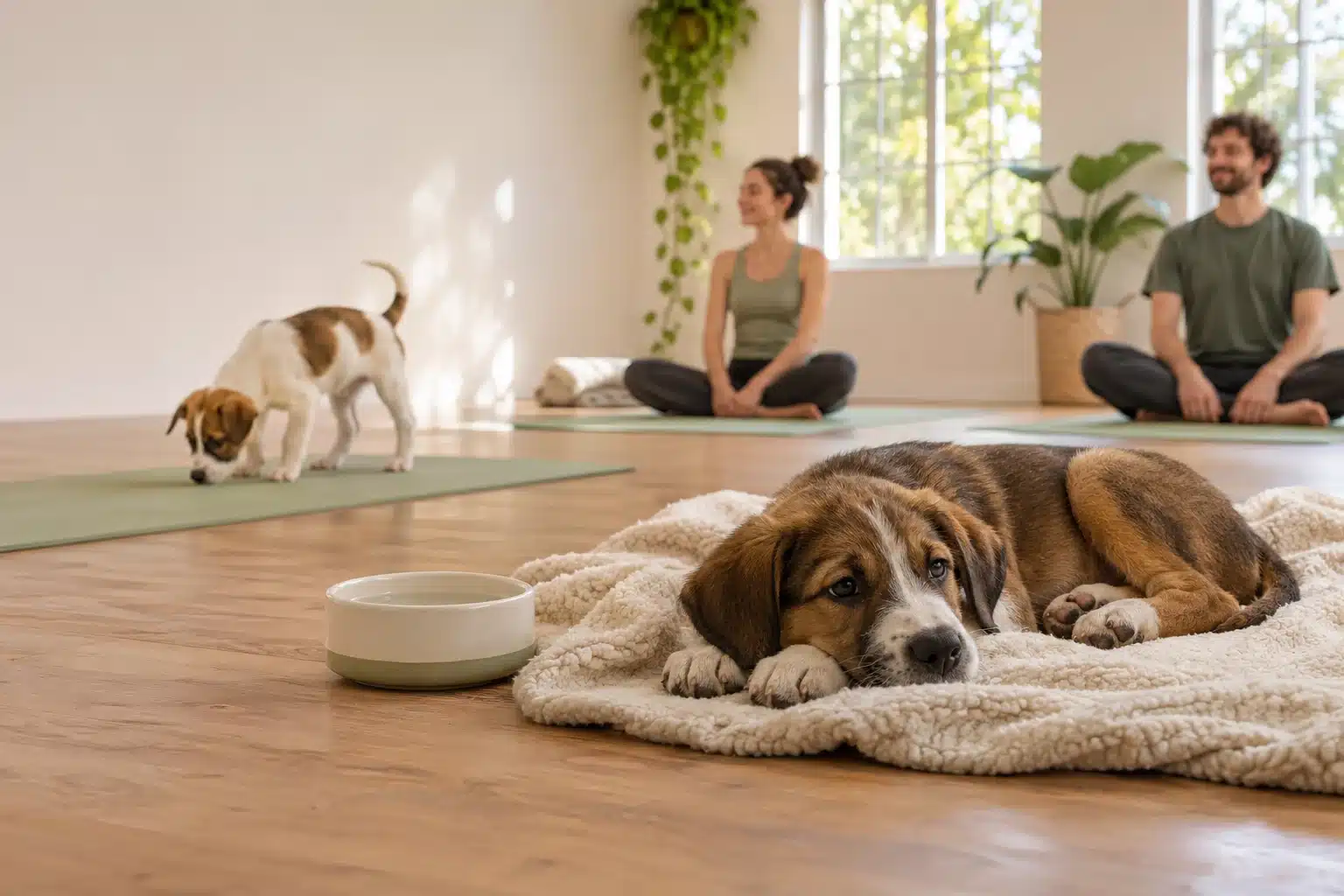
Puppy yoga is a beginner-level yoga class in which a litter of puppies roams freely around the room while people practise and then play with them. It may lift your mood for a short time, but animal welfare charities warn that it can stress young puppies. Italy banned it in 2024.
New to yoga and want to learn the poses first? Start with our guide to yoga exercises for beginners.
Key Takeaways
- What it is: a gentle yoga class with free-roaming puppies, followed by cuddle and play time.
- Typical format: about 45 minutes of yoga, then 15 to 30 minutes with the puppies.
- Reported cost: about $30 to $80 in the US, and up to about £40 in the UK.
- Main benefit: a possible short-term lift in mood and a low-pressure way to try yoga.
- Main concern: very young puppies may be over-handled, short of sleep and exposed to disease.
- Legal position: banned in Italy since 2024. We found no ban in the UK or US at the time of writing, although UK welfare charities want it stopped or licensed.
- Our view: yoga begins with ahimsa (non-harm). If you go, choose a class where the animals’ needs come first.
Picture a yoga studio on a Saturday morning. Twenty mats, one patient teacher, and a litter of Labrador puppies with no intention of letting anyone hold Downward-Facing Dog.
That’s puppy yoga, and it has spread from Los Angeles to London. A North Carolina TV station reported in 2025 that the trend draws hundreds of thousands of searches a month. One 75-minute class in Washington, DC cost a reviewer more than $70, and she still called it worth the cost.
It is also banned in Italy. In Britain, the RSPCA has asked people not to go, and Dogs Trust and The Kennel Club want it stopped.
So which is it: a harmless mood boost, or a wellness trend with a welfare problem? It depends on how the class is run, and many people book without knowing what to check.
Below: what happens in a class, what it costs in the US and UK, what the research shows, and why welfare charities are uneasy. There’s a 10-point checklist near the end for anyone who still wants to book.
One thing up front. Inteyoga does not run puppy yoga classes and has no commercial link to any provider. This is an independent, educational guide based on published sources. It is not a first-hand review of any class.
Puppy Yoga At A Glance
| Topic | Short Answer |
|---|---|
| Class structure | A 60 to 75-minute session: gentle yoga with puppies loose in the room, then dedicated play and cuddle time. |
| Benefits | A possible short-term lift in mood, an easy first step into yoga, light movement, social contact and, at rescue-run events, help with adoption. |
| Considerations and debates | Welfare charities warn of stress, lack of sleep, over-handling, disease risk and poor sourcing. Organisers say well-run classes help puppies get used to people. |
| Where to find classes | Event sites such as Eventbrite, Meetup and ClassPass, local rescues and shelters, and yoga studios’ event pages. |
Puppy Yoga In Numbers
| Figure | What It Refers To | Source |
|---|---|---|
| 45 + 15 to 30 minutes | Split between yoga and puppy time in two reported classes | The Australian Women’s Weekly, BuzzFeed |
| $30 to $80 | Reported US price for a session of about an hour | Canine Journal |
| Up to £40 | UK price found by reporters | ITV News, 2023 |
| 6 weeks | Age of the youngest puppies filmed in UK classes | ITV News, 2023 |
| 2024 | Year Italy banned puppies from yoga classes | ITV News, reporting Italy’s Ministry of Health |
| 10 minutes | Petting time after which cortisol was lower in a trial of 249 students | Pendry and Vandagriff, 2019 |
| 12 studies, 672 adults | Review in which yoga improved perceived stress | NCCIH, citing a 2020 review |
What Is Puppy Yoga?
Puppy yoga is a regular, beginner-friendly yoga class held in a room where puppies are free to wander among the mats. The American Kennel Club describes it the same way: the puppies are there for cuddles, and instructors only occasionally work them into a simple pose.
The yoga itself is usually gentle. Expect basic stretches and easy poses, with plenty of pauses.
The puppies normally come from one of three places:
- Breeders, who bring a litter before the puppies go to their new homes.
- Rescue groups and shelters, who use the class to find adopters.
- Local non-profits, who run a class as a fundraiser.
The source matters a great deal. We come back to it in the welfare section.
Is Puppy Yoga The Same As Doga?
No. Doga is yoga with your own pet dog, while puppy yoga uses a litter of young puppies supplied by the organiser.
Doga, short for “dog yoga”, is generally dated to the early 2000s in the United States. The dog is usually an adult, it knows its owner, and it goes home with them afterwards.
Puppy yoga differs in three ways. The animals are very young, they don’t know the people handling them, and one litter may meet many strangers in a day. That is why welfare groups treat the two differently. Italy’s 2024 rule bans puppies from yoga classes but still allows adult dogs.
Where Did Puppy Yoga Come From?
Puppy yoga grew out of the wider “animal yoga” trend. Goat yoga is usually traced to a farm in the US in 2016, and puppy and kitten versions followed.
The format took off in North America first. By the start of 2023, Euronews was reporting that it had reached the UK. The RSPCA believes social media is fuelling the trend.
Why Do People Search For Puppy Yoga?
Most searches fall into four groups:
- “What is it?” People who have seen a video and want to know how a class works.
- “Puppy yoga near me.” People ready to book.
- “Is it worth it?” People comparing the price with a normal class.
- “Is it cruel?” People who have read about the ban and want the facts first.
How Does A Puppy Yoga Class Work?
A puppy yoga class usually lasts 60 to 75 minutes: a short, gentle yoga session with puppies loose in the room, followed by dedicated play and cuddle time. The split varies by organiser.
| Format | Yoga | Puppy Time | Example |
|---|---|---|---|
| About 50 minutes | About 35 minutes | About 15 minutes | A Singapore studio reported by Mothership |
| 60 minutes | About 45 minutes | About 15 minutes | Sydney classes reported by The Australian Women’s Weekly |
| 75 minutes | About 45 minutes | About 30 minutes | A Washington, DC class reviewed by BuzzFeed |
In each case the pattern is the same. The first 30 to 45 minutes are beginner-friendly yoga with puppies wandering between the mats. The last 15 to 30 minutes are for playing, cuddling and photos.
What Happens Step By Step?
A well-run class should look something like this:
- Arrival and briefing. You check in, clean your hands and hear the rules for handling the puppies.
- Settle on the mat. Everyone sits down before the puppies come in, so nobody steps on a paw.
- Puppies enter. The litter explores the room at its own pace.
- Gentle yoga. The teacher leads easy poses such as Child’s Pose (Balasana), Cat-Cow (Marjaryasana-Bitilasana) and Downward-Facing Dog (Adho Mukha Svanasana).
- Play and cuddle time. The yoga stops and you can stroke and photograph the puppies.
- Close. Puppies leave first, and you wash your hands again.
Not every class includes a hand-washing step or a handling briefing. Ask before you book.
How Much Yoga Do You Actually Do?
Less than you’d think. Philadelphia magazine put it plainly after hosting an event: you can fit in a full beginner-level practice if you have real willpower, or spend the hour with a puppy in your lap, and either is fine.
If your goal is to learn yoga properly, treat this as a one-off. A puppy tugging at your sleeve makes it hard to notice where your knee is pointing.
Who Is Puppy Yoga For?
- Dog lovers who can’t have a dog, such as renters, frequent travellers and students.
- Complete beginners who find a normal studio intimidating.
- Groups looking for a shared activity.
- People who want a light-hearted hour away from a screen.
Who Should Give It A Miss?
- Anyone who wants a focused, quiet practice.
- People with dog allergies or a fear of dogs.
- People with a weakened immune system, unless their doctor says it’s fine.
- Anyone uncomfortable with the welfare questions covered below.
What Are The Benefits Of Puppy Yoga?
The possible benefits of puppy yoga are a short-term lift in mood, a low-pressure way to try yoga, gentle movement, social contact and, at rescue-run events, support for adoption. These are benefits for people. Whether the puppies benefit is disputed.
One caution first. We found no published study of puppy yoga itself. The evidence below comes from research on yoga in general and on brief contact with animals.
1. Does Puppy Yoga Reduce Stress?
It may, for a short time. Two separate bodies of research point that way.
- Contact with animals. In a 2019 randomised trial at Washington State University, 249 students were split into four groups. Those who spent 10 minutes petting cats and dogs had lower levels of the stress hormone cortisol afterwards than those who watched, viewed photos or waited. The authors, Pendry and Vandagriff, described it as momentary stress relief.
- Yoga. The US National Center for Complementary and Integrative Health (NCCIH) cites a 2020 review of 12 studies with 672 healthy adults, in which yoga had a beneficial effect on perceived stress.
Note the limits. The student trial used shelter cats and dogs, not litters of puppies, and it measured a brief effect in one group of people. Nobody has shown that combining yoga and puppies adds up to more.
2. Is Puppy Yoga A Good Way To Start Yoga?
It can lower the barrier. Many beginners worry about being stiff or looking silly. In a puppy class nobody is watching your form, because everybody is watching the puppies.
That’s also the weakness. You’ll learn very little technique. If the class makes you curious, follow it with a proper beginner session. Our review of Yoga With Adriene for beginners covers a free way to start at home.
3. Do You Get Any Exercise?
A little. The yoga is light: basic stretches, a few standing poses and some time on all fours. Count it as a gentle stretch, not as training.
4. Does It Help You Meet People?
It can. People talk to each other when a puppy steals a sock. That’s a reasonable expectation, not a research finding. We found no study on it.
5. Can Puppy Yoga Help Rescue Dogs?
It can, when a rescue or shelter runs the event. Some US classes are held with adoptable puppies, and NBC Dallas-Fort Worth has reported an adoption that began at a class. Where adoption is possible, you normally apply through the rescue afterwards.
This doesn’t apply to every class. The AKC notes that most breeder puppies are already claimed.
Does Puppy Yoga Benefit The Puppies?
Organisers say yes. Animal welfare charities say no. Providers told the American Kennel Club that classes help puppies get used to people and build confidence.
The RSPCA disagrees. It says socialisation has to be gradual and controlled, and that a busy room of strangers doesn’t provide that.
Does Yoga With Puppies Raise Oxytocin Or Ease Social Anxiety?
Possibly, but the evidence is indirect. Oxytocin is often called the bonding hormone. In a 2015 study in the journal Science, Nagasawa and colleagues found that when dogs and their owners gazed at each other, oxytocin rose in both.
That study involved 30 owners with their own dogs, not strangers meeting a litter for an hour. It does not show that a puppy yoga class raises your oxytocin.
On social anxiety, we found no study of puppy yoga at all. It is not a treatment for anxiety, and it is not pet therapy. Formal animal-assisted therapy uses trained adult animals and qualified handlers. If anxiety is affecting your daily life, speak to a doctor or mental health professional.
Benefits At A Glance: Humans And Puppies
| For Humans | For Puppies (As Claimed By Organisers) |
|---|---|
| Possible short-term stress relief | Socialisation: getting used to people |
| A possible effect on oxytocin, based on indirect evidence | More confidence in new places |
| An easier time talking to strangers | Better chances of adoption at rescue-run events |
| A gentle introduction to stress relief yoga | Funds for the shelter that cares for them |
The left column rests on research into yoga and into animal contact, not into puppy yoga. The right column is disputed by welfare charities, apart from adoption and fundraising at rescue-run events.
| Claimed Benefit | For Whom | How Strong Is The Evidence? |
|---|---|---|
| Short-term stress relief | People | Some evidence for yoga and for animal contact separately. None for puppy yoga itself. |
| Easy first step into yoga | People | Not studied. |
| Gentle movement | People | Depends how much yoga you do. |
| Social contact | People | Not studied. |
| Adoption and fundraising | Rescue dogs | Reported at rescue-run events. Doesn’t apply to breeder-run classes. |
| Socialisation | Puppies | Disputed. Claimed by organisers, rejected by the RSPCA. |
Is Puppy Yoga Ethical?
It depends on the class, and some classes have fallen well short. Major animal welfare charities, including the RSPCA and Dogs Trust, say puppy yoga puts young dogs at risk, and Italy has banned it. Supporters, including the providers quoted by the American Kennel Club, say well-run classes do no harm.
Why Are Animal Welfare Groups Worried About Puppy Yoga?
Seven concerns recur in statements from the RSPCA in the UK and RSPCA Australia:
- Age. Some puppies used in classes have been as young as six weeks. The RSPCA says puppies under eight weeks can be overwhelmed and frightened.
- Separation and travel. Young puppies are taken from their mother and transported to an unfamiliar venue.
- Sleep. Puppies need long periods of uninterrupted sleep while they develop.
- Handling. Puppies are passed around with little choice. Attendees often get no guidance, which raises the risk of a puppy being dropped.
- Disease. A parliamentary committee in the UK raised concern about underage and possibly unvaccinated puppies in classes.
- False socialisation. Good socialisation is gradual, positive and controlled. Welfare groups say a busy room with no escape route is not.
- Sourcing. Litters are often “borrowed” from breeders. Without oversight, you can’t tell whether your ticket supports puppy farming.
RSPCA Australia adds that classes often feature French Bulldogs, Pugs and Dachshunds, breeds prone to serious inherited health problems.
What Did The ITV News Investigation Find?
In July 2023, ITV News filmed undercover at a puppy yoga business in Essex, England. It reported puppies as young as six weeks being kept from water and sleep, worked for hours during sessions, and picked up while they were resting. Customers paid up to £40 a session.
The RSPCA responded by urging the public not to attend. One investigation doesn’t show that every class is like this. It does show what can happen when nobody is checking.
Where Is Puppy Yoga Banned Or Restricted?
| When | Where | What Happened |
|---|---|---|
| July 2023 | United Kingdom | ITV News investigation. The RSPCA asks people not to attend. |
| April 2024 | United Kingdom | Parliament’s Environment, Food and Rural Affairs Committee raises concerns about puppy yoga. |
| Spring 2024 | Italy | The Ministry of Health bans puppies from yoga classes on welfare grounds. Only adult dogs may take part. |
| May 2024 | Netherlands | Agriculture minister Piet Adema says he wants a ban on using young animals in yoga, as ITV News reported. We could not confirm whether a ban is now in force. |
| December 2025 | Australia | RSPCA Australia publishes its concerns and describes animal yoga as largely unregulated there. |
| March 2026 | United Kingdom | A petition to ban puppy yoga and similar events is published on the UK Parliament petitions site. |
Is Puppy Yoga Legal In The UK And The US?
We found no specific ban on puppy yoga in either country at the time of writing.
- United Kingdom. The RSPCA wants strict licensing, and Dogs Trust has called for the practice to be prohibited. The RSPCA advises anyone with concerns about a local event to contact their council.
- United States. We found no national rule on puppy yoga. Animal welfare rules vary by state and city, so check locally.
This is general information, not legal advice. Laws change, so check current rules where you live.
What Do Supporters Say?
Providers interviewed by the American Kennel Club say their puppies gain confidence, that breeders return because they see better-socialised dogs, and that rescue-run classes help puppies find homes.
Some organisers also publish their own standards, such as minimum ages and class-size caps. Those standards are what separate a class worth considering from one to avoid.
How Do Responsible Organisers Look After The Puppies?
A responsible organiser plans the class around the puppies’ sleep, vaccinations and water, not around the booking calendar. Based on the concerns welfare groups raise, that means:
- Sleep. A quiet pen or crate is open throughout, and a sleeping puppy is never woken or handed to a guest.
- Vaccination and health. Puppies are vet-checked and vaccinated to the schedule their vet advises.
- Hydration. Fresh water is always within reach.
- Short working hours. Sessions are limited, with long rests between them.
- A dedicated handler. Someone whose only job is to watch the animals.
- Choice. Puppies approach people when they want to. Nobody carries them to a mat.
This list is our editorial summary, not an official standard. Ask the organiser to confirm each point.
Ethical Breeder Vs Shelter Puppies: Which Is Better?
Classes run with a rescue or shelter are usually easier to justify, because the money and the exposure help animals that need homes. Breeder-run classes can be well managed too, but the puppies are often already claimed.
| Shelter Or Rescue Puppies | Breeder Puppies | |
|---|---|---|
| Why they are there | To find adopters and raise funds | To add an experience before the puppies go home |
| What to check | A named rescue you can verify | The breeder’s name, and a licence where one is required |
| Main risk | Young or unwell rescues being overworked | Very young puppies, and possible links to puppy farming |
PETA has raised a further concern. According to a September 2026 dpa report in The Star, it warns that puppy yoga may increase demand for fashionable purebred puppies. PETA India has used International Yoga Day to encourage people to adopt a “yoga buddy” from a local animal shelter.
What Does Yoga Itself Say?
Yoga’s first ethical principle is ahimsa, usually translated as non-harm. It is the first of the yamas, the ethical restraints listed in Patanjali’s Yoga Sutras, and it is traditionally understood to extend to all living beings.
That gives a simple test. If a class can only run by tiring, frightening or over-handling an animal, it sits badly with the principle yoga starts from. Our guide to the eight limbs of yoga explains where ahimsa fits.
Our view: the kindest options are a class with adult dogs who know their owners, a rescue-run event with strong welfare rules, or a normal yoga class followed by a donation to your local shelter.
How Do You Choose An Ethical Puppy Yoga Class?
Ask the organiser where the puppies come from, how old they are, how long they work and what happens when one wants to sleep. A good provider answers all four without hesitation.
Be aware that the RSPCA’s advice in the UK is not to attend at all. If you decide to go anyway, this checklist will help you avoid the worst operators. The Inteyoga Editorial Team built it from the welfare concerns above. It is general guidance, not a certification.
The 10-Point Ahimsa Checklist
| # | Ask The Organiser | Good Sign | Red Flag |
|---|---|---|---|
| 1 | Where do the puppies come from? | A named rescue, shelter or breeder you can look up | Vague answers |
| 2 | How old are they? | At least eight weeks, stated up front | Under eight weeks, or “we’re not sure” |
| 3 | Are they vaccinated and vet-checked? | Yes, to the schedule their vet advises | No answer |
| 4 | How many sessions do they do in a day? | Limited, with long rests between | Back-to-back classes all day |
| 5 | Is there a quiet area with water? | A pen or crate the puppies can use at any time | Nowhere to retreat |
| 6 | What happens when a puppy falls asleep? | It is left alone | Staff wake it or hand it to a guest |
| 7 | Who supervises the puppies? | A handler who is there only for the animals | Only the yoga teacher |
| 8 | Is there a handling briefing? | Yes, before the puppies come in | Guests pick puppies up freely |
| 9 | How many people per puppy? | Enough puppies that none is crowded | A packed room and two or three puppies |
| 10 | Where does the money go? | A stated share to a rescue, or a charity runs it | No information |
How to use it: message the organiser before you book. Clear answers are encouraging. Silence or irritation tells you to spend your money elsewhere.
What Are Kinder Alternatives To Puppy Yoga?
- Doga with your own dog. An adult dog who knows you can lie beside your mat at home.
- Adult-dog yoga events. This is what Italy’s rule still allows.
- Volunteering at a shelter. RSPCA Australia suggests this as a way to spend time with animals without putting young ones under stress.
- A regular yoga class plus a donation. You get a proper practice, and a rescue gets the price of a ticket.
- Yoga at home. Our list of relaxing yoga poses for beginners is a calm place to start.
How Much Does Puppy Yoga Cost And Where Can You Find It?
In the US, puppy yoga is reported to cost about $30 to $80 for a session of around an hour, according to Canine Journal. In the UK, ITV News found customers paying up to £40. These are published examples, not a price survey.
| Country | Reported Price | Source |
|---|---|---|
| United States | About $30 to $80 a session | Canine Journal |
| United States (Washington, DC) | $73.14 with fees for 75 minutes | BuzzFeed review |
| United States (Los Angeles) | $30 plus a fee at an animal-centre event | NBC Los Angeles |
| United Kingdom | Up to £40 a session | ITV News, 2023 |
| Netherlands (Amsterdam) | €40 for one hour | NL Times, 2024 |
| Australia (Sydney) | From AU$65 to AU$77 | The Australian Women’s Weekly |
Check the current price with the organiser.
Why Is Puppy Yoga More Expensive Than A Normal Class?
The BuzzFeed reviewer worked out that her ticket was more than double the price of a regular workout class. You’re paying for a novelty and for the cost of bringing animals and handlers to a venue.
Price tells you nothing about welfare. Use the checklist, not the ticket price.
Where Is Puppy Yoga Offered In The US And UK?
In the US, puppy yoga classes have been reported in cities including Los Angeles, Washington, DC, Seattle, Charlotte and Arlington, Texas. Laughing Frog Yoga in Los Angeles, for example, told reporters it has offered puppy yoga since 2019.
In the UK, classes are more contested. ITV News named businesses in Essex, Nottingham and Liverpool in its 2023 reporting. If you’re in Britain, weigh the RSPCA’s advice against attending before you search for “puppy yoga near me”.
How Do You Find Puppy Yoga Near You?
- Search “puppy yoga near me” along with your city.
- Check event sites such as Eventbrite, Meetup and ClassPass.
- Ask local rescues and shelters whether they run fundraising classes.
- Look at local yoga studios’ event pages. Many classes are one-off pop-ups.
What Should You Ask Before You Pay?
- How long is the yoga, and how long is the puppy time?
- Are mats provided?
- What is the refund policy if the puppies can’t attend?
- Is there a minimum age for guests?
- Are photos allowed?
Thinking about yoga as more than a one-off? Inteyoga is a yoga school in South Goa, India, that trains teachers in person. See the courses overview for current programmes.
Where Is Puppy Yoga Held In India?
Puppy yoga in India is mostly advertised as weekend pop-up events in cities such as Delhi NCR, Mumbai, Bengaluru, Pune and Hyderabad. Several organisers say they work with shelter or rescued puppies and describe their events as adoption drives.
The table gives dated examples from listing pages seen in November 2026. It is not a market average, and the puppy yoga price in India varies by city, date and booking fee.
| Organiser | Cities Listed | Puppies, As Described | Example Listed Price |
|---|---|---|---|
| Pawga | Delhi, Mumbai, Bengaluru, Pune, Hyderabad, Chennai | Shelter and foster puppies | About ₹850 to ₹1,416 |
| Pawasana | Delhi, Mumbai, Bengaluru, Pune, Hyderabad | Adoptable puppies | From ₹999 |
| Barket | Delhi NCR, Mumbai, Bengaluru, Pune, Hyderabad, Kolkata | Rescue puppies up for adoption | From ₹999 |
| Paws & Poses | Delhi | Not stated | From ₹1,749 |
| Pawsy Club | Delhi | Not stated | ₹1,499 |
| Puppiezo | New Delhi | Not stated | About ₹999 to ₹1,500 |
Examples come from LBB, District and Urbanaut. Inteyoga has not attended or vetted any of these events, and a listing here is not an endorsement.
What Should You Know Before Booking In India?
- Listed sessions are usually about 60 minutes.
- Events move between venues, so check the address each time.
- Listings describe the sessions as beginner-friendly. No yoga experience is asked for.
- Ask the same welfare questions. A shelter partnership is a good start, not a free pass.
Inteyoga is in Goa and does not run puppy yoga there or anywhere else.
Puppy Yoga Vs Traditional Yoga: What Is The Difference?
Puppy yoga is an entertainment experience built around animals, with a little yoga attached. Traditional yoga is a practice built around posture, breath and attention. They aren’t substitutes for each other.
| Point Of Comparison | Puppy Yoga | Traditional Yoga |
|---|---|---|
| Main purpose | Fun, mood and time with animals | Physical practice, breath work and mental focus |
| Yoga content | Light. Basic stretches and easy poses | Postures (asana), breathing (pranayama) and relaxation |
| Focus | Interrupted, by design | Sustained attention |
| Teacher’s attention | Split between the room and the puppies | On the students |
| Progress over time | Little | Builds skill with regular practice |
| Research behind it | None found on the format itself | A large body of studies, summarised by NCCIH |
| Animal welfare questions | Yes | None |
| Best for | A one-off experience | Learning and regular practice |
Which One Should A Beginner Choose?
If you want to learn yoga, choose a traditional beginner class. You’ll get clear instruction and a practice you can build on.
If you want a fun hour and you’ve found an organiser who passes the checklist, puppy yoga can be an enjoyable one-off. For a slower route into practice, try chair yoga.
How Does Puppy Yoga Compare With Doga And Goat Yoga?
| Puppy Yoga | Doga | Goat Yoga | |
|---|---|---|---|
| Animals | A litter of young puppies | Your own dog, usually adult | Goats |
| Do the animals know you? | No | Yes | No |
| Main welfare question | Age, rest, handling and sourcing | Whether the dog is comfortable and not forced into poses | Handling, and how the animals are kept |
| Legal restrictions we found | Banned in Italy | None found | None found |
Can You Do Yoga With Your Own Puppy At Home?
Yes, and it avoids most of the welfare concerns. Your puppy is in a familiar place with a familiar person, and can walk away whenever it likes.
Roll out your mat, practise as usual and let the puppy join in or ignore you. Don’t lift or stretch the puppy into positions, and stop if it seems unsettled.
What Should You Wear And Bring To Puppy Yoga?
Wear old, comfortable clothes that cover your arms and legs, tie back long hair, and bring a towel and a water bottle. Puppies chew, scratch, drool and have accidents.
| Item | Why |
|---|---|
| Old leggings and a long-sleeved top | Puppy claws are sharp |
| Hair tie | Loose hair is a toy |
| Towel | For drool and small accidents |
| An old yoga mat, if you need to bring one | It may get chewed. Some studios supply mats |
| Water bottle with a secure lid | Open cups get knocked over |
| No jewellery, laces or dangling cords | They can catch a tooth or a claw |
| Hand sanitiser | For use until you can wash your hands |
How Should You Behave Around The Puppies?
- Let them come to you. Don’t chase, grab or carry a puppy to your mat.
- Stay low. Sit or kneel before you stroke a puppy.
- Support the whole body if you’re allowed to hold one.
- Leave sleeping puppies alone.
- Keep your voice down.
- Watch for signs of distress, such as whining or trying to get away, and tell the handler.
- Don’t pose a puppy for a photo.
What Are The Best Tips For First-Timers?
- Arrive a little early so you can settle before the puppies come in.
- Lower your expectations of the yoga. You are there for a gentle stretch.
- Keep your phone for the play session.
- Keep bags zipped and valuables away from your mat.
Can You Bring Your Own Dog Or Puppy?
Usually not. Canine Journal notes that most classes don’t allow guests’ dogs. A few studios run “bring your own dog” sessions instead. Ask the organiser, and never turn up with a pet unannounced.
What Are The Hygiene Rules?
These are general precautions, in line with public health advice on contact with puppies:
- Clean your hands before you touch a puppy, and wash them with soap and water afterwards.
- Don’t attend if you are unwell.
- Cover any cuts or grazes.
- Don’t feed the puppies.
- Tell staff about any accident so it can be cleaned properly.
Is Puppy Yoga Safe For People?
For healthy adults, the main risks of puppy yoga are minor scratches and nips, plus a small chance of picking up a stomach bug. NCCIH describes yoga in general as a safe form of physical activity for healthy people when it’s done properly.
Can You Catch Anything From Puppies?
Yes, occasionally. In December 2019 the US Centers for Disease Control and Prevention (CDC) announced an investigation into Campylobacter infections linked to contact with puppies, especially those from pet stores. Campylobacter causes diarrhoea.
That outbreak involved pet stores, not yoga classes, and we found no reported outbreak linked to puppy yoga. Hand washing after touching puppies is still sensible.
Who Should Speak To A Doctor First Or Avoid Puppy Yoga?
- People with a weakened immune system.
- Pregnant women. NCCIH advises a medical evaluation before yoga in pregnancy. See our guide to yoga in pregnancy.
- People with dog allergies, or asthma triggered by animals.
- People with a knee or hip injury, lumbar spine disease, severe high blood pressure, balance problems or glaucoma, who NCCIH says should discuss modifications with their health care provider.
Wash any scratch or nip with soap and water. See a doctor if a bite breaks the skin, or if you become unwell after a class.
What Is Puppy Pose In Yoga?
Puppy Pose is a yoga posture, and it has nothing to do with live puppies. Its Sanskrit name is Uttana Shishosana, often called Extended Puppy Pose, and it is a kneeling stretch for the spine and shoulders.
The pose sits between Child’s Pose (Balasana) and Downward-Facing Dog (Adho Mukha Svanasana). Your hips stay over your knees while your chest lowers towards the floor.
How Do You Do Puppy Pose?
- Start on all fours, with your wrists under your shoulders and your knees under your hips.
- Walk your hands forward. Keep your hips above your knees.
- Lower your chest towards the mat and rest your forehead on the floor or a folded blanket.
- Breathe slowly for a few breaths.
- Walk your hands back and sit on your heels to come out.
Who Should Take Care With Puppy Pose?
Go gently or skip it if you have a knee, shoulder or neck injury. Place a folded blanket under your knees if they feel sore, and don’t push your chest down. Come out of the pose if you feel pain.
Is There Puppy Yoga For Kids?
Sometimes. Whether children can attend depends on the organiser. Canine Journal notes that some studios welcome children with adult supervision. Others are for adults only. One Singapore studio, for example, admits over-18s only.
What Should Parents Check First?
- Minimum age. Ask the organiser.
- Supervision. A child should stay with an adult throughout.
- Handling rules. Ask whether children may hold the puppies.
- Hand washing. The CDC advises adults to supervise hand washing for young children after contact with puppies.
- Allergies and fears.
What Are Good Alternatives For Children?
A children’s yoga class is a simpler way to combine the two ideas. Animal-named poses such as Puppy Pose, Cat-Cow and Downward-Facing Dog need no live animals.
Final Thoughts: Should You Try Puppy Yoga?
Puppy yoga can be a happy hour for people, but it is only worth doing if it is also a safe hour for the puppies. The answer changes from one organiser to the next.
If you go, go once, choose carefully and use the checklist. Pick a rescue-run event or an organiser who tells you plainly how old the puppies are, how long they work and where they rest.
If you can’t get those answers, skip it. A normal yoga class offers a fuller practice, and a donation to a shelter helps dogs directly.
Where Does Inteyoga Fit In?
Inteyoga (Swami Krishnananda Yoga Vidyapeeth) is a yoga school in Colva, South Goa, India. It is registered with Yoga Alliance as a Registered Yoga School (RYS 200, RYS 300 and RYS 500). It trains yoga teachers in person and does not offer puppy yoga.
Its current course is the Advanced TTC 300-Hour Integrated Restorative Yoga (Including Yoga Nidra, Chakra Sadhana, and Prana Vidya Intensive). It is a residential advanced teacher training programme, taught in English, for applicants aged 21 to 60 who have completed a 200-hour yoga teacher training or equivalent. A 200-hour programme is planned for approximately mid-2027.
Already a qualified teacher? Read the 300-hour programme details or apply through the application form. Questions? Email info@inteyoga.org or message +91 935-473-7240 on WhatsApp.and legal information were checked in November 2026 and may have changed.
Frequently Asked Questions (FAQ)
What Is Puppy Yoga?
Puppy yoga is a gentle, beginner-level yoga class held in a room where a litter of puppies roams freely. A teacher leads simple poses while the puppies wander between mats. Classes usually end with 15 to 30 minutes of play and cuddle time. The yoga is light, and the puppies are the main attraction.
Is Puppy Yoga Cruel?
It can be. A 2023 ITV News investigation in England filmed puppies as young as six weeks being kept from sleep and water during classes. The RSPCA and Dogs Trust say the format risks stress, disease and later behaviour problems. Standards vary, so ask about age, rest and sourcing before you book.
How Much Does Puppy Yoga Cost?
In the US, puppy yoga is reported to cost about $30 to $80 for a session of around an hour, according to Canine Journal. In the UK, ITV News reported prices of up to £40. Listings in Indian cities show roughly ₹850 to ₹1,750. Prices change, so check what the ticket includes.
Is Puppy Yoga Banned In The UK?
We found no ban in the UK at the time of writing. A parliamentary committee raised concerns in April 2024, and a petition for a ban was published in March 2026. The RSPCA wants strict licensing, and Dogs Trust wants the practice prohibited. Italy banned puppies from yoga classes in 2024.
Do You Need To Know Yoga To Do Puppy Yoga?
No. Puppy yoga is aimed at beginners. The teacher leads slow, simple poses, and you can stop to stroke a puppy. You don’t need to be flexible or fit. If you want to learn proper technique, follow up with a regular beginner class, because you will pick up very little in a room full of puppies.
Can I Bring My Own Puppy To Puppy Yoga?
Usually not. Most classes supply their own litter and don’t allow guests’ dogs. Some studios hold separate dog yoga sessions where you practise beside your own dog. Check with the organiser first. Practising at home with your own puppy is the simplest option, and it avoids most welfare concerns.
Is Puppy Yoga Good And Safe For Puppies?
That is disputed. Organisers say classes help puppies get used to people and build confidence. The RSPCA and RSPCA Australia say real socialisation is gradual and controlled, and that a busy room of strangers can leave young puppies overwhelmed. Look for an organiser who limits sessions and leaves sleeping puppies alone.
What Is A Puppy Pose In Yoga?
Puppy Pose, or Uttana Shishosana, is a kneeling yoga posture that stretches the spine and shoulders. You start on all fours, walk your hands forward and lower your chest towards the floor while your hips stay above your knees. It involves no animals, and it is often taught in beginner classes.
Is There Puppy Yoga For Kids?
Sometimes. Some organisers accept children with a supervising adult, and others are for adults only, so check the minimum age before booking. Adults should supervise hand washing for young children afterwards. A children’s yoga class with animal-named poses is a simpler alternative.
Is Puppy Yoga Worth It?
As a one-off with a well-run, rescue-linked organiser, some people think so. One reviewer paid more than double the price of a normal class and still felt it was worth the cost. As yoga, it’s poor value. If the organiser can’t tell you how the puppies are looked after, skip it.