
Quick Answer
Yoga nidra meditation, or “yogic sleep,” is a guided lying-down practice that leads you into a state between waking and sleeping. Unlike seated meditation, you stay physically still while a teacher’s voice guides you through body awareness, breath, and visualization. Research links it to better sleep, lower anxiety, and deep physical rest, and it requires no flexibility or prior experience.
Key Takeaways
- Yoga nidra meditation is a guided, lying-down relaxation practice that takes you to the border between waking and sleeping while your awareness stays present. You do not stretch, hold poses, or move.
- Yoga Nidra directs attention through a guided sequence, commonly including body awareness, breath and imagery. Some people find it relaxing; experiences and physiological responses vary. The sequence does not automatically switch off a stress response.
- Here is something most articles on this topic skip over: there is no single, universally agreed number of stages in yoga nidra. Depending on which teacher or lineage you learn from, you will hear the practice described as having seven, eight, or ten stages.
If you have ever finished a yoga class lying flat on your back in savasana and felt more rested than after a full night’s sleep, you have already brushed up against yoga nidra. Yoga nidra meditation is one of the oldest relaxation techniques in the yogic tradition, and also one of the most misunderstood. People often confuse it with a guided nap, a type of hypnosis, or “easy yoga for tired people.” It is none of these things.
This guide explains what yoga nidra meditation is, where it comes from, what happens in your body and brain while you practice it, and how it differs from the meditation you may already know. It also covers researched benefits, who should be cautious with it, how to try it at home tonight, and answers to the specific questions people ask most about both yoga nidra and meditation in general.
If you’d rather learn this practice properly than piece it together from recordings, that path exists too, and we’ll point you to it later in this guide.
1. What Is Yoga Nidra Meditation?
Yoga nidra meditation is a guided, lying-down relaxation practice that takes you to the border between waking and sleeping while your awareness stays present. You do not stretch, hold poses, or move.
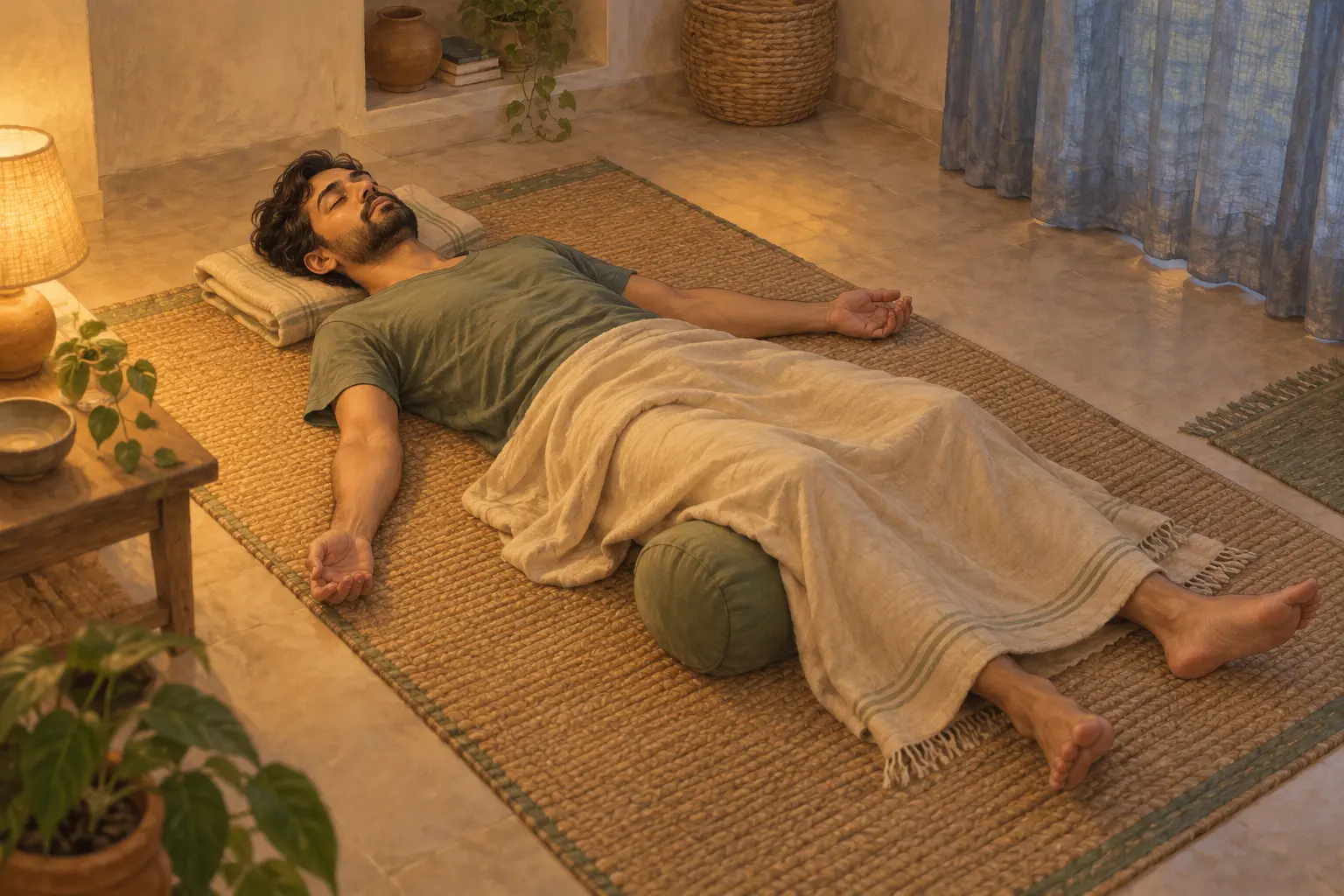
You lie in savasana, or corpse pose, while a teacher’s voice leads your attention through the body, the breath, and a set sequence of mental images. The goal is not to fall asleep. The goal is to stay aware while your body rests as deeply as it does during sleep.
The term is a compound of two Sanskrit words: yoga (union) and nidra (sleep). Together, “yoga nidra” is usually translated as “yogic sleep.” That name is a little misleading on its own, because true sleep involves a loss of awareness, and yoga nidra deliberately keeps a thread of awareness alive even as the body drops into deep rest.
What Does “Yoga Nidra” Mean in Sanskrit?
In Sanskrit, योग निद्रा (yoga nidrā) literally means “sleep of yoga” or “yogic sleep.” It describes a state, not just a technique: the senses withdraw, the body stills, and the mind rests, yet a thin thread of witnessing awareness stays switched on. Some teachers describe it as not awake, not asleep, but a third state in between.
Where Does Yoga Nidra Come From?
Yoga nidra is not a modern wellness trend borrowed from yoga studios. References to a state called yoga nidra appear in the Upanishads and the Mahabharata, and a goddess named Yoganidrā appears in the Devī Māhātmya.
The concept has roots going back well over a thousand years in Indian philosophical and devotional texts.
The structured, teachable version of yoga nidra used in most studios and teacher-training programs today is much newer. Swami Satyananda Saraswati, founder of the Bihar School of Yoga in Munger, systematized it in the 1960s, drawing on an older tantric practice called nyasa.
In the West, Dr. Richard Miller adapted a related model under the name iRest, which is now used in clinical and military settings. Both versions share the same core moves, a body scan, breath awareness, and a personal intention called a sankalpa, even though the exact number of steps differs between them.
2. How Does Yoga Nidra Meditation Work?
Yoga Nidra directs attention through a guided sequence, commonly including body awareness, breath and imagery. Some people find it relaxing; experiences and physiological responses vary. The sequence does not automatically switch off a stress response.
What Happens in the Body During Yoga Nidra?
The sympathetic and parasympathetic systems interact rather than functioning as a simple on/off switch. Relaxation during a session is not proof of a particular autonomic state, brain-wave pattern or clinical effect.
In a 2025 randomised trial of online Yoga Nidra, measured effects were small and depended on the comparison and practice. Such findings do not establish that every session reproduces deep sleep or repairs the body.
What Are the Koshas, and Why Do They Matter in Yoga Nidra?
The koshas are a traditional framework for aspects of experience, not layers identified by medical testing. Teachers may use this framework in a script, but approaches differ and it is not necessary to accept it as biomedical anatomy.
3. What Are the Stages of Yoga Nidra Meditation?
Here is something most articles on this topic skip over: there is no single, universally agreed number of stages in yoga nidra. Depending on which teacher or lineage you learn from, you will hear the practice described as having seven, eight, or ten stages.
Richard Miller’s own teaching materials have used both seven-step and eight-stage models at different points, and the popular Yoga Journal version, described later in this guide, breaks the same process into ten steps.
The differences are mostly about how finely a stage gets split, not a real disagreement about what happens during the practice.
Here is the version most closely tied to the Satyananda tradition, which is the sequence you will encounter most often in Indian yoga schools:
- Settling in. You lie down in savasana, get comfortable, and become still.
- Setting a sankalpa. You silently repeat a short, positive intention, stated in the present tense, such as “I am calm and confident” rather than “I will be calm.”
- Rotation of consciousness, or body scan. Your attention is guided rapidly through named body parts without moving them.
- Breath awareness. You notice the natural rhythm of your breath, sometimes counting breaths or noticing where you feel them.
- Sensation and opposites. You feel pairs of physical sensations, such as heaviness and lightness, or warmth and cold.
- Feelings and emotions. You briefly welcome an emotion, without analyzing it, then let it pass.
- Visualization. You are guided through a sequence of mental images or a symbolic journey.
- Repeating the sankalpa and closing. You return to your original intention once more before slowly bringing your awareness back to the room.
The exact stage count matters less than the shape of the practice: settle, intend, scan, breathe, sense, feel, visualize, and return.
If you have specifically come across a ten-step version, we cover that separately in the FAQ section, since it is a distinct, well-documented lineage worth knowing about on its own.
| Session length | Best for | What it usually includes |
|---|---|---|
| 5 to 10 minutes | A quick reset between meetings, or falling asleep faster at night | Body scan and breath awareness only |
| 20 to 25 minutes | The most common studio and app length | Full sequence: sankalpa, body scan, breath, sensation, visualization |
| 45 to 60 minutes | Deep restorative or teacher-training practice | Full sequence at an unhurried pace, often with extended visualization |
4. Is Yoga Nidra the Same as Sleeping?
Yoga Nidra is a guided meditative practice, not a replacement for ordinary sleep. A session can feel restful while awareness varies, and some people fall asleep. This does not demonstrate that it reproduces the functions of sleep or provides a fixed number of equivalent sleep hours.
5. How Long Should a Yoga Nidra Session Be?
Choose a duration that is comfortable and manageable. A brief trial is sufficient to see whether you like the practice; longer sessions are optional, not a proven therapeutic dose.
6. What Happens If You Fall Asleep During Yoga Nidra?
Falling asleep can happen during guided rest and is not a failure. It does not prove that the nervous system is unaccustomed to relaxation. Persistent excessive sleepiness or disturbed sleep deserves assessment rather than an energy explanation.
7. What Are the Benefits of Yoga Nidra Meditation?
Yoga Nidra research is promising but varies in programme design, population and quality. A teacher-training programme cannot be assumed to produce the health outcomes measured in a clinical trial.
Can Yoga Nidra Help With Sleep?
A 2026 sleep systematic review describes preliminary findings with very low certainty. Yoga Nidra may be considered as an optional adjunct when suitable, but it should not replace assessment or established insomnia care. The AASM guideline recommends multicomponent cognitive behavioural therapy for chronic insomnia.
Can Yoga Nidra Reduce Anxiety and Stress?
A systematic review of 73 studies reported promising stress, anxiety and depression outcomes, while identifying limitations in study quality and variation. This does not establish reliable treatment effects for every person or script.
A 2025 online trial found small effects under particular comparisons. Regular practice was associated with cortisol patterns, but this is not proof that every daily session lowers stress hormones or treats an anxiety disorder.
Does Yoga Nidra Help With Emotional Regulation?
Some people find guided attention useful for noticing experience. Others may find imagery, stillness or emotional prompts uncomfortable. Offer choices and the option to stop; an ordinary class is not trauma treatment.
Is Yoga Nidra Good for Beginners and People With Limited Mobility?
Supported lying or sitting can make the practice accessible to some people who find movement difficult. Position, script and duration still need adaptation, and accessibility is not guaranteed for every health condition or participant.
8. Who Should Avoid Yoga Nidra, or Practice With Caution?
Choose a comfortable position and stop if the practice increases pain or distress. Pregnancy, surgery, relevant health conditions or mental-health concerns may require individual guidance. Avoid a fixed rule that every person must lie on their back or change position at a particular trimester.
Seek appropriate prenatal or clinical advice where relevant. For trauma-related concerns, look for a teacher who offers choice and works within competence, and continue necessary healthcare. Do not describe Yoga Nidra as a brain-wave-altering treatment for seizure disorders.
9. How Do You Practice Yoga Nidra Meditation at Home?
You do not need a studio, special equipment, or a formal mat, just a floor and a quiet room. Here is a simple way to begin:
- Choose a quiet time, ideally when you will not be interrupted for 15 to 30 minutes. Right before bed or in the middle of a stressful workday both work well.
- Lie down in savasana. Rest on your back, arms slightly away from your body, palms facing up, legs relaxed and slightly apart. Use a folded blanket under your knees if your lower back feels tight.
- Cover yourself lightly. Your body temperature drops as you relax, so a light blanket helps you stay comfortable.
- Set a short sankalpa. Choose one positive, present-tense sentence about who you already are or wish to embody, such as “I am at peace.”
- Follow a guided recording or teacher. Yoga nidra is always guided, so this is not a practice you do in silence on your own the first few times. A recorded session or a live teacher walks you through the body scan, breath awareness, sensation pairs, and visualization stages.
- Let yourself be led. Do not try to analyze or control the process. If your mind wanders, simply return to the guiding voice.
- Return to your sankalpa, then slowly bring movement back into your fingers and toes before opening your eyes.
Consistency matters more than session length here. Ten focused minutes most nights will generally do more for you than one 45-minute session a month.
10. Yoga Nidra vs. Meditation: What Is the Difference?
Yoga nidra and meditation are close cousins, and many teachers describe yoga nidra as a specific style of guided meditation rather than something separate from it. They differ in a few clear, practical ways.
| Yoga Nidra | Meditation (general or seated) | |
|---|---|---|
| Posture | Lying down in savasana | Usually seated upright |
| Guidance | Always guided by a teacher or recording | Can be guided or completely silent |
| Structure | Follows a fixed sequence: sankalpa, body scan, breath, sensation, visualization | Varies widely, from open awareness to mantra to single-point focus |
| Effort level | Passive; you are led rather than directing yourself | Usually active; you sustain your own attention |
| Falling asleep | Common, and considered a normal part of the process | Generally discouraged, since the goal is wakeful awareness |
| Typical goal state | Conscious access to the border of deep sleep, or hypnagogic state | Heightened, steady wakeful awareness |
| Typical duration | 10 to 45 minutes, structured | 5 minutes to an hour or more, flexible |
If meditation is about training a wakeful, focused mind, yoga nidra is about consciously accessing the deepest layers of rest your body can reach without losing awareness altogether. Many practitioners use both together: seated meditation in the morning, yoga nidra before bed.
11. Where Can You Learn Yoga Nidra Properly?
A short guided recording is a fine place to start, but it will only take you as far as the recording itself allows. If you want to understand the practice well enough to sequence it, hold a sankalpa properly, and adapt it for people with different needs, you need direct instruction from an experienced teacher.
At Inteyoga, also known as Swami Krishnananda Yoga Vidyapeeth, yoga nidra is taught as part of the Advanced TTC 300-Hour Integrated Restorative Yoga program, which also covers Chakra Sadhana and Prana Vidya.
The program is led by Dr. Ashutosh, the school’s founder-director, whose background as a medical doctor and Yogacharya shapes a teaching style that connects Hatha Yoga with anatomy, Ayurveda, and preventive health, rather than treating yoga nidra as an isolated wellness trend. Classes run at Inteyoga’s residential ashram in Sernabatim, Colva, South Goa, and the school is a Registered Yoga School with Yoga Alliance.
Also read: 500 Hour Yoga Teacher Training in Goa: A Complete 2026 Guide
Also read: Yoga Instructor Course 2026: Best Fees, Certification & Eligibility
If you are curious whether a residential, restorative program is the right fit, the full Advanced TTC 300-Hour Integrated Restorative Yoga page covers eligibility, the daily schedule, and what is included.
You can also check the Inteyoga FAQ page for questions on accommodation and travel, review the arrival guide before booking flights, or get in touch with our team with any question you have.
If you are still deciding between a short trip and a full training, this guide is a useful next stop:
Also read: Best Yoga Classes in Goa: Honest 2026 Guide to Drop-ins & TTC
12. Frequently Asked Questions About Meditation in General (FAQ)
What are the 7 types of meditation? Most teachers group meditation into a similar set of styles: mindfulness meditation, which broadens awareness of the present moment; mantra meditation, including practices like Transcendental Meditation; loving-kindness or metta meditation, which directs goodwill toward yourself and others; body scan meditation, which moves attention through the body; visualization meditation; movement meditation, such as walking meditation or tai chi; and guided, lying-down styles such as yoga nidra. The exact list varies by source, and some styles overlap, but this covers the practices you will encounter most often.
Which is the most powerful form of meditation? There is no single “most powerful” technique that outperforms all others for everyone. Research reviews, including the yoga nidra meta-analysis cited earlier in this guide, generally find that several well-established techniques, mindfulness, loving-kindness, and guided practices like yoga nidra among them, produce measurable benefits. What consistently matters more than the specific technique is whether you actually practice it regularly and whether it fits your temperament and goal, whether that is calming an anxious mind, improving sleep, or building focus.
What is the golden rule of meditation? Across most traditions, the closest thing to a single golden rule is this: do not turn your practice into a problem to solve. Meditation teachers commonly advise observing your thoughts, restlessness, or a wandering mind without judging it or trying to force it away. Yoga nidra applies the same principle in its “witnessing” stages, where you welcome whatever arises, including sensations and emotions, rather than controlling it.
What is the best time to meditate? Traditional yogic teaching points to Brahma Muhurta, the period roughly 90 minutes before sunrise, as the most favorable time for meditation, since the mind is considered quiet and undisturbed before the day begins. In practice, most modern teachers say the best time is simply whichever time you can practice consistently, since a regular 10-minute habit will do more for you than an occasional hour at the “ideal” time. If you are curious about the best time specifically for yoga nidra, which differs from general seated meditation, see the FAQ above in Section 12.
Final Thoughts
Yoga nidra meditation is not a passive luxury or a shortcut around real practice. It is a structured, teachable technique with roots going back over a thousand years and a growing body of modern research behind it. Whether you use it as a five-minute reset before an important meeting or as the foundation of a deeper restorative yoga practice, the core idea stays the same: conscious rest, guided with intention, is a skill worth learning.
If this guide has made you curious about going deeper, whether that means practicing more confidently at home or training to teach yoga nidra to others, Inteyoga’s residential Advanced TTC 300-Hour program in South Goa is built for exactly that next step. Reach out to our team with any questions about eligibility or dates.
Frequently Asked Questions About Yoga Nidra (FAQ)
Is yoga nidra the same as meditation, or what’s the difference between them?
Not exactly. Yoga nidra is a specific, guided style of meditation practiced lying down, with a fixed sequence of stages. General meditation is a broader term covering many seated, silent, and self-directed practices. Most teachers describe yoga nidra as one form of meditation rather than a separate category. See the comparison table in Section 10 for a full side-by-side view.
What happens during a yoga nidra session?
You lie in savasana while a teacher or recording guides you through a fixed sequence: setting a short intention, scanning your attention through the body, noticing your breath, feeling pairs of sensations, briefly welcoming an emotion, and following a short visualization. Your body relaxes deeply while a thread of awareness stays present, then the session closes by returning to your intention and slowly bringing you back to the room.
How long should a beginner’s yoga nidra session be?
Most beginners do well starting with a 15- to 20-minute guided session. That is long enough to move through the full sequence, sankalpa, body scan, breath, and visualization, without feeling rushed, but short enough to fit into a normal evening routine.
Is it normal to fall asleep during yoga nidra?
Falling asleep can occur during guided rest and is not a failure. It does not prove a nervous-system imbalance. Persistent excessive sleepiness or disturbed sleep should receive appropriate assessment.
Can beginners with no yoga experience practice yoga nidra?
Yes. Yoga nidra requires no flexibility, fitness level, or asana experience, since you simply lie still and follow a guided voice. It is one of the most accessible yoga-based practices available, suitable for older adults and people with limited mobility.
Who should not do yoga nidra?
Suitability depends on the person, position and practice. Pregnancy, surgery, relevant health conditions or distress may require individual guidance. Use a comfortable supported position, obtain appropriate prenatal or clinical advice, and stop if uncomfortable.
Is yoga nidra safe during pregnancy?
Suitability depends on the person, position and practice. Pregnancy, surgery, relevant health conditions or distress may require individual guidance. Use a comfortable supported position, obtain appropriate prenatal or clinical advice, and stop if uncomfortable.
How is yoga nidra different from taking a nap?
A nap is sleep; Yoga Nidra is intended as guided meditative awareness. People may nevertheless fall asleep during it. Neither the subjective feeling of rest nor awareness during a session establishes sleep equivalence.
Do I need a teacher, or can I do yoga nidra by myself?
You can begin on your own with a well-made recording, and many people do exactly that. But if you want to understand the practice deeply enough to teach it, adapt it for specific needs, or troubleshoot your own experience, in-person instruction from an experienced, trained teacher is far more effective than any recording.
What are the 10 steps of yoga nidra?
The 8-stage sequence in Section 3 reflects the Satyananda lineage. A separate, widely cited 10-step version, popularized by Yoga Journal and based on Richard Miller’s teaching, breaks the process into finer stages: connecting to your heartfelt desire, setting your intention, sensing your inner resource, body sensing, breath awareness, welcoming feelings and their opposites, witnessing your thoughts, experiencing joy, resting in pure witnessing awareness, and closing by integrating the practice. Both versions guide you through the same core territory; they simply divide it differently.
How many hours of sleep is yoga nidra equivalent to?
There is no established conversion between Yoga Nidra minutes and sleep hours. It does not replace the biological functions of adequate sleep.
What is the best time to do yoga nidra?
There is no single correct time. Many people practice in the early afternoon to counter the natural post-lunch energy dip, while others prefer it right before bed to help the transition into sleep. A short morning session can also work well if you want to start the day calm rather than rushed. Match the timing to what you are using the practice for.
What happens if you do yoga nidra every day?
A 2025 online trial of 362 participants measured small, comparison-dependent effects. The 11-minute form reduced depression compared with music; regular practice was associated with cortisol patterns. These findings do not guarantee a result from daily practice or replace clinical care. See the linked trial in the research section.