

Many lists of best places to visit in Goa begin and end with the busiest beaches. That leaves out much of the state. Goa covers 3,702 square kilometres and has about 100 kilometres of coastline, along with river islands, Indo-Portuguese neighbourhoods, temples, forts, mangrove habitat and the forested edge of the Western Ghats.
The Goa Department of Tourism recorded 1,08,02,410 tourist arrivals in 2025. During peak periods, well-known attractions can be crowded, while less central places may require earlier starts, regional planning or longer road journeys.
This guide presents an editorial selection of 21 places for different interests. Factual descriptions have been checked against official or primary sources where available; recommendations such as how long to stay or which places to combine are practical suggestions rather than objective rankings.
The Short Answer: What Is Special About Goa?
Goa is unusual because several different landscapes and cultural histories fit into a small state:
- A long Arabian Sea coastline with busy resort beaches, fishing stretches and protected turtle-nesting areas
- Old Goa, whose Churches and Convents form a UNESCO World Heritage property
- Panaji neighbourhoods and South Goa villages shaped by Indo-Portuguese architecture
- River islands such as Divar and Chorao
- Wildlife sanctuaries, mangroves, waterfalls and the Western Ghats interior
- A food culture shaped by coastal ingredients, local Hindu traditions and Portuguese-era exchange
| If your priority is | Consider |
|---|---|
| UNESCO-listed Christian heritage | Old Goa – Basilica of Bom Jesus and Se Cathedral |
| A historic urban walk | Fontainhas, Panaji |
| A river-island village visit | Divar Island |
| A less developed South Goa beach | Galgibaga, subject to nesting protection, access and sea conditions |
| A major waterfall attraction | Dudhsagar Falls when authorised seasonal access is operating |
| A forest temple | Tambdi Surla in the Bhagwan Mahavir protected area |
| South Goa coastal fort views | Cabo de Rama |
| Restored fort interiors and exhibitions | Reis Magos Fort |
What Makes Goa Different From Other Indian Coastal Destinations?
1. A distinct historical layer
Portuguese rule in Goa lasted from 1510 until 1961, producing architectural, religious, linguistic and culinary influences that developed differently from most former British-administered regions of India. The result is visible in Old Goa, Panaji, village churches, ancestral homes and local food traditions.
2. Coast and hinterland in one small state
The coast receives most of the attention, but Goa also reaches into the Western Ghats. The interior includes wildlife sanctuaries, river valleys, forest temples, dams and seasonal waterfalls. Travellers who want a broader picture of Goa can include at least one day away from the coast.
3. Living places, not only monuments
Many churches, temples, villages and heritage homes remain active places of worship or private residence. Visit respectfully, dress appropriately, ask before photographing people or private interiors, and do not treat a village lane as a film set.
North Goa or South Goa: Choose Your Base First
North and South Goa are broad travel labels, not strict rules. Quiet pockets exist in the north, and busy tourist centres exist in the south. Still, the distinction helps when choosing accommodation.
| Factor | North Goa | South Goa |
|---|---|---|
| General atmosphere | Often busier, more social and more commercially concentrated | Often quieter, more spread out and more residential |
| Well-known beaches | Calangute, Baga, Anjuna, Vagator, Morjim, Ashwem, Arambol | Colva, Sernabatim, Benaulim, Agonda, Palolem, Patnem, Galgibaga |
| Nightlife | More clubs, bars and late-night activity | More limited and concentrated in selected areas |
| May suit | Visitors prioritising nightlife, cafes and a busy social scene | Visitors prioritising longer stays, quieter beaches and a slower routine |
| Usually more convenient airport | Manohar International Airport, Mopa (GOX), especially for far North Goa | Dabolim Airport (GOI), especially for Central and South Goa |
Do not plan to cross the entire state every day. Traffic, bridge approaches and peak-season congestion can turn a short map distance into a tiring journey.
21 Best Places to Visit in Goa
Heritage, Architecture and Island Goa

1. Old Goa: Basilica of Bom Jesus and Se Cathedral
The Churches and Convents of Goa were inscribed on the UNESCO World Heritage List in 1986. The serial property includes seven monuments, among them the Basilica of Bom Jesus and Se Cathedral.
The Basilica contains the tomb and relics of St Francis Xavier. Se Cathedral, across the square, is notable for its scale, high interior and gilded chapels. Together they provide a useful starting point for visitors interested in Goa’s UNESCO-listed Christian heritage.
Practical: The Basilica is generally open for public viewing from 9:00 AM to 5:00 PM Monday-Saturday and 11:00 AM to 5:00 PM Sunday. Se Cathedral is generally open daily from 7:30 AM to 6:00 PM. These remain active places of worship, so services can affect access. Go early and dress respectfully.
2. Fontainhas, Panaji
Fontainhas is Panaji’s historic Latin Quarter, known for narrow lanes, colourful facades, sloping tiled roofs and a mix of Indo-Western architectural influences. It is not itself a UNESCO World Heritage Site.
The value of Fontainhas is not a checklist of monuments. It is the experience of walking through a living neighbourhood where homes, cafes, guesthouses and small cultural spaces share the same compact streets.
Practical: Walk in the early morning or late afternoon. Keep voices low in residential lanes, avoid blocking doorways and ask before photographing private homes or residents.
3. Divar Island
Divar Island is reached by ferry from Ribandar or Old Goa. Its appeal lies in village roads, paddy fields, old houses, churches, temples and river views rather than a single landmark.
A half-day allows time for the ferry journey, village roads and the hillside Church of Our Lady of Compassion, with views over the Mandovi and Old Goa area.
Practical: Ferry schedules and vehicle arrangements can change. Check locally before departure. Bonderam is celebrated on Divar during August, so the island is much busier around festival dates.
4. Chandor and Its Heritage Houses
Chandor was an important earlier settlement and is now known for Indo-Portuguese ancestral homes, including the Braganza House and other privately maintained properties.
The interiors preserve family collections, furniture, chapels, books and architectural details that cannot be understood from the roadside alone.
Practical: These are private or family-managed homes, not standard public museums. Access, timings and contributions vary. Contact the property or a reputable heritage operator before travelling, and do not assume every wing will be open.
5. Rachol Seminary and the Old Fort Gateway
Rachol Seminary is a historic centre of theological learning near Margao. The surviving gateway of Rachol Fort marks the road into the seminary area.
Rachol can be combined with Chandor, Loutolim or Margao. It is a smaller-scale heritage stop than the principal monuments at Old Goa.
Practical: The seminary is a working institution. Visitor access may depend on services, classes and local permission. Dress respectfully and confirm access before entering restricted areas.
Beaches That Offer Different Experiences

6. Sernabatim and Colva
Colva is a major South Goa beach with shops, eateries and transport connections near its main access. Sernabatim lies on the adjoining coastal stretch. Facilities and crowd levels vary by access point, weekday and season.
This area can suit visitors who want to stay near Margao and established services without travelling to far South Goa. Early morning is often more comfortable for walking, but sea conditions must always be judged by current lifeguard guidance.
Practical: Do not assume a calm-looking sea is safe. Follow lifeguard flags and instructions, particularly during the monsoon and transition months.
7. Butterfly Beach
Goa Tourism describes boat trips from Palolem to Butterfly Beach and nearby coastal islands. Boat operations, landing conditions and access depend on weather and the operator.
The attraction is the small cove and coastal approach. Before leaving, confirm the return journey, drinking water, shade, landing arrangements and whether any facilities are operating.
Use an authorised or established local boat operator, confirm the return arrangement before departure and wear the safety equipment provided. Do not rely on an unconfirmed last-minute pickup.
8. Galgibaga Beach
Galgibaga is one of Goa’s Olive Ridley turtle-nesting beaches. The northern section is protected, and the beach has far less commercial development than major resort beaches.
Galgibaga offers a less developed beach setting than Goa’s major resort centres. The sea can be rough, and a quieter beach is not automatically a safer beach.
Responsible visit: Keep away from marked nesting areas, avoid flash and bright lights near nests or hatchlings, minimise noise and follow Forest Department or local instructions.
9. Cola Beach and Lagoon
Cola is a small South Goa coastal destination commonly associated with a beach-and-lagoon setting. The exact water level, access route and commercial facilities vary with season and local conditions.
Because access arrangements can change, do not rely on an old route description. Confirm the current road, parking point and return plan with your accommodation or driver.
Practical: Avoid unfamiliar access roads after dark or during heavy rain, and do not assume that every vehicle can use the final approach comfortably.
Wild Goa and the Western Ghats Interior
10. Dudhsagar Falls
Dudhsagar Falls descends about 306 metres inside the Bhagwan Mahavir Wildlife Sanctuary and Mollem National Park complex. It is one of Goa’s best-known waterfalls and lies about 10 kilometres from Collem within a protected forest landscape.
Visitor access is managed seasonally. Authorised transport arrangements from the Collem area may operate when the route is open, but permits, prices, operating dates and time at the falls can change.
Practical: Access can be suspended during the monsoon, heavy rain or other unsafe conditions. Confirm the current status with the Forest Department, authorised operators or Goa Tourism Helpline 1364 before travelling to Collem.
11. Netravali Bubbling Lake
Goa Tourism identifies a bubbling lake in the Sanguem area. Visitors observe bubbles rising from the bed of the small water body near a temple.
Claims about the precise cause, or about sound directly producing the bubbles, should not be presented as proven without a suitable geological source. It is more accurate to describe the observable bubbling and treat simplified explanations cautiously.
Practical: Treat it as a brief stop within a larger Sanguem or Netravali day. Roads are narrow in places. During heavy rain, check local access and avoid entering fast-moving water at nearby waterfalls.
12. Tambdi Surla Mahadev Temple
Tambdi Surla is a functioning 12th-century Shiva temple built in basalt within the Bhagwan Mahavir protected area. Its carved stonework and forest setting make it a notable historic site.
Popular accounts sometimes explain the temple’s survival through its remote location. That explanation should be treated as tradition or folklore rather than a conclusively established historical fact.
Practical: Entry to the temple is generally free. Dress modestly, remove footwear where required and avoid disturbing worship. Check local guidance before attempting nearby forest trails or waterfalls.
13. Cotigao Wildlife Sanctuary
Cotigao Wildlife Sanctuary covers 85.65 square kilometres in Canacona near the Karnataka border. It protects moist deciduous, semi-evergreen and evergreen forest habitat, with birdlife and other fauna recorded by the Forest Department.
Visit for the forest environment, interpretation facilities and trails rather than expecting a guaranteed wildlife sighting. Dense vegetation and a short visit can limit what is visible.
Practical: Check sanctuary timings, entry rules and trail access on the day. Carry water, insect protection and suitable footwear. Do not enter restricted forest routes without permission or a guide.
14. Dr Salim Ali Bird Sanctuary, Chorao
Dr Salim Ali Bird Sanctuary protects about 1.8 square kilometres of mangrove habitat on Chorao Island. It is reached via the Ribandar ferry, and movement through tidal channels may involve a canoe or boat depending on local conditions.
Goa Tourism recommends October to March for migratory bird activity and notes that tide affects boat access. Bird sightings are never guaranteed and depend on season, tide, time and weather.
Practical: Early morning and late afternoon are commonly recommended for birding. Confirm boat availability and tide conditions locally, and allow additional time for the ferry crossing.
15. Salaulim Dam and Sanguem
Salaulim Dam lies on the Selaulim River and is described by Goa Tourism as a vital water source for South Goa. The spillway carries more water when the reservoir is full, particularly during or after substantial monsoon rainfall.
Salaulim can be included in a wider Sanguem itinerary. Travel time, access restrictions and weather make it less suitable as an unplanned coastal detour.
Practical: Security restrictions and visitor access can change. Follow posted rules, stay behind barriers and do not approach spillways or fast-moving water.
16. A Spice Plantation in Ponda
Private plantations around Ponda offer guided visits through cultivated spice and tropical plants. The crops visible, length of the walk, meal arrangements and educational value vary by property and season.
Some visits focus on plant interpretation, while others are organised mainly around lunch and group tourism. Compare the actual itinerary rather than relying only on the label “spice plantation”.
Before booking: Ask how long the guided walk lasts, which plants are currently visible, whether lunch is included and whether the operator uses wildlife or elephant entertainment. Avoid businesses that promote animal rides or performances.
Forts and Viewpoints
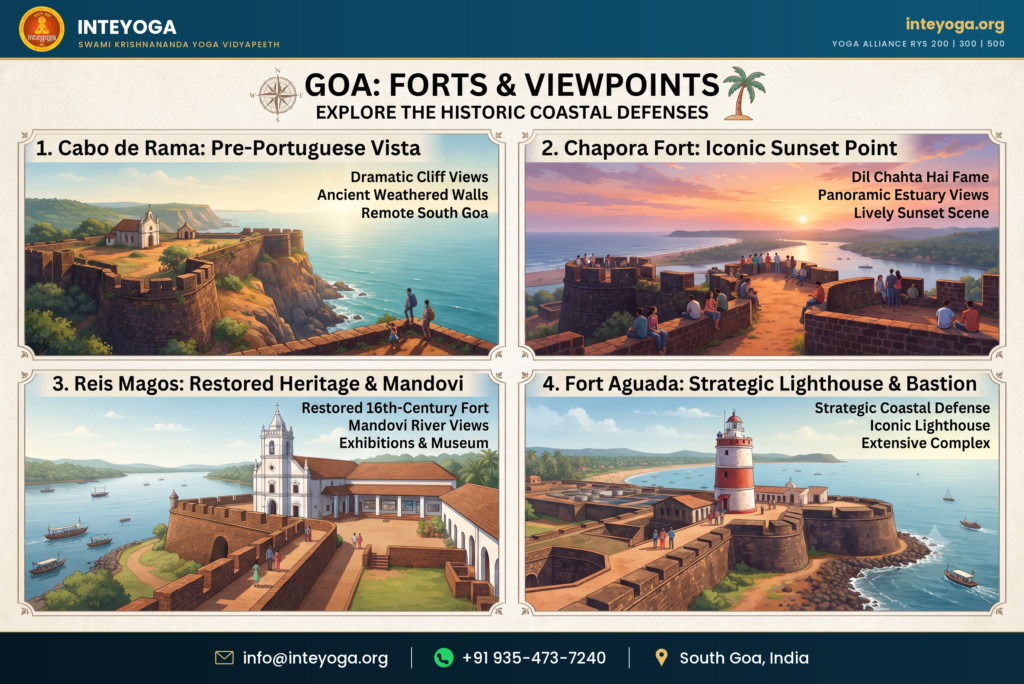
17. Cabo de Rama Fort
Goa Tourism describes Cabo de Rama as predating Portuguese rule. The surviving coastal site includes weathered fortifications, a chapel and views over the Arabian Sea.
The site is only partly preserved. Uneven surfaces and exposed edges require care, particularly near sunset or in wet weather.
Practical: Visit in daylight, wear proper footwear, supervise children closely and keep away from unfenced cliff edges. Carry water and allow enough time to leave before roads become dark.
18. Chapora Fort
Chapora Fort overlooks the Chapora River and Vagator coastline and is associated with the film Dil Chahta Hai. Its popularity and open viewpoint mean it can be busy, particularly near sunset.
The short climb is exposed to the sun. Visit mainly for the landscape and surviving fort layout; the site has fewer interpreted interiors than Reis Magos.
Practical: Go early or late, carry water, wear shoes with grip and avoid standing close to exposed edges for photographs.
19. Reis Magos Fort
Reis Magos Fort is a restored 16th-century fort overlooking the Mandovi River. Unlike many ruined forts, it functions as a cultural heritage space with exhibitions and interpretable interiors.
Choose Reis Magos if you prefer restored interiors and exhibitions; choose Chapora if your priority is an open coastal viewpoint. This is a difference in visitor experience, not a claim that one fort is objectively better.
Practical: Current public information lists opening from Tuesday to Sunday, with Monday closed. Verify the latest hours and entry fee before travelling, especially around events or maintenance closures.
20. Fort Aguada
Fort Aguada was completed in 1612 and protected the entrance to the Mandovi. Its name is linked to the freshwater supply that served ships, and the complex includes a large cistern and lighthouse history.
Fort Aguada is straightforward to include in many North Goa itineraries. It is a popular attraction and can be busy during peak visiting hours.
Practical: Goa Tourism currently lists the fort as open daily from 9:30 AM to 6:00 PM. Separate parts of the wider Aguada complex may have different access rules or tickets.
21. Corjuem Fort
Corjuem Fort is a small inland laterite fort near Aldona. Goa Tourism describes it as one of the smaller surviving inland forts and highlights the countryside views from its ramparts.
It fits naturally into an inland North Goa or Aldona route. Travellers crossing from another region should compare the additional travel time with their interest in a smaller historic site.
Practical: Goa Tourism lists daylight opening hours. Visit during cooler morning or evening periods and take care on uneven stone surfaces.
Goan Food Worth Seeking Out
Goan cuisine includes Hindu, Catholic, coastal and regional traditions. It is not only seafood, and it is not accurately represented by ordering a generic North Indian menu at every meal.
| Dish | What to expect |
|---|---|
| Xacuti | A Goan preparation using roasted coconut and spices; recipes vary by household and community |
| Cafreal | A green herb-and-spice preparation associated with Goan cuisine |
| Vindaloo | A vinegar-and-garlic based preparation; traditional versions are more complex than simply being very hot |
| Ambot tik | A sour-and-spicy curry commonly prepared with fish |
| Sannas | Soft steamed rice cakes, with fermentation methods varying by recipe |
| Khatkhate or khatkatem | A mixed-vegetable, coconut-based preparation found in Goan Hindu cooking |
| Poi | A local bread associated with Goa’s traditional baking culture |
| Bebinca | A rich coconut-and-egg dessert baked in multiple layers |
Vegetarian travellers should ask specifically for local vegetarian dishes rather than assuming that Goan food means fish curry or meat. Many homes and restaurants prepare vegetable, lentil, coconut and seasonal festival dishes.
Festivals Worth Planning Around
Festival dates can shift according to religious calendars and government schedules. Confirm the exact year before booking travel.
| Festival | Usual period | What to expect |
|---|---|---|
| Carnival | February or March | Float parades and public celebrations before Lent |
| Shigmo | March or April | Goan spring festival with village traditions, dance and town parades |
| Sao Joao | 24 June | Monsoon celebration associated with St John the Baptist, especially in Siolim |
| Bonderam | August | Flag-themed festival on Divar Island |
| Ganesh Chaturthi | August or September | Major family and community celebration across Goa |
| IFFI | November | International Film Festival of India in Panaji |
| Feast of St Francis Xavier | 3 December | Major observance at Old Goa |
| Christmas and New Year | Late December | Statewide celebrations and the busiest tourism period |
The Slow Side of Goa: Yoga and Staying Longer
Repeated long transfers can make a Goa itinerary tiring. One practical approach is to choose a regional base, group nearby places together and leave some time unplanned.
Where Inteyoga Fits
Inteyoga, also known as Swami Krishnananda Yoga Vidyapeeth, is based at Plot No. 6, Novo Vaddo, Sernabatim, Colva, South Goa. It is registered with Yoga Alliance as a Registered Yoga School at the RYS 200, RYS 300 and RYS 500 levels.
The current residential offering is the Advanced TTC 300-Hour Integrated Restorative Yoga, including Yoga Nidra, Chakra Sadhana and Prana Vidya Intensive. It is intended for yoga teachers and sincere practitioners who have completed a 200-hour teacher training or equivalent foundational study.
- Duration: 43 training days plus 2 additional days for arrival and departure – one day each
- Format: fully residential in Sernabatim, Colva, South Goa
- Participation model: Gift-it-Forward; no payment is required to apply for or participate
- Meals: simple vegetarian, dairy-free and vegan-friendly food
- Teaching lead: Dr. Ashutosh
- A 200-hour course is listed as coming by mid-2027
Current dates, eligibility and application information are available on the live courses page. The program is an intensive teacher training, not a short leisure retreat.
Best Time to Visit Goa
| Period | General conditions | Planning notes |
|---|---|---|
| November-February | Pleasant, mostly dry weather; commonly around 20-32°C | Peak season, busiest period and usually the highest accommodation demand |
| March-May | Hotter and more humid; daytime temperatures can approach the mid-30s | Fewer peak-season crowds, but midday sightseeing can be tiring |
| June-September | Southwest monsoon with heavy rainfall | Green landscapes, rougher seas, seasonal closures and access restrictions |
| October | Monsoon gradually recedes | Transition month; some seasonal businesses and forest access reopen gradually |
Goa Tourism describes October to March as the most pleasant period for visitors. During the southwest monsoon, the countryside becomes green, but beaches can have rough seas and dangerous undercurrents, while remote roads or forest trails may be affected by heavy rain.
Two Ready-Made Goa Itineraries
Three days: first visit
- Old Goa in the morning, followed by Fontainhas and Panaji later in the day.
- One region only: either a North Goa fort-and-beach day or a South Goa beach-and-Cabo de Rama day.
- A hinterland day: Dudhsagar when authorised seasonal access is operating, or Tambdi Surla, Salaulim or another interior route after checking current weather and access conditions.
Seven days: slower and more balanced
- Old Goa and Fontainhas
- Divar or Chorao Island
- South Goa beach day around Sernabatim, Benaulim or Colva
- Canacona day: Agonda or Palolem, with Galgibaga or Cabo de Rama depending on travel time
- Chandor and Rachol heritage day
- Hinterland day: Netravali, Salaulim or Cotigao with current access checks
- One unplanned day near your base
Getting Around Goa Safely
- Choose accommodation based on the region you will explore most often.
- Use registered taxis, the GoaMiles app or a reputable pre-arranged driver where practical.
- Before renting a scooter or car, confirm the licence requirement, insurance, deposit, fuel policy, helmet provision and damage procedure.
- Do not drink and drive. Wear a helmet and follow speed limits even on quiet village roads.
- Use ferries for Divar and Chorao when appropriate, but verify the current schedule locally.
- For current tourism guidance or help, the Goa Department of Tourism operates the multilingual, round-the-clock Tourism Helpline 1364.
Five Mistakes That Waste a Goa Trip
- Booking a nightlife centre and expecting complete quiet.
- Planning Dudhsagar or remote waterfall access from an outdated article without checking the current season and permits.
- Trying to cross the state every day instead of grouping places by region.
- Ignoring lifeguard flags, monsoon warnings or local restrictions because the sea or stream looks calm.
- Spending the entire trip on the coast and missing Goa’s islands, villages, forests and heritage sites.
Frequently Asked Questions
What are the Best Places to Visit in Goa for a First Trip?
For a balanced first visit, consider Old Goa, Fontainhas, one beach region, one fort and either an island or hinterland day. Choose attractions close to your accommodation rather than trying to cover the entire state.
What is the most historically important place to visit in Goa?
The Churches and Convents of Goa at Old Goa form the state’s UNESCO World Heritage property. The Basilica of Bom Jesus and Se Cathedral are two commonly visited components of that seven-monument serial property.
Is North Goa or South Goa better?
North Goa often has more concentrated nightlife, cafes and busy tourism centres. Many South Goa destinations have more spread-out beaches and a slower evening pattern. The actual experience depends on the village, property, season and travel priorities, not only the broad regional label.
How many days are enough for Goa?
Three days can cover a compact first itinerary in one or two regions. Five to seven days allows time for heritage, beaches, an island or hinterland day and less rushed travel.
What are good places to visit in Goa during the monsoon?
Fontainhas, Old Goa, Chandor, Rachol, selected museums, Salaulim and approved hinterland attractions can work well. Access to waterfalls, sanctuaries and remote roads must be checked after heavy rain. The sea is often rough and swimming may be restricted.
Is Dudhsagar open all year?
Authorised access arrangements are seasonal and can be suspended during the monsoon or other unsafe conditions. Confirm the current status before travelling to Collem.
Which places to visit in Goa are quieter?
Divar, Chandor, Rachol, Corjuem, parts of Sernabatim and selected far-South beaches may be quieter than major resort centres, but weekends, festivals and peak season can change the atmosphere.
Is Goa suitable for a yoga teacher training?
Yes, provided the school, curriculum, eligibility, residential conditions and external registration pathway are clear. A teacher training course is not the same as a holiday retreat.
What should visitors avoid in Goa?
Avoid drinking and driving, swimming against lifeguard guidance, entering protected forest routes without permission, disturbing turtle-nesting areas, photographing private homes without consent and relying on old prices or opening hours.
What is the best month to visit Goa?
Goa Tourism identifies October to March as the most pleasant tourism period. December and New Year form the busiest peak. June to September is the southwest monsoon, while April and May are hotter and more humid.