
Quick Answer
Yoga poses are commonly known by the Sanskrit word asana. In modern classes, asana may be used to develop mobility, strength, balance, body awareness and the ability to remain attentive while breathing steadily.
Key Takeaways
- An asana is a deliberately assumed position practised with awareness.
- These categories organise yoga poses for practical teaching and comparison; they are not a universal classical classification.
- The yoga poses and hold ranges below are conservative starting suggestions for a slow, unheated practice. They are not medical prescriptions and are not suitable for everyone.
Last reviewed: July 31, 2026
Yoga poses are commonly known by the Sanskrit word asana. In modern classes, asana may be used to develop mobility, strength, balance, body awareness and the ability to remain attentive while breathing steadily.
Yoga is broader than physical posture. Asana is one part of a wider tradition that also includes ethical discipline, breath regulation, concentration and meditation.
Yoga Sutra 2.46 is commonly translated as describing asana as steady and easeful or comfortable. In its classical context, the statement is closely connected with a stable meditative seat. Modern yoga teachers often apply the same principle more broadly: a posture should be stable and attentive without forcing the body.
This guide introduces 30 commonly taught yoga poses, practical starting ranges, ways to modify and situations in which direct professional guidance is advisable.
Important: This article is educational. It cannot assess your health, movement history or suitability for a particular yoga poses. Stop if you experience sharp pain, numbness, faintness, chest pain or unusual shortness of breath. Seek advice from an appropriately qualified healthcare professional when you have a medical condition, are pregnant, are recovering from surgery or have a recent injury.
What Is an Asana?
An asana is a deliberately assumed position practised with awareness.
In a yoga context, the posture is not only a shape. Attention, breathing, stability and the manner of entering and leaving the position are also important.
Modern yoga poses and asana practices may include:
- Static postures
- Repeated movements
- Flowing sequences
- Supported restorative positions
- Seated meditation positions
- Relaxation practices
A pose does not need to be visually advanced to be meaningful. A simple standing position practised with clear awareness may be more useful than a complex shape performed with strain.
How Many Yoga Poses Are There?
There is no single authoritative modern number of yoga poses.
Classical texts describe different selections of asanas:
| Text | General description |
|---|---|
| Yoga Sutras of Patanjali | Defines asana but does not provide a catalogue of named physical postures |
| Hatha Yoga Pradipika | Refers to a larger traditional body of asanas and describes 15 |
| Shiva Samhita | Refers to many asanas and gives particular attention to 4 seated postures |
| Gheranda Samhita | Describes 32 asanas |
Modern schools have created, named and organised many additional variations. A change in hand position, support or depth may be treated as a variation rather than a completely separate pose.
For a beginner, collecting hundreds of names is less useful than learning a smaller group of movements safely and consistently.
Practical Categories of Yoga Poses
These categories organise yoga poses for practical teaching and comparison; they are not a universal classical classification.
| Category | Common movement or purpose | Examples |
|---|---|---|
| Standing | Weight-bearing, balance and leg strength | Tadasana, Virabhadrasana II, Trikonasana |
| Forward folding | Hip flexion and lengthening of the back body | Uttanasana, Paschimottanasana |
| Back extension | Strengthening or opening the back and front body | Bhujangasana, Setu Bandhasana |
| Rotation | Controlled spinal and trunk rotation | Ardha Matsyendrasana, supine twist |
| Balance | Single-leg or reduced-base support | Vrikshasana, Garudasana |
| Inversion | The pelvis, legs or heart placed above the head to varying degrees | Viparita Karani, Sarvangasana |
| Rest and mobility | Gentle movement, supported positions and relaxation | Cat-Cow, Balasana, Savasana |
A balanced session does not need to include every category. The appropriate mix depends on the person, purpose, teaching method and available time.
30 Essential Yoga Poses
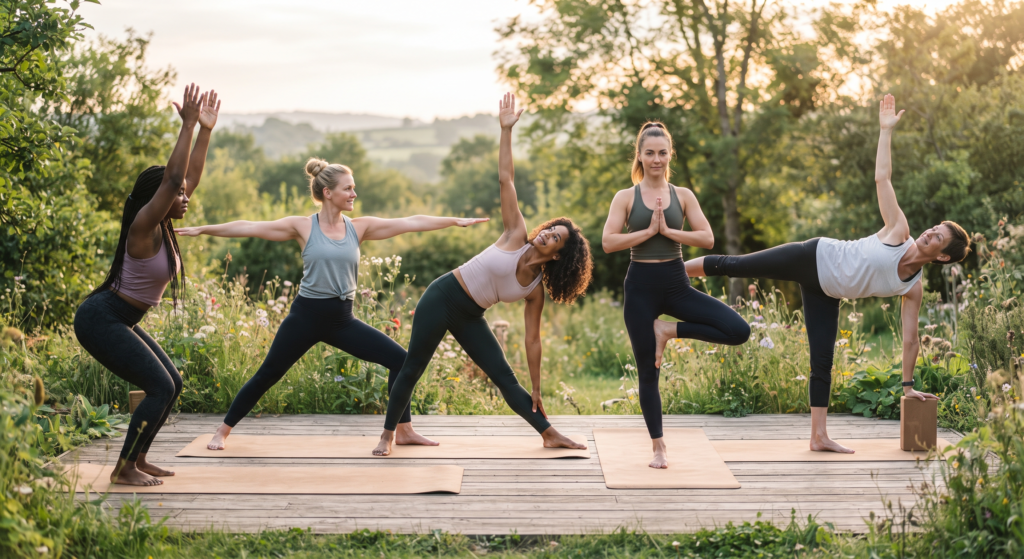
The yoga poses and hold ranges below are conservative starting suggestions for a slow, unheated practice. They are not medical prescriptions and are not suitable for everyone.
Standing Yoga Poses
| English name | Sanskrit name | Suggested starting range | What it develops | Modify or seek guidance when |
|---|---|---|---|---|
| Mountain Pose | Tadasana | 5-10 breaths | Standing awareness, alignment and balance | Use a wall or chair if unsteady; avoid locking the knees |
| Warrior I | Virabhadrasana I | 3-5 breaths each side | Leg strength, hip extension and overhead reach | Shorten the stance or reduce depth for hip, knee or sacroiliac discomfort |
| Warrior II | Virabhadrasana II | 3-5 breaths each side | Leg endurance, hip control and lateral awareness | Reduce knee bend or use a chair if the knee is painful |
| Triangle Pose | Trikonasana | 3-5 breaths each side | Lateral reach, hip movement and balance | Use a block; keep the neck neutral if turning the head is uncomfortable |
| Chair Pose | Utkatasana | 3-5 breaths | Leg strength and trunk control | Reduce depth or practise with wall support for knee or balance concerns |
| Standing Forward Fold | Uttanasana | 3-5 breaths | Hip folding and posterior-chain mobility | Bend the knees and use blocks; come up slowly if prone to dizziness |
Tadasana: A Useful Starting Point
Tadasana can reveal how a person distributes weight through the feet, positions the pelvis and organises the ribs over the hips.
A practical setup:
- Stand with the feet comfortable rather than forcing them together.
- Spread pressure through the heel, base of the big toe and base of the little toe.
- Keep the knees active but not locked.
- Allow the ribs to settle over the pelvis.
- Keep the breath quiet and unforced.
The aim is not military stiffness. It is organised, comfortable standing.
Seated Yoga Poses and Forward Folds
| English name | Sanskrit name | Suggested starting range | What it develops | Modify or seek guidance when |
|---|---|---|---|---|
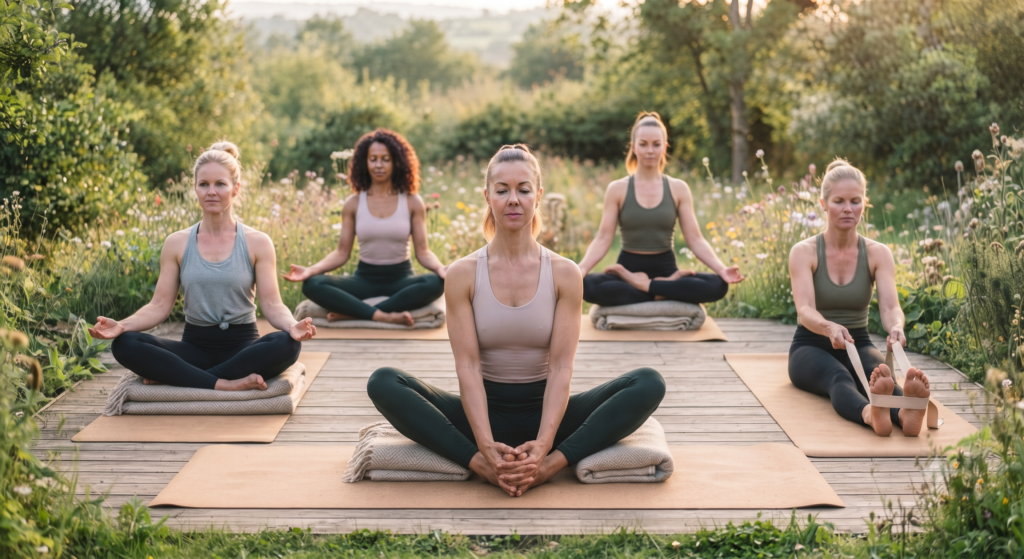
| Easy Pose | Sukhasana | 1-5 minutes | Seated awareness and comfortable hip rotation | Sit on folded blankets and support the knees when needed |
| Lotus Pose | Padmasana | Advanced – learn directly | Traditional meditation seat requiring substantial hip rotation | Do not force the feet into position; stop with any knee pain |
| Accomplished Pose | Siddhasana | 1-5 minutes | Stable seated practice | Add height under the pelvis for ankle, knee or hip discomfort |
| Seated Forward Fold | Paschimottanasana | 5-10 breaths | Hip folding and back-body mobility | Bend the knees, use a strap and avoid forcing during acute back or nerve symptoms |
| Bound Angle Pose | Baddha Konasana | 1-3 minutes | Hip and inner-thigh mobility | Support the thighs and stay within a pain-free range |
A Safety Note About Padmasana
Lotus Pose requires substantial external rotation at the hips. When the hips do not provide enough movement, force may be transferred to the knees.
Do not press the knees down or pull the feet into place. Use Sukhasana, Siddhasana or another supported seat instead.
Padmasana is not required for meditation and is not a measure of spiritual or physical progress.
Back-Extension Yoga Poses
| English name | Sanskrit name | Suggested starting range | What it develops | Modify or seek guidance when |
|---|---|---|---|---|
| Cobra Pose | Bhujangasana | 3-5 breaths, 2 rounds | Gentle spinal extension and upper-back activity | Keep the pose low and stop if the lower back feels compressed or painful |
| Locust Pose | Salabhasana | 3-5 breaths, 2 rounds | Back-body strength | Seek guidance during pregnancy, after abdominal surgery or with acute back pain |
| Bow Pose | Dhanurasana | 3-5 breaths | Stronger back extension and shoulder opening | Treat as intermediate; avoid unsupervised practice with pregnancy, recent surgery or abdominal pain |
| Bridge Pose | Setu Bandhasana | 5-8 breaths | Hip extension, leg strength and chest opening | Keep the neck neutral and do not turn the head while weight is on the shoulders |
| Camel Pose | Ustrasana | 3-5 breaths | Kneeling back extension and front-body opening | Keep the hands on the pelvis or blocks; avoid dropping the head when dizzy or uncomfortable |
Avoid Concentrating Every Backbend in the Lower Back
In Cobra Pose:
- Keep the legs active.
- Press the hands lightly rather than using the arms to force height.
- Lengthen forward through the chest.
- Stop below the point of pinching or compression.
A smaller, comfortable Cobra is more useful than a high position achieved through strain.
Twisting Yoga Poses
| English name | Sanskrit name | Suggested starting range | What it develops | Modify or seek guidance when |
|---|---|---|---|---|
| Half Lord of the Fishes | Ardha Matsyendrasana | 3-5 breaths each side | Seated rotation and postural control | Do not pull aggressively; seek guidance for acute spinal symptoms or pregnancy |
| Supine Twist | Jathara Parivartanasana variation | 5-8 breaths each side | Gentle trunk rotation and relaxation | Support the knees and reduce the range if the back, hip or shoulder is uncomfortable |
| Revolved Chair | Parivritta Utkatasana | 3-5 breaths each side | Rotation while weight-bearing | Treat as intermediate; use a wall and modify for knee, balance or pregnancy-related needs |
Twists should be controlled rather than forced. Lengthen into a comfortable position and rotate within a range that allows smooth breathing.
Yoga texts may describe traditional energetic or digestive effects of twisting poses. These statements should not be treated as a medical diagnosis, guaranteed physiological outcome or substitute for healthcare.
Inverted and Partly Inverted Yoga Poses
| English name | Sanskrit name | Suggested starting range | What it develops | Modify or seek guidance when |
|---|---|---|---|---|
| Downward-Facing Dog | Adho Mukha Svanasana | 3-5 breaths | Shoulder strength, hip folding and whole-body coordination | Use blocks or a wall for wrist, shoulder, balance or dizziness concerns |
| Legs Up the Wall | Viparita Karani variation | 3-10 minutes | Supported rest and a change from upright posture | Exit if you feel pressure, headache, tingling or dizziness; seek medical advice for eye or vascular restrictions |
| Shoulderstand | Sarvangasana | Advanced – learn directly | Traditional inversion and shoulder-supported balance | Not recommended from an article alone; avoid without clearance when neck, eye or blood-pressure restrictions apply |
| Plough Pose | Halasana | Advanced – learn directly | Deep hip and spinal flexion from a shoulder-supported base | Not recommended from an article alone; requires direct instruction and appropriate neck mobility |
Do Not Learn Shoulderstand or Plough Pose From a Table
Sarvangasana and Halasana place significant load through the shoulders and position the neck in flexion.
Learn them from a qualified teacher who can assess:
- Neck comfort
- Shoulder mobility
- Appropriate support
- Entry and exit
- Whether the pose is suitable for you
Supported alternatives may be more appropriate.
Research has shown that some head-down yoga positions can raise intraocular pressure. People with glaucoma, retinal conditions or recent eye surgery should ask their eye-care professional about inversions.
Balancing Yoga Poses
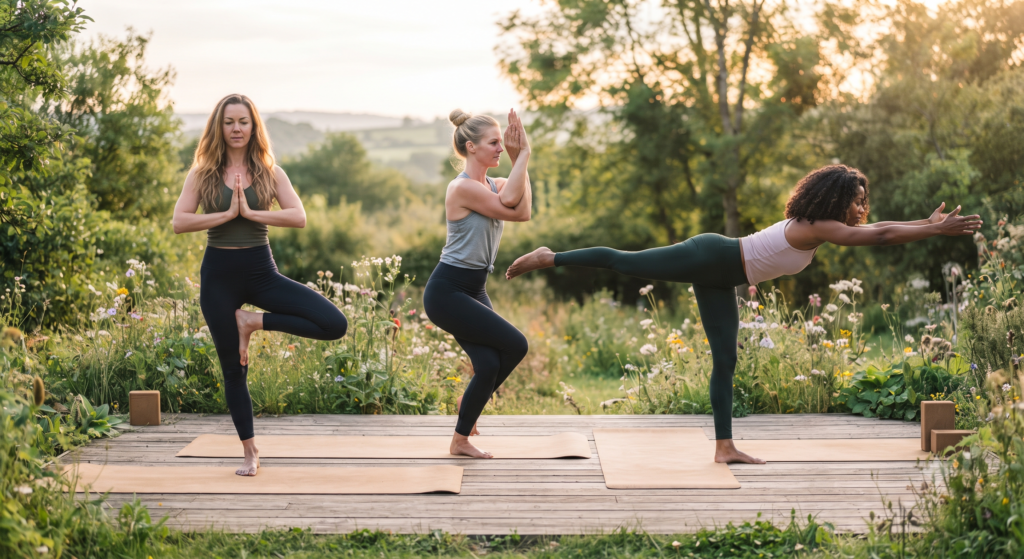
| English name | Sanskrit name | Suggested starting range | What it develops | Modify or seek guidance when |
|---|---|---|---|---|
| Tree Pose | Vrikshasana | 3-5 breaths each side | Single-leg balance and attention | Use a wall; place the foot above or below the knee rather than on the knee joint |
| Eagle Pose | Garudasana | 3-5 breaths each side | Balance, shoulder movement and hip control | Keep the toes down as a kickstand or reduce the wrap for knee or shoulder discomfort |
| Warrior III | Virabhadrasana III | 3-5 breaths each side | Balance, hip control and back-body strength | Use a wall or chair and keep the standing knee soft |
Balance can improve with practice, including in older adults, but a yoga poses should not replace a clinically appropriate falls-prevention program.
Use stable support whenever falling is possible.
Restorative Yoga Poses, Mobility and Relaxation
| English name | Sanskrit name | Suggested starting range | What it develops | Modify or seek guidance when |
|---|---|---|---|---|
| Child’s Pose | Balasana | 5-10 breaths | Rest, hip folding and back-body awareness | Place support under the torso or hips for knee, ankle or back discomfort |
| Reclined Bound Angle | Supta Baddha Konasana | 2-5 minutes | Supported chest and hip opening | Support both thighs; use a more upright or side-lying position during pregnancy when advised |
| Cat-Cow | Marjaryasana-Bitilasana | 6-10 slow rounds | Gentle spinal movement coordinated with breathing | Use fists, blocks or chair support for wrist or knee discomfort |
| Corpse Pose | Savasana | 5-10 minutes | Relaxation and body awareness | Place support under the knees; use side-lying or elevated support when lying flat is unsuitable |
Savasana is not a performance. The purpose is to rest comfortably while remaining aware.
How Long Should You Hold Yoga Poses?
There is no universal correct duration for holding yoga poses.
Hold time depends on:
- The style of yoga
- The purpose of the practice
- The pose
- Your experience
- Your health and mobility
- Whether the pose is active or supported
- The quality of breathing and control
Dynamic practices such as Cat-Cow move with the breath rather than being held.
For beginners, 3-5 comfortable breaths may be enough in many active poses. Supported restorative positions may be held longer when they remain comfortable.
Leave the pose when:
- Your breath becomes strained
- You lose control of the position
- You feel sharp pain
- You experience numbness or tingling
- You become dizzy or faint
- You cannot exit safely
Longer is not automatically better.
How Should You Breathe in Yoga Poses?
Keep the breath smooth, comfortable and unforced while practising yoga poses.
Nasal breathing is commonly used in yoga and may be comfortable for many people. Do not force it when nasal obstruction, respiratory symptoms or the intensity of movement makes breathing difficult.
A common teaching pattern is:
- Inhale while lengthening or opening
- Exhale while folding or rotating
This is a teaching convention, not an absolute rule for every movement.
Slow breathing practices may support relaxation, but beginners should avoid forceful breathing, prolonged breath retention or complicated ratios without appropriate instruction.
Stop and return to normal breathing if you become light-headed, anxious or uncomfortable.
When to Seek Individual Guidance
The NCCIH guide to yoga effectiveness and safety explains research findings, safety precautions and the importance of appropriate instruction when practising yoga poses.
Speak with a qualified healthcare professional and an appropriately trained yoga teacher before beginning or substantially changing practice when you have:
- A recent injury or surgery
- Pregnancy or recent childbirth
- Osteoporosis or previous fragility fracture
- Glaucoma, retinal disease or recent eye surgery
- Uncontrolled high blood pressure
- Heart or vascular disease
- A spinal condition
- Recurrent dizziness or fainting
- A neurological condition
- Significant joint instability
- Persistent or unexplained pain
This list is not exhaustive.
Pregnancy
Physical activity, including appropriately modified yoga, can be suitable during an uncomplicated pregnancy. Individual needs change during pregnancy.
Avoid hot yoga because of overheating risk. Discuss exercise with the maternity-care professional and use a prenatal-qualified instructor. Long periods lying flat on the back may need modification as pregnancy progresses.
Osteoporosis
People with osteoporosis can often exercise safely and benefit from strength and balance work.
The concern is not every forward bend. Greater care is needed with forced, repeated, uncontrolled or loaded spinal flexion, particularly for people with vertebral fractures or high fracture risk. Seek individual guidance.
High Blood Pressure and Cardiovascular Conditions
Yoga may be part of an active lifestyle, but some people need to modify:
- Long head-below-heart positions
- Strenuous holds
- Forceful breathing
- Breath retention
- Rapid transitions
Discuss appropriate intensity with a healthcare professional when blood pressure is uncontrolled or cardiovascular disease is present.
A Realistic 25-Minute Beginner Practice
This sequence combines accessible yoga poses for general educational purposes. Move slowly and skip any position that is not comfortable.
1. Seated or Chair-Based Breath Awareness – 2 minutes
Sit on a chair or folded blankets. Notice the natural breath without trying to make it deeper.
2. Cat-Cow – 2 minutes
Practise 6-10 slow rounds on hands and knees or seated in a chair.
3. Child’s Pose and Supported Downward Dog – 3 minutes
Rest in a supported Child’s Pose. Then practise Downward Dog with the hands on a wall, chair or floor.
4. Standing Sequence – 5 minutes
Practise:
- Tadasana
- A shallow Warrior II on each side
- Supported Trikonasana on each side
Use a wall or chair.
5. Low Cobra – 2 minutes
Practise 2 gentle rounds. Lift only as high as the back remains comfortable.
6. Bridge Pose – 2 minutes
Practise 2 short, controlled rounds without turning the head.
7. Supported Supine Twist – 2 minutes
Keep the knees supported and use a small range.
8. Legs Up the Wall or Calves on a Chair – 3 minutes
Choose the version that feels more comfortable.
9. Savasana or Supported Rest – 4 minutes
Support the knees, lie on the side or elevate the upper body as needed.
Practising a manageable sequence consistently is usually more useful than forcing a long, exhausting session.
An Eight-Week Learning Framework
This sample progression introduces yoga poses gradually; it is an educational framework, not a promise of results.
Weeks 1-2
Focus on:
- Tadasana
- Chair-based Cat-Cow
- Supported Balasana
- Low Bhujangasana
- Supported Savasana
Practise for 10-15 minutes, 3-4 times per week.
Weeks 3-4
Add:
- Warrior II
- Supported Trikonasana
- Vrikshasana with wall support
- Setu Bandhasana
Increase time gradually if the body responds well.
Weeks 5-6
Add:
- A gentle seated or supine twist
- Baddha Konasana with support
- A supported version of Adho Mukha Svanasana
Focus on entering and leaving each position smoothly.
Weeks 7-8
Extend comfortable holds slightly and refine:
- Breath awareness
- Use of props
- Balance support
- Rest between poses
- Savasana
Do not use a calendar to force progression. Repeat an earlier stage when needed.
Padmasana, Sarvangasana and Halasana are not part of this self-guided beginner progression.
What Does Research Say About Yoga?
Research usually evaluates yoga programs that combine several yoga poses, breathing practices or relaxation techniques rather than one isolated pose.
According to the US National Center for Complementary and Integrative Health:
- A substantial amount of research has examined yoga for chronic low-back pain.
- Yoga may provide small improvements compared with no exercise.
- Its effects may be similar to those of other exercise approaches.
- Some evidence suggests possible short-term benefit for neck pain.
- Evidence for other pain conditions varies in amount and quality.
Yoga should not be presented as a cure or a replacement for medical or psychological care.
Safety Evidence
Yoga is generally considered safe when practised appropriately, but adverse events occur.
Published research reports that:
- Most reported adverse events are musculoskeletal
- Strains and sprains are common reported injuries
- Advanced weight-bearing and inverted poses are frequently associated with adverse effects
- People with chronic conditions may need more individual support
- Yoga used for low-back pain can sometimes temporarily increase back pain
A qualified teacher, gradual progression and appropriate modification can reduce risk, but cannot eliminate it.
Props Are Part of Practice
Props can make yoga poses more accessible. Blocks, straps, blankets, bolsters, walls and chairs change the relationship between the body and the floor.
They can:
- Reduce unnecessary strain
- Improve balance
- Bring the floor closer
- Support joints
- Make rest positions more comfortable
- Help a teacher adapt a pose
Using a prop is not a lesser version of yoga.
Examples:
- Place a block under the hand in Trikonasana.
- Sit on folded blankets when the knees are higher than the hips.
- Use a chair for Warrior II or Warrior III.
- Support the thighs in Supta Baddha Konasana.
- Place a bolster under the knees in Savasana.
When Do You Need a Teacher?
Written guidance cannot see how your body responds to yoga poses or react to pain, balance changes or uncertainty.
Direct instruction is particularly valuable when:
- You are completely new
- You have a medical condition or injury
- You are pregnant
- You are learning inversions
- You experience repeated pain
- You are unsure how to use props
- You want feedback on teaching or sequencing
A responsible teacher works within the scope of yoga education and refers to healthcare professionals when assessment or treatment is required.
How Inteyoga Teaches Yoga Poses
Inteyoga, also known as Swami Krishnananda Yoga Vidyapeeth, is based in Sernabatim, Colva, South Goa. It is registered with Yoga Alliance as a Registered Yoga School (RYS) at the RYS 200, RYS 300, and RYS 500 levels.
Our current residential offering is the Advanced TTC 300-Hour Integrated Restorative Yoga, including Yoga Nidra, Chakra Sadhana and Prana Vidya Intensive.
The course is intended for yoga teachers and sincere practitioners who have completed a 200-hour teacher training or equivalent foundational study.
The study of yoga poses within the course includes:
- Yogic Sukshma and Sthoola Vyayam
- Standing, seated, supine, prone and balancing asanas
- Inverted asanas taught where appropriate
- Complementary poses and counterposes
- Surya Namaskar
- Alignment principles
- Modifications and props
- Observation of posture and movement
- Contraindications and responsible teaching boundaries
- Teaching methodology and practicum
The course is led by Dr. Ashutosh, a medical doctor and yoga educator whose qualifications include MBBS, postgraduate yoga education and Yoga Master certification through the Yoga Certification Board.
Inteyoga is listed by Yoga Alliance as a Registered Yoga School. The current program is offered under the RYS 300 designation.
The program follows the Gift-it-Forward model. No payment is required to apply for or participate. A participant may voluntarily support the initiative after the course, but there is no obligation to contribute.
This is an advanced 43+2-day residential training, comprising 43 training days and 2 additional days for arrival and departure – one day each. It is not a short beginner retreat or a drop-in asana course.
Check the live Advanced TTC 300-Hour course page for current dates, eligibility and application details. You can also review the teacher profile and frequently asked questions.
Frequently Asked Questions (FAQ)
What are the basic yoga poses for beginners?
Accessible starting options can include Mountain Pose, supported Child’s Pose, gentle Cat-Cow and comfortable supported rest. Choose variations that suit your body and learn unfamiliar movements with an appropriately qualified teacher.
How many yoga poses should a beginner learn?
There is no required number or fixed timetable. Learn a few comfortable movements first, including how to enter, adapt and leave them. Add new poses when you can practise with control and without pain.
Which yoga poses may help with back pain?
No single pose is suitable for every cause of back pain. Research on structured yoga programmes suggests small benefits for some people with chronic low-back pain; it does not establish a best pose. Seek individual guidance for new, severe or persistent symptoms and avoid movements that worsen pain.
Can I do yoga poses every day?
Some people find short, gentle daily practice manageable; others need rest days or a different schedule. Adjust the intensity to your health and recovery, and reduce or stop practice when pain or unusual fatigue develops.
What is the hardest yoga pose?
Difficulty depends on strength, mobility, balance, attention and experience. There is no objective hardest pose. Comfortable, well-controlled practice matters more than achieving an advanced shape.
Should I do yoga poses on an empty stomach?
Avoid a vigorous session immediately after a large meal if it causes discomfort. The comfortable interval varies with the meal and practice. Follow individual medical advice when fasting, medication or blood-sugar management affects your routine.
What is the best time of day for yoga poses?
Choose a time when you can practise consistently and comfortably. Some traditions favour early morning, but it is not universally best. Adjust evening intensity if you find that it interferes with sleep.
Do I need to be flexible to start?
No. Use suitable variations and props, and progress within a comfortable range. People develop differently; yoga is not a competition to become more flexible than someone else.