
Quick Answer
What is yoga nidra for deep sleep? A guided practice involving body awareness, natural breathing and sometimes imagery. Session length varies. Remaining aware while resting is a traditional aim, not a guaranteed brain state.
Does yoga nidra for deep sleep work? Early studies are promising, but they do not establish it as a treatment for insomnia or guarantee better sleep for an individual.
Key Takeaways
- The name translates to yogic sleep, which is a bit misleading, because you are not asleep. You are held in the narrow band between waking and sleeping, deliberately.
- The mechanisms remain under investigation. A traditional account of relaxation is different from a demonstrated clinical explanation.
- A 2023 pilot study by Datta and colleagues enrolled 41 healthy male volunteers; 30 underwent overnight sleep recording. It reported changes in some sleep measures after training and practice. The study used a before-and-after design rather than a randomised comparison group.
Yoga nidra for deep sleep is a guided relaxation practice, usually followed while lying down. This educational guide describes its traditional structure, research limitations and practical choices. It provides general education, not medical advice.
Yoga nidra is not a sleeping pill or a replacement for sleep, diagnosis or treatment. Feeling relaxed during a session does not establish that a sleep disorder has improved.
This guide covers the practice, the evidence, an eight-stage teaching framework and an optional relaxation script.
How do you practise yoga nidra for deep sleep? A common sequence includes settling, a personal resolve, body awareness, natural breathing, optional sensations and imagery, and a gradual return. Comfort takes priority over completing every instruction.
How long before it helps? There is no reliable timetable for an individual. Persistent sleep difficulties should not be managed by waiting for a relaxation practice to work.
When should you practise? Choose a quiet time when you can rest safely. Daytime practice may make it easier to follow the instructions without falling asleep.
What is Yoga Nidra, And Why is it Called Yogic Sleep?
The name translates to yogic sleep, which is a bit misleading, because you are not asleep. You are held in the narrow band between waking and sleeping, deliberately.
In classical terms it sits inside pratyahara, the fifth limb of Patanjali’s Ashtanga Yoga. Pratyahara means pulling the senses back from the outside world. At Inteyoga we list it as the sixth of our eight principles, “Crystallization: Pratyahara [Yoga Nidra],” placed between pranayama and dharana. You settle the breath first. Then you withdraw the senses. Only then is the mind quiet enough to concentrate on anything.
Different teachers use the term yoga nidra in different ways. Historical uses of the name and modern guided sequences should not be treated as identical.
Traditional descriptions concern yogic states and self-inquiry. They are not clinical explanations of sleep physiology or evidence that a particular recording treats a health condition.
The sequence associated with Swami Satyananda Saraswati and the Bihar School of Yoga is one influential modern teaching approach.
Other approaches use different body scans, imagery or language. A familiar name alone does not show that two recordings offer the same practice.
A teacher can explain the lineage and purpose of a sequence. Teaching credentials do not establish the clinical effectiveness of a relaxation practice.
Research uses varied protocols. Findings about one supervised programme cannot automatically be applied to every app, recording or teacher.
How Does Yoga Nidra Work for Deep Sleep?
The mechanisms remain under investigation. A traditional account of relaxation is different from a demonstrated clinical explanation.
Attention, perceived relaxation and changes in arousal are possible areas of study. These do not provide a way to diagnose a reader’s nervous system from their sleep habits.
A session may feel calming, neutral or uncomfortable. None of these responses proves that a particular branch of the nervous system has switched on or off.
Brain recordings can help researchers investigate a practice, but they do not define what every participant experiences.
Electrical activity during guided rest should not be treated as interchangeable with the stages of an ordinary night’s sleep.
The phrase “yogic sleep” is a traditional description, not a promise that a waking session reproduces deep sleep.
Yoga nidra does not replace the full functions of sleep. A recording cannot verify a listener’s brainwave state.
Anecdotes about unusual practitioners are not a basis for promising clinical benefits to beginners.
What Does The Research Say About Yoga Nidra for Deep Sleep?
A 2023 pilot study by Datta and colleagues enrolled 41 healthy male volunteers; 30 underwent overnight sleep recording. It reported changes in some sleep measures after training and practice. The study used a before-and-after design rather than a randomised comparison group.
| Evidence | What it can tell us | What it cannot establish |
|---|---|---|
| Small pilot research | Possible changes worth investigating | A reliable treatment effect for an individual |
| Self-reported relaxation | A participant’s experience | A medical diagnosis or a measured sleep stage |
| Traditional teaching | The purpose and structure of a practice | Clinical effectiveness |
The limits of a study matter as much as its headline results.
A small study in healthy volunteers cannot establish effectiveness for people with insomnia or other sleep disorders.
Group averages do not predict an individual’s response. A measured difference is not a guarantee of clinically meaningful improvement.
Larger independent studies with appropriate comparison groups are needed. Research findings should not be presented as an individual treatment plan.
What are The Benefits Of Yoga Nidra for Deep Sleep?
Some people use yoga nidra as a structured pause or an opportunity to practise attention. These are reasonable personal aims without promising a medical outcome.
Feeling rested is a personal experience. It does not confirm that sleep architecture or a health condition has changed.
There is no dependable promise that a session will shorten the time it takes to fall asleep.
Sleep difficulties and anxiety can coexist, but neither should be diagnosed or dismissed from an article.
Yoga nidra is not a substitute for assessment or treatment of anxiety, depression or a sleep disorder.
Reported laboratory changes in cognitive tasks do not establish that a recording will improve everyone’s memory or next-day performance.
A quiet rest may be welcome during a busy day. It should not be used to justify sleep deprivation or replace adequate sleep.
Free recordings are available, but “free” does not mean universally suitable or free of unwanted experiences. This guide does not compare yoga nidra with prescribed medicines.
A yoga teacher offers practice instruction, not a substitute for medical diagnosis. Persistent sleep problems warrant discussion with a qualified healthcare professional.
How To Do Yoga Nidra For Deep Sleep: The Eight Stages
Eight stages, in this order: settling, sankalpa, rotation of consciousness, breath awareness, opposite sensations, visualisation, sankalpa again, externalisation.
This is one traditional teaching framework. Variations exist, and a teacher may adapt or omit an element for a participant’s comfort. It is not a medical protocol.
Recordings vary in length. Choose a manageable session without treating a duration as a therapeutic dose.
The following outline explains the stages. It does not require you to complete an exercise that feels uncomfortable.
Different traditions use different body-awareness sequences; a fixed 61-point method should not be assumed to describe every yoga nidra practice.
Stage 1: Preparation and settling
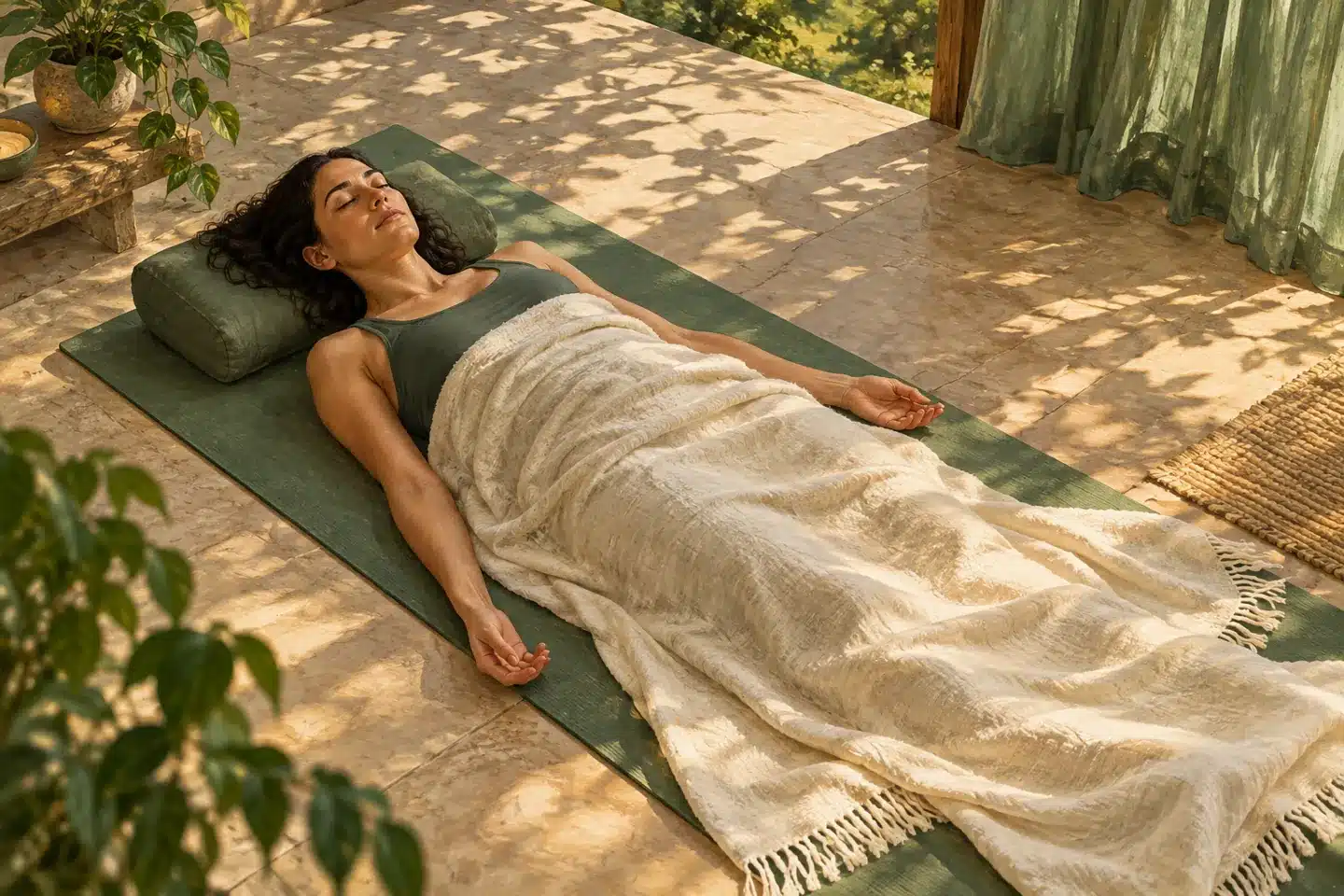
Rest in a comfortable, supported position. Lying on the back is common, but comfort and any existing professional guidance take priority.
Use a light covering if you prefer. Adjust your surroundings so that you can rest comfortably.
Stillness is an invitation, not a rule. You may move, open your eyes or end the practice whenever you need.
Stage 2: Sankalpa (resolve)
A sankalpa is a short positive statement in the present tense, repeated three times mentally, with feeling behind it.
Traditional teaching often uses a short, positive statement in the present tense. This is a reflective convention, not a proven mechanism for curing insomnia.
Choose wording that feels appropriate and unforced. No particular statement or period of repetition is guaranteed to produce a result.
Stage 3: Rotation of consciousness
A guide names areas of the body and invites you to notice them. You do not need to create a sensation, tense a muscle or suppress an urge to adjust your position.
The traditional sequence starts at the right thumb, runs through the fingers, palm, wrist, elbow, shoulder, armpit, side of the chest, waist, hip, thigh, knee, calf, ankle, heel, sole, each toe. Then the left side, identically. Then the back of the body, the front, the head.
Follow at a comfortable pace. Missing a cue or becoming distracted does not mean you have failed.
The body scan is an attention exercise; it should not be described as a guaranteed way to regulate a medical condition.
Stage 4: Breath awareness
You do not change the breath. You count it backwards, usually from twenty-seven down, watching the rise and fall at the navel or the air at the nostrils.
If you lose count, simply return to noticing the natural breath. Counting is optional.
Stage 5: Opposite sensations
Some guides invite imagined heaviness and lightness, or warmth and coolness. These are optional explorations.
You may skip any contrast that feels unpleasant. This exercise is not a method for controlling or treating emotional symptoms.
Stage 6: Visualisation
Images are named rapidly, one after another. A rose. A moonlit river. A candle flame. A temple bell. An ocean at dawn.
Imagery is optional. You can return to sounds in the room or open your eyes if it does not feel comfortable.
Stage 7: Sankalpa again
The personal resolve may be repeated. Traditional explanations of receptivity should not be presented as established claims about the brain.
Stage 8: Externalisation
Come back in stages. Awareness of the breath. Then the body on the floor. Then the sounds in the room. Then small movements in the fingers and toes. Roll onto your right side. Sit up slowly.
Allow time to reorient before standing or beginning another activity.
Yoga Nidra vs Meditation vs Shavasana vs Sleep
These practices can overlap, but the terms describe different activities. They are not interchangeable treatments.
| Activity | Typical format | Distinction |
|---|---|---|
| Yoga nidra | Guided rest and body awareness | Often includes a traditional sequence |
| Seated meditation | Attention practice while sitting | Many methods and aims |
| Shavasana | A resting posture | Does not require a guided sequence |
| Sleep | A natural biological process | Cannot be replaced by guided rest |
A recording’s label does not specify its content. Look for a clear description of the method, pace and intended use.
Shavasana is a resting posture. Yoga nidra is a guided practice that often uses that posture; simply lying quietly does not necessarily include its teaching sequence.
Is Yoga Nidra the Same As NSDR? The Andrew Huberman Yoga Nidra Question
NSDR means Non-Sleep Deep Rest, a term popularised by Andrew Huberman. It is a broad label and should not automatically be treated as an exact synonym for every yoga nidra tradition.
Some recordings share lying down, body awareness and attention to natural breathing.
Some NSDR recordings omit sankalpa or imagery. The actual instructions matter more than the label.
Yoga nidra traditions may place the practice within pratyahara and self-inquiry. Those aims are distinct from promises about dopamine, learning or sleep treatment.
Choose a clear description of the practice rather than a claim that one label guarantees better sleep.
Evidence about a specific programme does not validate every shortened or commercial version.
How Long And How Often Should You Practise Yoga Nidra for Deep Sleep?
| Personal aim | Practical choice | Boundary |
|---|---|---|
| Learning the sequence | A clear introductory recording | No need to master every stage |
| A quiet pause | A comfortable time and place | Rest does not replace sleep |
| Exploring a tradition | A teacher who explains the approach | Teaching is distinct from medical care |
| Persistent sleep difficulty | Discuss the concern with a qualified healthcare professional | No self-prescribed yoga nidra treatment schedule |
Practising while comfortably alert may help you learn the instructions. Bedtime use and daytime learning are different personal choices, not prescribed treatment schedules.
What Mistakes Do Beginners Make With Yoga Nidra For Deep Sleep?
Falling asleep or becoming distracted can happen. Neither is a moral failure or a diagnosis.
A sankalpa can provide continuity as a reflective practice. It does not need to become a test of discipline or a promise of recovery.
There is no need to force concentration. Notice what you can and return gently when attention wanders.
Choose a time when you feel physically comfortable. This guide does not prescribe an interval after eating.
Move or adjust whenever necessary. Comfort matters more than remaining motionless.
Choose a recording with clear, unhurried instructions and a volume you find comfortable. Avoid claims of guaranteed cures.
Do not judge the practice against a promised deadline for results. Ongoing symptoms deserve appropriate professional attention.
Is Yoga Nidra for Deep Sleep Safe For Everyone?
No practice is suitable for everyone. Relaxation exercises can sometimes feel uncomfortable or distressing.
The following boundaries are general safety information, not personal medical advice.
People with a history of trauma or PTSD may find some inward attention or imagery uncomfortable. Participation should remain optional, with room to pause or stop.
If you are receiving care for a mental or physical health condition, discuss suitability with your qualified healthcare professional. A recording cannot make that assessment.
Yoga nidra should not delay medical assessment or replace prescribed care. The NCCIH overview of practices for sleep disorders explains the limits of the evidence.
Use relaxation recordings only where becoming drowsy is safe, never while driving or operating machinery.
A Short Yoga Nidra Script for Deep Sleep
This optional script illustrates body awareness and natural breathing. Use a comfortable pace and omit any instruction you do not wish to follow. It is not a treatment script.
Lie on your back and make yourself comfortable. Cover your body. [pause]
You may rest still or adjust your position. You can open your eyes or stop at any time. [pause]
If you wish, repeat a personal resolve three times. I make space for rest. [long pause]
Take your awareness to the right hand thumb. Second finger. Third finger. Fourth finger. Fifth finger. Palm of the hand. Back of the hand. Wrist. Forearm. Elbow. Upper arm. Shoulder. Armpit. Right side of the chest. Right waist. Right hip. Right thigh. Knee. Calf. Ankle. Heel. Sole of the foot. Right big toe, second toe, third, fourth, fifth. [pause]
Now the left hand thumb… [repeat the same sequence on the left] [pause]
The whole back of the body. The whole front of the body. The whole head. The whole body together, lying still. [long pause]
Watch the natural breath at the navel. Count each breath backwards from twenty-seven. Twenty-seven, breathing in. Twenty-seven, breathing out. Twenty-six… [long pause]
If comfortable, imagine heaviness, then lightness. Or simply notice contact with the surface beneath you. [pause]
See these images as they are named, and let each one go. A red rose. Still water under moonlight. A candle flame. A wide dark ocean. A single star. [long pause]
If you wish, repeat your personal resolve. I make space for rest. [long pause]
Become aware of the breath. Become aware of the body lying down. If you wish to sleep now, let the practice carry you.
At the end, take time to notice your surroundings and choose what you need next. There is no requirement to remain withdrawn from the room.
Frequently Asked Questions (FAQ)
Is yoga nidra meditation for sleep different from ordinary guided meditation?
Yoga nidra commonly follows a structured sequence of guided rest and body awareness. Guided meditation includes many other methods. Neither label guarantees a particular brainwave state.
Can yoga nidra replace sleep?
No. Guided rest does not replace a full night’s sleep or its biological functions.
Is it normal to fall asleep during yoga nidra for deep sleep?
It can happen, especially when you are tired. Falling asleep is not proof that a sleep problem has been treated.
How long before I see results for sleep?
There is no reliable personal timetable. Research findings do not guarantee an individual result, and persistent sleep problems warrant professional assessment.
Can I do yoga nidra for deep sleep in bed?
A comfortable resting place is a personal choice. Follow any relevant professional guidance and avoid a position that causes discomfort.
What is the best time of day?
There is no universally best time. Choose a quiet, safe setting when you feel comfortable; daytime practice may help with learning the instructions.
Do I need a teacher, or is an app enough?
A clear recording can introduce the sequence. A qualified teacher can explain the method and adaptations, but neither replaces medical assessment.
Is yoga nidra the same as hypnosis?
They are distinct approaches, although some methods share guided attention or imagery. A label alone does not establish their effects or suitability.
Can children do yoga nidra?
Children need age-appropriate guidance and a willing, supervised setting. This article does not prescribe a duration or therapeutic programme for children.
Does yoga nidra help with anxiety as well as sleep?
Some research explores these outcomes, but yoga nidra should not be presented as treatment for anxiety or as a replacement for mental healthcare.
Is yoga nidra for deep sleep better than melatonin?
This article does not recommend, compare or combine medicines and supplements with yoga nidra. Discuss questions about melatonin or other treatments with a qualified healthcare professional.