
Quick Answer
Yoga may help reduce stress and anxiety. Most studies combine gentle postures, slow breathing and relaxation, and many report lower self-rated stress and anxiety. A 2017 meta-analysis of 42 trials linked yoga to lower cortisol, resting heart rate and blood pressure on average. Start with 15–20 minutes, three to five days a week, alongside any treatment you already receive.
Key Takeaways
- Yoga for stress and anxiety is a slow, breath-led way of practicing that aims to settle your body and mind, not to build strength or flexibility. It blends gentle postures (asanas), breathing techniques (pranayama), guided relaxation and short periods of meditation.
- Scientists don’t fully understand it yet. The leading explanation is that slow breathing, gentle movement and rest shift the balance of the autonomic nervous system away from the stress response. Here’s how that is thought to work:
- Research generally suggests that yoga can reduce stress and anxiety symptoms, but many studies are small or short, and yoga is best treated as a complement to standard care. The most useful evidence comes from reviews that combine many trials.
It’s 2 a.m. You’re wide awake, replaying an email you sent at 4 p.m. Your chest feels tight, and tomorrow’s to-do list is already running on a loop.
Plenty of people know that feeling. In Great Britain, 964,000 workers reported stress, depression or anxiety caused or made worse by work in 2024/25, according to the Health and Safety Executive (HSE). In the US, 62% of adults named societal division as a significant source of stress in the American Psychological Association’s Stress in America 2025 survey.
Yoga for reducing stress and anxiety is one of the more widely studied, low-cost options you can try at home. You don’t need to be flexible or buy an expensive class pass. A mat, a wall and about 20 minutes are enough to start.
This guide comes from the Inteyoga Editorial Team at Inteyoga (Swami Krishnananda Yoga Vidyapeeth) in South Goa, India. Inteyoga is registered with Yoga Alliance as a Registered Yoga School. Here’s what it covers:
- What the research shows, including where the evidence is still thin
- 12 beginner-friendly poses and how long to hold each one
- Three breathing techniques you can use on a train, at your desk or before a presentation
- A 20-minute routine and a 12-week plan
- Clear safety advice for pregnancy, blood pressure, panic attacks and more
New to yoga? Start with our beginner’s guide to restorative yoga: benefits, poses and how to start. It’s a gentle way in if your mind feels busy.
What Is Yoga for Stress and Anxiety?
Yoga for stress and anxiety is a slow, breath-led way of practicing that aims to settle your body and mind, not to build strength or flexibility. It blends gentle postures (asanas), breathing techniques (pranayama), guided relaxation and short periods of meditation.
There’s no single “anxiety yoga” style. Gentle Hatha, restorative yoga, Yin and Yoga Nidra can all fit. What they share is pace: long holds, unhurried breathing and plenty of rest.
If you’ve tried a fast vinyasa or hot yoga class and left feeling more wired, you’re not unusual. When you’re anxious, slower practices tend to be a better match.
Inteyoga approaches yoga as an integrated discipline. Body, breath, mind, daily conduct and relationships all play a part, so a calming practice covers more than poses.
Stress vs Anxiety: What’s the Difference?
| Stress | Anxiety | |
|---|---|---|
| Trigger | A clear outside pressure (a deadline, a bill, a difficult boss) | Often no clear trigger, or worry about what might happen |
| How long it lasts | Usually eases when the pressure ends | Can continue for weeks or months |
| How it feels | Tense, irritable, tired | Fearful, restless, on edge, racing thoughts |
| Physical signs | Tight shoulders, headaches, poor sleep | Pounding heart, shallow breathing, upset stomach |
| When to see a doctor | If it affects work, sleep or health for weeks | If worry is intense, constant or causes panic attacks |
Yoga may help with both. An anxiety disorder, however, is a medical condition. Yoga is best used alongside professional care, not instead of it. In the US, a primary care doctor is a good first stop. In the UK, see your GP, or refer yourself to NHS Talking Therapies.
How Does Yoga Calm the Nervous System?
Scientists don’t fully understand it yet. The leading explanation is that slow breathing, gentle movement and rest shift the balance of the autonomic nervous system away from the stress response. Here’s how that is thought to work:
- Something stresses you. A tense meeting, a late train or a news alert sets off the brain’s threat response, which involves the amygdala.
- The HPA axis activates. The hypothalamus, pituitary and adrenal glands help release stress hormones such as cortisol, along with adrenaline from the sympathetic nervous system.
- Your body speeds up. Heart rate rises, breathing gets shallower and muscles tighten.
- Slow breathing may help reverse this. Slow breaths with a longer exhale are associated with a lower heart rate. The vagus nerve, a major part of the parasympathetic system, is thought to play a role.
- Regular practice may make a difference over time. A 2015 systematic review of 25 randomized trials in the Journal of Psychiatric Research found preliminary evidence that yoga is linked to better regulation of the sympathetic nervous system and the HPA axis.
These are plausible mechanisms supported by early research. They are not proof that yoga resets the nervous system for every person.
What Happens in Your Brain?
One small study suggests a link between yoga and GABA, a brain chemical involved in calming nerve activity. In 2010, a Boston University team led by psychiatrist Dr. Chris Streeter compared 12 weeks of yoga with walking in 34 healthy adults. The yoga group reported greater improvements in mood and anxiety, and these changes tracked rising GABA levels in the thalamus.
The two groups did similar amounts of physical activity. That hints that yoga’s effect involves more than exercise. Still, it was a small study of healthy volunteers, and GABA’s exact role isn’t settled.
What Does the Research Say About Yoga for Anxiety?
Research generally suggests that yoga can reduce stress and anxiety symptoms, but many studies are small or short, and yoga is best treated as a complement to standard care. The most useful evidence comes from reviews that combine many trials.
Yoga is also mainstream now. Adult yoga use in the US rose from 5% in 2002 to 15.8% in 2022, according to NIH’s National Center for Complementary and Integrative Health (NCCIH). In national survey data reported in NCCIH’s Yoga for Health e-book, 86% of people who practiced yoga said it helped them reduce stress. That figure is self-reported, not a clinical outcome.
| Study (year) | What researchers looked at | What they found |
|---|---|---|
| Pascoe, Thompson & Ski, Psychoneuroendocrinology (2017) | 42 randomized trials of yoga vs active controls | Yoga was associated with lower waking and evening cortisol, resting heart rate and blood pressure |
| Yoga Nidra review, Annals of the New York Academy of Sciences (2025) | 73 studies, 5,201 participants | Significant pooled benefits for stress, anxiety and depression |
| JAMA Psychiatry (2021) | 226 adults with generalized anxiety disorder (GAD); Kundalini yoga vs CBT vs stress education | Yoga outperformed stress education; the authors concluded CBT should remain first-line |
| Complementary Therapies in Medicine (2007) | 131 adults with mild to moderate stress in South Australia; 10 weekly hatha sessions | Yoga was as effective as relaxation for stress and anxiety, and more effective for mental health |
| Perceptual and Motor Skills (2009) | 300 first-time visitors at a yoga center in north India | State anxiety fell 14.7% after a 2-hour practice session, vs 3.4% after a yoga theory session |
| Journal of Alternative and Complementary Medicine (2010) | 34 adults; 12 weeks of yoga vs walking | Larger anxiety reduction with yoga, linked to higher brain GABA |
What this means for you:
- Short-term relief is common. Several studies report lower anxiety right after a session, though “state anxiety” measures how you feel in the moment, not long-term change.
- More practice may bring more benefit. A meta-analysis of 17 hatha yoga studies (501 participants) in the Journal of Evidence-Based Medicine found larger effects with more total hours of practice. The same analysis found that people with higher anxiety benefited most.
- Evidence quality varies. Pooled reviews are only as strong as the studies they combine. Larger, well-controlled trials are still needed.
- It’s an add-on, not a replacement. NCCIH describes the evidence for yoga as an adjunctive therapy for anxiety symptoms as limited.
12 Best Yoga Poses for Stress Relief and Anxiety
The poses most often taught for stress are slow, supported and grounding: forward folds, gentle backbends, legs-up positions and long rest poses. Hold each for 5–10 slow breaths unless noted.
One honest caveat: research has tested yoga programs, not individual poses. The notes below reflect common teaching practice, not proven pose-by-pose effects.
No props? A sofa cushion works as a bolster, a bath towel as a blanket and a dressing-gown belt as a strap.
| # | Pose (Sanskrit / English) | Hold | Why teachers use it | Beginner-friendly? |
|---|---|---|---|---|
| 1 | Balasana / Child’s Pose | 1–3 min | Grounding; encourages slower breathing | Yes |
| 2 | Marjaryasana–Bitilasana / Cat-Cow | 6–8 rounds | Links breath and movement | Yes |
| 3 | Uttanasana / Standing Forward Fold | 5–8 breaths | Releases neck and back | Yes, knees bent |
| 4 | Paschimottanasana / Seated Forward Fold | 1–2 min | Inward focus | Yes, with a strap |
| 5 | Setu Bandhasana / Bridge Pose | 3 × 5 breaths | Opens the front of the chest | Yes |
| 6 | Supta Baddha Konasana / Reclining Bound Angle | 3–5 min | Supported rest | Yes, with props |
| 7 | Viparita Karani / Legs-Up-the-Wall | 5–10 min | Restful, low effort | Yes |
| 8 | Supta Matsyendrasana / Supine Twist | 1 min each side | Eases lower-back tension | Yes |
| 9 | Matsyasana / Supported Fish Pose | 1–2 min | Opens throat and chest | With a bolster |
| 10 | Makarasana / Crocodile Pose | 2–3 min | Belly-breathing awareness | Yes |
| 11 | Sukhasana / Easy Seated Pose | 3–5 min | Steady seat for breathing | Yes |
| 12 | Savasana / Corpse Pose | 5–10 min | Full-body relaxation | Yes |
1. Child’s Pose (Balasana)
Child’s Pose is a simple grounding pose that folds you inward and invites slower breathing. Kneel, bring your big toes together and widen your knees. Fold forward and rest your forehead on the mat or a pillow. Breathe into your back ribs. If your hips don’t reach your heels, slide a cushion under your chest.
2. Cat-Cow (Marjaryasana–Bitilasana)
Cat-Cow gives each movement one breath, which gives a busy mind something simple to follow. On hands and knees, inhale as you lift your chest and tailbone (Cow). Exhale as you round your back and tuck your chin (Cat). Let each exhale be a little longer than the inhale. Do 6–8 rounds.
3. Standing Forward Fold (Uttanasana)
A forward fold lets your head hang and your neck release. Stand with feet hip-width apart. Bend your knees generously and fold. Hold opposite elbows and let your head feel heavy. Roll up slowly, one vertebra at a time, so you don’t feel lightheaded.
4. Seated Forward Fold (Paschimottanasana)
This classic Hatha Yoga pose draws your attention inward. Sit with legs straight and loop a strap around your feet. Lengthen your spine as you inhale. Fold slightly as you exhale. Comfort matters more than depth, so never force it.
5. Bridge Pose (Setu Bandhasana)
Bridge Pose opens the front of the chest, a welcome change after hours hunched over a laptop. Lie on your back, knees bent, feet flat. Press into your feet and lift your hips. Hold for five breaths, lower slowly and repeat three times. For a restful version, slide a yoga block under your sacrum.
6. Reclining Bound Angle (Supta Baddha Konasana)
This supported pose is a staple of restorative yoga. Lie back over a bolster placed along your spine. Bring the soles of your feet together and let your knees drop open onto cushions. Rest your hands on your belly and stay for 3–5 minutes.
7. Legs-Up-the-Wall (Viparita Karani)
If you try only one pose tonight, many teachers would suggest this one: it’s restful and takes almost no effort. Sit sideways against a wall, then swing your legs up as you lie back. Let your arms rest by your sides. Stay 5–10 minutes. Skip it if you have glaucoma or uncontrolled high blood pressure, and ask your doctor if unsure.
8. Supine Twist (Supta Matsyendrasana)
A gentle twist can ease tension in the lower back and belly. Lie on your back, hug both knees in and let them fall to the right. Open your arms wide and turn your head left. Breathe here for a minute, then switch sides.
9. Supported Fish Pose (Matsyasana)
Supported Fish opens the throat and chest, two areas that can feel tight when you’re anxious. Place a bolster or rolled blanket under your shoulder blades and a pillow under your head. Let your arms fall open. Avoid it if you have a neck injury.
10. Crocodile Pose (Makarasana)
Crocodile Pose makes belly breathing easy to feel, which is why it’s often taught for breath awareness. Lie face down and stack your forearms under your forehead. Notice your belly press into the floor each time you inhale. Stay 2–3 minutes.
11. Easy Seated Pose (Sukhasana)
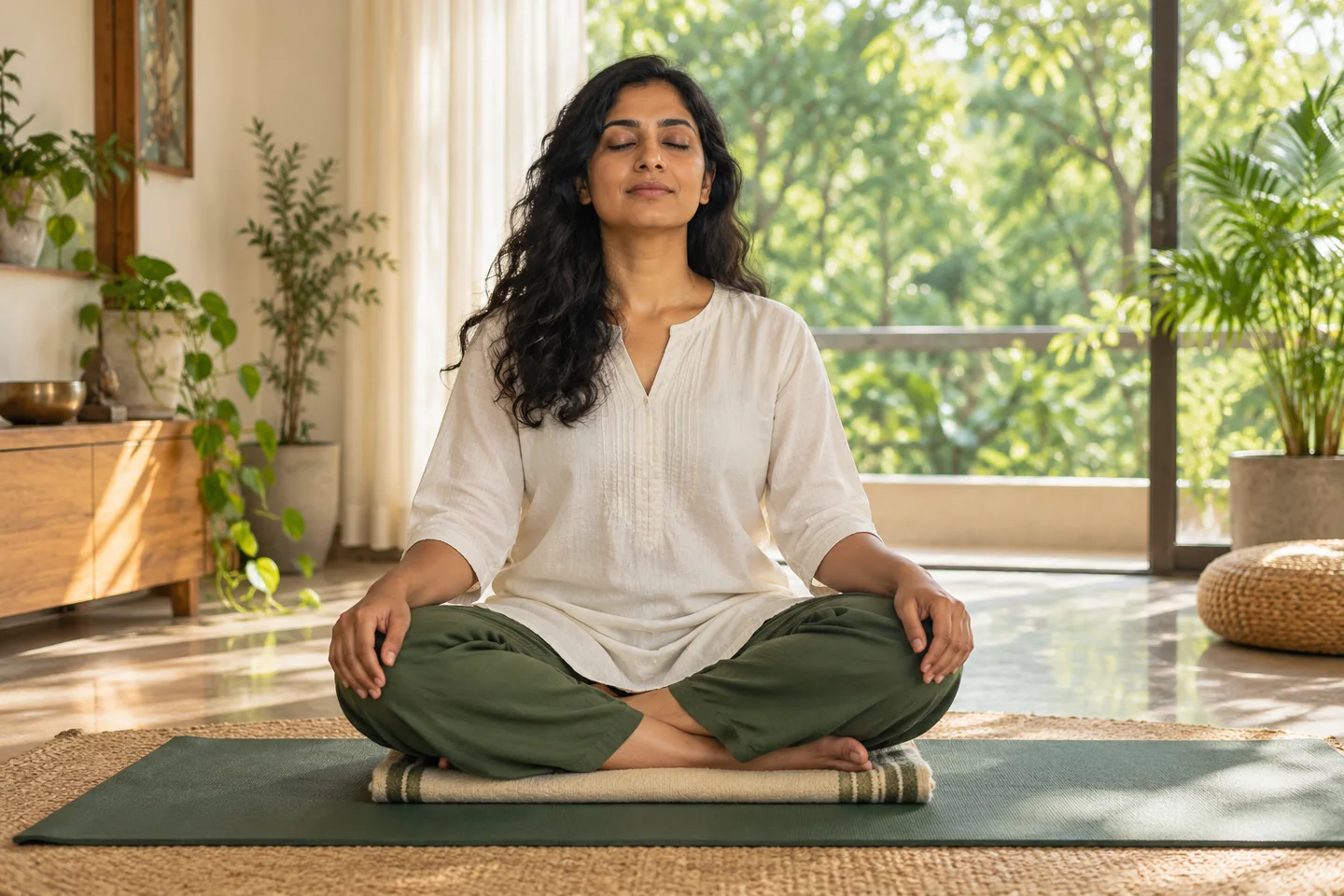
Sukhasana is a steady base for breathing practice and short meditation. Sit cross-legged on a folded blanket so your knees sit lower than your hips. Lengthen your spine and let your shoulders drop. Use this seat for the breathing exercises below.
12. Corpse Pose (Savasana)
Savasana gives your body time to rest after practice, so don’t skip it. Lie flat with feet apart and palms up. Scan your body from toes to head, relaxing each part. Stay 5–10 minutes. Cover yourself with a blanket, since you may cool down as you lie still.
Want more on supported postures? Read our guide to Hatha yoga: meaning, benefits and poses.
Which Breathing Exercises Help With Anxiety?
Slow belly breathing, alternate nostril breathing (Nadi Shodhana) and humming bee breath (Bhramari) are three gentle options, and each one slows the breath and lengthens the exhale. Slow breathing is associated with a lower heart rate. The NHS breathing exercise for stress uses a similar idea: slow, regular belly breaths for a few minutes, ideally as part of your daily routine.
You can do all three on a commuter train, in a quiet corner before a big meeting or in bed when you can’t sleep.
1. Belly Breathing (Diaphragmatic Breathing)
Belly breathing is the foundation of most calming practices.
- Sit or lie down. Place one hand on your chest and one on your belly.
- Breathe in through your nose for a count of 4. Let your belly rise while your chest stays fairly still.
- Breathe out slowly for a count of 6. Feel your belly fall.
- Keep going for 3–5 minutes. If counting feels stressful, drop the numbers and just breathe slowly.
2. Alternate Nostril Breathing (Nadi Shodhana)
Nadi Shodhana is a classical pranayama, often taught early because it’s slow and steady.
- Sit tall. Rest your left hand on your knee.
- Close your right nostril with your right thumb. Breathe in through the left for 4 counts.
- Close your left nostril with your ring finger. Release your thumb and breathe out through the right for 4–6 counts.
- Breathe in through the right. Close it, then breathe out through the left.
- That’s one round. Do 5–9 rounds.
3. Humming Bee Breath (Bhramari)
Bhramari gives your mind one simple sound to focus on.
- Sit comfortably and close your eyes.
- Gently press your ear flaps closed with your index fingers.
- Breathe in through your nose.
- Breathe out slowly while making a soft, steady hum, like a bee.
- Repeat 5–7 times, then sit quietly for a minute.
A word of caution: skip fast, forceful techniques such as Kapalbhati (“skull-shining breath”) and Bhastrika (“bellows breath”) when you’re anxious. Some people find them overstimulating or feel dizzy. Learn them only from a qualified teacher, once slow breathing feels easy.
Does Yoga Nidra Help With Stress and Anxiety?
Yoga Nidra, often called “yogic sleep,” is a guided relaxation practice with a growing body of research on stress and anxiety. A 2025 systematic review and meta-analysis in the Annals of the New York Academy of Sciences pooled 73 studies with 5,201 participants. It reported significant benefits for stress, anxiety and depression. The results are encouraging, but larger, well-controlled trials are still needed. Yoga Nidra is not a treatment for an anxiety disorder on its own.
You may have seen a similar idea called “NSDR” (non-sleep deep rest). In Yoga Nidra, you lie in Savasana while a teacher’s voice guides you through a set sequence:
- Settling: relax the body and notice sounds around you.
- Sankalpa: a short, positive intention repeated silently.
- Rotation of awareness: attention moves through each body part in turn.
- Breath awareness: counting or simply watching the breath.
- Opposite sensations: such as heaviness and lightness, warmth and cold.
- Visualization: simple, calming images.
- Return: repeat your sankalpa and slowly come back.
A session usually lasts 20–45 minutes. Many people describe it as deeply restful while staying aware. It can suit you if sitting meditation feels impossible or worry keeps you up at night. It does not replace sleep.
Yoga Nidra at Inteyoga: Yoga Nidra is one of the three specialties of Inteyoga’s Advanced TTC 300-Hour Integrated Restorative Yoga (Including Yoga Nidra, Chakra Sadhana, and Prana Vidya Intensive). The programme’s published sample daily schedule includes a 90-minute Yoga Nidra session, and trainees learn to guide it responsibly.
Try it at home: play a 20-minute recorded Yoga Nidra, lie on a mat with a blanket and practice in the afternoon or early evening. Avoid practicing straight after a heavy meal.
A 20-Minute Yoga Routine for Stress and Anxiety
This 20-minute routine moves from breath, to gentle movement, to supported rest, and ends with at least 5 minutes of Savasana. The Inteyoga Editorial Team built it on the order used in classical Hatha Yoga: prepare, move, breathe, rest. You’ll need a mat, a blanket, a cushion and a wall.
| Time | Practice | What to do |
|---|---|---|
| 0:00–2:00 | Belly breathing (lying face down or seated) | Breathe in for 4, out for 6 |
| 2:00–4:00 | Cat-Cow | 8 slow rounds, exhale longer than inhale |
| 4:00–6:00 | Child’s Pose | Breathe into your back ribs |
| 6:00–8:00 | Standing Forward Fold | Knees bent, head heavy; roll up slowly |
| 8:00–10:00 | Bridge Pose | 3 lifts of 5 breaths each |
| 10:00–11:00 | Supine Twist | 30 seconds each side |
| 11:00–14:00 | Legs-Up-the-Wall | Eyes closed or soft gaze, natural breath |
| 14:00–16:00 | Alternate nostril breathing (seated) | 5–7 rounds |
| 16:00–17:00 | Humming bee breath | 5 slow hums |
| 17:00–20:00+ | Savasana | Body scan; stay longer if you can |
How Often Should You Do Yoga for Anxiety?
Three to five sessions a week for 8–12 weeks is a reasonable target. Many of the studies above ran programs of 10–12 weeks. Regular short sessions are easier to keep up than one long class a week.
| Weeks | Goal | What to do |
|---|---|---|
| 1–2 | Build the habit | 10 minutes a day: belly breathing, Child’s Pose, Savasana |
| 3–4 | Add movement | The full 20-minute routine, 3 days a week |
| 5–8 | Go deeper | The routine 4–5 days a week, plus one 20-minute Yoga Nidra |
| 9–12 | Make it yours | Add a weekly gentle or restorative class with a qualified teacher |
What Can You Expect, and When?
- Right after a session: studies such as the 2009 north India trial reported short-term drops in anxiety after one practice.
- Over several weeks: most trials measured results after 8–12 weeks of regular practice.
- Individual results vary. Some people notice changes quickly; others need longer, and some find yoga less helpful than other approaches.
Real-Life Ways to Use This Routine
- The “Sunday scaries”: do the full 20 minutes on Sunday evening before the work week.
- After a long commute: five minutes of Legs-Up-the-Wall as soon as you get home.
- Before an exam or job interview: two minutes of belly breathing, then five rounds of alternate nostril breathing.
- When you can’t sleep: belly breathing and Savasana in bed, or a 20-minute Yoga Nidra recording.
- New parents: Child’s Pose and Legs-Up-the-Wall during a nap window, no special clothes needed.
Morning or evening? Morning practice can set a calmer tone for the day. Evening practice can help you wind down. Early riser? Pair this with our 10-minute morning yoga routine.
Benefits of Yoga for Reducing Stress and Anxiety
The potential benefits of yoga for reducing stress and anxiety include lower stress hormones on average, a slower resting heart rate, calmer breathing, better self-reported sleep and a greater sense of control over anxious thoughts. Results differ from person to person.
Physical Benefits
- Lower cortisol, on average. The 2017 Pascoe meta-analysis associated yoga with lower waking and evening cortisol compared with active controls. That doesn’t mean it lowers cortisol in everyone.
- Lower resting heart rate. The same review found an association with lower resting heart rate.
- Lower blood pressure. A 2016 meta-analysis in the European Journal of Preventive Cardiology found systolic blood pressure about 5 mmHg lower with yoga than with non-exercise controls.
- Less muscle tension. Long, gentle holds can ease the neck, shoulders and jaw, where many people feel stress.
- Better sleep for some. In survey data reported by NCCIH, 59% of people who practiced yoga said it improved their sleep.
Mental and Emotional Benefits
- Fewer anxious thoughts for some people. Focusing on your breath can interrupt a worry loop.
- Better mood. Small studies, including Streeter’s 2010 trial, report mood improvements with regular practice.
- More body awareness. You may start to notice early signs of tension, such as a clenched jaw or held breath, and respond sooner.
- A kinder relationship with discomfort. Gentle practice encourages you to notice difficult sensations without judging yourself.
- A portable skill. Once you know a breathing technique, you can use it on a plane, before a presentation or in a waiting room.
Lifestyle Benefits
- Room for healthier habits. A set practice time can encourage earlier nights and less late-night scrolling.
- A sense of purpose and connection. Practices like Karma Yoga (selfless action) turn attention outward. Read our guide to Karma Yoga: principles and benefits.
Key takeaway: yoga won’t remove what’s stressing you. It may change how your body and mind respond to it, and that response is something you can practice.
Yoga vs Meditation: Which Is Better for Anxiety?
Neither one wins outright. Yoga suits people who feel stress in the body or struggle to sit still. Meditation suits people whose main difficulty is racing thoughts. In classical yoga they aren’t rivals: postures and breathing prepare the body so that meditation comes more easily. In the US, meditation (17.3%) and yoga (15.8%) were the two most-used complementary health approaches in 2022, according to NCCIH.
| Factor | Yoga for stress and anxiety | Meditation |
|---|---|---|
| Main tool | Posture, breath and relaxation | Attention and awareness |
| Often suits | Physical tension, restlessness | Racing thoughts, overthinking |
| Ease for beginners | Easier if you’re restless, because your body has a job to do | Can feel hard at first with a busy mind |
| Physical effects studied | Cortisol, heart rate, blood pressure | Mainly studied for mental outcomes |
| Time needed | 15–60 minutes | 5–20 minutes |
| Equipment | A mat, optional props | None |
| Example research | 42-trial meta-analysis (2017) | Mindfulness-based stress reduction (MBSR) trials |
| Combine them? | Yes: end yoga with 5 minutes of meditation | Yes: start with gentle yoga to settle your body |
How Does Yoga Compare With Therapy, Exercise and Medication?
For a diagnosed anxiety disorder, follow clinical guidance first and use yoga as a supportive extra. In the UK, NICE guideline CG113 recommends a stepped approach for generalized anxiety disorder. It starts with education and monitoring, then moves to low-intensity, CBT-based self-help. After that come either a high-intensity psychological therapy (CBT or applied relaxation) or medication.
The 2021 JAMA Psychiatry trial, run by NYU Langone and Boston University, tested 12 weeks of Kundalini yoga, CBT or stress education in 226 adults with GAD. Yoga worked better than stress education. It did not match CBT, and according to an NCCIH summary, it was not as effective as CBT at 12 weeks or at six months.
| Approach | Strengths | Limits |
|---|---|---|
| Yoga | Low cost; builds a daily habit; may ease symptoms | Less evidence than CBT for anxiety disorders |
| CBT (talking therapy) | Recommended in NICE guidance; strongest evidence in the JAMA trial | Needs a trained therapist; waiting lists can be long |
| Walking or general exercise | Easy to start; good for overall health | In one small 2010 trial, yoga reduced anxiety more than matched walking |
| Medication | An option in NICE stepped care | Needs a doctor’s prescription and monitoring |
The practical answer: combine them. Yoga can be a daily reset. Therapy or medical care is for anxiety that’s persistent, severe or getting in the way of your life.
Who Should Be Careful With Yoga for Anxiety?
Most people can do gentle yoga safely, but some health conditions call for a doctor’s advice or modified poses first. Check with your doctor (your GP in the UK) before you start if any of these apply.
| Condition | Commonly advised precautions |
|---|---|
| Pregnancy | Avoid deep twists, lying on your belly and breath-holding; choose a prenatal class |
| High blood pressure | Avoid breath-holding, Kapalbhati and long inversions; keep your head above your heart |
| Low blood pressure | Rise slowly from forward folds and Savasana |
| Glaucoma or eye conditions | Avoid head-down poses and long holds in Legs-Up-the-Wall |
| Heart conditions | Practice only with your cardiologist’s approval |
| Recent surgery or injury | Wait for medical clearance; avoid loading the injured area |
| Panic disorder or trauma history | Keep your eyes open if closing them feels unsafe; avoid fast breathing; look for a trauma-informed teacher |
| Severe depression or suicidal thoughts | Get professional help first; yoga isn’t a substitute |
What Should You Do During a Panic Attack?
Keep it simple: ground yourself and slow your exhale. Long holds and silent meditation can feel overwhelming in the middle of panic. Try this instead:
- Plant your feet flat on the floor and press them down.
- Keep your eyes open and name five things you can see.
- Breathe out longer than you breathe in. Try in for 4, out for 6.
- Hum on the exhale (Bhramari) if that feels comfortable.
- Give it a few minutes. Panic attacks feel endless, but they usually pass within minutes.
Gentle yoga may help some people feel calmer between attacks, but research specific to panic disorder is limited. If panic attacks are frequent, see a doctor. NICE guidance for panic disorder includes CBT and, in some cases, medication.
Can Yoga Make Anxiety Worse?
Sometimes, yes, especially in fast classes, hot rooms or long silent meditations. Deep relaxation can also stir up emotions. Ordinary discomfort like this often passes, but it can feel unsettling. If a practice makes you more anxious, stop. Open your eyes, put your feet on the floor and breathe slowly.
Some reactions need more care. These include flashbacks, feeling detached from your body or surroundings, or losing track of where you are. If they happen, stop and talk to a mental health professional, ideally one experienced with trauma.
What Mistakes Do Beginners Make?
- Starting with a hot or power yoga class. Heat and speed can feel overstimulating when you’re anxious.
- Holding your breath in poses. Keep breathing smooth, with a slightly longer exhale.
- Forcing flexibility. Straining defeats the purpose of a calming practice.
- Skipping Savasana. Rest is part of the practice.
- Only practicing on bad days. A regular habit is easier to lean on when things get hard.
- Expecting overnight results. Give it several weeks before judging.
Yoga for Work Stress: A 5-Minute Desk Routine
A 5-minute chair routine can help you reset during a stressful workday without changing clothes or leaving your desk. Work stress is a large problem. In Great Britain, HSE figures attribute about 22.1 million lost working days in 2024/25 to work-related stress, depression or anxiety. Try this between back-to-back meetings or before a presentation.
- Seated belly breathing (1 minute). Feet flat, hands on your belly. In for 4, out for 6.
- Neck release (1 minute). Drop your right ear toward your right shoulder for 5 breaths, then switch.
- Seated Cat-Cow (1 minute). Hands on knees. Arch as you inhale, round as you exhale.
- Seated twist (1 minute). Hold the back of your chair and turn gently to each side.
- Silent breath count (1 minute). Close your eyes and count 10 slow exhales.
Short breaks can make a difference in the moment. In the 2009 study of 300 first-time practitioners, state anxiety fell by 14.7% after a single session.
Want to teach yoga for stress responsibly? Inteyoga’s advanced 300-hour programme includes modules on the yogic management of stress, Yoga Nidra and pranayama. It is a 43+2-day residential programme in South Goa, taught in English, for applicants aged 21–60 who have completed a 200-hour teacher training or equivalent. A teacher training does not qualify anyone to diagnose or treat medical conditions.
Frequently Asked Questions About Yoga for Stress and Anxiety (FAQ)
Which Type of Yoga Is Best for Anxiety?
No single style has been proven best. Gentle Hatha, restorative yoga and Yoga Nidra are often recommended because they use slow movement, props, long holds and guided relaxation. Many studies used gentle Hatha-style programs. If you’re a beginner, it’s usually wise to skip hot yoga and fast power classes at first, since heat and speed can feel overstimulating.
How Long Does It Take for Yoga to Reduce Anxiety?
Some people feel calmer after a single session. A 2009 study of 300 first-time practitioners found state anxiety fell by 14.7% after one two-hour session. Lasting change is less certain. Many trials ran 8–12 weeks, with practice several times a week. Showing up regularly matters more than the length of each session.
Can Yoga Cure Anxiety?
No. Yoga can’t cure an anxiety disorder, though research suggests it may ease symptoms for some people. In a 2021 JAMA Psychiatry trial, Kundalini yoga helped adults with generalized anxiety disorder, but CBT worked better. Use yoga alongside professional care, and never stop prescribed medication without talking to your doctor first.
Is Yoga Good for Panic Attacks?
Yoga may help some people feel calmer between panic attacks, but research specific to panic disorder is limited. During an attack, keep your eyes open, press your feet into the floor and make each exhale longer than the inhale. Avoid fast breathing techniques. If attacks are frequent, see a doctor. UK NICE guidance includes CBT for panic disorder.
Does Yoga Lower Cortisol?
It may, on average. A 2017 meta-analysis of 42 randomized trials in Psychoneuroendocrinology linked yoga to lower waking and evening cortisol compared with active control groups. It was also linked to lower resting heart rate and blood pressure. These are group averages, so yoga won’t lower cortisol in every person, and single-session effects can differ from long-term ones.
What Is the Best Yoga Pose for Stress Relief?
No study has identified a single best pose. Research tests yoga programs, not individual postures. Legs-Up-the-Wall (Viparita Karani) and Child’s Pose (Balasana) are among the most commonly recommended because they’re easy, supported and restful. Whichever poses you choose, finishing with 5–10 minutes of Savasana gives your body time to settle.
Which Breathing Exercise Is Best for Anxiety?
Slow breathing with a longer exhale is the common thread. Simple belly breathing, similar to the NHS breathing exercise for stress, is the easiest place to start. Alternate nostril breathing (Nadi Shodhana) and humming bee breath (Bhramari) are gentle traditional options. Avoid fast, forceful techniques like Kapalbhati when you feel anxious.
Is Hot Yoga Good for Anxiety?
Hot yoga isn’t the best starting point if you’re anxious. Heat raises your heart rate and makes you sweat, which can feel similar to anxiety symptoms. Some people enjoy it once they’re comfortable with yoga. Beginners usually do better with gentle, restorative or Yoga Nidra classes in a normal-temperature room.
Can I Do Yoga for Anxiety at Home as a Beginner?
Yes. Most beginners can safely start yoga for reducing stress and anxiety at home with gentle poses like Child’s Pose, Cat-Cow, Legs-Up-the-Wall and Savasana, plus slow belly breathing. Begin with 10 minutes a day. If you’re pregnant, have a medical condition or get panic attacks, check with your doctor first, and consider learning from a qualified teacher.
What Should I Do If Yoga Makes My Anxiety Worse?
Stop, open your eyes and press your feet into the floor. Breathe slowly, with a longer exhale, until you feel steadier. Next time, choose gentler poses, keep your eyes open and skip long silent meditation. If you experience flashbacks, feel detached from your surroundings, or strong feelings keep returning, talk to a mental health professional.
Conclusion: Start Small With Yoga for Reducing Stress and Anxiety
Yoga for reducing stress and anxiety may help because it combines slow breathing, gentle movement and rest, which together can ease the body’s stress response. Research on cortisol, heart rate and self-reported anxiety is encouraging, though many studies are small. Yoga works best as part of a wider plan that includes sleep, connection and, when needed, professional care.
You don’t need a perfect routine. Tonight, try five minutes of belly breathing and Legs-Up-the-Wall. This week, try the 20-minute routine three times. Then notice what changes for you.
Ready to go deeper?
- Yoga teachers and experienced practitioners: explore the 300-hour yoga teacher training in Goa. The next batch runs 13 Dec 2026 – 26 Jan 2027. It is an advanced residential programme, not a beginner retreat. Under Inteyoga’s Gift-it-Forward model, no payment is required to apply or to participate. After completing the programme, participants may voluntarily support future aspirants, with no obligation to contribute. Apply through the application form →
- Newer practitioners: a 200-hour programme is planned for approximately mid-2027.
- Questions first? Browse the FAQs, email info@inteyoga.org or message +91 935-473-7240 on WhatsApp.
About the Author
Author: Inteyoga Editorial Team. Inteyoga (Swami Krishnananda Yoga Vidyapeeth) is managed by Inteyoga Shala LLP and is registered with Yoga Alliance as a Registered Yoga School (RYS 200, RYS 300 and RYS 500). Address: Plot No. 6, Novo Vaddo, Sernabatim, Colva, Salcete, Goa 403708, India.
Founder-Director: Dr. Ashutosh, MBBS, M.Sc. (Yoga), Yoga Master Level 6 (Yoga Certification Board, Ministry of AYUSH, Government of India), Swami Krishnananda Yoga Vidyapeeth and Inteyoga, Colva, South Goa.
How this article was prepared: the Inteyoga Editorial Team drew on peer-reviewed studies and official sources, including WHO, NIH/NCCIH, NICE, the NHS, HSE and the APA, all listed below. The poses and timings reflect gentle, beginner-level practice in the classical Hatha tradition.
Safety Note and Medical Disclaimer
This article is for general education only. It is not medical advice and doesn’t replace diagnosis or treatment by a qualified doctor or mental health professional. Talk to your doctor before starting a new practice, especially if you’re pregnant or have a relevant health condition. That includes heart disease, high or low blood pressure, glaucoma, a recent injury or surgery, or a diagnosed mental health condition.