
Quick Answer
Restorative yoga is a slow, gentle style of yoga in which you rest in a few fully supported poses, usually for 5 to 20 minutes each. Props such as bolsters, blankets and blocks hold your body, so your muscles can let go. The goal is deep, conscious rest, not stretching, sweating or building strength.
Key Takeaways
- The Inteyoga Editorial Team wrote this guide. Inteyoga is registered with Yoga Alliance as a Registered Yoga School (RYS 200, RYS 300, RYS 500), and restorative yoga is a core part of our residential teacher training, which is led by Dr. Ashutosh, a physician and yoga teacher.
- Restorative yoga is a passive, prop-supported form of yoga designed to help your body and mind rest deeply. You don’t flow from pose to pose. You pick a few shapes, support them completely, and stay still. A typical one-hour class uses only four to six poses.
- Restorative yoga has no single official second name, but people often call it supported yoga, restful yoga, relaxation yoga or passive yoga. Studio timetables in the U.S. and UK may list it as “Restore,” “Rest and Restore” or “Supported Yin,” even though Yin yoga is a different style.
Stress is wearing people out on both sides of the Atlantic. In the American Psychological Association’s 2022 Stress in America survey, 27% of U.S. adults said that on most days they were so stressed they could not function. In the UK, a Mental Health Foundation survey of 4,619 adults found that 74% had felt so stressed at some point in the past year that they were overwhelmed or unable to cope.
Most of us respond by pushing harder. We add a spin class, a run, another to-do list. Restorative yoga goes the other way. You lie down on cushions and blankets, settle into a few comfortable shapes, and stay there until your breathing slows on its own.
So what is restorative yoga, and why do so many tired, overbooked people like it? This guide covers how it works, the best restorative yoga poses for beginners, what the research actually shows, and who should be careful.
Key Takeaways
- Restorative yoga uses props and long holds so you can rest without effort.
- It suits beginners, because it needs no strength or flexibility.
- Small studies suggest it may help mood and quality of life, but evidence for physical health effects is limited.
- It supports medical care; it does not replace it.
If you already teach yoga and want to study restorative practice in depth, it sits at the heart of our Advanced TTC 300-Hour Integrated Restorative Yoga (Including Yoga Nidra, Chakra Sadhana, and Prana Vidya Intensive) in South Goa, India.
Why Trust This Guide?
The Inteyoga Editorial Team wrote this guide. Inteyoga is registered with Yoga Alliance as a Registered Yoga School (RYS 200, RYS 300, RYS 500), and restorative yoga is a core part of our residential teacher training, which is led by Dr. Ashutosh, a physician and yoga teacher.
We base health statements on peer-reviewed studies, clinical guidelines and the U.S. National Center for Complementary and Integrative Health (NCCIH). Where the evidence is thin, we say so. Every source is listed at the end of the article.
What Is Restorative Yoga?
Restorative yoga is a passive, prop-supported form of yoga designed to help your body and mind rest deeply. You don’t flow from pose to pose. You pick a few shapes, support them completely, and stay still. A typical one-hour class uses only four to six poses.
Three things set it apart:
- Hold Times: each pose lasts several minutes, usually 5 to 20, so your body has time to settle.
- Use of Props: bolsters, blankets, blocks and straps carry your weight, so no muscle has to hold you up.
- Active Relaxation: you stay awake and aware while your body does almost nothing. It isn’t a nap, and it isn’t a stretch.
The word “restorative” means something that renews health or strength, and that is what the practice is built for.
What Is Another Name for Restorative Yoga?
Restorative yoga has no single official second name, but people often call it supported yoga, restful yoga, relaxation yoga or passive yoga. Studio timetables in the U.S. and UK may list it as “Restore,” “Rest and Restore” or “Supported Yin,” even though Yin yoga is a different style.
Judith Hanson Lasater, who did much to popularize the practice, used the phrase “restful yoga” in the title of her 1995 book. Since class names vary so much, read the class description before you book. A class called “Restore” might be true restorative yoga, or it might be gentle stretching.
What Is the Purpose of Restorative Yoga?
The purpose of restorative yoga is to teach you how to rest completely while staying awake. Most of us only rest when we collapse at the end of the day, usually with a phone in hand. Restorative yoga turns rest into a skill you can practice and get better at.
Teachers usually plan a restorative class around three aims:
- Remove every reason for the muscles to work, so the whole system can slow down.
- Help you stay present without doing anything, which is also a first step toward meditation.
- Give a busy or highly active life the “off switch” it usually lacks.
Where Did Restorative Yoga Come From?
Modern restorative yoga is widely traced to the work of B.K.S. Iyengar, the Indian teacher known for using props to make poses safe and accessible. Iyengar used ropes, blocks, belts and blankets to help students who were injured, unwell or simply stiff. Many of his supported poses became the backbone of restorative practice.
His American student Judith Hanson Lasater, who has taught yoga since 1971, helped bring restorative yoga to a wide Western audience. Her 1995 book Relax and Renew: Restful Yoga for Stressful Times set out supported poses and sequences people could follow at home. Today you can find restorative classes in studios, hospitals, cancer support programs and workplace wellness rooms.
The idea of rest is much older. Savasana (Shavasana), the corpse pose, appears in the Hatha Yoga Pradipika, a text usually dated to the 15th century, as a pose that removes fatigue and rests the mind. Restorative yoga takes that idea and builds a whole class around it.
How Does Restorative Yoga Work?
Restorative yoga is designed to take effort away from the body so that it can rest. When your muscles no longer need to hold you up, there is less to keep you on alert, and many people find their breathing and thoughts slow down.
Teachers often explain this through the autonomic nervous system. Its sympathetic branch drives the “fight or flight” response, and its parasympathetic branch supports “rest and digest.” The idea is that a supported, quiet, warm setup encourages a shift toward rest. That is a plausible explanation, but research measuring what restorative yoga itself does to the nervous system is limited, and one trial found it did not lower the stress hormone cortisol more than gentle stretching (see the research section below).
In practice, a restorative class uses four simple tools:
- Props take away the need to brace.
- Long holds give the body enough time to let go.
- Gentle, natural breathing, often with a slightly longer exhale, helps many people relax.
- Dim light, warmth, quiet and an eye pillow cut down on what your brain has to process.
What Is the Difference Between Restorative Yoga and Regular Yoga?
The main difference is effort. Regular yoga builds strength, flexibility and heat through movement, while restorative yoga removes effort so your body can rest. In a regular class you work your muscles. In a restorative class, the props do the work.
| Feature | Restorative yoga | Regular yoga (Hatha, Vinyasa, Power) |
|---|---|---|
| Effort level | Very low | Moderate to high |
| Poses per hour | About 4-6 | About 20-50 |
| Time in each pose | 5-20 minutes | A few breaths to 1 minute |
| Movement | Almost none | Regular movement, often flowing |
| Props | Essential, used in every pose | Optional, used to adjust a pose |
| Heart rate | Stays low | Rises, sometimes a lot |
| Main goal | Rest and recovery | Strength, flexibility, focus, fitness |
| Typical feeling after | Calm, heavy, sleepy | Energized, warm, worked |
The two styles fit together well. Plenty of students take a strong Vinyasa class during the week and a restorative class to recover.
Restorative Yoga vs Yin Yoga: What Is the Difference?
Restorative yoga aims for complete comfort and rest, while Yin yoga puts gentle, sustained stress on the joints and connective tissue. Both are slow and both use long holds, which is why people mix them up. Their goals are quite different.
| Feature | Restorative yoga | Yin yoga |
|---|---|---|
| Main goal | Deep rest and relaxation | Passive stretching of connective tissue |
| Sensation | Fully comfortable; no stretch felt | Mild to moderate stretch is expected |
| Props | Used heavily to support the whole body | Used to adjust intensity; optional |
| Typical hold | 5-20 minutes | 3-5 minutes |
| Poses per hour | About 4-6 | About 8-12 |
| Body position | Mostly reclined or lying down | Mostly seated or lying on the floor |
| Roots | B.K.S. Iyengar’s prop work; popularized by Judith Lasater | Developed from the late 1980s by Paul Grilley and others, drawing on Taoist yin-yang ideas |
| Best for | Stress, fatigue, recovery, poor sleep | Stiffness, flexibility, meditative focus |
| Mental state | Letting go | Staying with mild discomfort |
A simple rule: choose Yin yoga when your body feels tight, and restorative yoga when you feel drained or wired.
Also read: Hatha vs Yin Yoga: 9 Powerful Differences, Benefits & Poses
What Is the Calmest Form of Yoga?
Restorative yoga is the calmest form of yoga for the body, and many teachers consider Yoga Nidra the calmest for the mind. In restorative yoga, props remove nearly all physical effort. In Yoga Nidra, you lie still in Savasana while a teacher guides your attention, step by step, through a systematic relaxation.
The two pair naturally. A few restorative poses settle the body, and Yoga Nidra then guides the mind into deeper rest. Inteyoga’s 300-hour training includes a dedicated Yoga Nidra session in its daily schedule and teaches it alongside restorative practice. Yin yoga is slow too, but the stretch sensation makes it less restful than either.
Also read: What Is a Yoga Nidra? Meaning, Benefits, How It Works & 8 Easy Stages
Which Yoga Style Is the Hardest?
Physically, Ashtanga Yoga’s advanced series, hot yoga and power yoga are usually seen as the hardest styles. Ashtanga follows set sequences full of jumps, arm balances and binds. Hot yoga classes, such as the Bikram style, run in rooms heated to around 105°F (about 40°C). Power yoga keeps the pace fast and the muscles working throughout.
Many people find restorative yoga hard in a different way. Running a mile can feel easier than lying still for ten minutes with a busy mind, because stillness exposes the restlessness that movement usually hides. So the “hardest” style depends on whether your weak spot is strength or stillness.
Also read: Ashtanga Yoga Primary Series: Poses, Benefits & How to Start
What Props Are Used in Restorative Yoga?
Restorative yoga uses props to support the body completely, so no muscle has to work to hold a pose. The most common restorative yoga props are bolsters, blankets, blocks, straps and eye pillows. You don’t need to buy all of them to get started.
Here’s what each prop does, and what you can use from around the house instead:
| Prop | What it does in restorative yoga | Home substitute |
|---|---|---|
| Bolster | Supports the spine, chest or legs in reclined and forward-folding poses | A firm couch cushion or two blankets rolled tightly together |
| Blankets | Add height, padding and warmth; support the neck and knees | Thick bath towels or a folded quilt |
| Blocks | Raise the bolster, support knees or lift the pelvis | Two thick hardcover books, wrapped in a towel |
| Strap | Holds the legs or feet in place without effort | A cloth belt, scarf or bathrobe tie |
| Eye pillow | Blocks light and adds gentle weight over the eyes | A folded soft washcloth |
| Sandbag | Adds grounding weight to the thighs or hands | A small bag of dry rice or beans |
| Wall or chair | Supports the legs in gentle inversions | Any clear wall or a sturdy chair seat |
A quick test for any setup: if you have to “hold” anything, add more support. In restorative yoga, comfort is the alignment.
What Are the Top 5 Restorative Yoga Poses? 8 Common Poses to Try
The top 5 restorative yoga poses are Child’s Pose, Legs-Up-the-Wall, Reclined Bound Angle, Supported Bridge and Supported Corpse Pose. They’re easy to set up, suit most bodies, and cover the main shapes of the practice: folding forward, opening the front of the body, a gentle inversion and lying flat. Below are those five, plus three more restorative yoga poses for beginners.
1. Child’s Pose (Balasana), Supported
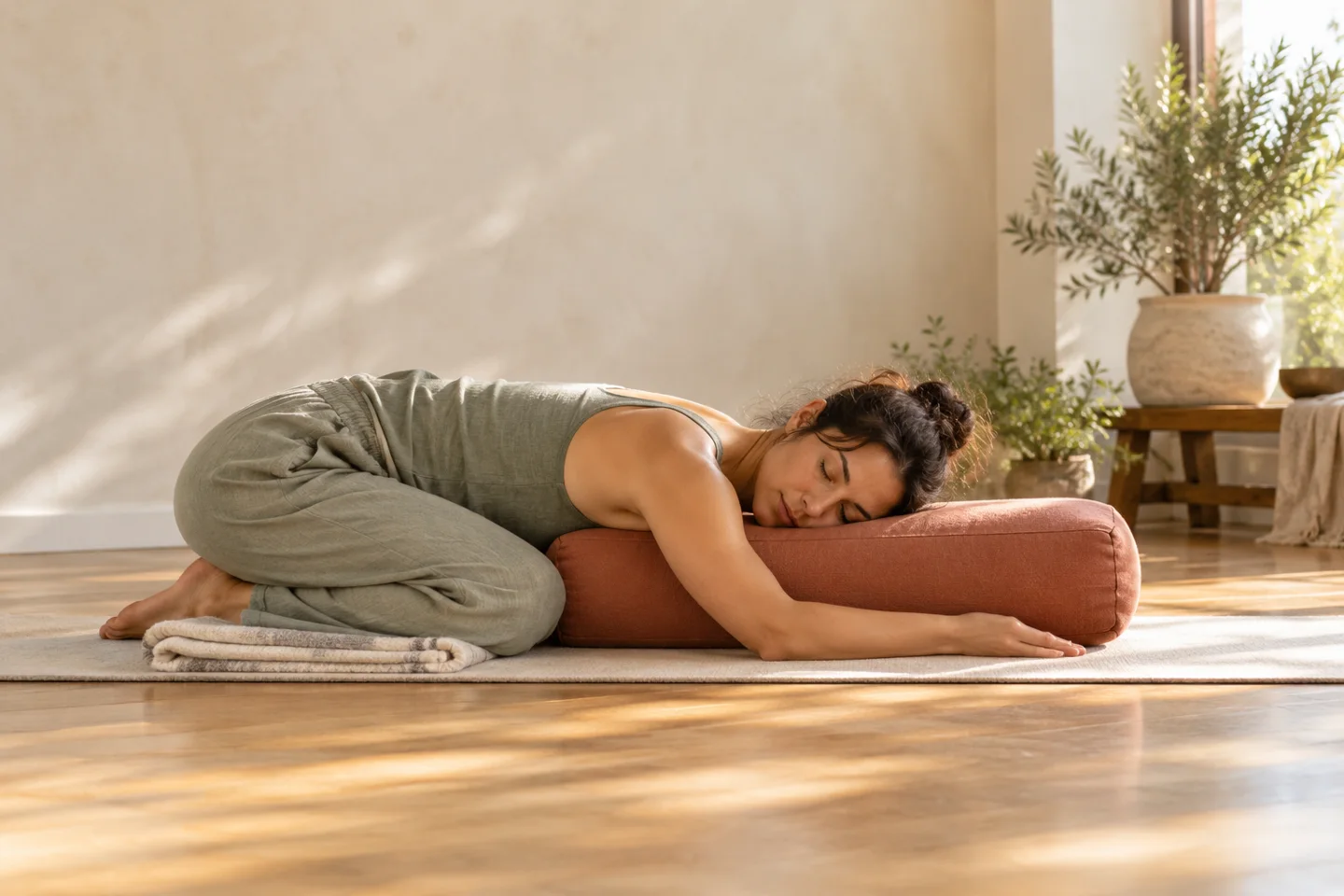
Kneel with your knees apart and place a bolster lengthwise between your thighs. Fold forward and rest your chest and one cheek on the bolster. Turn your head to the other side halfway through.
Hold for 3 to 5 minutes. If your knees feel tight, tuck a blanket behind them, and skip this pose if you have a knee injury.
2. Legs-Up-the-Wall (Viparita Karani)
Sit sideways next to a wall, then swing your legs up as you lie back. Slide a folded blanket under your hips if you like, and rest your arms by your sides.
Hold for 5 to 10 minutes. This is a mild inversion, so people with glaucoma, uncontrolled high blood pressure or certain heart conditions should check with a doctor first.
3. Reclined Bound Angle Pose (Supta Baddha Konasana)
Prop a bolster on a block behind you. Sit at its base, bring the soles of your feet together, and lie back. Place blocks or blankets under each thigh so your hips don’t strain.
Hold for 5 to 10 minutes. If your lower back pinches, lower the bolster or straighten your legs.
4. Supported Bridge (Salamba Setu Bandha Sarvangasana)
Lie on your back with your knees bent. Lift your hips and slide a block, set at its lowest height, under your sacrum (the flat bone at the base of your spine). Let your weight sink onto it.
Hold for 3 to 5 minutes. Avoid this pose if you have a recent neck or back injury.
5. Supported Corpse Pose (Savasana)
Lie on your back with a bolster under your knees and a thin blanket under your head. Cover yourself with a blanket and place an eye pillow over your eyes.
Hold for 10 to 20 minutes. In later pregnancy, rest on your left side instead of your back.
6. Supported Fish Pose (Salamba Matsyasana)
Place a bolster or rolled blanket lengthwise under your upper back so your chest lifts gently. Add a folded blanket under your head, and let your arms rest open at your sides.
Hold for 3 to 5 minutes. Keep the support low if your lower back or neck complains.
7. Supported Reclined Twist (Salamba Bharadvajasana Variation)
Sit with one hip against the short end of a bolster, legs bent to the side. Turn toward the bolster and lower your chest onto it. Rest your head facing whichever way feels easier.
Hold for 3 to 5 minutes on each side. Keep the twist soft, and avoid deep twists during pregnancy or after spinal surgery.
8. Supported Seated Forward Fold (Salamba Paschimottanasana)
Sit with your legs out in front, knees slightly bent over a rolled blanket. Stack a bolster or pillows on your legs and fold forward to rest your arms and head on them.
Hold for 3 to 5 minutes. Stack the props higher rather than pulling yourself down toward them.
What Is the Queen of All Yoga Poses?
Shoulder Stand (Sarvangasana) is often called the queen of all yoga poses, and Headstand (Sirsasana) the king. These titles are commonly linked to B.K.S. Iyengar’s classic book Light on Yoga (1966), and they are still widely used in yoga teaching.
Shoulder Stand is not a restorative pose. It puts weight on the neck and shoulders and takes training to do safely. NCCIH advises people who are new to yoga to avoid extreme practices such as headstands and shoulder stands. If you want the feeling of an inversion without the strain, Legs-Up-the-Wall is the closest restorative option.
Also read: What Is Sirsasana Yoga? Headstand Meaning, Benefits & Safety
What Happens in a Restorative Yoga Class?
A restorative yoga class is quiet, slow and low in effort. Most classes run 60 to 90 minutes and include only a handful of poses. Your teacher spends much of that time helping each student set up props until every pose feels comfortable.
The room is usually dim and warm, and studios usually provide the props. Some teachers play soft music, others prefer silence or a short guided relaxation. While you rest, they may give gentle cues about breath and body awareness. You’ll rarely see anyone break a sweat.
First-timers often notice heavy limbs, slower breathing and short moments when the mind goes quiet.
What Is a Good 60-Minute Restorative Yoga Sequence?
A good 60-minute restorative yoga sequence uses five or six poses, moves from gentle folding to opening and a mild inversion, and ends with a long Savasana. This order lets the body settle first, open gently, and then rest fully.
A sample 60-minute restorative yoga sequence looks like this:
| Time | Pose | Purpose |
|---|---|---|
| 0-5 min | Seated or lying breath awareness | Arrive and turn attention inward |
| 5-13 min | Supported Child’s Pose | Calm the back and breath |
| 13-23 min | Reclined Bound Angle | Open the chest and hips gently |
| 23-31 min | Supported reclined twist, both sides | Release the spine softly |
| 31-39 min | Supported Bridge | Gentle backbend and change of position |
| 39-47 min | Legs-Up-the-Wall | Mild inversion to quiet the body |
| 47-60 min | Supported Savasana with guided rest | Deep, complete rest |
Allow a minute or two between poses to rearrange your props. That slow setup time is part of the practice, not a break from it.
What Should I Wear to Restorative Yoga?
Wear soft, loose, warm clothes, such as sweatpants and a long-sleeved top, and bring socks and an extra layer. Your body cools down when you stay still for a long time, so warmth matters more here than in an active class.
Leave stiff waistbands and belts at home, since they dig in when you lie on a bolster. Take off jewelry and any hair clip at the back of your head, which gets uncomfortable in reclined poses. Choose breathable fabric over style, and bring a light sweater or shawl to pull on before the final rest.
Key Benefits of Restorative Yoga
Restorative yoga may help lower feelings of stress, support better sleep and ease muscle tension, and it is gentle enough for people with very little energy. These possible benefits come from rest itself, not from effort, and most of the evidence comes from studies of yoga in general rather than restorative yoga alone.
- It may reduce feelings of stress. A 2020 review of 12 studies, summarized by NCCIH, found that various types of yoga improved perceived stress in healthy adults.
- It may support better sleep. NCCIH notes that several studies have found yoga helpful for sleep in groups such as older adults and women with sleep problems. That makes restorative yoga for sleep a sensible, low-risk thing to try.
- It eases muscle tension without force. Because props hold you up, tight areas can soften slowly. That’s very different from pushing into a stretch.
- It works on low-energy days. If you’re tired, recovering or under strain, you can still practice, because the effort required is close to zero.
- It builds body awareness. Long holds give you time to notice where you clench your jaw, grip your shoulders or hold your breath.
- It may support emotional well-being. Small studies in women with cancer reported less depression and a greater sense of calm after restorative classes (details in the next section).
- It trains patience. Staying with stillness is a skill, and it tends to carry over into daily life.
These are wellness benefits, not cures. Restorative yoga can be a helpful addition to medical care, never a replacement for it.
What Does the Research Really Say About Restorative Yoga?
Research on restorative yoga is promising but small. Most studies have few participants, and results for physical health markers are mixed. The table includes the weaker results as well as the encouraging ones.
| Study | Who took part | What they did | What they found |
|---|---|---|---|
| Danhauer et al., 2009, Psycho-Oncology | 44 women with breast cancer | 10 weekly 75-minute restorative yoga classes vs a waitlist | The yoga group reported less depression, more positive mood and a greater sense of peace. Fatigue fell within the yoga group. |
| Danhauer et al., 2008, Journal of the Society for Integrative Oncology | 51 women with ovarian or breast cancer | 10 weekly 75-minute classes (no control group) | Improvements in depression, anxiety, mental health and quality of life. Fatigue decreased after the program. |
| Cohen et al., 2008, Metabolic Syndrome and Related Disorders | 26 inactive, overweight adults with metabolic syndrome | 15 sessions of 90 minutes over 10 weeks vs a waitlist | Restorative yoga was practical and well liked; 87% found the poses easy. Changes in weight and blood pressure did not differ significantly from the control group. |
| Corey et al., 2014, Psychoneuroendocrinology (PRYSMS trial) | 171 adults with metabolic syndrome | 1 year of restorative yoga vs gentle stretching | At 6 months, the stretching group had lower waking and bedtime cortisol than the restorative yoga group. At 1 year, the stretching group also reported a larger drop in perceived stress. |
What can we take from this?
- Restorative yoga appears safe and acceptable, even for people who find other exercise hard.
- Results for mood and quality of life look encouraging, especially in cancer support settings. These were small pilot studies, though, and larger trials are needed.
- Results for physical markers are less clear. In one well-designed trial, gentle stretching did better than restorative yoga on stress hormones and perceived stress.
- Looking at yoga more broadly, NCCIH reports it may help with stress, sleep, anxiety symptoms and quality of life in people with chronic illness, while noting that study quality varies.
Overall, restorative yoga is a reasonable, low-risk way to practice rest. Be skeptical of any health claim stronger than “may help.”
What Happens After 30 Days of Restorative Yoga?
After 30 days of regular restorative yoga, you will likely find it easier to settle, quicker to set up your props, and more aware of where you hold tension.
Changes are usually gradual and personal, and no one can promise a specific result. Research has not mapped a month-by-month timeline, so treat the table below as a realistic learning curve rather than a guarantee.
| Time | What you may notice |
|---|---|
| Week 1 | Setting up props feels slow. The mind wanders a lot. |
| Week 2 | You start to know which props you need. Settling takes less time. |
| Week 3 | Longer holds feel easier. You may notice tension earlier in daily life. |
| Week 4 | Rest starts to feel like a skill. Some people find they wind down more easily at night. |
If you’re also doing active yoga for 30 days, any changes in strength, balance or flexibility come from that active practice, not from your restorative sessions.
Why Do I Cry During Restorative Yoga, and Which Poses Make You Cry?
Crying during restorative yoga is common and usually harmless. When your body slows down and the usual distractions disappear, feelings you’ve been holding back have room to surface. Tiredness, relief, grief or simple release can all show up as tears.
Teachers and students often report that tears come most in poses that open the front of the body or the hips. That includes heart openers like Supported Fish and Supported Bridge, hip openers like Reclined Bound Angle, comforting curled shapes like Child’s Pose, and the long final rest.
You may have heard that “emotions are stored in the hips.” It’s a popular idea in yoga, but there’s little scientific evidence for it. A simpler explanation is that stillness, safety and quiet give space to whatever you’re carrying. If tears come, let them pass without judging them.
Ordinary emotional release is different from trauma-related reactions. If stillness brings flashbacks, panic, or a sense of being detached from your body or surroundings, open your eyes, sit up slowly and look around the room. If this happens often, talk with a qualified mental health professional, ideally one experienced in trauma.
Is Restorative Yoga Good for Beginners?
Yes. Restorative yoga for beginners is one of the easiest ways into yoga, because it needs no strength, flexibility or experience. If you can lie on the floor and get up again, you can practice.
New students tend to do best when they take a class before practicing alone, since prop setup is the trickiest part. Tell the teacher about any injuries or health conditions before class starts. And expect a restless mind for the first few sessions; that’s normal, not a sign you’re doing it wrong.
Who Should Try Restorative Yoga? Real-Life Examples
Restorative yoga suits anyone who needs to recover from strain, whether that strain comes from work, training, caregiving or illness. These everyday situations show where it tends to fit well:
- A nurse or shift worker who comes home wired after a long shift and can’t switch off.
- An office worker who spends the day hunched over a laptop and wants to release tension in the shoulders and chest.
- A runner in the week before a race, when training volume drops and recovery matters most.
- A new parent who has 20 minutes during a nap and needs real rest rather than more scrolling.
- An older adult who finds standing or fast classes too demanding.
- Someone recovering from illness who has been cleared by their doctor for gentle movement.
- A yoga teacher who wants to offer students a calmer class or a balance to strong flows.
How Long Should You Hold Restorative Yoga Poses?
Most restorative yoga poses are held for 5 to 20 minutes, and beginners can start with 3 to 5 minutes. The long hold matters, because the body often needs several minutes before it really lets go.
| Your level | Suggested hold per pose | Final rest |
|---|---|---|
| New to yoga | 3-5 minutes | 5-10 minutes |
| Some experience | 5-10 minutes | 10-15 minutes |
| Regular practice | 10-20 minutes | 15-20 minutes |
How Many Times a Week Should You Do Restorative Yoga?
One to three restorative yoga sessions a week work well for most people, and even a single 15-minute pose on a stressful evening can help you unwind. There is no research-based “ideal” number, so consistency matters more than session length.
During a busy week, try one 20-minute pose before bed on three nights. If you train hard, add one 45 to 60-minute session on a rest day. If stress is high, a short daily practice of 10 to 20 minutes is often easier to keep up than one long session.
Can You Lose Weight Doing Restorative Yoga?
Restorative yoga on its own is not a weight-loss practice, because it burns very few calories. It doesn’t count as aerobic or strength exercise. In the 2008 metabolic syndrome pilot study in the research table above, weight changes did not differ significantly from the control group.
Yoga in general may still play a part. NCCIH reports that a 2013 review of 17 yoga-based weight programs found gradual, moderate weight loss in most of them.
The most successful programs used longer, more frequent sessions and included a diet component. Restorative yoga may support healthy habits by easing stress, but it works best alongside regular activity.
Both the CDC in the U.S. and the NHS in the UK recommend at least 150 minutes of moderate activity a week, plus muscle-strengthening activity on at least two days.
Can You Do Restorative Yoga at Home? A 30-Minute Routine
Yes, you can do restorative yoga at home with a few cushions, blankets and a wall. Home practice is one of its biggest strengths. Here’s a simple 30-minute evening routine our team suggests for beginners.
| Step | Pose | Time | Props |
|---|---|---|---|
| 1 | Supported Child’s Pose | 5 min | Bolster or two pillows |
| 2 | Reclined Bound Angle | 7 min | Bolster, two blocks or books, blankets |
| 3 | Supported Bridge | 4 min | One block or a firm stack of books |
| 4 | Legs-Up-the-Wall | 6 min | Wall, folded blanket |
| 5 | Supported Savasana | 8 min | Pillow under knees, blanket, eye cover |
Set up all your props before you start, because getting up mid-practice breaks the calm. Silence your phone and set a gentle timer so you can forget about the clock. Dim the lights, since a bright room keeps the body alert. Then breathe naturally, letting each exhale run a little longer than the inhale without forcing it.
What Not to Do After Yoga
After yoga, don’t jump up quickly, eat a heavy meal straight away, or rush into anything stressful or intense. Give your body a few minutes to return to its normal pace.
- Don’t stand up fast. Roll to your side, pause, and use your hands to push yourself up. This matters most after long rests and inversions, when standing quickly can make you dizzy.
- Don’t eat a large meal right away. Water or a light snack is fine, and many yoga teachers suggest waiting a while before a full meal.
- Don’t drive while you still feel drowsy. Sit for a few minutes until you’re alert.
- Don’t go straight into a hard workout. Your body has just spent an hour winding down.
- Don’t reach for your phone at once. A few quiet minutes help the calm carry into the rest of your day.
Is Restorative Yoga Safe? Who Should Be Careful?
Restorative yoga is one of the gentlest forms of yoga, but some poses need changes for certain health conditions. NCCIH says yoga is generally considered safe for healthy people when practiced properly with a qualified teacher. It also advises people with health conditions to talk with their doctor and their teacher first.
Take extra care, and get medical advice first, in these situations:
- Pregnancy: avoid lying flat on your back for long periods, especially later in pregnancy. Rest on your side instead, and skip deep twists.
- Glaucoma or eye pressure problems: avoid inversions such as Legs-Up-the-Wall and any head-down position.
- High or low blood pressure: check inversions with your doctor.
- Heart conditions: ask your doctor which positions suit you.
- Recent surgery or injury: wait for medical clearance, then adapt poses to protect the healing area.
- Knee, hip or spine problems: add extra support and skip any pose that causes pain.
- Trauma history or strong anxiety: keep your eyes open if you prefer, and look for a teacher trained in trauma-aware teaching.
One rule covers everything: in restorative yoga, pain is always a signal to stop and adjust.
What Are the Most Common Restorative Yoga Mistakes?
The most common restorative yoga mistakes are using too few props, treating the pose like a stretch, and leaving the neck unsupported. Each one stops your body from fully relaxing.
- Too little support. If any part of you is hovering, put something under it.
- Chasing a stretch. Restorative yoga should feel easy. If you feel a strong pull, back off.
- An unsupported neck. When the head isn’t supported, the jaw and shoulders tense up. Add a folded blanket.
- Controlling the breath too much. Forced breathing keeps you alert, so let the breath find its own rhythm.
- Practicing on a full stomach. Folding and reclining feel uncomfortable after a big meal, so leave some time first.
- Trying to “do it right.” There’s no perfect restorative pose. If it feels comfortable and supported, it’s right.
Restorative and Therapeutic Yoga Studios: How to Choose One
A good restorative or therapeutic yoga studio offers small classes, plenty of props, and teachers with specific training in restorative or therapeutic yoga. Searching “restorative yoga near me” or “therapeutic yoga classes” is a good start, but check a few details before you book.
Ask whether the teacher has studied restorative yoga beyond a basic 200-hour course. Keep in mind that a yoga teacher and a yoga therapist are not the same thing.
The International Association of Yoga Therapists (IAYT) certifies yoga therapists with the C-IAYT credential, which requires far more training than a standard teacher training.
A proper restorative class needs several bolsters, blankets and blocks for each student, and smaller groups mean more hands-on help with setup. A careful studio will also ask about injuries and health conditions before your first class.
Be wary of any studio that promises to cure a disease. Therapeutic yoga can support the care you get from your doctor, but it doesn’t replace it.
Also read: What Is Therapy Yoga? Meaning, 8 Uses, Benefits & How It Works
Why Do Some Christians Say Not to Do Yoga?
Some Christians avoid yoga because it comes from Hindu and other Indian spiritual traditions, and they worry that its chants, meditation or philosophy conflict with their faith. Other Christians see the physical and relaxation side of yoga as compatible with their beliefs and practice it freely.
Views differ widely across churches and individuals. Those who object often point to mantras, references to deities, or the goal of spiritual union in classical yoga.
Those who practice often treat postures, breathing and rest as exercise and relaxation, separate from belief. Some Christian groups have created their own versions that combine yoga-style movement with Christian prayer or scripture.
Restorative yoga itself doesn’t require any religious belief, and most restorative classes in the U.S. and UK focus simply on rest, breath and awareness. If faith matters to you, ask the teacher what a class includes, then decide what feels right.
How Does Inteyoga Teach Restorative Yoga?
At Inteyoga, we teach restorative yoga as part of an integrated system that includes Hatha Yoga, pranayama, Yoga Nidra, meditation and yogic lifestyle, rather than as a standalone relaxation class. We find that rest becomes more useful when it’s connected to breath, awareness and daily living.
Our advanced 300-hour program runs in Colva, South Goa, India, and works like this:
- It is fully residential and runs 43+2 days (43 training days, plus one arrival day and one departure day). All teaching is in English.
- It is an advanced yoga teacher training program, not a beginner retreat. You need a completed 200-hour TTC or an equivalent qualification.
- It is open to participants aged 21 to 60 who are in good physical and mental health.
- The curriculum covers restorative principles, safe use of props and modifications, Yoga Nidra, Chakra Sadhana, Prana Vidya, pranayama, meditation, and the yogic management of stress and lifestyle-related imbalance.
- Inteyoga is registered with Yoga Alliance as a Registered Yoga School (RYS 200, RYS 300, RYS 500).
- Under the Gift-it-Forward model, no payment is required to apply or to participate. After completing the program, participants may voluntarily support the Gift-it-Forward initiative to help future aspirants, with no obligation.
Dr. Ashutosh leads the training personally. The teaching methodology module covers how to guide relaxation and Yoga Nidra responsibly, and how to recognize the limits of a yoga teacher’s role. Completing a teacher training does not qualify anyone to diagnose or treat medical conditions.
The next batch runs from December 13, 2026 to January 26, 2027, with further batches scheduled through 2027. See the current dates and full program details, then apply through our application form. New to teacher training? Our planned 200-hour program is expected in approximately mid-2027.
Conclusion: Is Restorative Yoga Right for You?
Restorative yoga is a slow, supported practice that teaches you how to rest on purpose. You hold a few comfortable poses for several minutes each, let the props carry your weight, and allow your breath and mind to settle.
The research is still small, but it points in a hopeful direction for mood and quality of life, and the practice itself carries very little risk. You don’t need a studio or special gear to try it. Tonight, prop your legs up the wall or lie back over a couch cushion for ten minutes, and notice how you feel afterward.
If you already have a 200-hour foundation and want to teach restorative yoga with confidence, explore our 300-hour yoga teacher training in Goa, browse our frequently asked questions, or contact the Inteyoga team with any questions.
Frequently Asked Questions (FAQ)
Can You Fall Asleep During Restorative Yoga?
Yes, and plenty of people do, especially at first. Falling asleep often means your body was more tired than you realized, and most teachers will simply let you rest. Over time, try to stay softly awake, because conscious rest is the real skill restorative yoga builds. If you keep dozing off, practice earlier in the day or leave a little more light in the room.
Is Restorative Yoga Good to Do Before Bed?
Restorative yoga can be a pleasant part of a bedtime routine. One or two gentle poses, such as Legs-Up-the-Wall or Supported Savasana, may help you wind down. If you have chronic insomnia, see a doctor: clinical guidelines from the American College of Physicians recommend cognitive behavioral therapy for insomnia (CBT-I) as the first-line treatment.
Can You Do Restorative Yoga in Bed?
You can do a few poses in bed, such as Supported Savasana or a simple supported Child’s Pose. A soft mattress gives less stable support than the floor, though, so poses like Supported Bridge or Legs-Up-the-Wall work better on a firm surface. If getting down to the floor is hard for you, practicing in bed is a reasonable place to start.
Can Restorative Yoga Help With Back Pain?
Restorative yoga may help some people relax tense muscles around the back, but it is not a treatment for back conditions. NCCIH reports that yoga in general shows only a slight benefit for low-back pain. Anyone with severe, new or worsening pain, numbness or weakness should see a doctor first. A qualified teacher can then help adapt poses safely.
Is Restorative Yoga Safe for Older Adults?
Restorative yoga is often a good fit for older adults because it involves little effort and no balancing. NCCIH notes, however, that the rate of yoga-related injuries treated in emergency departments is higher in people aged 65 and over. Older adults should talk with their doctor first, tell the teacher about any health issues, and take extra care getting up and down from the floor.
Can I Do Restorative Yoga During My Period?
Yes, most people can, and many find supported poses comforting during their period. Reclined Bound Angle and Child’s Pose are popular choices. Some yoga teachers advise skipping inversions such as Legs-Up-the-Wall during menstruation, although views differ. Listen to your body, choose what feels comfortable, and see a doctor if you have heavy bleeding or severe pain.
How Do I Become a Restorative Yoga Teacher?
Most teachers first complete a 200-hour foundation training, then take a restorative yoga teacher training or an advanced program. Look for training that covers prop use, safe modifications, contraindications, anatomy and supervised practice teaching. Check whether the school is registered with Yoga Alliance if that matters for your plans. Inteyoga’s 300-hour training includes restorative yoga within an integrated curriculum.