
Quick Answer
Yoga poses for better sleep are slow, mostly floor-based poses held with relaxed breathing before bed. Commonly recommended choices include Child’s Pose (Balasana), Legs-Up-the-Wall (Viparita Karani), Reclining Bound Angle (Supta Baddha Konasana), Supine Twist and Corpse Pose (Savasana). Hold each for 1 to 5 minutes, about 30 to 60 minutes before bed.
Yoga tradition favors early morning, around sunrise or during Brahma Muhurta, on an empty stomach. In practice, the best time is the one you can keep. If better sleep is your goal, do vigorous yoga earlier in the day and save gentle poses for the evening.
Key Takeaways
- Gentle, supported poses and slow breathing are the heart of bedtime yoga.
- Research suggests regular yoga may improve self-reported sleep quality, though most trials are small.
- For chronic insomnia, cognitive behavioral therapy for insomnia (CBT-I) remains the recommended first-line treatment.
- Practice on an empty or light stomach, and avoid vigorous effort in the hour before bed.
It’s 11:47 p.m. You’ve been in bed for an hour. Your body is done for the day, but your mind keeps going: tomorrow’s meetings, a text you sent at 4 p.m., whether you actually locked the back door.
If that sounds familiar, you have plenty of company. About 3 in 10 US adults sleep less than seven hours a night, according to 2024 survey data from the CDC’s National Center for Health Statistics. In the UK, around one in three adults will have a bout of insomnia at some point, NHS Grampian reports.
Yoga poses for better sleep won’t fix every bad night, and they aren’t a treatment for a sleep disorder. They cost nothing, carry little risk when done gently, and many people find them genuinely calming. In a 2012 US national survey, more than half of adults who practiced yoga said it helped their sleep (NCCIH). That figure is self-reported, so treat it as a starting point. The research section below looks at the stronger studies.
This guide comes from Inteyoga in Colva, South Goa, India. Inteyoga is registered with Yoga Alliance as a Registered Yoga School (RYS 200, RYS 300 and RYS 500). Below you’ll find:
- 12 beginner-friendly poses.
- A 15-minute bedtime routine.
- The breathing techniques that go with it.
- An evidence-checked answer on when to practice.
Want to study restorative practice in depth? Inteyoga’s Advanced TTC 300-Hour Integrated Restorative Yoga (Including Yoga Nidra, Chakra Sadhana, and Prana Vidya Intensive) is a residential advanced teacher training in South Goa. It is for people who have already completed a 200-hour TTC or an equivalent qualification.
What Are Yoga Poses for Better Sleep?
Yoga poses for better sleep are gentle postures held for one to five minutes with slow breathing, done in the evening to help your body and mind wind down. Most are done lying down, seated or kneeling. You won’t be stretching hard or building strength. The aim is to slow everything down.
A good bedtime sequence mixes three things:
- Light movement to ease the stiffness of a day at a desk or behind the wheel, such as Cat-Cow.
- Supported resting poses where your muscles can let go, such as Child’s Pose and Legs-Up-the-Wall.
- Breath and awareness practice to quiet a busy mind, such as Bhramari (humming bee breath) or Yoga Nidra.
In the classical Hatha Yoga approach taught at Inteyoga, posture (asana), breath (pranayama) and relaxation are treated as one practice rather than three separate tools. That integration is what separates bedtime yoga from a quick stretch.
How Does Yoga Help You Sleep Better?
Yoga may help you sleep by slowing your breathing, easing muscle tension and giving a racing mind something steady to focus on. These are plausible mechanisms, and some are supported by small studies. Researchers have not yet shown exactly how yoga improves sleep.
Many people with insomnia stay in a state of heightened alertness, often called hyperarousal, at bedtime. A 2019 perspective paper in Frontiers in Psychiatry notes that breathing naturally slows as good sleepers drift off. It proposes slow breathing as an add-on to established insomnia treatments (Jerath et al.).
Here is what the evidence suggests so far:
- Slower breathing. In a small randomized sleep-lab study, a single 30-minute Yoga Nidra session lowered breathing rate by about 1.4 breaths per minute. It did not change how quickly people fell asleep, their heart rate variability or their brain-wave measures (Closer Look at Yoga Nidra).
- Stress hormones. In one randomized trial of 41 adults with chronic insomnia at the All India Institute of Medical Sciences (AIIMS), New Delhi, salivary cortisol fell after a course of Yoga Nidra (National Medical Journal of India, 2021). One small trial can’t show that yoga lowers cortisol in everyone.
- Physical tension. Forward folds, twists and hip openers can loosen the lower back, neck and hips. Many people find that this makes it easier to get comfortable in bed.
- Attention. Following the breath in a pose gives your mind something to hold onto other than the day’s replay.
The breath matters more than the pose. A simple pose held with slow, quiet breathing is a better bedtime choice than a demanding pose held while you strain.
What Does the Research Say About Yoga for Sleep?
The research is encouraging but still limited. Systematic reviews suggest that regular yoga may improve self-reported sleep quality, with more consistent results in programs lasting several weeks. Most trials are small, and evidence from objective sleep measurements is thinner. Yoga is best seen as a supportive habit, not a replacement for medical care.
| Study (year) | Who was studied | What they found |
|---|---|---|
| Wang et al., BMC Psychiatry (2020) | 19 studies, 1,832 women with sleep problems | Yoga improved sleep compared with non-active controls; no serious adverse events were reported |
| Scoping review, PMC (2025) | People with sleep disorders practicing yoga over weeks or months | Programs of 7–16 weeks showed consistent gains in sleep quality and lower insomnia severity |
| Datta et al., AIIMS (2021) | 41 adults with chronic insomnia; Yoga Nidra vs CBT-I | Both groups improved; the Yoga Nidra group also showed more deep (N3) sleep and lower cortisol |
| NCCIH, National Health Interview Survey (2012) | US adults who practice yoga | Over 55% said their sleep improved; over 85% said stress fell (self-reported) |
| Slow-breathing review, Sleep Medicine Reviews (2026) | 9 studies, 457 participants | People reported longer, better sleep after slow breathing; objective sleep results were inconclusive |
| Johns Hopkins Medicine | Older adults in a yoga program | Reported better sleep quality, duration and efficiency |
Which Type of Yoga Is Best for Sleep?
Gentle Hatha, restorative yoga and Yoga Nidra are the best fits for bedtime, because they keep effort low and your body close to the floor. Johns Hopkins Medicine notes that hot yoga and fast vinyasa flows raise your heart rate, so they suit earlier in the day better.
| Yoga style | Good before bed? | Why |
|---|---|---|
| Restorative yoga | Yes | Props support your body so muscles can relax |
| Gentle Hatha yoga | Yes | Slow poses with breath awareness |
| Yoga Nidra | Yes | Guided relaxation done lying down |
| Yin yoga | Yes, with care | Long holds; keep stretches mild at night |
| Vinyasa or Power yoga | Better earlier if vigorous | A meta-analysis found that vigorous exercise ending within an hour of bedtime may delay sleep (Stutz et al., 2019) |
| Hot or Bikram yoga | Better earlier | In the same meta-analysis, a higher body temperature at bedtime was linked to lower sleep efficiency |
Our guides to restorative yoga and Hatha yoga explain each style in more detail.
When Is the Best Time to Do Yoga?
Traditionally, the best time to do yoga is early morning, around sunrise or during Brahma Muhurta, on an empty stomach. In practice, any time you can keep up consistently will serve you well. Different times of day suit different kinds of practice. Pick a slot that fits your life, then match the style to it.
Early Morning (Sunrise / Brahma Muhurta): Why Is It Considered the Best Time?
Early morning is the traditional time for yoga because your stomach is usually empty, the house is quiet and the day hasn’t started making demands. In Indian tradition, Brahma Muhurta is described as a 48-minute window that begins about 1 hour 36 minutes before sunrise. With a 6:00 a.m. sunrise, that is roughly 4:24 to 5:12 a.m.
You don’t need to wake at 4:24 to benefit. Plenty of people simply roll out a mat at 6:30 before the school run or the commute.
Pros
- An empty stomach makes twists and forward bends comfortable.
- A quiet start suits pranayama and meditation.
- Many people find it sets a calmer tone for the day.
- It is the traditional time for Surya Namaskar (Sun Salutations).
- It’s easier to protect as a habit before work and family take over.
Cons
- Muscles often feel stiffer first thing, so a gentle warm-up matters.
- It is hard for shift workers and natural night owls.
Short on time? Try our 10-minute morning yoga routine for energy.
Afternoon or Midday: Is It Good to Do Yoga at Lunchtime or Between 3 and 5 p.m.?
Yes, the afternoon can be a good time for yoga, as long as you leave enough time after lunch. Body temperature rises through the day. Some studies find people are slightly more flexible later in the day, though the evidence on flexibility is mixed.
For example, if you work from home and eat lunch at 12:30, a 3:30 p.m. session fits well and can break up the mid-afternoon slump.
Pros
- Your body is warmer than in the early morning.
- It gives desk workers a useful reset.
- It is a good time to work carefully on harder poses.
Cons
- It is hard to fit around office hours.
- Practicing too soon after lunch can cause heaviness, cramps or heartburn.
- In hot weather, avoid very heating practice at midday.
Evening or Late Afternoon (Around Sunset): What Kind of Yoga Works Best?
Evening yoga, around sunset, works best as gentle stretching and slow breathing to let go of the day’s tension. Moderate evening exercise doesn’t appear to harm sleep in healthy adults, according to a 2019 meta-analysis (Stutz et al.). Still, a calmer practice suits the hours before bed.
Pros
- It eases tension in the back, neck and hips after work.
- It draws a clear line between your workday and your evening.
- Your body is already warm, so stretches come easily.
Cons
- Evening plans and fatigue make it easy to skip.
- A strenuous session right before dinner or bedtime can feel unsettling.
Bedtime or Night: Is It Okay to Do Yoga Before Sleep?
Yes. Gentle yoga before bed is fine for most people and can be a relaxing part of a wind-down routine. Just avoid vigorous, energizing poses. The full bedtime sequence, the poses to skip and the 15-minute routine come later in this guide.
Morning vs Evening Yoga: How Do the Times of Day Compare?
Morning yoga suits energy and focus; evening yoga suits relaxation and stress relief. Use this table to choose your slot.
| Feature | Early morning | Afternoon (12–5 p.m.) | Evening (sunset) | Night (before bed) |
|---|---|---|---|---|
| Main aim | Energy and focus | Strength and mobility | Stress relief | Relaxation and sleep |
| Stomach | Usually empty | Needs a gap after lunch | Usually empty before dinner | Needs a gap after dinner |
| How your body feels | Often stiffer | Warmer | Warm | Winding down |
| Intensity | Active to moderate | Moderate to active | Gentle to moderate | Very gentle |
| Traditional Ayurvedic period | Vata before sunrise, then Kapha | Pitta, then Vata | Kapha begins | Kapha |
| Best for | Early risers, habit builders | Desk workers | High-stress jobs | Poor sleepers, busy minds |
What Does Ayurveda Say About the Best Time for Yoga?
Ayurveda, India’s traditional system of medicine, divides the day into periods associated with three doshas: Vata, Pitta and Kapha. It links each period with different kinds of activity. This is a traditional framework, not established physiology, but many practitioners find it a useful way to plan their day (Yoga International).
| Time | Dosha | Traditional qualities | Suggested practice |
|---|---|---|---|
| 2–6 a.m. | Vata | Light, airy, alert | Meditation, pranayama, rising in Brahma Muhurta |
| 6–10 a.m. | Kapha | Heavy, steady, slow | Active practice and Surya Namaskar |
| 10 a.m.–2 p.m. | Pitta | Hot, sharp, digestive | The main meal; avoid very heating yoga |
| 2–6 p.m. | Vata | Light, mobile | Grounding standing poses and steady breathing |
| 6–10 p.m. | Kapha | Slow, calm, heavy | Gentle, restorative practice |
| 10 p.m.–2 a.m. | Pitta | Internal repair | Sleep; Ayurvedic guidance favors bed by about 10 p.m. |
Ayurveda also favors a larger lunch and a light supper. That habit fits well with both evening yoga and an easier bedtime.
What Does Science Say About Timing Your Yoga Practice?
Science links practice timing to a few daily body rhythms, but none of them sets one “correct” time for yoga.
- Morning cortisol. Cortisol typically rises by 38–75% after waking and peaks about 30 minutes later (Elder et al., Sleep Medicine Reviews, 2014). Many people feel alert in the morning, and that suits active practice, though the hormone’s exact role is still debated.
- Body temperature. Core body temperature is lowest in the early hours and rises through the day. Physical performance tends to peak in the late afternoon or early evening, close to the temperature peak (narrative review, 2025).
- Digestion. Poses that press on the abdomen, such as twists and forward bends, can be uncomfortable on a full stomach. India’s Ministry of AYUSH advises practicing on an empty or light stomach (Common Yoga Protocol).
- Sleep. A 2019 meta-analysis of 23 studies found that evening exercise did not generally harm sleep. Vigorous exercise ending within an hour of bedtime was the exception (Stutz et al.).
What Are the Golden Rules of Yoga, Regardless of Time?
Whenever you practice, the same basics apply: an empty or light stomach, an empty bladder and bowels, a regular time, and intensity matched to the time of day.
What Is the Meal Gap Rule for Yoga?
A common rule of thumb among yoga teachers is to wait 3–4 hours after a heavy meal, 2–3 hours after a normal meal and 1–2 hours after a light snack. The Ministry of AYUSH guidance is simpler. It says to practice on an empty or light stomach, and suggests a little honey in lukewarm water if you feel weak beforehand (Common Yoga Protocol).
| What you ate | Typical wait before yoga |
|---|---|
| Heavy meal (Sunday roast, big pasta dinner, Thanksgiving plate) | 3–4 hours |
| Normal meal (a sandwich and soup) | 2–3 hours |
| Light snack (a banana, a handful of almonds) | 1–2 hours |
| A few sips of water | Fine |
After practice, the same AYUSH guidance suggests waiting about 20–30 minutes before eating.
Why Should Your Bladder and Bowels Be Empty Before Yoga?
An empty bladder and bowels make practice more comfortable, because many poses press on the abdomen and pelvis. The Ministry of AYUSH’s Common Yoga Protocol lists this as a basic guideline before any practice. In traditional Hatha Yoga, practice begins after morning elimination, which is one reason early mornings work well.
What Other Rules Apply at Any Time of Day?
- Consistency beats timing. Practice at roughly the same time each day so it becomes routine.
- Match the intensity to the clock. Active in the morning, moderate in the afternoon, gentle at night.
- Wear loose clothing and use a non-slip mat or folded blanket in a well-ventilated room.
- Rest when you’re unwell, feverish or dizzy, and skip intense practice on those days.
- Finish every session with a short Savasana, even if it’s only two minutes.
Which Yoga Style Should You Do at Each Time of Day?
Do energizing styles such as Vinyasa and Power Yoga earlier in the day, and calming styles such as Yin Yoga and Yoga Nidra at night.
| Time of day | Suitable yoga styles | Why |
|---|---|---|
| Early morning | Surya Namaskar, Vinyasa, Power Yoga, Ashtanga, pranayama, meditation | Builds energy and focus for the day |
| Afternoon | Hatha, alignment-based styles such as Iyengar Yoga | A warmer body suits careful, precise work |
| Evening (sunset) | Gentle Hatha, slow flow, Yin Yoga | Releases the day’s tension without overstimulating you |
| Night (before bed) | Restorative yoga, Yin Yoga, Yoga Nidra, Bhramari | Supports winding down for sleep |
What Are the 12 Best Yoga Poses for Better Sleep?
These are 12 widely recommended yoga poses for better sleep:
- Child’s Pose
- Cat-Cow
- Standing Forward Fold
- Seated Forward Bend
- Head-to-Knee Pose
- Reclining Bound Angle
- Legs-Up-the-Wall
- Supine Twist
- Happy Baby
- Supported Bridge
- Reclining Hand-to-Big-Toe
- Corpse Pose
They run from gentle movement to stillness. No study ranks one pose above the others for sleep, so choose four to six that feel good to you.
Before you start, dim the lights, switch your phone to Do Not Disturb, and keep a pillow, a folded blanket and a strap or towel nearby.
1. How Do You Do Child’s Pose (Balasana) for Sleep?
Child’s Pose is a kneeling forward rest that gently stretches the lower back and hips. Harvard Health includes the wide-knee version in its bedtime sequence (Harvard Health).
- Kneel with your big toes touching and your knees wide.
- Fold forward and rest your forehead on the mat or a pillow.
- Reach your arms forward, or rest them alongside your feet.
- Breathe slowly into your back ribs.
- Hold: 1 to 3 minutes.
- Easier version: place a pillow lengthwise under your chest.
- Caution: if your knees ache, put a folded blanket between your calves and thighs.
2. How Does Cat-Cow (Marjaryasana-Bitilasana) Help Before Bed?
Cat-Cow is a slow spinal movement that eases stiffness after a long day of sitting. It makes a good opener for a bedtime routine because each movement follows a breath.
- Come onto your hands and knees, wrists under shoulders, knees under hips.
- Inhale: let your belly drop and lift your chest (Cow).
- Exhale: round your spine and tuck your chin (Cat).
- Move as slowly as your breath, about 4 seconds each way.
- Repeat: 6 to 10 rounds.
- Good after: a long drive or a day of video calls.
- Caution: keep the neck movement small if you have neck problems.
3. Why Is Standing Forward Fold (Uttanasana) Good for Sleep?
Standing Forward Fold is a soft, hanging fold that many people find quieting after a busy day. Keep it loose and easy, like a rag doll, rather than deep.
- Stand with feet hip-width apart and knees softly bent.
- Fold forward from the hips and let your head hang.
- Hold opposite elbows and sway gently.
- Roll up slowly, one vertebra at a time.
- Hold: 30 seconds to 1 minute.
- Caution: this is a head-down pose. In a small 2015 study, head-down yoga poses including Uttanasana raised eye pressure within a minute (Jasien et al., PLOS ONE). If you have glaucoma, uncontrolled high blood pressure or get dizzy easily, use the seated forward bend instead.
4. How Does Seated Forward Bend (Paschimottanasana) Calm the Mind?
Seated Forward Bend stretches the back of the body and encourages slower breathing. Yoga tradition regards forward bends as calming.
- Sit with your legs straight and a folded blanket under your hips.
- Inhale to lengthen your spine.
- Exhale and fold forward, bending your knees as much as you need.
- Rest your hands on your shins, or loop a strap around your feet.
- Hold: 1 to 3 minutes.
- Caution: keep the knees bent and the fold shallow if you have a lower-back disc problem.
5. How Do You Do Head-to-Knee Pose (Janu Sirsasana)?
Head-to-Knee Pose is a one-leg forward fold that stretches the hamstrings and lower back one side at a time. Stiff beginners often find it easier than a full forward bend.
- Sit with your right leg straight. Bend your left knee and rest the sole against your right inner thigh.
- Inhale to lengthen. Exhale and fold over the straight leg.
- Rest your forehead on a pillow placed on your thigh.
- Switch sides.
- Hold: 1 minute each side.
- Caution: put a cushion under the bent knee if it doesn’t reach the floor.
6. Why Is Reclining Bound Angle (Supta Baddha Konasana) a Top Sleep Pose?
Reclining Bound Angle is popular at bedtime because your whole body is supported while the hips and chest gently open. That makes it easy to stay still and breathe slowly.
- Sit with the soles of your feet together and your knees falling open.
- Lie back, with a pillow or bolster along your spine if you like.
- Tuck cushions under each knee so your inner thighs can relax.
- Rest your hands on your belly and breathe slowly.
- Hold: 3 to 5 minutes.
- Caution: support the knees well if you have groin or knee strain.
7. How Does Legs-Up-the-Wall (Viparita Karani) Help You Sleep?
Legs-Up-the-Wall is a gentle, supported pose that many people find restful for tired legs at the end of the day. It also works on a bed, with your legs against the headboard.
- Sit sideways with one hip touching a wall.
- Swing your legs up the wall as you lie back.
- Slide a folded blanket under your hips if that’s comfortable.
- Let your arms rest open, palms up.
- Hold: 3 to 5 minutes.
- Good after: a day on your feet, such as a retail shift, a hospital ward or a long day of sightseeing.
- Caution: Viparita Karani was one of the head-down poses that raised eye pressure in the 2015 PLOS ONE study. If you have glaucoma, ask your eye specialist first. In pregnancy, the NHS advises against lying flat on your back for long periods, especially after 16 weeks (NHS).
8. How Do You Do Supine Twist (Supta Matsyendrasana) at Night?
Supine Twist is a lying-down rotation that gently releases the lower back.
- Lie on your back and hug your knees to your chest.
- Drop both knees to the right and open your arms wide.
- Turn your head to the left if your neck allows.
- Breathe into the left side of your ribs, then switch sides.
- Hold: 1 to 2 minutes each side.
- Caution: keep the twist mild during pregnancy and with spinal injuries.
9. Why Is Happy Baby (Ananda Balasana) Relaxing?
Happy Baby is a playful hip opener that eases the lower back and pelvis.
- Lie on your back and draw your knees toward your armpits.
- Hold the outsides of your feet, your ankles or your shins.
- Let your knees drop wide while your lower back stays on the mat.
- Rock gently side to side.
- Hold: 1 minute.
- Caution: hold behind your thighs instead if you can’t reach your feet.
10. How Do You Do Supported Bridge (Setu Bandhasana)?
Supported Bridge is a mild backbend done resting on a block or firm pillow, so the chest opens with very little effort. Save the active, unsupported Bridge for daytime.
- Lie on your back with knees bent and feet hip-width apart.
- Lift your hips and slide a firm pillow or yoga block under your sacrum.
- Lower your weight onto the support.
- Rest your arms by your sides.
- Hold: 2 to 3 minutes.
- Caution: keep the support low if you have neck or lower-back pain.
11. How Does Reclining Hand-to-Big-Toe (Supta Padangusthasana) Help?
Reclining Hand-to-Big-Toe stretches the hamstrings and calves while you lie flat, which many people find soothing for legs that feel restless at night.
- Lie on your back and loop a strap or towel around your right foot.
- Raise the leg toward the ceiling with a soft bend in the knee.
- Keep your left leg long on the floor.
- Switch sides.
- Hold: 1 minute each side.
- Caution: lower the leg if you feel a pull behind the knee. Persistent restless legs at night can have medical causes worth discussing with a doctor.
12. Why Is Corpse Pose (Savasana) the Final Sleep Pose?
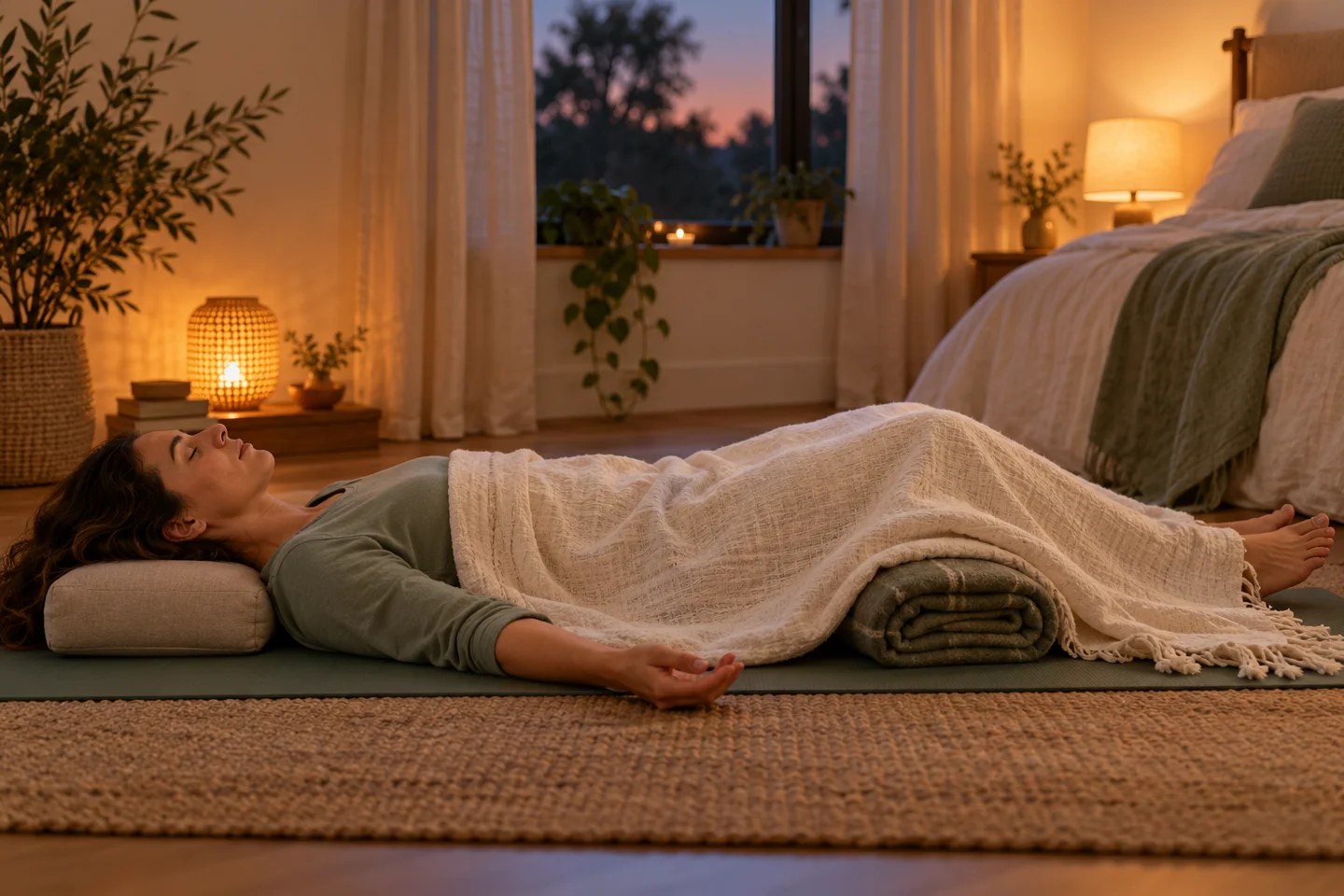
Corpse Pose is complete stillness lying on your back, and it traditionally closes every yoga practice. In a bedtime routine, this is where you stop doing and let sleep come.
- Lie on your back with legs slightly apart and arms away from your body, palms up.
- Put a pillow under your knees if your lower back aches.
- Close your eyes and let your muscles soften, from your toes to your face.
- Let your breathing find its own rhythm.
- Hold: 5 to 10 minutes, or until you fall asleep.
- In later pregnancy: rest on your side instead.
- Go further: add the short Yoga Nidra practice below.
Quick Reference: Yoga Poses for Better Sleep at a Glance
| Pose | Sanskrit name | Often used for | Hold | Can you do it in bed? |
|---|---|---|---|---|
| Child’s Pose | Balasana | Racing mind, back tension | 1–3 min | Yes |
| Cat-Cow | Marjaryasana-Bitilasana | Stiffness from sitting | 6–10 rounds | Yes, on a firm mattress |
| Standing Forward Fold | Uttanasana | Mental fatigue | 30–60 sec | No |
| Seated Forward Bend | Paschimottanasana | Slowing the breath | 1–3 min | Yes |
| Head-to-Knee | Janu Sirsasana | Tight hamstrings | 1 min each side | Yes |
| Reclining Bound Angle | Supta Baddha Konasana | Deep relaxation, hips | 3–5 min | Yes |
| Legs-Up-the-Wall | Viparita Karani | Tired legs, winding down | 3–5 min | Yes, against the headboard |
| Supine Twist | Supta Matsyendrasana | Lower back | 1–2 min each side | Yes |
| Happy Baby | Ananda Balasana | Hips and lower back | 1 min | Yes |
| Supported Bridge | Setu Bandhasana (supported) | Chest and shoulders | 2–3 min | Yes, with a pillow |
| Reclining Hand-to-Big-Toe | Supta Padangusthasana | Tight legs | 1 min each side | Yes |
| Corpse Pose | Savasana | Falling asleep | 5–10 min | Yes |
Which Yoga Poses Should You Avoid Before Bed?
Skip vigorous, heating or neck-loading poses in the hour before sleep. Some popular articles recommend Plow Pose (Halasana) for sleep, but it puts heavy load on the neck. It was also one of the head-down poses that raised eye pressure in the 2015 PLOS ONE study. It isn’t a good choice for beginners practicing alone at night.
- Sun Salutations (Surya Namaskar) are energizing and better in the morning.
- Strong backbends, such as Wheel or Camel, are stimulating.
- Headstand and Shoulder Stand are risky without supervision and stimulating.
- Plow Pose (Halasana) strains the neck.
- Fast flows and standing balances raise your heart rate.
- Kapalabhati and Bhastrika are fast breathing techniques traditionally used to energize.
Which Breathing Techniques Help You Fall Asleep?
Slow nasal breathing with a longer exhale may help you settle before sleep. A 2026 systematic review in Sleep Medicine Reviews looked at nine studies with 457 participants (Eide et al.).
People reported longer and better sleep after slow breathing before bed. Studies that measured sleep objectively were inconclusive. Pair any of the techniques below with your poses.
How Do You Practice Bhramari (Humming Bee Breath) for Sleep?
Bhramari is a breathing technique where you hum on a long exhale, and many practitioners use it to calm down at bedtime. A small 2023 pilot study of 23 adults in Cureus compared humming with physical activity, emotional stress and sleep. Humming produced the lowest stress index of the four, as measured by heart rate variability (PubMed). The study did not measure sleep outcomes, so treat it as early evidence.
- Sit comfortably or lie on your back, eyes closed.
- Gently close your ears with your thumbs or index fingers.
- Breathe in slowly through your nose.
- Breathe out with a low, steady hum, like a bee.
- Repeat 5 to 7 rounds, then sit or lie quietly.
Caution: don’t press hard on your ears, and skip the ear closure if you have an ear infection.
What Is the Easiest Sleep Breath for Beginners?
Belly breathing with a longer exhale is the easiest place to start. Breathe in through your nose for a count of 4, then out through your nose for a count of 6. Keep a hand on your belly and feel it rise and fall. Continue for 3 to 5 minutes.
Does Ujjayi Breath Help You Sleep?
A soft Ujjayi breath helps many people relax in restorative poses, and Harvard Health suggests it for bedtime yoga. Breathe through your nose while gently narrowing the back of your throat, so the exhale sounds like distant waves. At night, keep it quiet and effortless.
Is Nadi Shodhana (Alternate Nostril Breathing) Good Before Bed?
Nadi Shodhana, also called Anulom Vilom, is a slow, balancing breath that many practitioners use to settle the mind before sleep.
- Close your right nostril and breathe in through the left.
- Close the left nostril and breathe out through the right.
- Breathe in through the right.
- Close the right nostril and breathe out through the left. That’s one round.
Do 5 to 9 slow rounds without holding your breath.
Is Yoga Nidra Good for Sleep?
Yoga Nidra, often translated as “yogic sleep,” is a guided relaxation done lying down. Small trials suggest it may help some people with insomnia, though the evidence is still limited.
- The AIIMS trial. 41 adults with chronic insomnia did either Yoga Nidra or cognitive behavioral therapy for insomnia (CBT-I). Both groups improved, and the Yoga Nidra group also showed more deep (N3) sleep and lower cortisol (NMJI, 2021).
- A 2025 systematic review of randomized trials. Most included studies reported improvements in sleep onset, total sleep time and sleep efficiency (SAGE, 2025).
- A smaller sleep-lab study. A single session slowed breathing but did not shorten the time it took people to fall asleep.
Yoga Nidra is a relaxation practice. It doesn’t replace sleep or medical treatment. Some apps and podcasts describe a similar practice as “non-sleep deep rest” (NSDR).
How Do You Do a 10-Minute Yoga Nidra at Home?
- Settle (1 min). Lie in Savasana and take three slow breaths.
- Sankalpa (30 sec). Silently repeat a short, positive intention, such as “I rest deeply.”
- Body scan (4 min). Move your attention slowly through each part of the body: the fingers of your right hand, palm, arm, then the left side, legs, back, front and face.
- Breath awareness (2 min). Count breaths backward from 27 to 1. If you lose count, start again.
- Opposites (1 min). Notice heaviness, then lightness. Warmth, then coolness.
- Visualization (1 min). Picture a calm scene, such as a quiet beach at dusk.
- Close (30 sec). Repeat your Sankalpa. At bedtime, let yourself drift off.
A recorded voice makes this much easier for beginners. Traditionally, Yoga Nidra trains you to stay aware while deeply relaxed, but at bedtime it’s fine to fall asleep.
What Does Inteyoga’s Residential Day Teach Us About Sleep?
The published sample schedule for Inteyoga’s advanced 300-hour programme shows a simple pattern: active practice in the morning, stillness in the evening, and fixed times for meals, waking and lights out. The schedule may change with the training phase, weather and faculty guidance (sample schedule).
| Time | What happens |
|---|---|
| 5:00 a.m. | Wake-up bell |
| 8:00–10:30 a.m. | Asana and pranayama |
| 2:00–3:30 p.m. | Yoga Nidra |
| 6:30 p.m. | Dinner |
| 7:30–8:30 p.m. | Meditation (Dhyana Swaroopam) |
| 9:30 p.m. | Lights off |
You don’t need to live in a training center to borrow its structure:
- Keep vigorous practice for the morning. Use the evening for gentle movement and stillness.
- Eat dinner early, about three hours before you plan to sleep.
- Keep wake and bed times steady, including at weekends where you can.
What Is the Best 15-Minute Bedtime Yoga Routine?
This 15-minute bedtime routine moves from gentle movement to stillness: Cat-Cow, Child’s Pose, Supine Twist, Reclining Bound Angle, Legs-Up-the-Wall, then Bhramari and Savasana. Do it 30 to 60 minutes before bed, in dim light, following the meal gap rule above.
- Cat-Cow (1.5 minutes). 8 slow rounds, one movement per breath.
- Child’s Pose (2 minutes). Knees wide, forehead on a pillow.
- Supine Twist (2 minutes). 1 minute each side.
- Reclining Bound Angle (3 minutes). Cushions under the knees, hands on the belly.
- Legs-Up-the-Wall (3 minutes). Belly breathing, with the exhale longer than the inhale.
- Bhramari (1.5 minutes). 5 to 7 rounds, seated or lying down.
- Savasana (2 minutes or more). Let your body go and let sleep come.
Total: about 15 minutes. On nights when you have more time, add the 10-minute Yoga Nidra at the end. If you have glaucoma, swap Legs-Up-the-Wall for an extra few minutes in Reclining Bound Angle.
Which Routine Fits Your Sleep Problem?
Different sleep complaints call for different tools, so match your poses to what’s keeping you up. This is a practical guide built from the poses above, not a clinically tested protocol.
| Your sleep problem | Suggested poses | Suggested breath or practice | Time needed |
|---|---|---|---|
| Can’t fall asleep (racing mind) | Child’s Pose, Seated Forward Bend, Savasana | Bhramari, then Yoga Nidra | 15–20 min |
| Waking at 2–4 a.m. | Savasana in bed, with knees supported | 4–6 belly breathing | 5–10 min |
| Stiff back from desk work | Cat-Cow, Supine Twist, Happy Baby | Ujjayi | 10 min |
| Tight or achy legs | Reclining Hand-to-Big-Toe, Legs-Up-the-Wall | Belly breathing | 8–10 min |
| Too exhausted to move | Reclining Bound Angle, Savasana | Recorded Yoga Nidra | 10 min |
| Night shifts or irregular hours | Child’s Pose, Legs-Up-the-Wall, Savasana | Nadi Shodhana | 10 min, before your main sleep |
How Can You Tell If Bedtime Yoga Is Working?
Keep a simple two-week sleep log, because small changes are easy to miss. Research programs that reported benefits usually ran for several weeks, so give it time. Copy this into a notebook or your phone:
| Night | Poses practiced | Minutes | Time to fall asleep (estimate) | Times woken | Morning energy (1–5) |
|---|---|---|---|---|---|
| 1 | |||||
| 2 | |||||
| 3 | |||||
| … through 14 |
Compare week one with week two. If nothing has changed after a month, see your doctor or GP. See them sooner if you snore loudly, gasp at night or feel exhausted every day.
What Are the Benefits of Yoga Poses for Better Sleep?
Research and survey data suggest that yoga poses for better sleep may help you feel you slept better, ease stress and reduce muscle tension. Most benefits build over weeks of regular practice rather than overnight.
- Better self-reported sleep quality. A 2020 meta-analysis of 19 studies with 1,832 women found yoga improved sleep compared with non-active controls (BMC Psychiatry).
- Lower insomnia severity. A 2025 scoping review reported consistent improvements in programs of 7 to 16 weeks.
- Less stress. In US survey data, over 85% of people who practiced yoga said it reduced their stress (NCCIH).
- Possible changes in deep sleep and cortisol. One small AIIMS trial reported more deep N3 sleep and lower cortisol after Yoga Nidra. Larger studies are needed.
- Less muscle tension. Many people find twists, forward folds and hip openers ease the back, hips and shoulders.
- A bedtime ritual that replaces scrolling. A short, repeated sequence can become a cue that the day is over.
- A good safety record. The 2020 meta-analysis found no serious adverse events linked to yoga.
- Steadier mornings. If you pair this routine with our morning yoga routine, you get a simple daily rhythm.
Yoga Poses for Better Sleep vs Yoga Nidra: What Is the Difference?
Yoga poses for better sleep work through the body, using gentle movement and stretching. Yoga Nidra works through attention, using guided awareness while you lie completely still. They pair well: the poses help your body settle, then Yoga Nidra helps your mind follow.
| Feature | Yoga poses for better sleep | Yoga Nidra |
|---|---|---|
| What it is | Gentle poses held 1–5 minutes | Guided body scan and relaxation in Savasana |
| Main focus | Muscle tension, breath | Attention, deep relaxation |
| Movement | Yes, light | None |
| Time needed | 10–20 minutes | 10–30 minutes |
| Often chosen for | Stiff bodies, desk workers | Racing thoughts, waking at night |
| Equipment | Mat, pillow, strap or towel | Mat or bed, optional recording |
| Research snapshot | A meta-analysis of 19 studies in women found better sleep quality | Small trials, including the AIIMS study, report better sleep |
| Can you do it in bed? | Most poses, yes | Yes, fully |
| Learning curve | Easy | Easy with a recording; deeper with a trained teacher |
How Does Bedtime Yoga Compare With Other Sleep Aids?
Bedtime yoga is a low-risk habit that may support sleep, but it isn’t a substitute for treatment of a diagnosed sleep disorder. In 2024, 12.9% of US adults used sleep aids on most days or every day in the previous month (CDC NCHS). This comparison is for general information only.
| Approach | How it may help | Typical time to notice | Points to know |
|---|---|---|---|
| Yoga poses and breathing | Relaxation, less muscle tension | Often a few weeks | Low risk when done gently |
| Yoga Nidra | Guided relaxation | Days to weeks | Evidence promising but limited |
| CBT-I (therapy) | Changes sleep habits and unhelpful thoughts about sleep | Usually 4–8 sessions | The American Academy of Sleep Medicine strongly recommends it for chronic insomnia (AASM); also offered through digital programs |
| Sleep medication | Acts on brain chemistry | Fast | Use only under a doctor’s guidance |
| Vigorous late workouts | Physical tiredness | Varies | Ending within an hour of bed may delay sleep |
What Mistakes Stop Bedtime Yoga From Working?
The most common mistakes are practicing too hard, too soon after a big meal, or with screens and bright light around you.
- Turning it into a workout. Bedtime yoga should feel easy. If you’re sweating, slow down.
- Holding your breath. Keep breathing slowly through your nose. AYUSH guidance also advises against holding the breath unless a technique calls for it.
- Bright light and screens. Dim the lights and leave your phone in another room.
- Practicing on a full stomach. Follow the meal gap rule above, especially after a big dinner.
- Forcing deep stretches. Stop well short of your limit. Pain keeps you awake.
- Skipping props. Pillows and blankets let your muscles fully relax.
- Being inconsistent. Short nightly sessions are usually easier to keep up than occasional long ones.
- Jumping up after Savasana. Stay still, then go straight to bed.
Who Should Be Careful With Yoga for Sleep?
Most people can safely do gentle yoga poses for better sleep, but some conditions call for changes or medical advice first.
| Condition | What to avoid or change |
|---|---|
| Pregnancy | The NHS advises against lying flat on your back for long periods, particularly after 16 weeks. Use side-lying rest, keep twists mild, and check with your doctor or midwife. |
| Glaucoma or eye pressure problems | Head-down poses raised eye pressure in a small study. Ask your eye specialist before using Standing Forward Fold, Legs-Up-the-Wall or Plow Pose. |
| High or low blood pressure | Rise slowly from lying down and from forward bends. Avoid head-down poses if your blood pressure is uncontrolled. |
| Recent surgery | Wait for your surgeon’s go-ahead. |
| Back or disc injury | Keep forward folds and twists very mild, with knees bent. |
| Knee or hip injury | Use cushions under your knees in Child’s Pose and Bound Angle. |
| Heart conditions | Stick to gentle, supported poses and ask your doctor first. |
| Loud snoring, gasping at night or constant daytime sleepiness | These can be signs of sleep apnea. See your doctor or GP; yoga alone isn’t enough. |
Timing Questions
Is It Better to Do Yoga in the Morning or at Night?
Neither is better for everyone; it depends on your goal. Morning suits active styles such as Surya Namaskar, partly because your stomach is usually empty. Evening and night suit gentle poses and Yoga Nidra for winding down. Many people do a short active session in the morning and a gentle one before bed.
What Is the Correct Time to Do Yoga?
Yoga tradition favors Brahma Muhurta, a 48-minute window traditionally placed about 1 hour 36 minutes before sunrise, or soon after sunrise. In practice, any time works if your stomach is empty or light, your bladder and bowels are empty, and you can keep a regular slot. Avoid strenuous yoga right after meals and just before bed.
Can I Do Yoga at 3 p.m.?
Yes. 3 p.m. can be a good time for yoga, as long as you’ve left enough time after lunch: often 2–3 hours after a normal meal, or 3–4 hours after a heavy one. Your body is warmer by mid-afternoon. In the traditional Ayurvedic day, this falls in a Vata period, when grounding poses are suggested.
Can I Do Yoga After Dinner?
Only gentle practice, and only after a gap. The Ministry of AYUSH advises against yoga immediately after meals. Many teachers suggest waiting 3–4 hours after a heavy dinner before poses that press on the belly. Soon after a light meal, Vajrasana (Thunderbolt Pose) and slow breathing are traditionally considered suitable.
Is 30 Minutes of Yoga a Day Enough Exercise?
Thirty minutes a day can improve flexibility, balance and relaxation for many people. Whether it covers all your exercise needs depends on intensity. The WHO 2020 guidelines advise adults to get 150–300 minutes of moderate aerobic activity a week, plus muscle-strengthening work. Gentle yoga may need a brisk daily walk alongside it.
Is 15 Minutes of Yoga Enough?
Fifteen minutes a day is enough to build a calming habit, especially if you practice daily. Short, regular sessions are easier to sustain than long, irregular ones, and the 15-minute bedtime routine in this guide is a good example. For broader fitness goals, build up toward 30 minutes or more alongside other activity.
Conclusion: Start Tonight With Yoga Poses for Better Sleep
Yoga poses for better sleep are a simple, low-risk way to wind down. Research suggests regular practice may improve how well you feel you sleep, even though the evidence is still developing. You don’t need to be flexible or experienced.
Tonight, try five poses: Child’s Pose, Supine Twist, Reclining Bound Angle, Legs-Up-the-Wall and Savasana. Then add Bhramari or a short Yoga Nidra. Keep vigorous practice for earlier in the day, leave a gap after meals, and track your sleep for two weeks. If poor sleep continues, talk to a doctor about evidence-based treatment such as CBT-I.
If you’d like to study restorative practice in depth, Inteyoga offers:
- The advanced 300-hour programme. It is a residential, English-medium advanced yoga teacher training in South Goa, with Yoga Nidra, Chakra Sadhana and Prana Vidya Intensive at its core.
- It runs for 43+2 days.
- It is open to applicants aged 21–60 who have completed a 200-hour TTC or an equivalent qualification.
- The next batch is scheduled for 13 Dec 2026 to 26 Jan 2027. See the programme details or apply here.
- A 200-hour programme. It is planned for approximately mid-2027. Follow updates on the 200-hour programme page.
- Questions? Read the FAQ, email info@inteyoga.org or message us on WhatsApp.
The advanced 300-hour programme currently follows a Gift-it-Forward model. No payment is required to apply or to participate. After completing the programme, participants may voluntarily support the Gift-it-Forward initiative to help future aspirants, with no obligation to contribute.
Safety Note and Medical Disclaimer
This article is for general education. It isn’t medical advice, diagnosis or treatment. Yoga may support better sleep, but it does not cure insomnia, sleep apnea or any other medical condition, and it is not a substitute for evidence-based treatment such as CBT-I. Talk to your doctor or GP before starting a new practice if any of the following apply:
- You’re pregnant.
- You have high or low blood pressure, glaucoma or a heart condition.
- You’ve had a recent injury or recent surgery.
Stop any pose that causes pain, dizziness or breathlessness. If poor sleep lasts longer than a few weeks, see a qualified healthcare professional.
Frequently Asked Questions About Yoga Poses for Better Sleep
(FAQ)
Which Yoga Pose Is Best for Deep Sleep?
No study shows that one pose produces more deep sleep than another. Fully supported poses such as Legs-Up-the-Wall and Reclining Bound Angle are good choices because they make it easy to relax. Finish in Savasana. In one small AIIMS trial, Yoga Nidra was linked to more deep N3 sleep in people with chronic insomnia.
Does Yoga Really Help With Insomnia?
It may help. A 2020 meta-analysis of 19 studies found yoga improved sleep quality in women with sleep problems, and a 2025 review reported lower insomnia severity after 7 to 16 weeks. Most trials are small. For chronic insomnia, CBT-I is the recommended first-line treatment, so speak to your doctor if poor sleep persists.
Can Yoga Replace Sleeping Pills?
No. Never stop or change prescribed medication without your doctor’s advice. Yoga can sit alongside medical care, and many people find a calm bedtime routine helpful. The American Academy of Sleep Medicine strongly recommends CBT-I for chronic insomnia. If you want to reduce sleep aids, make a plan with your doctor or GP.
How Long Before Bed Should I Do Yoga?
Do gentle bedtime yoga about 30 to 60 minutes before you plan to sleep, and keep it to 10 to 20 minutes. Avoid vigorous effort in the final hour, since a 2019 meta-analysis linked it to slower sleep onset. Leave a few hours after a heavy dinner, and dim the lights while you practice.
Can I Do Yoga Poses for Better Sleep in Bed?
Yes. Child’s Pose, Supine Twist, Happy Baby, Reclining Bound Angle, Legs-Up-the-Wall against the headboard and Savasana all work well on a firm mattress. Practicing in bed is handy if you wake in the night, because you can relax without getting up or switching on bright lights.
How Long Does It Take for Yoga to Improve Sleep?
Some people feel calmer after the first session, but measurable changes usually take longer. Programs in the research that reported benefits generally ran for several weeks, with a 2025 review noting consistent gains at 7 to 16 weeks. Practice a short routine nightly and keep a sleep log to track progress.
Which Pranayama Is Best for Sleep?
There’s no research ranking pranayamas for sleep. Bhramari (humming bee breath), slow belly breathing with a longer exhale, and Nadi Shodhana are gentle options many people find calming before bed. A 2026 review found slow breathing improved self-reported sleep. Avoid fast techniques such as Kapalabhati or Bhastrika at night.
Is It Okay to Fall Asleep During Bedtime Yoga?
Yes. At bedtime, drifting off in Savasana or during Yoga Nidra is often the point. Just make sure you’re in a safe, comfortable position, ideally on your bed, and not in a pose that would strain your neck or joints if you stayed in it for hours. In later pregnancy, rest on your side.
Can Beginners Do Yoga Poses for Better Sleep?
Yes. All 12 poses in this guide can be adapted for beginners with pillows, blankets and a strap or towel. Start with four or five poses, move slowly and never push into pain. If you have a medical condition, an eye condition such as glaucoma, or you’re pregnant, check with your doctor first.