


Quick Answer
To work out how to clean a yoga mat, identify its exact model, follow its current care instructions, use the approved cleaning method and let it dry before storage. Do not assume that a method suitable for one rubber, PVC or cork mat is suitable for another. Cleaning also does not automatically mean disinfecting.
Key Takeaways
- Model before material: The product name and care label are more useful than colour, texture or a broad material category.
- Read both labels: A cleaning product must suit the mat, and its directions still matter.
- Separate the jobs: Removing dirt, dealing with a stain and meeting a disinfection requirement are different tasks.
- Plan the drying: Decide where the mat will dry before you start cleaning it.
- Stop when uncertain: A damaged, persistently slippery or suspiciously marked mat needs assessment, not a stronger improvised cleaner.
The awkward part of cleaning a yoga mat is rarely the wiping. It is deciding which advice applies. One bottle says it is suitable for every mat. A video recommends vinegar. A friend puts theirs in the bath. Meanwhile, your mat has a different surface, backing and set of care instructions.
This is Part 5 of our beginner-practice series, following consent in yoga classes. This guide is for looking after a mat you already own. It is not a ranking of brands, a shopping list or a promise that cleaning can rescue a damaged surface. The useful goal is simpler: a mat you can identify, maintain and assess before your next practice.
Start with the mat you actually have
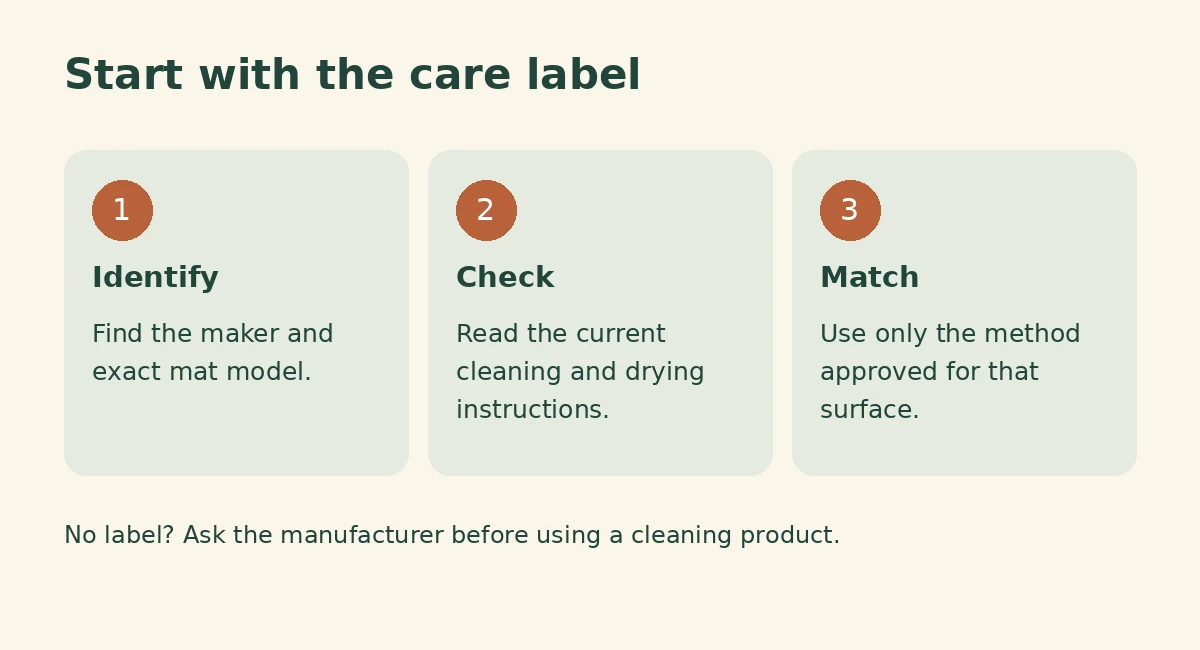
Find the brand, model and, if relevant, version. Look at the label, receipt, order confirmation or original product page. If it was a gift, ask for the product name rather than guessing from a photograph. Two mats from one brand can have different care requirements.
Write down the practice surface and backing separately when the maker identifies them. A cork top does not tell you everything about the material underneath. A rubber base does not necessarily mean that the surface touching your hands is also bare rubber. “Natural,” “sticky” and “eco-friendly” are not cleaning instructions.
Read the current care page all the way through, including warnings under a product’s FAQ. Check that the page describes your model rather than a newer product with a similar name. If the packaging and website disagree, ask the maker which instructions apply to your version before attempting a deep clean.
You do not need a laboratory description of the mat. You need practical answers: which cleaner, how much moisture, whether rinsing is permitted, how it should dry and how it should be stored. Save the page on your phone so that you are not making these decisions with a wet cloth already in your hand.
For a borrowed studio mat, ask staff. It is not your decision to test a new cleaner on someone else’s equipment. If you cannot identify a personal mat, postpone anything more aggressive than the care you can confirm. A missing label is a reason to investigate, not an invitation to try every method.
What manufacturers’ instructions show
The examples below illustrate why there is no single recipe. They are not endorsements, and they should not replace the complete current instructions for a particular product.
| Example | What its maker currently specifies | What not to generalise |
|---|---|---|
| Manduka PRO | Warm water or its specified mat wash; no soaking. | A wipe-clean surface does not make immersion acceptable. |
| Manduka GRP Adapt | Its specified cleaner and complete drying; Adapt and Adapt Lite roll practice-side inward, while Adapt Travel rolls outward. | Even rolling direction can differ within a range. |
| JadeYoga rubber mats | Damp-cloth routine care; its own compatible wash; warnings against other cleaners. | A homemade spray described as natural is not automatically suitable. |
| Gaiam Essentials 6 mm PVC | Spot cleaning with its mat wash or a damp cloth, cold water and mild detergent; drying flat. | This is permission for that product, not every PVC mat. |
| Yogamatters Sticky Mat | Mat cleaner and a damp cloth; its FAQ also describes a detergent-and-water option and advises against machine washing. | A flexible mat is not necessarily laundry. |
| Yoloha cork mats | Its cork-compatible cleaner; separate instructions for deeper cleaning. | Cork does not mean maintenance-free. |
Sources: Manduka care guide, JadeYoga FAQ, Gaiam Essentials care, Yogamatters Sticky Mat care and Yoloha product care.
Notice what this comparison does not provide: a universal number of soap drops, a fixed soaking time or a cleaning schedule for every household. Those omissions are deliberate. A useful routine begins with the product’s instructions, then fits them into your circumstances.
How to clean a yoga mat: a practical workflow
Prepare the space and supplies
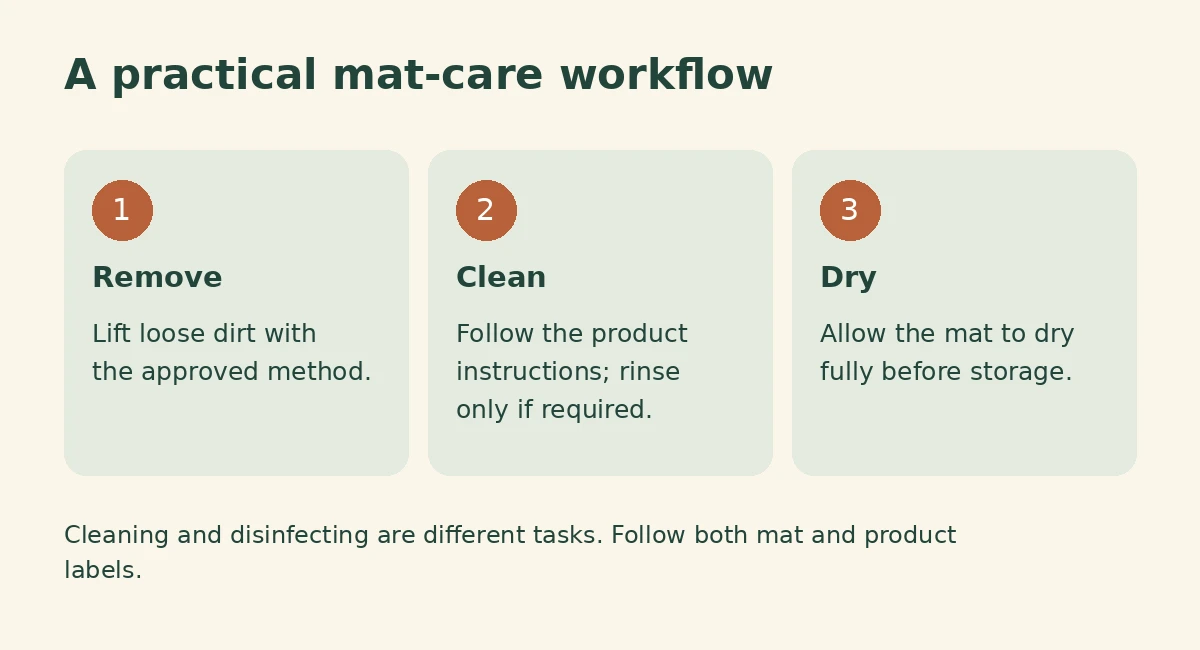
Read the directions before assembling your kit. Use the cloth or sponge, water temperature and cleaning product specified for your mat. Keep the product in its labelled container. Set aside a clean area for drying, and make sure the process will not leave a wet mat across a doorway or shared walkway.
A simple arrangement is easier to follow than a collection of competing sprays. Put the approved product beside the cloth you will use, and move unrelated bathroom or kitchen cleaners away. If someone else in the household helps with cleaning, show them the actual care instructions rather than saying “just wash it.”
Check the whole mat before applying anything. Look at the underside, edges and the areas beneath your hands and feet. Note whether you are dealing with loose debris, a local spill, a general surface film or physical damage. A photograph can help you explain an unusual change to the manufacturer later.
Follow the specified method, not an improvised upgrade
Use the stated amount and application method. “Apply to a cloth” and “spray onto the mat” are different instructions. So are wiping, rinsing and immersion. Do not translate one into another because it seems faster.
Work methodically so that you know which areas you have attended to. If the underside also needs cleaning, check whether it has separate requirements. Avoid putting the newly cleaned practice surface onto the same dirty patch of floor while turning the mat over.
If a mark does not respond, pause. Repeating an approved procedure may be reasonable when the instructions allow it; increasing the concentration, pressure or soaking time is a different experiment. Before changing methods, identify the stain if possible and ask for model-specific advice.
Finish the process before judging the result
Complete any required residue-removal step, then follow the drying directions. Do not judge grip halfway through cleaning. A wet surface or remaining cleaning product is not the same condition as a finished, ready-to-use mat.
Once the mat is ready, inspect it at floor level before beginning practice. If it remains slick, uneven, sticky in an unfamiliar way or visibly damaged, stop and investigate. Do not use a difficult balance or a fast transition as a test of whether the cleaning worked.
The point of this workflow is consistency. You should be able to say what you used, what you did and what changed. That is far more useful for troubleshooting than adding several products in succession and hoping one fixes the problem.
Cleaning, sanitising and disinfecting are different
The US Environmental Protection Agency distinguishes cleaning from sanitising and disinfecting. Cleaning removes dirt and organic material. Sanitising and disinfecting involve different antimicrobial claims and testing requirements. A pleasant fragrance or a visibly clean surface is not evidence that a mat has been disinfected.
For community facilities, including gyms, CDC guidance emphasises cleaning first, surface-compatible products and the labelled wet contact time when disinfecting. It also says not to mix cleaning chemicals. Facility rules and local public-health requirements may add obligations.
For a personal mat, this distinction prevents a common mistake: treating an ordinary maintenance spray as if it satisfies a specific infection-control need. For a shared mat, it raises a practical question for the operator: can the required procedure be carried out without contradicting the equipment manufacturer’s instructions?
If those requirements cannot both be met, staff need an approved alternative or different equipment, not a stronger improvised mixture. Do not use a general article as a disinfection protocol after a contamination incident. Tell the responsible staff what happened and keep the mat out of circulation while they decide the appropriate response.
What about vinegar, essential oils and homemade cleaners?
A familiar household ingredient is not proof of compatibility. The question is not whether vinegar, soap or an essential oil is “good” or “bad” in the abstract. It is whether the mat’s maker permits that ingredient, formulation and method for your particular product.
JadeYoga specifically warns that unsuitable cleaners, including certain soaps, alcohol-containing products and concentrated essential oils, can harm its rubber mats; oils may also make them slippery. This is a useful counterexample to the claim that every natural-rubber mat should receive the same homemade mixture. JadeYoga care FAQ
Liforme’s care page distinguishes routine cleaning from occasional deeper-cleaning options and attaches caution to the latter. Its instructions do not provide a reason to put a similar-looking mat through the same process. Follow the current guidance for your own model rather than extracting one ingredient from someone else’s routine. Liforme care guide
If a recipe has no identifiable source, no compatible mat named and no clear directions, leave it unused. You are not obliged to experiment because the ingredients are already in your kitchen. Likewise, a cleaner labelled “yoga mat spray” still needs a compatibility check. Its product category is not a universal permission slip.
Never combine several cleaning products to make them stronger. Keep the decision simple: approved method, complete instructions and a clear reason for using it.
Can you put a yoga mat in the bath or washing machine?
Only when the instructions for that exact mat explicitly permit the method. Do not infer permission from its flexibility, thickness or ability to get sweaty during practice.
The Yogamatters Sticky Mat FAQ, for example, recommends washing down in a bath or shower rather than machine washing. Manduka’s current guide prohibits soaking several ranges but gives different rinse guidance for its X model. These are product-specific differences, not competing universal rules. Yogamatters instructions; Manduka instructions
Before any permitted wet-cleaning method, think through the entire job. Where will you handle the mat? How will you remove the permitted amount of moisture? Where can it finish drying without blocking someone else’s space? A bathroom that works for washing may not provide a convenient place for the rest of the process.
If the instructions are silent about a machine, spin cycle, tumble dryer, steam cleaner or pressure washer, do not treat silence as approval. Ask the manufacturer. A photograph of somebody washing a different mat cannot answer that question for yours.
Drying and storage deserve their own plan
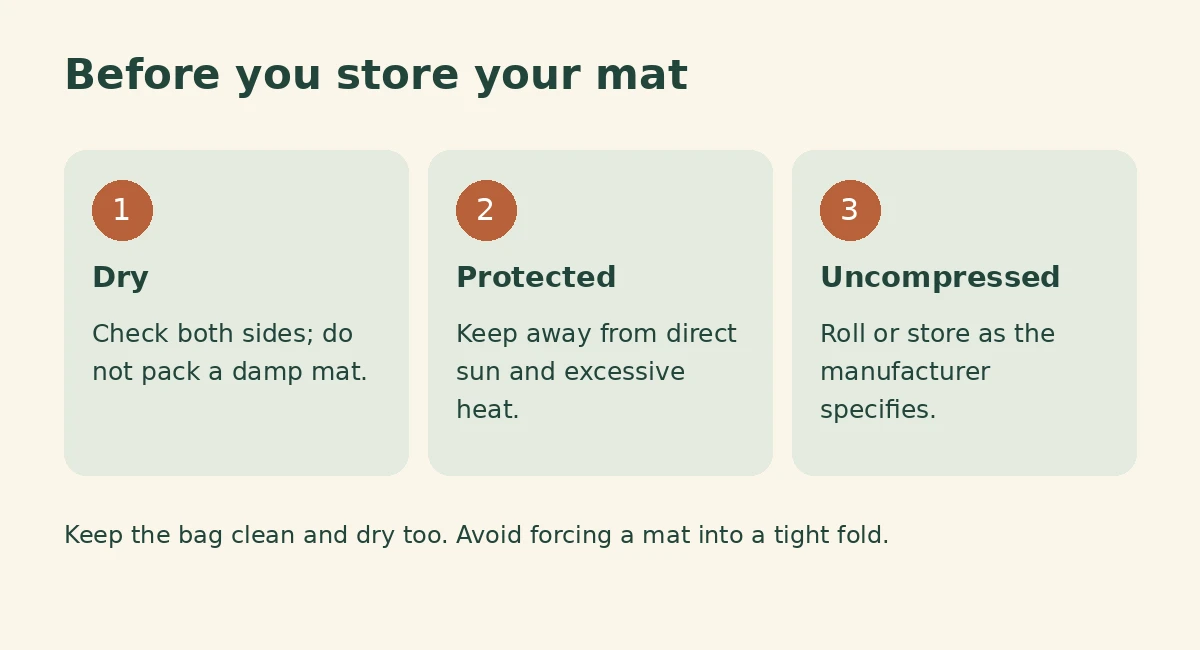
Liforme advises drying its mats flat and explains that a mat rolled for the journey home should be unrolled again to dry. It also specifies outward rolling of the practice side and discourages folding. That example shows why transport and long-term storage should not be treated as the same stage. Liforme drying and storage guidance
Choose a drying place before class if you know you will return in a hurry. In a shared room, agree on a location that does not take over a bed, block a cupboard or create a trip hazard. A routine that depends on an unavailable space is unlikely to survive a busy week.
Do not substitute a radiator, hair dryer or sunny balcony for the stated method just to meet a deadline. JadeYoga warns against UV exposure, and Gaiam warns that prolonged sun can damage its Essentials mat. Shade is not a technical disinfection method either. JadeYoga FAQ; Gaiam care instructions
When the mat is ready for storage, follow its rolling or folding directions. Keep its bag and strap in mind too: they are separate products with their own cleaning requirements. A bag is a carrying tool, not a reason to skip the final checks.
A useful reminder can be as small as leaving the empty mat bag beside your door until the mat is ready to pack. This is a household organisation idea, not a hygiene standard. Choose a cue that fits your home rather than a complicated schedule you will ignore.
How often should you clean it?
Start with the maker’s routine and adjust your planning to the actual use. JadeYoga describes weekly damp-cloth maintenance and more frequent attention after vigorous or hot practice. Yoloha recommends its compatible cleaner after use. Neither instruction establishes a universal weekly calendar for all mats. JadeYoga FAQ; Yoloha product care
For practical purposes, ask three questions after a session: Is there visible dirt or a spill? Does the approved routine call for attention now? Will the mat be ready when I next need it? These questions are more informative than waiting until an arbitrary Sunday.
A home mat used occasionally, a travel mat carried between venues and equipment shared through several classes present different organisational problems. The same person may need different routines for each. Do not use the convenience of one situation to decide what is acceptable in another.
If your cleaning routine repeatedly clashes with your next class, change the timing or speak to the studio about alternatives. Do not simply leave out required steps. Keeping a brief note for a week can reveal the real difficulty: forgetting after class, lacking a drying area or not having the approved supplies available.
Troubleshooting marks, smells and lost grip
Use observations rather than diagnoses. “There is a pale patch where my hands go” is more useful than “the mat is ruined.” “It became slippery after I used this product” is more useful than “the grip is bad.” Describe the change and its timing.
| What you notice | Useful information to collect | Sensible next step |
|---|---|---|
| Slipperiness after cleaning | Product name, dilution, application and whether finishing steps were completed | Stop practice; check directions and ask the maker if it persists. |
| A mark that remains | Location, likely spill, age and a clear photograph | Ask whether it is cosmetic or needs a different approved response. |
| An unfamiliar smell | When it began, recent storage and cleaning history | Do not disguise it with fragrance; identify the cause before reuse. |
| Crumbling, peeling or separation | Affected area and whether the surface changes under light handling | Take the mat out of practice and request assessment. |
| A problem limited to a shared mat | Mat identifier, time and what you observed | Inform staff and use another suitable mat. |
These are triage prompts, not a guarantee that any particular mat can be repaired. Avoid aggressive scrubbing merely to make a surface look uniform. A cosmetic change and a functional problem are different questions, and a photograph alone may not settle either.
If you suspect mould or another contamination problem, set the mat aside and seek appropriate guidance. Do not scrape, smell closely or test multiple household chemicals to identify it. A mat that cannot be cleaned appropriately or no longer provides a usable surface should not remain in service simply because it was expensive.
Borrowed mats, travel and residential practice
Before using a studio mat, ask where cleaned equipment is kept and where used equipment should go. If a wipe or spray is provided, ask how it is meant to be used rather than copying the quickest person in the room. Tell staff about spills or damage instead of returning the mat silently to the stack.
For travel, pack the care information with the packing list. Consider whether you can obtain the compatible supplies at your destination and whether your accommodation provides a workable drying space. Do not assume that a hotel cleaner, hand sanitiser or laundry service is suitable for your mat.
Keep the mat’s identity available. A note with its model and care-page link is easier to use than trying to identify a worn logo while away from home. If you borrow equipment during a trip, return to the owner’s procedure; your personal mat’s routine does not transfer automatically.
If you are preparing for study at Inteyoga, use the Arrival Guide for packing information and ask any unresolved equipment questions before travelling. For the classroom itself, our guide to what to expect at your first yoga class covers participation and preparation rather than product care.
Make a one-page care card
A short care card turns a long product page into a repeatable household routine without replacing the original instructions. Keep it somewhere you will actually look: inside the storage cupboard, beside your cleaning supplies or in a note on your phone.
Record these fields:
- Identity: Brand, model, version and purchase information if available.
- Source: The manufacturer’s current care-page link and the date you checked it.
- Routine: The permitted product, application method and finishing steps.
- Restrictions: Any stated limits on soaking, chemicals, scrubbing, heat or sunlight.
- Drying and storage: Your chosen location and the model’s rolling or folding instructions.
- Exceptions: Who to contact about damage, persistent residue or a disinfection requirement.
Leave an unknown field marked unknown in your private note until you have an answer. Do not fill it with advice copied from another brand. This small distinction can prevent an assumption from turning into a household rule.
For example, one person’s card might say “clean after returning home, then leave in the agreed drying space.” Another may need “ask studio staff before using the communal product.” These are planning examples, not claims about an ideal frequency or a particular manufacturer’s method.
Review the card when you replace the mat or change the cleaning product. Keep the old routine out of the way so that you do not accidentally follow it for a new surface. The best routine is not the most elaborate one. It is the correct one, carried through to the end.
Sources
Manufacturer examples were checked on 17 November 2026. Instructions can change; consult the current page for your exact model. These examples do not imply a commercial recommendation or an independent laboratory test.
- Manduka: yoga mat care by model
- JadeYoga: care, cleaning and storage FAQ
- Liforme: cleaning and maintaining your mat
- Gaiam: Essentials 6 mm product care
- Yogamatters: Sticky Yoga Mat care and FAQ
- Yoloha: caring for a cork yoga mat
- EPA: cleaning, sanitising and disinfecting
- CDC: cleaning and disinfecting community facilities
Frequently Asked Questions (FAQ)
What is the safest way to clean an unfamiliar yoga mat?
Identify its brand and model and obtain the care instructions before using a new product or deep-cleaning method. If it belongs to a studio, ask staff. Do not guess compatibility from the colour or texture, and do not experiment with a borrowed mat.
Can I use vinegar or essential oils on my yoga mat?
Only if the manufacturer explicitly allows that ingredient and method for your model. A homemade recipe is not universally suitable, and a natural fragrance is not proof of disinfection. Check the complete instructions rather than copying an ingredient from another mat’s routine.
Does wiping a yoga mat disinfect it?
Not automatically. Routine cleaning and disinfection are different tasks. Where disinfection is required, the product, surface compatibility and labelled procedure all matter. For shared equipment or a contamination incident, ask the responsible staff for the approved process.
Can I roll my mat up straight after class?
Transport and storage are different situations. Follow your model’s guidance, and make a plan to complete any required drying after the journey. Do not assume that putting the mat into its bag means its care is finished.
Should every yoga mat be rolled with the practice side out?
No. Manufacturers give different directions, even within a product range. Check the specific model rather than applying a universal rolling rule. Likewise, folding is appropriate only when your mat’s instructions permit it.
What should I do if my mat stays slippery after cleaning?
Stop using it for practice, check the product and procedure you used, and contact the manufacturer if the problem remains. Record when the slipperiness began. Do not add another cleaner or attempt a demanding pose to test whether the surface is usable.