

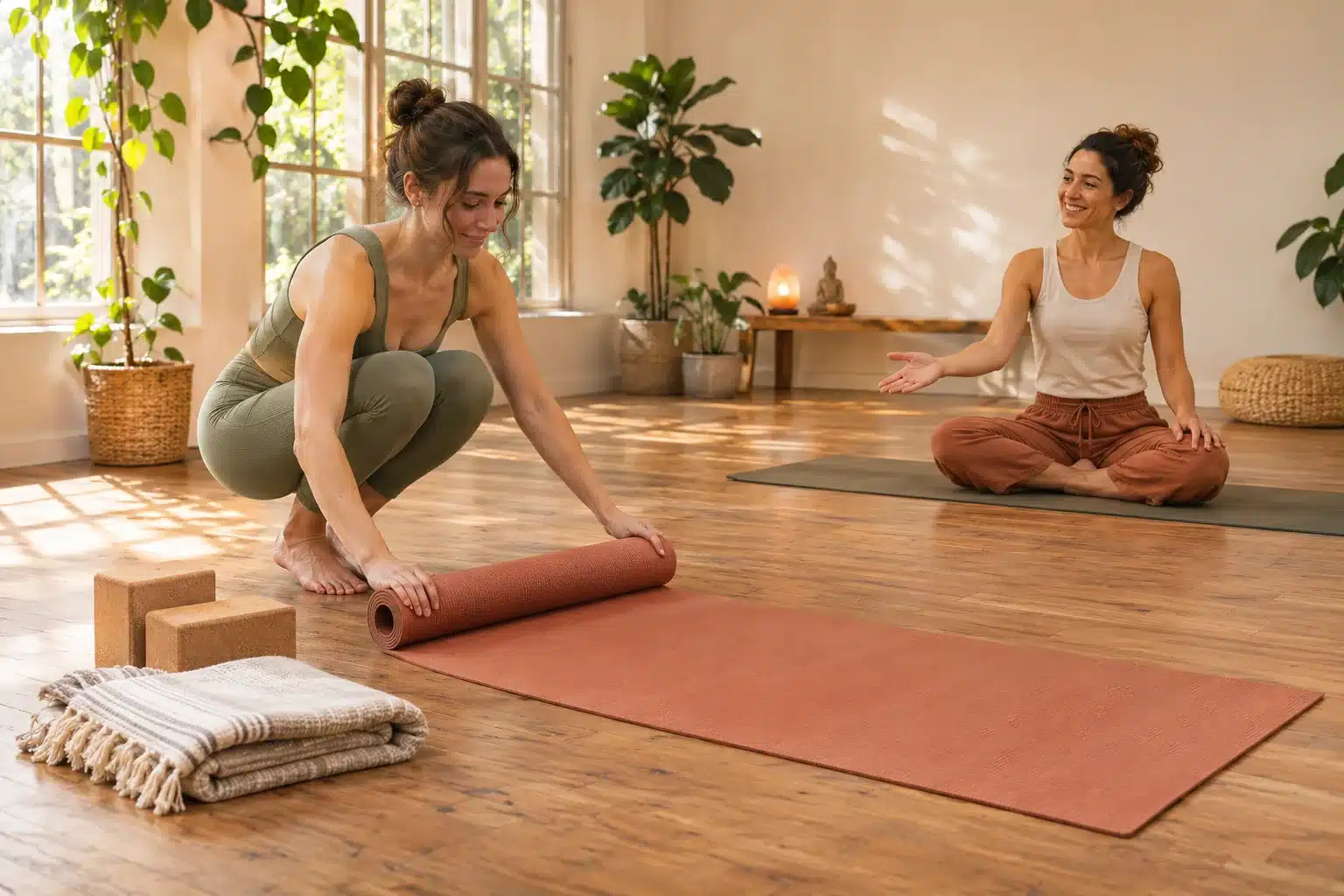
Quick Answer
A first yoga class commonly includes a brief introduction, gentle preparation, guided postures and a period of rest. The teacher may also introduce breath awareness or meditation. Arrive with time to ask questions, explain that you are new, and choose smaller movements or breaks whenever needed. The exact order, pace and duration depend on the class.
MedlinePlus describes classes commonly lasting 45–90 minutes, but the session you book may be shorter or longer. Read its own timetable rather than treating that range as a rule.
Key Takeaways
- Choose the right class: Look for beginner-focused teaching and ask about pace, access and equipment before booking.
- Prepare simply: Wear clothes you can move in, bring what the studio requests and allow time to settle in.
- Expect guidance: Classes often include preparation, postures and rest, but the order and pace vary.
- Keep your choices: You can ask questions, take a break, choose a smaller movement and decline hands-on adjustments.
- Learn at your own pace: You do not need to be flexible or know the poses before attending.
You have chosen a class, but the smaller questions remain. Where should you put your mat? What if the teacher names a pose you have never heard of? Can you sit out a movement without interrupting everyone?
Knowing what to expect at your first yoga class makes the practical side easier. This guide takes you from checking the class description to deciding whether you want to return. You do not need to memorise a sequence or demonstrate your flexibility before walking through the door.
Building a Steady Beginner Yoga Practice · Part 1. This series explores the small decisions that help you learn, practise and ask better questions. Continue with Part 2: How to Use Yoga Blocks.
Before Booking: Is This Class Suitable for You?
Start with the level, not the photograph. A class advertised as introductory or beginner-focused gives you a clearer starting point than a dramatic image of an advanced posture. If the description says “all levels”, ask what support a completely new student can expect.
A useful question is: “I have not attended a yoga class before. Will you explain how to enter and leave the poses, and can I take a seated option?” The answer should tell you more than the class name alone.
- Level and pace: Will there be time for demonstrations and questions?
- Room conditions: Is it heated? Will there be music, incense or low lighting?
- Accessibility: Are stairs involved, and can the class accommodate difficulty getting down to the floor?
- Equipment: Are mats and props supplied, rented or brought from home?
- Practical terms: What does one class cost, and what happens if you cancel?
These are details to confirm with the provider, not assumptions to make about every studio. A short beginner course can also be worth considering if you would prefer to learn with the same group over several sessions.
For explanations of the different practice labels, see our beginner yoga poses guide. This article focuses on attending a class, rather than giving you another routine to memorise.
How to compare two possible classes. Suppose one description says “Beginner foundations: demonstrations and time for questions”, while another says “All-level flow: continuous movement”. These are illustrative examples, not descriptions of particular providers. The first gives a new student more explicit information about the learning format. The second needs a conversation: does the teacher explain transitions to newcomers, or expect them to recognise the sequence?
For your first yoga class, use the following booking questions as a practical decision aid. They help you compare the actual experience, rather than choosing whichever title sounds most impressive.
| Class description | What to ask | What to keep in mind |
|---|---|---|
| Introductory or foundations class | Ask whether it starts from the beginning or is one session in a continuing course. If you have missed the first few weeks, find out what the teacher expects you to know. | Also check whether the same teacher leads each session; continuity may be useful when you are learning names and instructions. |
| Gentle or slower-paced class | Ask what “gentle” means in practice. Does it still involve kneeling, supporting weight through the hands, or repeated changes between the floor and standing? | A quieter pace and an accessible movement are separate things. Choose according to what you can participate in, rather than the reassuring label alone. |
| All-level class | Ask how beginners receive help while experienced students continue. | Useful answers describe options, demonstrations or a clear stopping point. “Just copy everyone else” gives you less information about how the teacher will support learning. |
| Heated class | Confirm the temperature and whether heat is optional. | NCCIH notes additional overheating and dehydration concerns with hot yoga. Choosing an unheated introduction lets you consider the teaching and movements without also having to decide how you respond to a heated room. |
| Live online class | Ask whether the teacher can see participants and offer individual guidance, whether a camera is expected, and how questions are handled. | A live link does not necessarily mean the teacher will watch your movements. Keep enough space to move without hitting furniture, and choose an arrangement in which you can hear without twisting repeatedly towards the screen. |
If you need individual adaptations, ask directly about the teacher’s experience with those needs and whether a group class is appropriate. A clear referral to a different teacher, class or healthcare professional can be a helpful answer. It is better to establish the limits before paying than to rely on a broad promise that yoga suits everyone.
What Should You Wear and Bring?
Wear clothing in which you can comfortably lift your arms, bend your knees and sit. Before leaving home, try those movements once. A shirt that needs constant adjustment may distract you more than whether it looks like specialist yoga clothing.
Pack according to the studio’s instructions. A simple first-class bag might contain a water bottle, the mat if required, and a light layer for the quieter end of the session. Leave unnecessary valuables at home and check where bags can be stored.
You do not need to buy an entire set of equipment before finding out what the class provides. If you later want your own mat, our guide to choosing a beginner yoga mat covers that separate decision.
Do a two-minute clothing check. Reach overhead, bend slightly forward and sit down. Notice whether a waistband digs in, a loose top falls over your face, or a zip presses into you. Adjusting clothing beforehand gives you one less thing to manage during the class. Specialist brands are unnecessary for this check.
Ask about shoes and socks rather than assuming every venue follows the same arrangement. If you need to keep footwear on for a health or access reason, discuss it before the session. For ordinary belongings, keep the walking route clear and avoid placing a phone or water bottle where someone might step back onto it.
Plan the journey as well as the practice. Check the entrance, travel time and any building-access instructions. If you are attending alone and feel uncertain, having the booking confirmation ready can simplify the check-in. At an unfamiliar venue, arriving early is useful because you have time to ask practical questions, not because you should begin stretching before the teacher starts.
Follow your ordinary medical and dietary advice. Do not skip prescribed food or medication because you have heard that everyone must practise on an empty stomach. If eating close to exercise is uncomfortable for you, ask about timing that suits your situation rather than adopting a rigid fasting rule from a general yoga guide.
Keep the first purchase small. Confirm what is supplied, attend a suitable session and then decide which equipment you actually want. A bag full of unfamiliar props will not replace clear teaching. For the same reason, avoid buying a long membership before you know whether the timetable, teaching and accessibility work for you.
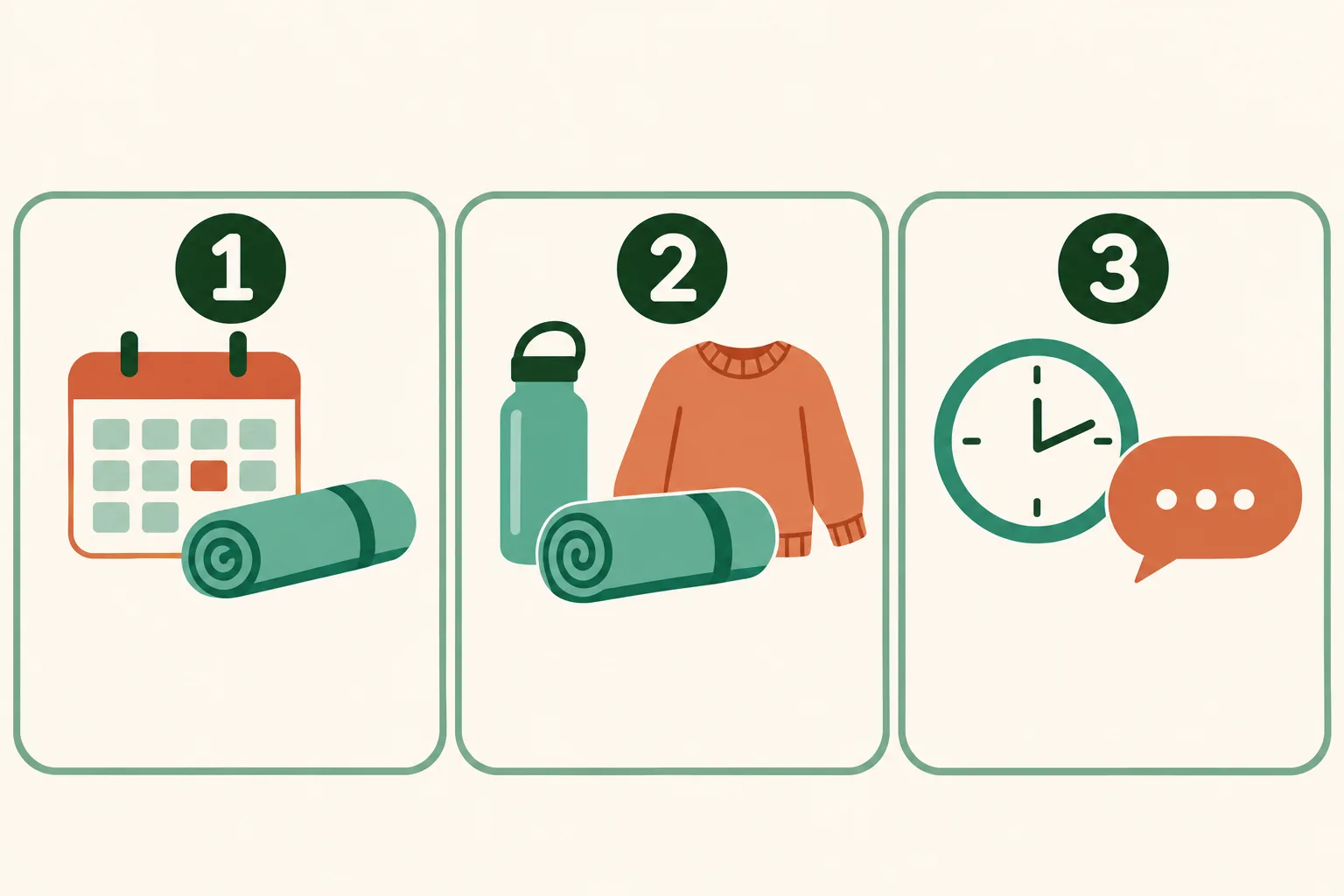
Arriving: Five Things to Do Before the Class Starts
Follow the arrival time given by the organiser. If none is stated, ask how much time to allow for registration and changing. Arriving exactly when teaching starts can leave you sorting out practical details while trying to follow the first instruction.
- Introduce yourself. Say that this is your first class rather than hoping the teacher will notice.
- Find the practical things. Ask where shoes, bags and phones go, and locate the toilet.
- Choose a useful position. Ask where you will be able to see demonstrations clearly. Hiding at the back is not always the easiest place to learn.
- Collect the recommended props. Ask what each one is for rather than arranging it to match another person’s mat.
- Agree on options. Ask what to do if you need a break or cannot follow a movement.
There is no need to explain a private health history to the whole room. Ask to speak with the teacher quietly if a condition, injury or access need affects participation.
A short introduction you can use. “This is my first yoga class. I would like to watch demonstrations before trying a movement, and I prefer verbal guidance. If I need to rest, what position or place would you recommend?” Add only the health or access information necessary for the teacher to understand your participation needs.
This conversation does not have to be polished. You can write your question down and read it if that is easier. If the room is busy, ask when you can speak privately. Try to separate three things: what is new to you, what you prefer, and what you have been advised not to do. The teacher may be able to help with the first two while needing further professional guidance for the third.
Position your mat for learning. Ask which direction the group will face and where demonstrations will happen. Leave room for movements beyond the edge of the mat, and follow the teacher’s spacing instructions. A position that seems unobtrusive beside a door may make it difficult to hear or see; being comfortable asking where to set up is more useful than trying to disappear.
If you arrive late, do not rush into a movement to catch up. Follow the venue’s late-arrival procedure and ask whether joining is still appropriate. You may have missed a safety explanation or the setup for the current activity. If the teacher recommends returning for another session, clarify the booking arrangement afterwards rather than trying to squeeze into an unsuitable point in the class.
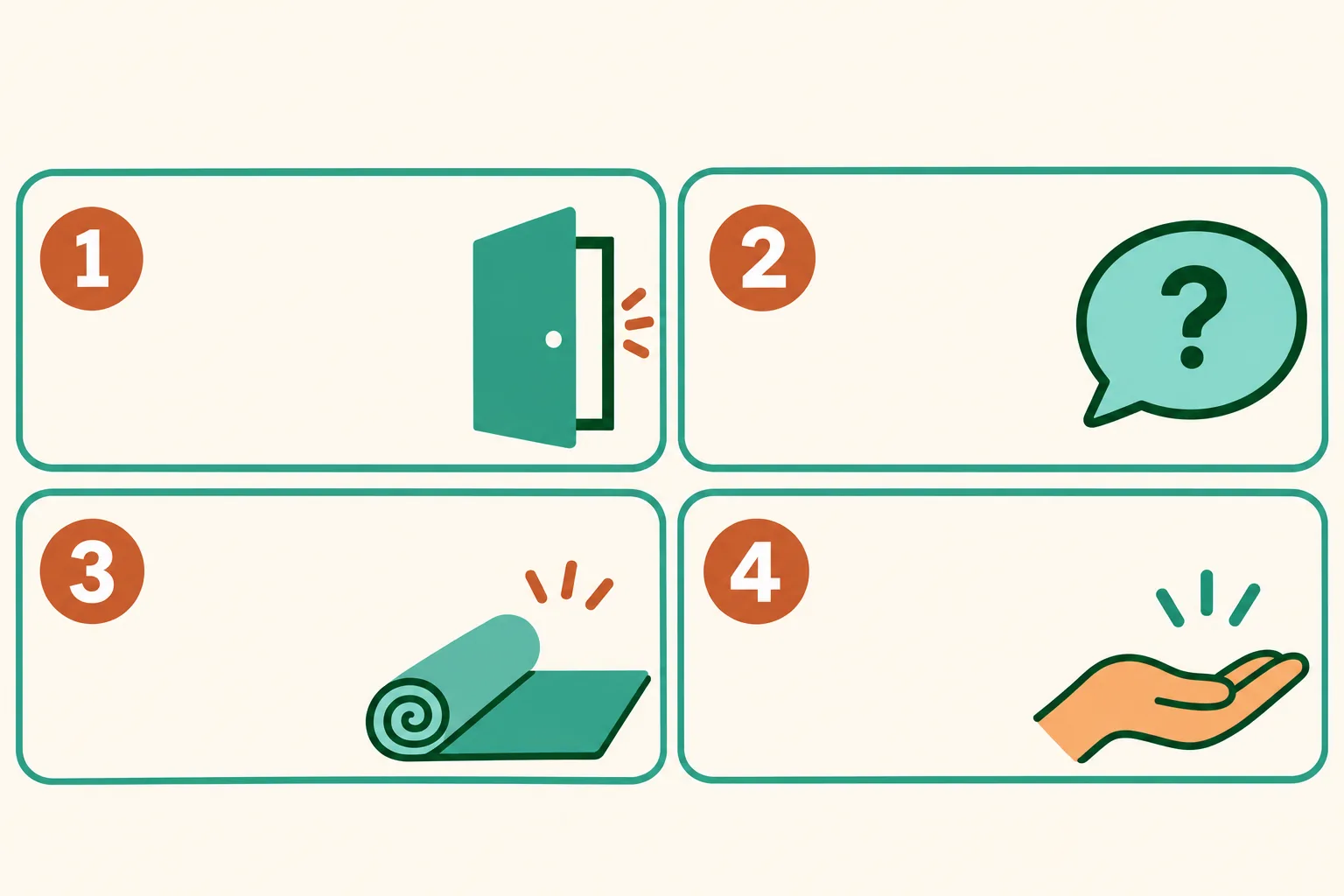
What to Expect at Your First Yoga Class, Step by Step
Settling In and Listening
The session may begin sitting, standing or lying down. The teacher might introduce the theme, invite you to notice your breathing, or explain the equipment. Listen for the choices offered. If sitting on the floor is uncomfortable, ask for a chair or another position before trying to endure it.
Preparation and Guided Movement
You may move through a gradual preparation before more sustained postures. Some teachers demonstrate; others give verbal instructions while observing. Watching a demonstration before joining is a reasonable way to learn an unfamiliar movement.
Do not rush to catch up if you lose the sequence. Pause and ask where to rejoin. Understanding one transition is more useful than copying three movements without knowing how to come out of them.
Postures and Variations
A teacher may offer different versions of the same pose. Your neighbour might use a block while you use a chair, or you may stay standing while others move to the floor. Choose the version you can manage with attention and control, rather than treating the options as a ranking.
The Sanskrit word asana refers to a posture. You may hear an English name alongside a Sanskrit one, but you do not need to learn the vocabulary in advance. Ask the teacher to repeat a cue that is unclear.
Breath Awareness and Quiet Practice
Breathing instructions vary between teachers and traditions. If coordinating breath and movement feels confusing, tell the teacher and return to comfortable breathing rather than straining to match a count. Beginners do not need to attempt forceful breathing or advanced breath practices.
Rest and Closing
The closing may include quiet rest, meditation or both. Savasana is a reclining rest posture often used at the end. Ask for an alternative if lying flat is uncomfortable; you can also ask to keep your eyes open. The details should serve the person practising, not a picture of how relaxation is supposed to look.
If you must leave early, tell the teacher beforehand and ask how to do so with minimal disturbance. You should still leave or seek help whenever necessary for your wellbeing.
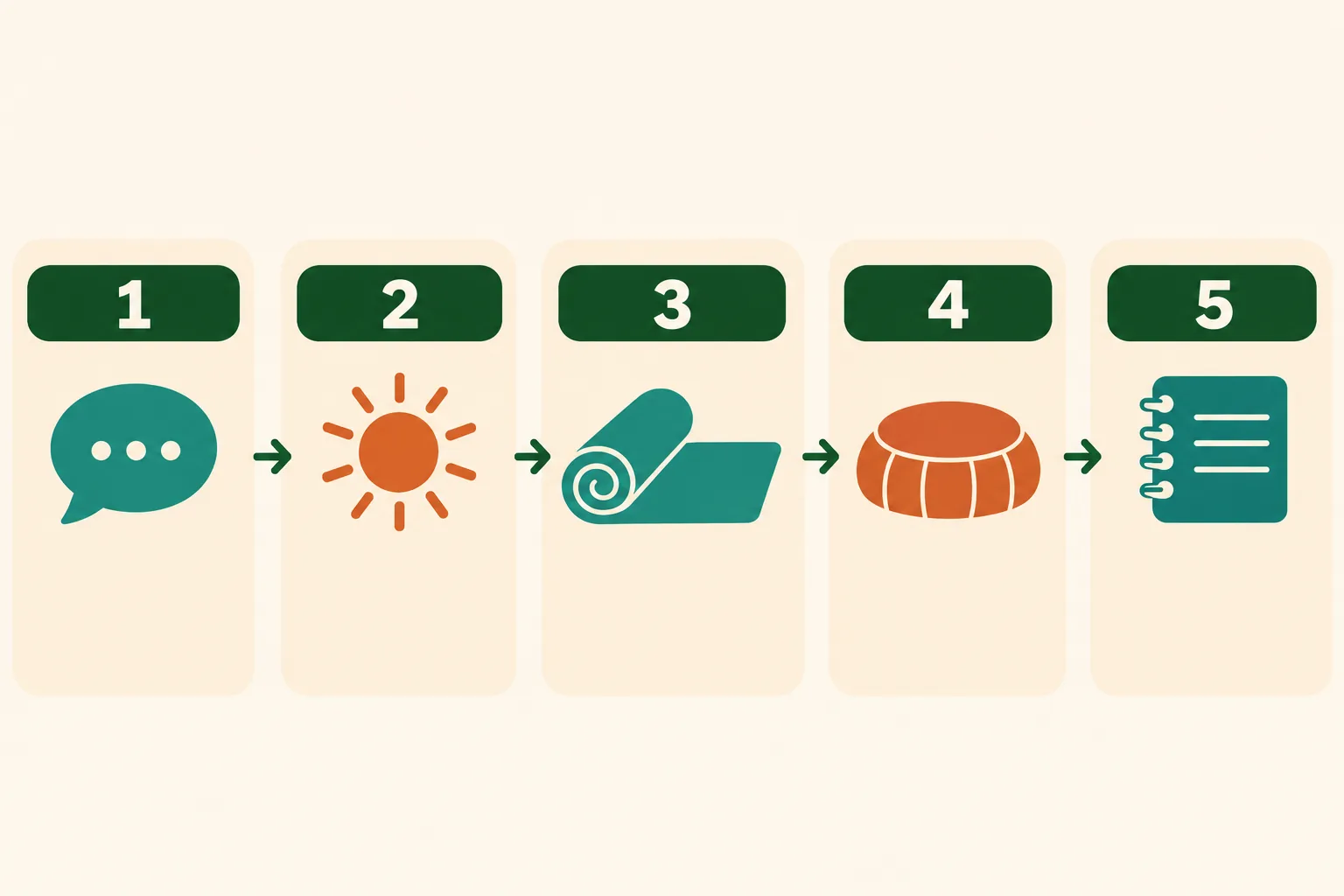
An example of how a class might be organised. To make the sequence easier to picture, imagine this 60-minute introduction. This is an illustrative plan, not a required teaching standard or a promise about your booking. Some classes give much more time to seated practice or individual explanation.
| Stage | Example time | What happens |
|---|---|---|
| Settle in | 5 minutes | Settling and explanation. |
| Prepare | 10 minutes | Gradual preparation. |
| Guided postures | 30 minutes | Postures and their transitions. |
| Rest | 10 minutes | Quiet rest. |
| Close | 5 minutes | Closing and time for questions. |
Notice the transitions as well as the held positions. The instruction to leave a posture matters just as much as the instruction to enter it. If the class changes direction while you are still working out a movement, stop at a comfortable point and ask. You do not need to complete every repetition to have learned something useful.
If a direction confuses you: “Right foot back” may feel harder to follow when the teacher is facing you. Look at your own feet, pause and check the side. If you have begun on the other side, ask where to rejoin instead of abruptly switching your weight to match the room.
If the teacher says to lengthen: Ask what they want you to change. Are they asking you to lift the torso, move the hips back or make more space between the shoulders and ears? A broad image can be useful, but a beginner may need a more concrete instruction. Do not assume that “lengthen” means stretch as far as possible.
If a breath instruction and a movement do not match: Slow down and ask which part to prioritise. You can learn the movement and breath coordination in stages. If trying to follow the count makes you strain, return to comfortable breathing and tell the teacher rather than continuing silently.
If a pose name means nothing to you: Look for the demonstration and listen for the setup. You can ask, “Where do my hands and feet start?” That is often a more useful first question than trying to memorise the Sanskrit name while everyone is moving. Familiarity comes through repeated explanations.
Treat your first yoga class as an introduction to the teacher’s language as well as the practice. You might recognise a movement from a video yet hear a different name or emphasis. Clarify the action being taught instead of assuming that a familiar-looking shape should feel exactly the same.
Your Choices: Rest, Questions and Hands-On Adjustments
You can decline physical contact. Ask how the class handles hands-on adjustments and whether verbal guidance is available instead. Agreeing to one adjustment does not mean agreeing to all future contact. Yoga Alliance Professionals’ guidance on student expectations emphasises clear information and ongoing consent.
Useful phrases to have ready include:
- “Could you show that once before I try?”
- “I would prefer verbal instructions, without hands-on adjustments.”
- “That position is uncomfortable. Could I have another option?”
- “I am taking a break. Where can I rest without blocking the space?”
Some classes include chanting or other traditional elements. Ask beforehand if this matters to your choice of class. Participation should be discussed openly; you can listen quietly rather than join in. A clear conversation is better than discovering an unexpected format after you arrive.
Consent should be specific. A teacher may ask before offering an adjustment, use a consent card, or invite students to state a preference. Ask how the system works and how to change your answer. Yoga Alliance’s Code of Conduct requires its members to obtain explicit, informed consent before physical adjustments. That is a requirement for members of that organisation, not proof that every class uses the same procedure.
You can say no after previously saying yes. You can also agree to a verbal explanation while declining touch, or ask what an adjustment involves before deciding. There is no need to provide a personal explanation for wanting more space.
Consider sensory comfort before the session. If strong fragrance, loud music, dim lighting or a crowded room affects your ability to participate, ask what to expect. Be concrete: “Is incense used?” or “Can I place my mat where I can see the teacher’s face?” gives the organiser something specific to answer. A studio may not be able to change every condition, but you can decide whether the offered setting suits you.
Quiet practices also allow choices. If closing your eyes makes you uncomfortable, ask to keep a soft gaze. If lying down is unsuitable, request a seated alternative. You do not need to describe private experiences to justify a preference. If a practice becomes distressing, pause or leave and seek appropriate support rather than treating distress as a requirement for progress.
Safety: When to Pause or Ask for Individual Advice
NCCIH advises beginners to avoid extreme practices such as headstands, shoulder stands, lotus position and forceful breathing. It also notes that pregnancy, certain health conditions and previous injuries may require adaptations. A beginner label does not make every movement suitable for every person.
If you have a medical condition, an injury, recent surgery or uncertainty about exercise, ask an appropriate healthcare professional what is suitable before starting. Tell the teacher about relevant restrictions. Yoga instruction does not replace diagnosis, treatment or a clinician’s advice.
Stop a movement that causes pain, dizziness or unusual discomfort, and tell the teacher. Do not accept pressure to push deeper just because the rest of the group continues. A useful first-class goal is to learn what you can do comfortably and where you need guidance.
After Class: How Do You Decide Whether to Return?
Before buying a long package, consider the teaching as well as the atmosphere. You do not have to decide that yoga is “for you” or “not for you” on the basis of one room, one pace or one teacher.
- Could you hear and understand the instructions?
- Were questions welcomed without embarrassment?
- Were alternatives explained when something was unsuitable?
- Were your choices about rest and touch respected?
- Did the class match the level and format advertised?
- Can you realistically attend again without rushing?
Write down one question for the next session. It might be as simple as how to arrange a block or how to move from standing to the floor. That gives your next class a specific learning purpose without setting an ambitious performance target.
Use a simple after-class note. Write three short lines: one thing you understood, one thing that remained confusing, and one practical change for next time. For example: “I understood how to set up my mat; I need another explanation of the transition to standing; next time I will ask for a position closer to the demonstration.” This is an example reflection, not a student testimonial.
This keeps your assessment specific. “I was terrible at yoga” gives you little to work with. “I could not hear when the teacher turned away” points to a question you can ask. Likewise, liking the room does not answer whether the movements were explained clearly, and finding a posture difficult does not by itself mean the class was poorly taught.
Look for a workable teaching relationship. A suitable teacher can explain what they are asking, listen when something is not working and recognise the boundaries of their role. You can ask why a particular variation was suggested. You do not need to accept guaranteed health outcomes, pressure to ignore pain, or unwanted touch as part of learning.
Your second class does not have to be harder. Repeating the same introductory session may give you more time to understand the instructions, arrange support and recognise transitions. Alternatively, you might choose a quieter group, a different time or another teacher. Choose the next step for the learning need you identified, rather than moving up a level because one session is finished.
Before booking a package, check that its practical conditions suit you: which classes it includes, how long credits remain valid, whether unused sessions carry over and how changes are handled. Those details belong to the provider’s current terms. A clear first yoga class experience and manageable attendance plan are better reasons to return than feeling obliged to commit immediately.
Why Clear Teaching Matters at Every Level
A first class makes the value of clear explanation easy to see. Knowing a posture and being able to teach it to someone else are different skills. Observation, adaptable instructions and appropriate boundaries remain important as practice develops.
For readers who are already trained teachers, Inteyoga’s Advanced TTC 300-Hour Integrated Restorative Yoga (Including Yoga Nidra, Chakra Sadhana, and Prana Vidya Intensive) includes teaching methodology, safe use of props and modifications, supervised teaching and feedback. It requires a completed 200-hour TTC or accepted equivalent. It is advanced teacher training, not a first yoga class.
If that is your next stage, explore the current programme and apply through Inteyoga’s application form. If you are just starting, focus first on finding a suitable beginner class and learning steadily.
Sources
- MedlinePlus: Yoga for health, for general class format and beginner guidance.
- National Center for Complementary and Integrative Health: Yoga, Effectiveness and Safety, for safety precautions and limits.
- Yoga Alliance Professionals: Setting Student Expectations, for class information, communication and consent.
- Yoga Alliance: Code of Conduct, for member requirements concerning consent-based touch.
- Inteyoga: Current 300-hour programme, for programme scope and teaching curriculum.
This article is general educational guidance, not personalised medical advice. Seek qualified guidance when a health condition or injury affects what is appropriate for you.
Frequently Asked Questions (FAQ)
Do I need to be flexible before my first yoga class?
No. Ask for a class intended for beginners and use the variations offered. Being able to touch your toes is not an entry test. The more useful question is whether the teacher can help you practise at a suitable level.
What if I cannot keep up?
Pause, watch and ask where to rejoin. You can skip a movement rather than rush through it. If the whole class feels too fast, ask whether a slower foundations class is available.
Can I take a break during class?
Yes. Ask the teacher for a comfortable resting option before the session begins. You do not need to wait for the group to stop or use a particular resting pose if it does not suit you.
Should I practise the poses before attending?
You do not need to rehearse an entire sequence. Reading the class description and preparing a few questions is enough. A class intended for first-time students should explain its movements rather than assume you already know them.
Can I attend a first yoga class on my own?
Yes. Ask the organiser how check-in works and let the teacher know that you are new. You do not need a partner for an ordinary individual practice class. If the description includes partner work, ask whether it is optional and how partners are arranged before booking.
What if I cannot get comfortably onto the floor?
Tell the teacher before the class rather than waiting for the first floor exercise. Ask whether chair-based participation is available throughout, including the transitions and final rest. A class that offers a chair for one pose may still expect repeated floor work elsewhere. If that does not suit you, look for a class specifically organised around your access needs.
Do I have to introduce myself to everyone?
Ask the teacher what the opening involves. Some sessions invite a brief introduction; others begin without one. You can keep your answer simple and decline to share private information with the group. Explaining a participation need privately is different from telling the room your personal history.
What should I do if I arrive and the class feels wrong for me?
Speak with the teacher before joining. Explain the specific concern: the room is heated when you expected it not to be, the class assumes previous experience, or the promised access arrangement is missing. Ask for a suitable option. You can choose not to participate; any refund or transfer depends on the booking terms and circumstances, so clarify that with the provider separately.
Should I choose a different teacher if I felt confused?
One unclear instruction can often be resolved with a question. Consider how the teacher responds and whether the rest of the session met your needs. If the pace consistently leaves no opportunity to learn, or your requests for an alternative are dismissed, it is reasonable to try another class. You are choosing a place to learn, not passing an audition.