

Quick Answer
Consent in yoga classes means having enough information to choose whether to accept a particular interaction, such as a hands-on adjustment. You can ask for an explanation, choose verbal guidance, decline touch or change your mind. Photography, partner work and volunteering for a demonstration deserve their own clear conversations.
Key Takeaways
- Ask for the detail: Find out what an adjustment involves before deciding.
- Choose your format: Verbal cues, a teacher’s demonstration and props may offer useful alternatives to touch.
- Keep choices specific: An answer about one interaction does not settle every later interaction.
- Separate permissions: Being in a class, being photographed and volunteering as a demonstration partner are different decisions.
- Expect respect: You should not have to reveal a private history or win an argument to have a boundary taken seriously.
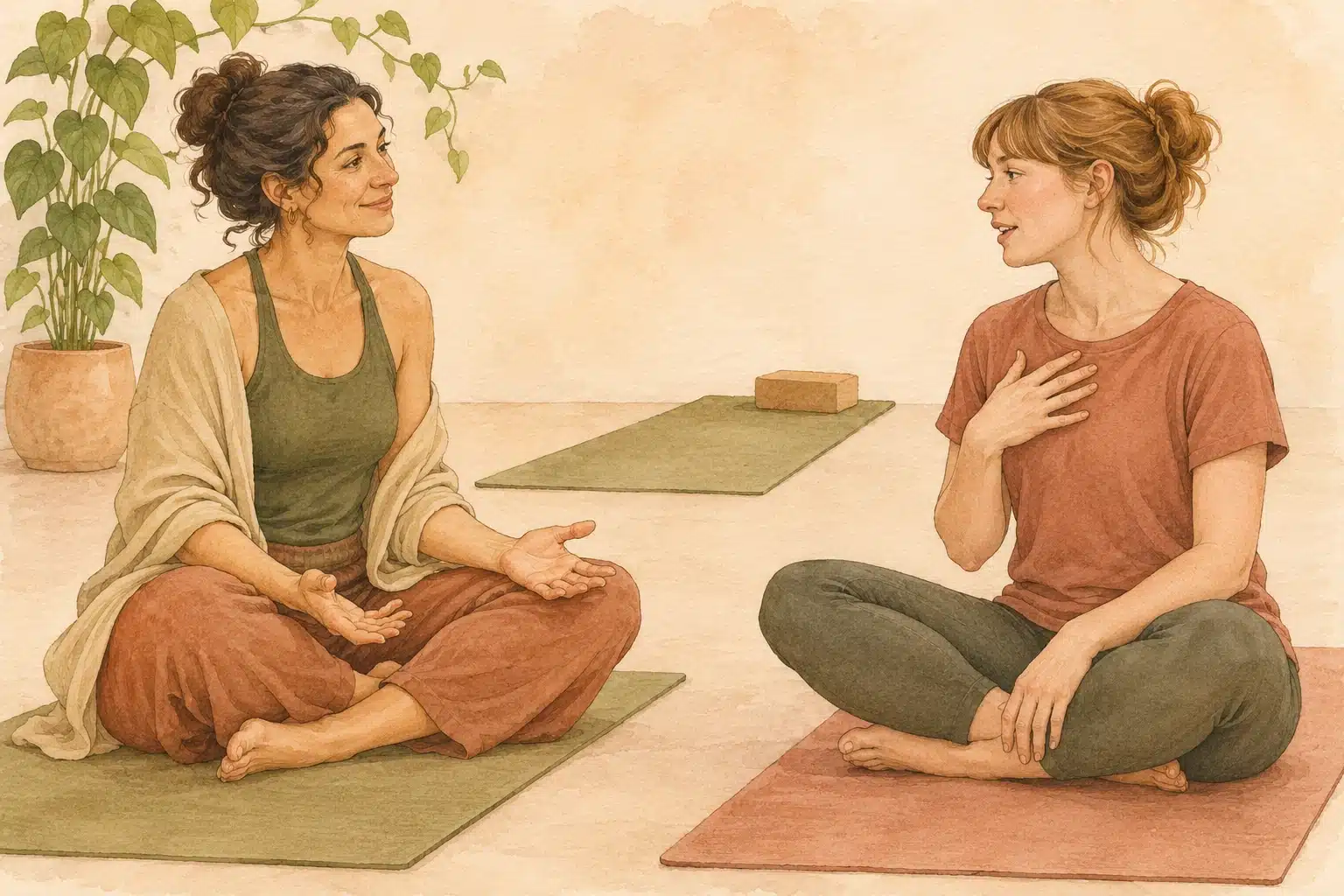
A teacher approaches your mat while you are concentrating on a pose. You are not sure whether they are about to explain something, move a prop or place a hand on your back. You might welcome some help. You might prefer to practise without touch. You might simply need a moment to understand what is being offered.
Consent in yoga classes makes room for that moment. It gives a student a clear choice about a specific interaction, rather than leaving both people to guess. Knowing how to ask a question, set a boundary or change an answer can make the practical details of attending a class much easier to navigate.
This guide is written for students. It offers ordinary language you can use before, during and after a class. The examples are suggested wording, not quotations from students or a claim that every school uses the same procedures.
What consent in yoga classes means in practice
The starting point is simple: the teacher has expertise to offer, and the student remains a participant in the decision. A helpful request explains the proposed interaction and leaves space for an answer. It should be possible to understand the offer without already knowing the pose, the teacher’s terminology or the traditions of that particular room.
For members of Yoga Alliance, this is also an explicit professional expectation. Its Code of Conduct requires informed permission before physical adjustments, treats consent as ongoing, and says silence or absence of resistance alone is insufficient. These are membership standards, not a statement that identical rules or laws apply to every teacher worldwide.
Consider the difference between a teacher saying, “Can I help?” and asking, “Would you like a verbal explanation, or would you like me to explain a possible hands-on adjustment first?” The second version gives you something clearer to decide. You can be interested in help while still wanting to know what kind of help is being proposed.
You do not need a perfect explanation of your preference. Perhaps you want to concentrate, you do not enjoy touch, or your choice is different from yesterday. A short answer can be enough. The responsibility for appropriate professional behaviour remains with the teacher; students are not responsible for preventing another person’s misconduct through flawless communication.
Hands-on adjustments, verbal cues and demonstrations
A hands-on adjustment involves physical contact intended to guide or support part of a practice. What it looks like can vary considerably. A teacher might describe a light directional cue, assistance with a prop or a more involved change of position. The word “adjustment” alone does not tell you the location, pressure, duration or purpose of the contact.
A verbal cue uses words. A visual demonstration shows an action, usually through the teacher’s own body or another agreed example. A prop can alter the setup without a teacher moving you. These formats may be combined, but it is useful to ask which one is being offered rather than assume that all assistance includes physical contact.
If you are learning new movement language, start with the missing information. “Which part should move?” is a different question from “Can you move me?” You can ask the first without inviting the second. Our guide to understanding yoga class cues explains how to ask for direction, pace and context when a short instruction is unclear.
No teaching method suits every person in every situation. Someone may find a demonstration easier to follow, while another person prefers a short spoken instruction. A useful class conversation explores that difference without treating one format as the more committed or advanced way to learn.
Five questions to ask before a physical adjustment
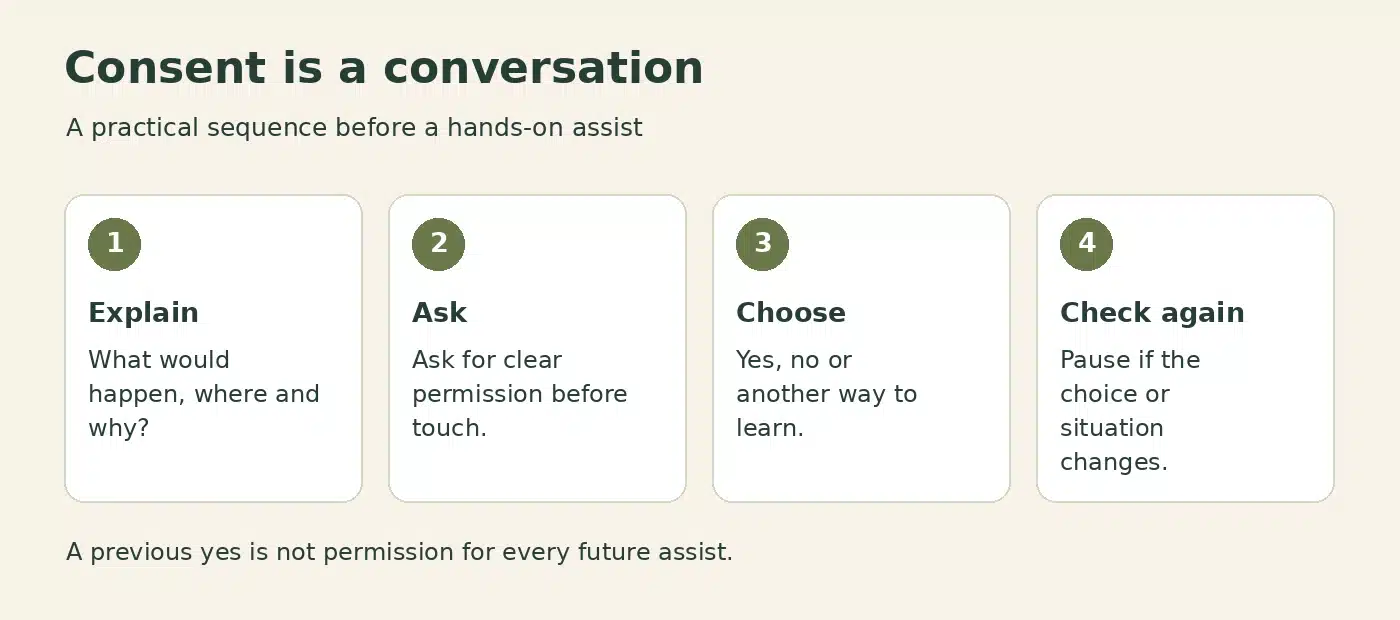
You do not need to run through a formal interview each time. These questions are a practical menu. Ask the one that supplies the information you are missing, and take time to settle into a position where you can listen before deciding.
What are you proposing to do?
Ask the teacher to describe the action in ordinary words. “Could you explain the adjustment before touching me?” is direct and neutral. If you do not understand the description, it is reasonable to ask them to demonstrate the idea on themselves instead.
Where would you place your hands?
A general offer to help with a pose can leave the location of contact unclear. Ask about the relevant part of the body and whether a prop is involved. A description lets you make a more specific choice, rather than agreeing to an undefined interaction.
What is the purpose?
An explanation might concern balance, the direction of a movement or a way to notice a particular action. Ask what you are meant to learn. A useful answer can help you decide whether you would rather explore the same idea through words or a smaller movement.
What could I do without touch?
“Could I try it with a block?” or “Would a demonstration help?” opens a practical alternative. The teacher may suggest a different setup, rest or another exercise. You can also stay with a version you understand while the group continues. The option should fit the class and your needs, not become a test of courage.
How do we stop?
Agree on a simple word or signal before an interaction that could make speaking or moving difficult. Avoid treating an enthusiastic initial answer as a requirement to continue. The useful outcome is a shared understanding of how to pause, not a promise that the adjustment will feel right.
Clear phrases for yes, no, pause and changed preferences
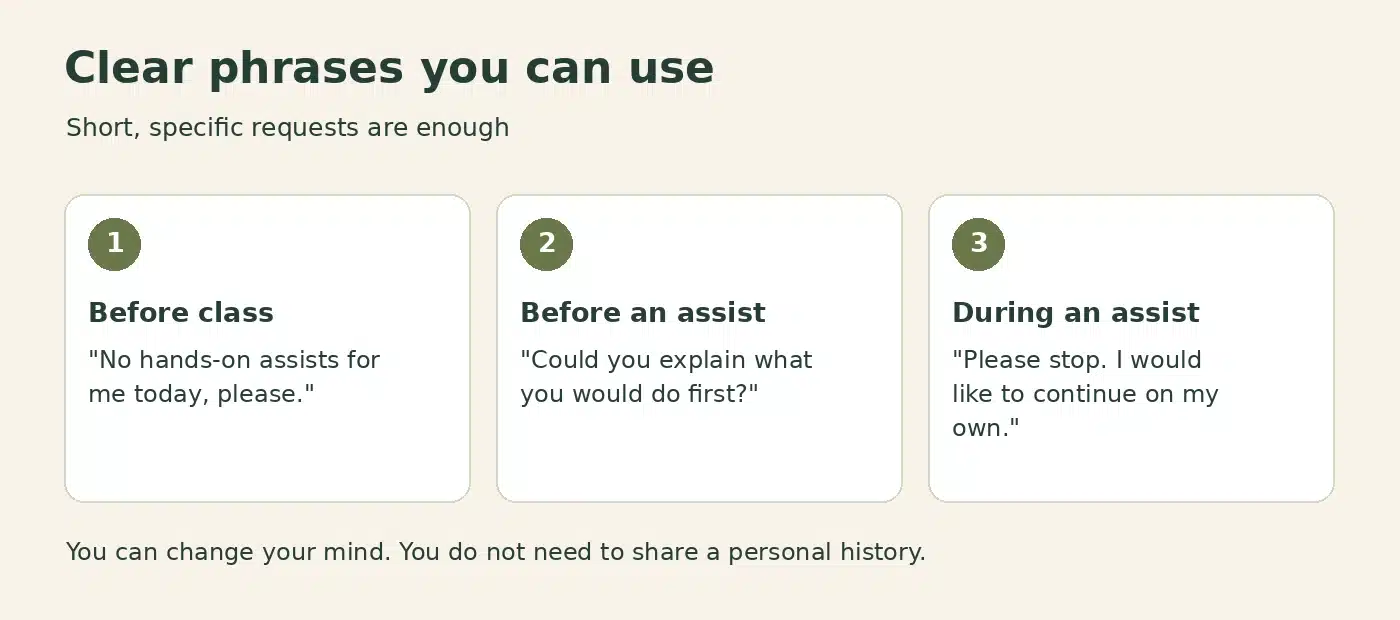
Choosing words beforehand can reduce the effort of finding them while balancing or following instructions. You can adapt these examples to sound like yourself. A shorter version is often easier to say and easier for the teacher to hear across a room.
| Situation | Wording you could use | What it makes clear |
|---|---|---|
| You want an explanation first | “Please explain it before touching me.” | You are asking for information, not yet agreeing to contact. |
| You prefer no touch today | “No hands-on adjustments today, thank you.” | Your current class preference. |
| You want a different teaching method | “Could you show me on yourself instead?” | The kind of help you would prefer. |
| You agree to a described interaction | “Yes, that shoulder cue is okay.” | Your answer is tied to the offer you understood. |
| You want to stop | “Stop, please.” | The interaction should end. |
| Your preference has changed | “I’ve changed my mind. I’d like to continue without touch.” | A previous answer no longer describes your choice. |
| You want privacy | “Could we discuss that quietly after class?” | You are choosing a more private setting. |
A phrase does not have to sound warm or polished in an uncomfortable moment. You can use a raised hand, move away when possible or simply repeat “no” if that is what you can manage. These are communication options, not obligations to respond in a particular way.
If you already know you want a no-touch class, tell the teacher before the session when possible. This can be particularly helpful with a substitute instructor, an assistant or a visiting teacher. A familiar teacher’s knowledge of your preferences should not be assumed to transfer automatically to everyone else in the room.
Consent cards and other class signals
Some classes use a card, token or another indicator placed near the mat. Such a system can make preferences visible without repeated public conversations. Its usefulness depends on everyone understanding what the indicator means and how it is used in that session.
Before relying on a card, ask the teacher to explain both sides. Does one side mean “please ask me first” or “I welcome a particular kind of assist”? What should someone do if they want to change their choice halfway through? Where should the card sit so it is visible without becoming an obstacle?
A card can be turned over accidentally, hidden by a blanket or moved with a mat. If the meaning or visibility is uncertain, a brief spoken clarification is better than guessing. You can keep a no-touch preference even if the class has a system you find confusing.
The Yoga Alliance Scope of Practice recognises several ways of communicating permission, including words and unambiguous gestures or indicators. It also makes the permission specific to the teacher involved. A card should support a clear exchange, rather than become a reason to skip understanding the actual interaction.
Students who use another language or a communication aid may want to agree on a simple signal before class. The goal is not elaborate terminology. It is knowing that your answer can be communicated, noticed and acted on.
You can accept one interaction and decline another
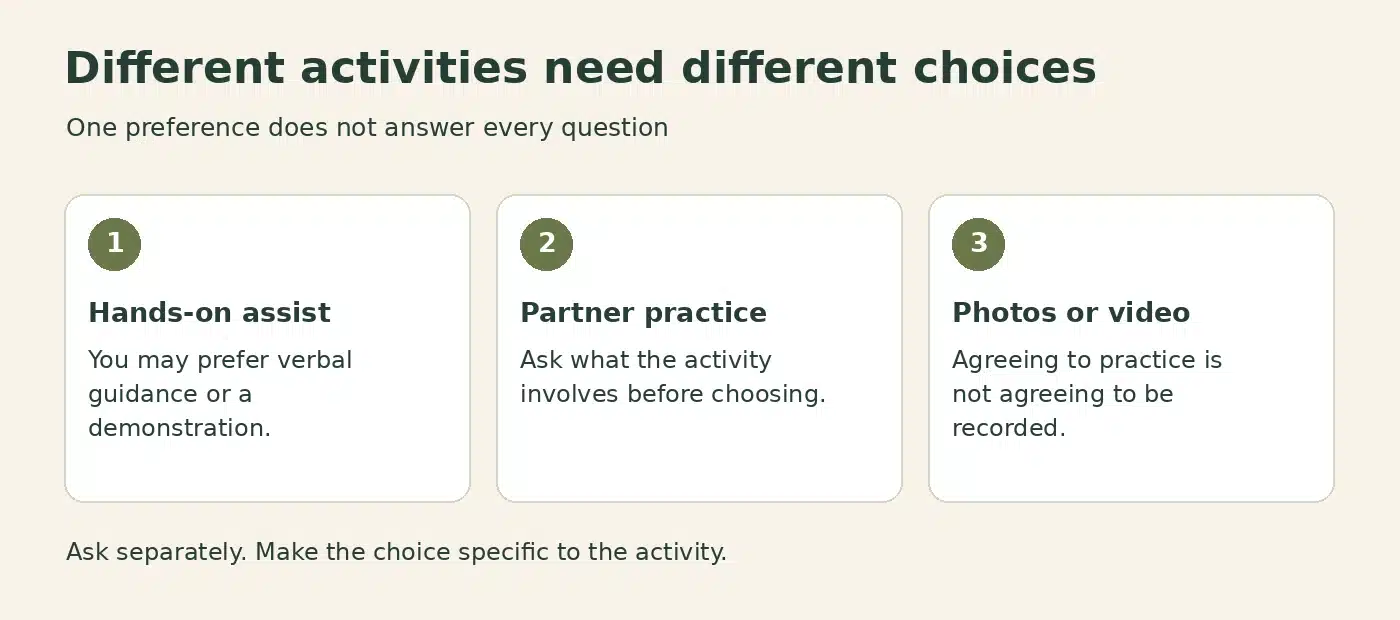
A useful way to think about a class is as a sequence of invitations. Agreeing to be shown a seated position does not tell the teacher how you feel about help during an inversion, a partner exercise or a later relaxation practice. The context can change even within the same session.
You might say, “That explanation was helpful. I’ll practise the next one on my own.” There is no contradiction in appreciating assistance and choosing independence afterward. You can also start with verbal guidance and decide later that you want to hear more about a proposed physical adjustment.
The same principle helps when you return to a regular class. Familiarity can make communication easier, but it can also encourage assumptions. A short update such as “I’m keeping things simple today” gives the teacher current information without requiring you to describe your whole day or medical history.
An adjustment you welcomed last week might not be what you want this week. You can communicate that change as an ordinary preference. A respectful response leaves room for the change rather than turning it into a debate about trust, progress or commitment.
Partner exercises and volunteering for demonstrations
Partner work introduces another person and another set of expectations. Before joining, ask what each person will do, whether physical contact is involved and what an individual alternative would look like. The fact that an activity appears playful does not remove the need for clear instructions.
If the teacher invites a volunteer, listen for the scope of the demonstration. Will you simply show the position you are already practising, or will the teacher move a limb or ask you to hold a shape? You can offer to demonstrate one part and decline another. You can also choose to watch.
When working with a classmate, keep the agreement with that person as clear as it would be with a teacher. Avoid testing an adjustment you saw elsewhere or adding pressure because you assume it will help. Ask the teacher to explain the activity rather than improvise a technique on someone else’s body.
| Before participating | A useful question |
|---|---|
| Partner activity | “What will each person do, and is there a solo option?” |
| Being a demonstration volunteer | “Could you describe what you would like me to demonstrate?” |
| Another student offering an assist | “Let’s ask the teacher to explain the activity first.” |
| A change during the exercise | “Can we pause and check the instructions?” |
Choosing to observe can still be part of learning. You can watch the sequence, listen to the explanation and ask a question afterward. Participation does not have to look identical across every mat to be thoughtful and engaged.
Photographs, videos and online recordings are separate choices
A group photograph can seem like a small addition at the end of class, yet it raises questions different from those involved in practising a posture. Ask who is taking the photograph, where it will be used and whether your face will appear. You can enjoy the session and prefer to stay out of its publicity.
Yoga Alliance’s Code of Conduct separately addresses express permission for photographs, video and use of a person’s likeness. In everyday terms, keep the conversation specific: posing for a private group photograph is a different request from appearing in a public advertisement or a recorded class available online.
For an online session, check the recording arrangement before turning on your camera. Ask whether participant video, display names or spoken questions will be included. If you want to attend without appearing, find out what practical options the provider offers rather than assuming that switching off video controls every form of recording.
A simple request can be: “I’m happy to join the class, but please keep me out of photos and recordings.” If you discover an image afterward, contact the organiser privately with the specific image or link and explain your concern. Privacy rights and formal remedies depend on the circumstances and location; this guide does not make a legal determination.
Health information, comfort and the limits of an adjustment
Permission and physical suitability are different questions. A person can agree to an adjustment that does not suit their current needs. A confident teacher, a familiar sequence or a signed form cannot make an individual physical outcome certain.
The US National Center for Complementary and Integrative Health notes that yoga injuries can occur and that qualified instruction and appropriate modifications matter. Its yoga safety guidance also advises people with relevant health circumstances to discuss practice with their healthcare professional and instructor. A general class cannot supply individual medical clearance.
Share the practical information that helps the teacher understand your current needs, ideally in a private conversation. You might say that you are avoiding pressure on a particular area or following advice to limit a movement. You do not have to turn a group-class introduction into a public account of your personal history.
Ask what the teacher can offer within their training. The word “adjustment” does not make an interaction a medical assessment or treatment. If you need diagnosis, rehabilitation guidance or mental-health care, seek the appropriately qualified professional rather than relying on a yoga credential alone.
If a movement or interaction feels wrong, pause and ask for space or an alternative. You do not need to continue so that the teacher can finish explaining. Persistent or concerning symptoms deserve appropriate healthcare advice rather than repeated attempts to make the same position work.
When a boundary is missed or ignored
You may not know immediately how you want to respond to an unwanted interaction. You might feel clear about it in the moment, or only think through it later. Either way, you can decide what would help you next without having to describe the event perfectly.
If possible, stop the activity and move to a place where you feel able to make a choice. You can leave the class, contact someone you trust or speak to a manager. If you need urgent medical attention or are in immediate danger, use the appropriate local emergency services.
For a follow-up conversation, a short factual account can be useful: what happened, when it happened, what you had communicated and what response you are requesting. Keep a copy of any message you send. You can ask the studio who receives concerns and whether there is a written complaints process.
You do not have to confront the teacher alone. Nor do you have to decide immediately whether to return. If a professional membership body is relevant, check its current reporting process and scope directly. A studio complaint, a membership complaint and a legal report are different routes; no article can determine the right one for every situation.
Above all, the student is not at fault for failing to anticipate a boundary problem or for being unable to speak in the moment. Communication tools are useful, but responsibility for respectful conduct does not shift onto the person receiving the instruction.
Choosing a class that makes questions welcome
The most useful information often comes from a specific question rather than a broad promise that a class is welcoming. Before booking, ask how hands-on adjustments are handled, whether a no-touch preference is easy to communicate and whether another teacher or assistant may participate.
Listen for a practical answer. Does the organiser explain the procedure? Can they describe how students change a choice? Is there a named person to contact afterward? You are looking for information you can use, not a guarantee that a particular style or credential eliminates every risk.
You can also ask about alternatives for the parts of a session that concern you. “Can I watch the partner exercise?” is more useful than trying to guess whether a class description covers your situation. If the answer is unclear, asking again before paying or travelling may save a difficult conversation later.
For the broader practical details, use our guide to preparing for your first yoga class. For support choices within a pose, the guide to using yoga blocks explains how props can change a setup. Neither replaces a conversation with the teacher about your own circumstances.
If you are exploring longer study with Inteyoga, read the current programme information and send your questions before applying. This article explains student communication choices; it does not announce a separate drop-in class, consent workshop or clinical service.
A small plan for your next class
Before arriving, decide whether you already have a clear preference about touch. You can write one sentence on your phone if you think it will be easier to read than improvise. At the start, introduce yourself and ask how the class communicates preferences.
During the session, choose the question that fits the moment: “What do you mean?”, “Could you demonstrate?” or “Can we stop?” You do not need to rehearse every possible situation. One clear phrase is often more useful than a long explanation delivered while you are trying to keep up.
After class, notice whether the communication worked for you. Perhaps you want to repeat the same request next time, ask about a different format or try another teacher. Consent in yoga classes is part of ordinary, ongoing communication. It should leave you with room to learn, ask and choose.
Safety note: This article offers general educational information about class communication. It is not individual medical, mental-health or legal advice. Seek appropriately qualified help for your circumstances.
Sources
- Yoga Alliance: Code of Conduct, particularly consent, professional relationships and images.
- Yoga Alliance: Scope of Practice, particularly explicit permission and professional boundaries.
- NCCIH: Yoga, Effectiveness and Safety.
Frequently Asked Questions (FAQ)
Can I say no to hands-on adjustments in a yoga class?
Yes. You can tell the teacher you prefer verbal instructions or demonstrations without touch. A short phrase such as “No hands-on adjustments today, thank you” communicates the preference. You can ask how the class records it and how to update it during the session.
Does a consent card mean I agree to every adjustment?
Ask what the card means in that class. It should help communicate a clear preference, not leave you uncertain about what is proposed. You can request an explanation of a particular assist and change your choice. A card’s colour or position should not be assumed to have a universal meaning.
Is signing a yoga waiver the same as agreeing to touch?
A registration form and a conversation about a particular physical interaction serve different purposes. Ask the provider to explain its documents and adjustment procedure. This article does not interpret the legal effect of a waiver; if that matters to your decision, obtain appropriate advice for your location.
Can I change my mind after an adjustment has started?
Yes. Say “stop” or use the signal you agreed on, and ask to continue without touch. You can also choose a different form of help afterward. You do not need to keep an interaction going just because you initially agreed to it.
Can a teacher demonstrate a pose without touching me?
You can ask the teacher to show the action on themselves, explain it verbally or discuss a prop-supported option. Which alternative fits depends on the activity and the teacher’s skills. Clear yoga cues and a slower explanation may answer the question you were trying to solve.
What if I want to join the class but not its photos?
Tell the organiser before photographs or filming begin, and ask how they will keep you out of the frame. For online classes, ask separately about participant cameras, display names and recorded questions. Taking part in a practice and appearing in publicity are separate choices.