


Quick Answer
A yoga practice journal is a short record of what you practised, what you noticed and what you want to understand next. Begin with the date and a few honest sentences. Keep the format easy to repeat, separate observations from explanations, and return to earlier entries when you need a clearer question or a practical next step.
Key Takeaways
- Choose a purpose. Record the details that help you learn, prepare a question or organise your next class.
- Start small. A date, one observation and one question can be a complete entry.
- Keep facts and guesses separate. Describe the experience before deciding what caused it.
- Use your own words. Plain language, sketches and short recordings can all hold a useful reflection.
- Return to the notes. Look for an unanswered question or a practical decision rather than a score.
- Keep sharing intentional. Your personal journal and anything you choose to show a teacher can be separate records.
Perhaps you remember that a class felt different, but cannot remember which instruction helped. Perhaps you have a question on the way home and lose it before the next lesson. A notebook can give those small details somewhere to stay.
You do not need a beautifully designed planner, an unbroken daily streak or a detailed account of every posture. The useful question is simpler: what would you like your future self to remember?
This is Part 6 of our Building a Steady Beginner Yoga Practice series. This guide offers an adaptable template, clearly labelled fictional examples and a way to review your notes without turning yoga into a performance report. The suggestions are learning tools, not a prescribed yoga method or a clinical assessment.
What belongs in a yoga practice journal?
A useful entry gives enough context to recognise the session later. It might identify the class, the lesson you were exploring, an instruction you want clarified, or a choice you made. You can also record something that simply interested you.
Consider the difference between these two hypothetical notes:
“Good class. Need to improve.”
“I could hear the instructions more clearly from the second row. I still did not understand what the teacher meant by ‘soften the ribs’. Ask before the next class.”
The first entry expresses an impression. The second gives a location, a specific uncertainty and a possible action. Neither needs elegant writing, but the second is easier to use.
You can decide what your journal is for before choosing its sections. If you want to remember new terms, leave space for vocabulary. If you often forget to ask questions, keep a running question list. If you are deciding between class formats, record the practical details that matter to you, such as whether instructions were audible and whether there was an opportunity to ask for clarification.
The journal does not need to contain your entire personal life. Choose the information that serves the purpose you have set. A short practice record can sit alongside a private diary, a study notebook or a teacher’s course materials without replacing any of them.
Choose a format you will actually use
Start with a format already within reach. Buying a special journal can wait until you know which features you want.
Paper makes it easy to place a quick sketch beside a sentence. A digital note is searchable and may be more convenient if you already organise your learning on a device. A brief voice note can suit someone who finds speaking easier than typing. None is automatically the best choice for everyone.
| Format | Useful when | A practical question to check |
|---|---|---|
| Plain notebook | You like handwriting, arrows or sketches | Can you find an older entry easily? |
| Digital notes | You want search, headings and links | Who can access the account or shared folder? |
| Voice notes | Speaking is easier than writing | Can you record privately and label the file clearly? |
| Simple spreadsheet | You mainly want dates and brief structured notes | Does the table leave enough room for meaning? |
| Printed template | A few repeated prompts help you begin | Can you leave irrelevant fields blank? |
Try one format before maintaining several. A paper notebook, an app and a spreadsheet can become three places to search for the same question. If you prefer a mixed system, give each part a clear role. For example, keep personal reflections on paper and a short list of teacher questions on your phone.
Use dates that you can recognise later. If you attend several classes, add a simple session label. “Tuesday evening beginners” may be enough. For digital notes, a consistent title such as “2026-11-17 – evening class” keeps the entries easy to sort.
Choose a place to store the journal as well as a place to write. A notebook left beside your class bag or a pinned digital note can be ready when you need it. These are organisational suggestions, not requirements for building a successful practice.
A simple yoga practice journal template
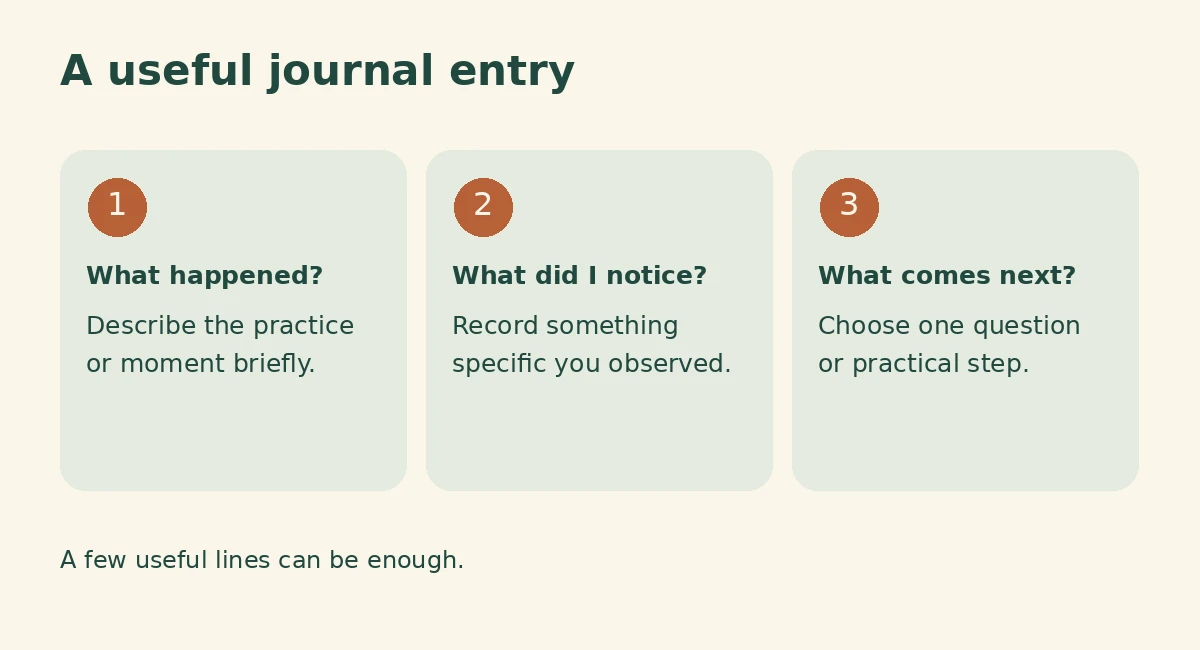
The following template is an original, adaptable worksheet. Use all of it, shorten it or keep only the fields that serve your purpose.
| Field | What to record |
|---|---|
| Date and session | Enough detail to identify the class or practice |
| What I explored | The lesson, activity or question you focused on |
| What I noticed | One specific observation in your own words |
| What helped me participate | An explanation, practical arrangement or choice |
| What remains unclear | A question rather than a forced conclusion |
| My next step | Something small and appropriate to do or ask |
For an even shorter version, write three lines:
- Today I explored:
- One thing I noticed:
- Next time I want to ask or remember:
You can copy these prompts into the front of a notebook and refer to them as needed. There is no need to prepare a page for every date in advance. Undated pages leave room for a brief entry one day and a longer reflection another day.
For background, the University of Edinburgh describes a reflective framework organised around an experience, its meaning and a future response. That general learning model informs the distinction here between recording, considering and deciding. It does not establish that this particular yoga worksheet has been clinically tested. University of Edinburgh Reflection Toolkit.
Keep the final field realistic. “Ask what that instruction means” is more usable than “understand all the alignment”. “Put my question in the class bag” is more concrete than “become more organised”. A next step can also be a deliberate pause: “I will leave this question open until I can discuss it.”
Write observations before explanations
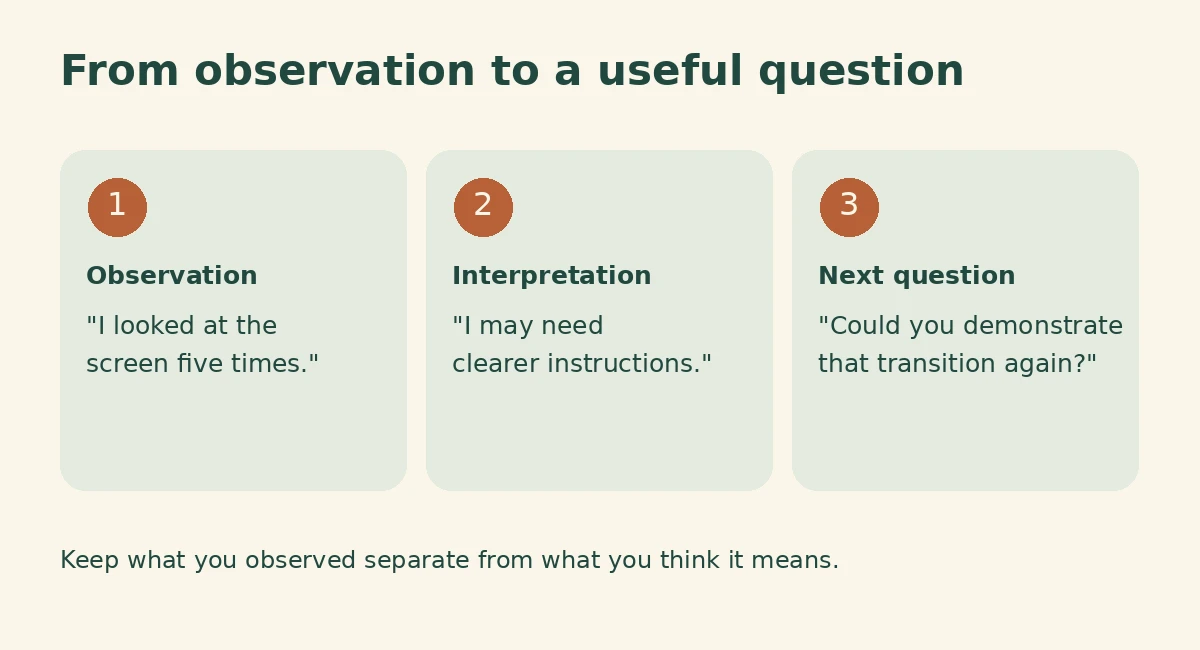
Your own experience is worth recording, including uncertainty. The important distinction is between what happened and the explanation you are considering.
“I lost track of the sequence after the second transition” describes an experience. “I am incapable of learning sequences” turns one moment into a broad judgement. The first statement leaves room to ask whether the instruction was unfamiliar, the demonstration difficult to see, or the sequence simply new to you.
Try describing one moment as if you were helping your future self recognise it. Include the relevant detail and leave out conclusions you cannot support.
| Broad judgement | More specific note |
|---|---|
| “I was terrible at following the class.” | “I missed the instruction when everyone turned away from the teacher.” |
| “Props do not work for me.” | “I did not understand where to place the block in that activity.” |
| “I learned nothing today.” | “I remember the demonstration, but I still need an explanation of its purpose.” |
| “I should be able to do more.” | “I chose the shorter option and want to ask how to select between the options.” |
These fictional examples are about writing clearly, not determining which physical option is suitable. A journal cannot evaluate technique or identify a medical cause. Questions about individual suitability belong in a conversation with an appropriately qualified professional.
You can include feelings without treating them as evidence about other people. “I felt hesitant to ask” records your experience. “The teacher did not want questions” claims knowledge of someone else’s intention. If you do not know, keep that distinction visible.
Similarly, a remembered instruction is not necessarily a verbatim quotation. Write “My understanding was…” when you are paraphrasing. Save quotation marks for words you can accurately recall or check. This makes it easier to revisit an apparent contradiction without building an argument on an uncertain memory.
Three fictional entries, from brief to detailed
The following entries are invented examples, not reports from Inteyoga students. They demonstrate different ways to use the same template.
A first-class entry
Session: My first beginner class.
What I explored: Following spoken instructions while watching demonstrations.
What I noticed: I often looked around to see which direction to face. The teacher’s demonstration was easier to follow when I could see their whole body.
What helped: I asked where to place my mat before class.
Question: When a demonstration faces the opposite direction, should I mirror it or follow the named side?
Next step: Ask this before the next lesson and note the answer.
This entry contains a useful learning question without grading the entire class. If you are preparing for a first session, Inteyoga’s guide to what to expect at your first yoga class covers the practical preparation separately.
A question about a cue
Session: Evening class, recurring instruction.
Observation: The teacher said to “create space”. I understood the direction of the movement, but not what that phrase added.
My interpretation: Perhaps it was an invitation to move less forcefully. I am guessing.
Question to ask: “When you say ‘create space’ in that movement, what would you like me to notice or do?”
After the conversation: The teacher explained the instruction in different words. I wrote the explanation below my original question rather than replacing it.
This preserves the difference between an initial interpretation and a later explanation. For more examples of clarification questions, see yoga class cues explained.
An entry after an ordinary session
Session: Familiar class, no particular breakthrough.
What I explored: Following the parts of the lesson I already recognised.
What I noticed: I remembered one transition without looking around. I also forgot a word the teacher used near the end.
What remains unclear: The word and its meaning.
Next step: Ask for the spelling next time. No other change planned.
An ordinary entry can be complete. You do not have to discover a personal revelation every time you open the notebook. Sometimes the useful record is a small detail, an unanswered question or confirmation that your current arrangement still suits you.
Use prompts that match the question you have
Choose a prompt because it opens a useful line of thought. You can skip prompts that feel irrelevant and return to them later if your purpose changes.
For understanding instructions:
- Which word or phrase would I like explained differently?
- What did I understand more clearly after the demonstration?
- Which question would help me distinguish between two options?
For participating in a class:
- Could I hear and see what I needed?
- Was there a practical arrangement I would like to discuss before next time?
- Did I know how to ask for an alternative or take a pause?
For remembering learning:
- What is one idea I want to revisit?
- Which part is my own interpretation?
- What would I need to check before explaining this idea to someone else?
For keeping the journal manageable:
- Which field did I find useful when I looked back?
- Which field am I completing only because it is printed on the page?
- Would a shorter entry serve the same purpose?
There is no need to answer every prompt after every session. Pick one, follow it far enough to produce a useful note, and stop when you have recorded what matters.
If you use Sanskrit terms, you can write the sound as you remember it and add “spelling to check”. Confirm the word with your teacher or a suitable source before turning that tentative note into a definition. Your private notebook can hold unfinished learning; an explanation you share with others needs greater care.
Review your yoga practice journal without making a scorecard
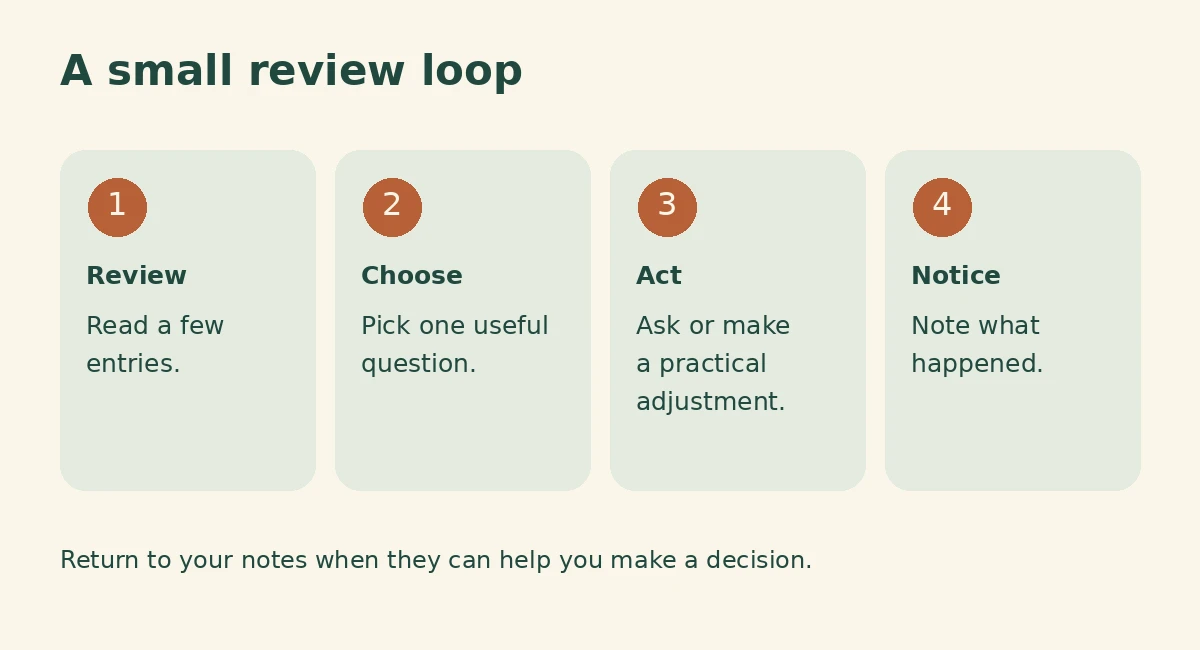
Set aside an occasional review rather than assuming each entry needs immediate analysis. You might look back after a few sessions, at the end of a course topic or before a conversation with your teacher. Choose a rhythm that fits the amount you write.
Read for questions and decisions. Which question has appeared more than once? Has an explanation answered it? Is there a practical detail you would like to keep using? Which earlier assumption now needs correcting?
A simple review can have three headings:
- Keep: Something useful you want to remember.
- Ask: A question that still needs an answer.
- Leave open: Something you do not yet understand well enough to conclude.
This is an editorial review suggestion, not a validated assessment scale. There is no need to assign a number to every session or calculate how well you are doing at yoga.
The University of Sheffield’s guidance distinguishes a record of an experience from reflection that examines it and considers how the learning might inform a later situation. That is a helpful distinction here: a list of completed sessions and a thoughtful question can serve different purposes. University of Sheffield reflective-writing guidance.
Treat patterns as starting points for enquiry. If your notes mention difficulty hearing on several occasions, the next step may be a practical conversation about where to sit. If several sessions felt different, the notebook alone cannot show why. A handful of entries is not a controlled comparison, and personal impressions do not establish cause and effect.
Avoid rewriting older entries to make them match what you believe now. Add a dated correction or follow-up instead. “I understood this differently after asking” preserves the learning process more honestly than making the original note look as if you knew the answer all along.
Turn a journal question into a useful conversation
Before showing a teacher your notes, choose the part you want help with. A whole notebook can contain several unrelated questions. One specific example gives the conversation a clearer starting point.
Try this structure:
- Identify the moment or instruction.
- Say what you understood.
- Explain what remains unclear.
- Ask for the kind of clarification you need.
For example: “During the standing section, I understood that we were turning to the side. I was unsure which foot should move first. Could you show that transition slowly?”
Or: “You offered two ways to use the prop. Could you explain how I should choose between them, rather than assuming the more demanding option is the goal?”
Keep the wording open enough for the teacher to correct your recollection. You may have missed a qualification or connected an instruction to the wrong activity. The point is to understand the lesson, not defend the first version in the notebook.
After the conversation, write the answer in your own words and check your understanding if needed. A short follow-up such as “So for this exercise, you would like me to…” can reveal whether the explanation answered the original question.
You can also decide not to share a personal reflection. A practical question does not require you to disclose unrelated private experiences. Ask about the lesson in the level of detail you are comfortable providing.
Keep privacy and permissions part of the setup
A practice journal may contain information about you and other people. Think about access before storing or sharing it.
For paper, choose somewhere you are comfortable keeping personal notes. For digital records, check whether the document, folder or account is shared. A file called “private” is only a label; it does not tell you who has access.
If you use voice notes, record your own reflection somewhere appropriate. Ask permission before recording a teacher, a class or another participant. A personal learning purpose does not automatically make someone else’s words or image yours to publish.
Keep other people’s identifying details out of your entries when they are unnecessary. You can write “another participant asked a question” without recording their name or personal circumstances. The journal is there to support your learning, not to create an informal record of everyone in the room.
When sharing, copy the relevant excerpt into a separate message rather than sending the entire notebook by default. Review that excerpt for details you did not intend to disclose. If you use an online tool to summarise your writing, consider the service’s privacy terms and what information you are comfortable uploading.
A course journal may have a different purpose from a private one. Before submitting reflective work, ask what is required, who will read it and whether you can keep personal material in a separate record. Follow the actual course brief rather than assuming that every honest reflection must become an assessed assignment.
Restart or simplify when the journal becomes a burden
If you have stopped writing, begin with the next useful entry. There is no need to reconstruct every missed session.
A gap can remain a gap. If you remember a detail later, label it as a later recollection rather than presenting it as a contemporaneous account. “Remembered on Friday” is enough to distinguish it from something written immediately after class.
If the template feels too large, reduce it to one question: “What do I want to remember?” If entries become repetitive, change the prompt rather than forcing a different answer. If you prefer drawing, use an arrow, a labelled sketch or a few keywords that you can understand later.
You might also discover that journaling is useful only at certain times, such as while learning unfamiliar vocabulary or preparing for a teacher conversation. That is a legitimate way to use a tool. Keeping a notebook is not a prerequisite for participating sincerely in yoga.
Keep the exercise within the purpose you chose. If you find yourself repeatedly scoring, criticising or expanding the record beyond what you wanted, pause and simplify. You can keep practical class questions without turning the notebook into a comprehensive judgement of yourself.
Begin with the next useful question
To start your yoga practice journal today, choose a notebook or note, add a date, and record one thing you want to understand. You can build the rest of the format around the questions that actually arise.
For a new student, the next question may concern a word, a transition or how to participate comfortably in class. For someone returning to study, it may concern an idea that deserves a careful explanation. The entry does not have to be impressive to be useful.
At Inteyoga, our educational resources are intended to support thoughtful enquiry alongside appropriate teaching. A personal journal can hold the question you bring to that teaching. Keep the question specific, leave room to revise your understanding, and let the next conversation do its part. For background on the school’s teaching, meet Inteyoga’s founder and principal teacher, Dr. Ashutosh.
Sources
- University of Edinburgh: What? So what? Now what? – a general framework for reflecting on experience and considering future action.
- University of Sheffield: How to reflect in an academic context – distinctions between reflective thinking, reflective writing and learning records.
These educational sources inform the general reflection principles. The yoga-specific template, prompts and fictional entries in this article are original practical suggestions, not a tested therapeutic programme or an official course-assessment rubric.
Frequently Asked Questions (FAQ)
What should I write in a yoga practice journal?
Start with the date, the session or topic, one specific observation and a question or next step. Include enough context to understand the note later. You can add vocabulary, sketches or follow-up answers when they serve your learning purpose.
Do I need to write after every yoga session?
No. Choose a frequency that makes the journal useful to you. You might write when a question arises or after learning something unfamiliar. An occasional useful note can serve your purpose without a daily streak or a completed page for every session.
Is a paper or digital yoga journal better?
Choose the format you find easiest to use and review. Paper suits handwriting and sketches; digital notes offer search and links. Check storage and sharing arrangements in either format. You can also use brief private voice notes if speaking suits you better.
How long should a journal entry be?
There is no required length for a personal entry. A few sentences can identify an experience, preserve a question and suggest a next step. Write more when a topic needs it, and stop when the additional detail no longer helps you understand the experience.
Should I show my journal to my yoga teacher?
Share only the part you want help with. A specific question or short excerpt is often enough to begin a conversation. You can keep personal reflections separate from class questions. If a course requires assessed reflection, check its actual submission and privacy arrangements.
What if I have nothing interesting to write?
An ordinary observation or an unanswered question is enough. You can also leave the journal closed. The purpose is to preserve useful learning, not manufacture a breakthrough after every class. Return when there is something you want to remember, explore or ask.