


Quick Answer
Yoga cues are brief verbal directions, demonstrations or other signals used to guide a practice. A useful cue makes the next action understandable in context. If a phrase is unclear, pause in a comfortable position and ask the teacher to identify the body part, movement or direction, or demonstrate the step.
The most useful question is often small: “Which foot moves first?” is easier to answer during class than “Can you explain this whole pose?”
Key Takeaways
- Understand the action: Hearing a phrase clearly and understanding the movement are different things.
- Recognise the cue: A cue may describe an action, suggest an image or invite you to notice something.
- Check the context: Familiar wording can mean different things in different postures.
- Ask for clarity: An instruction to the room may need a different explanation for you.
- Pause before rejoining: Clarify an uncertain transition before trying to catch up with it.
The teacher says “lengthen”, then “soften”, then asks you to move to the other side. You heard every word, but you are still trying to work out what the first instruction meant.
Yoga cues are short directions that help a teacher guide movement, breathing and attention. They can be useful shorthand once you know the context. In an unfamiliar class, however, a two-word instruction can leave several questions unanswered: which part moves, in which direction, how much, and when?
You do not have to solve those questions by guessing harder. This guide explains how to recognise different kinds of cues, ask for the missing detail and recover when the class moves on before you are ready. It is a guide to understanding instructions, not a list of anatomical rules or a substitute for individual teaching.
This is Part 3 of Inteyoga’s Building a Steady Beginner Yoga Practice series. Our guides to your first yoga class and using yoga blocks cover the setting and equipment. Here, the focus is the language you hear once practice begins.
Why can familiar yoga cues feel confusing in class?
Words such as lift, open and release sound ordinary. Their meaning becomes less obvious when the teacher is describing a movement you cannot see, asking you to coordinate several actions, or using an image rather than a literal direction.
“Reach forward” is incomplete if you do not know whether forward means towards the front of your mat or straight ahead of your chest. “Soften” does not tell you whether to reduce effort, slightly bend a joint or settle your attention. The missing context matters more than the simplicity of the word.
In her discussion of common yoga cues, teacher Rachel Land describes cues as shorthand for nuanced actions and explains why their usefulness depends on how and where they are applied. You do not need to memorise a supposedly perfect translation of every phrase. You need to understand what this teacher is asking in this moment.
There may also be a practical communication problem: music masks the instruction, the teacher turns away while speaking, or you cannot see the demonstration from your position. Ask for the problem you actually need solved. “I missed the last word” calls for repetition; “I heard it, but I do not know what moves” calls for explanation.
Learning the vocabulary of yoga cues takes time, but it should not become an entrance examination. Bring curiosity, and expect that asking a clear question can be part of learning.
Four kinds of yoga cues to recognise
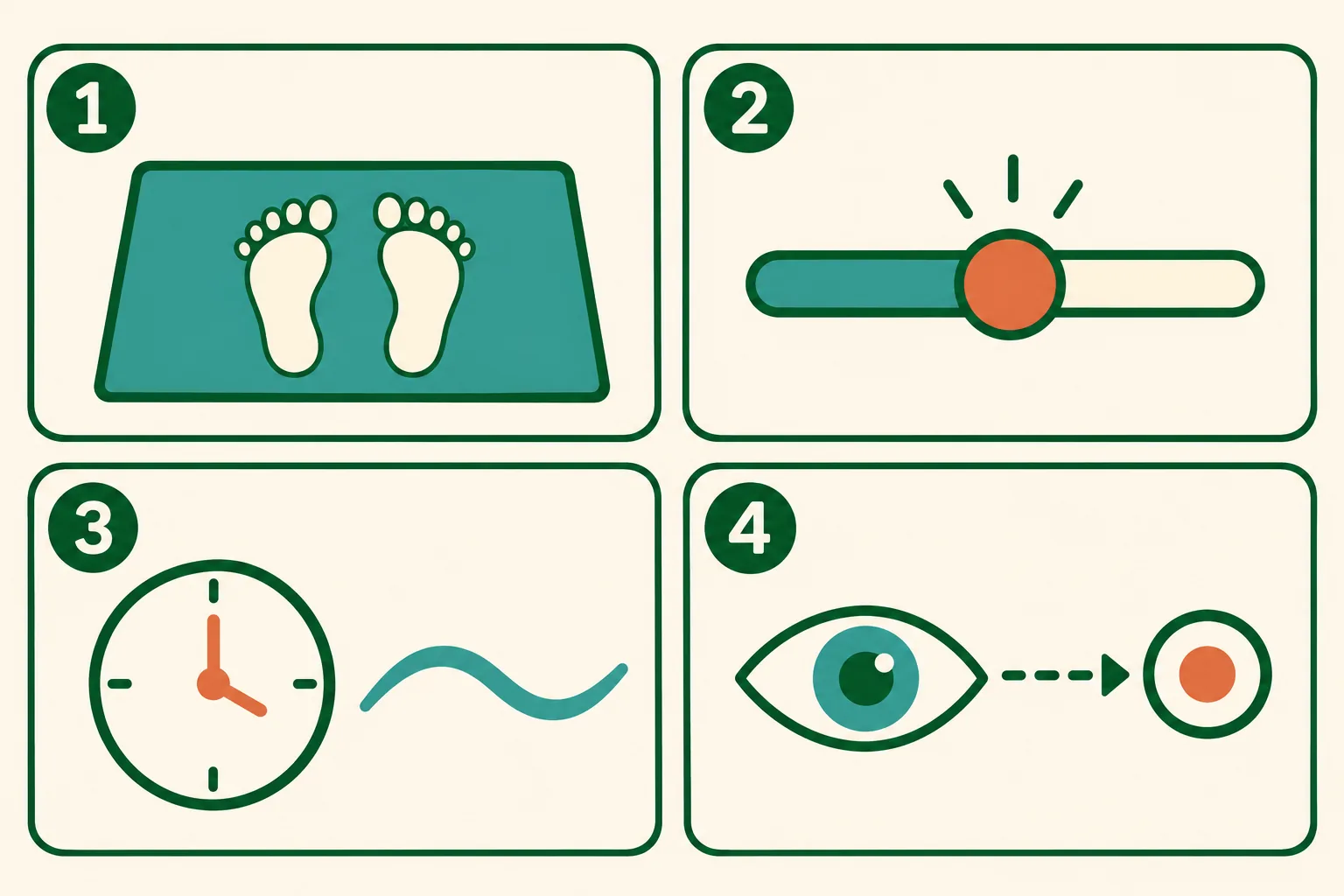
These categories are a practical way to listen to yoga cues. A teacher may combine more than one in a sentence, and you do not need to classify every instruction while moving.
Placement and movement
These cues tell you what to put where or what to move: place your hands on the mat, bend the front knee, or bring your arms beside your body. Listen for the body part, action and destination.
If one is missing, ask for it. “Where should my hands land?” is useful when the instruction is simply “hands down”. “Do I move my feet as well?” helps when you cannot tell whether the next action changes the whole stance or only the upper body.
Do not add a movement that was never requested because another student is doing it. They may be following a different option or responding to an individual instruction.
Effort and positioning
Examples include engage, press, draw in and lengthen. These may describe how to organise a position rather than how to enter it. Their meaning depends on the task and on what you are already doing.
Ask what the intended change is: “Should I change position or simply notice the contact with the floor?” If you respond by tightening everything and holding your breath, tell the teacher what happened. That information is more useful than silently trying the cue with greater effort.
Rhythm and timing
A teacher may connect a movement with an inhalation or exhalation, ask you to remain for several breaths, or signal when to change sides. Here, the instruction includes time as well as movement.
You can ask whether the next step happens once or repeats. If the teacher says “again”, clarify which part of the preceding movement is being repeated. In a flowing class, knowing where to pause is particularly useful when you have missed a step.
Attention and imagery
“Notice the contact beneath your feet” directs attention. “Imagine growing taller” uses an image. Neither necessarily asks for a large visible movement.
Images in yoga cues can help some students and leave others uncertain. You can ask for a literal alternative: “What small action are you suggesting?” Conversely, if an anatomical explanation is difficult to follow, a demonstration or simple everyday description may be more useful.
Common yoga cues and useful clarification questions
This table explores common yoga cues through possible meanings, not universal instructions. Ask your own teacher which meaning applies. The questions are examples you can adapt, not a script you must recite.
| Phrase you hear | What may need clarifying | A useful question |
|---|---|---|
| “Ground through your feet” | Whether to notice contact or change weight distribution | “Do you want me to move my weight, or just notice where it is?” |
| “Lengthen your spine” | Whether to adjust the torso or use an image of space | “Can you show the small change you mean?” |
| “Soften your knees” | How much bending the teacher intends | “Do you mean a slight bend or a lower position?” |
| “Engage your core” | Which action and amount of effort suit this task | “What should change, and can I keep breathing comfortably?” |
| “Open your chest” | Whether the arms, shoulders or torso are meant to move | “Which part should move first?” |
| “Square your hips” | Which direction the pelvis is being oriented towards | “Which direction are we aiming for in this variation?” |
| “Stack the joints” | Which joints and reference line are meant | “Which two points should I look at?” |
| “Take a half lift” | The starting position and intended next movement | “Could you demonstrate this step separately?” |
| “Follow your breath” | Whether to observe breathing or coordinate it with movement | “Are we changing the breath or noticing it?” |
| “Release” | Whether to reduce effort, lower a limb or leave the posture | “What moves, and where do I return?” |
| “Take your variation” | Which previously explained option the teacher means | “Could you remind me of the option you showed?” |
| “Repeat on the other side” | Which elements switch and which remain in place | “Which foot or hand changes first?” |
Read a row as a starting point for a conversation. For example, understanding that “square your hips” refers to orientation does not tell you how far you should turn. That depends on the posture and the individual setup. Ask about the direction without forcing your body into a remembered diagram.
Some phrases, including “take a vinyasa”, name a familiar sequence rather than a single action. If that sequence has not been taught to you, ask for the steps or a place to wait. Our Vinyasa Yoga guide explains the style; hearing its shorthand is not a requirement to attempt an unfamiliar sequence.
How to turn unclear yoga cues into clear questions
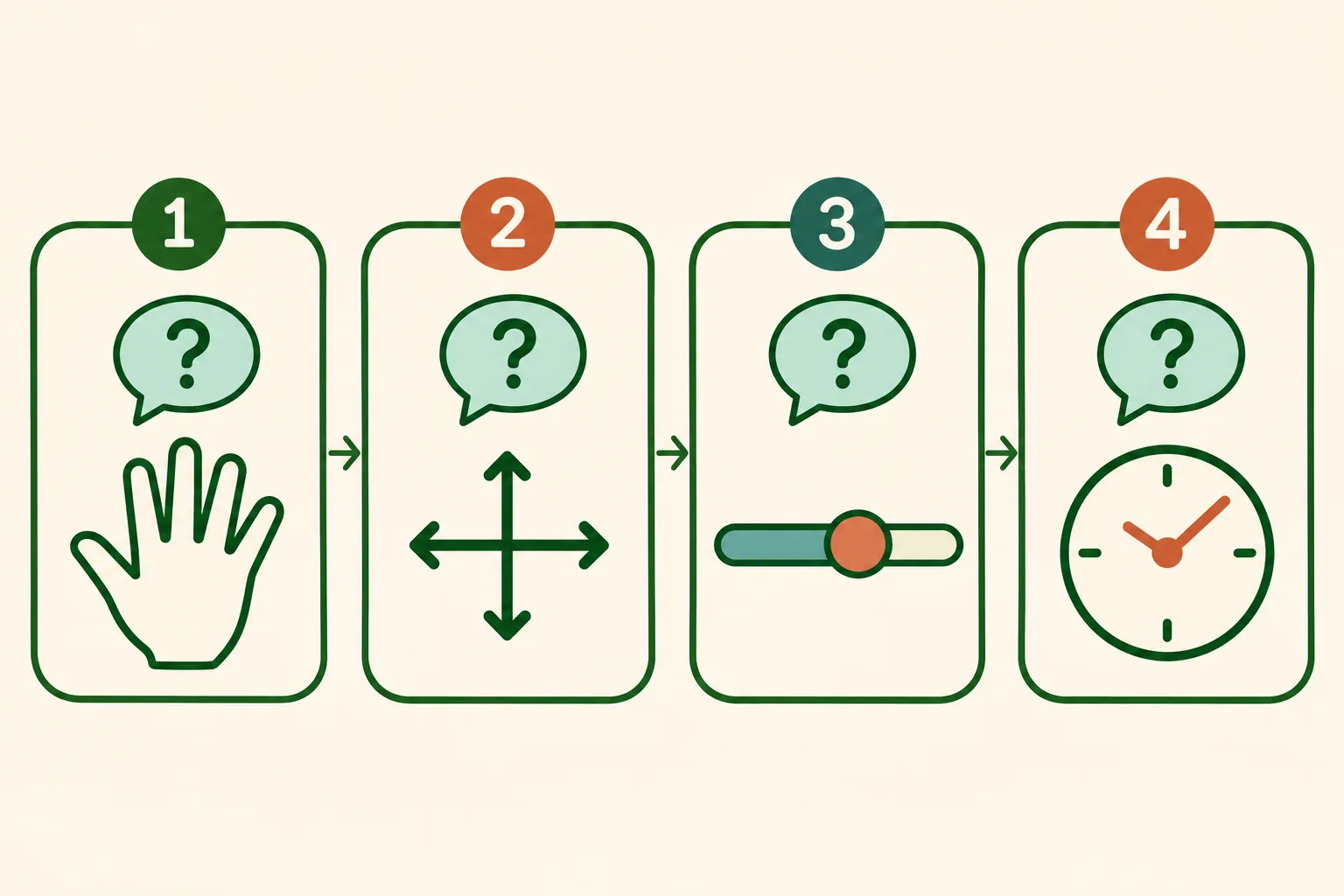
Start with the smallest missing piece. You can often resolve confusion without asking the teacher to repeat several minutes of instruction.
Identify what you did understand
Suppose you heard “bring the right foot forward”, but you do not know where it should land. You already have the action and body part. Ask about the destination: “Do you mean between my hands or a little to the side?”
If you heard “reach” but missed the rest, ask which arm and direction. If you know where the hand goes but cannot get it there comfortably, say that. Difficulty carrying out an understood instruction is a different issue from not understanding the words.
A useful sentence is: “I understand the first part; I am missing the next step.” It tells the teacher where to begin and avoids restarting an explanation you already followed.
Ask for an observable action
A phrase can become clearer when the teacher describes something you could see: move the hand closer, turn to face a particular wall, or lower the arm to a comfortable position.
Try: “What would look different if I did that?” This does not mean that visible shape is the whole purpose of practice. It is a way to discover whether the instruction asks for movement at all. The answer might be that the teacher wants you to notice a sensation while keeping the position unchanged.
If the response is another unfamiliar expression, say so kindly: “I am not sure what that phrase means either. Could you show me?” You are supplying feedback about the explanation, not judging the teacher’s knowledge.
Check the reference point
Directions can refer to the mat, the room or your body. Those reference points stop lining up once you turn sideways.
“Towards the top of the mat” may be clearer than “forward”. “Your right hand” may be clearer than “this hand” when a teacher is facing the group. Ask which reference they are using rather than trying to reverse every movement mentally.
If the teacher demonstrates on one side while naming the other, pause and clarify. Mirror teaching can be helpful, but you do not have to guess the convention. “Should I follow the side you are saying?” is enough.
Confirm the stopping point
Some instructions explain the direction but omit the range or ending. Ask: “Where do I pause?” or “Are we returning to the starting position after this?”
This is especially useful in transitions. Before leaving a steady position, understand where you are going and how the movement ends. A demonstration can show both the route and the destination. Seeing only the finished pose may leave the most difficult part unexplained.
Why alignment cues need context
An alignment cue is a teaching direction for a particular task. Treating it as a permanent rule for every posture can produce confusion. A direction given while your arms are beside your body may not describe what the teacher intends when they are overhead.
Ask, “Does that instruction still apply in this version?” when the position changes. You do not need to decide which teacher is right based on two phrases remembered from different classes. First check whether they were teaching the same movement, using the same starting position and aiming for the same action.
“More” is not a complete explanation
If you hear “lift more”, “turn more” or “reach further”, it is reasonable to ask what the teacher is looking for. More movement may not be available or useful for you at that moment.
Describe what happens when you try: “When I reach further, I lose my balance,” or “I can move the arm, but then I hold my breath.” Avoid trying to supply an anatomical diagnosis. The teacher needs to understand your experience before suggesting a different instruction or approach.
A request for clarification should lead to a clearer task, not merely a stronger version of the same unclear command. You can stay with a comfortable position while the explanation is being worked out.
Metaphors are not literal anatomy
Phrases about space, lightness, roots or opening can help communicate a feeling or direction. They are not automatically literal descriptions of what bones, organs or tissues are doing.
If an image makes sense to you, use it within the guidance for the practice. If it does not, ask the teacher to translate it into an action or an observation. You can appreciate the intention without pretending to feel something you do not recognise.
Likewise, anatomical terms are only helpful when they communicate. Asking where a body part is, or what a movement word means, is appropriate. You do not need to learn a technical vocabulary before a beginner teacher can explain a simple action.
A room-wide cue is not an individual assessment
The teacher may offer an instruction intended for several students, then a more specific direction to someone else. Do not automatically collect every correction you hear and apply it to yourself.
If you are unsure whether a cue was meant for you, ask. A useful question after class is: “When you suggested that change, was it for everyone or for that particular setup?” The answer can prevent you from carrying an irrelevant instruction into the next session.
For the basic postures themselves, use our beginner yoga poses guide. The aim here is to improve the conversation around a pose, not to prescribe one alignment for every reader.
Breath-related yoga cues: understand the task before matching the timing
A class may ask you to notice natural breathing, coordinate a movement with a breath, or learn a named breathing practice. These are different instructions. If you cannot tell which is happening, ask before trying to control the breath.
For a simple movement cue, clarify the sequence in ordinary words: “Are we raising the arms as we breathe in, then lowering them as we breathe out?” If your breathing and the group’s timing do not match, ask how to proceed at your own comfortable pace. Do not rush a movement or strain to prolong a breath to keep up with a count.
If you miss a breath cue, avoid inventing a holding pattern while you wait. Pause the movement, breathe comfortably and listen for a clear place to resume. Tell the teacher if coordinating both tasks is making the instruction harder to follow.
Terms such as pranayama name an area of practice rather than one universal technique. Ask for the method, preparation and suitability information relevant to the actual exercise. This article does not teach breath retention or forceful breathing. The NCCIH safety guidance advises beginners to avoid extreme practices, including forceful breathing, and recommends qualified instruction.
The useful learning goal is understanding what is being asked. Making the loudest sound, holding longest or matching the teacher’s pace is not evidence that you understood it better.
What to do when you miss yoga cues
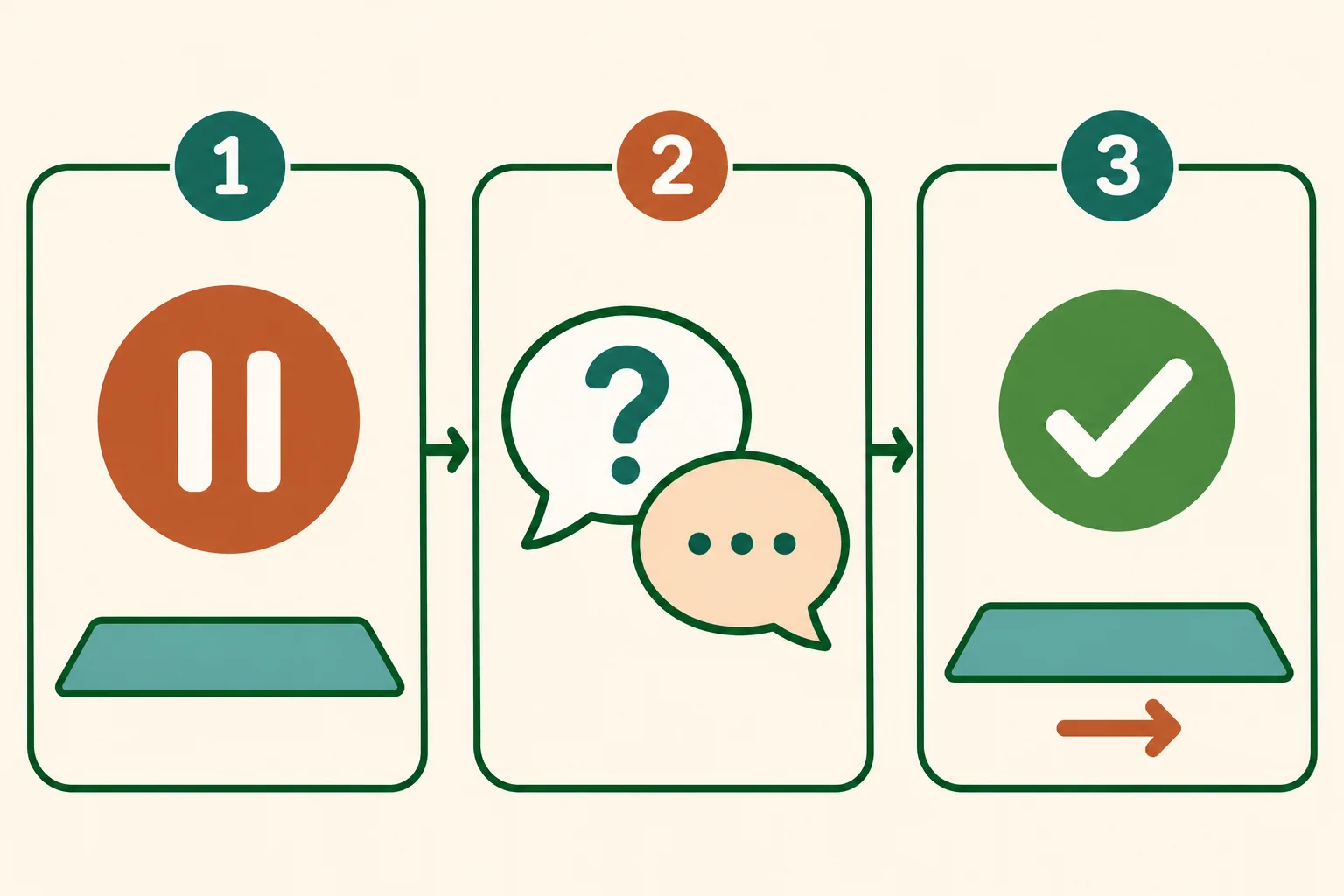
You look up and everyone is already facing the opposite direction. The temptation is to move quickly into whatever shape you can see. Instead, separate finding your place from copying the whole room.
First, stop adding movement. If you are in an uncomfortable or unstable position, ask for help coming out. If you are comfortable, pause there or use a familiar rest option agreed with the teacher. Do not remain in a demanding position simply because you missed the instruction to leave it.
Next, identify the current stage. A short question such as “Are we changing sides now?” may be enough. You do not need to perform every missed movement before joining the current one.
Then, ask for a starting point. “Where can I rejoin?” is particularly useful in a flowing class. The teacher can indicate a position or pause rather than asking you to recreate a transition from memory.
Finally, resume only what you understand. If the group is now doing something unfamiliar, watching from a comfortable position may be the useful choice. You can ask about the missing step later.
Teacher Charlotte Bell’s account of simplifying yoga cues describes the value she places on time to absorb instructions. That is a teaching perspective, not proof that one pace suits everyone. It does support a practical conversation: “I need a little more time between the direction and the movement.”
Questions before, during and after class
Different moments suit different questions. Planning when to ask can make the exchange easier without turning practice into a running discussion.
Before class: explain what helps you follow
You can say, “I am new to the terminology. A demonstration helps when a direction is unfamiliar.” Or: “I hear you best when I can see your face. Where would you suggest I practise?”
Ask how the teacher prefers students to signal a question during the session. Find out whether there will be demonstrations, whether unfamiliar terms are explained and where you can pause if you lose the sequence. These are practical arrangements rather than a demand for a particular teaching style.
If you have a relevant health condition or participation concern, discuss it privately. A public question about a cue does not have to include personal medical details.
During class: ask for the next usable detail
Keep the question connected to the immediate task. “Which knee bends?” “Are both hands moving?” “Could you repeat the destination?” The shorter the missing detail, the easier it is for the teacher to answer while attending to the group.
If the explanation will take time, come out of the posture first. You do not need to hold it while listening to a long answer. Ask the teacher to show the movement from a comfortable starting position or return to it after class.
If a cue causes pain or other concerning symptoms, stop and say what is happening. That is a safety issue, not a vocabulary exercise to solve by repeating the movement.
After class: connect the words to the moment
Bring back the exact phrase and situation: “In the standing sequence, when you said ‘lengthen’, did you mean change my torso position or just avoid reaching lower?” This gives the teacher a clearer starting point than “I did not understand the class.”
You can ask for one demonstration of the entry and exit, or a simpler phrase to listen for next time. If you take notes, use your own words and check that you have captured the explanation accurately.
A productive result may be modest: one instruction now makes sense. You do not need to leave with a complete glossary. Choose the term that interrupted your learning most often, and build from there.
Online classes and different communication needs
In a recorded class, the teacher cannot see that you are confused. Use the pause and replay controls before entering an unfamiliar transition. Watching a short section first can reveal the starting position, route and ending that were hard to infer from the words alone.
Keep the screen where you can see it from a comfortable position. If checking it requires twisting your neck or balancing awkwardly, stop the movement before looking. You can watch while seated or standing, then return to the starting position. A convenient camera angle for the demonstration is not necessarily a convenient viewing angle for every pose.
In a live online class, ask what the teacher can actually see. Their view may not include your feet or supports. If you want feedback on a particular setup, describe what is outside the camera frame rather than assuming it is visible.
If captions are available, they may help with unfamiliar words, but check unusual terms with the teacher. Automatic captions can mishear Sanskrit names or specialised vocabulary. A transcript can support learning; it does not verify that an instruction is appropriate for your body.
Ask for the communication you need
If you have a hearing, visual, language or processing-related need, discuss a workable arrangement with the provider. You might request a clear spoken destination, an unobstructed demonstration, a position where you can hear, or a brief pause after each step. Do not assume that every class offers every form of access; establish what is available before relying on it.
A Yoga Alliance-hosted teaching handout asks teachers to recognise differences in students’ language, culture and physical abilities and to use sensitive communication. It is a useful reminder that communication needs belong in teaching conversations. It is not a guarantee about the accommodations any particular studio provides.
When English is not your first language, ask for the unfamiliar word to be explained in a short sentence. You can also check a direction by repeating it back: “So my left hand stays where it is?” That confirms meaning more reliably than nodding when you are uncertain.
Practise understanding yoga cues without learning a new pose
This short exercise is about language. Choose a familiar, comfortable action your teacher has already explained. You do not need a difficult posture, a long hold or a new breathing technique.
Write the cue as you heard it. For example: “Bring your arms down.” Notice what is clear and what is missing. Do both arms move? Where do they finish? Is the movement happening now or with the next instruction?
Describe the intended action in plain words. If the teacher has explained that the hands return beside the body, write that. If you are not sure, leave the question open rather than supplying your own confident translation.
Ask one question. “Do the hands finish beside my body?” is enough for this example. Wait for the answer before adding questions about speed, breath and effort. Resolve the main movement first.
Try the familiar action only if it remains comfortable. Compare your understanding with what the teacher meant. The purpose is not to perform a shape perfectly; it is to see whether the instruction now tells you what to do.
Record the useful explanation. A note might read: “Arms down means returning both hands beside me in this exercise.” Include the context. Do not turn that note into a rule that every teacher uses the phrase identically.
For a more complex example, watch a teacher demonstrate an already familiar movement once without attempting it. Identify the starting point, first action and finishing point. Then ask which word or phrase marks each stage. This can reveal that your difficulty was the transition between instructions rather than the pose name itself.
Keep the exercise small. One understood cue is more useful than a notebook full of expressions you have not connected to a practice.
How can you tell whether the explanation helped?
After clarification, you should have a clearer idea of the task. You might know which body part moves, where it goes, how to pause or what you are being asked to notice. You do not have to feel an immediate change in flexibility, strength or mood.
Ask yourself:
- Could I describe the instruction in ordinary language?
- Did I know where to start and finish?
- Was I able to ask about the part that remained unclear?
- Could I follow without rushing or forcing the movement?
- Did the teacher distinguish a general direction from individual advice when needed?
If the answer is still no, tell the teacher exactly what remains unclear. A second explanation, a demonstration or a different format may help. If several classes remain difficult to follow despite those conversations, discuss whether another class format would provide more time for instruction. The issue may be a mismatch in pace or communication rather than lack of effort on your part.
Clear teaching is a shared process: the teacher offers a direction and responds to what students understand; the student can report confusion, limitations or uncertainty. Your question supplies information that an instructor cannot obtain simply by seeing you imitate the room.
Clear yoga cues are a teaching skill
Cueing is part of teacher education, not just a confident voice. Yoga Alliance’s RYS standards include verbal and visual cueing within teaching methodology. A qualification alone does not tell you how well an individual explanation will work for you, but the skill deserves deliberate study and practice.
For teachers considering further study, Inteyoga’s current curriculum includes voice, language, demonstration, observation, supervised teaching and feedback. These are relevant areas to explore when you want to make instructions clearer and respond more thoughtfully to students’ questions.
Our Advanced TTC 300-Hour Integrated Restorative Yoga (Including Yoga Nidra, Chakra Sadhana, and Prana Vidya Intensive) is an advanced residential programme taught in English in South Goa for applicants with completed 200-hour teacher training or an accepted equivalent. Read the programme and eligibility details or use the official application form if it fits your next stage.
If you are a beginner, the useful next step is much closer: take one phrase you did not understand and ask your teacher for a clearer version. Understanding grows through these small exchanges.
Safety and scope
This guide explains classroom language. It does not establish whether a posture or breathing practice is suitable for you. Understanding a cue is not the same as receiving individual assessment.
Stop practising if you experience pain, numbness, dizziness or unusual difficulty breathing, and seek appropriate advice rather than trying to decode the instruction while continuing. NCCIH recommends qualified guidance and notes that pregnancy, older age and health conditions may require modifications or avoiding particular practices.
Medical disclaimer: This article provides general education, not diagnosis or personalised medical advice. Discuss relevant health concerns with a healthcare professional and qualified yoga teacher.
Sources
- NCCIH: Yoga, Effectiveness and Safety.
- Yoga Alliance: Standards for RYS Credentials.
- Yoga Alliance-hosted handout: 10 Things You Need to Know About Being a Yoga Teacher.
- Rachel Land: 5 Common Yoga Cues Translated.
- Charlotte Bell: Simplify Your Yoga Cues to Increase Their Power.
- Inteyoga: current 300-hour programme and teaching-methodology curriculum.
Frequently Asked Questions (FAQ)
Do I need to know Sanskrit to follow yoga cues?
Ask for Sanskrit pose names to be paired with plain-language yoga instructions or a visual demonstration. Recognising a name does not tell you every step of entering or leaving the posture. Learn terms gradually in the context of practices you understand, rather than memorising a glossary before attending.
Is it rude to ask a teacher to repeat a cue?
A brief, relevant question is part of learning. Ask how the teacher prefers questions during class. If you need a longer explanation, leave the posture comfortably and ask when they can show you the step. You do not have to keep attempting an unclear movement while waiting.
Why do two teachers give different yoga cues?
Yoga alignment cues depend on the posture, variation and starting position; verbal instructions and visual demonstrations may emphasise different actions. Compare the context before deciding that the instructions conflict. Ask what the cue is intended to achieve and whether it applies to the variation you are practising.
What if I understand the words but cannot do the movement?
Describe that distinction: “I understand where you want the hand to go, but I cannot reach it comfortably.” The next conversation is about a suitable approach for you, not about repeating the words louder or trying harder. Avoid forcing the movement to prove you understood it.
Should I copy another student when I miss the instruction?
Another student may be using an individual variation or may also have missed the cue. Pause, check the current stage with the teacher and ask where to rejoin. Watching can help you understand a demonstration, but a neighbour’s shape is not a substitute for knowing the intended movement.