
Quick Answer
Bhakti Yoga is the yoga of loving devotion to the Divine. The word bhakti comes from the Sanskrit root bhaj, meaning “to share in” or “to belong to.” Practitioners use chanting (kirtan), mantra repetition (japa), prayer and service to turn emotions toward God. The Bhagavad Gita teaches it as one of three classical paths, alongside Karma Yoga and Jnana Yoga.
Key Takeaways
- Bhakti Yoga is the yoga of devotion. Its main tool is love, not physical postures.
- Its four main practices are kirtan (group chanting), japa (mantra repetition), puja (worship) and seva (service).
- Its classic framework is the nine forms of devotion (Navavidha Bhakti) from the Bhagavata Purana.
- Its roots run through the Upanishads, the Bhagavad Gita (Chapter 12) and the Indian Bhakti movement.
- Research on related practices suggests mantra repetition may slow breathing and bring small-to-moderate mental health benefits, though the evidence is limited.
- You can start today with 15 minutes a day, no equipment and no flexibility needed.
- Want to experience mantra and devotional practice as part of a complete yoga training? Explore the Advanced 300-Hour Integrated Restorative Yoga teacher training in Goa.
- How We Put This Guide Together
This guide was written by the Inteyoga Editorial Team at Swami Krishnananda Yoga Vidyapeeth in Colva, South Goa. Inteyoga is registered with Yoga Alliance as a Registered Yoga School, and Mantra Yoga and Swadhyaya (sacred study) are part of the daily schedule in our advanced 300-hour residential training. Scriptural references name the exact text, chapter and verse. Health statements are limited to what named, peer-reviewed studies support, and those studies are listed in the Sources section.
In 2022, about one in six American adults (16.9%) practiced yoga, according to the CDC’s National Center for Health Statistics. More than half of them also meditated as part of that practice. Bhakti Yoga, one of yoga’s oldest paths, works differently. It has nothing to do with poses.
So, what is Bhakti Yoga? It is the yoga of love and devotion. Instead of training the body or sharpening the intellect, it trains the heart. You direct your feelings toward the Divine through chanting, prayer, remembrance and service, and over time that devotion softens the ego and steadies the mind.
You may have met it already without knowing the name. If you have sung along at a kirtan night, repeated a mantra on a long commute, or heard George Harrison’s 1970 hit “My Sweet Lord,” which weaves in the Hare Krishna chant, you have brushed up against bhakti.
Bhakti also suits a large group of people. A 2023 Pew Research Center survey found that 22% of US adults describe themselves as “spiritual but not religious.” In England and Wales, 37.2% of people reported no religion in the 2021 Census. If you are curious about devotion but unsure where to start, this guide is for you.
We cover what Bhakti Yoga means, how it works, where it comes from, its main practices and forms of devotion, its rules and pillars, real-life examples and its benefits. We also compare it with Karma, Jnana and Raja Yoga and share a 15-minute routine you can try at home tonight.
What Is Bhakti in Short Answer?
In short, bhakti is loving devotion to the Divine. Bhakti Yoga is the spiritual path that uses this love as its main practice. The goal is not to escape feelings but to purify and focus them, so the heart becomes steady, humble and open.
Swami Vivekananda, whose lectures on this path were published as Bhakti-Yoga in the 1890s, defined it as “a real, genuine search after the Lord, a search beginning, continuing, and ending in love.” In bhakti, love is both the method and the destination.
What Are the Meanings of the Word “Bhakti”?
Bhakti comes from the Sanskrit root bhaj. Depending on context, scholars and dictionaries give it several related meanings:
- To share or partake: taking part in something greater than yourself
- To belong to: a relationship of belonging, not just liking
- To worship or honor: reverence shown through prayer and ritual
- To serve: devotion expressed through loving service
- Love and attachment: an emotional bond with the Divine
- Faith: trust placed in God as the means of liberation
Yoga comes from the root yuj, meaning “to join” or “to yoke.” Put the two together and Bhakti Yoga means joining with the Divine through loving participation.
Who Is a Bhakti Yogi?
A Bhakti Yogi (or bhakta) is a person who follows the path of devotion. A bhakta may chant daily, keep a home altar, read sacred stories, sing kirtan or serve others as an offering to God. What makes someone a bhakta is a sincere, loving relationship with the Divine that shapes everyday behavior, rather than any particular ritual.
What Is Another Name for Bhakti?
Another name for Bhakti Yoga is Bhakti Marga, meaning “the path of devotion.” You will also see it called:
- The Yoga of Devotion or the Yoga of Love: the most common English names
- Prema Bhakti: devotion that has matured into pure love (prema)
- Ishvara Pranidhana: Patanjali’s term for devotion or surrender to the Lord, used in the Yoga Sutras
- Upasana: a Sanskrit term for devoted worship or contemplation of the Divine
All of these point to the same idea: a relationship with the Divine built on love rather than on effort alone.
What Is the Core Meaning of Bhakti Yoga?
The core meaning of Bhakti Yoga is love for the Divine that gradually transforms the whole person. Nine ideas make up that core:
- Devotion (Bhakti): Turning your attention and feelings toward the Divine, again and again, until it becomes natural.
- Supreme Love (Prema): The Narada Bhakti Sutras (sutra 2) describe bhakti as being of the nature of supreme love. Love is the heart of the practice, not an add-on.
- Surrender (Sharanagati): Letting go of the need to control every outcome. Surrender is not passivity. It means doing your best and trusting a larger order.
- Faith (Shraddha): A steady trust that the practice is worthwhile, even on days when you feel nothing.
- Humility (Dainya): Recognizing that ego blocks love. Many bhakti saints described themselves as servants of God.
- Grace (Kripa): The belief that progress depends on Divine grace as well as personal effort. This keeps pride out of spiritual growth.
- Equal Vision: Seeing the same Divine presence in every person and creature. The Bhagavad Gita links this to true devotion.
- Sincerity Over Ritual: A simple offering made with love counts more than an elaborate ceremony made without it.
- Union as the Goal: Bhakti aims at closeness with, or oneness in, the Divine. Traditions differ on the details, but many describe a love that no longer feels separate.
How Does Bhakti Yoga Work?
Bhakti Yoga works by focusing the mind through love. What we love, we think about easily. Bhakti uses this natural tendency and points it toward the Divine. Step by step, the process looks like this:
- Attention: You choose a form of the Divine, or a sacred name, to focus on.
- Repetition: Chanting, prayer and remembrance bring the mind back to that focus many times a day.
- Redirected emotion: Feelings like longing, gratitude or even grief are offered to the Divine instead of being suppressed.
- A shrinking ego: As attention moves toward something greater, self-concern loosens its grip.
- Changed behavior: Devotion shows up in kinder speech, patience and service to others.
- Deepening love: Practice that began as effort slowly becomes spontaneous love.
Raja Yoga steadies the mind through discipline. Bhakti Yoga steadies it through attraction: instead of forcing the mind to stay, you give it something it wants to return to.
Where Does Bhakti Yoga Come From?
Bhakti Yoga has roots in the Upanishads, grows fully in the Bhagavad Gita, and became a mass movement across India between roughly the 6th and 18th centuries CE. Here is a short timeline.
| Period | Source or Movement | What It Added |
|---|---|---|
| Late Vedic period | Shvetashvatara Upanishad | One of the earliest uses of the word bhakti as devotion |
| c. 2nd century BCE to 2nd century CE (scholarly estimates vary) | Bhagavad Gita | Presents Bhakti Yoga as a complete path; Chapter 12 is titled “Bhakti Yoga” |
| c. 6th to 9th century CE | Alvars (Vaishnava) and Nayanars (Shaiva) in Tamil Nadu | Devotional poetry in local languages, open to all castes |
| Late first millennium CE (estimates vary) | Bhagavata Purana | Stories of Krishna and the famous list of nine forms of devotion |
| Medieval period (dates debated) | Narada Bhakti Sutras and Shandilya Bhakti Sutras | Short philosophical texts that define devotion and its signs |
| c. 12th to 18th century CE | The Bhakti movement across India | Saints such as Kabir, Mirabai, Tulsidas, Surdas, Tukaram and Chaitanya |
| 20th century onward | Global spread | Kirtan, mantra and devotional teaching reach Europe and North America |
Dates for ancient texts are approximate and debated by historians.
Why Did the Bhakti Movement Matter?
The Bhakti movement made spirituality accessible to ordinary people. Saints sang in everyday languages like Tamil, Marathi, Hindi and Bengali rather than classical Sanskrit. Many poet-saints rejected caste barriers and rigid ritual. Their message was simple: sincere love matters more than status or ceremony.
That is a big reason Bhakti Yoga still appeals to beginners today: it asks for sincerity, not scholarship, flexibility or money.
Who Is the Father of Bhakti?
There is no single “father of Bhakti,” but three names come up most often. The answer depends on whether you mean the earliest devotional poets, the philosophical foundation or the movement in North India.
- The Alvars and Nayanars (c. 6th to 9th century CE): These Tamil poet-saints are widely described as the pioneers of the Bhakti movement. The 12 Alvars sang to Vishnu, and the 63 Nayanars sang to Shiva.
- Ramanuja (traditionally dated 1017 to 1137 CE): The philosopher of Vishishtadvaita Vedanta is widely credited with giving devotion a philosophical foundation. Some popular sources call him the father of the Bhakti tradition, though historians generally describe the movement as having many founders.
- Ramananda (c. 14th to 15th century CE): Often called the founder or father of the Bhakti movement in North India. He taught in Hindi and welcomed disciples from many social backgrounds. Kabir is traditionally described as one of his disciples.
In the scriptures, the sage Narada is honored as a great teacher of devotion, and the Narada Bhakti Sutras carry his name.
What Does the Bhagavad Gita Say About Bhakti Yoga?
The Bhagavad Gita presents Bhakti Yoga as a direct and open path to the Divine, available to anyone who offers love sincerely. Krishna teaches three main paths in the Gita: Karma Yoga (action), Jnana Yoga (knowledge) and Bhakti Yoga (devotion). Many traditions read the Gita as treating devotion as the thread that ties the other two together.
Four passages stand out:
- Chapter 7, verse 16: the four kinds of devotees. Krishna describes people who turn to God when distressed, those seeking knowledge, those seeking wealth or reward, and the wise. All four are called noble. The wise devotee, who loves without wanting anything back, is described as the highest.
- Chapter 9, verse 26: the simple offering. Krishna says that if someone offers a leaf, a flower, a fruit or water with devotion, he accepts it. The point is that love, not the size of the gift, gives an offering its value.
- Chapter 12: “Bhakti Yoga.” This whole chapter is about devotion. Verses 13 to 20 describe the devotee: free from hatred, friendly and compassionate, free from “I” and “mine,” steady in pleasure and pain, and forgiving.
- Chapter 18, verse 65: fixing the mind. Krishna asks Arjuna to keep his mind on him, be devoted to him and offer worship to him. This verse is often read as a summary of the whole devotional path.
In the Gita, then, Bhakti Yoga is more than emotion. It builds character, and the measure of devotion is how kind, steady and humble a person becomes.
How Is Bhakti Connected to Patanjali’s Yoga Sutras?
The Yoga Sutras of Patanjali do not present bhakti as a separate path, but they teach Ishvara Pranidhana, devotion or surrender to Ishvara (the Lord). Sutra 1.23 names it as one route to samadhi. Sutra 2.1 includes it in Kriya Yoga, and sutra 2.32 lists it among the five niyamas (personal observances).
So even within Raja Yoga, the meditation path, devotion has a clear place.
Also read: What Is Raja Yoga (Meditation)? Meaning, 8 Limbs & Benefits
What Are the Main Practices of Bhakti Yoga?
The four main practices of Bhakti Yoga are kirtan, japa, puja and seva. Most bhaktas build their daily practice around one or more of these.
- Kirtan: Call-and-response singing of mantras or divine names. A leader sings a line and the group sings it back, usually with harmonium, drums and small cymbals. Kirtan is the practice many people associate with Bhakti Yoga. Some yoga studios in the US and UK host kirtan evenings, and many Hindu temples and ISKCON centers hold devotional singing that visitors can join.
- Japa: Repeating a mantra or sacred name, often on a mala of 108 beads, aloud, in a whisper or silently. Common choices include “Om Namah Shivaya” and “Om Namo Narayanaya.” If you are new, learn pronunciation from a qualified teacher.
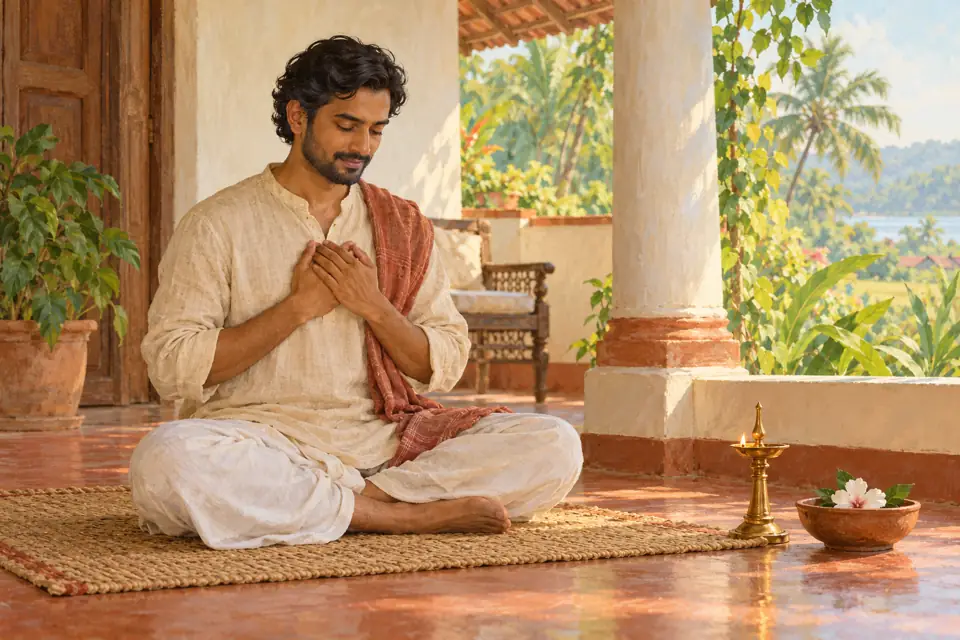
- Puja: Worship at an altar or shrine. It can be as simple as lighting a lamp or candle, offering a flower and sitting quietly for a minute. Remember the Gita’s leaf-flower-fruit-water teaching: simplicity is welcome.
- Seva: Selfless service offered to God through service to others. Volunteering, helping a neighbor or caring for a family member with full attention can all become acts of bhakti.
What Are Other Common Practices of Bhakti Yoga?
Alongside the four main practices, bhaktas commonly use:
- Prarthana (Prayer): Speaking to the Divine in your own words, with honesty.
- Bhajan: Devotional songs, often sung solo or in small groups, without the call-and-response format of kirtan.
- Aarti: Waving a lamp before the Divine while singing, usually at dawn or dusk.
- Svadhyaya (Sacred Reading): Reading the Bhagavad Gita, the Ramayana, the Narada Bhakti Sutras or bhakti poetry slowly and reflectively.
- Satsang (Good Company): Spending time with sincere practitioners, in person or online.
- Naivedya and Prasad: Offering food to the Divine before eating, then receiving it as blessed food (prasad).
- Tirtha Yatra (Pilgrimage): Visiting holy places such as Vrindavan, Varanasi or Pandharpur.
- Vrata (Vows and Observances): Keeping a day of simple living, fasting or extra prayer. See the safety notes below before fasting.
What Are the Nine Forms of Bhakti Yoga?
The nine forms of bhakti, called Navavidha (or Navadha) Bhakti, are listening, singing, remembering, serving, worship, bowing, servitude, friendship and complete self-surrender. They come from the Bhagavata Purana (Book 7, Chapter 5, verses 23 to 24), spoken by the young devotee Prahlada. Many teachers also call them the 9 pillars of bhakti, because together they support the whole devotional life.
| # | Sanskrit Name | Meaning | What It Looks Like |
|---|---|---|---|
| 1 | Shravana | Listening | Hearing sacred stories, talks or devotional music |
| 2 | Kirtana | Singing or praising | Joining a kirtan or chanting aloud |
| 3 | Smarana | Remembering | Pausing during the day to recall the Divine |
| 4 | Pada-sevana | Serving the Lord’s feet | Humble service, such as cleaning a temple or shared space |
| 5 | Archana | Worship | Formal offerings at a home altar |
| 6 | Vandana | Bowing, paying respect | Bowing with gratitude before practice or a meal |
| 7 | Dasya | Being a servant | Approaching your work as service, not just a job |
| 8 | Sakhya | Friendship | Speaking to the Divine honestly, like a trusted friend |
| 9 | Atma-nivedana | Complete self-surrender | Offering your actions, results and worries |
You do not need to do all nine. Most practitioners begin with one or two that feel natural. A music lover may start with kirtan. A quiet reader may start with listening and remembrance. A busy parent may start with service.
Are There More Than Nine Forms of Devotion?
Yes. The Narada Bhakti Sutras (sutra 82) describe eleven forms of devotional attachment. Five of them overlap with the nine forms above (worship, remembrance, servitude, friendship and self-surrender). The six that add something new are:
- Guna-mahatmya Asakti: Love for the Divine’s glorious qualities
- Rupa Asakti: Love for the Divine’s beauty and form
- Vatsalya Asakti: Love for the Divine as a parent loves a child
- Kanta Asakti: Love for the Divine as a beloved
- Tanmaya Asakti: Complete absorption in the Divine
- Parama-viraha Asakti: The intense longing felt in separation from the Divine, described as the highest form
Taken together, the two texts describe 15 forms of devotion. They show how wide bhakti is: it can be quiet or joyful, formal or intimate.
What Are the Two Types of Bhakti?
The two main types of bhakti are Saguna Bhakti, devotion to God with form, and Nirguna Bhakti, devotion to God without form.
- Saguna Bhakti: Devotion to the Divine with form and qualities, such as Krishna, Rama, Shiva or the Divine Mother. Tulsidas, Surdas and Mirabai are well-known saguna poets.
- Nirguna Bhakti: Devotion to the formless Divine. The poet-saint Kabir is the best-known example.
What Are the Other Pairs of Bhakti Types?
Texts also divide bhakti in two other ways:
- Apara Bhakti vs Para Bhakti: Apara (preparatory) bhakti uses rituals, images, prayers and rules. Para (supreme) bhakti is spontaneous, constant love that no longer depends on outer forms. Put simply, you practice bhakti to reach the state of bhakti.
- Vaidhi Bhakti vs Raganuga Bhakti: In the Bhakti Sandarbha, the 16th-century theologian Jiva Goswami distinguishes devotion guided by scripture and discipline (vaidhi) from devotion that flows naturally from inner attraction (raganuga).
What Are the Five Bhavas (Moods) of Devotion?
Teachers in the Gaudiya Vaishnava tradition, especially Rupa Goswami, describe five moods of love:
- Shanta: Peaceful reverence
- Dasya: The love of a servant for a master
- Sakhya: The love between friends
- Vatsalya: The love of a parent for a child
- Madhurya: The love of a beloved
These moods show that devotion is personal. People relate to the Divine in the way that feels most real to them. (These five moods are different from the “five pillars” explained below.)
What Are the Four Rules of Bhakti?
The “four rules of bhakti” usually refers to the four regulative principles taught in ISKCON (the International Society for Krishna Consciousness): no meat, fish or eggs; no intoxicants; no gambling; and no illicit sex.
| Rule | What It Means | Quality It Is Said to Protect |
|---|---|---|
| 1. No meat, fish or eggs | A vegetarian diet; food is offered to Krishna before eating | Mercy |
| 2. No intoxication | No alcohol, drugs or tobacco; some devotees also avoid tea and coffee | Austerity |
| 3. No illicit sex | Sexual relations only within marriage | Cleanliness |
| 4. No gambling | No betting or games of chance | Truthfulness |
ISKCON teachers link these rules to the four “legs” of dharma named in the Bhagavata Purana (1.17.24): austerity, cleanliness, mercy and truthfulness.
These rules are vows taken by initiated members of one tradition. Other bhakti lineages have their own guidelines, and you do not need to take any vow to begin a simple devotional practice at home.
What Are the Five Pillars of Bhakti?
The “five pillars of bhakti” usually refers to the five most powerful devotional practices named by Rupa Goswami and taught in the Gaudiya Vaishnava tradition:
- Sadhu-sanga: Associating with sincere devotees
- Nama-kirtana: Chanting the holy names of God
- Bhagavata-shravana: Hearing the Bhagavata Purana
- Mathura-vasa: Living in, or remembering, a holy place such as Mathura or Vrindavan
- Sri-murti Seva: Worshipping the sacred image of the Divine with faith
These five appear in Rupa Goswami’s Bhakti-rasamrita-sindhu and in the Chaitanya Charitamrita (Madhya-lila, Chapter 22). The tradition teaches that even a little sincere practice of these five can awaken love for God.
For practitioners outside this lineage, the same five ideas translate easily: good company, chanting, sacred study, a sacred space and loving worship.
What Are the Six Pillars of Bhakti?
The “six pillars of bhakti” usually refers to the six qualities that support devotional practice, listed by Rupa Goswami in verse 3 of the Upadeshamrita (The Nectar of Instruction):
- Utsaha (Enthusiasm): Practicing with energy and interest
- Nishchaya (Confidence): Firm conviction that the path works
- Dhairya (Patience): Continuing even when progress seems slow
- Tat-tat-karma-pravartana (Steady Practice): Following the regular practices of hearing, chanting and remembering
- Sanga-tyaga (Avoiding Unhelpful Company): Stepping away from influences that pull you off the path
- Sato Vritti (Following the Saints): Walking in the footsteps of earlier teachers
The same verse says these six qualities help devotional practice succeed. Most of them describe attitude rather than technique, which is worth remembering when you are starting out.
What Are the Stages of Bhakti Yoga?
One classic map of spiritual growth in Bhakti Yoga has nine stages, from first faith to pure love. It comes from Rupa Goswami’s 16th-century text Bhakti-rasamrita-sindhu.
- Shraddha (faith): A first spark of interest and trust.
- Sadhu-sanga (good company): Spending time with sincere practitioners.
- Bhajana-kriya (practice): Starting regular chanting, prayer or service.
- Anartha-nivritti (clearing obstacles): Unhelpful habits begin to fall away.
- Nishtha (steadiness): Practice becomes consistent, even on hard days.
- Ruchi (taste): Practice becomes enjoyable rather than a duty.
- Asakti (attachment to the Divine): The mind turns naturally toward God.
- Bhava (deep feeling): Strong, spontaneous devotional emotion.
- Prema (pure love): Selfless, steady love for the Divine.
You do not need to track your stage. The map does tell beginners something useful: dry days are normal. Taste comes after steadiness, not before it.
How to Practice Bhakti Yoga?
To practice Bhakti Yoga, choose a form of the Divine, pick one simple practice, and repeat it at the same time every day. These seven steps make a practical start:
- Choose your focus. Pick a form or name of the Divine that moves you. Traditions call this your Ishta Devata.
- Start with one practice. Choose from kirtan, japa, puja or seva (described above). One is enough.
- Fix a time and place. A small corner and a regular time, such as after waking or before dinner, build the habit.
- Learn from a reliable source. Learn mantra pronunciation and meaning from a qualified teacher or an established tradition.
- Find good company. Join a kirtan, a study group or an online satsang.
- Add one act of service each day. Even small kindness counts when it is offered with love.
- Measure sincerity, not feelings. Judge your practice by consistency and kindness, not by how emotional you felt.
A 15-Minute Bhakti Yoga Routine for Beginners
We put together this simple routine for readers who want a structured starting point. It needs no equipment other than a quiet corner.
| Minutes | Step | What to Do |
|---|---|---|
| 0 to 2 | Settle | Sit comfortably. Breathe slowly. Light a candle or lamp if you like. |
| 2 to 3 | Bow | Bow your head or join your palms in gratitude. |
| 3 to 8 | Japa | Repeat one mantra or divine name, aloud or silently, at an easy pace. |
| 8 to 11 | Read | Read one short verse from the Gita or a devotional poem. |
| 11 to 13 | Silent remembrance | Sit quietly. Hold one feeling: gratitude, love or trust. |
| 13 to 14 | Offering | Mentally offer your day, your work and your worries. |
| 14 to 15 | Intention | Choose one act of kindness to do today as service. |
Tip: consistency matters more than length. Fifteen minutes daily is better than two hours once a month.
Does Bhakti Yoga Involve Yoga Poses?
Bhakti Yoga does not have its own set of yoga poses. It is an inner practice centered on devotion. However, you can bring a bhakti attitude to any asana practice by dedicating your session to the Divine, chanting before or after, or practicing Surya Namaskar as an offering of gratitude. Kneeling, bowing and seated postures appear naturally in devotional practice.
Can You Give Me an Example of Bhakti Yoga?
Yes. A simple example of Bhakti Yoga is a person who repeats a mantra on the way to work, offers their workday to God, and cooks dinner as an act of love for their family. Bhakti happens in ordinary moments as much as in temples.
Everyday Examples
- The commuter: Silently repeats a divine name on the bus instead of scrolling.
- The nurse: Treats each patient as a chance to serve the Divine in another person.
- The parent: Offers the family meal with a short prayer before eating.
- The music lover: Attends a weekly kirtan and sings with the group.
- The grieving friend: Offers sorrow to God in prayer instead of carrying it alone.
Classic Examples From Sacred Stories
- Prahlada (Bhagavata Purana): A child who kept his devotion to Vishnu despite his father’s threats.
- Hanuman (Ramayana): The model of dasya, devoted service to Rama.
- Shabari (Ramayana): An elderly forest woman who welcomed Rama with fruit. In popular retellings, she tasted each berry first to make sure it was sweet, and Rama accepted them because they were offered with love.
- Mirabai (16th century): A Rajput princess-poet who left royal life to sing to Krishna.
A Modern Example From the West
In February 1973, George Harrison of the Beatles bought an estate in Aldenham, near Watford, England, and donated it to the International Society for Krishna Consciousness (ISKCON). Bhaktivedanta Manor still runs as an ISKCON temple and has now hosted 50 annual Janmashtami festivals, so bhakti has had a visible home in Britain for half a century.
What Are the Benefits of Bhakti Yoga?
Bhakti Yoga may help reduce stress, support emotional balance, build compassion and give life a sense of meaning. Traditional texts describe its spiritual fruits. Modern research on related practices, such as mantra repetition, offers some early support for its mental-health effects, though the evidence is still limited.
What Are the Spiritual and Emotional Benefits?
- A Softer Ego: Love for something greater shifts attention away from constant self-concern. The Gita describes the devotee as free from “I” and “mine.”
- Emotional Steadiness: Bhakti does not suppress feelings. It gives them a direction, which some practitioners find calming.
- Greater Compassion: Seeing the Divine in others encourages patience and kindness, the qualities Gita Chapter 12 praises.
- Gratitude: Daily offering and bowing build a habit of noticing what you already have.
- Meaning and Purpose: Devotion links ordinary tasks, like cooking or working, to something larger.
- Community: Kirtan and satsang give you a group to practice with and a sense of belonging.
- Better Focus: Returning to one name or form again and again may help train attention, though this has not been studied for bhakti specifically.
- Comfort in Hard Times: Some people find comfort in prayer during loss, illness or change.
- Accessibility: No flexibility, fitness level or academic study is needed. Bhakti is open to almost anyone.
- Support for Other Yoga Paths: Devotion can add warmth to meditation, steadiness to service and humility to study.
What Does Research Say?
There are very few studies on “Bhakti Yoga” as a whole. Most research looks at related practices, especially mantra repetition and rhythmic prayer. Here is what the evidence suggests:
- Slower breathing and heart-rate variability: A 2001 study in the BMJ by Bernardi and colleagues tested 23 healthy adults. Reciting a yoga mantra, or the rosary prayer, slowed breathing to about six breaths per minute and increased heart-rate variability and baroreflex sensitivity, two measures of how heart rate and blood pressure respond to breathing. This was a short laboratory study, so it does not show that chanting improves long-term heart health.
- Mental health in healthy adults: A 2018 systematic review by Lynch and colleagues in the European Journal of Integrative Medicine looked at 37 studies of mantra meditation. It found minimal to moderate benefits for mental health in non-clinical groups, but noted that study quality was often poor.
- Mental health symptoms: A 2022 meta-analysis by Álvarez-Pérez and colleagues in the International Journal of Environmental Research and Public Health found that mantra-based meditation produced small-to-moderate improvements in mental health symptoms. The authors warned that the evidence is weakened by risk of bias and few long-term studies.
In short: devotional chanting and mantra practice may help people feel calmer and more balanced. They are not a treatment for any medical or psychiatric condition, and they should not replace professional care.
Bhakti Yoga in Astrology: What Does Jyotisha Say?
In Vedic astrology (Jyotisha), devotion is traditionally read mainly from the 9th, 5th and 12th houses, the planet Jupiter and the shadow planet Ketu. Astrologers use these factors to describe a person’s spiritual leanings and the form of the Divine they may feel drawn to.
| Chart Factor | Traditional Association With Devotion |
|---|---|
| 9th house | Dharma, faith, the guru and devotion |
| 5th house | Mantra, past merit (purva punya) and devotional feeling |
| 12th house | Surrender, letting go and moksha (liberation) |
| Jupiter (Guru) | Wisdom, faith and respect for teachers |
| Ketu | Detachment and the search for liberation |
The classical text Brihat Parashara Hora Shastra (Chapter 33) links planets placed in the 12th house from the Karakamsha to particular forms of devotion. For example, it says Ketu with the Sun there indicates devotion to Shiva, and Ketu with the Moon indicates devotion to the Goddess Gauri.
Our view: astrology is a traditional belief system, not a science. Its predictions have not held up in controlled tests, such as a double-blind study published in Nature in 1985. You do not need a birth chart to practice Bhakti Yoga. The Gita’s teaching is open to everyone: any sincere offering, made with love, is accepted.
Bhakti Yoga vs Karma Yoga vs Jnana Yoga vs Raja Yoga
Bhakti Yoga is the path of the heart, Karma Yoga is the path of action, Jnana Yoga is the path of knowledge, and Raja Yoga is the path of meditation. Swami Vivekananda popularized this four-path framework in the West. Many teachers present all four as routes to the same goal and suggest combining them.
| Feature | Bhakti Yoga | Karma Yoga | Jnana Yoga | Raja Yoga |
|---|---|---|---|---|
| Main focus | Love and devotion | Selfless action | Self-inquiry and wisdom | Control of the mind |
| Key faculty | Emotion (heart) | Will and action (hands) | Intellect (head) | Concentration |
| Core practices | Kirtan, japa, puja, seva | Duty without attachment to results | Study, reflection, “Who am I?” | The eight limbs, dharana, dhyana |
| Key text | Bhagavad Gita Ch. 12, Narada Bhakti Sutras | Bhagavad Gita Ch. 3 | Upanishads, Gita Ch. 2 | Patanjali’s Yoga Sutras |
| Often suits | Emotional, warm, expressive people | Active, practical people | Reflective, analytical people | Disciplined, introspective people |
| Main risk | Sentimentality or blind belief | Burnout, ego in service | Dry intellectualism | Rigidity |
What Is the Difference Between Bhakti Yoga and Karma Yoga?
Karma Yoga focuses on doing your duty without attachment to results. Bhakti Yoga focuses on love for the Divine. The two overlap closely. When you serve others as an offering to God, Karma becomes Bhakti. When devotion expresses itself through service, Bhakti becomes Karma.
What Is the Difference Between Bhakti Yoga and Jnana Yoga?
Jnana Yoga uses inquiry to realize the true Self, while Bhakti Yoga uses love to unite with the Divine. Teachers often call them two wings of one bird. Knowledge without love can feel dry. Love without understanding can become blind.
Also read: What Is Jnana Yoga? Meaning, 8 Benefits, Easy Practice Guide
Which Yoga Path Is Right for You?
Traditional teachers often say that most people need some of each. Swami Sivananda’s well-known motto, “Serve, Love, Give, Purify, Meditate, Realize,” blends all four paths into one daily rhythm. A practical approach is to keep one main path and support it with the others.
What Are the Common Myths and Mistakes in Bhakti Yoga?
The most common mistakes are treating bhakti as only emotion, judging practice by feelings, and confusing devotion with blind obedience. Here are the common ones.
- Myth: “Bhakti means loud, emotional chanting.” Not always. Some teachers emphasize that true devotion is calm and steady, not agitated. Silent japa is as much bhakti as a lively kirtan.
- Mistake: Measuring practice by feelings. Some days you will feel deep love. Other days you will feel nothing. Both are normal. Keep going.
- Mistake: Using devotion to avoid problems. Bhakti is not a way to escape responsibility. The Gita teaches devotion and right action.
- Mistake: Giving up your judgment. Healthy devotion does not mean blind obedience to any person or group. Choose teachers and communities that respect your freedom, your boundaries and your time.
- Myth: “You need a guru before you can start.” Guidance from a qualified teacher helps a lot, especially with mantra and pronunciation. But simple prayer, gratitude and service can begin today.
Is Bhakti Yoga Safe? Precautions to Keep in Mind
Bhakti Yoga is generally gentle and safe for most people, but a few physical and emotional precautions apply.
- Voice care: Long sessions of loud chanting can strain your voice. Rest if your throat feels sore.
- Knees, back and joints: Kneeling, bowing and full prostrations can stress the knees, hips or lower back. Use a cushion, sit on a chair or modify the movement. Check with a doctor after recent surgery or injury.
- Breathing conditions: If you have asthma or another respiratory condition, chant at a comfortable pace and stop if you feel breathless.
- Fasting: Some devotional observances include fasting. People who are pregnant or breastfeeding, have diabetes, have a history of eating difficulties or take regular medication should speak with a doctor before fasting.
- Emotional intensity: Group devotional experiences can bring up strong emotions. That can be a normal part of practice, but if you are going through a mental-health difficulty, keep your doctor or therapist informed.
- Group pressure: Be cautious of any group that pressures you for money, isolates you from family or discourages medical care.
How Does Bhakti Fit Into Inteyoga’s Integrated Approach?
At Inteyoga, Bhakti is studied alongside Hatha, Raja, Karma, Jnana, Mantra, Kundalini and Kriya Yoga as part of one integrated discipline. The name Inteyoga means “Integrated Yoga.” Our approach treats practice, knowledge, service and devotion as streams that support one another.
On our homepage, we describe the shared aim of Karma and Bhakti this way: to act with sincerity, serve with humility and live with an open heart. Our teaching draws on the traditions of Swami Sivananda, Swami Krishnananda, Swami Satyananda, Swami Vishnudevananda and fellow masters.
Where Do Devotional Practices Appear in the 300-Hour Program?
Our Advanced TTC 300-Hour Integrated Restorative Yoga (Including Yoga Nidra, Chakra Sadhana, and Prana Vidya Intensive) is a residential program in Colva, South Goa. Devotional and mantra-based practices are part of daily life:
- Mantra Yoga: Pranav Gayatri, the Gayatri Mantra, the Mahamrityunjaya Mantra and a Durga Mantra
- Daily Mantra Yoga and Swadhyaya in the sample schedule
- Ajapa Japa, a meditative practice built on mantra and breath awareness
- Karma Yoga through mindful participation in community work
In the sample daily schedule, Mantra Yoga and Swadhyaya run from 12:00 to 13:00, and the day closes with Dhyana Swaroopam (meditation) from 19:30 to 20:30. Devotional practice is part of the daily routine of residential life, alongside asana, pranayama and Yoga Nidra.
The 300-hour program runs for 43+2 days, is taught in English and is designed for participants aged 21 to 60 who have completed a 200-hour TTC or an accepted equivalent. Inteyoga is registered with Yoga Alliance as a Registered Yoga School (RYS 200, RYS 300 and RYS 500).
Through our Gift-it-Forward model, no payment is required to apply or to participate. After completing the program, participants may voluntarily support the Gift-it-Forward initiative to help future aspirants, with no obligation.
Upcoming 300-hour batches:
- 13 December 2026 to 26 January 2027
- 5 February to 21 March 2027
- 24 May to 7 July 2027
- 16 July to 29 August 2027
- 7 September to 21 October 2027
- 1 November to 15 December 2027
Ready to bring mantra, service and devotion into a deeper practice? Apply for the 300-hour program, or read our frequently asked questions first.
Also read: What Is a Yoga Nidra? Meaning, Benefits, How It Works & 8 Easy Stages
Conclusion: Is Bhakti Yoga Right for You?
So, what is Bhakti Yoga? It is the path of the heart. It asks you to love sincerely, remember the Divine often, serve others and let go of the need to control everything. Its roots run through the Upanishads, the Bhagavad Gita and centuries of poet-saints, yet its practices are simple enough to start tonight.
You do not need to choose between devotion and the other paths of yoga. Bhakti adds warmth to meditation, humility to study and meaning to service. Start small: one mantra, one verse, one act of kindness, offered with love, every day.
If you are ready to experience mantra, service and devotion within a complete, traditional training, explore the Advanced 300-Hour Integrated Restorative Yoga program in Goa or contact the Inteyoga team with your questions.
Frequently Asked Questions About Bhakti Yoga (FAQ)
Is Bhakti Yoga a Religion?
Bhakti Yoga is a spiritual path that grew within Hinduism, so its classic form is devotion to a personal God. It is not a separate religion, and it asks for no conversion. Many people from other backgrounds, or none, practice it respectfully. Some teachers adapt it as devotion to love, truth or a higher principle. If you do, learn the meaning of the mantras and stories you use.
Who Is the God of Bhakti Yoga?
There is no single God of Bhakti Yoga. Devotees choose an Ishta Devata, a personal form of the Divine. Popular choices include Krishna, Rama, Vishnu, Shiva and the Divine Mother in forms such as Durga or Lakshmi. Many traditions teach that these are different faces of one ultimate reality, called Brahman.
Do I Need to Chant in Sanskrit?
No. Sanskrit mantras are traditional, and many people find their sound calming, but bhakti is about the feeling behind the words. A heartfelt prayer in English is genuine devotion. If you do use Sanskrit mantras, learn the correct pronunciation and meaning from a qualified teacher or a trusted recording, so you know what you are saying.
Is Kirtan the Same as Bhakti Yoga?
No. Kirtan is one practice within Bhakti Yoga, not the whole path. It is call-and-response devotional singing, usually with harmonium and drums. Bhakti Yoga also includes silent mantra repetition, prayer, sacred reading, service and an inner attitude of love. You can practice Bhakti Yoga fully without ever attending a kirtan.
How Do I Find a Kirtan or Bhakti Yoga Group Near Me?
Start with local yoga studios, some of which host kirtan evenings. Many Hindu temples and ISKCON centers in US and UK cities also hold open chanting sessions. Online satsangs are a good option if nothing is nearby. Before committing, attend once, check that the group is welcoming and transparent, and never feel pressured to give money.
How Long Does It Take to See Results From Bhakti Yoga?
There is no fixed timeline, and traditional teachers discourage measuring devotion by results. No reliable research shows how quickly devotional practice changes mood. The texts describe deeper changes, like steadier love and less ego, as the work of years. A short daily practice kept up over months matters more than occasional intense sessions.
Is Bhakti Yoga the Easiest Path of Yoga?
Bhakti is often called the most accessible path because it needs no flexibility, special equipment or academic study. But “easy to start” is not the same as “easy to master.” Sincere love, humility and surrender are demanding qualities. Many teachers say each path suits a different temperament, and most people benefit from combining them.
Can Children Practice Bhakti Yoga?
Yes. Bhakti adapts easily to family life because it needs no special fitness or equipment. Simple ways to include children are singing short chants together, telling stories like those of Prahlada or Hanuman, letting them help set up a small altar, and saying a short thank-you before meals. Keep sessions playful and brief, and let children ask questions rather than insisting on rules.