Quick Answer
A yin yoga teacher training is usually a specialist course focused on teaching slow, relatively long-held postures, functional anatomy, variations, sequencing, use of props, teaching language and class facilitation. Current programmes are offered in many formats, including 20- to 30-hour workshops, 50-hour specialist courses, 75- to 100-hour intensives and longer teacher trainings in which Yin is one part of a broader curriculum.
There is no universally mandated hour count for becoming a Yin teacher. If you already hold a foundational yoga teacher qualification, a well-designed specialist course can add focused skills. If you have never learned basic anatomy, teaching methodology, ethics or practicum, a short Yin course should not be assumed to replace a comprehensive foundational teacher training.
Key Takeaways
- There is no universal 50-hour rule for Yin Yoga teacher training.
- Yoga Alliance has no RYT Yin or RYT 300 designation.
- A standalone Yin course normally gives you the provider’s certificate of completion, not a new Yoga Alliance teacher credential.
- Yoga Alliance-registered teachers may be able to log eligible Yin training toward their continuing-education requirements; YACEP courses are one recognised route.
- Course quality depends on much more than hours: live instruction, anatomy, teaching practice, feedback, trainer qualifications and scope-of-practice teaching all matter.
- Claims about fascia, meridians, “detoxification”, organ healing or nervous-system effects should be presented carefully. The evidence for Yin-specific health effects is still limited.
- Inteyoga does not currently offer a standalone Yin Yoga teacher training. Its current advanced residential programme is a broader Integrated Restorative Yoga training.
A yin yoga teacher training can be a useful specialisation for an existing yoga teacher or a structured way for a committed practitioner to study Yin more deeply. The difficult part is comparing programmes. Some are weekend intensives, others run for one or two weeks, and some are built into 200-hour or 300-hour teacher-training programmes. The certificates may look similar even though the amount of live instruction, anatomy, teaching practice and assessment differs substantially.
There is also no single international rule saying that a Yin teacher must complete 20, 50, 100 or 200 hours. Yoga Alliance does not offer a separate “Registered Yin Yoga Teacher” designation, and a short Yin certificate is not the same thing as an RYT 200 or RYT 500 credential.
This 2026-27 guide explains what the different hour counts usually mean, what current courses cost, how Yoga Alliance continuing education works, what a credible curriculum should include, what the research does and does not support, and how to choose a programme without relying on marketing language alone.
1. What is Yin Yoga Teacher Training?
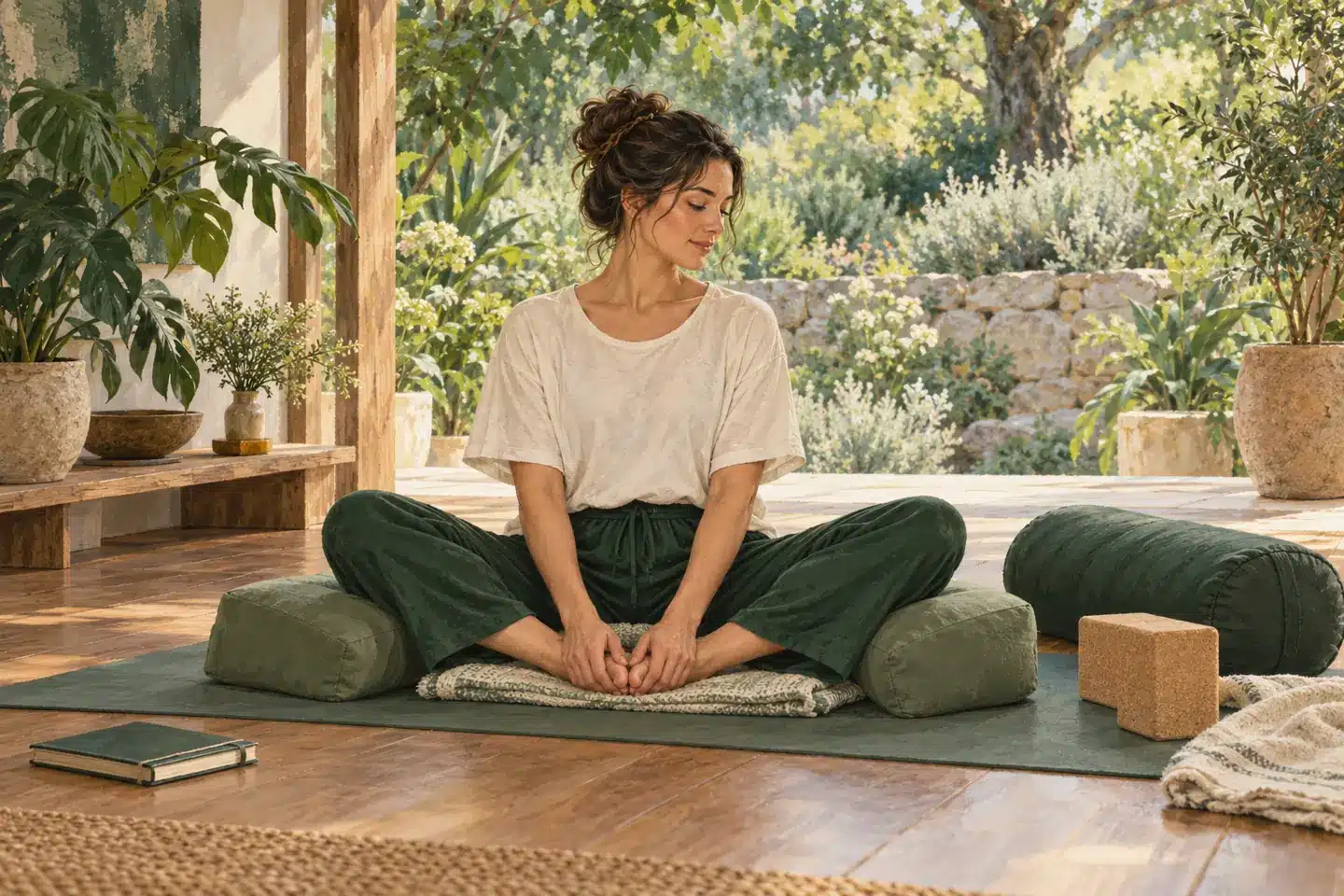
Modern Yin Yoga generally refers to a quiet style of practice in which many postures are performed close to the floor and held for longer periods than in faster, movement-led classes.
Teachers commonly use props, offer multiple variations and encourage students to work with an appropriate level of sensation rather than forcing a predetermined shape.
A yin yoga teacher training takes that practice and adds the skills needed to guide other people. Depending on the school, this may include:
- principles and history of Yin Yoga;
- functional anatomy and skeletal variation;
- pose families, target areas and variations;
- props and modifications;
- sequencing and class planning;
- verbal cueing, pacing and use of silence;
- consent, boundaries and scope of practice;
- meditation and breath awareness;
- supervised practice teaching and feedback; and
- optional study of Traditional Chinese Medicine concepts such as yin-yang theory, meridians or the five phases/elements.
The history of modern Yin Yoga is sometimes presented too neatly. Contemporary accounts commonly discuss the influence of Paulie Zink, Paul Grilley and Sarah Powers, but they do not always agree on how credit for the development of the modern style should be divided.
YinYoga.com credits Sarah Powers with coining the name “Yin Yoga” for the approach she and Paul Grilley were teaching, while Paulie Zink’s own materials give a different account of the practice’s development.
The safest conclusion is that the modern field developed through overlapping influences rather than a single universally agreed origin story.
That matters when evaluating a training. A course may follow a Grilley-influenced functional-anatomy approach, a Sarah Powers-influenced integration of mindfulness and Chinese medicine, a Paulie Zink lineage, or a modern hybrid. None of those labels tells you by itself whether the course is well taught.
2. How Many Hours Should a Yin Yoga Teacher Training be?
There is no single regulatory standard for the number of hours a Yin Yoga specialist course must contain. The hour count is therefore better understood as a description of programme size than as a guarantee of competence.
| Course format | What it often represents | What to check carefully |
|---|---|---|
| 20-30 hours | Short introduction, weekend intensive or continuing-education module | Whether teaching practice and individual feedback are included |
| 40-60 hours | Common specialist foundation format | Live/contact hours, anatomy depth, practicum and assessment |
| 75-100 hours | More time for anatomy, sequencing, philosophy/TCM and teaching practice | Whether the extra hours are live learning or mainly self-study |
| 200 hours | May be a complete foundational YTT with Yin as a major style, or a school’s own extended Yin qualification | Whether the programme is an RYS 200 if an RYT 200 pathway matters to you |
| 300 hours | Usually advanced teacher training in which Yin may be one component | Do not call this “RYT 300”; Yoga Alliance has no RYT 300 designation |
A 20-hour course is not automatically poor, and a 100-hour course is not automatically comprehensive. Twenty excellent live hours for an experienced teacher may be more useful than a longer self-paced programme with no observation or feedback.
For someone planning to teach public classes, the more important questions are:
- How many hours are live with a qualified trainer?
- How much time is spent actually teaching rather than only practising?
- Will someone observe and critique your teaching?
- Does the course teach safe scope of practice and when to refer a student to an appropriate healthcare professional?
- Does the anatomy teaching distinguish evidence from tradition and marketing claims?
Practical rule: do not choose a Yin course only because it has the largest number on the certificate. Choose the programme that gives you enough supervised learning for your starting level and intended teaching context.
3. Do You Need a 200-Hour Certificate Before Yin Yoga Teacher Training?
Not always. Prerequisites are set by individual training providers, and current programmes differ.
For example, Sampoorna Yoga’s current 50-hour Yin Yoga training in Goa states that previous teacher training is not required, while other specialist courses are designed primarily for already-qualified yoga teachers. This is why blanket statements such as “you must have RYT 200 before taking Yin” are inaccurate.
The more useful distinction is between joining a course and being broadly prepared to teach yoga professionally.
A comprehensive 200-hour foundation commonly covers areas that a short specialist Yin course may assume you already understand: general anatomy, teaching methodology, ethics, class planning, professional boundaries, practicum and broader yoga philosophy. If you have never studied those areas, a short Yin certificate should not be treated as an automatic substitute.
If you already hold a solid 200-hour qualification, a 40- to 100-hour Yin specialisation can be easier to evaluate because you can focus on what it adds: functional anatomy, long-hold sequencing, props, teaching language, stillness and Yin-specific practicum.
If you do not have a 200-hour qualification, ask the school directly:
- Is this course designed to prepare complete beginners to teach, or mainly to deepen personal practice?
- How much basic anatomy and teaching methodology is included?
- How much supervised practicum is required?
- What exactly will the certificate say?
- What do local studios, insurers or employers in the place where I intend to teach require?
Requirements for employment, insurance and professional practice vary by country, employer and context. A course website cannot guarantee that its certificate will satisfy every studio, insurer or jurisdiction.
4. What Should a Good Yin Yoga Teacher Training Curriculum Include?
A strong curriculum does not need to copy one lineage, but it should prepare students to work with real variation in real bodies.
Functional anatomy and individual variation
A useful Yin training should explain that people can experience the same posture very differently because of differences in bone structure, joint shape, previous injury, mobility, muscular tension and other factors. Teachers should learn to offer alternatives instead of treating one visual shape as the universal goal.
The anatomy module should cover joints and relevant surrounding tissues, basic movement principles, common areas of sensitivity, the distinction between tension and compression as a teaching model, and the limits of what a yoga teacher can diagnose.
Postures, props and exits
Schools use somewhat different Yin pose names, but many courses include variations of Butterfly, Half Butterfly, Dragonfly, Dragon, Swan/Sleeping Swan, Shoelace, Square, Sphinx, Seal, Saddle, Caterpillar, Frog, twists and supported resting positions.
The important part is not memorising a fixed list. Students should learn:
- how to enter and exit gradually;
- how to use bolsters, blocks, blankets and other props;
- how to reduce or redirect intensity;
- how to offer alternatives without diagnosing the student; and
- how to distinguish ordinary stretch/sensation from pain or symptoms that warrant stopping.
Sequencing
A Yin class needs more than a list of long holds. Training should address pacing, transitions, counter-movements where appropriate, total loading of a region, class duration, beginner versus experienced groups and how to avoid repeatedly stressing the same area simply because several poses look different.
Teaching methodology
Because Yin classes contain more stillness, teaching quality can depend heavily on language. A useful course should address how much to say, when silence is appropriate, how to avoid coercive language, how to teach without promising medical outcomes, and how to create clear boundaries around touch and adjustments.
Yoga Alliance’s Scope of Practice requires its members to stay within the fields for which they are appropriately trained and credentialed, and to obtain explicit informed consent before physical adjustments. Those are good principles even for teachers who are not Yoga Alliance members.
Practicum and feedback
If your goal is to teach, supervised practice teaching is one of the most valuable parts of a course. Ask how many times you will teach, who observes you, whether the feedback is individual and whether there is any practical assessment.
Optional energetic or Traditional Chinese Medicine material
Many Yin courses teach meridians, qi and the five phases/elements. These can be studied as traditional Chinese medicine frameworks. They should not be presented as if meridian pathways have been conclusively demonstrated to be anatomical fascial lines.
A credible teacher can distinguish traditional theory from established biomedical anatomy without dismissing either tradition or science.
5. How Much Does Yin Yoga Teacher Training Cost in 2026-27?
There is no official global price for yin yoga teacher training, and broad “average price” claims are difficult to defend because programmes differ in hours, accommodation, meals, location, trainer access and online versus residential delivery.
A more useful comparison is to look at current published examples and then compare like with like.
Current examples checked on 12 August 2026
| Provider / location | Format | Published price or fee information | Important context |
|---|---|---|---|
| Yog Love, Mumbai / Zoom | Yin Yoga TTC; live weekend plus two weeks of self-learning and practice teaching | INR 19,999 / USD 217 online; INR 24,999 / USD 262 in person | Provider states 50 YACEP hours for eligible yoga teachers; includes assessment |
| Sampoorna Yoga, Goa | 1-week / 50-hour in-person Yin Yoga Foundations TTC | Schedule page currently advertises total fees from about USD 599, with an early-bird discount structure | Includes accommodation, vegetarian meals, manual and certificate according to the course page; verify the exact batch price before booking |
| Yin Therapy / Unit Yoga, Wiesbaden | 6-day / 50-hour Yin Yoga & Anatomy Teacher Training I | Current event page confirms the 50-hour/6-day format; price is handled through the booking provider | Useful example of a specialist anatomy-led European format; confirm live price at checkout |
| Yin Yoga Bali School, Bali | 50- or 100-hour Yin Yoga teacher training | Provider currently lists 6-12 day formats | Check the live booking page for the current room category and total before comparing with non-residential courses |
These examples show why a single regional price range can mislead. One fee may be tuition only; another may include a room and meals. One “50-hour” course may include substantial self-study; another may place nearly all hours on site.
Before comparing prices, ask for the total cost and write down:
- tuition;
- accommodation and room type;
- meals;
- manuals and materials;
- assessment or certificate fees;
- taxes;
- required deposits;
- transfer/refund terms;
- airport transfers;
- live versus self-study hours; and
- any extra Yoga Alliance registration or membership costs, if relevant.
Prices and discounts are among the most changeable facts in this article. Always check the provider’s current page before paying.
6. Online vs in-Person Yin Yoga Teacher Training: Which is Better?
Both can be legitimate learning formats. The better choice depends on your experience and the design of the course.
Online can work well when:
- live sessions allow you to ask questions and receive feedback;
- you already have a stable personal practice;
- the course requires you to teach on camera or submit practicum work;
- anatomy and sequencing are taught systematically; and
- the trainer can observe your cueing and decision-making rather than only deliver prerecorded lectures.
In-person can be especially useful when:
- you are new to long-hold practice;
- you need close observation of prop use and variations;
- you learn better through discussion and demonstration;
- the course includes peer teaching and immediate feedback; or
- you want an immersive residential environment rather than fitting study around normal work.
Do not assume that “online” means low quality or that “residential” means high quality. A live online course with a small cohort and assessed practicum can be more educationally rigorous than a large in-person course where students never teach.
If Yoga Alliance continuing-education credit matters to you, verify the provider and the eligibility of the course rather than relying on the phrase “Yoga Alliance certified” in advertising.
7. What Does Yoga Alliance Recognition Mean for a Yin Yoga Certificate?
This is one of the most commonly misunderstood parts of yin yoga teacher training.
Yoga Alliance registers teachers and schools under specific credentials such as RYT 200, RYT 500, E-RYT, RYS 200, RYS 300 and RYS 500. It does not offer a separate credential called “RYT Yin”, “Registered Yin Yoga Teacher” or “RYT 300”.
A standalone Yin course normally gives you a certificate from the training provider. If you are already a Registered Yoga Teacher, eligible specialist training may also count toward Yoga Alliance continuing education.
Yoga Alliance currently requires RYTs to complete, in each three-year cycle:
- 45 hours of yoga teaching, and
- 30 hours of yoga-related training.
A Yoga Alliance Continuing Education Provider (YACEP) is an experienced registered yoga professional approved to offer continuing education. Yoga Alliance maintains a YACEP directory.
Training does not necessarily become invalid merely because the provider is not a YACEP; Yoga Alliance also allows qualifying continuing-education training from other eligible providers under its rules. If the hours matter for your own renewal, check the current logging requirements before enrolling.
What “Yoga Alliance certified Yin course” does not mean
It does not mean Yoga Alliance has created a separate professional licence for Yin Yoga. It also should not be taken as proof that Yoga Alliance independently tested every graduate’s teaching ability.
When evaluating a course, ask the provider to state precisely:
- What certificate do I receive from you?
- Is the school an RYS, is the trainer a YACEP, or both?
- Can an existing RYT log these hours as continuing education under current Yoga Alliance rules?
- Is this course part of an RYS 200/300/500 programme, or is it a standalone specialist course?
That wording is much more useful than a generic “Yoga Alliance certified” badge.
8. What Does the Science Actually Say About Yin Yoga, Fascia and Anxiety?
Yin marketing often moves faster than Yin research. The practice may feel helpful to many people, but teachers should separate what has been observed in studies from proposed mechanisms and from traditional explanations.
What Yin-specific studies have found
A 2018 randomized controlled trial in PLOS ONE studied 105 moderately to highly stressed adults assigned to a five-week Yin Yoga intervention, a combined Yin Yoga plus psychoeducation/mindfulness intervention, or a control group.
Both intervention groups showed greater reductions in anxiety and sleep problems than the control group, along with changes in one measured biomarker. The combined programme showed additional effects on perceived stress and depression.
That is encouraging, but it does not establish Yin Yoga as a treatment for an anxiety disorder, insomnia or any other medical condition. The study was relatively small and short, and the intervention context matters.
A 2024 study in Frontiers in Psychiatry followed 48 Latvian women during the COVID-19 pandemic in a ten-week online Yin Yoga programme.
State anxiety decreased after sessions and was lower in the intervention group at the end, while the study did not show the same between-group effect for trait anxiety. The authors also noted limitations including sample size, population and study context.
So a responsible conclusion is: early studies suggest Yin Yoga may be associated with short-term improvements in some stress- and anxiety-related outcomes, but the evidence base is still limited and does not justify cure claims.
What about fascia?
Laboratory research shows that connective-tissue fibroblasts can respond to static stretch with cellular and cytoskeletal changes. This is biologically interesting. It does not, by itself, prove that holding a particular Yin posture for three or five minutes produces a specific therapeutic remodelling effect in a human joint or fascia network.
A teacher-training course should therefore be cautious with statements such as:
- “Yin permanently lengthens your fascia”;
- “Yin lengthens ligaments”;
- “this pose detoxifies an organ”; or
- “three-minute holds are scientifically proven to remodel connective tissue.”
Those claims go beyond what the cited evidence establishes.
What about the nervous system and breathing?
Slow breathing can change heart-rate dynamics and measures such as heart-rate variability during practice. That makes it difficult to attribute every autonomic change in a slow yoga session specifically to Yin postures. A quieter class, slower respiration, attention, expectation and the social environment may all contribute.
It is reasonable for teachers to describe Yin as a slow, quiet practice that many students find calming. It is not reasonable to promise that every Yin class “activates the vagus nerve”, “resets the nervous system” or treats anxiety.
Medical disclaimer
This article is educational and is not medical advice. Yin Yoga teacher training does not qualify a yoga teacher to diagnose or treat medical conditions. If you have significant pain, a recent injury or surgery, pregnancy, or a health condition that may affect practice, seek appropriate professional guidance and tell the training provider before modifying your activity.
9. Meridians, Qi and the Five Elements: How Literally Should a Training Teach Them?
Many Yin Yoga schools incorporate ideas from Traditional Chinese Medicine (TCM), particularly yin-yang theory, qi, meridians and five-element/five-phase frameworks. These can provide a traditional language for sequencing and reflection.
The important distinction is epistemic: a traditional framework is not the same thing as a demonstrated anatomical model.
The US National Center for Complementary and Integrative Health describes TCM as a system that has evolved over thousands of years and notes that different components of TCM have been studied with mixed levels of evidence. That does not establish meridians as literal fascial pathways.
A high-quality Yin training can therefore say:
“In Traditional Chinese Medicine, this sequence is associated with particular meridian pathways.”
It should be more cautious about saying:
“Science has proved that this fascial line is the liver meridian, and this pose detoxifies the liver.”
Students do not have to reject traditional language to be scientifically careful. They simply need to know when a statement is traditional theory, a teaching metaphor, a plausible hypothesis or an evidence-supported biomedical claim.
10. How to Choose the Best Yin Yoga Teacher Training for You
The “best” course depends on your starting point and what you want to do afterwards. Instead of asking only whether a school is famous, send these questions before paying:
- Who is the lead trainer, and what is their training history?
- How many hours are live with a trainer?
- How many hours are self-study or prerecorded?
- How much supervised practice teaching do I complete?
- Will I receive individual feedback on my teaching?
- What anatomy is taught, and who teaches it?
- Does the course distinguish TCM/meridian theory from biomedical anatomy?
- What are the prerequisites?
- What exactly does the certificate state, and how does Yoga Alliance continuing education apply, if at all?
- What are the refund, transfer and cancellation terms?
Red flags
Be cautious when a provider:
- promises that a very short course will automatically make anyone a competent professional teacher;
- makes disease-treatment or cure claims;
- refuses to name the trainer;
- has no meaningful practicum for students who intend to teach;
- uses “Yoga Alliance certified” without explaining the actual RYS/YACEP relationship;
- claims meridians have been scientifically proven to be fascial pathways; or
- guarantees employment or income after certification.
Green flags
Look for transparent prerequisites, a detailed curriculum, realistic health language, clear trainer profiles, live feedback, practice teaching, boundaries around touch and medical advice, and a certificate description that matches what the programme actually is.
Yin Yoga vs Restorative Yoga Teacher Training
Yin and restorative yoga can look similar from across the room because both may use props, floor-based postures and longer periods of stillness. Their teaching intentions, however, are often different.
In many contemporary Yin approaches, a practitioner intentionally explores an appropriate level of sustained sensation in a target area while remaining relatively still. Restorative Yoga generally uses more support and aims to reduce unnecessary effort so the practitioner can rest comfortably.
The distinction is not absolute; schools use the terms differently and practices can overlap. That is why you should read the curriculum rather than assume that “slow yoga” means the same thing everywhere.
If your interest is primarily in deep rest, Yoga Nidra, supportive prop-based practice and a broader Hatha/Raja Yoga framework, a restorative-focused training may suit you better than a specialist Yin course. If your goal is specifically to teach a modern Yin methodology with functional anatomy and TCM-influenced sequencing, choose a course that explicitly teaches Yin.
Where Inteyoga Fits – and Where It Does Not
Inteyoga (Swami Krishnananda Yoga Vidyapeeth) does not currently offer a standalone Yin Yoga teacher training. It would therefore be misleading to present Inteyoga’s advanced programme as a 50-hour or 100-hour Yin certification.
Inteyoga’s current residential offering in South Goa is:
Advanced TTC 300-Hour Integrated Restorative Yoga
(Including Yoga Nidra, Chakra Sadhana, and Prana Vidya Intensive)
This is a broader advanced teacher-training programme rooted in an integrated Hatha and Raja Yoga framework. It includes restorative practice and substantial study beyond asana, but it is not marketed as a specialist Yin Yoga course and should not be chosen merely because someone wants a short Yin certificate.
Current programme facts
- Location: Plot No. 6, Novo Vaddo, Sernabatim, Colva, Salcete, Goa 403708, India
- Format: Residential
- Medium: English
- Duration: 43 training days + 1 arrival day + 1 departure day = 43+2 days / 45 days total
- Eligibility: Successful completion of at least a 200-Hour Yoga Teacher Training Course (TTC 200) or an equivalent yoga teacher-training qualification
- Age eligibility: Confirm current age and suitability criteria directly with Inteyoga admissions.
- Yoga Alliance: Inteyoga is registered with Yoga Alliance as a Registered Yoga School at the RYS 200, RYS 300 and RYS 500 levels
Confirmed upcoming batches
- 13 Dec 2026 – 26 Jan 2027
- 5 Feb 2027 – 21 Mar 2027
- 24 May 2027 – 7 Jul 2027
- 16 Jul 2027 – 29 Aug 2027
- 7 Sep 2027 – 21 Oct 2027
- 1 Nov 2027 – 15 Dec 2027
Eligible graduates who also hold qualifying 200-hour training may use their advanced training as part of the pathway toward RYT 500, subject to Yoga Alliance’s current requirements. There is no RYT 300 designation.
Gift-it-Forward
Inteyoga’s current 300-hour programme follows a Gift-it-Forward model:
- there is no payment required to apply;
- there is no payment required to participate;
- after completing the programme, participants may voluntarily support the Gift-it-Forward initiative to help future aspirants; and
- there is no obligation to contribute.
Inteyoga is also registered as an RYS 200. A new 200-hour programme is planned for around mid-2027, but its dates, curriculum details and other enrolment information are not final unless officially announced.
For the current 300-hour programme, visit the Courses & Fees page or application form. For questions, contact info@inteyoga.org or WhatsApp +91 935-473-7240.
What Can You do After a Yin Yoga Teacher Training?
A specialist certificate can add useful skills, but it is not an employment guarantee and it does not automatically authorise clinical or therapeutic work.
Depending on your existing qualifications, local requirements and experience, Yin training may support work such as:
- adding Yin classes to an existing studio timetable;
- offering private or small-group yoga sessions;
- integrating Yin principles into retreats or general yoga classes;
- teaching online classes; or
- continuing into deeper study of anatomy, restorative practice, meditation or other specialist areas.
If you work with medical conditions, rehabilitation or clinical populations, stay within your professional scope. A yoga teacher-training certificate is not a substitute for a healthcare licence or recognised clinical qualification.
Final Thoughts
The best yin yoga teacher training is not necessarily the longest, cheapest, most expensive or most heavily branded. A specialist course is valuable when it is honest about what it can teach, gives students enough supervised practice for their starting level, and distinguishes tradition from anatomy and evidence.
Before enrolling, look past the certificate title. Check the trainer, live hours, curriculum, practicum, feedback, scope-of-practice teaching and exact Yoga Alliance relationship. If a course makes medical promises or uses vague “international accreditation” language without explaining what it means, ask more questions.
If your goal is a short, dedicated Yin specialisation, choose a school that actually teaches Yin as its subject. If you are looking instead for a longer advanced residential programme centered on restorative practice, Yoga Nidra, Chakra Sadhana, Prana Vidya and an integrated Hatha/Raja Yoga framework, Inteyoga’s 300-hour programme is a different pathway and should be evaluated on those terms.
Frequently Asked Questions (FAQ)
How long does a Yin Yoga teacher training take?
There is no universal duration. Current programmes include weekend intensives, 40- to 60-hour specialist courses, 75- to 100-hour trainings and longer 200- or 300-hour programmes in which Yin is one component. Compare live instruction and practicum, not just the advertised hours.
Is 50 hours enough to teach Yin Yoga?
There is no official 50-hour competency threshold. For an experienced yoga teacher, a strong 50-hour specialist course with anatomy, practicum and feedback may be useful. For someone with no previous teacher training, 50 hours may leave significant gaps in broader anatomy, ethics, methodology and professional preparation.
Do I need RYT 200 before taking Yin Yoga teacher training?
Not necessarily. Individual schools set their own prerequisites, and some current 50-hour programmes accept dedicated practitioners without prior teacher training. If you intend to teach professionally, check what your intended employer, studio or insurer requires and whether you already have a sufficient foundational teaching education.
Does Yoga Alliance have a Yin Yoga certification?
No. Yoga Alliance does not offer “RYT Yin” or “Registered Yin Yoga Teacher”. A standalone Yin course gives you the training provider’s certificate. Eligible hours may also count toward continuing education for an existing RYT under Yoga Alliance’s current rules.
Does a YACEP Yin course count as Yoga Alliance continuing education?
YACEP courses are specifically designed as continuing-education offerings for yoga professionals. Yoga Alliance currently requires RYTs to complete 30 hours of yoga-related training and 45 teaching hours every three years. Check the current Yoga Alliance rules and your own account before relying on a course for renewal.
Is online Yin Yoga teacher training legitimate?
It can be. Look for live interaction, practicum, assessment and individual feedback rather than relying only on recorded videos. The delivery format matters less than whether the course can actually observe and develop your teaching skills.
What is the difference between Yin Yoga and restorative yoga teacher training?
They overlap in stillness, props and floor-based practice, but contemporary Yin often works with sustained sensation and a functional-anatomy approach, while restorative practice generally uses more support and aims to minimise unnecessary effort. Schools use the terms differently, so compare curricula.
Does Yin Yoga stretch fascia?
Connective tissue experiences mechanical loading during movement and stretching, and laboratory research shows that fibroblasts respond to static stretch. However, that does not prove that a particular Yin hold length produces a specific therapeutic fascial-remodelling effect in humans. Avoid courses that turn preliminary mechanisms into guaranteed health claims.
Can Yin Yoga help anxiety or sleep?
Small Yin-specific studies have reported improvements in some anxiety and sleep-related outcomes, but the evidence is not strong enough to treat Yin Yoga as a medical treatment. People with anxiety disorders, insomnia or other health conditions should seek appropriate professional care when needed.
Are meridians scientifically proven to be fascia lines?
No. Meridians are part of Traditional Chinese Medicine theory. Some teachers explore possible relationships between traditional maps and connective-tissue concepts, but those proposed relationships should not be presented as established anatomical fact.
How much does Yin Yoga teacher training cost?
There is no reliable single global average. Current courses range from relatively inexpensive online/specialist programmes to residential intensives that include accommodation and meals. Compare total inclusions, live hours, practicum and refund terms rather than the headline price alone.
Is Yin Yoga teacher training available in Goa?
Yes. Several schools in Goa currently advertise Yin specialist training. Inteyoga is also based in South Goa, but it does not currently offer a standalone Yin certificate. Inteyoga’s current advanced residential programme is the Advanced TTC 300-Hour Integrated Restorative Yoga (Including Yoga Nidra, Chakra Sadhana, and Prana Vidya Intensive).
What should I ask before booking a Yin Yoga teacher training?
Ask who teaches it, how many hours are live, how much practicum you receive, who teaches anatomy, what the prerequisites are, what the certificate actually represents, whether Yoga Alliance continuing education applies, and what the refund/transfer terms are.