
Quick Answer
It may help, but the strength of evidence depends on what you mean by “work.”
For stress and anxiety symptoms, the newest large meta-analysis found favorable effects across many studies, while also emphasizing serious limitations in study quality.
Key Takeaways
- Yoga nidra is commonly translated as “yogic sleep,” but that translation can be misleading if it makes the practice sound identical to ordinary sleep. Modern guided yoga nidra usually involves reclining comfortably while following verbal instructions that move awareness through the body, breath, sensations, mental images, and sometimes a short personal resolve known as a sankalpa.
- The best way to understand the evidence is to separate large reviews from individual studies.
- A useful explanation should distinguish what has actually been observed from what is still theoretical.
Yoga nidra for sleep and anxiety has become unusually popular because it asks very little from the body: you usually lie down, listen to a guided practice, and move attention through the body, breath, sensations, and imagery. That simplicity can make yoga nidra accessible when a vigorous yoga class or effortful meditation feels unrealistic.
The research is encouraging, but it needs careful interpretation. A 2026 systematic review and meta-analysis included 73 studies and 5,201 participants and found reductions in stress, anxiety, and depression. Importantly, the authors also warned that the moderate-to-large pooled effects were likely inflated by low methodological quality and wide variation in how yoga nidra was taught. A separate 2026 systematic review focused specifically on sleep and found only six randomized controlled trials involving 244 participants. Most reported improvements in outcomes such as sleep-onset latency, total sleep time, or sleep efficiency, but most studies also had moderate-to-high risk of bias and incomplete safety reporting.
So the useful answer is not that yoga nidra “cures” insomnia or anxiety. It does not. The better-supported position is that yoga nidra may be a useful low-cost relaxation and meditative practice for improving some sleep and anxiety-related symptoms, particularly as an adjunct to appropriate clinical care when a disorder is present.
For sleep, a 2026 review of randomized trials found promising improvements in several sleep measures, but the evidence base remains small and heterogeneous. One larger 2025 online randomized trial also found small improvements in stress, anxiety, depression, rumination, and some sleep outcomes, depending on the session length and comparison group.
What the research does not establish is equally important:
- Yoga nidra has not been shown to replace normal sleep.
- It is not an established cure for chronic insomnia, generalized anxiety disorder, panic disorder, PTSD, or depression.
- There is no proven rule that 10, 20, 30, or 45 minutes is the universally “best” duration.
- Claims that yoga nidra reliably “switches off cortisol,” produces one specific brainwave state, activates the vagus nerve in a unique way, or equals several hours of sleep go beyond the evidence.
For someone who simply wants a practical starting point, 10 to 20 minutes is a reasonable beginner duration because it is easier to repeat consistently. Longer practices can also be useful. The current research does not show that the shorter duration is universally superior.
1. What is Yoga Nidra for Sleep and Anxiety?
Yoga nidra is commonly translated as “yogic sleep,” but that translation can be misleading if it makes the practice sound identical to ordinary sleep. Modern guided yoga nidra usually involves reclining comfortably while following verbal instructions that move awareness through the body, breath, sensations, mental images, and sometimes a short personal resolve known as a sankalpa.
The practitioner may become deeply relaxed, drift toward sleep, remain aware throughout, or move back and forth between drowsiness and wakefulness. There is no single physiological state that defines every yoga nidra session.
The term yoga nidra has older roots and has been used in Indian traditions in more than one way. The structured guided form widely taught today was strongly popularized in the twentieth century, including through the Bihar School of Yoga and Swami Satyananda Saraswati.
Historical discussions also link aspects of the modern practice with older yogic and tantric methods of internalization, attention, and nyasa. It is therefore more accurate to describe contemporary yoga nidra as a modern system with older yogic antecedents than to say that one person simply “invented” the entire practice.
Yoga nidra is not ordinary sleep
Ordinary sleep is a biological process with recognizable stages and functions. Yoga nidra is a guided contemplative practice that may bring someone close to sleep or, sometimes, into sleep. The two can overlap experientially, but they should not be treated as physiologically interchangeable.
That is why the popular claim that “30 minutes of yoga nidra equals two or four hours of sleep” should not be presented as science. There is no accepted conversion formula between minutes of yoga nidra and hours of sleep.
Yoga nidra is also not simply savasana
Savasana is a posture. Yoga nidra can be practised in savasana, but the practice adds a guided sequence of attention and awareness. Someone can lie in savasana without doing yoga nidra, and someone who cannot lie flat can adapt yoga nidra to a side-lying, reclined, or supported seated position.
2. What Does the 2026 Research Actually Show?
The best way to understand the evidence is to separate large reviews from individual studies.
| Research | Participants | Main finding | Important limitation |
|---|---|---|---|
| Ghai, Odyniec & Ghai, 2026 systematic review and meta-analysis | 73 studies; 5,201 participants | Pooled results favored yoga nidra for stress, anxiety, and depression | Authors state the moderate-to-large effects likely reflect inflated estimates because of low methodological quality and variation in interventions |
| Dutta et al., 2026 systematic review of sleep RCTs | 6 RCTs; 244 participants | Most trials reported improvements in measures such as sleep-onset latency, total sleep time, sleep efficiency, or related outcomes | Heterogeneous protocols; most studies had moderate-to-high risk of bias; adverse-event reporting was inadequate |
| Moszeik, Rohleder & Renner, 2025 randomized online trial | 362 participants analyzed | 11- and 30-minute practices produced small improvements in several well-being outcomes; results depended on comparator and outcome | Effects were small; 11 minutes did not significantly outperform music on most outcomes; sleep improvement with the 11-minute version versus waitlist was only near significance |
| Datta et al., 2021 randomized trial in chronic insomnia | 41 participants | Both yoga nidra and CBT-I groups improved several subjective and objective sleep measures | Small study; should not be read as proof that yoga nidra is equivalent to established CBT-I across patients |
| Sharpe et al., 2023 randomized sleep-laboratory study | 22 adults with self-reported insomnia | Yoga nidra reduced respiratory rate during and after the session compared with control | No significant between-group differences in alpha EEG power, heart-rate variability, or sleep-onset latency |
The table is a useful antidote to two opposite mistakes. One mistake is dismissing yoga nidra because the evidence is not perfect. The other is turning promising early research into medical certainty.
The mental-health meta-analysis is encouraging, not definitive
The 2026 meta-analysis reported favorable pooled effects for stress, anxiety, and depression. Against active comparison groups, the reported Hedges’ g values were approximately -0.80 for stress, -1.35 for anxiety, and -0.69 for depression. Those look impressive.
But the authors themselves caution that the underlying studies were often methodologically weak and that intervention delivery varied widely.
Large pooled numbers do not erase weaknesses in the studies that created them. The responsible conclusion is that yoga nidra has promising potential for reducing symptoms, while better standardized, higher-quality trials are still needed before its clinical efficacy can be stated with confidence.
The sleep evidence is smaller than many websites suggest
The 2026 sleep review found only six randomized trials meeting its criteria. Across those trials, yoga nidra was associated with improvements in several sleep outcomes in different populations. Yet the protocols, populations, comparison treatments, and outcome measures differed substantially.
This is enough to justify further research and to make yoga nidra a reasonable low-risk practice for many people to explore. It is not enough to claim that yoga nidra is a proven stand-alone treatment for chronic insomnia.
For adults with chronic insomnia disorder, cognitive behavioral therapy for insomnia, or CBT-I, remains the recommended first-line treatment in major clinical guidance. Yoga nidra can be used alongside evidence-based care rather than presented as a replacement for it.
3. How might yoga nidra help sleep?
A useful explanation should distinguish what has actually been observed from what is still theoretical.
It can create a structured transition away from active thinking
Many people find bedtime difficult not because they lack physical tiredness but because attention remains attached to planning, worry, replaying conversations, or monitoring whether sleep is “working.” A guided rotation of attention gives the mind a structured task that is less demanding than problem-solving.
This may be particularly useful for people whose sleep difficulty is accompanied by cognitive arousal or rumination. The 2025 Moszeik trial found reductions in rumination in yoga nidra groups, although effect sizes were small and the active-control comparisons were less impressive than the waitlist comparisons.
Breathing may slow during the practice
The 2023 sleep-laboratory study by Sharpe and colleagues found a statistically significant reduction in respiratory rate during and after yoga nidra compared with the control condition. That is a concrete physiological observation.
It does not prove that yoga nidra uniquely “activates the parasympathetic nervous system,” nor does it prove a specific vagal mechanism. Slow breathing, lying still, reduced sensory input, expectation, and guided attention can all contribute to relaxation. The mechanism is likely multifactorial.
Yoga nidra may help some people rehearse a quieter pre-sleep state
A bedtime yoga nidra recording can become a consistent behavioral cue: dim lights, reduced movement, less screen engagement, and a predictable sequence that shifts attention away from the day. That routine may be useful even if the exact neurophysiology is still being studied.
However, people with persistent insomnia should be careful about turning yoga nidra into another performance test: “If I do this correctly, I must fall asleep in 12 minutes.” Sleep becomes harder when every night is evaluated. The practice is better approached as a period of rest and guided awareness, not an exam.
4. How might yoga nidra help anxiety?
Anxiety is not simply “sympathetic dominance,” and it is too reductive to describe every anxious person as being permanently stuck in fight-or-flight. Anxiety involves cognitive, emotional, behavioral, and physiological processes that differ between people and between disorders.
Yoga nidra may help some of those processes in several ways.
Guided attention can interrupt repetitive thought
The practice repeatedly moves attention from one neutral or mildly evocative object to another: a hand, the breath, a sensation, an image, a sound.
This may make it easier to disengage temporarily from repetitive worry. In research, reductions in rumination and anxiety symptoms have been reported, including in the 2025 online trial and across the 2026 meta-analysis.
The physical format lowers the barrier to practice
Someone who is highly anxious may find seated meditation difficult because stillness immediately amplifies internal sensations.
Yoga nidra gives more external structure: a voice to follow and a sequence that changes frequently. That does not make it universally easier, but many beginners find the format more approachable than silent meditation.
The immediate effect and the long-term effect are different questions
A person can feel calmer after one session without having treated an anxiety disorder. Short-term state relaxation and durable change in an anxiety disorder are not the same outcome.
The research supports describing yoga nidra as a potentially helpful adjunctive self-regulation practice. It does not support telling someone with generalized anxiety disorder, panic disorder, PTSD, or another psychiatric condition to replace psychotherapy, medication, or clinical care with a recording.
5. What About Brainwaves, Cortisol, HRV, and the “Nervous System Reset”?
These are the claims most likely to become exaggerated online.
Brainwaves
Small EEG and neurophysiological studies have reported changes during yoga nidra and related practices, including altered alpha or theta activity in some contexts.
That makes the practice scientifically interesting. It does not mean every yoga nidra session places the brain into one guaranteed “theta state,” nor that theta activity itself proves therapeutic benefit.
The 2023 randomized sleep-laboratory study is especially useful because it did not find significant between-group changes in alpha EEG power. That negative result belongs in the conversation alongside more exciting findings.
Cortisol
The 2021 insomnia trial reported a statistically significant reduction in salivary cortisol after yoga nidra. The larger 2025 online trial also examined diurnal cortisol patterns, but its findings were complex.
Some associations depended on practice frequency, and the authors explicitly warned that exploratory correlations should not be interpreted causally.
So “yoga nidra lowers cortisol” is too absolute. A better statement is that some studies have reported changes in cortisol measures, but the direction, size, and clinical meaning are not yet settled.
Heart-rate variability
HRV is often used online as shorthand for vagal tone. That interpretation is more complicated than marketing language suggests, because HRV is influenced by breathing pattern, posture, measurement method, age, fitness, medication, and many other variables.
It is reasonable to say that yoga nidra is a relaxation-oriented practice and may influence autonomic measures. It is not reasonable to promise that a session “resets the vagus nerve” or proves a permanent nervous-system change.
“Rest-and-digest” is a useful metaphor, not a complete mechanism
The phrase can help beginners understand why lying quietly with slow attention may feel different from answering emails at midnight. It should not be mistaken for a full clinical explanation of anxiety, sleep, or autonomic regulation.
6. How Long Should Yoga Nidra for Sleep and Anxiety Be?
There is no scientifically established universal duration.
The 2025 randomized study is useful because it directly compared an 11-minute version with a 30-minute version. Both produced some beneficial outcomes, generally with small effect sizes.
The longer practice was not consistently superior to the shorter one, and the short version did not significantly outperform an active music control on most outcomes. That is very different from saying “11 minutes is proven to be best.”
A practical starting framework is:
| Session length | Reasonable use |
|---|---|
| 8-12 minutes | A low-friction introduction, a workday reset, or a practice for someone who struggles with consistency |
| 15-20 minutes | A practical everyday length that allows a fuller body rotation and breath awareness without feeling difficult to schedule |
| 25-35 minutes | A more complete guided session, often suitable before bed or for experienced practitioners |
| 40 minutes or longer | Longer traditional, retreat, or training contexts; useful for some people but not necessary for everyone |
The best duration is the one you can practise comfortably and repeatedly without turning it into another obligation.
How often should you practise?
Several trials used regular or near-daily practice, but the research does not establish one minimum weekly dose. If you are experimenting with yoga nidra for sleep and anxiety, a reasonable personal trial is 10 to 30 minutes on most days for several weeks, while keeping other sleep and mental-health care unchanged.
Track whether it helps rather than assuming it must. Useful questions include:
- Am I less tense after the session?
- Is bedtime becoming less effortful?
- Am I spending less time ruminating?
- Is my daytime functioning improving?
- Does the practice ever make me more distressed, dissociated, or alert?
If nothing improves, there is no virtue in forcing the practice simply because it is yoga.
7. What are the Stages of Yoga Nidra?
There is no single eight-stage sequence used by every lineage. However, a Satyananda-style yoga nidra commonly uses a recognizable progression. A practical summary is:
- Preparation and settling: becoming physically comfortable and gradually reducing attention to external activity.
- Sankalpa: silently repeating a brief personal resolve or intention.
- Rotation of awareness: moving attention systematically through different parts of the body.
- Breath awareness: observing the natural breath, sometimes with counting.
- Pairs of sensations or opposites: exploring contrasting experiences such as heaviness and lightness or warmth and coolness.
- Visualization: following selected images, symbols, or scenes, depending on the method being taught.
- Repetition of sankalpa: returning to the same resolve.
- Externalization: gradually returning attention to the body and surrounding environment before moving.
Different teachers may omit, combine, expand, or reorder elements. Some contemporary secular recordings use little or no Sanskrit terminology. Some trauma-informed approaches deliberately modify visualization, body scanning, closed-eye instructions, or the language of stillness.
What is a sankalpa?
In this context, sankalpa is a concise resolve or intention repeated mentally. Traditional yoga nidra teaching gives it considerable importance.
What should be avoided is turning a traditional teaching into an unsupported neuroscience claim. There is not strong clinical evidence that repeating a sentence at “the most receptive moment” automatically rewires behavior. You can value sankalpa as a contemplative practice without claiming a mechanism that has not been established.
A beginner may choose a simple, non-coercive phrase such as:
- “I meet this moment with steadiness.”
- “I allow rest without forcing sleep.”
- “I respond with patience and clarity.”
For someone with anxiety or insomnia, an intention like “I must sleep deeply tonight” can accidentally become another demand. A gentler formulation is often more useful.
8. How to Practise Yoga Nidra for Sleep at Home
A recording is enough for many people to begin. The goal is comfort, safety, and low effort.
Step 1: Choose a position you can maintain comfortably
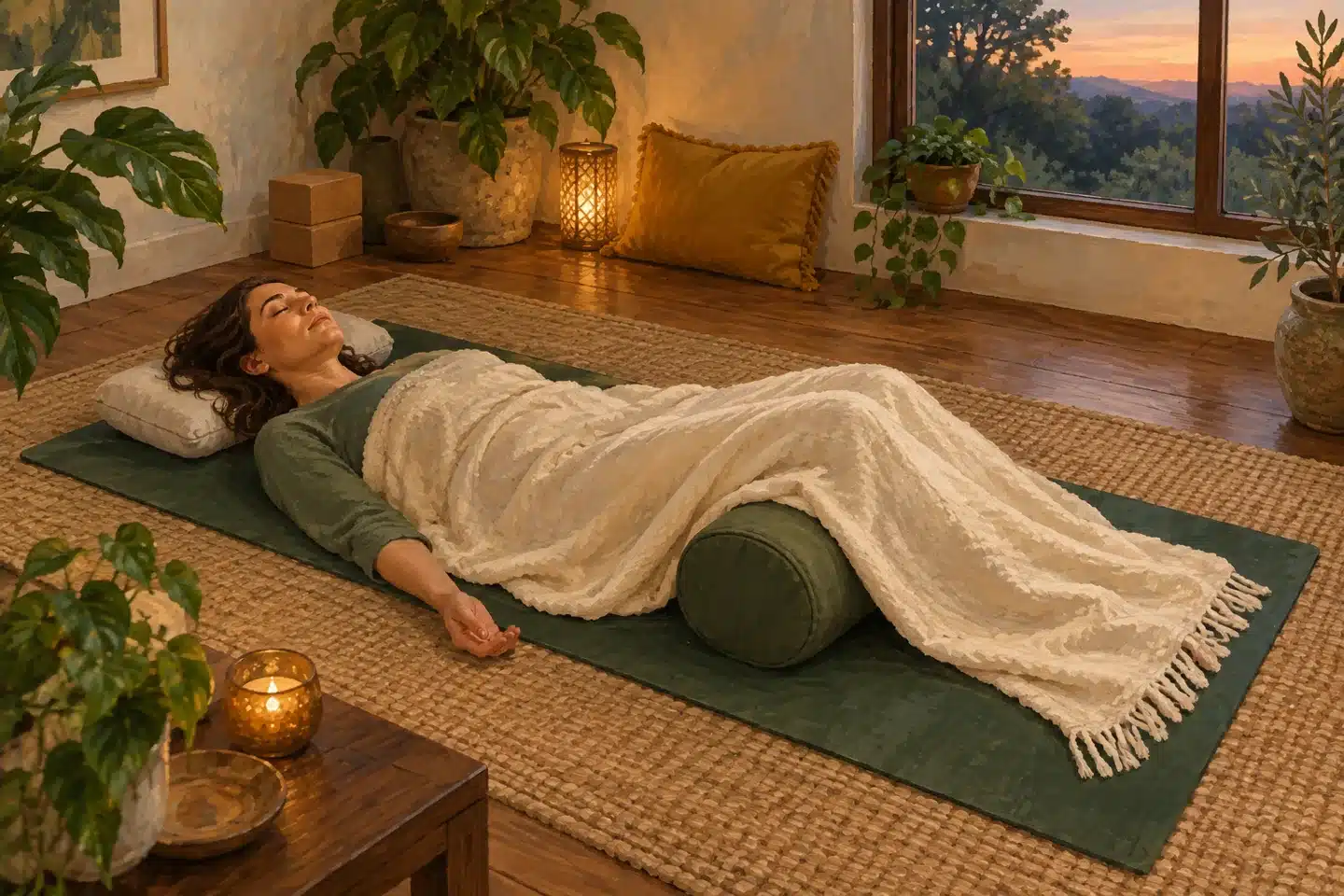
Savasana is traditional, but it is not mandatory. Lie on your back if comfortable, use a cushion under the knees if that reduces strain, or practise side-lying or semi-reclined. People who cannot safely or comfortably lie flat can use a supported chair.
Step 2: Reduce obvious interruptions
Lower the lights, silence notifications, and choose a room temperature that will remain comfortable. A light blanket is often useful because people can feel cooler when lying still.
Headphones are optional. A small speaker can feel less isolating, particularly for someone who is anxious about closing the eyes or becoming absorbed internally.
Step 3: Decide whether your goal is sleep or wakeful practice
If the goal is bedtime sleep, it is reasonable to practise in bed and allow sleep to come if it comes.
If the goal is daytime yoga nidra, use a position and setting in which you are more likely to remain aware, and allow a few minutes to reorient before returning to demanding activity.
Traditional yoga nidra generally values maintaining a thread of awareness, so falling asleep is not identical to completing the practice as intended. But if your immediate goal is bedtime sleep, drifting off is not a problem that needs to be fought.
Step 4: Follow the recording rather than trying to manufacture a state
You do not need to feel heavy, see vivid images, reach theta waves, or notice a dramatic nervous-system shift. If the voice says “right thumb” and your attention goes to the right thumb, you are participating.
Step 5: Give yourself permission to stop
If closing the eyes, scanning the body, imagery, or stillness makes you more anxious, numb, detached, or flooded with unwanted memories, stop the practice. Open the eyes, move, orient to the room, and use a more externally focused grounding method.
Yoga nidra is not a test of endurance.
9. A Short Beginner Yoga Nidra Script for Sleep
The following is a simple original practice for general relaxation. It is not a treatment protocol for insomnia, anxiety disorders, trauma, or other medical conditions. Read it slowly into a recorder or have someone read it to you. Leave several seconds between phrases.
Lie down or recline in a position that feels supported. If closing your eyes is comfortable, close them. If not, soften your gaze and keep the eyes partly open.
Notice three sounds outside the room or farther away from you. Then notice three sounds closer to you. There is nothing to block out.
Feel the places where the body meets the bed, floor, chair, or cushions. Let the support underneath you carry some of the work.
Notice the natural breath. Do not make it deeper. Feel one inhalation arrive and one exhalation leave.
Bring attention to the right hand: thumb, first finger, second finger, third finger, fourth finger, palm, back of the hand, wrist. Right forearm, elbow, upper arm, shoulder.
Bring attention to the left hand: thumb, first finger, second finger, third finger, fourth finger, palm, back of the hand, wrist. Left forearm, elbow, upper arm, shoulder.
Feel the back of the head. The face. The throat. The chest. The abdomen. The pelvis.
Bring awareness to the right leg: thigh, knee, calf, ankle, heel, sole of the foot, big toe, second toe, third toe, fourth toe, fifth toe.
Bring awareness to the left leg in the same way: thigh, knee, calf, ankle, heel, sole, big toe, second toe, third toe, fourth toe, fifth toe.
Now feel the whole body at once, supported from head to heel.
Notice the breath again. If counting feels easy, count each exhalation backward from 10 to 1. If you lose the number, simply begin again at 10. Nothing has gone wrong.
Imagine a quiet night sky. If no image appears, simply stay with the words “night sky.” No visualization is required.
If you use a sankalpa, repeat your chosen phrase silently three times. Keep it gentle and unchanged.
If you are using this practice for bedtime, you may now let the recording end and allow sleep to come naturally.
If you intend to stay awake, feel the room again. Notice sounds. Move the fingers and toes. Bend the knees if comfortable. Open the eyes when ready and take a little time before standing.
This is intentionally simpler than a full traditional yoga nidra. For deeper study, the sequence, symbolism, pratyahara, sankalpa, and related internal practices deserve more context than a short web script can provide.
10. When is The Best Time To Practise Yoga Nidra?
There is no single best time for everyone.
Before bed
This is the most obvious choice if your main goal is sleep. Practise after your normal wind-down routine, with the room already prepared for sleep. Choose a recording that does not end with an energetic reorientation if you want to drift off afterward.
During the day
A daytime session can be used as a structured rest period. Some people prefer late morning or early afternoon. The research does not establish that yoga nidra has a unique ability to restore alertness better than all other forms of rest, so treat this as a personal experiment rather than a guaranteed productivity tool.
After a difficult day
Yoga nidra can also be used as a transition between work and evening. That may be helpful if stress from the day is carrying directly into bedtime.
When not to practise
Do not practise while driving, operating machinery, supervising something that requires continuous attention, or in any situation where becoming drowsy would create risk.
If the practice repeatedly makes you feel emotionally destabilized rather than rested, change the method or seek appropriate professional guidance.
Yoga Nidra vs Meditation, Savasana, and NSDR
These terms overlap, but they are not interchangeable.
| Practice | Typical format | Main distinction |
|---|---|---|
| Yoga nidra | Usually guided, reclining, systematic rotation of awareness; may include sankalpa, opposites, and imagery | A specific family of yogic guided practices with traditional and modern forms |
| Seated meditation | Often upright; may involve concentration, open monitoring, mantra, breath, or inquiry | A much broader category with many methods; not necessarily relaxation-oriented |
| Savasana | A reclining yoga posture | Can be silent rest; yoga nidra may be practised in savasana but is not the same thing |
| NSDR | Modern umbrella label used by Andrew Huberman for guided deep-rest protocols | In Huberman’s framework, yoga nidra is one specific form of NSDR; not every NSDR recording follows yoga nidra structure |
Is yoga nidra the same as Andrew Huberman’s NSDR?
No, although they are closely related in current popular usage.
Andrew Huberman uses non-sleep deep rest (NSDR) as an umbrella term for guided practices intended to produce deep rest without necessarily falling asleep.
On the Huberman Lab website, yoga nidra is described as a more specific NSDR practice that typically includes guided meditation, intention setting, and yogic language.
That distinction matters scientifically. Evidence from a yoga nidra trial should not automatically be treated as evidence for every protocol labeled NSDR. The content, duration, instructions, and participant expectations may differ.
NSDR has helped introduce deep-rest practices to people who might not otherwise explore yoga. It is still useful to keep the names precise rather than implying that a modern umbrella term and a yogic tradition are identical.
Is Yoga Nidra Safe for Anxiety, Trauma, and Insomnia?
For many people, a gentle yoga nidra practice is low-risk. But “lying down and listening” does not mean every experience will be comfortable for every nervous system.
Trauma and dissociation deserve special care
A 2024 paper on trauma-informed yoga nidra notes that adverse reactions such as overwhelming flashbacks, emotional distress, and extended dissociation have been reported when yoga nidra is not delivered with appropriate sensitivity.
That does not mean people with trauma should never practise yoga nidra. It means the method should be adaptable. A trauma-informed teacher may offer choices such as keeping the eyes open, changing position, skipping certain imagery, orienting frequently to the room, allowing movement, and avoiding language that demands surrender or stillness.
If you have a history of dissociation, depersonalization, severe PTSD symptoms, or a practice repeatedly triggers flashbacks or emotional flooding, work with an appropriately qualified mental-health professional and a trauma-informed teacher rather than pushing through distress.
Chronic insomnia needs proper assessment
If sleep difficulty occurs at least several nights a week, persists for months, or significantly affects daytime functioning, speak with a healthcare professional.
Chronic insomnia can coexist with sleep apnea, restless legs syndrome, depression, anxiety, medication effects, substance use, pain, circadian disorders, and other conditions that a relaxation recording cannot diagnose.
CBT-I remains first-line treatment for chronic insomnia in established clinical guidance. Yoga nidra may sit alongside that care if it helps you relax and your clinician has no concern about its use.
Anxiety disorders also deserve evidence-based care
Yoga nidra can be one self-regulation tool, but persistent or severe anxiety should not be reduced to a breathing problem. Evidence-based psychotherapy, medication when appropriate, lifestyle factors, sleep care, and medical assessment may all matter.
Pregnancy
Yoga nidra is a low-movement practice and can often be adapted during pregnancy, but there is not enough yoga-nidra-specific evidence to make universal pregnancy instructions. Comfort and individual medical circumstances matter.
A supported side-lying or reclined position may be preferable if lying flat is uncomfortable. Anyone with a high-risk pregnancy or specific obstetric concerns should ask their maternity-care professional for individualized advice.
Common myths about yoga nidra for sleep and anxiety
Myth 1: “Thirty minutes of yoga nidra equals four hours of sleep”
There is no accepted scientific equivalence. Yoga nidra may feel restorative, but it does not replace the biological functions of adequate sleep.
Myth 2: “If you fall asleep, you failed”
Traditional practice generally aims to preserve awareness, so sleep and yoga nidra are not identical. But beginners commonly become drowsy. If your immediate goal is bedtime sleep, falling asleep is not a reason for concern.
Myth 3: “Yoga nidra switches on the parasympathetic nervous system”
Relaxation-oriented practices can influence breathing, arousal, and autonomic measures, but the human nervous system is not a two-position switch. The mechanism is more complex.
Myth 4: “An 11-minute session is scientifically proven to be better than 30 minutes”
No. In the 2025 randomized trial, both durations produced some benefits and the 30-minute version improved sleep disturbances versus waitlist, while the 11-minute sleep effect versus waitlist was only near significance. The longer version was not consistently superior either. The sensible conclusion is that both short and longer formats can be useful.
Myth 5: “Yoga nidra cures anxiety”
The evidence supports promising symptom reduction, not a universal cure. Anxiety disorders are clinical conditions and may require professional treatment.
Myth 6: “You must lie flat and keep completely still”
No. Comfort and safety come first. A side-lying, reclined, or supported seated version is still a valid way to engage with a guided practice.
Where Yoga Nidra fits at Inteyoga in Goa
Inteyoga (Swami Krishnananda Yoga Vidyapeeth) does not present Yoga Nidra as a stand-alone medical treatment for insomnia or anxiety.
It is taught as part of a broader yogic framework that includes Hatha Yoga, Raja Yoga, pranayama, meditation, pratyahara, and other internal practices.
Our current advanced residential programme is the:
Advanced TTC 300-Hour Integrated Restorative Yoga
(Including Yoga Nidra, Chakra Sadhana, and Prana Vidya Intensive)
The programme is registered under Inteyoga’s Yoga Alliance RYS 300 status. Inteyoga is also registered with Yoga Alliance as RYS 200 and RYS 500.
This is an advanced teacher-training programme rather than a beginner Yoga Nidra retreat. Applicants must have successfully completed at least a 200-Hour Yoga Teacher Training Course (TTC 200) or an equivalent yoga teacher training qualification. The medium of instruction is English, and the programme is fully residential.
Duration
The programme consists of:
- 43 training days
- 1 arrival day
- 1 departure day
- 45 days total, written as 43+2 days
Yoga Nidra is studied in greater depth alongside Chakra Sadhana and Prana Vidya rather than being separated from the wider system of yogic practice.
Confirmed upcoming batches
| Arrival | Departure |
|---|---|
| 13 Dec 2026 | 26 Jan 2027 |
| 5 Feb 2027 | 21 Mar 2027 |
| 24 May 2027 | 7 Jul 2027 |
| 16 Jul 2027 | 29 Aug 2027 |
| 7 Sep 2027 | 21 Oct 2027 |
| 1 Nov 2027 | 15 Dec 2027 |
Gift-it-Forward
Inteyoga currently follows a Gift-it-Forward model for this programme. There is no payment required to apply and no payment required to participate. After completing the programme, participants may voluntarily support the Gift-it-Forward initiative to help future aspirants. There is no obligation to contribute.
Full course details are available on the Advanced TTC 300-Hour course page. Applications can be submitted through the Inteyoga registration page.
Inteyoga’s next 200-hour programme is planned for around mid-2027. Dates, curriculum details, and other particulars should be checked on the website when they are formally announced rather than assumed in advance.
For questions, contact info@inteyoga.org or WhatsApp/phone +91 935-473-7240.
Final perspective
Yoga nidra for sleep and anxiety deserves neither dismissal nor hype.
The strongest 2026 evidence says something more interesting than either extreme. A large meta-analysis suggests meaningful potential for reducing stress, anxiety, and depression symptoms, but its authors warn that the pooled effects are probably inflated by low-quality evidence. A sleep-specific review finds promising results, yet only six randomized trials and 244 participants met the criteria, with important risk-of-bias and safety-reporting limitations.
That is enough to take the practice seriously. It is not enough to turn it into a cure.
If you are generally well and want a simple experiment, try a comfortable 10- to 20-minute guided practice several times a week for a few weeks. Notice what actually changes. If longer sessions suit you, use them. If yoga nidra makes you more distressed, stop. If insomnia or anxiety is persistent, severe, or affecting daily life, seek proper clinical care and use yoga nidra only as an adjunct if appropriate.
The value of yoga nidra does not depend on claiming that it replaces sleep, rewires the brain in 11 minutes, or eliminates anxiety. A practice can be useful without being miraculous.
Frequently Asked Questions About Yoga Nidra for Sleep and Anxiety (FAQ)
Can yoga nidra replace sleep?
No. There is no reliable evidence that a fixed amount of yoga nidra is physiologically equivalent to a certain number of hours of sleep. It can be used as a relaxation or restorative practice, but adequate sleep remains essential.
Is yoga nidra good for anxiety?
Research suggests that yoga nidra may reduce anxiety symptoms for some people. The 2026 meta-analysis found favorable pooled effects, but the authors also warned that the size of those effects is probably inflated by weaknesses in the underlying studies. It is best viewed as a potentially useful adjunct, not a replacement for treatment of an anxiety disorder.
Does yoga nidra help insomnia?
It may help some sleep outcomes. A 2026 systematic review of six randomized trials found promising results for measures such as sleep onset, total sleep time, and sleep efficiency, but study quality was limited. For chronic insomnia disorder, CBT-I remains first-line care.
How long should yoga nidra be for sleep?
There is no proven ideal duration. Ten to 20 minutes is a practical starting point; many traditional or bedtime recordings run 20 to 40 minutes. Choose a duration that you can use consistently and comfortably.
Can I do yoga nidra every day?
For most healthy adults, a gentle daily practice is reasonable if it feels helpful and does not cause distress. Research has used regular and near-daily schedules, but there is no established medical requirement to practise every day.
Can I do yoga nidra before bed?
Yes. Bedtime is a common time to practise, particularly when the goal is winding down. If the practice becomes frustrating because you are monitoring whether it makes you sleep, move it earlier in the evening and keep your normal sleep routine intact.
Is it normal to fall asleep during yoga nidra?
Yes, drowsiness and sleep are common. Traditional yoga nidra generally aims for maintained awareness, but drifting off is not unusual. If you are using it specifically as a bedtime wind-down, falling asleep does not need to be treated as a failure.
Can yoga nidra help during a panic attack?
It should not be promoted as an acute treatment for panic attacks. Closing the eyes, lying down, or focusing on internal sensations can help some people and intensify symptoms for others. During acute panic, use the coping plan recommended by your clinician or therapist. Yoga nidra may be explored separately as a regular relaxation practice if it suits you.
Is yoga nidra safe during pregnancy?
It can often be adapted because it involves little movement, but pregnancy-specific evidence is limited and individual circumstances vary. Use a comfortable supported position and consult your maternity-care professional if you have a high-risk pregnancy, symptoms, or concerns.
What is the difference between yoga nidra and meditation?
Yoga nidra is one structured meditative practice, usually guided and often reclining. “Meditation” is a much broader category that includes concentration, mindfulness, mantra, open monitoring, loving-kindness, inquiry, and many other methods.
What is the difference between yoga nidra and NSDR?
NSDR is a modern umbrella term used by Andrew Huberman for guided deep-rest protocols. In that framework, yoga nidra is one more specific form of NSDR. The terms should not be treated as scientifically interchangeable because different recordings may use different methods.
Do I need a teacher to learn yoga nidra?
Not necessarily for basic relaxation. A well-made recording can be enough to begin. A qualified teacher becomes more useful when you want to understand the traditional framework, sankalpa, pratyahara, subtle practices, teaching methodology, or adaptations for individual needs. People with significant trauma or dissociation should prefer trauma-informed guidance.