

Quick Answer
Yoga in a small space starts with matching the available area to the practice you intend to do. Check the floor, surrounding obstacles, overhead clearance and access routes, then agree how a shared room will be used and restored. A mat fitting between furniture does not establish that every movement will fit there.
Key Takeaways
- Purpose: Assess the room for the particular practice, rather than for yoga in general.
- Clearance: Consider the space around and above you, not only the mat’s outline.
- Access: Keep ordinary walking routes and exits usable throughout the setup.
- Shared use: Agree when the area is available and how interruptions will work.
- Storage: Give each item a reachable home that does not obstruct the room.
- Reset: Plan how to put everything away before deciding the arrangement is practical.
A room can look spacious in a photograph and feel crowded when someone opens a cupboard. Another room may look ordinary, with laundry and a work desk, yet offer a usable area at an agreed time. The useful difference is how the room functions, not how closely it resembles a studio.
Before buying storage baskets or choosing a corner, separate two questions. What does the practice require? What can this room actually provide? When the answers do not match, change the arrangement or seek guidance about an appropriate alternative. There is no need to squeeze a planned activity into a gap simply because the mat fits.
This guide is about assessing and organising a practice area. It does not prescribe poses, a home routine or a universal minimum room size. The aim is a workable decision you can repeat in a real home, including a home shared with other people.
Plan yoga in a small space around the intended practice
A useful yoga practice space is defined by an activity, a person and a setting. A room that works for listening to a teaching may not accommodate the movement in another lesson. The same room may work differently when furniture, equipment or other occupants change.
Start by naming what you plan to follow: a familiar practice already taught to you, a live class, or a particular recorded lesson. Check what the teacher says is needed. If you do not know what movements or equipment the lesson involves, that uncertainty belongs at the beginning of your assessment.
You do not need to perform unfamiliar movements to discover whether they fit. Ask for the space and equipment requirements, or preview the lesson’s description. Tell the teacher about a fixed limitation such as a low ceiling, a narrow gap or a doorway that must remain accessible. They can then discuss whether the intended practice is suitable for that setting.
Write a short brief in everyday language. For example: “I can use part of the living room after breakfast. The route to the balcony stays open. I cannot move the desk, and everything must be stored afterwards.” That is more useful than “I need a peaceful yoga corner,” because it identifies actual decisions.
Separate a preference from a requirement. Facing a window might be pleasant. Keeping the only doorway clear is essential. Having a permanent mat might be convenient. In a shared room, restoring the floor for others may be part of the agreement.
For the broader question of establishing a practice, see Inteyoga’s guide to starting yoga at home. Here, the narrower task is to decide whether a particular room arrangement works before building plans around it.
Map usable area, access and storage separately
Think of the room as three overlapping needs: somewhere to practise, somewhere to move through, and somewhere to keep things. Problems arise when one patch of floor is expected to serve all three at once.
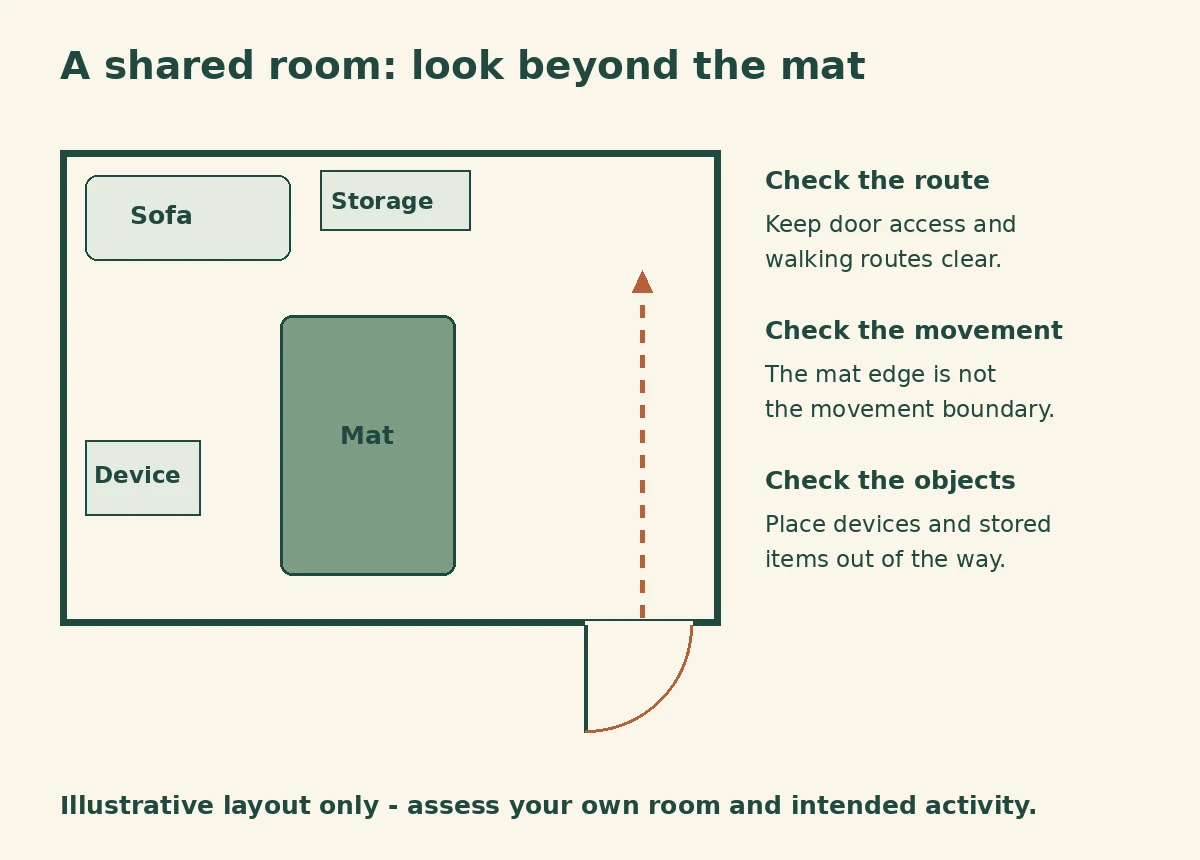
Sketch the room roughly on paper. Mark fixed furniture, doors and the places people regularly need to reach. Include cupboard and drawer openings, not just the furniture when closed. You do not need an architectural drawing; you need a reminder of what changes when the room is in use.
Then identify the proposed practice area. A mat can help you visualise its starting position, but it is not the outer boundary of every activity. Compare the intended practice with the surrounding space and any overhead obstructions. Where the fit is uncertain, leave that question unresolved until you have suitable guidance.
Mark the walking route separately. Someone should not have to step over you, your equipment or a charging cable to reach an essential part of the home. A route that works before you bring equipment out may disappear once the setup is complete.
The U.S. Fire Administration’s home escape guidance specifically advises keeping doors and windows unblocked. Apply that principle when arranging a practice area: do not trade an exit route for a larger-looking rectangle of floor.
Finally, mark storage. If a stool is moved aside, where does it go? If the mat comes from a cupboard, can you still reach the cupboard after setting up? A layout is incomplete when displaced belongings are simply assigned to “somewhere else.”
| Part of the room | Question to answer | What a useful answer looks like |
|---|---|---|
| Practice area | Does the intended activity fit here? | The requirement is understood and the surrounding space checked |
| Access route | What must remain reachable while I use it? | Doorways and necessary walking routes stay available |
| Moving items | Where will each item go temporarily? | A specific agreed location, not another blocked passage |
| Equipment storage | Where will everything return afterwards? | A reachable place that suits the equipment and room |
| Shared use | Who else needs this area, and when? | A clear agreement rather than an assumed empty room |
This map can reveal that a different orientation is worth considering, or that another room is the better candidate. It may also reveal that the proposed practice does not fit. That is a useful result, not a failure of the room or of your commitment.
Assess the whole space, not only the floor
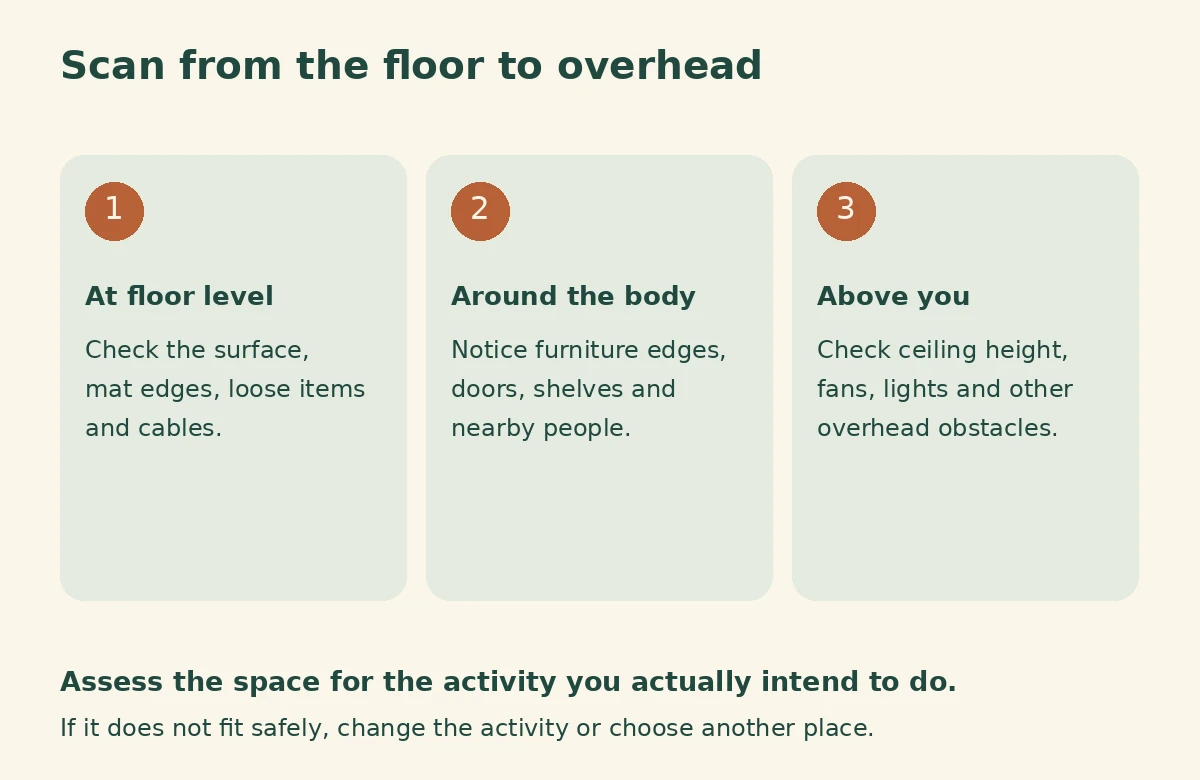
Look at three levels: the floor, the surrounding furniture and the area overhead. This is an observation exercise, not a movement challenge. Notice what is present before deciding what to do there.
At floor level, check the actual surface you intend to use, including what is under the mat. Look for moisture, damaged areas, uneven edges or material that shifts. Follow the mat manufacturer’s instructions about suitable surfaces and use. A mat does not automatically correct an unsuitable floor beneath it.
At the surrounding level, notice projecting handles, table corners, open shelves and anything that can enter the area. A wheeled chair may occupy a different position tomorrow. A cupboard door may open into the gap that looked clear when you first inspected it.
Overhead, include fans, hanging lights, shelves and sloping ceilings in your assessment. Switching an appliance off does not remove its physical presence. If the planned movement might reach an obstruction, choose a different arrangement or discuss an appropriate alternative rather than testing how close you can get.
The CDC’s Check for Safety home checklist, written for older adults, identifies floor clutter, loose rugs and cords in walking paths as hazards. It is useful background for noticing household obstacles, not a yoga-specific spacing standard or a guarantee that a room is suitable.
Some things can be corrected before setup. Others are fixed limitations. Keep that distinction visible:
| Observation | Decision to make before using the area |
|---|---|
| A movable item occupies the proposed area | Decide whether moving it is manageable and where it will go |
| A door swings into the proposed position | Choose another position that preserves normal door access |
| The intended movement may reach a fixed obstruction | Reconsider the room or ask about an appropriate alternative |
| The surface or mat shifts during ordinary setup | Resolve the surface problem rather than assuming practice will stabilise it |
| The room is needed as a passage | Preserve a usable route or choose another time or location |
| You cannot establish what the lesson requires | Ask before treating the space as ready |
Avoid turning nearby furniture into improvised yoga equipment. A desk, shelf or bed is not a practice prop simply because it is within reach. Any use of support should be appropriate to the instruction and to equipment designed or assessed for that purpose.
Compare a small yoga corner with a temporary setup
A permanent corner has an obvious attraction: fewer things to bring out. But permanence is useful only if the area can remain available without compromising the rest of the room. Leaving a mat down in a passage does not make the arrangement more practical.
A temporary setup may suit a home where the same room serves several purposes. It can be as simple as retrieving equipment from an agreed place and using an area that is available at that time. The important question is how much effort the changeover requires and whether it is manageable for you.
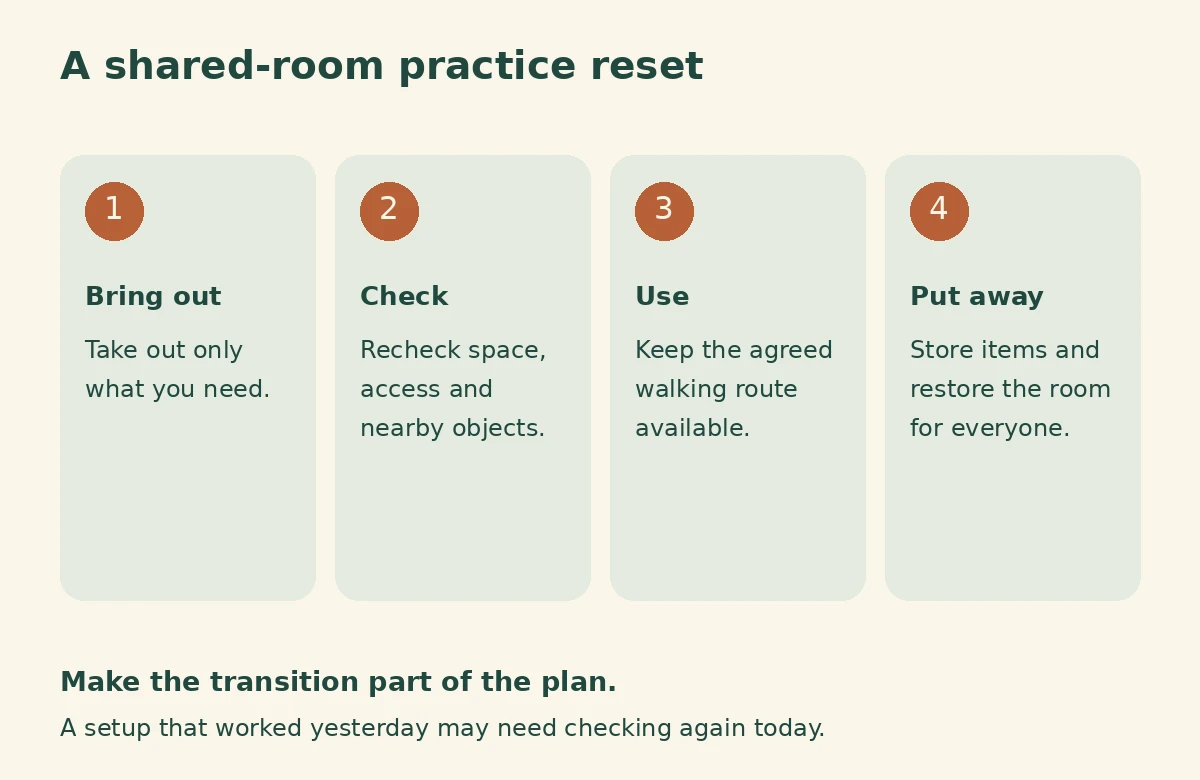
Try the setup and reset without adding a practice session. Retrieve what you need, place it where intended, check the room, and put it away. Notice which step is awkward. Perhaps the storage door cannot open once the mat is down, or the lamp’s cable reaches only by crossing the area.
That trial gives you specific information. You might change where equipment is stored, choose another device position or agree a different time with a housemate. It also prevents a small inconvenience from becoming an elaborate redesign project before you know whether the layout works.
Be realistic about furniture. If every setup requires moving a heavy object, ask whether that is a sensible recurring arrangement. Do not shift bulky furniture alone merely to preserve an ideal layout. A different room, time or suitable activity may be more workable than repeated lifting.
A small yoga corner can also be a storage and preparation corner rather than a permanently occupied floor area. The equipment has a home; the practice uses a shared area when available. This distinction lets the room remain a room instead of becoming an obstacle course organised around a mat.
The choice is practical, not symbolic. A permanent display does not demonstrate greater dedication, and putting equipment away does not make your practice less meaningful. Choose the arrangement you can actually use and restore.
Check lighting, visibility and the room at the right time
Assess the room when you expect to use it. A bright afternoon viewing does not tell you what the area looks like before sunrise or after the curtains are closed. Notice whether you can distinguish the edge of the mat, the surrounding floor and the route in and out.
Check where the light comes from, not just whether a light is switched on. A lamp behind furniture may leave the area you need in shadow. A bright window may make a screen difficult to see. Adjust the arrangement before the session rather than repeatedly handling lamps or curtains while following instructions.
If you use a lamp, give it a stable position outside the intended movement area and keep its cable out of the route. Avoid balancing it on a temporary pile just to produce a pleasing atmosphere. The purpose of the lighting is to let you use the room clearly.
Decoration is optional. A framed image or a familiar object can be meaningful without occupying the floor around you. You can choose a plain, well-lit room and still have a considered practice space. Dimness, incense, candles and elaborate displays are not requirements for yoga.
Consider the room’s ordinary conditions as well. Is it comfortable to occupy at the chosen time? Is a fan or window needed, and does operating it change the layout? Could rain enter through an open window? These questions concern the actual room; there is no universal setting that this article can prescribe for every home and person.
Keep improvements proportionate to the problem you observe. If you cannot see a corner clearly, address visibility. If the room is unavailable at that time, a new lamp will not resolve access. Naming the problem prevents decoration from becoming a substitute for a workable arrangement.
Give screens and other equipment a defined place
When following a lesson, the screen is another object in the room, not a reason to arrange everything around it. Decide where it can sit securely and whether you can see or hear the teaching from the intended area.
Test that position before joining. Start a brief sample or check the audio, then return to the place where you expect to be. If the screen is too small or the sound is unclear, solve the setup issue first. Do not assume that you will keep moving the device throughout the lesson.
A stable device position should not depend on a stack of cushions or an open drawer. Use the equipment according to its instructions and keep it away from the movement area. Charging cables and accessories need their own placement rather than being added after the room assessment is finished.
For live teaching, tell the teacher what can be seen and what cannot. A camera view may hide the low shelf behind you or the doorway beside the mat. You are assessing a physical room, not just producing a tidy video frame.
If you want individual observation, discuss whether the available view suits the lesson. A camera that shows only part of the area cannot establish that the whole setup is clear. Equally, you do not need to share a detailed view of private belongings just to ask a basic question about available space.
Keep the amount of equipment tied to the actual lesson. Set out what is required, with a defined place for items not currently in use. A storage collection and a working setup are different things. Bringing every accessory into a small area can defeat the reason you organised it.
Plan yoga mat storage and the reset together
Yoga mat storage is most useful when you can retrieve and replace the mat without unpacking half the room. The same applies to any other equipment you genuinely use. Choose storage around access and care requirements rather than around how attractive a basket looks in a photograph.
Check the manufacturer’s guidance for cleaning, drying, rolling or folding the particular mat. Materials differ, and a storage method that suits one product may not suit another. Inteyoga’s yoga mat cleaning guide provides a separate starting point for care questions.
Think about the journey between storage and the practice area. Can you carry what you need in a manageable way? Do you have to reach over other belongings? Will putting equipment away disturb someone who is working or sleeping? These details influence whether the arrangement is genuinely convenient.
If an item needs to dry before storage, identify a suitable temporary place that preserves the room’s access routes. “Put it away later” is not a complete plan when later means leaving it across a shared floor. Agree where it can remain until it is ready to be stored according to its care instructions.
Avoid expanding storage simply because empty space appears. An additional box, rack or hanging system should solve an observed problem. Before installing anything, check permission where relevant and follow its installation and load instructions. This guide does not assess the suitability of walls, fixings or furniture for equipment storage.
A useful reset has a clear finishing point: equipment is returned appropriately, the area is available for its ordinary use, and anything moved has an agreed destination. You should be able to describe that point without the vague instruction to “tidy up somehow.”
Agree how a shared practice space will work
A shared practice space depends on communication as much as layout. The person who uses the living room for work, meals or play needs to know what you are proposing. A predictable agreement is easier to follow than a request for indefinite quiet.
Discuss a realistic time window, including setup and putting things away. If you need the area from one time to another, include the whole changeover rather than only the lesson length. That makes the arrangement easier for everyone to plan around.
Agree what happens when someone needs to enter. Keeping a doorway clear and allowing ordinary access may be enough. In another home, the workable choice may be a different time. Do not assume that a closed door means the room can become inaccessible to someone who needs it.
| Shared-room question | Example of a clear agreement |
|---|---|
| When is the area available? | A specific window that includes setup and reset |
| What remains accessible? | The doorway and the route to agreed shared facilities |
| Where do moved belongings go? | Named temporary locations accepted by the people using them |
| How are interruptions handled? | Pause when someone needs the area, then reassess before continuing |
| What happens afterwards? | Equipment is stored and the room returned to its agreed arrangement |
Keep children and pets in mind when deciding whether the area can remain clear. A household plan needs to account for their care and movement; it should not depend on everyone staying perfectly still. If the room changes during the session, pause and check it again.
Privacy can be handled separately from exclusivity. You may prefer not to be watched without needing the whole room reserved permanently. Explain the particular request: fewer interruptions, no filming, or a short period without conversation. Specific requests leave more room for a workable agreement.
Use a short room decision worksheet
Bring the assessment together in a few written lines. The worksheet is a planning aid, not a certificate that the room is safe or that a practice suits you medically.
- Intended activity: Name the lesson or familiar practice and confirm what it requires.
- Available area: Describe the usable position and fixed limitations.
- Access: Identify the routes and doors that must stay available.
- Temporary changes: List what moves and its destination.
- Teaching equipment: Note the screen, audio and equipment positions if needed.
- Shared use: Record the agreed window and interruption plan.
- Reset: State where each item returns and any care step needed first.
- Open question: Name anything that still needs an answer before proceeding.
Consider three hypothetical situations. These are examples of decisions, not accounts of students or tested room designs.
In the first, a bedroom has a gap beside the bed, but a cupboard opens into it. The question is not whether the mat can be squeezed in. It is whether the intended practice and necessary cupboard access can coexist. A different position or a different room may be the answer.
In the second, the living room has an available area only after a small table is moved. The household agrees a destination for the table and a time window. The arrangement still needs to be checked against the actual practice, but the shared-use problem now has a concrete answer.
In the third, a learner has a usable floor area but does not know whether a recorded lesson involves movements beyond it. The missing information is the lesson requirement. The next step is to ask or choose appropriately understood teaching, not to begin and improvise around furniture.
When discussing these questions with a teacher, describe the constraint plainly. For background on Inteyoga’s teaching, the teacher profile introduces Dr. Ashutosh. A biography provides context; it does not amount to a remote assessment of your room or an offer of an individual home-setup service.
The NCCIH guidance on yoga recommends asking about an instructor’s training and experience and advises against postponing healthcare for a medical concern. Room planning cannot determine individual medical suitability. Seek appropriate guidance where a health issue affects participation.
Yoga in a small space works best as a specific planning question: what fits here, under these conditions, with this teaching? Keep the answer open to revision. A room changes, a household changes, and a different lesson may require a different arrangement.
Sources
- CDC: Check for Safety, a Home Fall Prevention Checklist for Older Adults. Household obstacle awareness; not a yoga room-size standard.
- U.S. Fire Administration: Home Fire Escape Plans. Keeping doors and windows unblocked.
- NCCIH: Yoga, Effectiveness and Safety. Instructor background and healthcare cautions.
Frequently asked questions (FAQ)
How much room do I need for yoga in a small space?
There is no single dimension supplied here that makes every practice suitable. Compare the actual lesson requirements with the usable floor area, surrounding objects and overhead clearance. A mat fitting is only one part of the assessment. Ask the teacher when you are unsure what the practice requires.
Can I use a bedroom as a yoga practice space?
Assess the bedroom like any other room: consider the intended activity, furniture, door and cupboard openings, lighting and access. The room’s label does not decide suitability. If the required movement or access does not fit, choose another arrangement rather than squeezing around obstacles.
Do I need a permanent yoga corner?
No. A temporary area with a clear setup and reset plan may suit a shared home. You can give equipment a consistent storage place while using an agreed part of the room when available. Permanence is useful only when it works with the room’s other purposes.
Should I leave my yoga mat out all day?
That depends on the room, household needs and the mat’s care instructions. Keep routes clear and agree how shared space will be used. If leaving the mat out obstructs ordinary access, plan suitable storage and bring it out when the area is available.
Can nearby furniture be used as a yoga prop?
Do not assume furniture is suitable support because it is close to the practice area. Ask about the intended instruction and appropriate equipment. A desk, shelf or bed has not been assessed as a yoga prop by this room-planning guide.
What if the practice I planned does not fit the room?
Pause the plan and identify the limitation. You may need another location, a different arrangement or guidance about an appropriate alternative. Do not improvise unfamiliar movements around obstacles. The purpose of assessing the room is to discover such limits before relying on the setup.