
Quick Answer
Yes, yoga can support weight loss, but mostly in an indirect way. Faster styles such as power yoga, vinyasa and sun salutations burn more calories than gentle classes. Regular practice may also reduce stress eating, improve body awareness and help you stay active. For best results, combine yoga with balanced meals and other physical activity.
Key Takeaways
- Yoga for weight loss means using yoga postures, breathing, relaxation and mindful habits as one part of a plan to reach and keep a healthy weight. There is no separate style called weight loss yoga. You choose and practice yoga with a clear goal in mind: moving more, building strength and changing the habits that lead to weight gain.
- Can yoga reduce weight? Yes, you can lose weight with yoga, but it rarely works alone. Weight loss happens when your body uses more energy than it takes in over time. Yoga adds to the “energy used” side, especially in faster styles. Its bigger strength is that it may change the habits that drive weight gain, such as stress eating, low activity and poor body awareness.
- Research on yoga for weight loss is promising but mixed. Some studies link regular yoga with lower body weight or less weight gain over time. Larger reviews, however, find small or uncertain effects, mainly because many trials are small and short.
More than 4 in 10 American adults (40.3%) live with obesity, according to CDC data collected between 2021 and 2023. In England, 64% of adults are overweight or living with obesity, according to the Health Survey for England 2022. If you are one of the millions trying to lose weight, you have probably cut carbs, counted steps or pushed through workouts you hate, only to watch the scale barely move.
So, does yoga for weight loss actually work? Yes, it can. Yoga helps you lose weight by burning calories, building muscle and making you more aware of what and why you eat. It works best alongside healthy meals, and it is far kinder to your joints than most workouts.
Yoga is already a common habit in the US: about 1 in 6 adults (16.9%) practiced it in 2022, according to a CDC data brief.
Two myths often get in the way. Some people say yoga is “just stretching.” Others promise that a few sun salutations a day will melt fat away. Neither is right. Yoga is a steady, low-impact practice, and it supports weight loss when you practice regularly and eat well.
Below, we cover the 11 best yoga asanas for weight loss with step-by-step instructions, what research actually says, how many calories each style burns and when power yoga for weight loss makes sense. You will also find a 4-week plan, a quick morning yoga routine for weight loss, advice for women, men and home practice, and clear safety notes.
Key takeaways
- Yoga can support weight loss, but the CDC notes that most weight loss comes from eating fewer calories than you use.
- Power yoga burns about 280 calories an hour for a 154 lb (70 kg) adult. Gentle hatha yoga burns about 160.
- Research is promising but mixed. Large reviews find small or uncertain effects on body weight.
- Aim for 3 to 5 sessions a week, add walking, and pair yoga with balanced meals.
- No pose burns belly fat from one spot. Overall fat loss is what shrinks the waist.
Why you can trust this guide: The Inteyoga editorial team wrote this guide at Swami Krishnananda Yoga Vidyapeeth in Colva, South Goa. Inteyoga is registered with Yoga Alliance as a Registered Yoga School (RYS 200, RYS 300 and RYS 500). Every health claim in this article links to peer-reviewed research or public health guidance from the CDC and NHS, listed in the Sources section at the end.
If you want to understand the thinking behind our approach to practice, you can meet Dr. Ashutosh, the physician and yoga teacher who guides our training.
What Does Yoga For Weight Loss Mean?
Yoga for weight loss means using yoga postures, breathing, relaxation and mindful habits as one part of a plan to reach and keep a healthy weight. There is no separate style called weight loss yoga. You choose and practice yoga with a clear goal in mind: moving more, building strength and changing the habits that lead to weight gain.
It usually combines:
- Active practice: flowing sequences such as sun salutations, vinyasa or power yoga that raise your heart rate.
- Strength and stability: standing poses, plank and core work that build muscle.
- Calm and awareness: breathing, relaxation and Yoga Nidra that help you manage stress and notice your eating habits.
Traditional yoga was never designed as a weight loss method. Classical texts describe yoga as a discipline of body, breath and mind. Modern “yoga for weight loss” applies parts of that discipline to a common health goal.
Can I Lose Weight By Doing Yoga?
Can yoga reduce weight? Yes, you can lose weight with yoga, but it rarely works alone. Weight loss happens when your body uses more energy than it takes in over time. Yoga adds to the “energy used” side, especially in faster styles. Its bigger strength is that it may change the habits that drive weight gain, such as stress eating, low activity and poor body awareness.
The US Centers for Disease Control and Prevention (CDC) says most weight loss comes from eating fewer calories, while regular physical activity is what helps people keep the weight off. Yoga fits that picture well. It will not melt fat on its own, but it can make healthy habits easier to keep.
The answer has two parts:
- As exercise, yoga burns a modest number of calories. Vigorous styles burn more.
- As a lifestyle practice, yoga may support mindful eating, better stress control and long-term consistency.
What Does The Research Say About Yoga For Weight Loss?
Research on yoga for weight loss is promising but mixed. Some studies link regular yoga with lower body weight or less weight gain over time. Larger reviews, however, find small or uncertain effects, mainly because many trials are small and short.
| Study | What it looked at | What it found |
|---|---|---|
| Kristal et al., Fred Hutchinson Cancer Research Center (2005) | About 15,500 adults aged 53 to 57, asked about yoga and weight between ages 45 and 55 | Overweight adults who practiced yoga lost about 5 lb over 10 years. Those who did not practice gained about 14 lb. The study was observational and self-reported. |
| Lauche et al., Preventive Medicine (2016) | 30 randomized trials with 2,173 participants | No overall effect on weight, BMI, body fat or waist size. Yoga was linked with a lower waist-to-hip ratio in healthy adults and was preliminarily considered safe and effective for lowering BMI in people with overweight or obesity. |
| Siti Asiah et al., Complementary Therapies in Medicine (2023) | Yoga in adults with obesity and central obesity | Mixed results across comparisons. Evidence quality was rated very low to moderate, so the authors called the findings inconclusive. |
| Caner and Erdoğan Yüce, Obesity Reviews (2025) | Nine studies of young people aged 10 to 24 with overweight or obesity | Pooled data showed that yoga significantly reduced BMI and body fat percentage. |
What this means for you: yoga is a safe and reasonable part of a weight loss plan. It is unlikely to work as a quick fix on its own. The Fred Hutchinson study is especially interesting because the researchers did not think calorie burn explained the result. Lead author Alan Kristal suggested that yoga may make people more aware of their bodies and less likely to overeat, while also stressing that the findings needed to be repeated.
How Does Yoga For Weight Loss Work?
Yoga for weight loss works in five main ways: it burns calories, builds muscle, may reduce stress-driven eating, improves body awareness and makes regular movement easier to keep up. Each of these is small on its own. Together, they can make a real difference over months.
Does Yoga Burn Calories?
Yes. Every yoga class burns some calories, and slow classes burn about as much as a gentle walk. Faster classes, such as power yoga and repeated sun salutations, push your heart rate higher and burn more. We break down the numbers in the next section.
Does Yoga Build Muscle?
Yes, many poses use your own body weight as resistance. Plank, Chair Pose and Warrior poses work the legs, core, shoulders and arms. The CDC advises adults to do muscle-strengthening activity at least two days a week, and a strong, steady yoga practice can count toward that goal.
Can Yoga Reduce Stress Eating?
It may. Many people eat when they feel stressed, bored or tired rather than hungry. Yoga trains you to slow down, breathe and notice what your body feels.
That pause can make it easier to reach for a glass of water, a walk or a proper meal instead of a late-night snack. Evidence here is still developing, so think of it as a likely benefit, not a promise.
Does Yoga Improve Body Awareness?
Yes, and this may be its most underrated benefit. When you practice regularly, you start to notice fullness, tension and energy levels more clearly. The researchers behind the 2005 Fred Hutchinson study suggested this kind of awareness could explain why yoga practitioners gained less weight.
Does Yoga Help You Stay Consistent?
For many people, yes. Yoga is low impact, needs little equipment and can be done in 10 to 30 minutes. That makes it easier to stick with than an intense routine you dread. Consistency over months matters far more than intensity over a single week.
Also read: What Is Restorative Yoga? 7 Benefits, Poses and How to Start
How Many Calories Does Yoga Burn?
Most yoga styles burn between about 160 and 280 calories per hour for a 154 lb (70 kg) adult. The exact number depends on the style, your body weight and how hard you work. These estimates use MET values from the 2024 Adult Compendium of Physical Activities, a standard research reference for energy use.
A MET (metabolic equivalent) shows how much energy an activity uses compared with sitting still. A simple formula is: calories = MET x body weight in kg x hours.
| Yoga style | MET value (2024 Compendium) | Calories per hour at 154 lb (70 kg) | Calories per hour at 198 lb (90 kg) |
|---|---|---|---|
| Nadi Shodhana (alternate nostril breathing) | 2.0 | about 140 | about 180 |
| Hatha yoga | 2.3 | about 160 | about 210 |
| Vinyasa yoga | 2.7 | about 190 | about 245 |
| Hot yoga | 3.0 | about 210 | about 270 |
| Surya Namaskar (sun salutations) | 3.5 | about 245 | about 315 |
| Power yoga | 4.0 | about 280 | about 360 |
Moderate-intensity activity generally starts at around 3 METs. Gentle hatha yoga falls below that line, while sun salutations and power yoga sit above it. If you want a fat-burning yoga workout, choose faster, flowing styles and keep the pace steady.
Keep in mind that these are estimates. Fitness trackers and real bodies vary, so use the table to compare styles rather than to count every calorie.
Which Yoga Style Is Best For Weight Loss?
For weight loss, the best yoga style is the one you will practice regularly at a level that challenges you. Power yoga, vinyasa and sun salutations burn the most calories. Gentler styles such as hatha and restorative yoga burn less but may help with stress, recovery and sleep. Many people do best with a mix.
| Style | Pace | Best for | Calorie burn |
|---|---|---|---|
| Power yoga | Fast, strong | People with some fitness who want a workout | Higher |
| Vinyasa | Flowing, breath-led | Beginners to intermediate learners who like movement | Moderate |
| Ashtanga | Set sequence, steady | People who like structure and challenge | Moderate to higher |
| Hot or Bikram yoga | Moderate, in a heated room | Experienced, healthy practitioners | Moderate |
| Hatha | Slower, holds poses | Complete beginners, learning alignment | Lower |
| Restorative and Yoga Nidra | Very slow, supported | Stress relief, recovery, better rest | Very low |
A good weekly mix for weight loss might include two or three active sessions (vinyasa, power or sun salutations) and one or two calmer sessions (hatha or restorative). That mix builds strength and still leaves time for recovery.
Is Power Yoga Or Vinyasa Flow Better For Faster Weight Loss?
Power yoga for weight loss is usually the stronger choice if burning calories is your main goal. Power yoga links strength-based poses with very little rest. The 2024 Compendium rates it at 4.0 METs, compared with 2.7 for vinyasa, which puts power yoga in the moderate-intensity range.
Vinyasa flow is a good middle ground. It moves at a steady pace, links each movement with the breath and is easier to learn.
A sensible plan is to start with vinyasa for a few weeks, then add one or two power yoga classes once you know the poses. Neither style works quickly on its own. What speeds up results is pairing them with the diet changes later in this guide.
Also read: What Is Power Yoga? Meaning, 10 Benefits, Poses & How It Works
Also read: What Is Bikram Yoga? Meaning, 26 Poses, Benefits & Safety
What Are The Best Yoga Poses (Asanas) For Weight Loss?
The best yoga asanas for weight loss work large muscle groups and raise your heart rate. Sun Salutation, Chair Pose, Warrior II, Plank, Boat Pose and Bow Pose are good examples. Link them into a flowing sequence and you get more benefit than from holding single poses with long breaks.
For each asana below, you will find step-by-step instructions, its main benefits and who should avoid or modify it. Warm up for a few minutes first, move slowly and stop if you feel sharp pain.
1. Sun Salutation (Surya Namaskar): Best For A Full-Body Cardio Flow
Sun Salutation is a series of 12 linked movements done with the breath. Repeated at a steady pace, it is one of the higher calorie-burning practices in the table above.
How to do it, step by step (one round):
- Prayer pose (Pranamasana): Stand tall with palms together at your chest. Exhale.
- Raised arms (Hasta Uttanasana): Inhale and lift your arms overhead with a gentle backbend.
- Standing forward fold (Uttanasana): Exhale and fold forward. Bring your hands beside your feet, bending your knees as needed.
- Low lunge (Ashwa Sanchalanasana): Inhale and step your right leg back. Look forward.
- Plank: Step your left leg back so your body forms a straight line.
- Eight-point pose (Ashtanga Namaskara): Exhale and lower your knees, chest and chin to the floor.
- Cobra (Bhujangasana): Inhale, slide forward and lift your chest.
- Downward Dog (Adho Mukha Svanasana): Exhale and lift your hips into an upside-down V.
- Low lunge: Inhale and step your right foot forward between your hands.
- Standing forward fold: Exhale and bring your left foot forward.
- Raised arms: Inhale and rise up with arms overhead.
- Prayer pose: Exhale and bring your hands back to your chest. Repeat, leading with the left leg.
Benefits:
- Raises your heart rate and works the whole body
- Builds strength in the arms, legs and core
- Links breath and movement, which makes it a good warm-up
Who should avoid or modify it:
- Wrist, shoulder or back injuries: skip the eight-point pose and step through slowly.
- High blood pressure: keep a slow pace and avoid holding your head below your heart for long.
- Pregnancy or hernia: practice only with guidance from a qualified teacher.
Beginner tip: Start with 3 to 5 slow rounds. Add a few rounds each week.
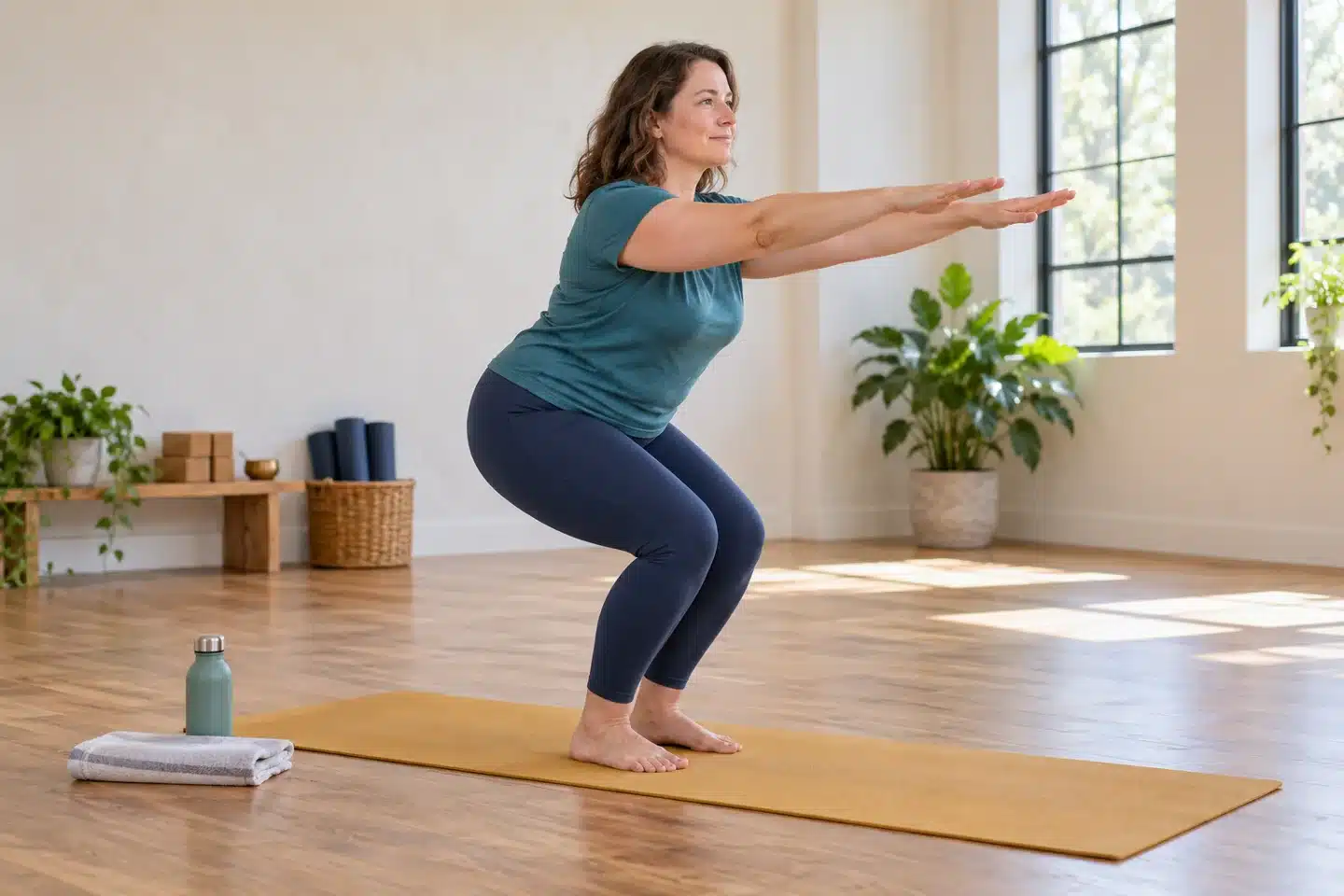
2. Chair Pose (Utkatasana): Best For Thighs And Glutes
Chair Pose looks simple but quickly builds heat in the lower body.
How to do it, step by step:
- Stand with your feet together or hip-width apart.
- Inhale and raise your arms overhead, palms facing each other.
- Exhale, bend your knees and sit your hips back as if onto a chair.
- Keep your weight in your heels and your knees behind your toes. Lift your chest.
- Hold for 5 breaths, then straighten your legs to come up.
Benefits:
- Strengthens the thighs, glutes and calves
- Works the core to keep you upright
- Builds heat fast, even in a short session
Who should avoid or modify it:
- Knee pain: bend your knees only a little.
- Low blood pressure or dizziness: keep your hands at your chest instead of overhead.
- Ankle injury: practice with your back against a wall.
Beginner tip: Hold for 3 breaths at first and repeat twice.
3. Warrior II (Virabhadrasana II): Best For Leg Strength And Stamina
Warrior II is a steady standing pose that builds endurance in the legs and shoulders.
How to do it, step by step:
- Stand with your feet about 3 to 4 feet (1 meter) apart.
- Turn your right foot out 90 degrees and your left foot in slightly.
- Raise your arms to shoulder height, parallel to the floor.
- Exhale and bend your right knee over your right ankle.
- Look over your right fingertips. Hold for 5 breaths, then repeat on the left.
Benefits:
- Strengthens the legs and glutes
- Builds endurance in the shoulders and arms
- Opens the hips and chest
Who should avoid or modify it:
- Knee or hip injury: use a shorter stance and a smaller knee bend.
- Neck problems: look straight ahead instead of over your hand.
- High blood pressure: rest your hands on your hips.
Beginner tip: Keep your front knee in line with your second toe.
4. Plank Pose (Phalakasana): Best For Core Strength
Plank works your core, shoulders, arms and legs at the same time.
How to do it, step by step:
- Start on your hands and knees with your hands under your shoulders.
- Step your feet back one at a time.
- Make a straight line from head to heels. Draw your belly in gently.
- Press the floor away and keep your neck long.
- Hold for 15 to 30 seconds while breathing steadily. Lower your knees to rest.
Benefits:
- Strengthens the whole core
- Builds shoulder and arm endurance
- Supports better posture
Who should avoid or modify it:
- Wrist or shoulder injury: practice on your forearms.
- Later pregnancy, recent abdominal surgery or the weeks after giving birth: wait for medical clearance.
- Lower back pain: lower your knees to the floor.
Beginner tip: A knees-down plank with good form is better than a full plank that sags.
5. Boat Pose (Navasana): Best For The Deep Core
Boat Pose strengthens the deep abdominal muscles and hip flexors.
How to do it, step by step:
- Sit with your knees bent and feet flat on the floor.
- Hold the backs of your thighs and lean back slightly. Keep your chest open.
- Lift your feet so your shins are parallel to the floor.
- If you feel steady, release your hands and reach them forward.
- Hold for 3 to 5 breaths, then lower your feet.
Benefits:
- Strengthens the deep core and hip flexors
- Improves balance
- Builds spine stability
Who should avoid or modify it:
- Pregnancy: avoid this pose.
- Lower back pain: keep your hands on your thighs and toes on the floor.
- Hernia or recent abdominal surgery: avoid until cleared by your doctor.
Beginner tip: Keep your toes touching the floor until your core gets stronger.
6. Bow Pose (Dhanurasana): Best For Back Strength And A Belly Stretch
Bow Pose is often included in yoga for belly fat routines. It strengthens your back and stretches the whole front of your body, including your belly. Like every pose, it cannot burn fat from the belly directly.
How to do it, step by step:
- Lie on your belly with your arms by your sides.
- Bend your knees and reach back to hold the outside of your ankles.
- Inhale and lift your chest and thighs off the floor, pressing your feet into your hands.
- Look forward and keep breathing.
- Hold for 3 to 5 breaths. Exhale and lower slowly.
Benefits:
- Strengthens the back, glutes and hamstrings
- Stretches the abdomen, chest and hip flexors
- Helps counter the rounded posture of long sitting
Who should avoid or modify it:
- Pregnancy: avoid belly-down poses.
- Back or neck injury: avoid or practice only with a teacher.
- Hernia, recent abdominal surgery, high blood pressure or heart conditions: avoid.
Beginner tip: Try Half Bow first. Hold one ankle at a time while the other arm rests on the floor.
7. Bridge Pose (Setu Bandhasana): Best For Glutes And Hamstrings
Bridge Pose strengthens the back of the body and opens the chest.
How to do it, step by step:
- Lie on your back with knees bent and feet hip-width apart, close to your hips.
- Place your arms by your sides, palms down.
- Inhale, press into your feet and arms, and lift your hips.
- Keep your knees in line with your hips.
- Hold for 5 breaths. Exhale and roll down slowly.
Benefits:
- Strengthens the glutes, hamstrings and lower back
- Opens the chest and front of the hips
- Balances the effects of long sitting
Who should avoid or modify it:
- Neck injury: avoid, and never turn your head while lifted.
- Later pregnancy: avoid lying flat on your back.
- Knee pain: keep your feet a little farther from your hips.
Beginner tip: Place a block under your hips for a supported version.
8. Downward-Facing Dog (Adho Mukha Svanasana): Best For Arms And Hamstrings
Downward Dog strengthens the upper body and stretches the back of the legs. It also links many poses in a flow.
How to do it, step by step:
- Start on your hands and knees with your hands slightly ahead of your shoulders.
- Tuck your toes and lift your knees.
- Push your hips up and back into an upside-down V.
- Bend your knees as needed to keep your spine long. Let your heels move toward the floor.
- Hold for 5 breaths, then lower your knees.
Benefits:
- Strengthens the arms and shoulders
- Stretches the hamstrings and calves
- Acts as a resting point between more active poses
Who should avoid or modify it:
- Uncontrolled high blood pressure or glaucoma: avoid, since the head is below the heart.
- Wrist injury: rest on your forearms (Dolphin Pose).
- Later pregnancy: practice only with a prenatal teacher.
Beginner tip: Bend your knees generously. A long back matters more than straight legs.
9. Triangle Pose (Trikonasana): Best For The Side Waist
Triangle Pose is often recommended for “side fat.” It strengthens the muscles along the side of your waist and stretches the side body. Reducing fat there still depends on overall fat loss.
How to do it, step by step:
- Stand with your feet 3 to 4 feet apart. Turn your right foot out and your left foot in slightly.
- Raise your arms to shoulder height.
- Reach forward over your right leg, hinging at the hip.
- Lower your right hand to your shin or a block. Lift your left arm up.
- Hold for 5 breaths, then repeat on the left.
Benefits:
- Strengthens the legs and side-waist muscles
- Stretches the hamstrings and side body
- Improves balance and posture
Who should avoid or modify it:
- Neck problems: look down instead of up.
- Low blood pressure: come up slowly to avoid dizziness.
- Hamstring or hip injury: use a block and a shorter stance.
Beginner tip: Keep both sides of your waist long rather than reaching too low.
10. High Lunge (Ashta Chandrasana): Best For Legs And Balance
High Lunge builds leg strength and balance while stretching the hip flexors.
How to do it, step by step:
- From standing, step your left foot back about 3 to 4 feet with the heel lifted.
- Bend your right knee over your right ankle.
- Inhale and raise your arms overhead.
- Press back through your left heel and lift your chest.
- Hold for 5 breaths, then switch sides.
Benefits:
- Strengthens the legs and glutes
- Stretches tight hip flexors
- Trains balance and focus
Who should avoid or modify it:
- Knee injury: lower your back knee to the floor.
- Balance problems: keep one hand on a wall or chair.
- High blood pressure: rest your hands on your hips.
Beginner tip: Keep your front knee directly above your ankle.
11. Corpse Pose (Savasana) Or Yoga Nidra: Best For Recovery
Corpse Pose does not burn many calories, but it matters. Ending with rest helps your body move out of “stress mode” and may support recovery.
How to do it, step by step:
- Lie on your back with legs slightly apart and arms by your sides, palms up.
- Close your eyes and let your breath be natural.
- Relax your body part by part, from your feet to your head.
- Stay for 5 to 10 minutes. Yoga Nidra is a longer, guided form of this rest.
- Roll onto your side and sit up slowly.
Benefits:
- Calms the nervous system after practice
- May help you sleep and recover better
- Builds the habit of noticing how your body feels
Who should avoid or modify it:
- Later pregnancy: rest on your left side instead.
- Lower back discomfort: place a cushion under your knees.
Beginner tip: Use a blanket so you stay warm and relaxed.
What Are The Best Yoga Poses For Weight Loss In 5 Minutes?
In 5 minutes, the best yoga poses for weight loss are a quick, nonstop flow of Sun Salutations, Chair Pose, Warrior II, Plank and Bridge. Five minutes will not burn many calories. It does get you moving on busy days, though, and it keeps the habit going.
Use the poses described above in this order, moving with your breath:
| Time | What to do |
|---|---|
| Minute 1 | 3 slow rounds of Sun Salutation to warm up |
| Minute 2 | Chair Pose for 5 breaths, stand up, repeat twice |
| Minute 3 | Warrior II for 5 breaths on each side |
| Minute 4 | Plank for 20 to 30 seconds, rest, then Plank again |
| Minute 5 | Bridge Pose twice, then 30 seconds of stillness on your back |
Treat this as a “minimum day,” not your whole plan. On days with more time, use the longer sessions in the beginner plan below.
Also read: The Simple 10-Minute Morning Yoga Routine For Energy 2026
Can Breathing Practices Support Weight Loss?
Breathing practices (pranayama) burn very few calories, but they may support weight loss indirectly by calming stress and building focus. The 2024 Compendium lists alternate nostril breathing at 2.0 METs, which is close to light activity. They are more useful for calming the mind than for burning energy.
Two common practices are:
- Nadi Shodhana (alternate nostril breathing): A slow, balanced breath that many people find calming. It is gentle and suits most beginners.
- Kapalabhati (skull-shining breath): A forceful breath with quick exhales from the belly. It is energizing, but it is not for everyone. It is commonly advised against during pregnancy and for people with high blood pressure, heart disease, hernia, recent abdominal surgery or epilepsy. Learn it from a qualified teacher.
Do not expect breathing exercises to “burn belly fat.” Use them to feel calmer and more in control, which can help you make better food and lifestyle choices.
Also read: What Is a Yoga Nidra? Meaning, Benefits, How It Works & 8 Easy Stages
What Are The Benefits Of Yoga For Weight Loss?
The benefits of yoga for weight loss go beyond the scale. Even when the weight comes off slowly, you may notice that you feel stronger, calmer and more in tune with your body.
- Burns calories: Faster styles such as power yoga and sun salutations can burn around 245 to 360 calories per hour, depending on body weight.
- Builds lean muscle: Body-weight poses strengthen the legs, core and upper body.
- May reduce stress eating: Slow breathing and mindful movement can help you pause before eating out of stress or boredom.
- Improves body awareness: You may notice hunger and fullness signals more clearly.
- Low impact on joints: Yoga is often easier on knees and hips than running, which matters if you are carrying extra weight.
- Supports better rest: Calming practices such as restorative yoga and Yoga Nidra may help you wind down at night.
- Improves waist-to-hip ratio in some studies: A 2016 review found yoga was linked with a lower waist-to-hip ratio in healthy adults compared with usual care.
- Easy to keep up: You can practice in short sessions with little equipment.
- Builds a positive relationship with your body: Yoga focuses on what your body can do, not just how it looks.
Yoga For Weight Loss vs Cardio: Which Works Better?
For pure calorie burn, cardio usually wins. For long-term habits, joint comfort and stress control, yoga has clear strengths. The best plan for most people combines both. The table below compares them side by side.
| Factor | Yoga for weight loss | Cardio (running, cycling, brisk walking) |
|---|---|---|
| Calorie burn per hour | Low to moderate (about 160 to 280 for a 154 lb adult, depending on style) | Moderate to high, depending on speed and effort |
| Muscle strength | Good, through body-weight poses | Limited, mostly legs |
| Impact on joints | Low | Low to high (running is high impact) |
| Stress relief | Strong focus on breath and calm | Can help mood, but less focus on calm |
| Flexibility and balance | Strong benefit | Little benefit |
| Mindful eating support | Built into the practice | Not a direct focus |
| Equipment needed | A mat | Shoes, bike or gym access |
| Best use | Long-term habits, strength and recovery | Raising daily calorie burn and heart fitness |
You do not have to choose, though. A weekly plan with 3 yoga sessions and 2 or 3 brisk walks or bike rides covers calorie burn, strength, flexibility and stress control.
What Are Some Examples Of Yoga For Weight Loss In Real Life?
Examples of yoga for weight loss include a short morning flow before work, a lunchtime session, an evening class mixed with walks, or yoga paired with the gym. The examples below are sample weekly setups for different lifestyles, not real student stories. Pick the one closest to your life and adjust it.
| Example | Typical week | Why it works |
|---|---|---|
| Busy office worker | 20-minute vinyasa flow before work on 5 days, plus a longer weekend class | Short sessions fit around work and build a daily habit |
| Parent at home | Three 30-minute home flows during nap time or after school drop-off, plus family walks | No travel time and walks add extra movement |
| Gym-goer | 2 strength sessions at the gym, 2 power yoga classes and 1 restorative class | Yoga adds mobility and recovery to strength training |
| Adult over 50 starting out | Three 30-minute gentle hatha or chair-supported classes, plus daily walks | Low impact, builds balance and confidence safely |
| Runner or cyclist | 2 or 3 cardio sessions plus 2 vinyasa classes | Yoga eases tight hips and legs and adds core strength |
How Often Should You Do Yoga To Lose Weight?
Aim for at least 3 to 5 yoga sessions a week, each lasting 30 to 60 minutes, alongside other activity. Regular, steady practice brings better results than one long class a week.
Public health guidance gives a useful target. Both the CDC and the NHS recommend at least 150 minutes of moderate activity each week, plus muscle-strengthening work on at least 2 days. The CDC also notes that some people need more than this to maintain their weight, and the amount varies a lot from person to person.
Remember that gentle styles sit below moderate intensity. If most of your yoga is slow, add brisk walking or a faster flow to reach the weekly target.
Also read: What Is Vinyasa Yoga? Meaning, 8 Benefits, Poses & Practice
Is 20 Minutes Of Yoga A Day Enough To Lose Weight?
Twenty minutes of yoga a day can help with weight loss, especially if most sessions are active and you also eat well. Done every day, it adds up to 140 minutes a week, close to the weekly activity target. A daily 20-minute power or vinyasa flow burns roughly 60 to 95 calories for a 154 lb (70 kg) adult, based on Compendium values.
That is not a large number on its own. The habit matters more. A short daily practice is easier to keep than a long session you keep skipping.
Ways to make 20 minutes count:
- Keep moving between poses instead of resting for long.
- Make at least half of your weekly sessions active styles.
- Add a 10 to 20-minute walk on most days.
- If you have more time, stretch it to 30 minutes, which takes you past the 150-minute mark over a week.
What Is The Best Time Of Day To Do Yoga?
The best time of day to do yoga is the time you can stick with every week. For weight loss, consistency matters much more than the clock. Morning and evening practice each have their own advantages.
- Morning: A short morning yoga routine for weight loss, such as the 5-minute flow above, is easy to protect before the day gets busy. An active flow can leave you feeling energized.
- Midday: A short session can break up long hours of sitting.
- Evening: Calmer styles can help you unwind. Keep vigorous flows away from bedtime if they make it harder to sleep.
Whatever time you choose, avoid a heavy meal for 2 to 3 hours before practice. Twists, forward folds and inversions feel uncomfortable on a full stomach. A light snack about an hour before is fine for most people.
How Should Beginners Start Yoga For Weight Loss?
Beginners should start with short, simple sessions, learn safe alignment first and increase pace gradually. A good starting point is 20 to 30 minutes, three times a week, using beginner-friendly hatha or slow vinyasa classes before trying power or hot yoga.
Start like this:
- Learn the basics first. Spend your first few sessions learning Sun Salutation, Downward Dog and standing poses slowly.
- Use props. Blocks, straps and folded blankets make poses easier and safer, especially if you are carrying extra weight.
- Choose beginner classes. Look for “beginner,” “gentle” or “foundations” labels. Avoid hot yoga until you know the poses.
What Is A Good 4-Week Beginner Yoga Plan For Weight Loss?
This 4-week plan starts gently, adds strength and flow week by week, and keeps one calm session for recovery. Pair it with walking and sensible meals.
| Week | Active yoga sessions | Calm session | Extra movement | Focus |
|---|---|---|---|---|
| Week 1 | 3 x 20 min: 3 rounds of Sun Salutation, Chair Pose, Warrior II, Bridge | 1 x 15 min restorative poses or Savasana | 2 x 20 min easy walks | Learn the shapes, breathe slowly |
| Week 2 | 3 x 30 min: 5 rounds of Sun Salutation, add Plank and Triangle | 1 x 20 min hatha or Yoga Nidra | 2 x 25 min brisk walks | Hold poses for 5 steady breaths |
| Week 3 | 4 x 30 min: 6 to 8 rounds of Sun Salutation, add High Lunge and Boat Pose | 1 x 20 min restorative | 2 x 30 min brisk walks | Link poses into a flow |
| Week 4 | 4 x 40 min: vinyasa or power yoga class, or a home flow | 1 x 20 min Yoga Nidra | 2 to 3 x 30 min brisk walks or cycling | Keep a steady pace, rest when needed |
How to use this plan:
- Rest one full day a week.
- If a week feels too hard, repeat it before moving on.
- Check with your doctor first if you have a health condition.
How Do You Do Yoga For Weight Loss At Home?
To do yoga for weight loss at home, set up a small, clear space, follow a trusted beginner video or written sequence, and practice at a fixed time. Home practice removes travel time and cost, which makes it easier to be consistent.
What you need:
- Space: A clear area about the size of a mat, with room to stretch your arms.
- A non-slip mat: This matters more than any other item.
- Props: Two firm cushions or thick books can replace blocks. A belt or towel can replace a strap. A folded blanket supports your knees.
- Guidance: Use a reputable online class or a written sequence. If you can, take a few in-person classes first so a teacher can check your form.
Tips for safe home practice:
- Clear away furniture you could knock into.
- Practice on a firm floor, not a soft rug or bed.
- Keep water nearby and open a window for fresh air.
- Put your phone on silent so the session is not interrupted.
Yoga For Weight Loss For Women: What Should You Know?
Yoga for weight loss works the same way for women as for men, but women may need to adapt their practice to the menstrual cycle, pregnancy, the months after birth and menopause. Adjusting intensity to these life stages helps you stay consistent without strain.
- Menstrual cycle: Energy can change through the month. On low-energy days, swap a power class for hatha or restorative yoga instead of skipping practice.
- Pregnancy: Pregnancy is generally not a time to aim for weight loss, so follow your doctor’s or midwife’s advice. If you want to practice, choose a prenatal class led by a qualified prenatal teacher and avoid hot yoga.
- After giving birth: Wait until your doctor or midwife says it is safe to exercise. Start with gentle breathing and core-friendly poses, and build up slowly.
- Menopause: Weight and body shape can change around this time. Keep up the muscle-strengthening work the CDC recommends for all adults, and use calming practices if they help you sleep or manage stress.
If you have a hormonal or thyroid condition, ask your doctor how best to combine exercise, diet and any treatment.
What Is The Fastest Way For A Woman To Lose Weight?
The fastest safe way for a woman to lose weight is a steady calorie deficit combined with regular activity, aiming for about 0.5 to 1 kg (1 to 2 lb) a week. The NHS recommends this rate. There is no shortcut that is both fast and safe.
To get there:
- Eat a little less, not a lot less. Small cuts you can keep up beat extreme diets.
- Build regular protein into meals to help you feel full.
- Combine yoga with walking and strength training so you burn more energy and protect muscle.
- Sleep well. Being tired makes healthy choices harder.
- Avoid crash diets. The NHS warns that losing weight too quickly through strict dieting is not recommended.
The same principles apply to men. If you need to lose weight faster for medical reasons, do it under the care of a doctor.
Yoga For Weight Loss For Men: What Should You Focus On?
For men, yoga for weight loss works best when it combines strength-based styles such as power yoga or Ashtanga with mobility work for tight hips and hamstrings. Many men start yoga with limited flexibility, so a slower start and plenty of modifications help avoid injury.
Where to focus:
- Respect tight areas. Bend your knees in forward folds and Downward Dog. Flexibility improves with time.
- Choose challenging styles for a workout. Power yoga and Ashtanga build strength and heat.
- Pair yoga with lifting or cardio. Yoga adds recovery and mobility to a gym routine.
- Do not force poses. Pushing too hard, too fast is a common cause of injury.
- Watch the waistline. If your waist is growing, overall fat loss through food and activity is the way to reduce it.
Can Yoga Reduce Belly Fat?
Yoga cannot burn fat from your belly alone, because the body does not lose fat from one chosen spot. When you lose body fat overall, your waist usually gets smaller too. Yoga can help by building core strength, improving posture and supporting the habits that lead to overall fat loss.
Yoga for belly fat works indirectly. Stronger core muscles may improve your posture, which can make your waist look and feel firmer. A 2016 review also found that yoga was linked with a lower waist-to-hip ratio in healthy adults. Still, real change around the belly comes from overall fat loss through food, activity, sleep and time.
Yoga For Weight Loss And Belly Fat: Which Core Sequence Helps?
A short core sequence of Cat-Cow, Plank, Boat Pose, Cobra, Locust and Bridge can strengthen the muscles around your middle. Use it 3 times a week alongside your full-body practice. It builds strength and posture but works best as part of overall fat loss.
| Order | Pose | Hold or repeat |
|---|---|---|
| 1 | Cat-Cow (Marjaryasana-Bitilasana) | 6 to 8 slow rounds to warm the spine |
| 2 | Plank (Phalakasana) | 2 holds of 20 to 30 seconds |
| 3 | Boat Pose (Navasana) | 3 holds of 3 to 5 breaths |
| 4 | Cobra (Bhujangasana) | 3 holds of 3 breaths, lifting gently |
| 5 | Locust (Salabhasana) | 3 holds of 3 breaths |
| 6 | Bridge (Setu Bandhasana) | 3 holds of 5 breaths |
Once Locust feels easy, you can replace it with Bow Pose (Dhanurasana).
Safety note: skip belly-down poses such as Cobra and Locust, and deep core work such as Boat Pose, during pregnancy, after recent abdominal surgery or if you have a hernia.
Can I Get A Flat Tummy In 7 Days With Yoga?
No, you cannot get a flat tummy in 7 days with yoga or any other method. Losing visible belly fat takes weeks to months. What can change in a week is bloating, posture and how your core muscles feel.
In 7 days, you may notice:
- Less bloating if you eat more whole foods, drink water and move daily.
- Better posture from core and back strengthening, which makes your middle look flatter.
- More awareness of how your body feels after different meals.
Be careful with “7-day flat belly” promises. They usually rely on water loss, not fat loss, and the results return quickly.
What Happens After 30 Days Of Yoga?
After 30 days of regular yoga, you will probably feel stronger and more flexible, and you may notice early changes in how your clothes fit. Large weight changes are less likely in a month, but the habits you build in these weeks set up longer-term results.
The first month often goes like this:
- Weeks 1 to 2: You learn the poses and may feel less stiff. Some muscles may be sore at first.
- Weeks 3 to 4: Poses feel steadier, holds get longer and you may sleep better.
- Day 30: Many people find yoga has become part of their routine. Some notice small changes in weight or waist size, especially if they also changed their eating.
- Months 2 to 3 and beyond: With regular practice and healthy eating, weight and waist changes become easier to see.
The 2005 Fred Hutchinson study looked at people who practiced for years, not weeks. Patience is part of the practice.
At What Age Is It Hardest To Lose Weight?
Many people find it hardest to lose weight in midlife and after age 60, but metabolism alone is not the main reason before 60. A large 2021 study in Science, led by Herman Pontzer, measured the energy use of more than 6,600 people aged one week to 95 years. It found that metabolism stays fairly stable from the 20s through the 50s and declines by about 0.7% a year after 60.
Even so, US data shows that midlife is when weight problems peak. CDC figures from 2021 to 2023 show that adults aged 40 to 59 had the highest obesity rate of any age group, at 46.4%.
So why does weight often creep up in the 40s and 50s? Common reasons include:
- Less daily activity as work and family demands grow
- Gradual loss of muscle if you do no strength training
- Poorer sleep and higher stress
- Hormonal changes around menopause for women
Yoga can help at any age, because it builds muscle, trains balance and can be adapted for older or less flexible bodies.
Yoga + Healthy Diet = Faster Results: What Should You Eat?
Yoga works much better for weight loss when you pair it with a healthy diet of mostly whole, minimally processed foods. Yoga raises the energy you use and builds awareness, while your diet controls the energy you take in. Together, they bring faster and more lasting results than either one alone. You do not need an extreme diet. Small, steady changes are easier to keep.
A few guidelines:
- Fill half your plate with vegetables and fruit. The NHS suggests at least five portions a day.
- Include a source of protein, such as lentils, beans, eggs, fish, yogurt or tofu.
- Choose whole grains over refined ones where you can.
- Drink water through the day.
- Do not skip meals. The NHS notes that skipping meals can lead to more snacking later.
If you have a medical condition, take medication or have a history of difficult eating patterns, talk with your doctor or a registered dietitian before changing your diet.
What 3 Foods Should You Drop To Lose Weight?
The three foods most worth cutting back to lose weight are sugary drinks, ultra-processed snacks and fast food, and alcohol. You do not have to remove them forever. Reducing them often makes the biggest difference for the least effort.
- Sugary drinks: Soda, sweetened coffee drinks and many juices add calories quickly. The NHS suggests swapping them for water.
- Ultra-processed snacks and fast food: In a 2019 NIH study published in Cell Metabolism, 20 adults ate about 500 more calories a day on an ultra-processed diet than on a minimally processed one, and gained about 2 lb in two weeks.
- Alcohol: Alcohol contains about 7 calories per gram, and drinking often makes it harder to stick to food choices.
What Is The 30-30-30 Rule For Weight Loss?
The 30-30-30 rule means eating 30 grams of protein within 30 minutes of waking, then doing 30 minutes of low-to-moderate steady cardio. The idea comes from Tim Ferriss’s book The 4-Hour Body and was later spread on TikTok by biologist Gary Brecka.
What the evidence says, according to Cleveland Clinic:
- The 30-30-30 rule itself has not been studied, so there is no direct proof it works.
- A protein-rich breakfast may help you feel full, and morning activity can help you reach weekly exercise targets.
- It gives no guidance for the rest of the day, so other meals can easily undo its effect.
- Not everyone can eat 30 grams of protein right after waking, and people with kidney or liver disease should check with a doctor first.
How yoga fits: a slow yoga class is not steady-state cardio. If you try this routine, use a brisk walk or a continuous vinyasa flow for the 30 minutes.
What Is The Japanese Trick To Lose Weight?
The best-known Japanese trick to lose weight is “hara hachi bu,” which means eating until you are about 80% full. According to Cleveland Clinic, the practice comes from Okinawa, Japan. It helps you eat less without strict rules or calorie counting.
How to try it:
- Look at your meal and aim to eat about 80% of what would make you full.
- Stop when you feel satisfied, not stuffed.
- Eat slowly, since your body takes time to register fullness.
- If you usually clear your plate, start by leaving one bite, then two.
It pairs well with yoga, since both train you to pay attention to your body. There is little direct research on hara hachi bu itself, so treat it as a helpful habit rather than a proven method.
Who Should Be Careful With Yoga For Weight Loss?
Yoga is safe for most healthy adults, but some people need to adapt their practice or get medical advice first. The 2016 review found no reported adverse events linked to yoga in the trials it studied. Even so, safety depends on choosing the right style and listening to your body.
Speak with a doctor before starting, and practice with a qualified teacher, if you:
- Are pregnant or have recently given birth
- Have high or low blood pressure or a heart condition
- Have glaucoma or other eye pressure problems (avoid head-down poses)
- Have had recent surgery or a recent injury
- Have joint, back or neck problems
- Have diabetes, especially if you take insulin or medicines that can cause low blood sugar
- Have significant obesity or have been inactive for a long time
Hot yoga needs extra care, since heat can raise the risk of dehydration and dizziness. Stop at once if you feel chest pain, severe breathlessness, dizziness or sharp joint pain.
What Tips Help You Get Effective Results From Yoga?
The most effective tips are to practice at a fixed time, build up gradually, track more than your weight and stay patient. Small habits like these turn yoga from an occasional class into a routine that supports weight loss.
- Link yoga to an existing habit. For example, practice right after your morning coffee or before dinner.
- Warm up and cool down every time. A few gentle rounds at the start and a short rest at the end help your body adapt.
- Use your breath as a guide. If you cannot breathe steadily, ease off a little.
- Track more than the scale. Measure your waist, notice how clothes fit and note your energy and sleep.
- Increase one thing at a time. Add a few minutes, a few more rounds or one new pose each week.
- Do not compare yourself with others. Yoga is a personal practice, and progress looks different for everyone.
Also read: What Is Hatha Yoga? Meaning, 9 Benefits, Poses, How It Works
How Does Inteyoga Approach Yoga And Healthy Living?
At Inteyoga, we see yoga as an integrated discipline that includes body, breath, mind, conduct and daily choices. We do not treat yoga as a quick weight loss tool. Instead, we teach practices that help people live with more balance and awareness, and that tends to support healthy habits.
Inteyoga, also known as Swami Krishnananda Yoga Vidyapeeth, is based in Colva, South Goa, India. The school is registered with Yoga Alliance as a Registered Yoga School (RYS 200, RYS 300 and RYS 500), and all courses are taught in English. Our training is guided by Dr. Ashutosh, a physician and yoga teacher who brings together Hatha Yoga, Raja Yoga, Ayurveda, applied anatomy and classical texts, with a focus on the preventive and restorative side of practice.
Our current program is the Advanced TTC 300-Hour Integrated Restorative Yoga (Including Yoga Nidra, Chakra Sadhana, and Prana Vidya Intensive). It is a residential program of 43+2 days, taught in English, for people aged 21 to 60 who have completed a 200-hour teacher training or an equivalent qualification.
It is an advanced teacher training, not a weight loss retreat. Under our Gift-it-Forward model, no payment is required to apply or to participate. After completing the program, participants may voluntarily support the Gift-it-Forward initiative to help future aspirants, with no obligation.
Current batch dates and details for all our programs are on the courses page. If you are new to teacher training, our 200-hour program is planned for approximately mid-2027.
Have a question about yoga, our training or life at the school? Contact the Inteyoga team.
Conclusion
Yoga for weight loss works best as a steady, long-term practice, not a quick fix. Active styles such as power yoga, vinyasa and sun salutations burn a fair number of calories, while every style can help build strength, calm stress and improve body awareness. Research is promising but mixed, which is why the most reliable results come from combining yoga with balanced meals, other activity and good rest.
Start small. Practice three times a week, use the 4-week plan above, and pay attention to how you feel, not just the number on the scale. Give it at least a month before you judge the results.
Which yoga pose do you enjoy most for staying active? Tell us in the comments below.
Ready to go deeper into yoga as a way of living? If you have completed a 200-hour teacher training, explore our Advanced TTC 300-Hour Integrated Restorative Yoga program in Goa and apply for an upcoming batch. If you are just starting out, learn about our planned 200-hour program, or visit our FAQ page for answers to common questions.
About Inteyoga
Inteyoga (Swami Krishnananda Yoga Vidyapeeth) is managed by Inteyoga Shala LLP and is located at Plot No. 6, Novo Vaddo, Sernabatim, Colva, Salcete, Goa 403708, India. Email: info@inteyoga.org. WhatsApp: +91 935-473-7240.
Founder-Director: Dr. Ashutosh, MBBS, M.Sc. (Yoga), Yoga Master Level 6 (Yoga Certification Board, Ministry of AYUSH, Government of India), Swami Krishnananda Yoga Vidyapeeth and Inteyoga, Colva, South Goa.
Medical Disclaimer
This article is for general education only and is not medical advice. Yoga is not a treatment for obesity or any medical condition. Always talk with your doctor or another qualified health professional before starting a new exercise or diet plan, especially if you are pregnant, have a health condition, take medication or have an injury. Stop any practice that causes pain, dizziness or breathlessness.
Frequently Asked Questions (FAQ)
Does Yoga Help You Lose Weight Every Day?
No, you will not see weight loss on the scale every day, with yoga or any other method. Body weight naturally goes up and down from day to day because of water, salt, food in your gut and hormones. What matters is the trend over weeks. Weigh yourself once a week at the same time and look for steady change over a month or two.
How Many Minutes Of Yoga Should I Do For Weight Loss?
It depends on your level. Beginners can start with 15 to 20 minutes on most days. Once the poses feel familiar, aim for 30 to 45 minutes per session. Regular practitioners can build up to 45 to 60 minutes. Make most of these sessions active styles, such as power yoga or vinyasa, so they count toward your weekly activity.
Does Yoga Speed Up Your Metabolism?
Yoga raises your energy use while you practice, especially in faster styles. It may also help a little over time by building muscle, which uses slightly more energy than fat even at rest. However, the effect is modest. Do not count on yoga to “boost” your metabolism dramatically. Its value for weight loss comes more from steady activity, strength and better habits.
How Many Sun Salutations Should I Do A Day For Weight Loss?
There is no magic number. Beginners can start with 3 to 5 slow rounds and add a few rounds each week. Many regular practitioners do 12 or more rounds in one session. Focus on steady breathing and good form rather than speed. Combine sun salutations with other poses and walking for a balanced routine.
Should I Do Yoga Before Or After Cardio?
If you do both in one session, many people do cardio first and finish with yoga, because stretches and calming poses make a natural cool-down. If your main workout that day is a hard power yoga class, do it first while you are fresh and keep the cardio light. On busy weeks, it is fine to do them on separate days.
Does Sweating More In Hot Yoga Mean More Fat Loss?
No. Heavy sweating in hot yoga mostly means you are losing water, not fat. The weight returns once you drink and rehydrate. To lose fat, you still need regular practice over weeks, plus balanced meals. If you try hot yoga, drink plenty of water and stop if you feel dizzy or unwell.
Do I Need To Be Flexible To Start Yoga?
No, you do not need to be flexible to start yoga. Flexibility is a result of practice, not a requirement. Start with the range of motion you have today and let it grow gradually. Many people who start stiff find they move much more freely after a few months of regular practice.
Is Yoga Or Pilates Better For Weight Loss?
Both are low-impact mind-body practices with a modest calorie burn, so neither is a clear winner for weight loss. Pilates focuses more on core control and precise movement. Yoga adds breathing, relaxation and a wider range of standing and flowing poses. Choose the one you enjoy and will do regularly, and pair it with walking or cardio.