
Quick Answer
For many people with common low back pain, yes. Gentle yoga may ease pain and improve daily function, and a 2017 trial in Annals of Internal Medicine found a 12-week yoga program worked about as well as physical therapy. The benefit is usually modest, so start slowly and see a doctor first if pain is severe.
Key Takeaways
- Yoga for back pain is a gentle, adapted yoga practice that uses slow postures, breathing and relaxation to ease back stiffness and support the spine. It is not a separate style. It is a careful choice of poses that avoid strain, with props and modifications so the practice fits the body you have today.
- Most lower back pain has no single clear cause. Doctors call this “non-specific low back pain,” and it accounts for about 90% of cases, according to the World Health Organization (WHO).
- Yoga may help common back pain, but the benefit in studies is modest. Trials show yoga can reduce pain and improve function in chronic non-specific low back pain, and it performs about as well as other back exercise. Reviews disagree on how large the effect is.
Nearly 4 in 10 American adults had back pain in the past three months, according to 2019 data from the CDC. In the UK, around 9.5 million people live with low back pain in any given year, according to Arthritis UK. If you are reading this with a stiff lower back after a day at your desk, you are in very large company.
For many people, the pain builds around ordinary habits: hours in a chair, slumping over a laptop or phone, long commutes. None of these habits is a proven cause on its own, but many people notice their back feels worse after long, still days.
Yoga for back pain is one of the most popular ways people look for relief without medication. In 2022, about 1 in 6 US adults practiced yoga, and more than a quarter of them said they used it to manage physical pain, according to the CDC. (In India, the same search is often typed as “कमर दर्द के लिए योगासन”, or kamar dard ke liye yogasan.)
Yoga is not one thing, though. Some poses suit a sore back and others can make it worse. This guide explains what the research shows, which 12 poses are safest to start with, which to skip, and how to build a routine you can keep.
Safety first: If you have a slip disc, a serious spinal injury or recent surgery, talk to your doctor or physical therapist (physiotherapist in the UK) before trying these poses. Stop right away if your pain increases. Our full medical disclaimer is at the end of this article.
Key takeaways
- Yoga may help common low back pain, with results in trials similar to physical therapy and other back exercise.
- The safest starting poses are slow and supported, such as Cat-Cow, Child’s Pose, Knees-to-Chest and Bridge.
- While your back hurts, avoid deep forward bends, deep backbends, strong twists and poses that load the neck.
- Short, regular sessions of 10 to 20 minutes are easier to keep up than long, occasional ones.
- Leg weakness, numbness, fever or bladder and bowel changes need urgent medical care, not yoga.
About this guide: This guide was prepared by the Inteyoga Editorial Team at Inteyoga (Swami Krishnananda Yoga Vidyapeeth) in South Goa, India. Inteyoga is registered with Yoga Alliance as a Registered Yoga School (RYS 200, RYS 300, RYS 500). Health claims are linked to named sources, including clinical guidelines, Cochrane reviews, peer-reviewed trials, the WHO, the CDC and the NHS. Yoga is presented here as a supportive practice, not a replacement for medical care.
Want to see the slow, supported style of practice we teach? Read about our restorative approach to yoga teacher training.
What Is Yoga for Back Pain?
Yoga for back pain is a gentle, adapted yoga practice that uses slow postures, breathing and relaxation to ease back stiffness and support the spine. It is not a separate style. It is a careful choice of poses that avoid strain, with props and modifications so the practice fits the body you have today.
A back-friendly practice usually has four parts:
- Mobility: small, pain-free movements of the spine and hips.
- Stretching: gentle release for the hamstrings, hips and buttocks.
- Strength: light work for the deep core and glutes that help hold the spine steady.
- Relaxation: slow breathing and rest.
The yoga programs tested in back pain trials were designed specifically for back pain and led by experienced teachers, as the Cochrane review authors point out. A random class off a studio schedule is not the same thing.
Why Does the Lower Back Hurt?
Most lower back pain has no single clear cause. Doctors call this “non-specific low back pain,” and it accounts for about 90% of cases, according to the World Health Organization (WHO).
The problem is global. The WHO reports that low back pain affected 619 million people in 2020 and expects that number to reach 843 million by 2050. It is the leading cause of disability worldwide.
Factors often linked with back pain include:
- Long hours of sitting at a desk, in a car or on the couch.
- Slumped posture over a laptop or phone for long stretches.
- Stiff hips and weak core and glute muscles, explained below.
- Stress and poor sleep, which can make pain feel worse.
- Low physical activity.
A smaller group of people have specific low back pain, which is pain linked to a known cause such as a disc problem, a fracture, an infection or nerve compression. These cases need a medical diagnosis first. Yoga may play a role later, but only with your doctor’s approval.
How Do Tight Hips and a Weak Core Strain the Lower Back?
A common explanation is that stiff hips and a weak core shift extra work onto the lower back. The pelvis sits between the legs and the spine, so muscles that pull on the pelvis can change how the lower back moves. Research linking any single muscle pattern to back pain is mixed, so treat this as a practical model rather than a proven cause.
- Tight hip flexors at the front of the hips, which can follow long sitting, may tip the pelvis forward and increase the arch of the lower back.
- Tight hamstrings at the back of the thighs may pull the pelvis the other way, so the lower back rounds more when you bend.
- Weak deep core and glute muscles may leave the back muscles doing more of the work of steadying the spine.
Picture an office worker who sits for eight hours, then drives home. The hips stay bent all day and the glutes barely work. This is why most back-friendly routines do not focus on the back alone. They also release the hips and strengthen the core and glutes.
Does Yoga Help Your Back Pain? What the Research Says
Yoga may help common back pain, but the benefit in studies is modest. Trials show yoga can reduce pain and improve function in chronic non-specific low back pain, and it performs about as well as other back exercise. Reviews disagree on how large the effect is.
| Study | What it looked at | Main finding |
|---|---|---|
| Saper et al., Annals of Internal Medicine (2017) | 320 adults with chronic low back pain; 12 weeks of yoga vs physical therapy vs education | Yoga was noninferior to (about as effective as) physical therapy for pain and function. Neither was clearly better than the education book on the main outcomes. |
| Cochrane Review (2022), 21 trials, 2,223 people | Yoga vs no exercise and vs other exercise | Low- to moderate-certainty evidence of small improvements in pain and function vs no exercise, which the authors judged may not be clinically important. Little or no difference from other back exercise for function. |
| Systematic review in Pain (2022), 27 studies, 2,702 people | Yoga vs passive care and active care | Yoga improved pain, disability, physical function and mental health compared with non-exercise controls. No significant difference vs active comparators. |
| American College of Physicians guideline (2017) | Non-drug options for chronic low back pain | Recommended non-drug treatments, including yoga, as initial treatment, based on low-quality evidence. |
What does this mean for you? Yoga is a reasonable, low-cost option for common back pain. It has not been shown to beat other good exercise, but some people enjoy it more and stick with it longer, and the routine you keep doing is the one that can help.
Current guidelines, such as NICE guideline NG59 in the UK and the ACP guideline in the US, put exercise and self-management at the center of care for low back pain. Yoga is one exercise option within that approach. It does not replace a medical assessment.
One more caveat: the Cochrane review found that increased back pain was the most common side effect reported in yoga trials. Pose choice and pacing matter, which is why the rest of this guide focuses on practicing safely.
What Are the Benefits of Yoga for Back Pain?
The possible benefits of yoga for back pain include less stiffness, better flexibility, a stronger core, better posture awareness and help with stress. Results vary from person to person.
- It may ease muscle tension. Slow stretches work the muscles around the spine, hips and hamstrings. Harvard Health notes that yoga can help muscles that support the spine, such as the multifidus and transverse abdominis.
- It may improve flexibility and range of motion, so everyday tasks like loading the dishwasher or lifting a child can feel easier.
- It can build core and glute strength. Poses such as Bridge Pose work the muscles around the lower back and pelvis.
- It builds body awareness. Many people start to notice how they sit, stand and move.
- It may help with stress. Slow breathing and relaxation help many people feel calmer, and stress can make pain feel worse.
- It may reduce reliance on pain medication. In the 2017 Annals trial, people in the yoga group were 21 percentage points less likely than the education group to use pain medication at 12 weeks.
- It is cheap and flexible. You need a mat, a cushion and a strap or belt, and you can practice at home in 15 to 20 minutes.
Safety, Precautions and Best Practices for Yoga for Back Pain
The safest way to practice yoga for back pain is to move slowly, stay in a pain-free range, breathe steadily and use props. Apply these habits to every routine in this guide.
What Are the Golden Rules Before You Start?
- Move within a pain-free range. A mild stretch is fine. Sharp, pinching or shooting pain is not.
- Breathe slowly through the nose. If you are holding your breath, you are pushing too hard.
- Use props. The table below shows which ones help and what to use at home.
- Warm up first. Start every session lying down or on hands and knees before any stretch.
- Tell your teacher. Share your back history before a class so the teacher can offer options.
How Should Beginners Use Props Such as Blocks and Bolsters?
Props make poses smaller, softer and safer, so beginners can practice without strain. You do not need special equipment. Household items work well.
| Prop | Household swap | How it helps a sore back |
|---|---|---|
| Yoga block | A thick book | Raises the floor in Downward-Facing Dog and Child’s Pose, so the back stays long |
| Bolster | A firm pillow or rolled blanket | Supports the chest in Child’s Pose and the knees in Shavasana |
| Strap | A belt or scarf | Lets you stretch the hamstrings without rounding the back |
| Folded blanket | A thick towel | Cushions the knees in Cat-Cow and lifts the hips in Legs-Up-the-Wall |
| Chair | A sturdy dining chair | Allows seated versions of poses on stiff or painful days |
| Wall | Any clear wall | Supports a half Downward-Facing Dog and Legs-Up-the-Wall |
How Do You Know If a Pose Is Helping or Hurting?
Use a simple traffic-light check: green means continue, yellow means ease off, and red means stop.
| Signal | What you feel | What to do |
|---|---|---|
| Green | A mild, even stretch. Breathing stays slow. You feel the same or better afterward. | Continue. |
| Yellow | Some discomfort that fades when you ease off. Your breath gets a little short. | Reduce the depth, add a prop or shorten the hold. |
| Red | Sharp, pinching or shooting pain, pain down the leg, numbness or tingling, or pain that is worse the next day. | Stop the pose. If it continues, see a doctor. |
A practical rule: you should feel the same or better within 24 hours of practice. If your back is clearly worse the next morning, do less next time.
What Common Mistakes Should You Avoid?
Common mistakes are pushing too deep, moving too fast and skipping rest.
- Chasing flexibility. Touching your toes is not the goal. A comfortable back is.
- Skipping rest. Shavasana and slow breathing are part of the practice.
- Comparing yourself with others. Your body, history and pain are your own.
- Practicing through red-flag pain. Sharp, shooting or spreading pain needs a doctor, not more stretching.
Best Yoga Poses for Back Pain: Which 12 Are Safest?
Good starting poses for back pain are gentle, slow and supported: Cat-Cow, Child’s Pose, Knees-to-Chest, Sphinx, Cobra, Bridge, Downward-Facing Dog, a reclined twist, a reclined hamstring stretch, a reclined figure-four, Crocodile Pose and Legs-Up-the-Wall. Each pose below has step-by-step instructions and a hold time. No pose suits everyone, so let the traffic-light check guide you.
1. Cat-Cow Pose (Marjaryasana-Bitilasana)
Cat-Cow moves the spine gently through flexion and extension, which can help with spinal flexibility and stiffness. It is one of the most common warm-ups for the back.
- Come onto hands and knees, wrists under shoulders and knees under hips.
- Inhale and let the belly drop softly as you lift the chest (Cow).
- Exhale and round the back gently, drawing the navel in (Cat).
- Repeat 6 to 8 slow rounds. Keep the movement small if your back is sore.
2. Child’s Pose (Balasana)
Child’s Pose is a resting pose that gently stretches the lower back and gives the breath a chance to slow down.
- From hands and knees, sit your hips back toward your heels.
- Rest your forehead on the mat or a cushion. Your arms can reach forward or rest by your sides.
- Widen the knees if your belly feels squeezed.
- Stay for 5 to 10 breaths, breathing into the back of your ribs.
If your hips do not reach your heels, place a pillow between your thighs and calves.
3. Knees-to-Chest Pose (Apanasana)
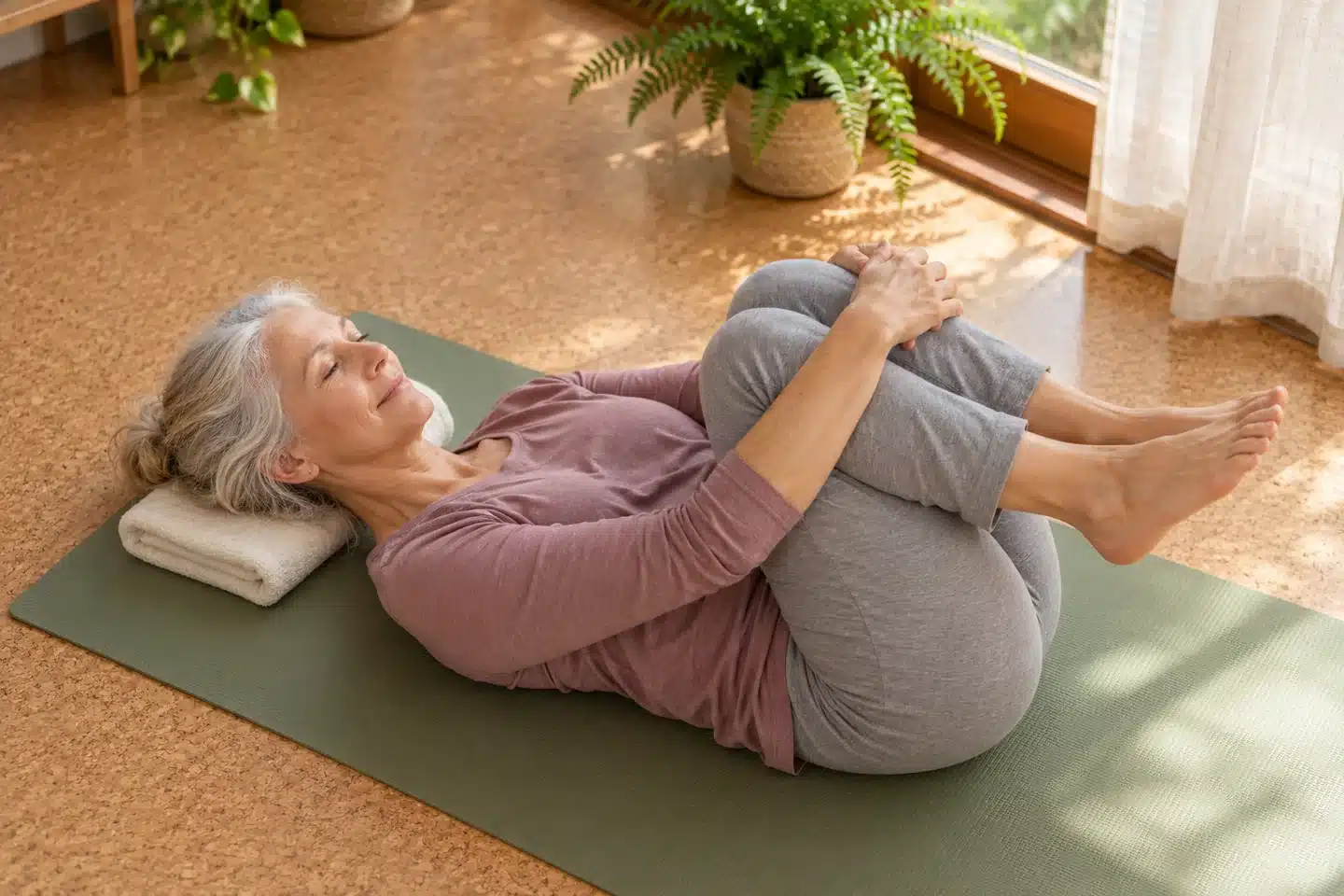
Knees-to-Chest gently stretches the lower back and is one of the most comfortable poses for many people on sore days.
- Lie on your back. Bend both knees and draw them toward your chest.
- Hold behind the thighs, not on top of the knees.
- Rock slowly side to side for a light massage of the low back.
- Stay for 5 to 10 breaths. Try one knee at a time if both feel like too much.
4. Sphinx Pose (Salamba Bhujangasana)
Sphinx is a gentle, supported backbend that suits people who feel better when they arch slightly.
- Lie on your stomach with your forearms on the mat, elbows under or slightly ahead of the shoulders.
- Press the forearms down and lift the chest a little.
- Keep the lower belly lightly engaged so the low back does not sag.
- Stay for 5 breaths. If you feel pinching, slide the elbows forward to reduce the bend.
5. Cobra Pose (Bhujangasana)
Cobra Pose works the muscles along the spine and opens the chest and shoulders. Practice it as a low, gentle Cobra, and only once Sphinx feels comfortable.
- Lie on your stomach with your hands under your shoulders, elbows bent and close to your sides.
- Press the tops of your feet and your pubic bone gently into the mat.
- Inhale and lift your chest a few inches, using your back muscles more than your arms.
- Keep the elbows bent and the neck long. Hold for 3 to 5 breaths, lower slowly, and repeat 3 times.
Skip Cobra if backbends increase your pain, or if you have spinal stenosis or spondylolisthesis, unless your doctor or physical therapist says it suits you.
6. Bridge Pose (Setu Bandhasana)
Bridge Pose strengthens the glutes and hamstrings, which support the pelvis and lower back.
- Lie on your back with knees bent and feet hip-width apart.
- Press into your feet and lift your hips slowly, one vertebra at a time.
- Lift only as high as feels comfortable. Squeeze the glutes, not the low back.
- Hold for 3 to 5 breaths, then lower slowly. Repeat 3 to 5 times.
7. Downward-Facing Dog (Adho Mukha Svanasana)
Downward-Facing Dog stretches the whole back of the body, from the shoulders through the spine to the hamstrings and calves. With back pain, aim for a long spine, not straight legs.
- Start on hands and knees. Spread your fingers wide and tuck your toes.
- Exhale and lift your hips up and back into an upside-down V.
- Bend your knees generously so your lower back stays long instead of rounded. Your heels do not need to touch the floor.
- Hold for 5 breaths, then lower into Child’s Pose. Repeat 2 to 3 times.
For an easier version, place your hands on blocks, or do a half dog with your hands on a wall or chair seat. Skip this pose if you have glaucoma, uncontrolled high blood pressure or painful wrists.
8. Reclined Spinal Twist (Supta Matsyendrasana)
A reclined twist rotates the spine gently and can ease tension in the back and hips.
- Lie on your back and hug both knees in.
- Lower both knees slowly to one side, keeping both shoulders on the floor.
- Place a pillow under the knees if they do not reach the floor.
- Stay for 5 to 8 breaths, then switch sides. Keep the twist mild. Depth is not the goal.
9. Reclined Hand-to-Big-Toe Stretch With a Strap (Supta Padangusthasana)
This stretch lengthens the hamstrings without rounding the lower back.
- Lie on your back and loop a strap or belt around one foot.
- Straighten that leg toward the ceiling, keeping the other knee bent with the foot on the floor.
- Keep the back of the pelvis heavy on the mat.
- Hold for 5 to 8 breaths, then switch. A soft bend in the lifted knee is fine.
10. Reclined Figure-Four (Supta Kapotasana Variation)
Reclined Figure-Four stretches the hips and buttocks, including the piriformis, without loading the spine. For most beginners it is a gentler choice than full Pigeon Pose.
- Lie on your back with both knees bent.
- Cross your right ankle over your left knee.
- Draw the left thigh toward you, holding behind it.
- Hold for 5 to 8 breaths, then switch sides.
11. Crocodile Pose (Makarasana)
Crocodile Pose is a face-down resting position from Indian yoga traditions, used to practice slow belly breathing while the back muscles relax.
- Lie on your stomach. Fold your arms and rest your forehead on your hands.
- Let your legs relax, feet slightly apart.
- Breathe slowly and feel your belly press into the floor as you inhale.
- Stay for 1 to 3 minutes.
12. Legs-Up-the-Wall (Viparita Karani)
Legs-Up-the-Wall is a restorative pose that many people use to rest the back at the end of a session.
- Sit sideways next to a wall, then swing your legs up the wall as you lie back.
- Place a folded blanket under your hips if that feels better.
- Rest your arms by your sides and close your eyes.
- Stay for 3 to 5 minutes. Skip this pose if you have glaucoma or uncontrolled blood pressure, and ask your doctor first.
Finish every session with Shavasana (Corpse Pose) or a short Yoga Nidra practice. Lie on your back with a pillow under your knees and rest for 3 to 5 minutes.
Also read: What Is Restorative Yoga? 7 Benefits, Poses and How to Start
Which Asanas Should You Avoid in Back Pain?
While your back hurts, avoid asanas that force deep forward bends, deep backbends, strong twists or weight on the neck. These cautions come from common clinical and teaching advice rather than head-to-head trials, but they are a sensible default for a sensitive spine.
| Asana or movement | Why it may aggravate back pain | Safer swap |
|---|---|---|
| Standing forward fold with a rounded back (Uttanasana) | Bends the lower back under body weight | Reclined hamstring stretch with a strap |
| Seated forward bend (Paschimottanasana) | Pulls on tight hamstrings and rounds the low back | Knees-to-Chest or a strap stretch |
| Full Wheel (Urdhva Dhanurasana) | A very deep backbend through the lower back | Sphinx or a low Bridge |
| Plow (Halasana) | Places heavy load on the neck and spine | Legs-Up-the-Wall |
| Headstand (Sirsasana) | Loads the neck and spine and is risky without expert guidance | Child’s Pose |
| Deep seated twists | Can strain the joints of the lower spine | Gentle reclined twist |
| Full Pigeon Pose (Eka Pada Rajakapotasana) | Can twist the pelvis and stress the sacroiliac joint | Reclined Figure-Four |
| Fast, heated flows | Speed and heat make it easy to push past safe limits | Slow Hatha or restorative classes |
These asanas are not “bad.” Many healthy people practice them safely. They are just not the right starting point when your back hurts.
What Are Three Exercises to Avoid With Lower Back Pain?
Three gym exercises to pause while your lower back hurts are full sit-ups, double straight-leg raises and heavy lifting with a rounded back. Each one puts a high load on the lower spine at a time when it is sensitive. The yoga poses to skip are in the table above.
| Exercise to pause | Why it can aggravate low back pain | Back-friendlier choice |
|---|---|---|
| Full sit-ups and fast crunches | Repeated, forceful bending of the lower spine | Curl-up (see the Big 3 section) or Bridge Pose |
| Double straight-leg raises | Both legs pull hard on the pelvis and can arch the low back | Bend the knees and lower one leg at a time |
| Heavy deadlifts, rows or lifts with a rounded back | High load plus bending can provoke a flare-up | Lighter weights, a neutral spine, or a pause until pain settles |
You do not have to give these up for life. Once pain settles, many people return to them with good form and gradual loading, ideally with help from a physical therapist or qualified coach.
Yoga for Back Pain Beginners: A 4-Week Plan
Safe yoga for beginners with back pain starts slowly, and this 4-week plan moves step by step from rest and mobility to light strength. It uses only poses from the list above. Practice 3 to 4 days a week for 15 to 20 minutes, and stay in the green zone the whole time.
| Week | Focus | Poses | Time |
|---|---|---|---|
| Week 1 | Rest and gentle movement | Crocodile, Knees-to-Chest, Cat-Cow (small range), Child’s Pose, Shavasana | 10 to 15 min |
| Week 2 | Add mobility and stretching | Week 1 plus Reclined Twist and Reclined Hamstring Stretch with a strap | 15 min |
| Week 3 | Add hips and light strength | Week 2 plus Reclined Figure-Four and Bridge (3 rounds) | 15 to 20 min |
| Week 4 | Add gentle backbends, a full-body stretch and deep rest | Week 3 plus Sphinx (progress to Low Cobra), half Downward-Facing Dog at a wall, Legs-Up-the-Wall and a 10-minute Yoga Nidra | 20 min |
Tips to make the plan stick:
- Consistency beats intensity. Fifteen calm minutes four times a week is easier on your back than one long session on Sunday.
- Practice at a regular time. Many people like a short session right after work.
- Keep a short log. Rate your pain from 0 to 10 before and after each session, so you can see how your back responds over the four weeks.
Have questions about practice or training? Our Inteyoga FAQ page answers common questions, and our team can help with anything it does not cover.
5-Minute Yoga for Lower Back Pain
A 5-minute yoga routine for lower back pain can be done on the floor or in a chair: seated Cat-Cow, a chair figure-four, Knees-to-Chest, a reclined twist and one minute of rest. It is meant for busy days, desk breaks and stiff mornings when a full session is not realistic.
| Time | Pose | How to do it |
|---|---|---|
| 0:00 to 1:00 | Seated Cat-Cow | Sit tall on a chair, hands on knees. Inhale and lift the chest. Exhale and round the back gently. |
| 1:00 to 2:00 | Chair Figure-Four | Sitting tall, place your right ankle on your left knee and hinge forward slightly from the hips. 30 seconds each side. |
| 2:00 to 3:00 | Knees-to-Chest | Lie on your back, on the floor or bed. Hug your knees in and rock slowly. |
| 3:00 to 4:00 | Reclined Twist | Lower both bent knees to one side, then the other. 30 seconds each side. |
| 4:00 to 5:00 | Rest | Lie on your back with a pillow under your knees. Breathe out for longer than you breathe in. |
Think of this as a reset, not a replacement for longer sessions, which give you time to work on strength as well as stiffness.
Yoga for Back Pain in 10 Minutes: A Daily Routine
A 10-minute yoga routine for back pain can cover breathing, mobility, stretching, light strength and rest. This floor sequence does all five, so it works as a daily habit when you cannot fit in a longer practice.
| Time | Pose | Focus |
|---|---|---|
| 0:00 to 1:00 | Crocodile Pose (Makarasana) | Slow belly breathing |
| 1:00 to 2:00 | Knees-to-Chest (Apanasana) | Gentle stretch for the low back |
| 2:00 to 3:30 | Cat-Cow (Marjaryasana-Bitilasana) | Spinal mobility |
| 3:30 to 4:30 | Child’s Pose (Balasana) | Lengthening the lower back |
| 4:30 to 6:00 | Bridge Pose (Setu Bandhasana), 3 to 5 lifts | Glute and core strength |
| 6:00 to 7:30 | Reclined hamstring stretch with a strap | Hamstring stretch, 45 seconds each leg |
| 7:30 to 9:00 | Reclined Spinal Twist | Gentle rotation, 45 seconds each side |
| 9:00 to 10:00 | Shavasana with a pillow under the knees | Rest |
The order is deliberate. You start lying down, build slowly, do strength work in the middle once you are warm, and finish with rest. When this feels easy, move on to the full 4-week plan.
Morning Yoga Stretches for a Stiff Back
Morning yoga stretches for a stiff back should be gentle and avoid deep forward bending for the first hour after waking. Many people feel stiffest in the morning. In a 1998 trial published in Spine, 85 people with chronic low back pain who limited early-morning bending of the lower back reported less pain, fewer days in pain and lower medication use.
Try this wake-up sequence:
- Pelvic tilts in bed (1 minute). Lie on your back with knees bent. Gently flatten, then slightly arch, your lower back in time with your breath.
- Single knee hug (1 minute). Draw one knee toward your chest, then the other, keeping the other foot on the bed.
- Log-roll out of bed. Roll onto your side, lower your feet over the edge and push up with your arms, so you avoid a sudden sit-up movement.
- Cat-Cow on the floor (1 minute). Move slowly and keep the range small.
- Standing side stretch (1 minute). Stand tall, reach one arm overhead and lean gently to the opposite side. Switch sides.
Save toe touches and deep forward folds for later in the day. If mornings are rushed, an evening session works too, and many people like to use it after a day of sitting.
Yoga for Lower Back Pain Relief During a Flare-Up
For lower back pain relief during a flare-up, scale your yoga practice down to supported rest positions, slow breathing and very small movements. For the first few days, aim to stay comfortable and keep moving gently, not to stretch or strengthen.
- Find a position of ease. Many people are comfortable lying on their side with a pillow between the knees. The supported 90/90 position in the L4 and L5 section below is another option.
- Breathe low and slow. Use the longer-exhale breath from the breathing section below for 2 to 3 minutes.
- Add tiny movements only. Rock your bent knees a few inches side to side, or tilt the pelvis gently, staying well inside the green zone.
- Return to your routine in steps. As pain eases, add back the 5-minute routine, then the 10-minute routine, then the full plan.
Skip strong stretching on the worst days. It can irritate a back that is already sensitive.
Yoga for Back Pain for Men
Yoga for back pain works the same way for men as for women. Men who lift weights, do manual work, drive long hours or sit at a desk may want to focus on hip and hamstring stretches plus glute strength. The poses stay the same.
Back pain is common in men too. CDC data from 2019 shows 37.2% of US men had back pain in the past three months, compared with 40.6% of women. Yet only about 1 in 10 US men practiced yoga in 2022, compared with nearly 1 in 4 women. Among men who did practice, 31.8% said they used yoga for physical pain.
Practical tips for men starting yoga for back pain:
- Leave the ego at the door. Strength does not equal flexibility, and forcing a stretch can provoke a flare-up.
- Start with three poses: the reclined hamstring stretch with a strap, Reclined Figure-Four and Bridge Pose.
- Pair yoga with strength training sensibly. On heavy lifting days, keep yoga short and restful. On rest days, do the full routine.
- Use props without hesitation. A strap, a block and a cushion are tools, not crutches.
- Break up long drives. Stop every 60 to 90 minutes to walk and do a few standing hip circles.
Flexibility and strength work best together, so a well-rounded routine includes both.
What Are the Big 3 Exercises for Back Pain?
The “Big 3” exercises for back pain are the curl-up, the side plank and the bird-dog. Spine biomechanics expert Dr. Stuart McGill of the University of Waterloo developed them to build core endurance while keeping the spine in a neutral position, as Harvard Health explains.
| Exercise | How to do it | Hold |
|---|---|---|
| Curl-up | Lie on your back with one knee bent and one leg straight. Slide your hands under your low back. Lift your head and shoulders slightly without flattening the low back. | 10 seconds |
| Side plank | Lie on your side on one forearm, knees bent. Lift your hips into a straight line from head to knees. Straighten the legs only once this is easy. | Up to 10 seconds per side |
| Bird-dog | On hands and knees, reach one arm forward and the opposite leg back, keeping your hips level. | 10 seconds, then switch sides |
Harvard Health describes a simple pyramid: 5 reps of each, then 3, then 1. Start 2 to 3 times a week.
The Big 3 and yoga fit together well. The Big 3 focus on core endurance, while yoga adds mobility, stretching and relaxation. Many people do the Big 3 first, then a short yoga routine. Bird-dog even starts from the same hands-and-knees position as Cat-Cow.
Which Exercises Remove Back Pain?
No single exercise removes all back pain, but regular exercise is one of the best-supported ways to reduce it. The best exercise is usually the one you enjoy and will repeat. In the UK, NICE recommends exercise and supported self-management for low back pain, including group exercise programs suited to each person’s needs and preferences.
| Type of exercise | Examples | What it can help with |
|---|---|---|
| Mind-body | Yoga, tai chi, Pilates | Mobility, core control, stress and coping with pain |
| Core endurance | The Big 3, Bridge Pose | Spinal support during daily tasks |
| Aerobic | Walking, swimming, cycling | General fitness; walking may help prevent new episodes |
| Strength | Light weights, resistance bands | Capacity for lifting and work |
| Mobility | Cat-Cow, gentle stretching | Stiffness, especially after sitting |
Mixing types works well for many people. A balanced week might include 2 to 3 short yoga sessions, the Big 3 two or three times, and a daily walk. Expect gradual change over weeks, not days.
Is Walking Good for Back Pain?
Yes, walking suits most people with common back pain, and a recent trial suggests it may help keep pain from coming back. It is low impact, free and easy to fit into any day.
The best recent evidence comes from the WalkBack trial, published in The Lancet in 2024. Researchers in Australia followed 701 adults who had recently recovered from an episode of low back pain. One group got an individualized walking program plus six physiotherapist-guided education sessions over six months. The other group received neither.
- People in the walking group went a median of 208 days before their pain came back.
- People in the control group went a median of 112 days.
How to walk for back pain:
- Start with short walks of 10 to 15 minutes at a comfortable pace.
- Add a few minutes each week as your back allows.
- Walk on even ground in supportive shoes.
- Stand tall and let your arms swing naturally.
Walking and yoga complement each other. Walking builds general fitness, while yoga adds flexibility, core work and relaxation.
How to Cure Back Pain Fast at Home Naturally?
There is no instant cure for back pain, but most common low back pain improves within a few weeks, according to the NHS. Staying active, using heat, resting comfortably and moving gently are sensible steps at home while it settles.
What tends to help:
- Stay as active as you can. The NHS advises against staying in bed for long periods. Keep doing daily tasks at a lighter pace.
- Use heat. The NHS suggests a heat pack or hot water bottle wrapped in a towel to ease stiffness and muscle spasms.
- Sleep with support. The positions of ease from the flare-up section above can work at night too.
- Break up sitting. Stand up and move for a minute or two every 30 to 45 minutes. A phone reminder helps if you work from home.
- Look after stress and sleep. Both can affect how much pain you feel.
- Ask a pharmacist about pain relief. Over-the-counter options help some people stay active, but they are not right for everyone.
- Return to gentle yoga and walking as soon as pain allows.
See a doctor if pain is not improving after a few weeks, is getting worse, or comes with any of the red-flag symptoms listed later in this guide.
How to Decompress L4 and L5 at Home?
You cannot truly “decompress” the L4 and L5 vertebrae at home, but some supported positions can take load off the lower spine and may ease pain. L4 and L5 are the two lowest vertebrae of the lower back, and the disc between them is a common site of disc problems.
Gentle resting positions many people find helpful:
- Supported 90/90 position. Lie on your back with your calves resting on a chair or sofa, so your hips and knees bend to roughly right angles. Rest for 5 to 10 minutes.
- Knees-to-Chest. See the pose above.
- Supported Child’s Pose. A cushion under the chest and between the thighs reduces strain.
- Sphinx Pose. Some people with disc-related pain feel better in gentle extension, while others feel worse. Use it only if it eases your symptoms.
Avoid hanging from bars or using inversion tables without medical advice. Hanging upside down raises blood pressure and pressure in the eyes, so it does not suit everyone.
If you have a diagnosed disc problem or pain spreading down your leg, follow a plan from your doctor or physical therapist. Home positions can ease symptoms, but they do not replace a proper assessment.
Yoga for Back Pain vs Physical Therapy: Which Is Better?
Neither is clearly better for common back pain. In a 2017 trial of 320 adults, a structured 12-week yoga program was about as effective as physical therapy for pain and function. The right choice depends on your diagnosis, budget and what you will stick with.
| Factor | Yoga for back pain | Physical therapy for back pain |
|---|---|---|
| Best suited for | Common, non-specific back pain; staying active; stress-related tension | Injuries, post-surgery recovery, nerve symptoms, specific diagnoses |
| Evidence | About as effective as physical therapy in the 2017 Annals trial | Well-established first-line treatment |
| Personalization | Group classes are general; a skilled teacher can adapt poses | Tailored to your exam and diagnosis |
| Mind-body focus | Strong: breathing, relaxation and awareness | Usually more focused on mechanics |
| Cost | Generally lower; can be done at home | Often higher; may need a referral, insurance in the US or an NHS waiting list in the UK |
| Diagnosis | Cannot diagnose or treat medical conditions | Licensed to assess and treat |
| Long-term use | Easy to keep up as a habit | Usually a set course of sessions |
The two can work well together. If your pain is new, severe or comes with leg symptoms, start with a doctor or physical therapist. Once you have clearance, yoga can help you keep moving.
Which Is the Best Yoga for Back Pain?
For back pain, slow, alignment-focused or restorative styles are usually the best fit, such as Hatha, Iyengar, restorative yoga or Viniyoga. These styles hold poses gently, use props and let you adapt each movement.
- Hatha Yoga moves at a traditional, steady pace with time to settle into each pose. It suits most beginners.
- Iyengar Yoga focuses closely on alignment and uses props such as blocks, belts and chairs. Several back pain trials have used this style.
- Restorative Yoga uses fully supported poses held for several minutes. It suits sore days and stress-related tension.
- Viniyoga adapts the practice to the individual and links each movement to the breath. It has also been studied in back pain trials.
Approach fast Vinyasa, Power Yoga and hot yoga (such as Bikram) with caution. They are not off-limits forever, but speed and heat make it easy to push past safe limits when your back is sensitive. If you are choosing a class at a studio in the US or UK, look for words like “gentle,” “slow flow,” “restorative” or “beginners” on the schedule.
Also read: What Is Iyengar Yoga? Meaning, 10 Benefits and 8 Easy Poses
Can Breathing and Yoga Nidra Help Back Pain?
Breathing practices and Yoga Nidra may help some people relax, which can make pain easier to cope with, but evidence specific to back pain is limited. Treat them as supportive practices alongside movement, not as treatments on their own.
Stress, worry and poor sleep can make pain feel worse. Many people find that slow breathing gives them a sense of control on a bad day.
Simple practices to try:
- Belly breathing in Crocodile Pose: breathe slowly into the belly for 2 to 3 minutes.
- Longer exhales: breathe in for a count of 4 and out for a count of 6, for about 2 minutes.
- Bhramari (humming bee breath): hum softly on each exhale for 5 to 7 rounds.
- Yoga Nidra: a guided relaxation, done lying down, that moves your attention through the body. Many people feel calmer after 10 to 20 minutes.
At Inteyoga, Yoga Nidra is one of the three specialities of our advanced restorative training, alongside Chakra Sadhana and Prana Vidya.
Also read: What Is Hatha Yoga? Meaning, 9 Benefits, Poses, How It Works
When Should You Not Do Yoga for Back Pain?
Do not start yoga for back pain, and get medical help first, if your pain came from an injury or comes with leg weakness, numbness, fever, weight loss or changes in bladder or bowel control. These red flags can point to a more serious cause.
Based on NHS guidance, get emergency help right away (call 911 in the US or 999 in the UK) if back pain comes with:
- Loss of bladder or bowel control, or difficulty passing urine.
- Numbness around the genitals or buttocks.
- New weakness in the legs or feet.
- Numbness or tingling in both legs.
See a doctor promptly (your primary care doctor or urgent care in the US, or your GP or NHS 111 in the UK) if you have:
- Back pain after a fall or accident.
- Fever, chills or a general feeling of being unwell.
- Unexplained weight loss.
- Pain that is worse at night or does not ease with rest.
- A history of cancer.
Ask your doctor before starting yoga if you are pregnant or have osteoporosis, a herniated disc, spinal stenosis, recent spinal surgery, glaucoma, uncontrolled high blood pressure or a heart condition. Many people with these conditions can still practice, but they need a tailored plan.
Conclusion: Start Gently and Stay Consistent
Yoga for back pain works best when it is slow, supported and regular. Research suggests gentle yoga can ease pain and improve daily function for common low back pain, about as well as physical therapy and other exercise. The benefit is modest, and safe pose choice matters.
Start with the 12 poses in this guide. Use the 5-minute or 10-minute routine on busy days, and follow the 4-week plan when you can. Add walking and the Big 3 for a well-rounded week. And see a doctor first if your pain is severe, follows an injury or comes with red-flag symptoms.
Want to go deeper into restorative practice? Inteyoga’s residential training covers restorative yoga, applied anatomy, pranayama and Yoga Nidra, with attention to safety and modifications. The Advanced TTC 300-Hour Integrated Restorative Yoga (Including Yoga Nidra, Chakra Sadhana, and Prana Vidya Intensive) runs in South Goa, India, as a 43+2 days residential program taught in English. It is an advanced teacher training for practitioners who have completed a 200-hour TTC or equivalent, not a beginner retreat.
- Explore the 300-hour restorative yoga program
- Apply for an upcoming 300-hour batch
- Ask our team a question
Our teacher training helps you understand yoga more deeply and teach it more safely. It does not qualify anyone to diagnose, prescribe treatment for or claim to cure medical conditions.
About Inteyoga
Inteyoga (Swami Krishnananda Yoga Vidyapeeth) is managed by Inteyoga Shala LLP and is based at Plot No. 6, Novo Vaddo, Sernabatim, Colva, Salcete, Goa 403708, India. Inteyoga is registered with Yoga Alliance as a Registered Yoga School (RYS 200, RYS 300, RYS 500). Contact: info@inteyoga.org or WhatsApp +91 935-473-7240.
Founder-Director: Dr. Ashutosh, MBBS, M.Sc. (Yoga), Yoga Master Level 6 (Yoga Certification Board, Ministry of AYUSH, Government of India), Swami Krishnananda Yoga Vidyapeeth and Inteyoga, Colva, South Goa.
Medical Disclaimer
This article is for general education only. It is not medical advice and does not replace diagnosis or treatment from a qualified healthcare professional. Back pain can have many causes, some of them serious. Please consult your doctor or physical therapist before starting a new exercise or yoga program, especially if you have a slip disc (herniated disc), a serious spinal injury or recent surgery, or if you are pregnant or living with a heart, eye or blood pressure condition. Stop the practice immediately if your pain increases, or if you feel sharp or spreading pain, numbness or tingling, and seek medical advice.
Frequently Asked Questions (FAQ)
Is It Safe to Do Yoga With a Slip Disc?
It can be, but only after medical clearance. A slip disc, also called a herniated disc, needs a more careful plan than general back stiffness, and the same goes for yoga for sciatica and slip disc together. Rounded-back poses and strong twists are usually the riskiest. Supported poses, gentle core work and relaxation are often better tolerated. Follow your doctor’s or physical therapist’s guidance, and stop if leg pain or numbness increases.
How Long Should You Do Yoga Every Day for Back Pain Relief?
Many beginners do well with 10 to 20 minutes a day, or 15 to 20 minutes on 3 to 4 days a week. Short, regular practice is easier to keep up than long, occasional sessions. On sore days, a few minutes of gentle poses such as Knees-to-Chest, Crocodile Pose and Child’s Pose is better than skipping practice entirely. Add time slowly as your back allows.
Can You Do Yoga for Back Pain During Periods?
Many women find gentle yoga comfortable during their period. Soft, supported poses such as Child’s Pose, Knees-to-Chest and Supported Bound Angle Pose (Supta Baddha Konasana, lying back with the soles of the feet together and the knees resting on cushions) may feel soothing for lower back cramping. Research on yoga for period pain is limited. Skip anything that feels strenuous, and see a doctor if period pain is severe or getting worse.
How Long Does It Take for Yoga to Help Back Pain?
It varies. Most yoga trials for back pain tested programs of around 12 weeks. In the 2017 Annals of Internal Medicine trial, improvements after 12 weeks of yoga lasted through a one-year follow-up for many participants. Some people feel less stiff sooner. A reasonable starting target is 3 to 4 sessions a week for 15 to 20 minutes, reviewed after a few months.
Can Yoga Cure Back Pain Permanently?
No exercise can promise a permanent cure, and back pain often comes and goes over a lifetime. Yoga may help reduce pain and improve how well you move while you keep practicing. Evidence on preventing future episodes comes mostly from general exercise and walking programs rather than yoga alone. Pair yoga with walking and regular breaks from sitting for a well-rounded plan.
Can Yoga Make Back Pain Worse?
Yes, it can if you push too far or choose the wrong poses. The 2022 Cochrane review found that increased back pain was the most common side effect reported in yoga studies. To lower the risk, move slowly, use props, avoid deep forward bends and strong twists, and stop any pose that causes sharp, pinching or shooting pain.
Is Yoga Good for Sciatica?
Gentle yoga may help some people with mild sciatica, especially poses that ease tight hips and glutes, such as Reclined Figure-Four. Sciatica involves an irritated nerve, though, so it needs more care. Avoid deep forward bends and strong hamstring stretches. If you have leg weakness, numbness or pain below the knee, see a doctor before you start.
Do I Need a Teacher, or Can I Do Yoga for Back Pain at Home?
You can start at home with simple, gentle poses like the ones in this guide. A qualified teacher can check your alignment and suggest modifications for your body. If you have a diagnosed spine condition, severe pain or past injuries, learning with a teacher, with input from your doctor or physical therapist, is the safer choice.