Quick Answer
Yoga poses, or asanas, are physical postures you hold with steady breathing and focused attention. Most beginners start with 10 to 20 foundational poses, such as Mountain Pose, Downward-Facing Dog, Warrior II, Tree Pose, Cobra, Child’s Pose and Corpse Pose. Practised regularly, they can help build strength, flexibility and balance, and many people find them calming.
Key Takeaways
- Yoga poses are physical postures, called asanas in Sanskrit, that you hold or move through with steady breathing and focused attention. Asana literally means “seat”. In the Yoga Sutras, Patanjali describes it as sthira sukham: a position that is steady and comfortable at the same time.
- Yoga poses (asana) are the third of the eight limbs of yoga described by Patanjali, coming before breath regulation (pranayama) and meditation. Poses prepare the body to sit still and breathe well. Styles such as Hatha, Vinyasa, Ashtanga and Iyengar all use the same poses but practise them very differently.
- Most yoga poses fall into seven types: standing, balancing, seated, forward bends, backbends, twists, and supine or restorative poses. Inversions and arm balances are usually treated as advanced extras. Once you know a pose’s type, you know roughly what it will ask of your body.
You stand up from your desk, and your lower back lets you know about it. It doesn’t matter whether that desk is in a flat in Leeds or an apartment in Austin. Then you open Instagram, see someone folded flat on a beach, and think: yoga isn’t for bodies like mine.
It is. Yoga poses aren’t a flexibility contest. They’re simple shapes you hold while you breathe slowly, and about 20 of them carry most of what a beginner needs.
You’d be in good company. In the US, about 16% of adults (roughly 1 in 6) practised yoga in 2022, up from about 5% in 2002 (NCCIH). In the UK, the NHS lists yoga alongside weights and pilates as a muscle-strengthening activity. Adults are advised to do strengthening activity on at least two days a week (NHS).
This guide takes you through 20 essential yoga poses, one at a time. For each pose you get:
- the Sanskrit name and what it means
- the steps
- when to breathe in and out
- which muscles it works
- what to watch for
- who should skip it
TL;DR: The Short Version
- About 20 basic yoga poses cover every basic movement: standing, balancing, folding, bending back, twisting and resting.
- Hold active poses for 3 to 5 slow breaths. Resting poses can last 1 to 10 minutes.
- 15 to 20 minutes on most days is plenty to start.
- Check with your doctor first if you have glaucoma, uncontrolled blood pressure or a spinal injury, or if you’re pregnant. Some poses won’t be right for you.
- A few classes with a qualified teacher will make your home practice safer.
Not sure where to start? Jump to what you need.
| If you’re looking for… | Go to |
|---|---|
| Yoga poses for beginners | The 20 essential poses, then the 20-minute routine |
| Help with a stiff or aching back | The pose picker by goal |
| Morning flexibility, stress relief or better sleep | The pose picker by goal, and the supine and restorative poses |
| How to do one pose properly | Any of the 20 poses, or Crow Pose in the advanced section |
| Something more challenging | Examples by level, and advanced yoga poses |
| Names, meanings and tradition | The 84 classic poses, and what pose names mean |
Want to learn yoga poses the way teachers do? Explore Inteyoga’s yoga teacher training courses in Goa.
About this guide
This guide was prepared by the Inteyoga Editorial Team at Inteyoga (Swami Krishnananda Yoga Vidyapeeth) in Colva, South Goa. Inteyoga is registered with Yoga Alliance as a Registered Yoga School (RYS 200, RYS 300 and RYS 500).
Pose instructions follow classical Hatha Yoga teaching and standard alignment principles. Health information is checked against:
- the US National Center for Complementary and Integrative Health (NCCIH)
- the NHS and NICE in the UK
- the World Health Organization
- India’s Ministry of Ayush
- peer-reviewed research
All sources are listed at the end.
Contents
- What Are Yoga Poses?
- How Do Yoga Poses Fit Into the Wider Practice of Yoga?
- What Are the Main Types of Yoga Poses?
- What Are the 84 Yoga Poses?
- What Are Some Examples of Yoga Poses by Level?
- What Do Yoga Pose Names Mean?
- What Are the 20 Essential Yoga Poses for Beginners?
- What Are the Benefits of Yoga Poses?
- How Do Yoga Poses Work?
- Yoga Poses vs Stretching: What’s the Difference?
- Which Yoga Poses Should You Choose for Your Goal?
- How Should You Practise Yoga Poses?
- How Do You Do a 20-Minute Beginner Yoga Routine?
- What Are the Most Common Mistakes in Yoga Poses?
- Are Yoga Poses Safe? Who Should Avoid Which Poses
- Frequently Asked Questions About Yoga Poses
What Are Yoga Poses?
Yoga poses are physical postures, called asanas in Sanskrit, that you hold or move through with steady breathing and focused attention. Asana literally means “seat”. In the Yoga Sutras, Patanjali describes it as sthira sukham: a position that is steady and comfortable at the same time.
That definition is worth remembering on your first day. A yoga pose isn’t a test of how far you can bend. If your breath turns jerky or you start gritting your teeth, back off until you can breathe smoothly again.
At Inteyoga, asana is taught as one part of an integrated practice. That practice also includes:
- Hatha Yoga: body, breath and energy
- Raja Yoga: meditation and the mind
- Jnana Yoga: inquiry
- Karma and Bhakti Yoga: action and devotion
The poses prepare the body. Breath and awareness turn them into yoga.
How Do Yoga Poses Fit Into the Wider Practice of Yoga?
Yoga poses (asana) are the third of the eight limbs of yoga described by Patanjali, coming before breath regulation (pranayama) and meditation. Poses prepare the body to sit still and breathe well. Styles such as Hatha, Vinyasa, Ashtanga and Iyengar all use the same poses but practise them very differently.
Patanjali’s eight limbs (ashtanga) are:
- yama (ethical restraints)
- niyama (personal observances)
- asana (posture)
- pranayama (breath regulation)
- pratyahara (withdrawal of the senses)
- dharana (concentration)
- dhyana (meditation)
- samadhi (absorption)
Seen this way, a pose is only one part of yoga.
If you’ve ever been confused by a gym timetable in Chicago or a studio menu in Bristol, this table helps:
| Style | How yoga poses are practised | Good for |
|---|---|---|
| Hatha Yoga | Poses held for several breaths, with rests in between; the root of most modern styles | Beginners and steady learners |
| Vinyasa | Poses linked into a flowing sequence, one movement per breath | People who like a dynamic class |
| Ashtanga (Mysore style) | The same fixed series of poses every time, as taught by Pattabhi Jois | Disciplined, athletic practitioners |
| Iyengar | Precise alignment, long holds and props such as blocks, straps and chairs | Detail-minded learners and stiff bodies |
| Yin and Restorative | Long, passive holds on the floor, often 3 to 5 minutes or more | Relaxation and gentle practice |
Two more traditional ideas often show up inside poses:
- Mudra (hand gesture or seal). Anjali Mudra, with the palms pressed together at the chest, is used in Tree Pose. Chin Mudra, with the thumb and index finger touching, is common in Easy Pose during pranayama and meditation.
- Chakra (energy centre). Hatha and Tantric traditions describe seven chakras along the spine, from Muladhara at the base to Sahasrara at the crown. These are traditional, experiential frameworks, not anatomical structures. Some teachers link poses to them, for example grounding standing poses with Muladhara.
Inteyoga’s Advanced TTC 300-Hour Integrated Restorative Yoga (Including Yoga Nidra, Chakra Sadhana, and Prana Vidya Intensive) studies these traditional practices in depth. See the programme.
India’s Ministry of Ayush also publishes the Common Yoga Protocol. It is a standard sequence of postures, breathing practices and meditation for the International Day of Yoga on 21 June, with technique, benefits and cautions for each practice.
What Are the Main Types of Yoga Poses?
Most yoga poses fall into seven types: standing, balancing, seated, forward bends, backbends, twists, and supine or restorative poses. Inversions and arm balances are usually treated as advanced extras. Once you know a pose’s type, you know roughly what it will ask of your body.
| Type of yoga pose | What it does | Examples |
|---|---|---|
| Standing poses | Build leg strength, posture and grounding | Mountain, Warrior I, Warrior II, Triangle, Chair |
| Balancing poses | Train focus, ankle stability and coordination | Tree, Eagle, Half Moon |
| Seated poses | Open the hips, lengthen the spine, prepare for breathwork | Easy Pose, Butterfly, Staff Pose |
| Forward bends | Stretch the hamstrings and back; often feel calming | Standing Forward Bend, Seated Forward Bend, Child’s Pose |
| Backbends | Open the chest; strengthen the back muscles | Cobra, Locust, Bridge, Camel |
| Twists | Move the spine through rotation | Seated Half Spinal Twist, Supine Twist |
| Supine and restorative poses | Release tension and allow rest | Legs-Up-the-Wall, Corpse Pose |
| Inversions and arm balances (advanced) | Build upper-body strength and control | Shoulder Stand, Headstand, Crow |
A balanced session uses several types. The section “How Should You Practise Yoga Poses?” shows the order to put them in.
What Are the 84 Yoga Poses?
The 84 yoga poses are the classic asanas of Hatha Yoga tradition. According to the Gheranda Samhita, Shiva described as many postures as there are living species, traditionally counted as 8.4 million, and 84 of these are the best. There is no single fixed list of 84; different lineages teach different sets.
The Hatha Yoga Pradipika (15th century) describes 15 asanas. The Gheranda Samhita (usually dated to the late 17th century) repeats the 84 tradition, then names the 32 it considers most useful for people. Those 32 are the nearest thing we have to a classical core list:
| # | Sanskrit name | English meaning | In this guide? |
|---|---|---|---|
| 1 | Siddhasana | Accomplished pose | No |
| 2 | Padmasana | Lotus | No |
| 3 | Bhadrasana | Gracious pose | No |
| 4 | Muktasana | Liberated pose | No |
| 5 | Vajrasana | Thunderbolt | No |
| 6 | Svastikasana | Auspicious pose | No |
| 7 | Simhasana | Lion | No |
| 8 | Gomukhasana | Cow face | No |
| 9 | Virasana | Hero | No |
| 10 | Dhanurasana | Bow | No |
| 11 | Mritasana | Corpse | Yes, as Shavasana (pose 20) |
| 12 | Guptasana | Hidden pose | No |
| 13 | Matsyasana | Fish | No |
| 14 | Matsyendrasana | Pose of the sage Matsyendra (twist) | Yes, half version (pose 17) |
| 15 | Gorakshasana | Pose of the sage Goraksha | No |
| 16 | Paschimottanasana | Seated forward bend | Yes (pose 15) |
| 17 | Utkatasana | Fierce pose | Name only; modern Chair Pose (pose 6) differs from the classical squat |
| 18 | Sankatasana | Difficult pose | No |
| 19 | Mayurasana | Peacock | No |
| 20 | Kukkutasana | Rooster | No |
| 21 | Kurmasana | Tortoise | No |
| 22 | Uttana Kurmasana | Upturned tortoise | No |
| 23 | Mandukasana | Frog | No |
| 24 | Uttana Mandukasana | Upturned frog | No |
| 25 | Vrikshasana | Tree | Yes (pose 2) |
| 26 | Garudasana | Eagle | No |
| 27 | Vrishasana | Bull | No |
| 28 | Shalabhasana | Locust | Yes (pose 13) |
| 29 | Makarasana | Crocodile | No |
| 30 | Ushtrasana | Camel | No |
| 31 | Bhujangasana | Cobra | Yes (pose 12) |
| 32 | Yogasana | Yoga pose | No |
Many classical asanas are seated meditation postures (Siddhasana, Padmasana) or tough arm balances (Mayurasana, Kukkutasana). That’s partly why beginner guides lean on standing and floor poses. Many of the poses used in classes today don’t appear in these medieval texts and became widespread only in the 20th century.
The good news is that you don’t need hundreds. About 20 well-understood yoga poses cover everything a beginner needs: standing, balancing, folding, bending back, twisting and resting.
What Are Some Examples of Yoga Poses by Level?
Beginner yoga poses include Mountain and Child’s Pose. Intermediate poses include Crow and Half Moon. Advanced poses include Headstand and Wheel. The level depends on how much strength, balance and flexibility a pose demands, not on how impressive it looks.
| Level | Example yoga poses | What you need first |
|---|---|---|
| Beginner | Mountain, Child’s Pose, Cat-Cow, Cobra, Bridge, Corpse | A mat and steady breathing |
| Intermediate | Crow (Bakasana), Half Moon (Ardha Chandrasana), Camel (Ustrasana), Side Plank (Vasisthasana), Pigeon (Eka Pada Rajakapotasana) | A few months of regular practice, wrist and core strength, stable balance |
| Advanced | Headstand (Sirsasana), Shoulder Stand (Salamba Sarvangasana), Wheel (Urdhva Dhanurasana), Peacock (Mayurasana) | A teacher’s guidance, strong shoulders and core, a healthy neck and spine |
All 20 poses in this guide are beginner or beginner-to-intermediate.
What Do Yoga Pose Names Mean?
Most yoga pose names are Sanskrit compounds: a describing word plus an image from nature, animals or mythology, ending in -asana (pose). The word yoga itself comes from the Sanskrit root yuj, meaning “to join” or “to yoke”. Learn the two dozen words below, and most pose names start to make sense.
| Sanskrit word | Meaning | Example pose |
|---|---|---|
| Adho Mukha | Downward-facing | Adho Mukha Svanasana (Downward-Facing Dog) |
| Urdhva | Upward | Urdhva Mukha Svanasana (Upward-Facing Dog) |
| Svana | Dog | Adho Mukha Svanasana |
| Ardha | Half | Ardha Matsyendrasana (Half Spinal Twist) |
| Supta | Reclined, lying down | Supta Baddha Konasana (Reclined Bound Angle) |
| Utthita | Extended | Utthita Trikonasana (Extended Triangle) |
| Trikona | Triangle | Utthita Trikonasana |
| Parivrtta | Revolved, twisted | Parivrtta Trikonasana (Revolved Triangle) |
| Eka Pada | One foot or leg | Eka Pada Rajakapotasana (One-Legged Pigeon) |
| Salamba | Supported | Salamba Sarvangasana (Supported Shoulder Stand) |
| Sarvanga | All the limbs, the whole body | Setu Bandha Sarvangasana (Bridge Pose) |
| Setu Bandha | Bridge-building, bridge lock | Setu Bandha Sarvangasana |
| Prasarita | Spread wide | Prasarita Padottanasana (Wide-Legged Forward Bend) |
| Paschima | West; the back of the body | Paschimottanasana (Seated Forward Bend) |
| Tada | Mountain | Tadasana (Mountain Pose) |
| Vriksha | Tree | Vrikshasana or Vrksasana (Tree Pose) |
| Virabhadra | A fierce warrior from Indian mythology | Virabhadrasana I and II (Warrior Poses) |
| Utkata | Fierce, powerful, intense | Utkatasana (Chair Pose) |
| Bala | Child | Balasana (Child’s Pose) |
| Marjari | Cat | Marjariasana (Cat Pose) |
| Bitila | Cow | Bitilasana (Cow Pose) |
| Bhujanga | Cobra, serpent | Bhujangasana (Cobra Pose) |
| Matsyendra | “Lord of the fishes”, a legendary yogi | Ardha Matsyendrasana (Seated Twist) |
| Shava | Corpse | Shavasana or Savasana (Corpse Pose) |
These words also reveal families of poses:
- Every Supta pose is done lying on your back.
- Every Parivrtta pose adds a twist.
- Every Ardha pose is a half, or gentler, version of a fuller one.
What Are the 20 Essential Yoga Poses for Beginners?
The 20 essential yoga poses for beginners are: Mountain, Tree, Warrior I, Warrior II, Triangle, Chair, Standing Forward Bend, Cat-Cow, Child’s Pose, Downward-Facing Dog, Low Lunge, Cobra, Locust, Easy Pose, Seated Forward Bend, Butterfly, Seated Twist, Bridge, Legs-Up-the-Wall and Corpse Pose. Between them, they cover every basic way the body moves. Use the chart below as a quick reference, then work through each pose.
Inteyoga yoga poses chart: names, level and beginner hold times
| # | English name | Sanskrit name | Type | Level | Beginner hold | Main focus |
|---|---|---|---|---|---|---|
| 1 | Mountain Pose | Tadasana | Standing | Beginner | 5–8 breaths | Posture, grounding |
| 2 | Tree Pose | Vrikshasana (Vrksasana) | Balancing | Beginner | 3–5 breaths each side | Balance, focus |
| 3 | Warrior I | Virabhadrasana I | Standing | Beginner | 3–5 breaths each side | Legs, hip flexors |
| 4 | Warrior II | Virabhadrasana II | Standing | Beginner | 5 breaths each side | Legs, stamina |
| 5 | Triangle Pose | Utthita Trikonasana | Standing | Beginner | 3–5 breaths each side | Side body, hamstrings |
| 6 | Chair Pose | Utkatasana | Standing | Beginner–Intermediate | 3–5 breaths | Thighs, core |
| 7 | Standing Forward Bend | Uttanasana | Forward bend | Beginner | 5 breaths | Hamstrings, back |
| 8 | Cat-Cow | Marjariasana–Bitilasana | Kneeling | Beginner | 5–8 rounds | Spinal mobility |
| 9 | Child’s Pose | Balasana | Resting | Beginner | 1–2 minutes | Rest, lower back |
| 10 | Downward-Facing Dog | Adho Mukha Svanasana | Mild inversion | Beginner | 5 breaths | Whole back of the body |
| 11 | Low Lunge | Anjaneyasana | Kneeling lunge | Beginner | 3–5 breaths each side | Hip flexors |
| 12 | Cobra Pose | Bhujangasana | Backbend | Beginner | 3–5 breaths | Back strength, chest |
| 13 | Locust Pose | Shalabhasana | Backbend | Beginner | 3 breaths, 2 rounds | Back muscles |
| 14 | Easy Pose | Sukhasana | Seated | Beginner | 1–3 minutes | Sitting posture, breath |
| 15 | Seated Forward Bend | Paschimottanasana | Forward bend | Beginner–Intermediate | 5–8 breaths | Hamstrings |
| 16 | Butterfly (Bound Angle) | Baddha Konasana | Seated | Beginner | 5–8 breaths | Inner thighs, hips |
| 17 | Seated Half Spinal Twist | Ardha Matsyendrasana | Twist | Beginner–Intermediate | 3–5 breaths each side | Spinal rotation |
| 18 | Bridge Pose | Setu Bandha Sarvangasana | Supine backbend | Beginner | 3–5 breaths, 2 rounds | Glutes, back |
| 19 | Legs-Up-the-Wall | Viparita Karani | Restorative | Beginner | 3–5 minutes | Relaxation |
| 20 | Corpse Pose | Shavasana (Savasana) | Restorative | Beginner | 5–10 minutes | Rest |
One breath means one slow inhale and exhale through the nose, about 6 to 10 seconds. Only hold longer if your breathing stays smooth.
Standing Yoga Poses
Standing yoga poses are done on your feet. They build leg strength, posture and balance. They usually open a session because they warm up the whole body. They also teach alignment you’ll use in almost every other pose.
1. Mountain Pose (Tadasana)
Mountain Pose is the foundation of every standing yoga pose: you stand tall, feet grounded, spine long, breathing steadily. It looks like plain standing. Done well, it takes real attention.
Sanskrit meaning: tada means mountain.
- Stand with your feet hip-width apart, toes pointing forward.
- Spread your weight evenly across both feet, front to back.
- Lengthen up through the crown of your head and let your shoulders drop away from your ears.
- Rest your arms by your sides, palms facing forward or in. Breathe evenly.
Breathing: inhale to grow taller; exhale to soften the shoulders.
Muscles worked: feet, calves, quadriceps, glutes, deep core and the muscles along the spine.
Alignment cues:
- Press evenly through the big toe, little toe and both sides of the heel.
- Keep your knees soft, never locked.
- Let your ribs settle over your pelvis instead of flaring forward.
Benefits: builds posture and body awareness.
Avoid or modify if: you feel dizzy standing. Keep your eyes open and your feet wider.
Try it in real life: practise it while you wait for the kettle or stand in a queue.
2. Tree Pose (Vrikshasana or Vrksasana)
Tree Pose is a one-legged balance that builds focus and ankle stability. For many people it’s the first balancing pose they learn.
Sanskrit meaning: vriksha means tree.
- From Mountain Pose, shift your weight into your left foot.
- Place the sole of your right foot on your left ankle, calf or inner thigh, never on the knee joint.
- Bring your palms together at your chest or raise your arms overhead.
- Fix your gaze on one still point. Hold, then switch sides.
Breathing: inhale as you raise your arms, then keep the breath slow and even while you balance.
Muscles worked: ankle stabilisers, calves, outer hip (gluteus medius) and core of the standing leg. The lifted leg’s inner thigh and hip get a stretch.
Alignment cues:
- Press your foot and standing leg into each other with equal force.
- Keep both hip bones level and facing forward.
- Hands in Anjali Mudra (palms together at the chest) help you stay steady.
Benefits: trains balance and concentration while working the ankles, calves and core.
Avoid or modify if: your balance is unsteady or you have vertigo. Practise next to a wall.
Try it in real life: balance on one leg while brushing your teeth.
3. Warrior I (Virabhadrasana I)
Warrior I is a lunging pose that strengthens the legs and stretches the hip flexors of the back leg. It’s named after Virabhadra, a fierce warrior from Indian mythology.
Sanskrit meaning: Virabhadra is the warrior; I marks the first pose in the series.
- Step your left foot back about one leg’s length and turn it out about 45 degrees.
- Bend your front knee over the ankle, not past the toes.
- Turn your hips towards the front of the mat as far as feels comfortable.
- Raise your arms overhead. Hold, then switch sides.
Breathing: inhale to raise the arms; exhale to bend the front knee.
Muscles worked: the front leg’s quadriceps and glutes, the calves and the shoulders. The back leg’s hip flexors and calf are stretched.
Alignment cues:
- Keep the back heel grounded and the back leg strong.
- Track the front knee over your second toe.
- Draw your lower ribs in so your lower back doesn’t over-arch.
Benefits: builds leg strength and opens the front of the hips.
Avoid or modify if: you have shoulder pain. Keep your hands on your hips.
Try it in real life: a useful stretch after long drives or flights, when the hips feel tight from sitting.
4. Warrior II (Virabhadrasana II)
Warrior II is a wide-legged standing pose that builds leg strength, stamina and a steady posture. Unlike in Warrior I, your hips face the long side of the mat.
Sanskrit meaning: Virabhadra is the warrior; II marks the second pose.
- Stand with your feet about 1 to 1.2 metres (3.5 to 4 feet) apart.
- Turn your right foot out 90 degrees and your left foot in slightly.
- Bend your right knee over your right ankle.
- Stretch your arms out at shoulder height and look over your front hand.
Breathing: inhale to extend the arms; exhale to bend the front knee.
Muscles worked: quadriceps, glutes, inner thighs (adductors) and shoulders.
Alignment cues:
- Keep your torso stacked over your pelvis; don’t lean towards the front leg.
- Press the outer edge of your back foot into the mat.
- Let your shoulders relax while your arms stay active.
Benefits: strengthens the thighs, opens the hips and builds stamina.
Avoid or modify if: your front knee drifts inward. Shorten your stance.
Try it in real life: hold it for five breaths between work calls.
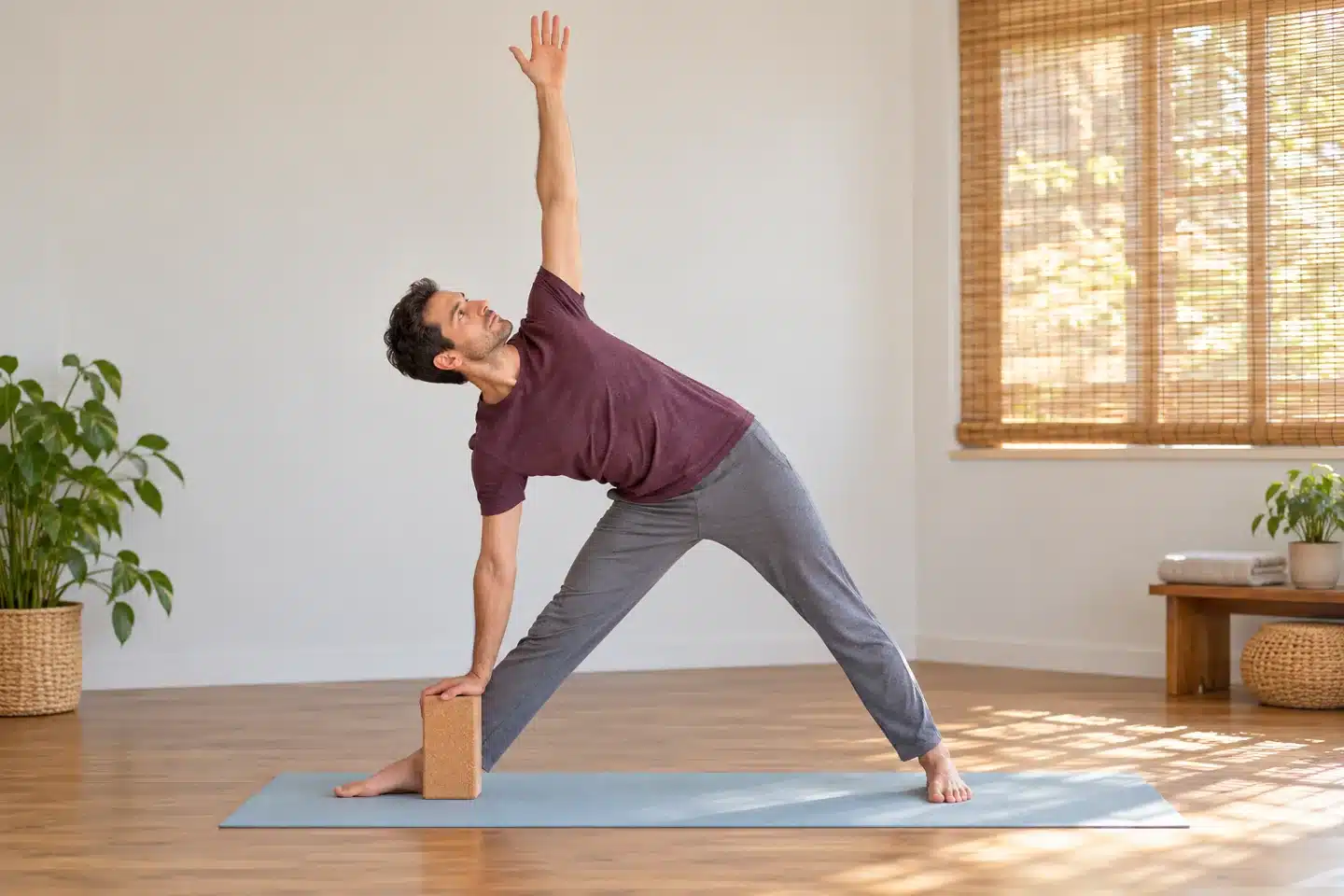
5. Triangle Pose (Utthita Trikonasana)
Triangle Pose is a standing side stretch that lengthens the hamstrings, side waist and spine. Your legs, arms and the floor form triangles, hence the name.
Sanskrit meaning: utthita means extended; trikona means triangle.
- Start in a wide stance, as for Warrior II, with both legs straight.
- Reach your right arm forward, then lower your right hand to your shin, a block or the floor.
- Stretch your left arm up towards the ceiling.
- Keep both sides of your waist long. Hold, then switch sides.
Breathing: inhale to reach long towards the front; exhale to tilt down.
Muscles worked: the quadriceps and core hold the shape. The hamstrings, inner thighs and side waist (obliques) stretch.
Alignment cues:
- Keep both sides of your waist equally long.
- Rest your lower hand on the shin or a block, never on the knee joint.
- Keep a micro-bend in the front knee.
Benefits: stretches the side body, hamstrings and groin, and many people find it energising.
Avoid or modify if: you have neck pain or low blood pressure. Look down instead of up.
Try it in real life: a good stretch after carrying a bag or a child on one side for hours.
6. Chair Pose (Utkatasana)
Chair Pose is a squatting pose that strengthens the thighs, glutes and core. You lower yourself as if sitting on an invisible chair.
Sanskrit meaning: utkata means fierce or powerful.
- Stand with your feet together or hip-width apart.
- Bend your knees and send your hips back, keeping your weight in your heels.
- Raise your arms forward or overhead.
- Keep your knees in line with your toes and breathe steadily.
Breathing: inhale to raise the arms; exhale to sit a little lower.
Muscles worked: quadriceps, glutes, hamstrings, core and upper back.
Alignment cues:
- Shift your weight back so you can see your toes.
- Keep your knees behind your toes and pointing the same way as your feet.
- Lengthen your tailbone down rather than pushing your hips far back.
Benefits: works the quadriceps, glutes and upper back and builds lower-body strength.
Avoid or modify if: you have knee pain. Don’t sit as deep.
Try it in real life: it’s the same movement you use to sit down and stand up from a chair.
7. Standing Forward Bend (Uttanasana)
Standing Forward Bend is a folding pose that stretches the hamstrings and the back of the body. Teachers also use it to move between standing poses.
Sanskrit meaning: ut means intense and tan means to stretch, so “intense stretch pose”.
- From Mountain Pose, hinge forward from your hips, not your waist.
- Bend your knees as much as you need so your spine can relax.
- Rest your hands on your shins, blocks or the floor.
- Let your head hang. To come up, bend your knees and roll up slowly.
Breathing: inhale to lengthen the spine; exhale to fold a little deeper.
Muscles worked: the hamstrings, calves and the muscles along the spine are stretched.
Alignment cues:
- Fold from the hip joints, not by rounding your waist.
- Bend your knees freely; a long spine matters more than straight legs.
- Let your head and neck hang loose.
Benefits: stretches the back of the body.
Avoid or modify if: you have glaucoma, uncontrolled high blood pressure or a recent back injury. Skip deep folds.
Try it in real life: after a run or a long day on your feet, a soft-kneed fold eases tight hamstrings.
Kneeling and All-Fours Yoga Poses
Kneeling and all-fours yoga poses are done on your hands and knees. They warm up the spine, stretch the hips and give you easy places to rest. Because you’re close to the floor, many beginners find them reassuring. If your knees complain on a hard floor, fold a blanket under them.
8. Cat-Cow (Marjariasana–Bitilasana)
Cat-Cow is a gentle, flowing movement that warms up the spine by rounding and arching it in time with your breath. It’s a common way to begin a session.
Sanskrit meaning: marjari means cat; bitila means cow.
- Come onto your hands and knees, wrists under shoulders, knees under hips.
- Lift your chest and tailbone and let your belly drop (Cow).
- Round your spine and tuck your chin (Cat).
- Keep moving slowly between the two.
Breathing: inhale into Cow; exhale into Cat. Let each phase last about 4 seconds.
Muscles worked: the muscles along the spine, the abdominals and the neck, moving through flexion and extension.
Alignment cues:
- Keep wrists under shoulders and knees under hips the whole time.
- Move evenly through the whole spine, from tailbone to neck.
- Press the floor away so your shoulders don’t sink.
Benefits: warms up and mobilises the spine.
Avoid or modify if: your knees are sensitive. Pad them with a folded blanket.
Try it in real life: five rounds first thing in the morning, before the school run or the commute.
9. Child’s Pose (Balasana)
Child’s Pose is a kneeling resting pose that gently stretches the lower back, hips and thighs. You can come back to it any time you need a break during practice.
Sanskrit meaning: bala means child.
- Kneel and sit back towards your heels.
- Fold forward and rest your forehead on the mat or a block.
- Stretch your arms forward or rest them beside your body.
- Breathe into the back of your ribs.
Breathing: let each exhale become a little longer than the inhale.
Muscles worked: the lower back, glutes, hips, front thighs and ankles are gently stretched.
Alignment cues:
- Widen your knees if your belly or chest feels squashed.
- Support your forehead so your neck can relax.
- Let your hips sink towards your heels without forcing.
Benefits: a restful pose that stretches the back; many people find it calming.
Avoid or modify if:
- you’re pregnant: widen the knees.
- your knees are tight: put a cushion between your hips and heels.
Try it in real life: a two-minute pause after a stressful day. For more calming poses, see yoga for stress and anxiety.
10. Downward-Facing Dog (Adho Mukha Svanasana)
Downward-Facing Dog is an upside-down V shape that stretches the hamstrings and calves while working the arms and shoulders. It appears in most modern yoga classes.
Sanskrit meaning: adho means downward, mukha means face and svana means dog.
- From hands and knees, tuck your toes and lift your hips up and back.
- Press firmly through your whole palm, fingers spread.
- Keep your knees bent at first so your spine stays long.
- Let your head relax between your arms. Pedal your feet to warm the calves.
Breathing: exhale as you lift your hips, then breathe slowly and evenly.
Muscles worked: the shoulders and triceps take weight, the hamstrings and calves stretch, and the spine lengthens.
Alignment cues:
- Press through the base of your index fingers so your wrists aren’t overloaded.
- Lift your hips high and lengthen your spine before trying to lower your heels.
- Keep your ears in line with your upper arms and your shoulders away from your ears.
Benefits: lengthens the spine, stretches the hamstrings and calves, and builds upper-body strength.
Avoid or modify if: you have wrist pain or glaucoma, or you’re in late pregnancy. Try a forearm version or skip it.
Try it in real life: many runners and cyclists use it to stretch tight calves after training.
11. Low Lunge (Anjaneyasana)
Low Lunge is a kneeling lunge that stretches the hip flexors and the front of the thigh. It’s especially useful if you sit for most of the day.
Sanskrit meaning: Anjaneya is a name for Hanuman, son of Anjani.
- From Downward Dog or all fours, step your right foot between your hands.
- Lower your left knee to the mat, padded if needed.
- Lift your torso and rest your hands on your front thigh, or raise them overhead.
- Ease your hips gently forward. Hold, then switch sides.
Breathing: inhale to lift the torso and arms; exhale to ease the hips forward.
Muscles worked: the back leg’s hip flexors (including the psoas) and front thigh stretch, while the glutes and core stabilise.
Alignment cues:
- Stack the front knee over the ankle.
- Draw your lower belly in so your lower back doesn’t sag.
- Keep the back knee padded and slightly behind the hip.
Benefits: stretches tight hips.
Avoid or modify if: you have knee pain. Keep the front knee over the ankle and pad the back knee well.
Try it in real life: a quick stretch after a long day at a desk or a long-haul flight.
Prone (Lying on the Belly) Yoga Poses
Prone yoga poses are done lying face down. Most are gentle backbends that strengthen the muscles along the spine and open the chest. They’re a useful counter-movement to hours spent hunched over a phone or laptop. Lift with your back muscles rather than pushing with your arms, and keep your neck long.
12. Cobra Pose (Bhujangasana)
Cobra Pose is a gentle backbend that strengthens the back muscles and opens the chest. Start with a low Cobra and build from there.
Sanskrit meaning: bhujanga means cobra or serpent.
- Lie on your belly, legs extended, tops of the feet on the mat.
- Place your hands under your shoulders, elbows close to your body.
- Lift your chest using your back muscles, not by pushing hard with your arms.
- Keep your neck long, then lower slowly.
Breathing: inhale as you lift; exhale as you lower.
Muscles worked: the muscles along the spine, the upper back and the glutes. The chest and abdomen stretch.
Alignment cues:
- Keep your elbows bent and close to your ribs.
- Press your pubic bone and the tops of your feet into the mat.
- Draw your shoulders back and down and look slightly forward, not up.
Benefits: opens the chest and strengthens the upper back.
Avoid or modify if:
- you’re pregnant or have had recent abdominal surgery: avoid this pose.
- you have lower-back pain: keep it low.
Try it in real life: a few low Cobras are a good counter-movement after hunching over a phone. For a back-care sequence, see yoga for back pain.
13. Locust Pose (Shalabhasana)
Locust Pose is a belly-down backbend that strengthens the muscles along the spine, the glutes and the backs of the legs. It’s a small movement, but it’s hard work.
Sanskrit meaning: shalabha means locust.
- Lie on your belly, arms beside you, palms down or up.
- Lift your chest, arms and legs a few centimetres (an inch or two) off the mat.
- Look down to keep your neck long.
- Hold for three breaths, lower, rest and repeat once.
Breathing: inhale as you lift; exhale as you lower, then rest for a few breaths before round two.
Muscles worked: the muscles along the spine (erector spinae), glutes, hamstrings and the backs of the shoulders.
Alignment cues:
- Reach your legs long behind you before you lift.
- Keep the back of your neck long and look at the mat just ahead.
- A small, even lift is better than a high, strained one.
Benefits: builds back strength that supports good posture.
Avoid or modify if: lifting both legs strains your lower back. Lift one leg at a time.
Try it in real life: useful if you often lift children, shopping or boxes.
Seated Yoga Poses
Seated yoga poses are done sitting on the floor. They lengthen the spine, open the hips, stretch the legs and prepare the body for pranayama and meditation. Sitting on a folded blanket so your hips are higher than your knees makes most seated poses easier on your lower back.
14. Easy Pose (Sukhasana)
Easy Pose is a simple cross-legged seat used for breathing practice, meditation and centring. “Easy” is relative if your hips are tight, so use support.
Sanskrit meaning: sukha means ease or comfort.
- Sit cross-legged on the mat.
- Raise your hips on a folded blanket so your knees are level with or below your hips.
- Lengthen your spine and rest your hands on your knees.
- Close your eyes and breathe slowly.
Breathing: a natural, quiet breath through the nose. It’s also a classic seat for pranayama such as Nadi Shodhana (alternate nostril breathing).
Muscles worked: the postural muscles of the back and core, with the hips in external rotation.
Alignment cues:
- Sit on the front edge of a folded blanket.
- Balance your weight evenly on both sitting bones.
- Rest your hands in Chin Mudra (thumb and index finger touching) and tuck your chin slightly.
Benefits: trains an upright, relaxed sitting posture.
Avoid or modify if: your knees or hips hurt. Sit on a chair instead.
Try it in real life: two quiet minutes here before a big meeting or exam.
15. Seated Forward Bend (Paschimottanasana)
Seated Forward Bend is a fold that stretches the whole back of the body, from your heels to your neck.
Sanskrit meaning: paschima means west, or the back of the body; uttana means intense stretch.
- Sit with your legs out in front. Bend your knees slightly if your hamstrings are tight.
- Lengthen your spine.
- Fold forward from your hips, holding your shins, feet or a strap.
- Aim your chest towards your thighs rather than your head towards your knees.
Breathing: inhale to lengthen; exhale to fold.
Muscles worked: the hamstrings, calves and lower back are stretched.
Alignment cues:
- Tilt your pelvis forward first; the fold starts at the hips.
- Loop a strap around your feet instead of rounding your back to reach.
- Keep your feet flexed, toes pointing up.
Benefits: stretches the hamstrings and lower back.
Avoid or modify if: you have a disc injury or sciatica. Don’t fold deeply unless your doctor approves.
Try it in real life: a slow wind-down in the evening. For a full sequence, see yoga for flexibility.
16. Butterfly or Bound Angle Pose (Baddha Konasana)
Butterfly Pose is a seated hip opener that stretches the inner thighs and groin.
Sanskrit meaning: baddha means bound; kona means angle.
- Sit tall and bring the soles of your feet together.
- Let your knees drop out to the sides; support them with blocks if needed.
- Hold your feet or ankles.
- Stay upright, or fold forward slightly with a long spine.
Breathing: inhale to sit taller; exhale to fold forward a little.
Muscles worked: the inner thighs (adductors), groin and hips are stretched.
Alignment cues:
- Raise your hips on a blanket if your knees sit high.
- Never push your knees down with your hands.
- Fold from the hips with a long spine rather than dropping your head.
Benefits: improves hip mobility.
Avoid or modify if: you have groin or knee discomfort. Support your knees.
Try it in real life: sit this way while you read or watch TV.
17. Seated Half Spinal Twist (Ardha Matsyendrasana)
Seated Half Spinal Twist rotates the spine and stretches the outer hips and upper back. It’s named after the legendary yogi Matsyendranath.
Sanskrit meaning: ardha means half; Matsyendra means “lord of the fishes”.
- Sit with your legs out. Bend your right knee and place your right foot outside your left knee.
- Keep your left leg straight, or fold it under you.
- Turn to the right, hugging your right knee with your left arm.
- Twist from the belly upward. Hold, then switch sides.
Breathing: inhale to lengthen; exhale to turn a little further.
Muscles worked: the obliques, the deep spinal rotators and the outer hip of the bent leg.
Alignment cues:
- Lengthen your spine before you rotate.
- Keep both sitting bones grounded.
- Turn your head last, after your belly and chest.
Benefits: keeps the spine mobile. Twists are traditionally said to aid digestion, though research on this is limited.
Avoid or modify if: you’re pregnant or have disc problems. Twist gently or skip it.
Try it in real life: a gentle seated twist on an office chair makes a good break between video calls.
Supine and Restorative Yoga Poses
Supine and restorative yoga poses are done lying on your back. They range from gentle strengthening, like Bridge, to complete rest, like Corpse Pose. They usually close a session. Blankets and bolsters make them more comfortable.
18. Bridge Pose (Setu Bandha Sarvangasana)
Bridge Pose is a backbend done lying on your back. It strengthens the glutes and back while opening the chest.
Sanskrit meaning: setu bandha means bridge-building; sarvanga means all the limbs.
- Lie on your back, knees bent, feet hip-width apart and close to your hips.
- Press through your feet and lift your hips.
- Keep your knees parallel and your neck still; don’t turn your head.
- Lower slowly, one vertebra at a time.
Breathing: inhale to lift your hips; exhale to lower.
Muscles worked: the glutes, hamstrings and spinal muscles. The chest and hip flexors stretch.
Alignment cues:
- Keep your knees hip-width apart; don’t let them splay out.
- Place your heels under your knees.
- Carry your weight on your shoulders, never your neck.
Benefits: strengthens the glutes and back while gently stretching the chest and the front of the hips.
Avoid or modify if: you have neck problems. Try a supported version with a block under your sacrum.
Try it in real life: a few rounds after a day of sitting get the glutes and back working again.
19. Legs-Up-the-Wall Pose (Viparita Karani)
Legs-Up-the-Wall is a restorative pose where you lie on your back with your legs resting up a wall. It’s one of the simplest ways to slow down at the end of the day.
Sanskrit meaning: viparita means inverted; karani means action.
- Sit sideways next to a wall, then swing your legs up as you lie back.
- Shuffle your hips as close to the wall as feels comfortable.
- Rest your arms by your sides and close your eyes.
- Stay for 3 to 5 minutes, then roll onto one side to come out.
Breathing: slow, easy belly breathing; feel your abdomen rise as you inhale.
Muscles worked: the hamstrings get a gentle stretch while the rest of the body rests.
Alignment cues:
- A folded blanket under your hips is optional.
- Let your legs rest without locking your knees.
- Move your hips a little away from the wall if the backs of your legs pull.
Benefits: a simple, restful pose many people use to unwind.
Avoid or modify if: you have glaucoma or uncontrolled high blood pressure, or it feels uncomfortable during menstruation.
Try it in real life: five minutes before bed. For a bedtime sequence, see yoga poses for better sleep.
20. Corpse Pose (Shavasana or Savasana)
Corpse Pose is the final resting pose of a yoga session. You lie still on your back for several minutes at the end of practice. It’s often described as one of the hardest poses, because staying still and alert takes practice.
Sanskrit meaning: shava means corpse.
- Lie on your back, legs apart, arms away from your body, palms up.
- Slip a rolled blanket under your knees if your lower back feels tight.
- Close your eyes.
- Stay for 5 to 10 minutes. Roll onto your right side before sitting up.
Breathing: don’t control it. Let the breath find its own natural rhythm.
Muscles worked: none actively; the aim is to let the whole body rest.
Alignment cues:
- Lay your body out symmetrically, head in line with your spine.
- Tuck your chin very slightly to lengthen the back of your neck.
- Cover yourself with a blanket; your body cools quickly at rest.
Benefits: gives you a period of complete rest at the end of practice. Some traditions follow Shavasana with Yoga Nidra, a guided relaxation practice.
Avoid or modify if: you’re later in pregnancy. Lie on your left side with support.
Try it in real life: ten minutes here on a hectic Sunday.
What About Advanced Yoga Poses?
Advanced yoga poses, such as Headstand, Shoulder Stand and Wheel, need real strength, flexibility and a teacher’s guidance before you try them.
Headstand and Shoulder Stand load the neck. According to a published review of the book, The Harvard Medical School Guide to Yoga leaves them out for that reason. Give yourself a few months of steady practice with the 20 poses above first.
How Do You Do Crow Pose (Bakasana) Step by Step?
Crow Pose is an intermediate arm balance in which your knees rest on the backs of your upper arms and your feet lift off the floor. It’s often the first arm balance people learn. It builds wrist, arm and core strength for harder poses. Baka means crane, so you may also hear it called Crane Pose.
- Squat with your feet close together and your knees wide.
- Place your hands shoulder-width apart on the mat, about 30 cm (a foot) in front of your feet, fingers spread.
- Bend your elbows slightly back, lift your hips and rest your knees high on the backs of your upper arms.
- Look at the mat ahead of your hands, then shift your weight forward.
- Lift one foot, then the other. Hold for 2 to 3 breaths, then lower your feet with control.
Breathing: exhale as you shift forward and lift; keep breathing steadily once you’re balanced.
Muscles worked: forearms, triceps, shoulders, abdominals and hip flexors.
Alignment cues:
- Put a cushion in front of your face while you’re learning.
- Look forward, not down at your feet.
- Squeeze your knees into your arms and round your upper back slightly.
Benefits: builds upper-body and core strength and concentration.
Avoid or modify if: you have wrist, elbow or shoulder injuries, are pregnant, or have uncontrolled high blood pressure.
Thinking about going deeper than poses? Inteyoga’s planned 200-hour programme is expected around mid-2027. Learn more and register your interest.
What Are the Benefits of Yoga Poses?
Practised regularly, yoga poses can help improve flexibility, strength, balance and posture, and many people use them to manage stress. NCCIH notes that studies suggest yoga may help people manage stress and improve sleep and balance (NCCIH). For specific health conditions the evidence is more mixed, so treat big promises online with caution.
- Flexibility and mobility. Forward bends, lunges and twists take your joints through a wider range of motion.
- Strength. Standing poses, Chair, Locust and Bridge use your own body weight as resistance.
- Balance and stability. Tree and the Warrior poses train the small muscles around the ankles and hips.
- Stress. In a 2012 US national survey reported by NCCIH, 86% of adults who practised yoga said it helped them reduce stress (NCCIH).
- A habit that sticks. In the same survey, 63% said yoga motivated them to exercise more regularly.
- Whole-person wellness. 80% of the US yoga practitioners surveyed said general wellness or disease prevention was one reason they practised (NCCIH).
- Body awareness. Holding a pose with attention helps you notice tension, breath and posture in everyday life.
What guidelines in the UK and US say about back pain:
- UK: NICE’s guideline on low back pain and sciatica (NG59) advises clinicians to consider a group exercise programme for a specific episode or flare-up of low back pain, and that programme can include mind-body exercise such as yoga (NICE NG59; BMJ report).
- US: the American College of Physicians’ 2017 guideline encourages non-drug options, including exercise and yoga, for low back pain (NPR report).
Neither guideline promises that yoga will fix every back problem, so check with your doctor first.
How Do Yoga Poses Work?
Yoga poses combine five things: muscles working against body weight, gradual stretching, balance training, slow breathing and focused attention. Take away the breath and the attention, and a pose becomes ordinary exercise.
- Strength. Holding a pose makes your muscles work against gravity without moving, which is called an isometric contraction. Warrior II loads the thighs; Locust loads the back.
- Flexibility. Regular, gentle stretching gradually increases the range of movement most people can comfortably reach.
- Balance. One-legged poses challenge proprioception, your sense of where your body is in space, along with the small stabilising muscles of the ankles and hips.
- Breathing. Many people find slow breathing with longer exhales calming. Researchers are still studying how slow breathing affects heart rate and the nervous system, and how much this matters over the long term.
- Attention. Keeping your focus on sensation and breath is similar to mindfulness practice. Over time, many people find it easier to notice tension early.
This is why classical yoga treats the pose, the breath and the mind as one practice rather than three.
Yoga Poses vs Stretching: What’s the Difference?
Yoga poses combine posture, breath and attention, while stretching mainly lengthens muscles. Many yoga poses include a stretch, but they also build strength and balance. A stretch is a tool; a yoga pose is a practice.
| Feature | Yoga poses (asanas) | Stretching exercises |
|---|---|---|
| Main goal | Steadiness, strength, flexibility and focus together | Lengthen specific muscles |
| Breath | Matched to every movement | Usually not emphasised |
| Mental focus | Central: attention stays on body and breath | Optional |
| Strength element | Yes (standing poses, backbends, balances) | Little or none |
| Balance training | Yes | Rarely |
| Typical hold | 3 breaths to several minutes, then a counter-pose | Often 15 to 60 seconds per muscle |
| Structure | Sequenced: warm-up, active poses, rest | Often a list of separate stretches |
| Origin | Hatha Yoga tradition, adapted in modern yoga | Sports science and physiotherapy |
If you just need to loosen tight hamstrings after a 5K, a quick stretch does the job. If you want flexibility along with strength, balance and a calmer focus, yoga poses give you more for the same 20 minutes.
Which Yoga Poses Should You Choose for Your Goal?
Choose yoga poses by your goal: standing poses for strength, folds and twists for flexibility, and supine poses for relaxation and winding down before sleep. Use this picker, then read our detailed guides.
| Your goal | Best poses from this list | Read next |
|---|---|---|
| Starting from zero at home | Mountain, Cat-Cow, Child’s Pose, Bridge, Corpse | How to start yoga for beginners at home |
| Morning wake-up and flexibility | Cat-Cow, Mountain, Low Lunge, Downward-Facing Dog, Warrior II | The best time to do yoga: morning vs evening |
| More flexibility | Standing Forward Bend, Low Lunge, Seated Forward Bend, Butterfly | Yoga for flexibility: 12 poses and routine |
| A stiff or aching back | Cat-Cow, Child’s Pose, Cobra, Bridge | Yoga for back pain: 12 poses and routines |
| Stress and anxiety | Child’s Pose, Legs-Up-the-Wall, Corpse | Yoga for stress and anxiety |
| Winding down before sleep | Seated Forward Bend, Legs-Up-the-Wall, Corpse | Yoga poses for better sleep |
| Strength and stamina | Warrior I, Warrior II, Chair, Locust, Crow (intermediate) | This guide: poses 3, 4, 6 and 13, plus the Crow Pose steps |
| Gentle practice for older adults | Mountain, chair-supported Tree, Easy Pose | What is senior yoga? 5 safe poses |
How Should You Practise Yoga Poses?
Practise yoga poses in a sensible order, link each movement to your breath, work both sides equally, follow strong poses with counter-poses, and keep sessions short and regular. These five habits turn a list of poses into a practice.
- Warm up first. Start with something gentle, such as Cat-Cow, neck rolls or a few slow breaths in Easy Pose.
- Follow a simple order. Do standing poses and balances while your energy is high. Then move to floor poses (backbends, forward bends, twists), and finish lying down in Corpse Pose.
- Use counter-poses. After a backbend like Cobra or Bridge, rest in a gentle forward fold such as Child’s Pose. After a twist, come back to a neutral spine.
- Match breath to movement. As a rule, inhale when you lift, lengthen or open the chest, and exhale when you fold, twist or lower.
- Work both sides equally. Hold one-sided poses, such as Tree, Warrior and Triangle, for the same number of breaths on each side.
Short and regular beats long and rare. Fifteen to twenty focused minutes on most days is a realistic start.
Yoga also counts towards your weekly activity. The World Health Organization recommends that adults get at least 150 minutes of moderate-intensity activity a week, and it notes that muscle strengthening benefits everyone (WHO). It also reports that about 31% of adults worldwide don’t meet this level. Strong standing poses, Chair, Locust and Bridge add a strength element. Gentle yoga alone may not meet the aerobic target, so combine it with activities such as brisk walking.
How Do You Do a 20-Minute Beginner Yoga Routine?
A 20-minute beginner routine moves from a warm-up to standing poses, then floor poses, and ends with 5 minutes of rest. Many teachers suggest practising on an empty stomach, around 2 to 3 hours after a meal. For timing ideas, see the best time to do yoga.
- Easy Pose with slow breathing: 2 minutes. Make each exhale a little longer.
- Cat-Cow: 1 minute (about 8 rounds).
- Downward-Facing Dog, knees bent: 5 breaths.
- Mountain Pose: 5 breaths.
- Warrior II: 5 breaths each side.
- Triangle Pose: 3 to 5 breaths each side.
- Tree Pose: 3 to 5 breaths each side, near a wall.
- Child’s Pose: 1 minute.
- Low Cobra: 3 breaths, twice.
- Bridge Pose: 3 breaths, twice.
- Seated Half Spinal Twist: 3 breaths each side.
- Corpse Pose: 5 minutes.
Try this routine three to five times a week for four weeks before adding new poses. All you really need is a mat. A block, a strap and a blanket make many poses easier. Our guides to choosing a beginner yoga mat and eco-friendly yoga props can help you choose.
What Are the Most Common Mistakes in Yoga Poses?
The most common mistakes in yoga poses are holding your breath, forcing the stretch, locking your knees and copying someone else’s shape. Each one is easy to fix once you know to look for it.
- Holding your breath. If your breath stops, back off until it flows again.
- Forcing the stretch. A stretch should feel strong, never sharp. Sharp, burning or electric pain means stop.
- Locking your knees. Keep a micro-bend in straight-leg poses such as Triangle and Forward Bend.
- Front knee past the toes. In Warrior and Lunge poses, stack the knee over the ankle.
- Rounding your back to reach the floor. Bend your knees or use a block instead.
- Skipping Corpse Pose. The final rest is part of the practice, not an optional extra.
- Comparing yourself to photos. Bodies differ in proportion and joint structure. Your version of a pose is the right one if it’s steady and comfortable.
Are Yoga Poses Safe? Who Should Avoid Which Poses
Yoga is generally considered safe for healthy people when practised properly under a qualified instructor. Injuries can still happen, as with any physical activity. According to NCCIH, the most common yoga injuries are sprains and strains, and serious injuries are rare.
- 2015 meta-analysis: a meta-analysis of randomised controlled trials found yoga about as safe as usual care and other exercise (Cramer et al., American Journal of Epidemiology, 2015).
- 2019 national survey: practising only by self-study, with no supervision, was associated with a higher risk of adverse effects (Cramer et al., 2019).
That’s a good reason to learn the basics from a qualified teacher, even if you mostly practise at home.
Talk to your doctor before you start, and ask your teacher to adapt poses, if any of these apply to you:
| Condition | Avoid or modify (poses from this guide) | Usually gentler options |
|---|---|---|
| Pregnancy | Cobra and Locust (belly-down), deep Seated Twist, Crow; lying flat on your back for long periods (Bridge, Corpse) after the first trimester | Wide-knee Child’s Pose, Warrior II, Tree near a wall, side-lying rest |
| High blood pressure (uncontrolled) | Downward-Facing Dog, long Standing Forward Bends, Legs-Up-the-Wall, Headstand, Shoulder Stand, Crow, quick up-and-down movements | Mountain, Warrior II with hands on hips, Easy Pose, Corpse with the head raised |
| Low blood pressure | Getting up quickly from forward bends or lying poses | Come up slowly; seated poses |
| Glaucoma or retinal problems | Head-below-heart poses: Downward-Facing Dog, Standing Forward Bend, Legs-Up-the-Wall, inversions | Upright standing and seated poses |
| Spinal injury, disc herniation or sciatica | Deep Standing and Seated Forward Bends, Seated Twist, full Cobra or Locust | Small-range Cat-Cow, gentle Bridge, Legs-Up-the-Wall, only with medical clearance |
| Osteoporosis | Deep forward bends and loaded twists | Mountain, supported Tree, Warrior II, Bridge |
| Recent surgery (abdominal, spinal or eye) | All strong poses until your surgeon clears you | Gentle breathing and supported rest once cleared |
| Heart conditions | Inversions, breath-holding, long strenuous holds such as Chair | Gentle standing and restorative poses, with medical clearance |
| Wrist, elbow or shoulder injury | Downward-Facing Dog, Crow, full Cobra | Forearm variations, standing poses |
| Knee injury | Deep Chair, kneeling Low Lunge, cross-legged sitting | Shallow Chair, standing lunge, sitting on a chair |
This table is general guidance only. Your own doctor, GP or physiotherapist knows your situation best, so follow their advice.
Conclusion: Start Small With the Right Yoga Poses
The best way to learn yoga poses is to master a small foundation first: about 20 poses, practised slowly with a steady breath, a few times a week. Begin with Mountain, Cat-Cow, Downward-Facing Dog, Warrior II, Tree, Cobra, Child’s Pose and Corpse Pose. Add the rest as your body and confidence grow.
Keep Patanjali’s definition in mind: steady and comfortable. Yoga poses aren’t a performance for anyone else. They’re a way to check in with your body, breath and mind, and that’s where the deeper practice of yoga begins.
If you already hold a 200-hour qualification and want to study yoga more deeply, Inteyoga offers its advanced 300-hour programme in South Goa:
- Format: residential, taught in English
- Duration: 43 training days plus arrival and departure days (43+2 days)
- Eligibility: a completed 200-hour TTC or equivalent qualification, and age 21–60
- Next batch: 13 December 2026 to 26 January 2027
- Gift-it-Forward model: no payment is required to apply or to participate. After completing the programme, participants may voluntarily support future aspirants, with no obligation to contribute.
Explore the advanced 300-hour programme in Goa · Apply through the application form · Read the FAQ
New to teacher training? See the planned 200-hour programme, expected around mid-2027.
Questions? Email info@inteyoga.org or WhatsApp +91 935-473-7240.
Frequently Asked Questions (FAQ)
What Are Five Basic Yoga Poses?
Five of the most basic yoga poses are:
Mountain Pose (Tadasana)
Downward-Facing Dog (Adho Mukha Svanasana)
Child’s Pose (Balasana)
Warrior II (Virabhadrasana II)
Corpse Pose (Shavasana)
Together they teach standing alignment, carrying weight through the arms, resting, leg strength and relaxation. They appear in many beginner classes, so learning them first makes most classes easier to follow.
Is There a Difference Between Yoga Poses and Yoga Positions?
No. “Yoga poses”, “yoga positions” and “yoga postures” all mean the same thing: the physical shapes of yoga, called asanas in Sanskrit. You’ll see all three terms used in classes and articles in the US and UK. Whatever you call them, the principle is the same: hold a steady shape with a calm, even breath.
How Long Should You Hold a Yoga Pose?
Beginners can hold most active yoga poses for 3 to 5 slow breaths, roughly 20 to 45 seconds. Resting poses such as Child’s Pose can last 1 to 2 minutes, and Corpse Pose 5 to 10 minutes. Only hold longer while your breath stays smooth and even. If you start holding your breath or shaking hard, come out of the pose.
How Often Should a Beginner Practise Yoga Poses?
Aim for three to five short sessions a week, using 10 to 20 foundational poses. Most healthy adults can do gentle yoga daily if they alternate stronger days of standing poses and backbends with gentler days of stretching and rest. Give it at least four weeks before judging how it feels, and ask your doctor if you have a health condition.
Can Yoga Poses Help With Back Pain?
Gentle yoga poses such as Cat-Cow, Child’s Pose, Bridge and a low Cobra may help many people with everyday, non-specific back stiffness. UK and US clinical guidelines include exercise approaches such as yoga among options for low back pain. See a doctor first if your pain follows an injury, spreads down a leg, or comes with numbness or weakness.
Can I Learn Yoga Poses at Home?
Yes. You can learn basic yoga poses at home with a mat, a quiet space and a reliable guide. Start with gentle poses such as Cat-Cow, Child’s Pose and Bridge, and keep sessions short. A few classes with a qualified teacher, in person or online, will help you learn safe alignment early and spot habits you can’t see yourself.
Are Yoga Poses Good for Weight Loss?
Yoga poses can support weight management as part of an active lifestyle, but most styles burn fewer calories than running or cycling. Faster styles such as Vinyasa generally use more energy than slow Hatha practice. If weight loss is your goal, combine yoga with balanced eating and other activity such as brisk walking.
What Is the Hardest Yoga Pose?
There’s no single hardest yoga pose. Arm balances and deep backbends are widely seen as among the most demanding, including:
Peacock (Mayurasana)
Scorpion (Vrschikasana)
full Wheel (Urdhva Dhanurasana)
Corpse Pose is also often described as difficult, because lying completely still while staying alert is harder than it sounds. Learn advanced poses with a qualified teacher.