
Quick Answer
Yes, for many people. Reviews of controlled trials link regular yoga with lower perceived stress, lower cortisol and a slower resting heart rate, though results vary. For most beginners, 10 to 15 minutes a day is enough to start: Child’s Pose, Legs-Up-the-Wall, a few rounds of Bhramari (Humming Bee Breath) and a few minutes of Savasana.
Key Takeaways
- Yoga for stress relief is a way of practicing yoga that uses slow movement, controlled breathing and deep rest to help the body settle out of “fight or flight.” It isn’t a separate style. It’s a way of choosing and pacing practices so they calm you down rather than rev you up.
- Stress is your body’s response to a specific pressure, and it usually eases once that pressure passes. Anxiety is ongoing worry or fear that can continue even when there’s no clear trigger. The two feel alike in the body, which is why people often mix them up.
- Researchers think yoga eases stress in several overlapping ways: shifting the nervous system toward “rest and digest,” dampening the hormonal stress response, slowing the breath and training attention away from worry. Some of these pathways have stronger evidence than others.
It’s 2 a.m. and your mind is replaying tomorrow’s meeting. Your jaw is clenched, your shoulders are up near your ears, and sleep feels a long way off. Yoga for stress relief may help in moments like this. Slow poses and long exhales can help calm your nervous system, and regular practice has been associated with lower levels of cortisol, your body’s main stress hormone.
If that scene feels familiar, you’re in good company. In the American Psychological Association’s Stress in America 2025 survey of 3,199 U.S. adults, 62% named societal division as a significant source of stress. In Great Britain, the Health and Safety Executive estimates that 964,000 workers had stress, depression or anxiety caused or made worse by work in 2024/25.
Plenty of people are already turning to the mat. According to the US National Center for Complementary and Integrative Health (NCCIH), 15.8% of American adults practiced yoga in 2022. In an earlier national survey from 2012, 86% of people who practiced yoga said it helped them reduce stress.
You don’t need to be flexible, and you don’t need an hour a day. This guide covers the science behind yoga and stress, the 6 best poses with step-by-step instructions, two beginner-friendly breathing techniques, a 15-minute routine and the safety points that matter.
Key takeaways
- Yoga combines movement, slow breathing and deep rest, which together may help ease the body’s stress response.
- The evidence is encouraging but still limited; many studies are small or short.
- Short daily sessions of 10 to 15 minutes are a realistic way to start.
- Breathing practices such as Anulom Vilom and Bhramari need no flexibility and can be done almost anywhere.
- Yoga can support, but not replace, medical or psychological care for anxiety disorders, depression or chronic insomnia.
About this guide: It was prepared by the Inteyoga editorial team. Inteyoga is registered with Yoga Alliance as a Registered Yoga School (RYS 200, RYS 300 and RYS 500). Health statements below are linked to government health bodies, clinical guidelines or peer-reviewed studies, and we note where the evidence is still thin.
If you’d like to study restorative practice in depth, see our Advanced 300-Hour Integrated Restorative Yoga program in Goa.
What Is Yoga for Stress Relief?
Yoga for stress relief is a way of practicing yoga that uses slow movement, controlled breathing and deep rest to help the body settle out of “fight or flight.” It isn’t a separate style. It’s a way of choosing and pacing practices so they calm you down rather than rev you up.
A typical stress-relief session has three parts:
- Gentle movement (asana) to release tension in the neck, shoulders, back and hips.
- Breath regulation (pranayama), usually with a longer exhale than inhale.
- Stillness and rest, such as guided relaxation, Yoga Nidra or Savasana (Corpse Pose) at the end.
Hatha Yoga texts describe posture, breath and inner attention as parts of one practice. Modern stress research tends to study these pieces separately.
What Is the Difference Between Stress and Anxiety?
Stress is your body’s response to a specific pressure, and it usually eases once that pressure passes. Anxiety is ongoing worry or fear that can continue even when there’s no clear trigger. The two feel alike in the body, which is why people often mix them up.
The US National Institute of Mental Health (NIMH) explains that both can cause poor sleep, muscle tension, irritability and trouble concentrating. The difference lies in what sets the feeling off and how long it lasts.
| Feature | Stress | Anxiety |
|---|---|---|
| Trigger | Usually a clear outside cause, such as a deadline, conflict or bills | May have no clear cause |
| Duration | Often short term; fades when the trigger ends | Can last for weeks or months |
| Main feeling | Pressure, overwhelm, tension | Worry, dread, a sense of danger |
| When to get help | When it lingers or stops you functioning | When it’s persistent, intense or affects daily life |
Yoga may help with everyday stress and anxious feelings. It isn’t a treatment for an anxiety disorder, though. If anxiety shows up most days for weeks, please talk to a doctor, your GP or a mental health professional.
The Science Behind Yoga and Stress (How It Works)
Researchers think yoga eases stress in several overlapping ways: shifting the nervous system toward “rest and digest,” dampening the hormonal stress response, slowing the breath and training attention away from worry. Some of these pathways have stronger evidence than others.
Fight or Flight vs Rest and Digest: Your Two Nervous System Modes
Your autonomic nervous system runs in the background without you thinking about it. It has two branches that behave a bit like an accelerator and a brake.
The sympathetic nervous system drives the “fight or flight” response. Stress switches it on. Your heart beats faster, your blood pressure rises, your breathing turns quick and shallow, and your muscles tighten so you can react.
The parasympathetic nervous system supports “rest and digest.” It slows the heart, supports digestion and sleep, and gives the body a chance to recover.
| Feature | Fight or flight (sympathetic) | Rest and digest (parasympathetic) |
|---|---|---|
| Triggered by | Stress, danger, deadlines, conflict | Safety, rest, recovery |
| Heart rate | Faster | Slower |
| Breathing | Quick and shallow, high in the chest | Slow and deep, low in the belly |
| Muscles | Tense and ready to act | Soft and relaxed |
| Digestion and sleep | Put on hold | Supported |
| Where yoga may help | Gentle poses can release built-up tension | Slow exhales and Savasana may encourage this state |
This system evolved for short bursts of danger. Modern stress is different: emails, bills and traffic can keep the stress response going for hours or days. Yoga offers a regular, deliberate pause, and the research below suggests it may help the body recover from that state.
A 2015 systematic review of 25 randomized controlled trials by Pascoe and Bauer, published in the Journal of Psychiatric Research, found preliminary evidence that yoga improves regulation of both the sympathetic nervous system and the hypothalamic-pituitary-adrenal (HPA) axis, the hormone system that releases cortisol.
Can Yoga Lower Cortisol?
Some studies show lower cortisol with yoga, but results vary between studies and between people. A 2017 meta-analysis of 42 randomized controlled trials by Pascoe, Thompson and Ski in Psychoneuroendocrinology linked practices that included yoga poses with lower evening cortisol, lower waking cortisol, lower ambulatory systolic blood pressure and a lower resting heart rate, compared with active control groups. That’s an average across studies. It doesn’t mean yoga lowers cortisol in everyone.
The Breathing Connection: How Long Breaths May Signal Calm
Breath is the one part of the stress response you can control on purpose, and slow breathing with a long exhale is one of the simplest ways to feel calmer. When you’re stressed, you tend to breathe fast and high in the chest. When you’re calm, you breathe slowly and low in the belly. Changing your breath on purpose is a way to work with that link.
When you breathe slowly with a long exhale, a few things happen:
- Your heart rate naturally dips a little on each exhale and rises on each inhale. This normal rhythm is called respiratory sinus arrhythmia, and it’s linked to activity in the vagus nerve.
- Slow breathing tends to make this rhythm more pronounced. Researchers see this as a plausible way breathing exercises may calm the body, though a slower breath alone doesn’t prove your nervous system has shifted state.
- Many people notice their shoulders drop and their thoughts slow down within a few minutes.
The best direct evidence comes from a 2023 randomized trial in Cell Reports Medicine. Balban and colleagues at Stanford compared three daily 5-minute breathing exercises with 5 minutes of mindfulness meditation over one month. Exhale-focused “cyclic sighing” improved mood the most and lowered breathing rate the most. The authors concluded that daily 5-minute cyclic sighing shows promise as a stress-management exercise.
How Does Yoga Quiet a Busy Mind?
A lot of stress comes from rumination, the habit of replaying the same worries on a loop. Yoga keeps bringing your attention back to the breath and to sensations in the body. With practice, it may become easier to notice a stressful thought without chasing it.
In a 2024 study in Frontiers in Public Health, Hagen and Hagen interviewed 13 people who practiced yoga regularly. They described self-awareness, calmness, focus and presence as things that helped them cope with work stress. That’s a small qualitative study, so it describes experiences rather than proving an effect.
Can Yoga Reduce Stress? What the Research Says
Most reviews find that yoga reduces perceived stress in healthy adults, though the size of the benefit varies and not every study agrees.
| Study or source | What it looked at | What it found |
|---|---|---|
| NCCIH, 2020 review cited on its yoga fact sheet | 12 studies, 672 healthy adults | Beneficial effects on perceived stress in all 12 studies |
| NCCIH, 2014 review cited on its yoga fact sheet | 17 studies, 1,070 participants | 12 of 17 showed improvements in physical or psychological stress measures |
| Pascoe, Thompson & Ski, Psychoneuroendocrinology, 2017 | 42 randomized controlled trials | Lower waking and evening cortisol, resting heart rate and systolic blood pressure vs active controls |
| Balban et al., Cell Reports Medicine, 2023 | 5 minutes of daily breathwork for 1 month | Cyclic sighing improved mood and lowered breathing rate more than mindfulness meditation |
| Moszeik, Rohleder & Renner, Stress and Health, 2025 | 362 adults doing online Yoga Nidra for 2 months | Small but significant drops in stress, anxiety and rumination |
| Zok et al., Frontiers in Public Health, 2024 (pilot survey) | Regular yoga practitioners | Stress reduction was the most common reason to start; experienced practitioners reported lower stress than beginners |
How Strong Is the Evidence?
It’s promising but not conclusive. The NCCIH notes that only a modest amount of research has studied yoga for general well-being, and the findings haven’t been completely consistent. Many trials are small, short or unblinded, so more high-quality research is needed.
Does Yoga Always Beat Stretching?
No. In the PRYSMS randomized trial, published in Psychoneuroendocrinology in 2014, adults with metabolic syndrome did either restorative yoga or low-impact stretching. The stretching group showed bigger drops in salivary cortisol and chronic stress than the restorative yoga group.
So regular, calming movement of almost any kind may help, and the best practice is the one you’ll keep doing. Yoga’s advantage is that it combines movement, breath training and attention training in one habit.
Best Yoga Poses for Stress Relief: Top 6
The best yoga poses for stress relief are slow, supported shapes that let you breathe easily: Child’s Pose, Cat-Cow, Bridge Pose, Standing Forward Bend, Legs-Up-the-Wall and Savasana (Corpse Pose). Practice them in this order and always finish with Savasana. Each pose below includes steps, benefits and a safety tip.
| Pose (English / Sanskrit) | Often used for | Hold time |
|---|---|---|
| Child’s Pose / Balasana | Calming the mind, easing tiredness | 1 to 3 minutes |
| Cat-Cow / Marjaryasana-Bitilasana | Releasing body tension | 6 to 10 rounds |
| Bridge Pose / Setu Bandhasana | Opening the chest, settling the mind | 5 breaths, 3 rounds (or 1 to 3 minutes supported) |
| Standing Forward Bend / Uttanasana | Letting go of neck and back tension | 5 to 8 breaths |
| Legs-Up-the-Wall / Viparita Karani | Winding down, feeling “wired but tired” | 5 to 10 minutes |
| Corpse Pose / Savasana | Deep relaxation; always practiced last | 5 to 10 minutes |
1. Child’s Pose (Balasana)
Child’s Pose is a resting forward fold that may help calm the mind and ease physical and mental tiredness.
How to do it:
- Kneel on your mat with your big toes touching.
- Sit back toward your heels and widen your knees to about the width of your mat.
- Exhale and fold forward, letting your belly rest between your thighs.
- Rest your forehead on the mat, a block or a pillow.
- Stretch your arms forward, or rest them beside your body, palms up.
- Breathe slowly into your lower back for 1 to 3 minutes.
- To come out, press your hands down and walk your body back up to sitting.
Benefits:
- Gently stretches the lower back, hips and shoulders.
- Resting your forehead down can feel safe and quiet.
- Your belly presses against your thighs, so slow breathing is easier to feel.
- It’s a good place to rest whenever you feel tired during practice.
Safety tip: Put a pillow under your hips, or between your calves and thighs, if your knees feel strained. Avoid this pose after a recent knee injury.
2. Cat-Cow Pose (Marjaryasana-Bitilasana)
Cat-Cow is a gentle, flowing movement of the spine that can release tension in the back, neck and shoulders.
How to do it:
- Come onto your hands and knees, wrists under shoulders and knees under hips.
- Cow: inhale, let your belly sink toward the floor, lift your chest and look slightly forward.
- Cat: exhale, round your back toward the ceiling and tuck your chin toward your chest.
- Move slowly between the two, one movement per breath.
- Repeat 6 to 10 times, then rest in Child’s Pose.
Benefits:
- Loosens the spine, where tension often builds up.
- Matching movement to breath gives a busy mind a simple rhythm to follow.
- Warms the body gently for the poses that follow.
Safety tip: Keep the movement small if you have neck pain. You can also do Cat-Cow sitting on a chair with your hands on your knees.
3. Bridge Pose (Setu Bandhasana)
Bridge Pose is a gentle backbend that opens the chest, and its supported version is a restful way to settle the mind.
How to do it:
- Lie on your back with knees bent and feet flat, hip-width apart.
- Rest your arms by your sides, palms down.
- Inhale and press into your feet to lift your hips slowly.
- Keep your knees in line with your hips and your neck relaxed. Don’t turn your head.
- Hold for 5 slow breaths, then exhale and roll down one vertebra at a time.
- Repeat 3 times.
Supported version (the better choice for stress): lift your hips and slide a yoga block or firm cushion under your sacrum, the flat bone at the base of your spine. Let your weight rest on it for 1 to 3 minutes.
Benefits:
- Opens the chest and the front of the hips, which tighten when we hunch over a desk or sit for hours.
- The supported version lets you stay in a restful position with almost no effort.
- Some people find it calming and gently uplifting at the same time.
Safety tip: Skip Bridge after a recent neck or back injury. If you have high blood pressure that isn’t well controlled, check with your doctor first and use the supported version rather than lifting high.
4. Standing Forward Bend (Uttanasana)
Standing Forward Bend is a simple fold that lets your head hang and can release tension in the neck, back and hamstrings.
How to do it:
- Stand with your feet hip-width apart.
- Bend your knees generously and fold forward from your hips.
- Let your head and arms hang. Hold opposite elbows if that feels good.
- Gently nod “yes” and shake “no” to loosen your neck.
- Breathe slowly for 5 to 8 breaths.
- Roll up very slowly, one vertebra at a time, with your head coming up last.
Benefits:
- Releases the neck and upper back, two common places where tension settles.
- Stretches the backs of the legs after long hours of sitting.
- Letting the head hang can give a sense of letting go.
Safety tip: Come up slowly to avoid dizziness. Skip this pose if you have glaucoma, low blood pressure or a back injury.
5. Legs-Up-the-Wall Pose (Viparita Karani)
Legs-Up-the-Wall is a restful, passive pose that’s often used to wind down when you feel anxious or can’t settle at night.
How to do it:
- Sit sideways with one hip close to a wall.
- Lie back and swing your legs up the wall in one smooth movement.
- Shuffle your hips as close to the wall as feels comfortable. A small gap is fine.
- Rest your arms by your sides or on your belly, and close your eyes.
- Breathe slowly, making each exhale longer than the inhale.
- Stay for 5 to 10 minutes.
- To come out, bend your knees, roll onto your right side and rest for a few breaths.
Benefits:
- It takes almost no effort, so you can simply rest.
- A good choice before bed when you feel “wired but tired.”
- It pairs naturally with slow breathing.
- Tired legs get a break after a long day of standing or walking.
Safety tip: If the wall feels like too much, rest your calves on a chair seat instead. Ask your doctor first if you have glaucoma or a heart condition, or are in later pregnancy.
6. Corpse Pose (Savasana)
Savasana is the final resting pose in yoga and the deepest relaxation pose in this routine. Always practice it last.
How to do it:
- Lie flat on your back with your legs apart and feet falling open.
- Rest your arms a little away from your body, palms facing up.
- Place a rolled blanket under your knees if your lower back feels tight.
- Close your eyes and let your whole body feel heavy.
- Stop controlling your breath. Let it find its own rhythm.
- When your mind wanders, gently bring it back to the feeling of your body on the floor.
- Stay for 5 to 10 minutes, then roll to your right side and sit up slowly.
Benefits:
- Gives your body time to rest after the earlier poses.
- Lets you practice relaxing on purpose, a skill you can use anywhere.
- It’s usually the part of the session where people feel most still.
Safety tip: Cover yourself with a light blanket, since you may feel cooler as you rest. If closing your eyes feels uneasy, keep them open or lie on your side.
More Stress Relief Poses to Try
Once the top 6 feel comfortable, add these gentle options for variety.
| Pose (English / Sanskrit) | Main area released | Hold time |
|---|---|---|
| Puppy Pose / Uttana Shishosana | Upper back, chest | 5 to 8 breaths |
| Seated Forward Bend / Paschimottanasana | Back of the body | 1 to 2 minutes |
| Reclined Twist / Supta Matsyendrasana | Spine, outer hips | 1 minute per side |
| Reclined Bound Angle / Supta Baddha Konasana | Hips, chest | 3 to 5 minutes, with thighs supported |
Also read: What Is Restorative Yoga? 7 Benefits, Poses and How to Start
Calming Breathing (Pranayama) Techniques
Pranayama, the yogic practice of regulating the breath, is one of the most direct tools for stress, because breath is the part of the stress response you can control. Yoga isn’t only physical poses, and for stress relief the breathing can matter as much as the poses. Two good starting points for beginners are Anulom Vilom and Bhramari.
Anulom Vilom (Alternate Nostril Breathing)
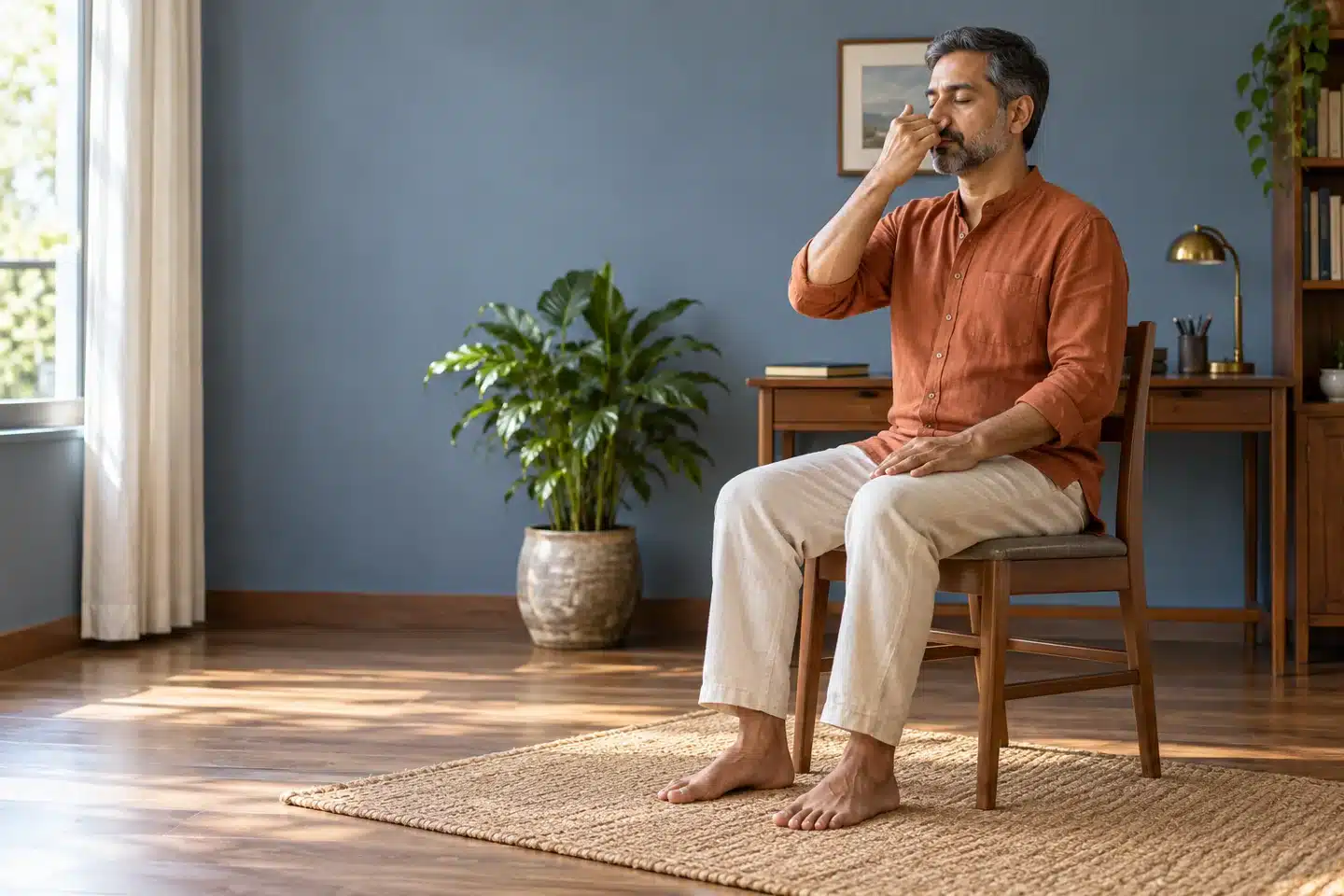
Anulom Vilom is a slow breathing technique in which you breathe in through one nostril and out through the other. Many people find it balancing and calming. It’s often called Nadi Shodhana, although some traditions use that name for a version with a short breath hold. The beginner version below has no breath holding.
How to do it:
- Sit comfortably with a tall but relaxed spine. A chair is fine.
- Rest your left hand on your left knee.
- Fold the index and middle fingers of your right hand into your palm. You’ll use your thumb and ring finger.
- Close your right nostril with your right thumb. Inhale slowly through your left nostril for a count of 4.
- Close your left nostril with your ring finger. Release your thumb and exhale through your right nostril for a count of 4 to 6.
- Inhale through the right nostril for a count of 4.
- Close the right nostril, release the left and exhale through the left nostril.
- That’s one round. Practice 5 to 10 rounds, about 3 to 5 minutes.
Benefits:
- Slows your breathing and gives your mind one simple thing to focus on.
- Some people find it clears their head before work or study.
- It suits mornings or the minutes before a stressful task.
Safety tip: Breathe gently and never force air through your nose. Stop if you feel dizzy, and skip it when your nose is blocked.
Bhramari Pranayama (Humming Bee Breath)
Bhramari is a breathing technique in which you hum softly as you exhale. The long exhale and gentle vibration make it a popular choice when your thoughts are racing, and it takes only a minute or two.
How to do it:
- Sit comfortably, close your eyes and relax your face.
- If you like, place your thumbs gently on the small flaps of cartilage at the front of your ears and rest your fingers lightly over your closed eyes.
- Inhale slowly through your nose.
- Keep your lips closed and teeth slightly apart. Exhale slowly while making a steady, low “mmmm” sound, like a humming bee.
- Notice the vibration in your face and head.
- Repeat 5 to 7 times, then sit quietly for a minute.
Benefits:
- Quick to do when stress hits in the moment.
- The long humming exhale slows your breathing without effort.
- The sound gives a busy mind something to focus on.
- Useful before sleep or before a tense conversation.
Safety tip: Hum softly; there’s no need to be loud. Don’t press hard on your ears or eyes, and skip it if you have an ear infection.
Other Calming Breathing Techniques
| Technique | How to do it | When to use it |
|---|---|---|
| Belly breathing | Hand on belly; feel it rise as you inhale and fall as you exhale | Any time; the foundation for everything else |
| Extended exhale (1:2) | Inhale for 4, exhale for 6 to 8 | Before sleep, or after a tense call |
| Cyclic sighing | Full inhale, short top-up inhale, long slow exhale through the mouth | Sudden spikes of stress |
Cyclic sighing is the exhale-focused pattern tested in the 2023 Stanford trial described above.
Safety note: Avoid breath holding, rapid “breath of fire” (Kapalabhati) and other forceful techniques if you’re pregnant or have heart disease, high blood pressure, epilepsy, glaucoma or a history of panic attacks, unless a qualified professional has cleared you.
Can Yoga Nidra Help With Stress?
Early controlled evidence suggests Yoga Nidra, a guided relaxation practice done lying down, may reduce stress, anxiety and rumination, although the effects in trials have been small. The name is often translated as “yogic sleep.” You stay awake while your body rests.
A typical Yoga Nidra session goes like this:
- You settle into Savasana.
- You set a sankalpa, a short, positive intention.
- The guide leads your awareness around the body, one part at a time.
- You rest your attention on the breath.
- You notice opposite sensations, such as heaviness and lightness.
- You repeat your sankalpa and come back slowly.
In a 2025 randomized controlled trial in Stress and Health, Moszeik, Rohleder and Renner assigned 362 adults to an 11-minute Yoga Nidra, a 30-minute Yoga Nidra, a music group or a waitlist. Both Yoga Nidra versions reduced stress compared with the waitlist. The 30-minute version produced the biggest drop in stress, but the effects were small. The authors argue that small, low-cost changes can still matter when people practice regularly.
Yoga Nidra is one of the three focus areas of Inteyoga’s advanced 300-hour program, alongside Chakra Sadhana and Prana Vidya. It can suit people who find it hard to sit still for seated meditation.
Have questions about the training? Our Inteyoga FAQ page covers the program, the schedule and residential life in Goa.
Practical Tips for Beginners
If you’re new to yoga or short on time, start with 10 to 15 minutes in the morning or before bed, in a quiet corner, wearing comfortable clothes. There’s no pressure to get it perfect. These tips make it easier to start and keep going.
Ideal Time: Morning or Before Bed
For stress relief, the two easiest times to practice are first thing in the morning and in the hour before bed.
In the morning, a short session before you check your phone can set a calmer tone for the day. Try Cat-Cow, Bridge Pose and Anulom Vilom.
Before bed, a slow session can help you let go of the day. Try Child’s Pose, Legs-Up-the-Wall, Bhramari and Savasana.
Pick one time and stick to it. When yoga happens at the same time every day, it becomes a habit rather than something you have to decide on.
Duration: Start With Just 10 to 15 Minutes
You don’t need long sessions. Start with 10 to 15 minutes a day, with no pressure to do more. Short, regular practice is easier to keep up than long sessions you skip. Research has used small doses too: the 2023 Stanford trial used 5 minutes of daily breathing, and the 2025 Yoga Nidra trial included an 11-minute version.
On a hectic day, even 5 minutes of Bhramari and Savasana counts. Once 15 minutes feels easy, build up to 20 or 30.
Environment: A Quiet Corner and Comfortable Clothes
Choose a quiet corner where nobody will disturb you, and wear loose, comfortable clothes.
- Space: enough floor to lie down, plus a clear wall for Legs-Up-the-Wall.
- Surface: a yoga mat, or a rug or folded blanket on a floor that isn’t slippery.
- Clothes: anything loose or stretchy that doesn’t dig in when you bend or lie down.
- Props: a pillow or folded blanket and, if you have one, a yoga block.
- Distractions: put your phone on silent or leave it in another room. Dim the lights in the evening.
- Temperature: keep the room comfortably warm, with a light blanket nearby for Savasana.
More Beginner Tips
- Use props freely. Pillows and blocks make poses restful.
- Focus on the breath, not on how the pose looks. If you can’t breathe smoothly, ease off.
- Expect ups and downs. Some days will feel calmer than others, and that’s normal.
- Rate your stress from 1 to 10 before and after each session to see what helps you.
- Learn from a qualified teacher when you can, especially if you have a health condition.
How to Practice Yoga for Stress Relief
To practice yoga for stress relief, keep sessions short and frequent, move slowly, breathe with a longer exhale and always end with rest. Below you’ll find a ready-made routine, a week-long plan and the most common mistakes.
What Is a Good 15-Minute Yoga Routine for Stress Relief?
A good 15-minute routine starts with breathing, moves through 4 or 5 gentle poses and ends with at least 3 minutes of rest. You need a mat or rug, a pillow and a wall.
| Time | Practice | What to focus on |
|---|---|---|
| 0:00 to 2:00 | Belly breathing, lying down | Let the belly rise and fall |
| 2:00 to 3:30 | Cat-Cow | One movement per breath |
| 3:30 to 5:30 | Child’s Pose | Breathe into the back of the ribs |
| 5:30 to 7:00 | Standing Forward Bend | Knees soft, head heavy |
| 7:00 to 9:00 | Reclined Twist, both sides | Shoulders heavy on the floor |
| 9:00 to 12:00 | Legs-Up-the-Wall with extended exhale breathing | Inhale 4, exhale 6 to 8 |
| 12:00 to 15:00 | Savasana | Let go of all effort |
Step by step:
- Silence your phone and dim the lights.
- Lie on your back and practice belly breathing for 2 minutes.
- Roll onto your hands and knees for Cat-Cow.
- Sit back into Child’s Pose.
- Walk to standing and fold into Standing Forward Bend.
- Lie down for a Reclined Twist on each side.
- Move to the wall for Legs-Up-the-Wall, lengthening each exhale.
- Finish flat on the floor in Savasana.
- Roll to your right side and sit up slowly.
Short on time? Do steps 2, 7 and 8 only. That version takes about 8 minutes.
A 7-Day Yoga Plan for Stress Relief
This plan adds one skill a day, so by day 7 you have a full toolkit. Each session takes 10 to 20 minutes.
| Day | Focus | Practice |
|---|---|---|
| Day 1 | Learn to breathe low | 5 minutes of belly breathing + 5 minutes of Savasana |
| Day 2 | Add the long exhale | 3 minutes of belly breathing + 5 minutes of 1:2 breathing + Child’s Pose |
| Day 3 | Loosen the spine | Cat-Cow, Puppy Pose, Reclined Twist + 3 minutes of Savasana |
| Day 4 | Rest the legs | Legs-Up-the-Wall for 8 minutes with extended exhales |
| Day 5 | Calm a busy mind | 5 rounds of Bhramari + an 11-minute guided Yoga Nidra |
| Day 6 | Put it together | The full 15-minute routine above |
| Day 7 | Reflect and choose | Repeat your favorite session and note what helped most |
After day 7, keep the two or three practices that worked best for you. A plan you enjoy beats a “perfect” plan you abandon.
What Mistakes Make Yoga Less Calming?
- Treating it like a workout. Straining into deep stretches keeps your body in effort mode.
- Pushing into pain. A mild stretch is fine; sharp or pinching pain means stop.
- Skipping Savasana. The final rest is part of the practice, not an optional extra.
- Comparing yourself to others. Self-criticism is just another source of stress.
- Practicing only in a crisis. Yoga tends to help most as a regular habit.
Also read: The Simple 10-Minute Morning Yoga Routine For Energy 2026
Examples of Yoga for Stress Relief in Daily Life
Yoga for stress relief is easiest to keep up when it fits real moments in your day, like a tense workday, the commute home or the hour before bed. Here are four practical examples.
Example 1: A 5-Minute Desk Reset
Use this between back-to-back calls or after a long stretch at the screen.
- Sit near the front of your chair with both feet flat.
- Seated Cat-Cow: hands on knees, arch and round your spine for 6 breaths.
- Neck release: drop your right ear toward your right shoulder for 3 breaths, then switch sides.
- Shoulder rolls: 5 slow rolls backward.
- Seated twist: hold the back of the chair and twist gently, 3 breaths each side.
- Finish with 1 minute of extended exhale breathing.
Example 2: Before a Stressful Meeting, Interview or Exam
Stand with your feet hip-width apart and do 3 rounds of cyclic sighing. Then press your feet into the floor and feel your weight for 30 seconds. It takes under 2 minutes, and you can do it in a restroom or a quiet hallway.
Example 3: After Work, to Switch Off
Change your clothes, then spend 10 minutes on Child’s Pose, a Reclined Twist and Legs-Up-the-Wall. It draws a clear line between work and home, which helps if you work from home or bring your laptop back with you.
Example 4: A 10-Minute Bedtime Wind-Down
- Child’s Pose for 2 minutes.
- Reclined Twist for 1 minute on each side.
- Legs-Up-the-Wall for 4 minutes with extended exhale breathing.
- Bhramari for 5 rounds.
- Get into bed and do a short body scan.
Keep screens off during this routine. If poor sleep has lasted for months, a wind-down routine may not be enough. The American College of Physicians recommends cognitive behavioral therapy for insomnia (CBT-I) as the first-line treatment for chronic insomnia in adults, so it’s worth speaking to a doctor.
Which Practice Fits Your Kind of Stress?
Stress doesn’t feel the same for everyone. This matcher is a practical starting point, not a clinical tool.
| How your stress feels | Try first | Avoid at first |
|---|---|---|
| Racing thoughts, constant worry | Bhramari, Yoga Nidra, Child’s Pose | Long silent sitting meditation |
| Tight neck, jaw and shoulders | Puppy Pose, Cat-Cow, neck rolls | Fast, demanding flows |
| Restless, irritable, can’t sit still | 5 minutes of gentle flow, then Legs-Up-the-Wall | Starting with stillness |
| Wired at night, can’t sleep | Legs-Up-the-Wall, extended exhale, Yoga Nidra | Backbends and vigorous practice at night |
| Drained, flat, low energy | Supported Bridge, Anulom Vilom | Very long passive holds |
Which Type of Yoga Is Best for Stress Relief?
Restorative Yoga, Yin Yoga, gentle Hatha Yoga and Yoga Nidra are usually good choices for stress relief, because they’re slow and focus on breath and rest. Faster styles suit some people too. The right choice depends on your energy and your goal.
| Yoga type | Pace | Often suits | Watch out for |
|---|---|---|---|
| Restorative Yoga | Very slow, fully supported | Exhaustion, burnout, poor sleep | You’ll need props to be comfortable |
| Yoga Nidra | Lying still, guided | Racing thoughts, trouble switching off | You may fall asleep |
| Yin Yoga | Slow, long holds | Stiffness, a restless mind | Long holds can strain joints |
| Gentle Hatha Yoga | Slow to moderate | Beginners, all-round balance | Class levels vary a lot between studios |
| Vinyasa Yoga | Flowing, faster | Pent-up energy, frustration | Can feel too intense when you’re exhausted |
| Hot or power yoga | Fast, vigorous | Fit people who like intensity | Heat and effort raise heart rate, so it’s not ideal when you’re worn out |
The 2024 pilot survey by Zok and colleagues in Frontiers in Public Health reported that dynamic yoga with synchronized breathing also helped people manage stress. So faster styles aren’t “wrong.” If you feel restless and agitated, a short flow before slower poses can burn off some of that energy first.
Also read: What Is Hatha Yoga? Meaning, 9 Benefits, Poses, How It Works
Which Yoga Reduces Anxiety?
Gentle, slow and predictable practices tend to suit anxious feelings best: gentle Hatha Yoga, Restorative Yoga, Yoga Nidra and slow breathing such as Bhramari and extended exhales. An anxious mind often settles more easily when the practice feels safe and easy to follow.
A few adjustments make yoga more anxiety-friendly:
- Keep your eyes open during relaxation if closing them feels uneasy.
- Avoid fast, forceful breathing such as Kapalabhati, which can make your heart race.
- Choose grounding, floor-based poses where the floor or props support much of your body.
- Start with small, calm classes rather than crowded, high-energy studios.
NCCIH describes the research on yoga for diagnosed anxiety disorders as mildly positive but still very preliminary. For generalized anxiety disorder, the UK’s NICE guideline recommends treatments such as cognitive behavioral therapy (CBT), applied relaxation or medication, depending on the person. Yoga can sit alongside that care, but it shouldn’t replace it.
Benefits of Yoga for Stress Relief
The main reported benefits of yoga for stress relief are lower perceived stress, a calmer physical stress response, possible help with sleep and a practical skill for hard moments. The research supports some of these more strongly than others.
- Lower perceived stress. This is the most consistent finding across the reviews summarized by NCCIH.
- Healthier stress hormone patterns in some studies. The 2017 meta-analysis found lower waking and evening cortisol, on average, with yoga poses.
- A calmer heart rate and blood pressure. The same review linked yoga with a lower resting heart rate and lower ambulatory systolic blood pressure.
- Better mood. Exhale-focused breathing lifted mood in the 2023 Stanford trial.
- Less rumination. Yoga Nidra reduced rumination slightly in the 2025 Stress and Health trial.
- Possible help with sleep. NCCIH lists sleep among the wellness areas where yoga may help.
- Less physical tension. Gentle stretching can ease the neck, shoulders and back.
- A skill you can carry anywhere. Once you’ve learned a breathing technique, you can use it in a meeting or stuck in traffic.
- Healthier habits. NCCIH notes that yoga may support good health habits more broadly.
- Low cost. Yoga needs little equipment, and gentle styles are generally safe for healthy people when taught well.
Yoga for Stress Relief vs Meditation: Which Works Better?
Neither one is clearly better for everyone. Yoga suits people who carry stress in their body or struggle to sit still, while meditation suits people who want a purely mental practice they can do anywhere. Many people do best with both, and traditional yoga includes both.
| Feature | Yoga for stress relief | Meditation for stress relief |
|---|---|---|
| Main tools | Poses, breath, relaxation | Focused or open attention |
| Works on the body | Directly | Indirectly |
| Works on the mind | Through breath and attention | Directly |
| Easy for restless beginners | Usually | Often hard at first |
| Space or equipment needed | A mat and some floor | Almost none |
| Gives you a tool for stressful moments | Yes, especially the breathing | Yes |
| Fitness benefit | Flexibility, balance, some strength | Minimal |
The 2023 Stanford trial adds a useful detail. Five minutes a day of exhale-focused breathing, a core yoga skill, improved mood more than five minutes of mindfulness meditation. Both groups improved, so meditation still worked. The result suggests breath-based practice may be an easier way in for some beginners.
What Is the Best Exercise for Stress?
The best exercise for stress is the one you enjoy and can repeat most days. Pairing regular aerobic activity with a calming practice like yoga covers both body and mind.
| Exercise | Why people use it for stress | Good for |
|---|---|---|
| Brisk walking, especially outdoors | Steady rhythm, daylight, low strain | Almost everyone, including beginners |
| Running, cycling, swimming | Burns off tension and restlessness | People who like intensity |
| Strength training | Gives a sense of progress and control | People who enjoy measurable goals |
| Yoga | Combines movement, breath and attention | Stress felt in both body and mind |
| Tai chi or qigong | Slow, flowing, meditative movement | Older adults, people with joint limits |
For general health, the World Health Organization’s 2020 guidelines recommend that adults get 150 to 300 minutes of moderate aerobic activity a week, plus muscle-strengthening activity on at least 2 days. Gentle yoga works well alongside aerobic exercise; it doesn’t replace it.
What Happens If You Do Yoga Every Day?
If you do gentle yoga every day, you may feel calmer during and after sessions, and over weeks some people notice easier sleep, less tension and steadier reactions to stress. Experiences vary a lot, and research doesn’t give a fixed timeline.
| Time frame | What you may notice |
|---|---|
| During one session | Slower breathing, looser muscles, a quieter mind |
| After a few weeks | For some people: easier sleep, better mood, less neck and back tension |
| After a few months | For some people: steadier reactions to everyday stress |
The research gives some guide to timing. The 2023 Stanford breathing trial lasted one month, and the 2025 Yoga Nidra trial lasted two months. In that Yoga Nidra trial, people who practiced the short version more regularly showed healthier cortisol patterns, although that was an association rather than proof of cause.
Daily practice is generally safe for healthy people if you vary the poses, rest when you’re sore and never push into pain. Aim for 10 to 20 minutes on most days.
What Time of Day Is Best for Yoga?
There’s no single best time of day for yoga. The best time is the one that fits your goal and that you can stick to. For stress, mornings and bedtime are easiest for beginners, as covered in the beginner tips above. For other goals, the timing shifts.
| Your main goal | Time that often suits it | Why |
|---|---|---|
| A calm, focused start | Early morning | Quiet house, fewer interruptions |
| Breaking up work tension | Midday or a work break | Stops tension building through the afternoon |
| Flexibility | Late afternoon or early evening | Many people feel less stiff once they’ve been moving for a while |
| Winding down | The hour before bed | Slow poses and Bhramari suit the end of the day |
| A habit that lasts | The same time every day | Routine removes the daily decision |
Wait about 2 hours after a heavy meal before a full session. Avoid vigorous or heated yoga late at night, since it may leave you more alert. Breathing practices and gentle seated stretches are fine at almost any time.
How to Reduce Stress Quickly?
To reduce stress quickly, slow your exhale, move your body for a minute and shift your attention to your senses. These tools take 1 to 5 minutes.
- Do 3 to 5 rounds of cyclic sighing to slow your breathing.
- Fold forward into a Standing Forward Bend for 5 breaths, knees soft.
- Gently shake your hands, arms and legs for 30 seconds to release physical tension.
- Step outside. A short walk or a few minutes of daylight changes your surroundings and your pace.
- Name what you feel. Some people find that saying “I’m stressed about the deadline” makes the feeling easier to handle.
- Unclench your jaw and drop your shoulders away from your ears.
What Are Some Relaxation Techniques That Can Help With Anxiety?
Common relaxation techniques for anxious feelings include progressive muscle relaxation, body scans, grounding exercises, box breathing, guided imagery and guided Yoga Nidra. Use them alongside the breathing methods above.
- Progressive muscle relaxation: tense one muscle group for 5 seconds, then release it for 10. Work from your feet up to your face.
- Body scan: lie down and move your attention slowly through each part of your body, simply noticing what you feel.
- 5-4-3-2-1 grounding: name 5 things you can see, 4 you can touch, 3 you can hear, 2 you can smell and 1 you can taste.
- Box breathing: inhale for 4, hold for 4, exhale for 4, hold for 4. Skip the holds if they make you uneasy.
- Guided imagery: picture a calm, safe place in detail, down to the sounds, smells and temperature.
- Guided Yoga Nidra: a structured relaxation practice done lying down, with early research support.
Applied relaxation, a structured form of relaxation training, is one of the treatments NICE lists for generalized anxiety disorder, usually delivered by a trained therapist. If your anxiety is intense or frequent, or comes with panic attacks, please talk to a health professional. These self-help techniques can support care, but they aren’t a treatment on their own.
What Are Some Fun and Calming Activities for Adults to Relieve Stress?
Fun and calming activities for adults include gardening, walking in nature, dancing, cooking, coloring or drawing, playing music and spending time with friends or pets. Enjoyment matters, because you’re more likely to repeat something you like.
| Activity | Why people find it calming |
|---|---|
| Gardening | Gentle movement, fresh air and a simple task to focus on |
| A walk in a park or by water | Rhythm, daylight and a change of scene |
| Dancing to your favorite music | Movement plus music you enjoy |
| Cooking a slow, simple meal | Hands-on focus that pulls you out of your head |
| Coloring, drawing or crafts | Repetitive, absorbing and screen-free |
| Playing or listening to music | Can shift your mood and slow you down |
| Time with friends, family or pets | Connection, laughter and support |
| Journaling | Moves worries out of your head and onto paper |
| A group or partner yoga class | Movement plus a calm, shared experience |
What Foods Can Reduce Stress?
No single food is proven to reduce stress. What helps most is eating regular, balanced meals and keeping caffeine and alcohol in check, especially later in the day. Skipping meals can leave you tired and irritable, which makes stress harder to handle.
A balanced, everyday pattern usually includes:
- Whole grains and oats.
- Plenty of vegetables and fruit.
- Beans, lentils, nuts and seeds.
- Fish, including oily fish such as salmon or sardines, if you eat it.
- Water and caffeine-free drinks such as herbal tea in the evening.
What to watch:
- Caffeine. It can make you feel jittery and, late in the day, it can disturb sleep.
- Alcohol. It may feel relaxing at first, but it can disrupt sleep. The NHS advises avoiding caffeine and alcohol before bed if you have trouble sleeping.
- Very large meals late at night, which can make it harder to settle.
Yoga traditions describe a sattvic way of eating: fresh, simple, home-cooked food eaten calmly. You don’t need to follow it strictly, but eating slowly and away from screens is a small, practical habit. If you have a medical condition or follow a special diet, go with your doctor’s or dietitian’s advice.
What Are 7 Ways to Manage Stress?
Seven practical ways to manage stress are moving your body, breathing slowly, sleeping well, staying connected, cutting back on stimulants, setting boundaries and getting help when you need it.
- Move every day. Combine walking or other aerobic activity with yoga.
- Practice slow breathing. Use one breathing technique for 5 minutes a day.
- Protect your sleep. Keep regular sleep and wake times, and wind down without screens.
- Stay connected. Talk to friends, family or a support group. In the APA’s 2025 survey, people with high levels of loneliness were more likely to be struggling with their physical and mental well-being.
- Cut back on caffeine, alcohol and endless news scrolling. Notice what winds you up and reduce it.
- Set boundaries. Say no to non-essential tasks and plan breaks into your day.
- Get support. A doctor, counselor or therapist can help when stress feels too heavy to carry alone.
How Do I Know If My Stress Is Too High?
Your stress may be too high if it lasts for weeks, disrupts your sleep, affects your health or work, or makes everyday life feel unmanageable. NIMH lists signs in both body and mind.
Warning signs include:
- Trouble falling or staying asleep, or sleeping much more than usual.
- Frequent headaches, stomach problems or muscle tension.
- Feeling irritable, angry or overwhelmed most days.
- Trouble concentrating or making decisions.
- Pulling away from friends and activities you used to enjoy.
- Relying more on alcohol, nicotine or other substances to cope.
Talk to a doctor or mental health professional if these signs last more than a few weeks or get in the way of daily life. If you ever feel hopeless or think about harming yourself, contact emergency services or a crisis line right away. In the US, call or text 988. In the UK, you can call Samaritans on 116 123.
Who Should Not Practice Yoga?
Very few people need to avoid yoga completely, but some should wait, get medical advice first or skip certain poses and breathing methods. NCCIH considers yoga generally safe for healthy people when it’s done properly with a qualified instructor, but injuries can happen.
Talk to your doctor before starting if you:
- Are pregnant. Avoid lying flat on your back for long periods after the first trimester, deep twists and breath holding.
- Have high or low blood pressure. Rise slowly from forward bends and avoid long inversions unless you’ve been advised otherwise.
- Have glaucoma or a detached retina. Avoid head-down poses such as Standing Forward Bend and Legs-Up-the-Wall unless your eye specialist agrees.
- Have heart disease or have had recent surgery.
- Have a spine, hip or knee injury.
- Have epilepsy, or a history of panic attacks.
- Are an older adult. The NCCIH yoga e-book advises older adults to be cautious, start slowly, choose a class suited to their level and avoid poses beyond their physical limits.
If you have a history of trauma, deep relaxation or closed-eye practices can sometimes bring up difficult feelings. Mild restlessness is common and usually passes. Flashbacks, feeling detached from your body or strong distress are different. If that happens, open your eyes, stop the practice and speak to a mental health professional, ideally one experienced in trauma.
Please keep in mind that a yoga teacher isn’t a yoga therapist or a doctor. Completing a teacher training doesn’t qualify anyone to treat a medical or mental health condition.
Conclusion: Start Small and Practice Often
Yoga for stress relief works best as a small, steady habit. Choose two or three poses you enjoy, learn one breathing technique well and finish every session with real rest. The research is encouraging, even if it isn’t settled. It suggests regular practice may lower perceived stress, support healthier cortisol patterns in some people and help you feel calmer day to day.
You don’t need to do everything in this guide. Start with the 7-day plan or the 15-minute routine tonight, notice what changes and build from there.
If you’d like to study restorative yoga, Yoga Nidra and breathwork in depth, explore our 300-hour residential program in Goa or read what past students say about their training. When you’re ready, you can apply through our application form.
Frequently Asked Questions (FAQ)
Can 10 Minutes of Yoga Reduce Stress?
It may, especially when you practice daily. In a 2023 Stanford trial, 5 minutes of exhale-focused breathing each day improved mood over one month. A 2025 trial found that an 11-minute Yoga Nidra reduced stress slightly over two months compared with no practice. A 10-minute session of Child’s Pose, Legs-Up-the-Wall, Bhramari and Savasana is a practical place to start.
Which Yoga Pose Is Best for Anxiety?
There’s no single proven best pose, but Legs-Up-the-Wall (Viparita Karani) is a popular choice for anxious feelings. It takes no effort, keeps you close to the floor and pairs naturally with slow exhales. Child’s Pose is a good alternative if lying on your back feels exposed. Yoga can support treatment for an anxiety disorder, but it can’t replace it.
Should I Do Yoga in the Morning or at Night for Stress?
Choose based on when stress hits you hardest. If you wake up anxious or dread the day ahead, practice in the morning so you start calmer. If stress builds through the day and makes it hard to switch off, practice at night with slow poses, Bhramari and Savasana. If you can, do both: 5 minutes of breathing in the morning and 10 minutes of rest before bed.
Do I Need to Be Flexible to Do Yoga for Stress Relief?
No. You don’t need flexibility, and stress-relief practice isn’t about deep stretches. Supported poses like Child’s Pose, Legs-Up-the-Wall and Savasana work for most bodies. Pillows, blankets or a chair can make any pose more comfortable, and the breathing practices need no flexibility at all. The goal is ease and calm, not how far you can reach.
What Equipment Do I Need for Yoga for Stress Relief?
Very little. A yoga mat or soft rug, a firm pillow or folded blanket, and a clear wall are enough for every pose in this guide. A yoga block, strap and bolster make supported poses more comfortable, but they’re optional. Wear loose clothing, choose a quiet room and silence your phone before you begin.
Can Yoga Replace Therapy or Medication for Stress?
No. Yoga can support you, but it isn’t a substitute for professional care. If stress has been affecting your sleep, work, relationships or appetite for weeks, speak to a doctor or mental health professional. Never stop prescribed medication without medical advice. Yoga can often be practiced alongside therapy; ask your clinician if you’re unsure.
Is It Better to Learn Yoga From Videos or a Live Teacher?
Videos are a convenient way to start and to keep a daily habit going. A live teacher can give you things a video can’t: feedback on alignment, safer modifications and a sense of community. For stress relief, a mix works well. Learn the basics with a qualified teacher, then use short recorded sessions at home on busy days.
Is Yoga for Stress Relief Safe for Older Adults?
Usually, if the practice is gentle and adapted. NCCIH advises older adults to be cautious, start slowly, choose a class suited to their level, such as gentle or seniors yoga, and avoid poses beyond their physical limits. Chair-based poses, supported rest and slow breathing are good starting points. Check with your doctor first if you have balance, heart or joint problems.