
Quick Answer
Yes. Yoga for flexibility uses held poses, slow movement and steady breathing to increase range of motion in your hips, hamstrings, spine and shoulders. Studies show measurable gains within 6 to 12 weeks, even with one weekly class. Practicing 3 to 5 times a week and holding each stretch for 30 to 60 seconds brings faster results.
Key Takeaways
- In short stretching programs, most flexibility gains appear to come from the nervous system tolerating a stretch better, rather than from longer muscles (Weppler and Magnusson, Physical Therapy, 2010).
- In a small study sponsored by the American Council on Exercise (ACE), 8 weeks of Hatha yoga, three times a week, improved flexibility by 13% to 35% depending on the test.
- The American College of Sports Medicine suggests holding stretches for 10 to 30 seconds (30 to 60 seconds for older adults), about 60 seconds per muscle group, at least 2 to 3 days a week. Daily practice works best.
- Start with gentle Level 1 poses and progress slowly. Deep backbends such as Wheel Pose come last.
- A 2015 meta-analysis of 94 trials found yoga about as safe as other exercise, but conditions such as a slip disc, knee injury, glaucoma or pregnancy need specific changes.
Drop your keys, bend down to pick them up, and notice what pulls. For many adults it is the backs of the legs and the lower back. Long days in a chair, whether at a desk in Chicago or on a commuter train into London, leave the hips and hamstrings short and the upper back rounded. Yoga for flexibility is one of the most practical ways to change that, and you do not need to be flexible to begin.
You would be in good company. In 2022, about one in six American adults (16.9%) practiced yoga, according to the CDC’s National Center for Health Statistics. In the UK, the Chief Medical Officers’ physical activity guidelines ask adults to build strength on at least two days a week and to break up long periods of inactivity, and they ask older adults to add balance work twice a week. A steady yoga practice can work on flexibility, strength and balance in the same session.
This guide covers what happens inside your body when you stretch, what the research shows, which styles and poses help most, and how to follow simple routines at home. It is written for beginners, for anyone who sits too much, and for professionals who want the evidence behind the practice.
New to yoga and unsure where to begin? Our Inteyoga FAQ answers common first questions, and you can reach our team at info@inteyoga.org or on WhatsApp at +91 935-473-7240.
What Is Flexibility Yoga?
Flexibility yoga, often called yoga for flexibility, is a way of practicing yoga that focuses on safely increasing how far your joints and muscles can move. It combines held postures (asanas), slow transitions, and controlled breathing (pranayama) to lengthen tight areas such as the hamstrings, hip flexors, chest and shoulders.
Flexibility means the range of motion around a joint, and it differs from joint to joint. You can have loose shoulders and tight hips at the same time, which is why a good flexibility practice works the whole body rather than only the hamstrings you feel when reaching for your toes.
In yoga, flexibility is not the goal by itself. Classical Hatha Yoga treats the body as a way into steadier breathing and a calmer mind, and flexibility tends to follow from regular, patient practice. Still, “getting more flexible” is the reason many beginners first unroll a mat, and it is a good reason to start.
Also read: What Is Hatha Yoga? Meaning, 9 Benefits, Poses, How It Works
Does Yoga Really Improve Flexibility? What the Research Says
Yes. Multiple controlled studies and two meta-analyses show that regular yoga improves flexibility, especially in the lower back and hamstrings. Gains appear in young adults, athletes and older adults, and some show up with only one class a week.
The main studies are summarized below.
| Study (year) | Who took part | Yoga dose | Flexibility result |
|---|---|---|---|
| Tran et al., Preventive Cardiology (2001), small before-and-after study | 10 untrained adults, ages 18 to 27 | 2+ Hatha classes a week for 8 weeks | Trunk flexion up 14%, ankle flexibility up 13%, large gains in shoulder elevation and trunk extension |
| Boehde & Porcari, ACE-sponsored study reported by ACE, not a peer-reviewed journal paper, University of Wisconsin-La Crosse (2005) | 34 sedentary women, average age 33 | Three 55-minute Hatha classes a week for 8 weeks | Flexibility improved by 13% to 35% depending on the test |
| Journal of Physical Therapy Science (2015) | 56 women, ages 50 to 79 | One 90-minute Hatha class a week for 20 weeks | Better spinal mobility and hamstring flexibility, regardless of age |
| Biomedical Human Kinetics (2016) | 59 university students, ages 19 to 22 | One 90-minute class a week for 13 weeks | Significant gains in forward and side bending of the spine |
| International Journal of Yoga (2016) | Male college athletes | 10 weeks of yoga added to normal training | Yoga group improved flexibility; the warm-up-stretching-only group did not |
| International Journal of Yoga (2021) | Male rugby players | 1-hour yoga twice a week for 8 weeks in season | Yoga group kept hamstring flexibility; the control group lost about 15% |
| Sivaramakrishnan et al., meta-analysis (2019) | Older adults across randomized trials | Varied | Moderate improvement in lower-body flexibility compared with no exercise |
| Shin, meta-analysis (2021) | 12 studies of older adults | Varied; 9 to 12 weeks worked best | Moderate gains in lower-body flexibility; little change in upper-body flexibility |
Two patterns are clear. First, consistency matters more than intensity. Even one class a week produced change over several months. Second, the 2016 student study concluded that results would be better with more than one session per week. More frequent practice speeds things up.
The research also has limits. Many studies are small, and most measure the sit-and-reach or toe-touch test, which mainly reflects the hamstrings and lower back. That is why the meta-analyses found clearer results for the lower body than for the shoulders.
How Does Yoga Make Your Body More Flexible? The Science Inside Your Body
Research suggests yoga improves flexibility mainly by helping your nervous system accept a deeper stretch, and possibly by small changes in how muscles and fascia (connective tissue) respond to sustained, gentle load. Knowing what is likely happening inside the body explains why slow, patient practice tends to work better than forcing.
What Happens in Your Muscles During a Stretch?
When you stretch, sensors inside the muscle called muscle spindles detect the change in length and can trigger a protective contraction, known as the stretch reflex. Quick or forceful stretching sets this reflex off, so the muscle tightens against you. Slow entry and steady holds keep it quiet.
Muscle and tendon tissue is also viscoelastic. Like warm putty, it lengthens a little when you hold a steady stretch, then slowly returns to its resting length afterward. A widely cited 2010 review in Physical Therapy by Weppler and Magnusson found that this length change is temporary, which is why one session leaves you looser for a while but does not create lasting range on its own.
What Role Does Fascia Play in Flexibility?
Fascia is a continuous web of connective tissue that wraps every muscle, links muscles to each other, and helps transmit force across joints. Poses that lengthen long chains of the body, such as Downward-Facing Dog or Triangle Pose, are likely to stretch fascia along with muscle, although this is hard to measure directly in people.
A 2021 narrative review by Stecco and colleagues in Applied Sciences reported that deep fascia carries roughly 30% of the force produced by a contracting muscle. The authors suggest fascia may be one of the first tissues to resist a passive stretch, and that fascial connections may explain why stretching one area sometimes improves range in a distant one. Fascia is rich in hyaluronan, a slippery molecule that helps layers glide. Its behavior changes with warmth, movement and long periods of stillness.
A caveat: fascia research is still young. Much of the evidence comes from small, animal or laboratory studies, and the authors themselves state that the exact mechanism behind stretching remains unclear. It is reasonable to say yoga loads fascia, but not that a pose “releases” fascia in a single session.
How Does Your Nervous System Control Flexibility?
Most early flexibility gains come from the nervous system, not from longer muscles. Two processes are at work.
- Stretch tolerance. Weppler and Magnusson’s review concluded that most gains from short programs (3 to 8 weeks) appear to come from a change in sensation. Your body learns that the stretch is safe, so it lets you go further before signaling “stop.”
- Slow breathing and relaxation. A 2018 systematic review of 15 studies by Zaccaro and colleagues in Frontiers in Human Neuroscience found that breathing slower than 10 breaths per minute was associated with higher heart rate variability, and that people reported feeling more relaxed and less anxious. Heart rate variability is an indirect measure. A change in it does not prove that the parasympathetic (“rest-and-digest”) system has switched on or that vagal tone has improved. It is plausible that a calmer state makes a stretch easier to tolerate, which is one reason yoga teachers cue you to “breathe into the stretch.”
What the evidence does not show: there is little evidence that stretching by itself shifts the nervous system toward rest. A small 2016 study in MedicalExpress found no significant change in heart rate variability after two short chest stretches. In yoga, the slow exhale is the part most often linked with relaxation, so the breath deserves as much attention as the pose.
Over longer periods, stretching also appears to slightly reduce passive stiffness in the muscle-tendon unit. This change is slower and smaller than the change in tolerance. Many poses also use your own muscles to hold a lengthened position, which makes new range usable. The strength section below explains this in detail.
How Much Can Flexibility Improve in 8 Weeks?
One study reported flexibility gains of roughly 13% to 35% after 8 weeks of regular yoga, depending on which joint and test was measured. In this ACE-sponsored study at the University of Wisconsin-La Crosse (2005), reported by ACE rather than in a peer-reviewed journal, 34 previously sedentary women took three 55-minute Hatha classes a week. After 8 weeks, the yoga group’s flexibility rose by 13% to 35%, with the largest gains in the shoulders, trunk and ankles. The control group did not see the same change.
It was a small study, and percentages vary widely between studies because they depend on the test, the starting point and how often people practiced. A stiff joint that starts with very little range can show a large percentage jump from a small change. Use these figures as a realistic guide, not a promise.
In short, flexibility depends on both your tissues and your nervous system. Forcing a stretch tends to make the body tense up to protect itself, while slow, breath-led practice gives it a better chance to relax.
What Are the Benefits of Yoga for Flexibility?
The main benefits of yoga for flexibility are easier everyday movement, better posture, less stiffness, and improved balance and strength. Regular practice may help in these ways:
- Everyday movement gets easier. Tying shoelaces, reaching a high shelf or getting up off the floor takes less effort.
- Sitting leaves you less stiff. Hip flexor and hamstring stretches counter long hours at a desk or behind the wheel.
- Posture may improve. Chest-opening and spine poses work against the rounded shape of phone and laptop use.
- You build strength and balance at the same time. Unlike passive stretching, yoga asks your muscles to work while they lengthen. The 2001 Tran study recorded strength gains of 19% to 31% in several muscle groups alongside the flexibility gains.
- It supports healthy aging. Both meta-analyses on older adults found benefits for lower-body flexibility, balance and leg strength, all of which matter for staying independent later in life.
- Stress may ease. Small studies have linked slow breathing with feeling more relaxed.
- You get to know your body. You learn where you are tight, where you are loose, and how that changes from day to day.
Keep in mind: flexibility training has not been proven to prevent injuries on its own. The American College of Sports Medicine (ACSM) notes that the link between flexibility and lower injury risk is not well established. Better range of motion helps comfort and everyday function, but it does not protect you from injury by itself.
What Yoga Is Best for Flexibility?
Hatha, Yin, Iyengar and Vinyasa yoga are all good choices for flexibility. Hatha and Yin are usually best for beginners because they hold poses longer and move at a slower pace.
| Yoga style | Pace | Typical hold | Best for | Beginner-friendly? |
|---|---|---|---|---|
| Hatha | Slow to moderate | 30 to 60 seconds | Balanced flexibility and strength | Yes |
| Yin | Very slow | 2 to 5 minutes | Deep hip, hamstring and spine release | Yes, with props |
| Iyengar | Slow, precise | 30 seconds to several minutes | Alignment, props, tight or stiff bodies | Yes |
| Vinyasa | Flowing | A few breaths | Dynamic mobility and warmth | Moderate |
| Restorative | Very slow | 5 to 10 minutes, fully supported | Relaxation; gentle opening | Yes |
| Power / Ashtanga | Fast, vigorous | 5 breaths | Strength plus mobility for fit practitioners | Less so |
Our recommendation: if your main goal is flexibility, combine one or two slower sessions (Hatha or Yin) with one more active session (Vinyasa) each week. Dynamic movement warms the tissues, and longer holds let the nervous system release.
What Are the Best Yoga Poses for Flexibility?
The best yoga poses for flexibility target the hamstrings, hips, spine and shoulders, four areas that often feel tight after long hours of sitting. Below are 12 beginner-friendly poses. Warm up for 5 minutes first, move slowly, and stay at a point of mild tension, never sharp pain.
1. Cat-Cow (Marjaryasana-Bitilasana): How Does It Loosen the Spine?
Cat-Cow is a gentle flowing movement that warms up the whole spine. It makes a good first pose in any flexibility session.
- Come onto your hands and knees, wrists under shoulders, knees under hips.
- Inhale, lift your chest and tailbone, and let your belly drop (Cow).
- Exhale, round your back and tuck your chin (Cat).
- Repeat slowly for 8 to 10 breaths.
Common mistake: moving only the neck and head. Start each wave from the tailbone and let it travel up the spine.
Make it easier: place a folded blanket under your knees.
2. Downward-Facing Dog (Adho Mukha Svanasana): What Does It Stretch?
Downward-Facing Dog stretches the hamstrings, calves, shoulders and back at the same time.
- From hands and knees, tuck your toes and lift your hips up and back.
- Keep your knees bent at first. Focus on a long spine rather than straight legs.
- Press the floor away with your hands. Pedal your feet slowly.
- Hold for 5 to 8 breaths.
Common mistake: forcing the heels to the floor while the back rounds. A long spine matters more than flat heels.
Make it easier: bend your knees generously or place your hands on blocks.
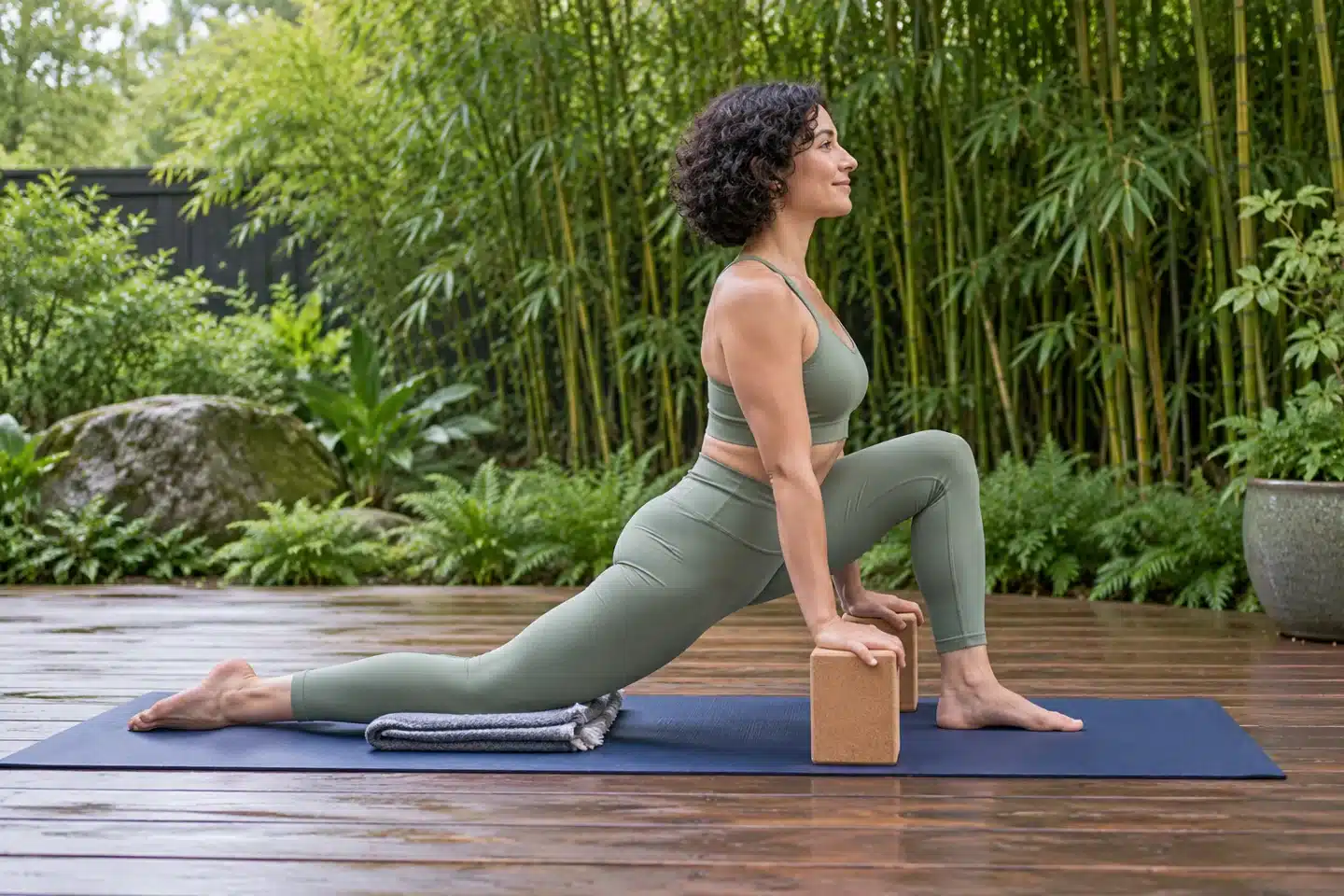
3. Low Lunge (Anjaneyasana): How Does It Open the Hips?
Low Lunge stretches the hip flexors, which shorten with long periods of sitting.
- Step your right foot forward between your hands. Lower your left knee to the floor.
- Slide your hips gently forward until you feel a stretch at the front of the left hip.
- Keep your front knee over your ankle. Lift your chest.
- Hold for 30 to 45 seconds, then switch sides.
Common mistake: sinking into the lower back instead of the hip. Draw the tailbone slightly down so the stretch moves to the front of the back hip.
Make it easier: pad the back knee and rest your hands on blocks.
4. Standing Forward Bend (Uttanasana): Is It Good for Tight Hamstrings?
Standing Forward Bend lengthens the hamstrings and lower back and lets the spine hang freely.
- Stand with feet hip-width apart. Hinge at the hips, not the waist.
- Bend your knees as much as you need. Let your head and arms hang.
- Hold opposite elbows and sway gently, or rest your hands on blocks.
- Hold for 30 to 60 seconds. Roll up slowly.
Common mistake: pulling yourself down with your arms. Let gravity do the work and keep the arms soft.
Skip or modify if: you have high blood pressure, glaucoma or feel dizzy when your head is below your heart.
5. Pyramid Pose (Parsvottanasana): Why Is It So Effective?
Pyramid Pose gives an intense, focused stretch to the hamstrings of one leg at a time.
- Step your left foot back about one leg-length. Turn the back foot out slightly.
- Square your hips forward and place your hands on blocks on either side of your front foot.
- Lengthen your spine, then fold over the front leg.
- Hold for 30 seconds on each side.
Common mistake: letting the back hip swing open. Keep both hip points facing forward, even if that means a shorter stance.
Make it easier: keep a slight bend in the front knee.
6. Triangle Pose (Trikonasana): What Does It Stretch?
Triangle Pose stretches the side body, hamstrings, groin and chest while building leg strength.
- Stand with feet wide apart. Turn your right foot out 90 degrees.
- Reach your arms out to the sides, then tilt over your right leg.
- Rest your right hand on your shin or a block. Extend your left arm up.
- Hold for 30 seconds on each side.
Common mistake: tipping the chest toward the floor to reach lower. Keep the chest open to the side, as if your body is between two panes of glass.
Make it easier: shorten your stance.
7. Garland Pose (Malasana): How Does It Help Hips and Ankles?
Garland Pose is a deep squat that opens the hips, groin and ankles.
- Stand with feet a little wider than your hips, toes turned out.
- Lower your hips toward the floor.
- Press your elbows gently against your inner knees, palms together.
- Hold for 30 to 60 seconds.
Common mistake: letting the knees cave inward and the weight fall onto the toes. Keep the knees in line with the toes and the heels heavy.
Make it easier: sit on a block or place a rolled blanket under your heels.
8. Head-to-Knee Pose (Janu Sirsasana): Is It Good for Beginners?
Head-to-Knee Pose is a seated forward fold that stretches one hamstring and the lower back. It suits all levels.
- Sit with your right leg straight and the sole of your left foot against your inner right thigh.
- Inhale and lengthen your spine.
- Exhale and fold forward from the hips over the straight leg.
- Hold for 30 to 60 seconds, then switch sides.
Common mistake: turning the chest away from the straight leg. Center your breastbone over the middle of the thigh before folding.
Make it easier: sit on a folded blanket and loop a strap around your foot.
9. Cow Face Pose Arms (Gomukhasana Arms): How Does It Open the Shoulders?
Cow Face arms target the shoulders and triceps, which many hamstring-focused routines leave out.
- Sit or stand tall. Reach your right arm up, bend the elbow and drop your hand down your back.
- Reach your left arm behind you from below and try to clasp hands.
- Keep your head lifted and ribs soft.
- Hold for 30 seconds on each side.
Common mistake: arching the lower back and flaring the ribs to make the hands meet. Keep the ribs soft, even if the hands stay apart.
Make it easier: hold a strap between your hands instead of clasping.
10. Cobra Pose (Bhujangasana): How Does It Help Back Flexibility?
Cobra Pose gently bends the spine backward and opens the chest and abdomen.
- Lie face down, hands under your shoulders, elbows close to your body.
- Press the tops of your feet into the floor.
- Inhale and lift your chest using your back muscles, with little weight in your hands.
- Hold for 3 to 5 breaths. Repeat 3 times.
Common mistake: pushing up with straight arms and hunching the shoulders toward the ears. Keep the elbows bent and the shoulders down.
Make it easier: lower to Sphinx Pose (Salamba Bhujangasana), resting on your forearms.
Skip or modify if: you have a recent back injury or are pregnant.
11. Bridge Pose (Setu Bandhasana): What Does It Stretch?
Bridge Pose stretches the hip flexors, chest and front of the spine while strengthening the glutes.
- Lie on your back, knees bent, feet flat and hip-width apart.
- Press into your feet and lift your hips.
- Interlace your hands under your back or keep arms by your sides.
- Hold for 5 breaths. Repeat 3 times.
Common mistake: letting the knees splay outward or turning the head while lifted. Keep the knees hip-width and the neck still.
Make it easier: slide a block under your sacrum for a supported version.
12. Reclined Hand-to-Big-Toe Pose (Supta Padangusthasana): Why Use a Strap?
Reclined Hand-to-Big-Toe Pose stretches the hamstrings while your back stays fully supported on the floor. Because your back stays supported, it is a gentle starting point for beginners.
- Lie on your back. Loop a strap around the ball of your right foot.
- Straighten the right leg toward the ceiling. Keep the left leg long on the floor or bent.
- Hold the strap with both hands. Relax your shoulders.
- Hold for 45 to 60 seconds, then switch sides.
Common mistake: lifting the hips or gripping the shoulders to pull the leg closer. Keep both hips heavy on the floor.
Make it easier: bend the left knee with the foot on the floor.
How Should You Progress from Beginner Poses to Deep Stretches?
Progress in three levels: build a pain-free base with simple poses, then add deeper hip and hamstring stretches, and only then try full backbends. Jumping straight to advanced poses is the fastest way to strain the lower back, knees or shoulders.
| Level | Who it suits | Poses | Typical time at this level |
|---|---|---|---|
| Level 1: Stiff body | New or very tight practitioners | Cat-Cow, Child’s Pose, Downward-Facing Dog | At least 4 to 6 weeks |
| Level 2: Intermediate | Comfortable with Level 1 and the 12 poses above | Pigeon Pose, Lizard Lunge, Seated Forward Bend | Several months |
| Level 3: Advanced | Strong, pain-free spine and shoulders, ideally with a teacher | Camel Pose, Wheel Pose | Ongoing |
Level 1: Which Poses Suit a Stiff Body?
Level 1 uses Cat-Cow, Child’s Pose and Downward-Facing Dog because each one is easy to adjust and safe to repeat daily. Cat-Cow and Downward-Facing Dog are explained as Poses 1 and 2 above, with their steps and common mistakes. At this level, the goal for both is smooth breathing, not depth. If your wrists complain, rest on your forearms for Cat-Cow and place your hands on a chair seat for Downward-Facing Dog.
Child’s Pose (Balasana)
Child’s Pose gently stretches the lower back, hips and the tops of the thighs while calming the breath.
- Kneel with your big toes touching and your knees hip-width apart or wider.
- Sit your hips back toward your heels.
- Walk your hands forward and rest your forehead on the mat.
- Breathe into your back ribs for 1 to 2 minutes.
Common mistake: forcing the hips down to the heels when the knees or ankles hurt.
Modifications with props: place a bolster or two pillows lengthwise under your chest, a block under your forehead, and a rolled blanket behind your knees or under your ankles.
Level 2: Which Intermediate Poses Come Next?
Level 2 adds Pigeon Pose, Lizard Lunge and Seated Forward Bend, which open the hips and hamstrings more deeply.
Pigeon Pose (Eka Pada Rajakapotasana, Half or Prep Version)
Pigeon Pose stretches the outer hip and glutes of the front leg and the hip flexors of the back leg.
- From Downward-Facing Dog, bring your right knee forward behind your right wrist.
- Lower your left leg straight back along the mat.
- Keep your hips level and walk your hands forward to fold if comfortable.
- Hold for 1 minute, then switch sides.
Common mistake: letting the hips tilt to one side so the weight dumps into the front knee.
Modifications with props: place a block or folded blanket under the hip of the bent leg. If you feel any knee pain, switch to a reclined figure-4 position on your back.
Lizard Lunge (Utthan Pristhasana)
Lizard Lunge opens the inner thighs, hip flexors and groin more deeply than a regular Low Lunge.
- From Low Lunge with the right foot forward, step the right foot toward the right edge of the mat.
- Place both hands inside the right foot.
- Lower the back knee to the floor and let the hips sink.
- Hold for 45 to 60 seconds, then switch sides.
Common mistake: letting the front knee fall inward or drift beyond the ankle.
Modifications with props: place both hands on blocks, and pad the back knee with a folded blanket. Rest on your forearms only if your hips allow it without strain.
Seated Forward Bend (Paschimottanasana)
Seated Forward Bend stretches both hamstrings, the calves and the whole back of the body at once.
- Sit with both legs straight in front of you.
- Inhale and lengthen the spine.
- Exhale and hinge forward from the hips, holding your shins, ankles or feet.
- Hold for 1 to 2 minutes, breathing slowly.
Common mistake: rounding the upper back to get the head down. The movement should come from the hips first.
Modifications with props: sit on a folded blanket so the pelvis can tilt forward, bend the knees as much as you need, and loop a strap around the feet. A bolster on the thighs supports a restful version.
Level 3: How Do You Safely Approach Advanced Backbends?
Level 3 introduces Camel Pose and Wheel Pose, two deep backbends that need open hip flexors, strong legs and a healthy spine and shoulders. Practice them after a full warm-up, and ideally learn them with a qualified teacher.
Camel Pose (Ustrasana)
Camel Pose stretches the whole front of the body, from the thighs and hip flexors to the chest and throat.
- Kneel with your knees hip-width apart and your thighs vertical.
- Place your hands on your lower back, fingers pointing down.
- Lift your chest, press your hips forward and lean back slowly.
- Reach for your heels only if your neck and lower back stay comfortable. Hold for 3 to 5 breaths.
Common mistake: dropping the head back first and collapsing into the lower back.
Modifications with props: tuck your toes to raise the heels, or place a block beside each foot to reach. Keep your hands on your lower back and your chin slightly tucked if your neck is sensitive.
Wheel Pose (Urdhva Dhanurasana)
Wheel Pose is a full backbend that stretches the chest, shoulders and hip flexors while demanding strength in the arms and legs.
- Lie on your back with your knees bent and your heels close to your hips.
- Place your hands beside your ears, fingers pointing toward your shoulders.
- Lift into Bridge Pose first, then press into your hands to lift onto the crown of the head.
- Press up through your arms and legs. Hold for 3 to 5 breaths, then lower slowly.
Common mistake: letting the elbows and knees splay outward, which strains the shoulders and lower back.
Modifications with props: stay in Bridge Pose and add a block under the sacrum, or lift with your hands on two blocks placed against a wall. A teacher can also offer support at the shoulders.
When Are You Ready for the Next Level?
You are ready to move up when the current level’s poses feel steady for five slow breaths without pain, breath-holding or strain the next day. If any pose causes sharp pain, numbness or tingling, step back a level and ask a teacher or health professional before progressing.
What Are 7 Yoga Poses for Full-Body Flexibility?
Seven poses from the list above cover every major area of the body: Cat-Cow, Downward-Facing Dog, Low Lunge, Triangle Pose, Cobra Pose, Reclined Hand-to-Big-Toe Pose and Cow Face arms. Together they move the spine in both directions and open the back of the legs, the front of the hips, the side body and the shoulders.
If you only have time for a short practice, this is the shortlist to keep. Each pose earns its place by covering an area the others miss.
| # | Pose (Sanskrit) | Main area | What it adds to the set |
|---|---|---|---|
| 1 | Cat-Cow (Marjaryasana-Bitilasana) | Whole spine | Warms the back by moving it forward and backward |
| 2 | Downward-Facing Dog (Adho Mukha Svanasana) | Calves, back of legs, upper back | Opens the whole back line of the body in one shape |
| 3 | Low Lunge (Anjaneyasana) | Front of the hips | Counters the hip shortening caused by sitting |
| 4 | Triangle Pose (Trikonasana) | Side body, inner thighs | Adds a sideways stretch that forward folds do not cover |
| 5 | Cobra Pose (Bhujangasana) | Chest, abdomen, front of spine | Balances all the forward folding with a gentle backbend |
| 6 | Reclined Hand-to-Big-Toe (Supta Padangusthasana) | Hamstrings | Targets one leg at a time while the back rests on the floor |
| 7 | Cow Face arms (Gomukhasana arms) | Shoulders, triceps | Covers the upper body, which the meta-analyses found harder to change |
Why this mix works: it stretches the front, back and sides of the body, plus both hips and both shoulders.
Yoga for Flexibility for Beginners: How Should You Start?
Beginners should start with three short sessions a week, use props freely, and add time and frequency gradually over four weeks. This plan was built by our team around ACSM flexibility guidelines and the dosing used in the studies above.
Three principles matter most in the first month:
- Choose comfort over depth. Bent knees and blocks are part of good technique.
- Practice at the same time and place. A fixed slot, such as after your morning shower, helps the habit stick.
- Change one thing at a time. Each week, add either a longer hold or an extra session, but not both.
| Week | Sessions per week | Session length | Hold time per pose | Focus |
|---|---|---|---|---|
| Week 1 | 3 | 15 minutes | 20 to 30 seconds | Learn the poses; breathe slowly; use props |
| Week 2 | 3 to 4 | 20 minutes | 30 to 45 seconds | Add 2 rounds of each hamstring and hip pose |
| Week 3 | 4 | 25 minutes | 45 to 60 seconds | Add Cow Face arms and Bridge; take a baseline measurement |
| Week 4 | 4 to 5 | 30 minutes | 60 seconds | Full 12-pose sequence; re-test and compare |
Props that help: two yoga blocks, a strap (a belt or towel works), and a folded blanket. They let you hold good alignment while your range grows.
Want to understand practice at a deeper level, including how to teach it? Inteyoga’s planned 200-hour program, expected around mid-2027, is a foundation pathway. You can join the 200-hour waitlist to hear from us when details are announced.
What Is a Good 15-to-20 Minute Beginner-Friendly Yoga Routine?
A good 15-to-20 minute beginner routine uses the 7 full-body poses in a fixed order: warm the spine, open the standing body, then finish with supported floor stretches. It takes about 15 minutes. Repeat the lunge and hamstring stretch to stretch it to 20.
| Step | Pose | Time | Beginner tip |
|---|---|---|---|
| 1 | Easy seated breathing | 1 minute | Sit on a folded blanket and slow your exhale |
| 2 | Cat-Cow | 2 minutes | Move with the breath, not faster than it |
| 3 | Downward-Facing Dog | 1 minute | Rest in Child’s Pose (Balasana) halfway if needed |
| 4 | Low Lunge | 1 minute per side | Pad the back knee |
| 5 | Triangle Pose | 45 seconds per side | Hand on a block, not the floor |
| 6 | Cobra Pose | 3 short lifts of 20 seconds | Rest your forehead on the mat between lifts |
| 7 | Reclined Hand-to-Big-Toe | 1 minute per side | Use a belt or towel as the strap |
| 8 | Cow Face arms | 45 seconds per side | Hold a strap between your hands |
| 9 | Corpse Pose (Savasana) | 2 minutes | Let the breath return to normal |
How to know it is working: by the end of the first week, the routine should feel calm rather than effortful. If any step still feels like a fight, shorten the hold before you skip the pose.
What Does a 30-Minute Yoga for Flexibility Session Look Like?
A 30-minute yoga for flexibility session adds a longer warm-up, all 12 poses, and a slow floor finish with longer holds. It suits week 4 of the plan above, or anyone who is comfortable with the short routine.
| Phase | Poses | Time |
|---|---|---|
| Arrive | Seated breathing | 2 minutes |
| Warm up | Cat-Cow, then 3 slow rounds of a gentle Sun Salutation | 6 minutes |
| Standing | Low Lunge, Pyramid Pose, Triangle Pose (about 45 to 60 seconds per side), then Garland Pose | 7 minutes |
| Floor | Head-to-Knee, Reclined Hand-to-Big-Toe (1 minute per side), Cobra and Bridge (3 rounds each), Cow Face arms | 9 minutes |
| Slow finish | Reclined Bound Angle Pose (Supta Baddha Konasana) with pillows under the knees, then a gentle reclined twist on each side | 4 minutes |
| Rest | Corpse Pose (Savasana) | 2 minutes |
What makes the 30-minute version different: the extra time goes to warming up and to the slow finish. A warmer body and a calmer nervous system let you reach further in the same poses, without pushing harder.
What Is a 10-Minute Desk Job Routine for a Stiff Back and Hips?
A 10-minute desk routine should open the hip flexors and chest, twist and lengthen the spine, and finish with gentle floor poses that release the lower back. It is built for people who sit for long hours and feel stiff in the back and hips.
| Step | Pose | Time | Where |
|---|---|---|---|
| 1 | Seated Cat-Cow on a chair: arch and round the back with hands on the knees | 1 minute | Chair |
| 2 | Seated side bend: one hand on the chair, the other arm reaching overhead | 30 seconds per side | Chair |
| 3 | Seated chair twist (Bharadvajasana variation): turn from the ribs, holding the chair back | 30 seconds per side | Chair |
| 4 | Desk-supported Half Forward Bend (Ardha Uttanasana): hands on the desk, hips back, spine long | 1 minute | Standing at desk |
| 5 | High Lunge with hands on the desk (Ashta Chandrasana variation) | 1 minute per side | Standing at desk |
| 6 | Sphinx Pose (Salamba Bhujangasana): gentle backbend on the forearms | 1 minute | Floor |
| 7 | Happy Baby (Ananda Balasana): hold the outer feet and let the lower back settle | 1 minute | Floor |
| 8 | Knees-to-Chest (Apanasana) with slow breathing | 2 minutes | Floor |
No floor space at work? Repeat steps 1 to 5 twice instead. Doing the chair and standing half once in the morning and once mid-afternoon is a practical way to break up long sitting.
Morning vs Evening Flexibility Yoga: What Is the Difference?
Morning flexibility yoga is best for gentle mobility and waking up the body, while evening practice usually allows deeper stretches because the body is warmer and more mobile. The best time is still the one you will keep.
| Factor | Morning practice | Evening practice |
|---|---|---|
| How your body feels | Stiffer; spinal discs have absorbed fluid overnight | Warmer and looser after a day of movement |
| Best style | Flowing, gentle mobility; shorter holds | Longer holds, deeper hip and hamstring stretches |
| Nervous system effect | Wakes you up and builds energy | Slow exhales help you wind down before sleep |
| Main caution | Avoid deep rounded forward bends in the first hour after waking | Avoid very vigorous practice right before bed if it keeps you awake |
| Research note | Lower-back bending stress appears higher early in the day | Evening and afternoon stretching produced larger gains in one 6-week trial |
What the research says:
- Researchers Adams, Dolan and Hutton reported in Spine (1987) that the lumbar spine is more vulnerable to bending stress in the early morning, after the discs take up fluid overnight. That is why gentle movement suits the first hour of the day better than deep forward folds.
- A 2018 study in Physiotherapy Quarterly assigned 60 trained men to stretch in the morning, afternoon or evening, five times a week for 6 weeks. All three groups improved, but the afternoon and evening groups gained more flexibility than the morning group.
Our suggestion: use mornings for flowing movement and evenings for your deeper holds. If heat makes you feel more flexible, remember that a heated room increases how far you can go without making the tissue safer to push.
Which Routine in This Guide Fits Your Lifestyle?
Pick the routine that matches where your stiffness comes from and how much time you have. The table below points to the right section of this guide for common situations.
| If you are… | Where you probably feel tight | Start with |
|---|---|---|
| An office worker or remote worker | Hip flexors, upper back, neck | The 10-minute desk routine, plus Low Lunge and Cobra in the evening |
| A runner or cyclist | Hamstrings, calves, front of the hips | Reclined Hand-to-Big-Toe and Low Lunge after training; Lizard Lunge once you reach Level 2 |
| A complete beginner with a stiff body | Everywhere, especially hamstrings | Level 1 poses and the 15-to-20 minute routine, three times a week |
| Over 50 | Hips, spine, shoulders | Longer holds of 30 to 60 seconds, the balance poses, and the 4-week plan |
| Short on time | Varies | The 7 full-body poses, about 10 minutes a day |
| Stuck at the same level for weeks | Varies | The plateau breaker guide and two short strength sessions a week |
How Does Yoga for Flexibility and Strength Work Together?
Yoga builds flexibility and strength together because many poses ask your own muscles to hold you in a lengthened position. This is called active flexibility: range you can control, not just range someone could push you into.
This fits public health advice too. The UK Chief Medical Officers recommend building strength on at least two days a week, and holding yoga poses with control is one way to work your muscles.
Passive range is how far a joint can be moved. Active range is how far you can move it yourself. The gap between the two is where many strains happen, so closing it is a good goal for any practice.
These four poses train strength and length at the same time:
- Warrior II (Virabhadrasana II). Strengthens the thighs and hips while opening the inner legs. Hold 30 seconds per side, keeping the front knee over the ankle.
- Chair Pose (Utkatasana). Builds leg and back strength and stretches the shoulders as the arms reach up. Hold 20 to 30 seconds.
- Plank Pose (Phalakasana). Strengthens the core, shoulders and wrists, which support every other pose. Start with your knees down for 20 seconds.
- Locust Pose (Salabhasana). Strengthens the muscles along the back of the body that support forward bends. Lift for 3 to 5 breaths, repeat 3 times.
A simple way to add strength to any stretch: in Low Lunge, lift your hands off the blocks for a few breaths. In Reclined Hand-to-Big-Toe, gently press the leg into the strap for 5 seconds, then relax and see if it moves a little further.
How Does Yoga for Flexibility and Balance Work?
Yoga may improve balance because standing poses train the ankles, hips and core to hold steady over a small base, and freer movement in those joints gives you more room to adjust. Studies in older adults support the link.
The UK Chief Medical Officers advise older adults to do balance activities on two days a week to reduce the chance of frailty and falls. The research on yoga supports this for older adults. The 2019 meta-analysis by Sivaramakrishnan and colleagues found that yoga produced a moderate-to-large improvement in balance (effect size 0.7) compared with no exercise.
Try these three balance poses near a wall or a chair:
- Tree Pose (Vrksasana). Stand on one leg and place the other foot on your calf or inner thigh, never on the knee. Hold 20 to 30 seconds per side.
- Standing Hand-to-Big-Toe Pose (Utthita Hasta Padangusthasana), strap version. Loop a strap around one foot and extend the leg forward at a comfortable height. This joins a hamstring stretch to a balance challenge. Hold 15 to 20 seconds per side.
- Warrior III (Virabhadrasana III), hands on a chair. Hinge forward and lift one leg behind you until your body forms a T. Hold 3 to 5 breaths per side.
Safety tip: practice balance poses before the deep floor stretches, while your attention is fresh. Keep a hand near support if you have a history of falls.
How Long Should You Hold a Yoga Pose for Flexibility?
Hold most yoga poses for flexibility for 30 to 60 seconds, repeated two to four times, for a total of about 60 seconds per muscle group.
This matches the American College of Sports Medicine’s evidence-based guidance:
- Most adults: hold static stretches for 10 to 30 seconds.
- Older adults: holds of 30 to 60 seconds may give greater benefit.
- Total volume: about 60 seconds per muscle group per session (for example, 2 × 30 seconds or 4 × 15 seconds).
- Intensity: stretch to a feeling of tightness or slight discomfort, not pain.
In yoga terms, 30 to 60 seconds equals roughly 5 to 10 slow breaths. Yin Yoga uses much longer holds of 2 to 5 minutes, which can suit the hips and lower back. If you try long holds, come out slowly and avoid bouncing.
How Often Should You Do Yoga to Get More Flexible?
Practice yoga for flexibility at least 2 to 3 days a week. Daily practice gives the fastest results.
The ACSM recommends flexibility exercise at least two to three days a week and notes that greater gains come with daily stretching. The research on yoga agrees. Studies with only one weekly class still showed improvement, but over longer periods (13 to 20 weeks). Studies with two or more weekly sessions saw changes in 8 to 10 weeks.
A practical target for most busy adults:
- At minimum, 2 sessions of 20 to 30 minutes per week.
- Better, 3 to 4 sessions per week.
- Best, a short 10 to 15 minute daily practice plus one longer class per week.
Short and frequent practice beats long and rare practice. Ten minutes every day usually does more than one 70-minute session on a Sunday.
How Long Does It Take to See Results?
Many people feel looser within 2 to 4 weeks and see measurable flexibility gains within 6 to 12 weeks of regular yoga.
| Time frame | What you may notice | What is mainly changing |
|---|---|---|
| First session | Temporary looseness for an hour or so | Short-term muscle relaxation |
| Weeks 1 to 4 | Poses feel less intense; you reach a little further | Stretch tolerance (nervous system) |
| Weeks 6 to 12 | Clear gains on a toe-touch or sit-and-reach test | Tolerance plus some reduction in stiffness |
| 3 months and beyond | New range feels normal and stable | Long-term adaptation and control |
The 2021 meta-analysis of older adults found the largest effects in programs lasting 9 to 12 weeks. A small pilot study of Iyengar yoga, published in the Journal of Bodywork and Movement Therapies, found significant gains in lower-back and hamstring flexibility after just 6 weeks of one 90-minute class per week.
Your starting point, age, genetics and consistency all affect your pace. Bone shape also sets natural limits. Some people will never touch their toes with straight legs, and that is fine. Progress is measured against your own baseline, not someone else’s photos.
How Can You Measure Your Flexibility at Home?
You can track your progress with two simple tests: the toe-touch test for hamstrings and lower back, and the back-scratch test for shoulders. Measure at the start, then every two to four weeks, at the same time of day, after the same warm-up.
Toe-touch test (hamstrings and lower back):
- Stand on a sturdy step with your feet together and knees straight but not locked.
- Fold forward slowly and reach down along a ruler held against the step.
- Record how far above or below the step edge your fingertips reach.
Back-scratch test (shoulders):
- Reach your right hand over your shoulder and down your back.
- Reach your left hand up your back from below.
- Measure the gap between your middle fingers. Repeat on the other side.
Use our simple tracking table:
| Date | Toe-touch (cm/in) | Back-scratch right (cm/in) | Back-scratch left (cm/in) | How did your body feel? |
|---|---|---|---|---|
| Start | ||||
| Week 2 | ||||
| Week 4 | ||||
| Week 8 | ||||
| Week 12 |
Notice whether one side is tighter than the other. It is common to have a tighter side, and it deserves an extra round in each session.
Yoga for Flexibility vs Stretching: What Is the Difference?
Stretching lengthens one muscle at a time, while yoga for flexibility works whole chains of muscles together and adds breath, strength and balance. Both improve range of motion. Yoga usually offers more benefits per session.
| Feature | Yoga for flexibility | Traditional stretching |
|---|---|---|
| Focus | Whole-body movement patterns | Individual muscles |
| Breath | Slow breathing is built into every pose | Usually not emphasized |
| Strength | Builds strength while lengthening | Mostly passive |
| Balance | Many standing poses train balance | Little to none |
| Mental benefit | Calming, mindful focus | Varies |
| Time efficiency | Several areas stretched in one pose | One area at a time |
| Best for | Overall mobility and well-being | Targeting one tight spot quickly |
| Evidence | Gains shown in controlled trials and meta-analyses | Strong evidence base; ACSM guidelines |
The 2016 study of college athletes found that adding yoga improved flexibility, while warm-up stretching alone did not. A 2019 meta-analysis also found that yoga improved lower-body flexibility more than other active exercise programs did, as well as more than no exercise.
If you only have five minutes after a run, a few targeted stretches are useful. For lasting, usable flexibility with strength and calm on top, a regular yoga practice gives you more.
What Are 5 Flexibility Exercises You Can Do Outside Yoga?
Five simple flexibility exercises are leg swings, the standing quad stretch, the doorway chest stretch, the seated figure-4 stretch and the neck side stretch. They are not yoga poses, but they fill gaps on busy days, at your desk or before a run.
- Leg swings (hips). Hold a wall and swing one leg forward and back 10 to 15 times, then side to side. This is a dynamic exercise, so it suits the start of a workout.
- Standing quad stretch (front of thigh). Hold a wall, bend one knee and hold the ankle behind you. Keep the knees together and the hips level. Hold 30 seconds per side.
- Doorway chest stretch (chest and front shoulders). Place your forearms on a door frame at shoulder height and step one foot through. Hold 30 seconds. It helps after long hours at a laptop.
- Seated figure-4 stretch (glutes and outer hip). Sit on a chair, cross one ankle over the other knee and lean forward with a long back. Hold 30 seconds per side.
- Neck side stretch (upper neck and shoulders). Sit tall, drop one ear toward the shoulder and let the opposite arm hang. Hold 20 to 30 seconds per side, never pulling the head.
How they fit with yoga: use leg swings before activity, the other four after it, and keep your yoga sessions for full-body work.
Why Does Flexibility Stop Improving? The Plateau Breaker Guide
Flexibility usually stops improving because the body has adapted to the same stimulus, often the same poses, holds and intensity for weeks. The fix is to change the stimulus: add strength through your full range, use contract-relax stretching, and vary angles and recovery.
Why Do Flexibility Plateaus Happen?
- The routine never changes. Your nervous system has already accepted that level of stretch, so the same poses no longer challenge it.
- Your end range is weak. If your muscles cannot control the last part of a movement, the nervous system holds back to protect you.
- Recovery is poor. Short sleep and high stress keep the body in a more guarded, tense state.
- You have reached a natural limit. Bone shape eventually stops some movements, as noted in the results section, and more force will not change that.
How Do You Break a Flexibility Plateau?
- Combine strength training with yoga. A 2021 systematic review and meta-analysis by Afonso and colleagues in Healthcare pooled 11 studies with 452 participants and found that strength training through a full range of motion improved range about as much as stretching did, although the studies varied widely in design. Add two short strength sessions a week with full-range moves such as slow Romanian deadlifts, split squats and deep bodyweight squats, using light loads and full control.
- Use contract-relax (PNF) stretching. The ACSM describes this as a 3 to 6 second muscle contraction at 20% to 75% of maximum effort, followed by a 10 to 30 second assisted stretch. It is the structured version of the strap tip in the strength section. Use it two or three times per session, not on every pose.
- Train active end range. Lying on your back, lift one straight leg as high as you can without help and hold for 5 seconds. Repeat 5 times per side. This teaches the body it is safe to own the new range.
- Change the angle. If Pyramid Pose has stalled, rotate in Wide-Legged Forward Bend (Prasarita Padottanasana) or Seated Forward Bend. A new angle loads the tissue in a slightly different way.
- Add a little time, not force. Lengthen holds by about 15 seconds every week or two, or add one short session. Increase only one variable at a time.
- Plan a lighter week. Every 4 to 6 weeks, practice gently for a week to let your body recover before you push on.
- Test fairly. Re-measure at the same time of day, because flexibility changes from morning to evening.
What Mistakes Slow Down Flexibility Progress?
The most common mistakes are forcing stretches, practicing cold, holding your breath, and being inconsistent. Avoid these and progress usually comes faster:
- Forcing or bouncing. Pushing into pain triggers a protective reflex that tightens the muscle. Go to mild tension and wait.
- Skipping the warm-up. The ACSM notes that flexibility exercise works best when muscles are warm. Do a few minutes of Cat-Cow or easy movement first.
- Holding your breath. Breath-holding raises tension. Slow, long exhales help the body release.
- Locking the knees. In forward bends, a micro-bend protects the back of the knee and keeps the stretch in the hamstrings.
- Rounding the back to reach further. Hinge from the hips and keep the spine long. Reaching with a rounded back moves the stress to your lower spine.
- Comparing yourself to others. Bone structure differs. Your only benchmark is your own last measurement.
- Only stretching, never strengthening. Range without control can be unstable. See the strength section above for poses that build both.
- Practicing once in a while. Flexibility fades when practice stops. A short routine you keep is better than a long one you skip.
Is Yoga for Flexibility Safe? Who Should Be Careful?
Yoga for flexibility is generally safe for healthy people when practiced appropriately, but some people need to modify or avoid certain poses.
A 2015 meta-analysis in the American Journal of Epidemiology reviewed 94 randomized trials with 8,430 participants and found that yoga appeared about as safe as usual care and other exercise. The US National Center for Complementary and Integrative Health (NCCIH) adds an important point: learning yoga alone without supervision has been linked to a higher risk of injury. Guidance from a qualified teacher reduces that risk.
Which Poses Should You Avoid with Specific Conditions?
Talk to your doctor before starting, and tell your teacher, if you have any of the conditions below. This table shows which poses from this guide usually need to be avoided or changed, and what to do instead.
| Condition | Avoid or limit | Safer approach |
|---|---|---|
| Slip disc (herniated disc) or sciatica | Rounded forward bends: Standing Forward Bend, Seated Forward Bend, Head-to-Knee; deep twists; Wheel Pose | Flat-back hinges with hands on blocks or a chair; Reclined Hand-to-Big-Toe with the other knee bent; follow your physiotherapist’s advice |
| Knee injury or knee replacement | Deep knee bending: Garland Pose, Pigeon Pose, Child’s Pose with a full knee bend; kneeling backbends such as Camel Pose | Padding under the knees, a chair or block to reduce knee bend, reclined versions of hip stretches |
| High or low blood pressure | Long head-down holds: Downward-Facing Dog, Standing Forward Bend, Wide-Legged Forward Bend; Wheel Pose; holding the breath | Half Forward Bend with hands on a wall; rise slowly from any fold |
| Glaucoma or high eye pressure | Inversions and long head-below-heart poses | Seated and reclined stretches |
| Pregnancy | Deep backbends (Camel, Wheel), deep closed twists, lying on the belly (Cobra, Locust, Sphinx), long periods flat on the back | A prenatal class; wide-knee Child’s Pose; side-lying and supported stretches |
| Osteoporosis or low bone density | Rounded forward bends, deep twists, Wheel Pose | Flat-back hinges, standing poses, gentle supported backbends with guidance |
| Shoulder injury | Wheel Pose, Cow Face arms, long weight-bearing holds in Downward-Facing Dog or Plank | A strap for shoulder stretches; Downward-Facing Dog with hands on a wall |
| Wrist pain or carpal tunnel | Downward-Facing Dog, Plank, Wheel, Cat-Cow on the hands | Forearm versions, fists, or a folded mat under the heel of the hand |
| Neck problems | Dropping the head back in Camel Pose; Wheel Pose; lifting the chin high in Cobra | Keep the neck in line with the spine |
| Recent surgery or a heart condition | Starting any new practice without clearance | Get medical clearance and advice on safe intensity first |
What Precautions Matter for Forward Bends with a Slip Disc or Knee Injury?
With a slip disc, hinge from the hips with a long spine and never round the lower back under load. With a knee injury, protect the joint from both deep bending and locking.
- Slip disc: bend your knees generously, keep your hands on blocks or a chair, and come up with a flat back. Avoid bouncing, adding weight or folding while twisting.
- Red flags: stop at once and seek medical advice if a forward bend causes pain that travels down the leg, numbness, tingling or weakness.
- Knee injury: keep a soft bend in the knee during forward folds, never lock it straight, and avoid putting body weight on the kneecap. Use a strap rather than pulling the leg toward you.
- Both: reclined hamstring stretches with a strap are usually the most knee- and back-friendly choice. Yoga does not replace assessment or treatment by a doctor or physiotherapist, so follow their guidance first.
Simple safety rules: stop if you feel sharp, shooting or joint pain; never force a pose; use props; and stay within a range where you can breathe smoothly.
Can You Be Too Flexible?
Yes. Some people have joint hypermobility, and for them more stretching is not the answer. People with very loose joints can move past a safe range without feeling a strong stretch. Over time, this can strain ligaments and joints.
If you are naturally very flexible, focus your practice on:
- Strength and control rather than depth. Keep a micro-bend in the knees and elbows.
- Stability poses from the strength section above, such as Warrior II, Chair and Plank.
- A moderate range. Stop well before the end of your range, especially in deep forward bends and splits.
If you have frequent joint pain, dislocations or unusual joint looseness, ask a doctor or physical therapist for an assessment before pursuing deep flexibility work.
Is Yoga for Flexibility Good for Kids?
Yes, yoga can be good for kids when it is playful, short and never forced. The US National Center for Complementary and Integrative Health (NCCIH) notes that yoga may have benefits for children. Most children are already quite flexible, so the main gains are body awareness, balance, calm breathing and keeping that natural range as they grow.
Good kids’ yoga looks different from adult practice:
- Keep it playful. Use animal poses children recognize: Cat-Cow, Cobra as a “snake,” Downward-Facing Dog, Butterfly (Baddha Konasana) and Tree Pose.
- Keep holds short. A few breaths per pose is enough, and children should move in and out freely.
- Never push. Adults should not press a child deeper into a stretch, because growing joints and bones need gentle loading.
- Supervise advanced poses. Avoid headstands, shoulder stands and deep backbends unless a teacher trained in children’s yoga is present.
- Check with a doctor when needed. Ask a pediatrician (or GP in the UK) first if the child has a joint, heart or growth-related condition, or very loose joints.
How Does Inteyoga Approach Flexibility?
At Inteyoga, we treat flexibility as one result of an integrated practice, not as a performance goal. Our approach brings together Hatha Yoga, Raja Yoga, Jnana Yoga, and Karma and Bhakti Yoga, so body, breath and mind are trained together.
In practice, that means:
- The breath leads. Each pose is guided by slow, steady breathing so the nervous system can let go.
- Anatomy informs the teaching. Our training is led by Dr. Ashutosh, Inteyoga’s founder and principal teacher, a physician and yoga teacher who brings applied anatomy and the preventive and restorative side of practice into class.
- Effort is balanced with rest, in line with the restorative focus of our training.
- Practice fills the day. In our residential setting in Colva, South Goa, practice is part of daily life, which supports the consistency flexibility needs.
Inteyoga (Swami Krishnananda Yoga Vidyapeeth) is managed by Inteyoga Shala LLP and is registered with Yoga Alliance as a Registered Yoga School (RYS 200, RYS 300 and RYS 500). You can read what past students say on our testimonials page. Our current residential course is the Advanced TTC 300-Hour Integrated Restorative Yoga (Including Yoga Nidra, Chakra Sadhana, and Prana Vidya Intensive). It runs for 43+2 days, is taught in English, and is an advanced program for applicants who have completed a 200-hour TTC or an accepted equivalent, aged 21 to 60.
Under our Gift-it-Forward model, no payment is required to apply or to participate. After completing the course, participants may voluntarily support the Gift-it-Forward initiative to help future aspirants, with no obligation.
Also read: What Is Restorative Yoga? 7 Benefits, Poses and How to Start
Conclusion: Where to Start with Yoga for Flexibility
Yoga for flexibility works, and the research supports it. Regular practice can improve range of motion in your hips, hamstrings, spine and shoulders within weeks, while also building strength, balance and a calmer mind. The basics are simple: warm up, breathe slowly, hold poses for 30 to 60 seconds, practice at least two or three times a week, and never force a stretch.
Start with the 12 poses and the 4-week plan in this guide. Measure your progress, respect your body’s limits, and let consistency do the work.
Ready to go deeper? If you have already completed a 200-hour training, explore our Advanced 300-Hour Integrated Restorative Yoga program in Goa. The next confirmed batch runs from 13 December 2026 to 26 January 2027. When you are ready, complete the Inteyoga application form. Each application is reviewed individually.
Frequently Asked Questions (FAQ)
Can You Do Yoga If You Are Not Flexible?
Yes. You do not need flexibility to start yoga. Flexibility is a result of practice, not a requirement for it. Stiff beginners are exactly who yoga for flexibility is designed for. Classes labeled “gentle,” “beginner” or “all levels” expect tight bodies, and a good teacher will offer a version of each pose that works for you from the first session.
Is 20 Minutes of Yoga a Day Enough for Flexibility?
Yes, 20 minutes a day is enough for most people to improve flexibility. The ACSM recommends about 60 seconds of stretching per muscle group, at least two to three days a week, and notes daily practice works best. A 20-minute session easily covers the hamstrings, hips, spine and shoulders. Consistency matters more than session length.
Which Yoga Pose Is Best for Flexibility?
No single pose is best, because flexibility is specific to each joint. The best pose for you targets your tightest area, which the home toe-touch and back-scratch tests can reveal. If you must pick one, Downward-Facing Dog covers the most ground in a single shape. Still, a short set of poses that covers the front, back and sides of the body works better than any one pose.
Is Daily Yoga Better or 3 Times a Week?
Daily yoga usually brings faster flexibility gains than three sessions a week, and the ACSM notes that daily stretching works best. But quality matters more than the count. Three focused 30-minute sessions beat seven rushed ones you skip. A good middle path is three longer sessions plus short 10-minute practices on other days, with a lighter day whenever you feel sore.
Is Yoga Better Than Stretching for Flexibility?
Both improve flexibility, but yoga usually offers more benefits per session. Yoga works several muscle groups at once and adds strength, balance and breath control. A 2016 study found that college athletes who added yoga improved flexibility, while those who only did warm-up stretching did not. Simple stretching remains useful for quickly targeting one tight muscle.
How Long Does It Take to Get Flexible with Yoga?
Mild muscle tenderness the next day can happen, especially after new poses or longer holds than usual. It should ease within a day or two, and gentle movement often helps. Sharp, shooting or joint pain is not normal. Neither is pain that travels down a limb, or numbness or tingling. If you feel any of these, stop that pose and speak to a doctor or physiotherapist.
Does Yoga Help with Flexibility as You Get Older?
Yes. Research suggests yoga can improve flexibility in older adults too. A 2015 study of women aged 50 to 79 found better spinal mobility and hamstring flexibility after 20 weeks of weekly Hatha yoga. Two meta-analyses also found moderate gains in lower-body flexibility in older adults. Older practitioners may benefit from longer holds of 30 to 60 seconds.