
Quick Answer
Yoga for reducing stress and anxiety combines gentle postures, slow breathing, relaxation and focused attention to calm the body’s stress response. Research reviews show yoga may reduce perceived stress and anxiety symptoms in the short term, especially for people with elevated stress. It works best as regular practice and does not replace medical care for anxiety disorders.
Key Takeaways
- Yoga may help shift your nervous system away from fight-or-flight and toward rest-and-digest. Slow breathing with a longer exhale appears to do much of the work.
- A 2024 review of 13 trials (1,026 stressed adults) found yoga reduced perceived stress in the short term compared with doing nothing.
- In a 2021 trial of 226 adults with generalized anxiety disorder, 54% responded to Kundalini yoga, compared with 71% for CBT and 33% for stress education.
- Gentle styles work best for most anxious beginners: restorative yoga, gentle hatha, yin and Yoga Nidra.
- Breathwork deserves most of your attention. In a 2023 Stanford study, five minutes a day of breathwork improved mood and reduced anxiety over one month.
- Yoga supports good care. It is not a replacement for therapy or medication when you need them.
It’s 11 p.m. Your body is tired, but your mind is still replaying the meeting, the email you forgot to send and tomorrow’s to-do list. Your shoulders are up near your ears and your breath is short and shallow. If that sounds familiar, yoga for reducing stress and anxiety is one of the simplest, lowest-risk tools you can try tonight, and this guide shows you exactly how.
You’re in good company. In the American Psychological Association’s Stress in America 2025 survey of 3,199 US adults, 54% said they felt isolated from others at least some of the time.
In the UK, a 2018 YouGov poll for the Mental Health Foundation found that 74% of 4,619 adults had felt so stressed at some point in the past year that they were overwhelmed or unable to cope. Worldwide, the World Health Organization estimates that 301 million people were living with an anxiety disorder in 2019.
Below, we explain how yoga may calm the nervous system, what the research really shows (including its limits), and which poses and breathing practices help most. You’ll also get three routines you can start today: 5 minutes at your desk, 15 minutes in the morning and 10 minutes before bed.
Not sure where to start? Try the 5-minute desk routine today. If you’d like to study these practices more deeply, you can explore Inteyoga’s courses.
How We Wrote This Guide
This guide is written by the Inteyoga team at Swami Krishnananda Yoga Vidyapeeth in Colva, South Goa, a school registered with Yoga Alliance as a Registered Yoga School (RYS 200, RYS 300 and RYS 500). The practices here come from the same families of practice we teach in our restorative training: restorative yoga, Yoga Nidra and pranayama.
We checked each health claim against peer-reviewed research, clinical guidelines or public health bodies such as the WHO, the US National Institutes of Health, the UK’s NICE and the UK Health and Safety Executive. Where the evidence is early or mixed, we say so. Every source is listed at the end of the article.
What Is Yoga for Reducing Stress and Anxiety?
Yoga for reducing stress and anxiety is a slow, calm style of practice that uses gentle postures, controlled breathing (pranayama), deep relaxation and meditation to help ease the nervous system out of fight-or-flight and toward rest-and-digest. It’s less about touching your toes and more about how you feel when you finish.
A stress-focused session looks very different from a sweaty power class at your local gym. You move slowly and hold supported poses for longer. You spend real time breathing and resting. Most sessions end with Savasana (Corpse Pose) or a guided relaxation such as Yoga Nidra.
It draws on three classical parts of yoga. Asana (postures) releases muscle tension. Pranayama (breath regulation) slows the breath, usually with a longer exhale. Dhyana (meditation) and relaxation train calm, steady attention. At Inteyoga, we treat these as one whole: body, breath and mind are worked on together.
What Is the Difference Between Stress and Anxiety?
Stress is usually a response to a clear outside pressure, such as a deadline, a long commute or a hard conversation. Anxiety is persistent worry or fear that can continue even when no clear threat is present. Both show up in the body the same way: a faster heart, tight muscles and shallow breathing.
Knowing which one you’re dealing with helps you choose the right support.
| Feature | Stress | Anxiety |
|---|---|---|
| Main trigger | A clear, present pressure (work, money, caregiving) | Often no clear trigger, or worry about what might happen |
| Duration | Usually eases when the pressure ends | Can persist for weeks or months |
| Common feelings | Overwhelm, irritability, frustration | Dread, unease, racing or looping thoughts |
| Body signs | Tension, headaches, poor sleep | Fast heartbeat, tight chest, restlessness, poor sleep |
| When to get help | When it affects your health, work or relationships | When worry is hard to control, lasts six months or more, or affects daily life |
Both are common. Based on national survey data collected in the early 2000s, the US National Institute of Mental Health estimates that about 19.1% of American adults had an anxiety disorder in the past year. In Great Britain, the Health and Safety Executive counted 964,000 workers with stress, depression or anxiety caused or made worse by work in 2024/25.
Everyday stress and mild anxiety are a normal part of life. An anxiety disorder is different. It’s a medical condition that deserves a professional assessment. Yoga can support both, but in different roles.
Does Yoga Really Reduce Stress and Anxiety? What the Research Says
Yes, the research is encouraging, but it’s still developing. Reviews of randomized controlled trials suggest yoga may reduce perceived stress and anxiety symptoms in the short term, especially in people with elevated stress or anxiety. The evidence for diagnosed anxiety disorders is weaker, and yoga doesn’t replace proven treatments.
What Do the Major Reviews and Trials Show?
| Study (year, journal) | Who took part | What was tested | Key finding |
|---|---|---|---|
| Schleinzer et al. (2024), Frontiers in Psychiatry | 13 trials, 1,026 stressed adults | Yoga vs no yoga, and vs other active programs | Moderate short-term drop in perceived stress vs no treatment (low-certainty evidence). No clear short-term advantage over mindfulness or relaxation. No adverse events in the three trials that reported safety. |
| Cramer et al. (2018), Depression and Anxiety | 8 trials, 319 people with anxiety or elevated anxiety | Yoga for anxiety | Small short-term effect vs no treatment. Benefits seen in people with elevated anxiety, but no clear effect in diagnosed (DSM) anxiety disorders. |
| Simon et al. (2021), JAMA Psychiatry | 226 adults with generalized anxiety disorder (GAD) | 12 weeks of Kundalini yoga vs CBT vs stress education | 54% responded to yoga, 71% to CBT and 33% to stress education. CBT stayed the first-line treatment. |
| Smith et al. (2007), Complementary Therapies in Medicine | 131 adults with mild to moderate stress | 10 weekly one-hour hatha yoga sessions vs relaxation | Both helped stress and anxiety equally. Yoga did better on the mental health measure. |
What Does This Mean for You?
For everyday stress and worry, yoga is a reasonable, low-risk tool with real evidence behind it. The 2024 review in Frontiers in Psychiatry concluded that yoga can be considered a non-medication option for stress reduction in stressed adults.
For diagnosed anxiety disorders, the picture is more careful. The US National Center for Complementary and Integrative Health (NCCIH) says yoga may help with anxiety symptoms linked to difficult life situations, but research on anxiety disorders is still preliminary. In the NIH-funded JAMA Psychiatry trial, yoga helped many people with GAD, yet it didn’t match cognitive behavioral therapy (CBT).
Our honest summary: yoga is a helpful companion to good care. It isn’t a cure, and it shouldn’t delay treatment when you need it.
A note on study limits: many yoga trials are small, participants know they’re doing yoga, and results are often self-reported. Researchers want larger and longer studies. We share this so you can judge the evidence for yourself.
How Does Yoga Reduce Anxiety? The Science Explained
Researchers have proposed three main ways yoga may reduce anxiety: by shifting the nervous system away from its fight-or-flight branch, by engaging the vagus nerve through slow breathing, and by lowering stress chemistry such as cortisol while supporting calming brain chemicals such as GABA. These are plausible mechanisms backed by early research. They are not yet proven explanations of how yoga helps any one person.
How Does Yoga Switch Off Fight-or-Flight and Turn On Rest-and-Digest?
Your autonomic nervous system has two main branches, and yoga practices are designed to favor the calming one. Think of the sympathetic nervous system as your accelerator and the parasympathetic nervous system as your brake.
| Sympathetic (“fight or flight”) | Parasympathetic (“rest and digest”) | |
|---|---|---|
| Job | Prepares you to face a threat | Helps you recover, digest and repair |
| Heart rate | Speeds up | Slows down |
| Breathing | Fast, shallow, high in the chest | Slow, deep, low in the belly |
| Muscles | Tense, ready to move | Relaxed |
| Digestion and sleep | Put on hold | Switched back on |
| In anxiety | Stuck “on” too long | Hard to reach |
With anxiety, the accelerator can stay pressed even when there’s no real danger. Slow movement, long exhales, supported poses and quiet rest are meant to send the opposite signal. A 2015 systematic review of 25 trials by Pascoe and Bauer found preliminary evidence that yoga is linked with better regulation of the sympathetic nervous system and the hypothalamic-pituitary-adrenal (HPA) axis, the hormone system that drives the stress response.
How Do Breathwork and Poses Stimulate the Vagus Nerve?
The vagus nerve is the main nerve of the rest-and-digest system, and slow breathing with a long exhale is one of the simplest ways people try to engage it. It runs from the brainstem to the heart, lungs and gut, and it helps slow the heart.
Researchers often estimate vagal activity through heart rate variability (HRV), the small natural changes in time between heartbeats. Higher HRV is generally linked with a more flexible nervous system, but a change in HRV on its own doesn’t prove that vagal tone has improved. These yoga practices may support it:
- Long, slow exhales. Heart rate naturally dips a little on each out-breath, and a longer exhale gives that dip more time.
- Slow breathing at around six breaths a minute. This pace is common in HRV research and close to the rhythm of many pranayama practices.
- Humming (Bhramari). The vibration and long exhale make it a popular vagus-friendly practice, although direct research on humming is still limited.
- Supported forward folds and gentle inversions. Child’s Pose and Legs-Up-the-Wall tend to slow the breath and quiet the body.
Does Yoga Lower Cortisol and Raise GABA?
Research suggests yoga may lower the stress hormone cortisol and may raise GABA, a brain chemical linked with calm, although results vary between people and studies. A 2017 meta-analysis of 42 studies in Psychoneuroendocrinology linked programs that included yoga postures with lower waking and evening cortisol, lower resting heart rate and lower ambulatory systolic blood pressure, compared with other active control activities.
GABA (gamma-aminobutyric acid) helps quiet nerve activity, and low GABA activity is linked with anxiety. In a 2010 Boston University study, 19 adults did yoga and 15 did walking that burned the same energy, three times a week for 12 weeks. The yoga group reported bigger improvements in mood and larger drops in anxiety, and those changes tracked with higher GABA levels in the thalamus. It was a small study, so treat it as promising, not final.
How Does Yoga Quiet an Overthinking Mind?
Yoga trains attention, eases muscle tension and builds body awareness, which together may help interrupt the worry loop. Anxiety often lives in the future. Yoga keeps bringing you back to your breath and your feet right now, and with practice it gets easier to step out of rumination (replaying the same worry).
Stress also hides in the jaw, neck, shoulders and hips. As those muscles soften, fewer “danger” signals travel back to the brain. Yoga also builds interoception, the skill of noticing body signals like a clenched jaw or held breath, so you can respond early instead of after stress has piled up.
What Are the Benefits of Yoga for Reducing Stress and Anxiety?
The main benefits of yoga for reducing stress and anxiety are lower perceived stress, fewer anxiety symptoms, a calmer body, better quality of life and practical tools you can use anywhere.
- Lower perceived stress, shown in short-term trials of stressed adults.
- Fewer anxiety symptoms, especially in people with elevated anxiety.
- A calmer body. Programs that include yoga postures have been linked with lower resting heart rate and cortisol.
- Better quality of life. The 2024 review found moderate-certainty evidence for this compared with no yoga.
- Easier sleep for many people, especially with evening practice and Yoga Nidra, though sleep research is still mixed.
- Tools you can carry anywhere. A slow exhale works in a meeting, on the subway or the Tube, or in bed.
- More self-compassion, because yoga asks you to work with your body as it is today.
- Connection. A group class gives you a calm, social space, which matters when so many people report feeling isolated.
- Low risk for most people when practiced gently with sensible adaptations.
- Low cost. You need a mat, a blanket and a quiet corner.
Which Type of Yoga Is Best for Stress and Anxiety?
Gentle, slow and restorative styles are usually best for stress and anxiety, especially for beginners. Restorative yoga, gentle hatha yoga, yin yoga and Yoga Nidra all focus on breath, rest and calm attention. Faster or heated styles suit some people, but they can feel overstimulating when you’re already anxious.
| Style | Pace | Best for | Watch out for |
|---|---|---|---|
| Restorative yoga | Very slow, fully supported poses | Burnout, exhaustion, high stress | Needs props for comfort |
| Gentle hatha yoga | Slow, steady | Beginners, everyday stress | Choose classes labeled “gentle” or “all levels” |
| Yin yoga | Slow, long holds (2 to 5 min) | Tight hips and back, busy minds | Long holds can bring up emotions |
| Yoga Nidra | Lying still, guided | Sleep problems, mental fatigue | Some people prefer eyes open at first |
| Kundalini yoga | Varied, with breath and chanting | Studied for GAD in a major trial | Some fast breathing practices may not suit anxious beginners |
| Vinyasa / power yoga | Faster, flowing | People who calm down through movement | Can feel overstimulating during high anxiety |
| Hot / Bikram yoga | Vigorous, heated room | Experienced, healthy practitioners | Heat and effort can mimic anxiety symptoms |
Also read: What Is Restorative Yoga? 7 Benefits, Poses and How to Start
How Do You Choose the Right Routine for Your Experience, Time and Style?
Choose your routine by three things: your experience level, the time you really have each day, and whether stillness or movement calms you more. The best routine is the one you’ll actually repeat.
Are You a Beginner or an Experienced Practitioner?
Beginners should start with short, gentle, well-supported practice and simple breathing. Experienced practitioners can hold poses longer, slow the breath further and add Yoga Nidra or longer pranayama.
If you’re a beginner, start with the 5-minute desk routine or the 10-minute bedtime routine. Use pillows and blankets freely, keep breathing simple and never hold your breath. One or two classes with a qualified teacher will help you learn safe alignment.
If you already practice, hold restorative poses for 3 to 5 minutes, practice Nadi Shodhana for 5 to 10 minutes with a longer exhale, and add a 20 to 30 minute Yoga Nidra once or twice a week. Even experienced students should skip forceful breathing on days when anxiety is high.
How Much Time Do You Have to Practice Each Day?
Even 5 minutes a day builds the habit, and 10 to 30 minutes is a practical daily target for most people. Consistency matters more than session length.
| Time you have | What to do |
|---|---|
| 2 to 5 minutes | The 3-3-3 rule plus extended-exhale breathing, or the 5-minute desk routine |
| 10 minutes | The 10-minute bedtime wind-down sequence |
| 15 minutes | The 15-minute morning calm flow |
| 30 minutes or more | Morning flow plus 10 minutes of pranayama, or a guided Yoga Nidra session |
| 60 to 90 minutes, 1 to 3 times a week | A gentle, restorative or hatha class, similar to the programs used in research |
Do You Prefer Gentle Restorative Stretches or a Slightly More Active Flow?
If you feel tired, drained or burned out, choose gentle restorative stretches. If you feel restless, wired or unable to sit still, start with a few minutes of active flow and then slow down.
Some teachers use this “move first, then rest” approach for restless anxiety. Lying still with a racing body can feel impossible. A few rounds of flowing movement burn off nervous energy, and slower poses and breathing feel easier afterward. That’s why the 15-minute morning calm flow below includes a more active option.
What Are the Best Yoga Poses for Stress and Anxiety?
The best yoga poses for stress and anxiety are simple, grounding shapes that slow the breath and release tension. Child’s Pose, Legs-Up-the-Wall, Cat-Cow, Bridge Pose and Corpse Pose are the five most reliable. Step-by-step instructions for each are below, followed by five more calming poses.
Safety first: If you have severe panic attacks or a spinal injury, consult your doctor or a certified yoga instructor before trying any pose in this guide. Move slowly, breathe through your nose if you can, and come out of any pose that causes pain, dizziness or rising panic.
1. How Do You Do Child’s Pose (Balasana)?
- Kneel with your big toes touching and your knees hip-width or wider apart.
- Sit your hips back toward your heels.
- Walk your hands forward and lower your chest between or over your thighs.
- Rest your forehead on the mat, a block or a folded blanket.
- Let your arms rest forward or alongside your body, palms up.
- Breathe slowly into the back of your ribs for 1 to 3 minutes.
The folded shape and gentle pressure on the forehead feel safe and enclosed, and the breath naturally slows as it moves into the back body. For more support, slide a bolster or pillow lengthwise under your chest and a blanket between your hips and heels.
Safety: Avoid or modify with knee injuries, late pregnancy (widen the knees and use a bolster) or recent abdominal surgery. If you have severe panic attacks or a spinal injury, consult your doctor or a certified instructor first.
2. How Do You Do Legs-Up-the-Wall (Viparita Karani)?
- Sit sideways with one hip touching a wall.
- Lower your back to the floor as you swing both legs up the wall.
- Shuffle your hips as close to the wall as feels comfortable. A slight bend in the knees is fine.
- Rest your arms by your sides or on your belly.
- Close your eyes or soften your gaze, and stay for 3 to 10 minutes.
- To come out, bend your knees, roll to your right side and rest for a few breaths before sitting up.
This is one of the most restful shapes in yoga and a favorite before bed. If the wall feels too intense, put a folded blanket under your hips or rest your calves on a chair seat instead.
Safety: Avoid in later pregnancy, with glaucoma or after recent eye surgery. Check with your doctor if you have heart problems or uncontrolled blood pressure. If you have severe panic attacks or a spinal injury, consult your doctor or a certified instructor first.
3. How Do You Do Cat-Cow (Marjaryasana-Bitilasana)?
- Come to hands and knees, wrists under shoulders and knees under hips.
- Inhale: let your belly drop, lift your chest and tailbone, and look slightly forward (Cow).
- Exhale: round your spine, tuck your chin and tailbone, and press the floor away (Cat).
- Move slowly and let your breath lead the movement.
- Repeat for 6 to 10 rounds.
Linking each movement to a breath steadies both, and it loosens a spine that has stiffened under stress. You can do the same movement sitting on a chair with your hands on your knees.
Safety: Keep the movement small if you have neck or back pain, and use fists or forearms if your wrists hurt. If you have severe panic attacks or a spinal injury, consult your doctor or a certified instructor first.
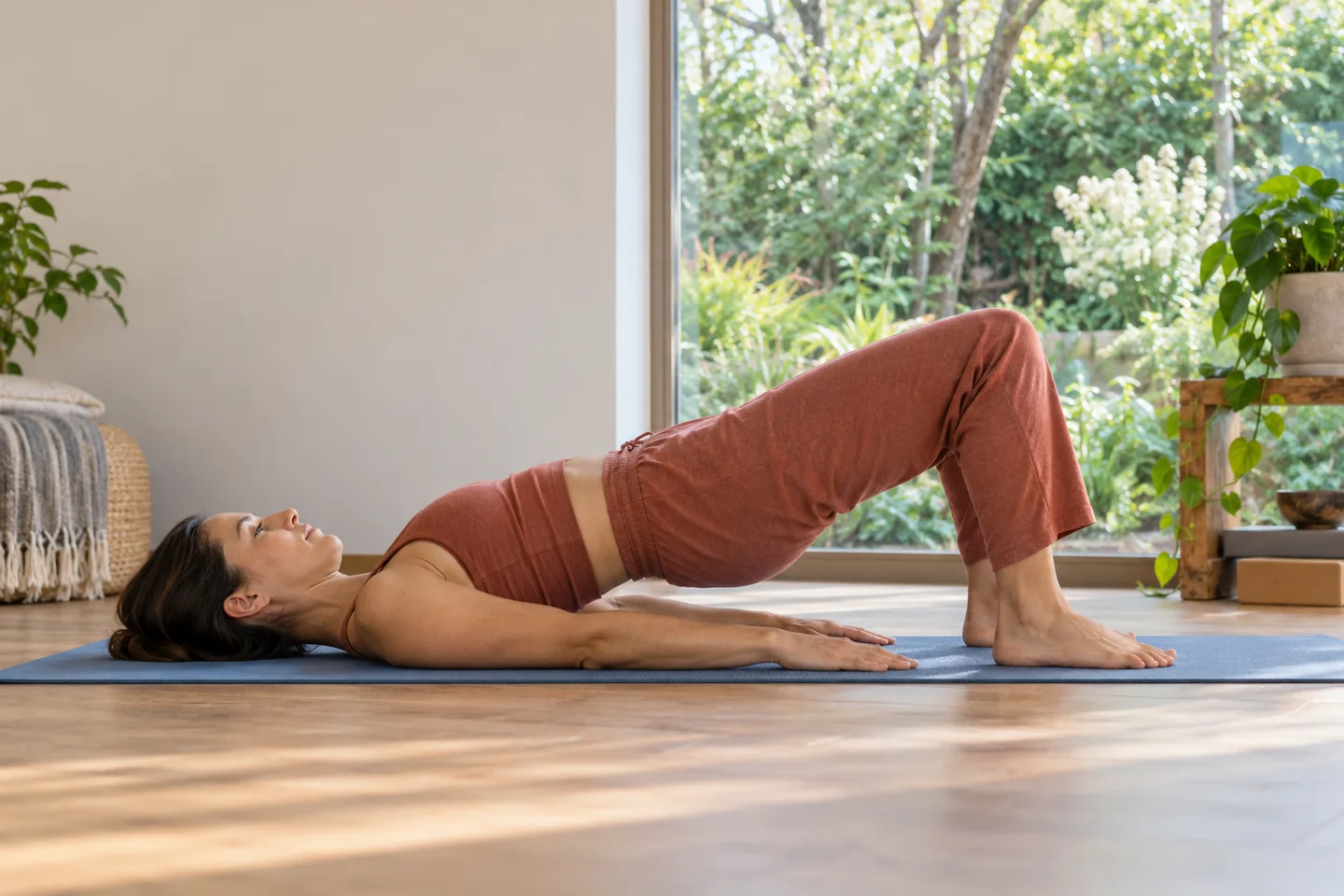
4. How Do You Do Bridge Pose (Setu Bandhasana)?
- Lie on your back with knees bent and feet flat, hip-width apart and close to your hips.
- Rest your arms by your sides, palms down.
- Inhale and press through your feet to lift your hips slowly.
- Keep your knees pointing forward and your gaze straight up. Don’t turn your head.
- Hold for 3 to 5 breaths, then exhale and roll down one vertebra at a time.
- Repeat 3 to 5 times.
For a more relaxing version, lift your hips and slide a yoga block or firm cushion under your sacrum (the flat bone at the base of your spine), then rest your weight on it for 1 to 3 minutes. Bridge gently opens the chest and the front of the body, where many people hold anxious tension.
Safety: Avoid with neck injuries or after recent neck or spine surgery, and use the supported version if you have back pain. If you have severe panic attacks or a spinal injury, consult your doctor or a certified instructor first.
5. How Do You Do Corpse Pose (Savasana)?
- Lie on your back with your legs slightly apart and your arms a little away from your body, palms up.
- Put a pillow under your knees and a folded blanket under your head if you need them.
- Cover yourself with a blanket to stay warm.
- Close your eyes or soften your gaze toward the ceiling.
- Let your breath become natural, and relax your jaw, shoulders and hands.
- Stay for 5 to 10 minutes, then roll to your right side before sitting up slowly.
Many teachers treat Savasana as the time when the effects of practice settle, so try not to skip it. If lying still feels uneasy, keep your eyes open and rest your hands on your belly to feel it rise and fall.
Safety: If you’re pregnant, ask your midwife or doctor whether lying on your back is suitable for you. Resting on your side is a common alternative. If you have severe panic attacks or a spinal injury, consult your doctor or a certified instructor first.
What Other Calming Poses Can You Add?
These five poses also work well for stress and appear in the routines below.
- Standing Forward Bend (Uttanasana): stand with feet hip-width apart, bend your knees generously and let your head and arms hang for 5 to 8 breaths, then roll up slowly. Safety: skip with glaucoma, uncontrolled high blood pressure or recent eye surgery.
- Low Lunge (Anjaneyasana): from hands and knees, step one foot forward between your hands and lower the back knee onto a blanket. Hold for 5 breaths per side. Safety: pad the back knee, and skip with acute knee or hip pain.
- Reclined Bound Angle Pose (Supta Baddha Konasana): lie back, bring the soles of your feet together and let your knees fall open onto pillows for 2 to 5 minutes. Safety: support the knees well with groin or knee injuries.
- Supine Spinal Twist (Supta Matsyendrasana): lie on your back, hug one knee in and let it fall across your body for 1 minute per side. Safety: keep it gentle with disc problems or after back surgery.
- Seated Forward Bend (Paschimottanasana): sit with legs out front, knees bent as needed, and fold gently forward onto a pillow for 1 to 2 minutes. Safety: skip deep folding with disc injuries or sciatica.
For all five, if you have severe panic attacks or a spinal injury, consult your doctor or a certified instructor first.
Which Pranayama Breathing Techniques Work Best for Anxiety?
Slow pranayama with a longer exhale is often the most useful part of yoga for anxiety. Anulom Vilom, Nadi Shodhana and Bhramari are the three best-known techniques for calming the nervous system. Most people focus on poses and skip the breathing. For anxiety, the breathing usually does the heavy lifting.
Breathwork is the real key: Poses prepare the body, but slow breathing is often where people feel the quickest change. If you only have time for one thing, do 3 to 5 minutes of slow breathing with a longer exhale.
Why Does Breathwork Work Faster Than Poses for Anxiety?
Breathing is the one part of the stress response you can change on purpose, and slowing it may calm the body within minutes. You can’t will your heart to slow down, but you can lengthen your exhale. That longer exhale is thought to act on the heart through the vagus nerve.
There is some research support for this. In a 2023 Stanford study in Cell Reports Medicine, adults who did five minutes of breathwork a day for a month improved their mood and reduced their anxiety. Exhale-focused breathing (“cyclic sighing”) improved positive mood and lowered breathing rate more than mindfulness meditation did. It was a breathwork study rather than a yoga study, but it relies on the same long-exhale principle as pranayama.
How Do You Do Anulom Vilom (Alternate Nostril Breathing)?
Anulom Vilom is a simple alternate nostril breathing practice without breath retention, which makes it the best starting point for beginners. Some teachers use the names Anulom Vilom and Nadi Shodhana for the same practice. In many Indian schools, though, Anulom Vilom means the simpler version and Nadi Shodhana means the slower classical practice described next.
- Sit tall on a chair or cushion and relax your shoulders.
- Rest your left hand on your knee.
- Fold the index and middle fingers of your right hand toward your palm (Vishnu Mudra). You’ll use your thumb and ring finger.
- Close your right nostril with your thumb and breathe in slowly through the left for a count of 4.
- Close the left nostril with your ring finger, release the thumb and breathe out through the right for a count of 4.
- Breathe in through the right for 4, close it, and breathe out through the left for 4. That’s one round.
- Continue for 3 to 5 minutes, breathing quietly and smoothly.
Safety: Never force the breath. Stop if you feel dizzy or short of breath, and skip it if your nose is blocked. If you have severe panic attacks or a spinal injury, consult your doctor or a certified instructor first.
How Do You Do Nadi Shodhana (Channel-Purifying Breath)?
Nadi Shodhana follows the same alternate nostril pattern but slows the breath and lengthens the exhale, which many people find deeply calming. In traditional yoga, nadis are described as channels through which prana (life energy) flows. That is a traditional framework, not a description of human anatomy. The classical, advanced form also adds breath retention (kumbhaka). For anxiety, practice it without retention.
- Set up exactly as you would for Anulom Vilom.
- Breathe in through the left nostril for a count of 4.
- Breathe out through the right nostril for a count of 6, and later 8.
- Breathe in through the right for 4, and out through the left for 6 to 8.
- Continue for 5 to 10 rounds, building up to 10 minutes as you gain experience.
- Finish with three natural breaths through both nostrils.
Safety: Don’t add breath holding if you’re anxious, pregnant, or have high blood pressure, heart disease or epilepsy, unless your doctor approves and a qualified teacher guides you. If you have severe panic attacks or a spinal injury, consult your doctor or a certified instructor first.
How Do You Do Bhramari (Humming Bee Breath)?
Bhramari is a humming exhale that lengthens the out-breath and fills your head with a soothing vibration. Many people say it helps quiet racing thoughts, though direct research on humming is still limited.
- Sit tall and close your eyes.
- If you like, rest your index fingers gently on the small flap of cartilage in front of each ear to soften outside noise.
- Breathe in slowly through your nose.
- With your lips closed, breathe out slowly while making a steady, low “mmmm” sound.
- Feel the vibration in your face, throat and head.
- Repeat 5 to 7 times, then sit quietly for a few breaths.
Safety: Don’t press on the ears if you have an ear infection. Practice sitting up, not lying down, and stop if you feel lightheaded. If you have severe panic attacks or a spinal injury, consult your doctor or a certified instructor first.
What Simple Breathing Techniques Can You Use Anywhere?
Belly breathing and extended-exhale breathing need no hand positions, so you can use them at your desk, in line at the store or in bed.
For belly (diaphragmatic) breathing, place one hand on your chest and one on your belly. Breathe in through your nose so the belly hand rises more than the chest hand, then breathe out slowly. Keep going for 2 to 5 minutes.
For extended-exhale breathing, breathe in for a count of 4 and out for 6 to 8. If counting stresses you out, just make each out-breath a little longer than the in-breath.
Which Breathing Practices Should Anxious Beginners Avoid?
Avoid fast or forceful techniques such as Kapalabhati (skull-shining breath), Bhastrika (bellows breath) and long breath retention when you feel anxious. Rapid breathing can cause lightheadedness, tingling or a racing heart, which can feel like anxiety itself. Learn these later from an experienced teacher, if at all. If you’re pregnant or have high blood pressure, a heart condition or epilepsy, avoid them unless your doctor approves.
Also read: How To Choose Pranayama Online Course? Practice Safely 2026
Can Yoga Nidra Help With Stress and Anxiety?
Yes. Yoga Nidra, a guided relaxation practiced lying down, shows promising results for stress and anxiety. A 2025 systematic review and meta-analysis by Ghai and colleagues in the Annals of the New York Academy of Sciences pooled 73 studies with 5,201 participants. It reported meaningful reductions in stress, anxiety and depression, including when Yoga Nidra was compared with other active practices.
The studies varied a lot in length and design, so the exact size of the benefit is still uncertain. Even so, Yoga Nidra suits many stressed people because it needs no flexibility and no effort. You lie down and follow a voice. A session usually moves through settling, a sankalpa (a short personal resolve), a body scan, breath awareness, opposite sensations, simple visualization and a slow return.
Yoga Nidra is one of three specialties at the heart of our advanced 300-hour program, alongside Chakra Sadhana and Prana Vidya.
Also read: What Is a Yoga Nidra? Meaning, Benefits, How It Works & 8 Easy Stages
What Are the Best Ready-to-Use Yoga Routines for Stress and Anxiety?
The three best ready-to-use routines are a 5-minute desk and chair routine for the workday, a 15-minute morning calm flow to start the day, and a 10-minute bedtime wind-down for sleep anxiety and overthinking. Each one uses the poses and breathing practices explained above.
5-Minute Desk and Chair Yoga for Office Workers
You only need a stable chair, so you can do this in work clothes, between Zoom or Teams calls, or before a difficult conversation.
| Step | Practice | Time | How |
|---|---|---|---|
| 1 | Grounding breath | 30 sec | Feet flat, hands on thighs, 3 slow belly breaths |
| 2 | Seated Cat-Cow | 1 min | Hands on knees. Inhale, lift the chest. Exhale, round the back |
| 3 | Neck release | 45 sec | Drop your right ear toward your right shoulder for 3 breaths, then switch |
| 4 | Seated side stretch | 45 sec | Right hand on the seat, left arm overhead, lean right for 3 breaths, then switch |
| 5 | Seated twist | 1 min | Sit tall, turn gently right holding the chair back for 3 breaths, then left |
| 6 | Extended-exhale breathing | 1 min | In for 4, out for 6 to 8, eyes resting on one spot |
Safety: Keep twists and neck stretches gentle and skip anything that hurts. If you have severe panic attacks or a spinal injury, consult your doctor or a certified instructor first.
15-Minute Morning Calm Flow
This flow steadies your mind before the day starts: breathing first, gentle movement next and a short rest at the end.
| Step | Practice | Time |
|---|---|---|
| 1 | Anulom Vilom, seated | 3 min |
| 2 | Cat-Cow | 1.5 min |
| 3 | Child’s Pose | 1 min |
| 4 | Low Lunge, each side | 2 min |
| 5 | Standing Forward Bend, knees bent | 1 min |
| 6 | Mountain Pose with arms overhead, slow breaths | 1 min |
| 7 | Bridge Pose, lift and lower 3 to 5 times | 1.5 min |
| 8 | Supine Spinal Twist, each side | 2 min |
| 9 | Savasana | 2 min |
If you wake up restless, swap step 4 for three slow rounds of half sun salutation (arms up, fold forward, half lift, fold, rise up), moving one breath per movement.
Safety: Rise slowly from folds to avoid dizziness. If you have severe panic attacks or a spinal injury, consult your doctor or a certified instructor first.
10-Minute Bedtime Wind-Down Sequence
This sequence is built for sleep anxiety and overthinking, so it stays low to the floor and slows down step by step. Dim the lights and leave your phone in another room.
| Step | Practice | Time |
|---|---|---|
| 1 | Child’s Pose with a pillow under the chest | 1.5 min |
| 2 | Bhramari breath, seated | 1 min |
| 3 | Supine Spinal Twist, each side | 2 min |
| 4 | Reclined Bound Angle Pose with pillows under the knees | 1.5 min |
| 5 | Legs-Up-the-Wall | 2.5 min |
| 6 | Savasana with a slow body scan from toes to head | 1.5 min |
If a thought keeps coming back, silently label it “thinking” and return to the feeling of your breath.
Safety: Skip Legs-Up-the-Wall with glaucoma or in later pregnancy and rest on your side instead. If you have severe panic attacks or a spinal injury, consult your doctor or a certified instructor first.
How Often Should You Practice Yoga for Stress and Anxiety?
Most studies used one to three sessions a week for 8 to 12 weeks, with sessions of about 60 to 90 minutes. At home, short daily sessions are usually easier to stick with. A 2016 meta-analysis of 17 hatha yoga studies for anxiety found that benefits were linked to the total hours practiced, so consistency matters more than intensity.
This four-week starter plan builds on the routines above.
| Week | What to do | Goal |
|---|---|---|
| 1 | 5-minute desk routine on 5 workdays | Build the habit |
| 2 | Desk routine on workdays, plus the 10-minute bedtime wind-down on 4 nights | Add evening calm |
| 3 | 15-minute morning flow on 3 days, bedtime wind-down on 4 nights | Learn the full flow |
| 4 | Your favorite routine daily, plus a 15 to 20 minute guided Yoga Nidra twice a week | Deepen relaxation |
Track how you feel by rating your stress from 0 to 10 before and after each session. Look back after four weeks. Many people see the “after” numbers drop first, with the “before” numbers following over time.
What Is the 3-3-3 Rule of Anxiety?
The 3-3-3 rule is a quick grounding technique: you name three things you can see, three sounds you can hear, and then move or touch three parts of your body or objects around you. It pulls your attention out of anxious thoughts and back into the present. Rethink Mental Illness, a UK mental health charity, describes a version that uses three things you can touch.
- See: look around and name three things, such as a window, a mug and a plant.
- Hear: listen for three sounds, such as traffic, a fan and your own breathing.
- Move or touch: wiggle your toes, roll your shoulders and press your palms together, or touch three objects near you.
The 3-3-3 rule is a popular coping tool rather than a researched treatment. It works best as a quick reset, not as a replacement for professional care.
How Can You Combine the 3-3-3 Rule With Yoga Breathing in an Anxious Moment?
Pair the 3-3-3 rule with a long exhale to calm both mind and body in about two minutes. A full yoga class isn’t the right tool during an acute panic attack, but this short sequence can help you ride out an anxious moment:
- Plant your feet and feel the floor under you.
- Do the 3-3-3 rule slowly.
- Lengthen your exhale: in for 4, out for 6 to 8, for 5 to 10 breaths.
- Hum two or three rounds of Bhramari if you’re somewhere private.
- Drop your shoulders and soften your jaw on each exhale.
If you have chest pain, trouble breathing, fainting or symptoms you’ve never had before, get urgent medical care. Panic symptoms can look like other medical problems, so new symptoms should always be checked.
What Are 12 Ways to Deal With Stress?
Twelve practical ways to deal with stress are: move daily, slow your breathing, protect your sleep, eat regular meals, cut back on caffeine and alcohol, avoid unhealthy coping habits, stay connected, take breaks from news and screens, set boundaries, spend time outdoors or on hobbies, practice mindfulness, and get professional help when stress persists. Yoga covers several of these at once.
- Move your body every day. Even a 10-minute walk or the desk routine above helps.
- Slow your breathing. Three minutes of extended-exhale breathing can take the edge off.
- Protect your sleep. Keep regular bed and wake times, and use the bedtime wind-down.
- Eat regular, balanced meals. Skipped meals can leave some people shaky and irritable.
- Cut back on caffeine and alcohol. Both can disturb sleep and feed anxious feelings.
- Avoid unhealthy coping habits. Leaning on alcohol, drugs, overeating or endless scrolling usually adds stress over time.
- Stay connected. Talk with a friend, a family member or a community group you trust.
- Take breaks from news and social media. Check at set times instead of scrolling all day.
- Manage your time and set boundaries. Break big tasks into small steps, and say no when your plate is full.
- Get outdoors and make time for hobbies. A walk in the park, music, cooking or crafts give your mind a different focus.
- Practice mindfulness or meditation. Short daily sessions train calmer attention.
- Get professional help. If stress lasts for weeks or affects daily life, talk to your doctor (your GP in the UK), a psychologist or a counselor.
What Exercise Can Help Relieve Stress?
Almost any regular exercise can help relieve stress, including brisk walking, running, cycling, swimming, strength training, dancing, tai chi and yoga. The best exercise for stress is the one you enjoy enough to do most days.
A large 2023 overview in the British Journal of Sports Medicine (Singh et al.) pooled 97 reviews covering 1,039 trials and about 128,000 adults. Physical activity produced medium-sized reductions in both depression and anxiety symptoms. For anxiety, yoga and other mind-body exercise showed the largest median effect of any exercise type. The authors noted that many of the reviews were low quality, so treat the exact numbers with care.
| Type of exercise | Examples | Why it helps with stress |
|---|---|---|
| Aerobic | Brisk walking, jogging, cycling, swimming, dancing | Can lift mood and use up restless energy |
| Strength | Bodyweight exercises, weights, resistance bands | Builds strength, and many people find it gives a sense of control |
| Mind-body | Yoga, tai chi, qigong | Combines movement with breath and calm attention |
| Outdoor and social | Hiking, team sports, group walks | Adds nature and social connection |
How much do you need? The WHO’s 2020 guidelines recommend that adults get 150 to 300 minutes of moderate activity, or 75 to 150 minutes of vigorous activity, each week, plus muscle-strengthening activity on two or more days. Yoga can count toward this, especially the more active styles.
Yoga for Reducing Stress and Anxiety vs Other Exercise and Therapy: Which Works Better?
Yoga, other exercise and therapy all help, but they work in different ways. Yoga adds breath regulation, relaxation and focused attention to movement. Aerobic and strength exercise build fitness and lift mood. For diagnosed anxiety disorders, cognitive behavioral therapy (CBT) still has the strongest evidence.
| Approach | How it helps | Evidence for stress and anxiety | Best suited to |
|---|---|---|---|
| Yoga | Movement + breath + relaxation + attention | Short-term benefits for stress and elevated anxiety; helped many people with GAD, though less than CBT | People who want a calm, whole-body practice |
| Aerobic exercise | Builds fitness and can lift mood | Medium effects on anxiety in large reviews; yoga beat matched walking in the small GABA study above | People who calm down through rhythmic activity |
| Strength training | Builds strength and confidence | Helps anxiety, though with fewer reviews than other types | People who like clear goals and progress |
| Breathwork alone | Slows breathing and arousal | Five minutes a day improved mood and anxiety in a 2023 trial | Very busy people; relief in the moment |
| Cognitive behavioral therapy (CBT) | Changes worry patterns and avoidance | First-line treatment for anxiety disorders; strongest long-term evidence | Anyone with a diagnosed or suspected anxiety disorder |
The best choice is often a combination. Plenty of people do yoga alongside walking, therapy or medical treatment, and a calmer body can make it easier to get the most out of therapy.
Is Yoga Safe for People With Anxiety?
Gentle yoga is generally safe for most adults, including people with anxiety, when they practice within comfortable limits. The 2018 review of yoga for anxiety found no increase in injuries in the trials that reported safety. Some people still need extra care.
Check with your doctor before you start if you:
- Have severe or frequent panic attacks
- Have a spinal injury, a disc problem or recent neck or back surgery
- Are pregnant or recently gave birth
- Have high or low blood pressure, or a heart condition
- Have glaucoma or recent eye surgery (avoid head-down poses)
- Have had other recent surgery or an injury
- Have epilepsy (avoid fast breathing practices)
- Have osteoporosis
- Take medication that affects your balance or blood pressure
If you have a history of trauma, some practices can bring up strong feelings. Closing your eyes, lying still or certain hip-opening poses may feel uneasy, and mild discomfort like this is common. You can keep your eyes open, stay near the door or choose a trauma-informed class. If a practice makes your anxiety worse, stop and go back to slow breathing. Flashbacks, feeling detached from your body or surroundings, or losing track of time are different from ordinary unease. If those happen, stop and talk to a trauma-informed mental health professional.
What Mistakes Should Beginners Avoid?
The most common beginner mistakes are pushing too hard, choosing an overstimulating class, holding the breath and skipping the final relaxation.
- Forcing poses. Stress relief comes from ease, not effort.
- Starting with hot or power yoga when anxiety is high. Begin gently.
- Holding your breath. If you notice it, exhale slowly.
- Skipping Savasana. Many teachers see it as the time when the calm settles in.
- Comparing yourself with others. Your body and your day are different.
- Practicing only when you feel terrible. Regular practice builds resilience.
- Using yoga to avoid getting help. It works best alongside proper care when you need it.
When Should You See a Doctor Instead of Relying on Yoga?
See a doctor or mental health professional if worry is hard to control, lasts for weeks, disrupts your sleep, work or relationships, or comes with panic attacks. Yoga can support your recovery, but it shouldn’t delay an assessment or treatment.
The WHO notes that effective treatments for anxiety disorders exist, yet only about 1 in 4 people who need treatment receive any. Please don’t wait.
For generalized anxiety disorder, the UK’s NICE guideline CG113 recommends a stepped approach. It starts with low-intensity options such as guided self-help or psychoeducational groups. If those aren’t enough, it offers a choice of a high-intensity psychological therapy (CBT or applied relaxation) or medication such as an SSRI, decided together with the patient. Yoga can sit alongside this care, but it isn’t one of these recommended treatments. In the US, start with your primary care doctor or a licensed therapist. In the UK, start with your GP. In England, you can also refer yourself to NHS Talking Therapies.
Get urgent help right away if you have thoughts of harming yourself, chest pain or severe breathing problems. In the US, call or text 988. In the UK, call NHS 111 or Samaritans on 116 123. In an emergency, call 911 (US) or 999 (UK).
A yoga teacher isn’t a medical professional or a yoga therapist. A general yoga class, or even a teacher training course, doesn’t qualify anyone to treat anxiety disorders.
Also read: What Is Therapy Yoga? Meaning, 8 Uses, Benefits & How It Works
How Does Inteyoga Approach Stress and Restorative Practice?
At Inteyoga, we approach yoga as an integrated discipline that includes body, breath, mind, conduct and daily life, rather than a set of isolated techniques. Our school, Swami Krishnananda Yoga Vidyapeeth in Colva, South Goa, India, is registered with Yoga Alliance as a Registered Yoga School (RYS 200, RYS 300 and RYS 500).
Our current program is the Advanced TTC 300-Hour Integrated Restorative Yoga (Including Yoga Nidra, Chakra Sadhana, and Prana Vidya Intensive). It centers on restorative practice, Yoga Nidra and breath-centered Prana Vidya, the same families of practice covered in this guide.
Key facts about the advanced 300-hour program:
- Format: fully residential, with accommodation and meals included, taught in English
- Length: 43+2 days (43 training days plus one arrival and one departure day)
- Who it’s for: practitioners who have completed a 200-hour TTC or an accepted equivalent, aged 21 to 60. It’s an advanced training, not a beginner retreat.
- Contribution model: Gift-it-Forward. No payment is required to apply or to participate. After completing, participants may voluntarily support the Gift-it-Forward initiative to help future aspirants, with no obligation.
- Next scheduled batch: 13 December 2026 to 26 January 2027. The course page lists all six scheduled batches for 2026 and 2027.
The training is led by our founder-director, Dr. Ashutosh, a physician and yoga teacher who brings together Hatha Yoga, Raja Yoga, Ayurveda, applied anatomy and classical sources.
Are you a trained teacher who wants to go deeper into restorative practice? Explore the 300-hour Integrated Restorative Yoga program or apply for an upcoming batch.
New to yoga? Our planned 200-hour program is expected around mid-2027, and details will be shared once they’re officially announced. You can join the 200-hour program waitlist.
Conclusion
Yoga for reducing stress and anxiety isn’t a quick fix, but it’s a low-risk practice with growing research support that can help many people feel calmer in body and mind. It may help by moving your nervous system away from fight-or-flight, and trials show short-term drops in stress and anxiety for many participants. The evidence is strongest for everyday stress and elevated anxiety. For diagnosed anxiety disorders, yoga works best alongside proven care.
Start small. Pick the routine that fits your day and give breathwork most of your attention. Lengthen your exhale, stay in Savasana a little longer than feels necessary, and track how your stress score changes over a few weeks.
If you’re a yoga teacher who wants to study restorative practice, Yoga Nidra and Prana Vidya in depth, our residential training in Goa could be your next step. Read our FAQ to learn more about life and study at Inteyoga.
Frequently Asked Questions (FAQ)
How Long Does Yoga Take to Relieve Anxiety?
Some people feel calmer within 5 to 10 minutes of slow breathing, and trials have reported short-term relief after a single gentle session. Lasting change takes longer. Most research programs ran for 8 to 12 weeks, with one to three sessions a week. A short daily practice of 5 to 15 minutes is a good way to build steady results.
Can Beginners Do Yoga for Anxiety at Home Without an Instructor?
Yes, most healthy beginners can safely do gentle yoga and simple breathing at home. Start with short, supported routines like the ones in this guide, move slowly and never hold your breath. A few classes with a qualified teacher will help you learn safe alignment. If you have severe panic attacks, a spinal injury or another health condition, ask your doctor first.
Yoga vs Meditation: Which Is Better for Stress Relief?
Both work, and research hasn’t shown a clear winner. The 2024 Frontiers in Psychiatry review found no clear short-term difference between yoga and mindfulness training for stress. Yoga may suit you better if sitting still is hard or your body holds a lot of tension. Meditation may suit you if you prefer quiet stillness. Many people do both, since most yoga sessions end in meditation.
Can Yoga Replace Anxiety Medication or Therapy?
No. Yoga can support your mental health, but it shouldn’t replace treatment prescribed by a doctor or therapist. In a major 2021 trial, yoga helped many people with generalized anxiety disorder, but CBT worked better and stayed the first-line treatment. Never stop or change medication without talking to your doctor first.
Can Yoga Help With Both Anxiety and Depression?
Research suggests it can help with symptoms of both. A 2023 overview in the British Journal of Sports Medicine found that physical activity, including yoga, produced medium-sized reductions in depression and anxiety symptoms, with yoga and mind-body exercise showing the largest median effect for anxiety. Yoga works best alongside, not instead of, care from a doctor or therapist.
What Is the Best Yoga Pose for Anxiety?
There’s no single best pose, but Child’s Pose (Balasana) and Legs-Up-the-Wall (Viparita Karani) are two of the most calming for beginners. Both are simple, supported and easy to hold for several minutes. Pair any pose with a slow, long exhale for the strongest calming effect.
Can Yoga Make Anxiety Worse?
Sometimes. Fast breathing, intense heat, long breath holds or lying still with your eyes closed can feel uncomfortable for some anxious people, and strong emotions may come up. If a practice makes you more anxious, stop, open your eyes and go back to slow belly breathing. Choose gentler styles and trauma-informed teachers.
Is It Okay to Do Yoga Every Day for Stress?
Yes. Gentle yoga and breathing practice are safe to do daily for most healthy adults. A daily habit makes the calming effect easier to reach. Keep the intensity low, rest when you’re tired, and vary your poses so no single area gets overworked.