Quick Answer
A pranayama online course teaches yogic breath control through recorded videos, live classes or private sessions. A good one starts with breath awareness and gentle techniques such as Nadi Shodhana and Bhramari, lists safety rules and contraindications, gives you feedback on your practice, and progresses slowly over weeks. Beginners should skip courses that start with forceful breathing or long breath holds.
Ready to study pranayama in depth with a teacher in the room? See our Advanced TTC 300-Hour Integrated Restorative Yoga (Including Yoga Nidra, Chakra Sadhana, and Prana Vidya Intensive).
Key Takeaways
- Start with gentle techniques: breath awareness, full yogic breath, Nadi Shodhana without breath holding, and Bhramari.
- Kapalbhati, Bhastrika and breath retention carry more risk and are better learned with a teacher who can see you.
- Research on slow breathing shows modest, short-term improvements in mood and stress for some people. It does not show that pranayama cures any disease.
- Judge a course by its teacher, its sequencing, its safety guidance and how much feedback you get, not by the length of its technique list.
- A short online pranayama certificate can add to a yoga teacher’s skills, but it doesn’t make anyone a Registered Yoga Teacher.
- If you’re in the US and considering live classes run from India, check class times in your own time zone first.
In 2022, 16.9% of American adults said they had practiced yoga in the past year, according to the CDC’s National Center for Health Statistics. That’s roughly one in six people. Plenty of them learn from a laptop or a phone, and breathing practice is part of that shift.
A pranayama online course can be a good way in. It can also go wrong without anyone noticing. Breathing exercises look simple on a screen, but small mistakes in posture, pace or breath holding change what a technique does to the body, and a pre-recorded video can’t see you make them.
This guide covers what a good online pranayama course should teach, how to vet one before you pay, which techniques to start with, what the research does and doesn’t show, and when learning in person makes more sense. Classical pranayama is part of the residential teacher training curriculum at Inteyoga in Colva, South Goa, India, and this guide draws on that training framework.
What Is A Pranayama Online Course?
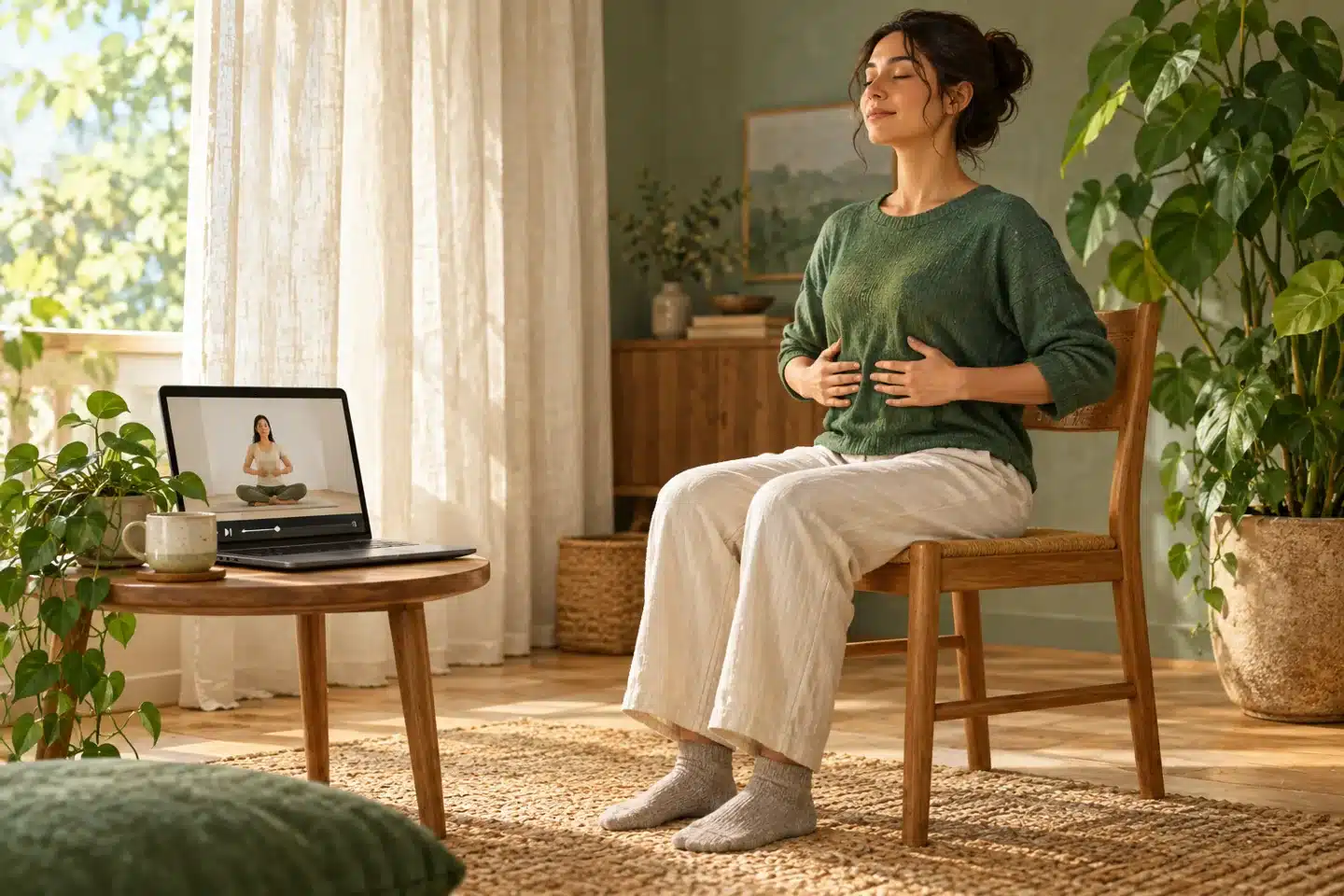
A pranayama online course is a structured program that teaches yogic breathing techniques over the internet. You learn through recorded videos, live group classes on Zoom or a similar platform, or private one-to-one sessions.
Most courses mix hands-on practice with some theory about the breath, the nervous system and yoga philosophy.
You’ll find three main formats:
| Format | How It Works | Best For | Main Weakness |
|---|---|---|---|
| Self-paced recorded | Pre-recorded videos you watch any time | Busy schedules, self-motivated learners | Nobody checks your technique |
| Live group classes | Scheduled classes on video call | People who need a routine and some feedback | Fixed times, less personal attention |
| One-to-one sessions | Private live sessions with a teacher | Beginners with health concerns, people who want close guidance | Higher cost |
Many providers combine these. A self-paced course might add recorded Q&A calls, while a private-session program might let a family or a small group of friends join together.
What Should US Students Know About Time Zones?
Some online pranayama schools run live classes on Indian Standard Time. India is 9.5 to 13.5 hours ahead of the continental US, depending on your time zone and whether daylight saving is in effect. A 7:00 a.m. live class in India starts at 9:30 p.m. the previous evening in New York during daylight saving time.
Before you sign up for live sessions, convert the class times to your own time zone and ask whether recordings are available.
If no one ever watches you breathe, choose a course that sticks to gentle techniques and explains safety in detail.
What Does Pranayama Actually Mean?
Pranayama is the yogic practice of regulating the breath. The word joins two Sanskrit terms: prana, which yogic tradition describes as life force, and ayama, meaning extension or regulation. Some teachers read it as prana plus yama, meaning control.
In Patanjali’s Yoga Sutras, pranayama is the fourth of the eight limbs of yoga. It comes after ethical conduct (yama and niyama) and posture (asana), and before sense withdrawal and meditation. Classical yoga treats pranayama as a bridge between body and mind, not as a standalone breathing workout.
The Hatha Yoga Pradipika, a hatha yoga text usually dated to the 15th century, gives pranayama its own chapter. It says the breath should be brought under control gradually, the way lions, elephants and tigers are tamed, and warns that careless practice can cause harm.
In the yogic tradition, a complete pranayama practice includes more than breathing exercises:
- Breath awareness, where you notice the natural breath without changing it
- Regulated breathing, where you change the length, depth and ratio of inhale and exhale
- Kumbhaka, or breath retention, introduced only after the basics are steady
- Bandhas, the locks at the throat, abdomen and pelvic floor, used with retention
- Posture and mudras, meaning how you sit and hold your spine and hands
Traditional texts also describe nadis, channels through which prana is said to flow. These are concepts from yogic philosophy, not structures described in modern anatomy.
A pranayama online course that only teaches regulated breathing is teaching breathwork, not the full traditional practice.
What Will You Learn In A Pranayama Online Course?
A complete pranayama online course covers breath anatomy, preparatory breathing, the main classical techniques, safe sequencing, and how to build a daily routine. Courses for yoga teachers add teaching methods, verbal cues and how to screen students for health risks.
How Does Breathing Work In The Body?
Good courses start with basic anatomy. You learn how the diaphragm, rib cage and abdominal muscles move with each breath, and how breathing relates to the autonomic nervous system, which is involved in stress and relaxation responses. This makes the techniques easier to learn and to practice safely.
What Are The Preparatory Practices?
Before classical pranayama, a well-built course teaches:
- Abdominal, or diaphragmatic, breathing
- Thoracic, or chest, breathing
- Clavicular, or upper chest, breathing
- Full yogic breath, which joins all three in one smooth wave
These build control and awareness. A course that jumps past them leaves out the foundation the rest of the practice depends on.
Which Classical Techniques Are Taught?
Most courses teach some version of these:
- Nadi Shodhana, also called Anulom Vilom (alternate nostril breathing)
- Ujjayi (ocean-sound breath)
- Bhramari (humming bee breath)
- Sheetali and Sheetkari (cooling breaths)
- Kapalbhati (rapid forceful exhales, classed in hatha yoga as a cleansing practice, or kriya)
- Bhastrika (bellows breath)
- Surya Bhedana and Chandra Bhedana (right and left nostril breathing)
How Do You Sequence And Progress?
A good course tells you what to practice first, for how long, and when to move on. It also explains how to pair pranayama with yoga poses and meditation, and which techniques suit mornings versus evenings.
What Should The Course Teach About Safety?
This is where many online courses are thin. A proper course tells you who should avoid each practice, which warning signs to watch for, and when to stop.
If a course page lists techniques but says nothing about sequencing or safety, treat that as a red flag.
Which Pranayama Techniques Should Beginners Learn First?
Beginners should start with breath awareness, full yogic breath, Nadi Shodhana without breath holding, and Bhramari. These are gentle, easy to learn without close supervision, and suitable for most healthy adults. Forceful techniques and long breath holds can wait.
| Technique | Level | What It Involves | Beginner-Friendly Online? |
|---|---|---|---|
| Breath awareness | Beginner | Watching the natural breath | Yes |
| Full yogic breath | Beginner | Slow belly, rib and chest breath | Yes |
| Nadi Shodhana (no retention) | Beginner | Alternate nostril breathing | Yes |
| Bhramari | Beginner | Humming on the exhale | Yes |
| Ujjayi | Beginner to intermediate | Slight throat narrowing for a soft sound | Yes, with clear cues |
| Sheetali / Sheetkari | Beginner to intermediate | Inhaling through the rolled tongue or the teeth | Yes, especially in hot weather |
| Kapalbhati | Intermediate | Rapid forceful exhales | Only with health screening and feedback |
| Bhastrika | Intermediate to advanced | Forceful inhale and exhale | Better learned in person |
| Kumbhaka with bandhas | Advanced | Breath retention with locks | Learn in person |
How Do You Practice Nadi Shodhana As A Beginner?
- Sit upright with a straight, relaxed spine.
- Rest your left hand on your knee.
- Close your right nostril with your right thumb.
- Inhale slowly through the left nostril.
- Close the left nostril with your ring finger and release the right.
- Exhale slowly through the right nostril.
- Inhale through the right, switch, and exhale through the left.
- That completes one round. Start with 5 to 9 rounds.
Keep the breath quiet and unforced, and don’t hold it at this stage.
How Do You Practice Bhramari?
- Sit comfortably and close your eyes.
- Inhale gently through the nose.
- As you exhale, make a steady humming sound, like a bee.
- Keep your lips closed and your jaw relaxed.
- Repeat 5 to 7 rounds, then sit quietly for a minute.
The humming gives the mind something to rest on, which some beginners find helpful when their thoughts are busy.
What If You Can’t Roll Your Tongue For Sheetali?
Not everyone can curl the tongue into a tube, and that’s normal. If Sheetali doesn’t work for you, practice Sheetkari instead: rest the teeth lightly together, part the lips, and inhale slowly through the gaps between the teeth.
Slow, gentle and steady works better than long, forceful and impressive.
What Are The Benefits Of A Pranayama Online Course?
The main benefits of a pranayama online course are convenience, lower cost, the ability to replay lessons, and access to teachers you couldn’t reach locally. A well-designed course also helps you build a steady daily habit at home, which is where most progress happens.
What Are The Practical Benefits?
- You learn from anywhere, with no drive to a studio.
- You can rewatch a lesson as often as you need, since many platforms give long or lifetime access.
- Self-paced formats fit around shift work, parenting and long workdays.
- Online courses usually cost less than residential training.
- You can study with a school in another state or another country.
What Benefits Might You Notice In Your Practice?
With regular, well-guided practice, pranayama may help you:
- Feel calmer and less reactive
- Focus better
- Settle your mind before meditation or sleep
- Notice what’s happening in your body
- Deepen and steady your yoga pose practice
These are common aims of practice, not guaranteed outcomes. Results vary from person to person.
How Do People Use Pranayama In Everyday Life?
Here are a few ways people fit breath practice into a normal American workday:
- Ten minutes of Nadi Shodhana before logging on for remote work
- A few rounds of slow breathing with a longer exhale before a presentation or a job interview
- Bhramari in the evening as part of winding down before bed
- Full yogic breath at the end of a gym session or a run, while the heart rate settles
Never practice pranayama while driving. Any technique that changes your breathing can also change your alertness.
Why Do Yoga Teachers Take Pranayama Courses?
For teachers, a pranayama online course can fill gaps left by a 200-hour training, sharpen how they cue and sequence breath practices, and count toward continuing education if the provider is approved.
Yoga Alliance asks Registered Yoga Teachers to complete 45 teaching hours and 30 training hours every three years.
The benefits come from practicing, not from watching. A course you never practice gives you information, not results.
Also read: Yoga Instructor Course 2026: Best Fees, Certification & Eligibility
What Does The Research Say About Breathing Practices?
Research on slow, structured breathing is promising but still early. Some good-quality studies suggest short daily breathing practice can improve mood and reduce self-reported stress for some people. No study shows that pranayama cures disease.
What Did The Stanford Breathing Study Find?
In a remote randomized study published in Cell Reports Medicine in January 2023, Stanford researchers assigned volunteers to one of three five-minute daily breathing exercises, or to mindfulness meditation, for one month.
The breathing groups practiced cyclic sighing with longer exhales, box breathing with equal phases, or fast breathing followed by breath holds.
The exhale-focused cyclic sighing group showed greater improvement in mood and a larger drop in breathing rate than the mindfulness meditation group.
The study has clear limits. It found no significant change in heart rate variability or resting heart rate in any group. It tested short modern breathing drills in healthy volunteers, not classical pranayama practiced over years, and it lasted only one month.
What Does The Wider Evidence Show?
A 2023 meta-analysis in Scientific Reports pooled 12 randomized controlled trials with 785 adults. It linked breathwork interventions with lower self-reported stress than control conditions. The effect was small to medium, and the authors rated most of the included studies as having a moderate risk of bias.
What Does This Mean For You?
- Slow breathing with a longer exhale is a sensible, low-risk place to start for most healthy adults.
- Most people notice calm and better mood rather than dramatic physical change.
- A slower breathing rate in a study doesn’t prove a specific change in the nervous system.
- Claims that pranayama “cures” diabetes, high blood pressure or anxiety go beyond the evidence.
- If you have a health condition, pranayama may support your medical care but should not replace it.
Be cautious of any online pranayama course that promises cures. Careful language is a sign the teacher respects the evidence.
Is It Safe To Learn Pranayama Online?
Gentle pranayama is generally safe to learn online for healthy adults. Forceful techniques and breath retention carry more risk and are better learned with a teacher who can see you. Your health history decides which practices suit you.
Which Techniques Need The Most Care?
Kapalbhati needs the most care. The Ministry of AYUSH’s Common Yoga Protocol lists high blood pressure, peptic ulcer and hernia among the conditions in which it should be avoided.
Other yoga sources go further. They advise against Kapalbhati during pregnancy or menstruation, and for people with low blood pressure, heart disease, epilepsy, vertigo, migraine, glaucoma, detached retina, a history of stroke, or recent abdominal surgery.
Bhastrika and long breath retention carry similar cautions. Fast breathing can cause dizziness, tingling or lightheadedness, and retention may not be appropriate for people with heart or eye conditions.
What Warning Signs Mean You Should Stop?
Stop and rest if you feel:
- Dizziness or lightheadedness
- Tingling in your hands, feet or face
- Chest pain or a racing heart
- Headache or pressure behind the eyes
- Anxiety, agitation or panic
- Nausea
If symptoms don’t settle, contact your healthcare provider. Chest pain that doesn’t pass is a medical emergency.
How Can You Make Online Learning Safer?
- Pick a course that asks about your health before you start.
- Stay with gentle techniques for several weeks.
- Practice on an empty stomach, ideally in the morning.
- Sit upright on a chair or cushion, not slouched on a couch or bed.
- Keep the breath smooth and quiet. Never force it.
- Leave out breath holding until a teacher has checked your basics.
- Ask for feedback through live classes, Q&A sessions or a video of your practice.
The safest online course tells you what not to do, not just what to do.
How Do You Choose The Right Pranayama Online Course?
Choose a pranayama online course by checking the teacher’s training, the order of the curriculum, the safety guidance, how much feedback you get, and whether the certificate matches your goals. A clear course page should answer all of this before you pay.
What Is The 10-Point Checklist?
| # | Question To Ask | What A Good Answer Looks Like |
|---|---|---|
| 1 | Who teaches it? | A named teacher with stated training and years of practice |
| 2 | Is there a health screening? | A form or call before you start |
| 3 | Does it start with the basics? | Breath awareness and preparatory breathing come first |
| 4 | Are contraindications listed? | Clear “who should not do this” notes for each technique |
| 5 | Will you get feedback? | Live classes, Q&A, or video review of your practice |
| 6 | How long does it run? | Enough weeks to build slowly, not a weekend cram |
| 7 | What tradition does it follow? | A clear, stated approach or lineage |
| 8 | Is the certificate useful to you? | It fits your goal, whether personal practice or CE hours |
| 9 | How long is access? | Long enough to practice and review |
| 10 | What is the refund policy? | Stated clearly before you buy |
What Are The Red Flags?
- Promises to cure medical conditions
- Kapalbhati or Bhastrika in the very first lesson
- Long breath holds for beginners
- No named teacher, or vague credentials
- No safety section anywhere
- “Master pranayama in 7 days” style marketing
- Wording that overstates Yoga Alliance status, such as “certified by Yoga Alliance”
Which Course Type Fits Which Learner?
| Your Situation | Best Fit |
|---|---|
| Healthy beginner | Live group or self-paced course focused on gentle techniques |
| Beginner with a health condition | One-to-one sessions, after clearance from your healthcare provider |
| Yoga teacher who needs CE hours | A course from a Yoga Alliance Continuing Education Provider (YACEP) |
| Serious practitioner who wants depth | In-person or residential training with daily supervision |
The best online pranayama course for you matches your health, your goal and your self-discipline. It isn’t necessarily the one with the longest list of techniques.
Can You Get Certified Through An Online Pranayama Course?
Yes. Many online pranayama courses give a certificate of completion, and some are approved for Yoga Alliance continuing education hours. A short online pranayama certificate doesn’t make you a Registered Yoga Teacher on its own.
It helps to know the difference between three types of credential:
| Type | What It Means | Example |
|---|---|---|
| Certificate of completion | You finished the course | Most self-paced courses |
| Continuing education (CE) hours | Hours a Registered Yoga Teacher can log toward renewal | Courses from a YACEP |
| Registered Yoga Teacher (RYT) | A Yoga Alliance registration for individuals who meet its training requirements through a Registered Yoga School | RYT 200, RYT 500 |
Course sizes vary a lot. For example, as listed on their websites in 2026, Sampoorna Yoga offers a 50-hour online pranayama teacher training with a multiple-choice theory test, and My Vinyasa Practice offers an online pranayama certification approved for 20 Yoga Alliance CE hours. These are examples only, not recommendations or an industry average.
If CE hours matter to you, confirm the provider appears in the Yoga Alliance directory before you enroll.
A pranayama certificate adds to your teaching skills. It doesn’t replace a full teacher training.
Also read: 500 Hour Yoga Teacher Training In Goa: A Complete 2026 Guide
Pranayama Online Course Vs Breathwork Course: What Is The Difference?
A pranayama online course teaches breath control within the yoga tradition, with its philosophy, sequence and energy practices. A breathwork course usually teaches modern breathing methods for stress, focus or performance, often without the yogic framework. Both can be useful, but they aren’t the same thing.
| Feature | Pranayama Online Course | Breathwork Course |
|---|---|---|
| Roots | Classical yoga texts such as the Yoga Sutras and Hatha Yoga Pradipika | Modern psychology, sports science, newer methods |
| Stated aim | Prepare the mind for meditation; in yogic terms, regulate prana | Stress relief, energy, performance, emotional release |
| Techniques | Nadi Shodhana, Ujjayi, Bhramari, Kapalbhati, Bhastrika | Box breathing, cyclic sighing, coherent breathing, hyperventilation methods |
| Breath retention | Kumbhaka with bandhas, introduced slowly | Varies; some methods use long holds after fast breathing |
| Philosophy | Part of the eight limbs of yoga | Often none, or a light wellness framing |
| Pace | Gradual, over months or years | Often faster and results-focused |
| Best for | Yoga practitioners and teachers | Anyone who wants quick, practical stress tools |
The two overlap. Nadi Shodhana shows up in many breathwork courses, and some teachers blend both approaches.
If you want to go deeper into yoga and meditation, choose pranayama. If you want quick stress tools without a spiritual framework, a breathwork course may suit you better.
Online Vs In-Person Pranayama Training: Which Is Better For You?
Online learning wins on convenience and cost. In-person training wins on depth, correction and advanced practice. Many practitioners use both, starting online and moving to in-person study when they want to go further.
| Factor | Online | In-Person / Residential |
|---|---|---|
| Cost | Usually lower | Usually higher, unless a school uses a different model |
| Flexibility | High | Fixed dates and location |
| Technique correction | Limited | Direct and immediate |
| Advanced practices | Risky without supervision | Taught with a teacher present |
| Daily discipline | Depends on you | Built into the schedule |
| Community | Online groups | Living and practicing together |
| Depth of immersion | Low to moderate | High |
When Should You Move From Online To In-Person?
Consider in-person training when:
- You want to learn breath retention and bandhas properly.
- You have practiced gentle pranayama daily for a few months and feel stuck.
- You plan to teach pranayama to others.
- You want pranayama as part of a full yogic lifestyle, alongside yoga poses, meditation and study.
Online is a good first step. For anyone who wants real depth, it’s rarely the last step.
Also read: Ashtanga Vinyasa Yoga Teacher Training: 200 Hour Certificate
A 4-Week Starter Plan For Home Practice
This plan helps healthy beginners build a steady daily habit alongside any pranayama online course. Practice 10 to 20 minutes a day, on an empty stomach, sitting upright. If you have a health condition, check with your healthcare provider first.
| Week | Daily Practice | Time | Focus |
|---|---|---|---|
| Week 1 | Breath awareness (5 min) + abdominal breathing (5 min) | 10 min | Notice the breath without changing it |
| Week 2 | Full yogic breath (5 min) + Bhramari, 5 rounds + quiet sitting | 12 to 15 min | Smooth, even breath |
| Week 3 | Full yogic breath + Nadi Shodhana, 5 to 9 rounds + Bhramari | 15 min | Balance between left and right |
| Week 4 | Full yogic breath + Nadi Shodhana with a longer exhale + Bhramari + 3 to 5 min silent sitting | 20 min | Longer exhale, calm mind |
How Do You Stick With It?
- Practice at the same time and in the same spot each day. Tying it to an existing habit, such as the end of the workday, makes it easier to remember.
- Keep a short log of how you feel before and after.
- Stay with gentle practices for the full month.
- Don’t add Kapalbhati or breath holding on your own. Wait for proper guidance.
Four weeks of steady, gentle practice will teach you more than four days of intense, forced breathing.
Where Does Inteyoga Fit In?
Inteyoga does not currently offer an online pranayama course. We teach pranayama as part of our residential Advanced TTC 300-Hour Integrated Restorative Yoga (Including Yoga Nidra, Chakra Sadhana, and Prana Vidya Intensive) in Colva, South Goa, India.
If you’ve started with an online course and want to study in depth under close supervision, this is where our training fits.
What Does The 300-Hour Program Include?
This is an advanced yoga teacher training program, not a beginner retreat. It’s designed for teachers who have completed a 200-hour training or equivalent foundational study, and for practitioners who want a deeper, more disciplined residential experience with restorative yoga, pranayama, meditation and internal yogic practices.
Program details:
- 43+2 days of fully residential training: 43 training days, plus one arrival day and one departure day
- An integrated approach combining Hatha Yoga, including Satyananda and Sivananda Yoga, Raja Yoga, and Mantra Yoga
- Applied anatomy and physiology for yoga teachers through online lectures
- Breath awareness, pre-pranayama practices and classical pranayama, taught progressively
- Yoga Nidra, Chakra Sadhana and a Prana Vidya Intensive
- Taught in English
- Age eligibility: Confirm current age and suitability criteria directly with Inteyoga admissions.
Inteyoga is registered with Yoga Alliance as a Registered Yoga School (RYS 200, RYS 300, RYS 500).
How Does The Gift-It-Forward Model Work?
The program follows the Gift-it-Forward model. No payment is required to apply or to participate. After completing the program, participants may voluntarily support the Gift-it-Forward initiative to help future aspirants. There is no obligation to contribute.
When Are The Upcoming Batches?
| Batch | Dates |
|---|---|
| 1 | December 13, 2026 to January 26, 2027 |
| 2 | February 5 to March 21, 2027 |
| 3 | May 24 to July 7, 2027 |
| 4 | July 16 to August 29, 2027 |
| 5 | September 7 to October 21, 2027 |
| 6 | November 1 to December 15, 2027 |
Please confirm availability on our registration page before booking flights.
What Visa Do International Participants Use?
The program is a short-term yoga program for personal growth and deeper yogic study, and participants receive a participation or completion certificate, not an academic degree.
International participants, including those traveling from the US, use the Indian e-Tourist Visa route, subject to nationality-specific eligibility and current Government of India rules. Check the official Indian e-Visa website before applying.
Completing a teacher training prepares you to teach yoga. It does not make you a yoga therapist or qualify you to treat medical conditions.
Questions about whether the 300-hour training suits you? Read our frequently asked questions or email info@inteyoga.org.
PPA
What Are The 7 Types Of Pranayama?
There’s no fixed classical list of seven. The “7 types” people search for usually refer to a popular modern daily sequence:
- Bhastrika (bellows breath)
- Kapalbhati (forceful exhale breath)
- Bahya (external retention with locks)
- Anulom Vilom (alternate nostril breathing)
- Bhramari (humming bee breath)
- Udgeeth (chanting “Om” on a long exhale)
- Pranav (silent meditation on Om with the breath)
Bhastrika, Kapalbhati and Bahya are forceful or involve retention, so learn them with a teacher.
What Are The 5 Basic Pranayama?
Many yoga schools treat these five as a core set:
- Nadi Shodhana, for balancing the left and right breath
- Ujjayi, for steadying and slowing the breath
- Bhramari, for calming the mind through sound
- Sheetali, for cooling the body
- Kapalbhati, a cleansing, energizing practice
The first four suit most beginners. Kapalbhati needs a health check first.
What Are The 10 Most Powerful Pranayamas?
The Hatha Yoga Pradipika describes eight classical kumbhakas. Add two widely taught practices and you get ten:
- Surya Bhedana (right nostril breathing)
- Ujjayi (ocean-sound breath)
- Sitkari (hissing breath through the teeth)
- Sheetali (cooling breath through the tongue)
- Bhastrika (bellows breath)
- Bhramari (humming bee breath)
- Murchha (swooning breath, advanced)
- Plavini (floating breath, advanced)
- Nadi Shodhana (alternate nostril breathing)
- Kapalbhati (skull-shining breath)
Murchha and Plavini are advanced practices. Only learn them in person.
What Is The 15-Minute Pranayama Practice?
It’s a short daily routine that fits into a busy day. Try this once you’ve finished the 4-week starter plan:
- 2 minutes: sit upright and watch your natural breath
- 3 minutes: Ujjayi breathing, slow and quiet
- 5 minutes: Nadi Shodhana, with the exhale twice as long as the inhale
- 2 minutes: Sheetali in warm weather, or Bhramari in cool weather
- 3 minutes: sit in silence and notice how you feel
Practice on an empty stomach and skip any breath holds.
Conclusion
A pranayama online course is a practical way to start yogic breathing. The right course starts slowly, teaches gentle techniques first, explains safety clearly and gives you some way to get feedback. The wrong one rushes you into forceful breathing, promises cures and leaves you practicing alone with nobody to correct you.
Run any course through the checklist in this guide before you enroll, and use the 4-week plan to build a daily habit. When you’re ready to go further, with breath retention, bandhas and a full yogic lifestyle, consider learning in person with a teacher who can see and guide you.
If that next step appeals to you, explore our Advanced TTC 300-Hour Integrated Restorative Yoga (Including Yoga Nidra, Chakra Sadhana, and Prana Vidya Intensive). You can also review all Inteyoga courses, email info@inteyoga.org, or message us on WhatsApp at +91 935-473-7240.
About The Authors
This guide was written by the Inteyoga Editorial Team at Inteyoga (Swami Krishnananda Yoga Vidyapeeth), managed by Inteyoga Shala LLP, Plot No. 6, Novo Vaddo, Sernabatim, Colva, Salcete, Goa 403708, India. Inteyoga is registered with Yoga Alliance as a Registered Yoga School (RYS 200, RYS 300, RYS 500), and classical pranayama is part of its residential teacher training curriculum.
Inteyoga’s Founder-Director is Dr. Ashutosh, MBBS, M.Sc. (Yoga), Yoga Master Level 6 (Yoga Certification Board, Ministry of AYUSH, Government of India). You can read more on our teacher page.
Our health information draws on peer-reviewed research and government sources. We avoid cure claims and review this guide regularly to keep it current.
Safety Note And Medical Disclaimer
This article is for general education only and is not medical advice. Pranayama can affect breathing, heart rate, blood pressure and alertness. Talk to your doctor or healthcare provider before starting any new breathing practice, especially if you’re pregnant or have a heart or lung condition, high or low blood pressure, glaucoma, epilepsy, a hernia, a mental health condition, or recent surgery. Stop right away if you feel dizzy, short of breath, anxious or unwell. If you have symptoms of an anxiety disorder or any other health condition, please seek care from a qualified professional.
Frequently Asked Questions (FAQ)
What Is The Best Online Pranayama Course?
No single online pranayama course is best for everyone. The right one depends on your health, your goal and how much guidance you need. Look for a named, experienced teacher, a slow step-by-step curriculum, clear safety guidance and some form of live feedback. Use the 10-point checklist earlier in this guide to compare courses before you pay.
Can I Learn Pranayama Online As A Complete Beginner?
Yes. Healthy beginners can learn gentle pranayama online, such as breath awareness, full yogic breath, Nadi Shodhana and Bhramari. Pick a course that starts with the basics and explains safety. Hold off on forceful techniques and breath retention until a teacher has checked your practice. If you have a health condition, talk to your healthcare provider first.
How Much Does An Online Pranayama Course Cost?
Prices vary widely. Self-paced video courses are usually the most affordable, live group programs cost more, and private sessions and teacher trainings cost the most. When comparing prices, look at how many live hours with a teacher you get, not just the number of videos. Feedback on your technique is the part most worth paying for.
Can I Get Certified In Breathwork Online?
Yes. Many schools offer online breathwork and pranayama certificates, from short courses to 50-hour teacher trainings. Some are approved for Yoga Alliance continuing education hours, which Registered Yoga Teachers can log toward renewal. A breathwork certificate shows you completed a course. It does not make you a Registered Yoga Teacher or qualify you to treat medical conditions.
Do Online Pranayama Courses Work In US Time Zones?
Self-paced courses work anywhere. For live classes, check the schedule in your own time zone. Some schools run live sessions on Indian Standard Time, which is 9.5 to 13.5 hours ahead of the continental US, so early-morning classes in India often fall in the US evening. Ask whether live sessions are recorded.
Is Pranayama Religious?
Pranayama comes from yoga, which has spiritual roots in Indian philosophy, and traditional courses teach that context. You don’t need to follow any religion to practice the techniques. Many people practice breathing exercises purely for relaxation and focus. A good course explains the tradition without asking you to adopt particular beliefs.
Who Is The King Of Pranayama?
No classical text gives one technique an official title. Many modern teachers call Nadi Shodhana the king of pranayama because it is balancing, suitable for most people, and forms the base for other practices. The Hatha Yoga Pradipika, however, treats Kevala Kumbhaka, a natural pause in breathing that arises without effort, as the highest state pranayama leads to.
Who Should Not Do Pranayama?
Gentle breath awareness suits almost everyone. Get medical advice before starting pranayama if you’re pregnant or have heart or lung disease, uncontrolled blood pressure, epilepsy, glaucoma, or recent surgery. Hold off during a fever, a bad cold or any acute illness. People with panic disorder or a history of trauma should start with a qualified teacher. Forceful techniques carry the most restrictions, as listed in our safety section.
Which Pranayama Is Most Powerful?
The most powerful pranayama is the one that fits your need. Bhastrika and Kapalbhati are the most stimulating, which is also why they carry the most risk. Nadi Shodhana is often used for balance and focus, and Bhramari for settling the mind. For most people, steady daily practice of a gentle technique is more useful than occasional practice of an intense one.
How Many Times Can I Do Pranayama In A Day?
Most people do well with one or two sessions a day. A morning session of 10 to 30 minutes is traditional, and a short calming session in the evening is fine too. Keep stimulating practices like Kapalbhati to the morning. More isn’t better. Practicing many times a day, or pushing for very long sessions, can leave you dizzy, tired or restless.
What Is The Best Time To Do Pranayama?
Early morning, around sunrise, is the traditional time. Your stomach is empty and the house is usually quiet. If mornings don’t fit your schedule, practice in the evening at least two to three hours after a meal. Choose calming practices like Bhramari and slow Nadi Shodhana before bed, and avoid stimulating ones late in the day.
How Long Does It Take To Learn Pranayama?
You can learn the basic techniques in a few weeks. Building a steady, comfortable practice usually takes a few months of daily effort. Advanced practices like breath retention with bandhas take much longer and are best learned in person. Most traditions see pranayama as a lifelong practice, not a skill you finish.
Can Pranayama Cure Anxiety Or High Blood Pressure?
No. Some studies suggest slow breathing may help with everyday stress and mood, but the evidence is still developing. The National Institute of Mental Health describes psychotherapy, medication, or both as the usual treatments for anxiety disorders. For high blood pressure, follow your doctor’s treatment plan and avoid forceful techniques. Pranayama may support well-being alongside care, not replace it.
Can Pranayama Cure Anxiety Or High Blood Pressure?
No. Some studies suggest slow breathing may help with everyday stress and mood, but the evidence is still developing. The National Institute of Mental Health describes psychotherapy, medication, or both as the usual treatments for anxiety disorders. For high blood pressure, follow your doctor’s treatment plan and avoid forceful techniques. Pranayama may support well-being alongside care, not replace it.
Is An Online Pranayama Course Enough To Teach Others?
It can add useful skills, especially if you already hold a full teacher training. On its own, a short online course is rarely enough to teach safely. Teaching pranayama well takes supervised practice, a working knowledge of contraindications, and experience observing real students. Deeper in-person training helps fill that gap.