
Quick Answer
The best yoga poses for better sleep are slow, restful and easy on the body. Good choices include Legs-Up-the-Wall, Child’s Pose, Reclined Butterfly, Cat-Cow, a modified Standing Forward Bend and Corpse Pose. Hold each one for one to five minutes with slow breathing, starting about 20 to 30 minutes before bed.
Want to learn restorative yoga from a physician-teacher? Meet Dr. Ashutosh, who leads training at Inteyoga.
Key Takeaways
- This guide comes from the editorial team at Inteyoga (Swami Krishnananda Yoga Vidyapeeth) in Colva, South Goa, India. Our training is led by Dr. Ashutosh, a physician (MBBS) with an M.Sc. in Yoga, whose teaching focuses on the preventive and restorative side of yoga.
- Yoga poses for better sleep are gentle postures you do in the evening to help your body and mind wind down before bed. You usually do them close to the floor, hold each one for one to five minutes and breathe slowly throughout. The goal isn’t fitness. It’s to move out of “busy mode” and into “rest mode.”
- For many people, yes. Research suggests regular yoga can improve sleep quality, and many people who practice it report less stress and better sleep. It won’t cure a sleep disorder, but it’s a low-cost habit that can support better rest when you practice it consistently.
It’s 12:40 a.m. Your body is exhausted, but your brain has other plans. It wants to replay that awkward meeting and remind you about the gas bill. Your shoulders ache, your legs won’t settle, and the clock keeps moving.
If that sounds like your night, you’re not alone. In 2020, about one in three US adults (33.2%) said they slept less than seven hours a day, according to the CDC. In the UK, the NHS describes insomnia as regularly having problems sleeping, and treats it as long-term once it lasts three months or more.
Gentle yoga poses for better sleep are one of the simplest things you can try tonight. You don’t need to be flexible, and you don’t need a class. You need a few pillows, a bit of floor (or your bed) and about 15 minutes. This guide shows you what to do, what the research does and doesn’t say, and when to talk to a doctor instead.
Bedtime yoga at a glance
| Question | Short answer |
|---|---|
| Does yoga help you sleep? | Research suggests regular yoga can improve sleep quality for many people, mostly over 8 to 16 weeks |
| Best single pose to start with | Legs-Up-the-Wall (Viparita Karani) |
| How long to practice | 10 to 20 minutes |
| When to start | About 20 to 30 minutes before bed |
| Breathing to pair with it | Slow breathing such as 4-7-8 or Anulom Vilom (alternate nostril breathing) |
| What to avoid at night | Fast flows, hot yoga, deep backbends and energizing breathwork |
| Can yoga cure insomnia? | No. It can support sleep, but chronic insomnia needs a doctor |
Why trust this guide?
This guide comes from the editorial team at Inteyoga (Swami Krishnananda Yoga Vidyapeeth) in Colva, South Goa, India. Our training is led by Dr. Ashutosh, a physician (MBBS) with an M.Sc. in Yoga, whose teaching focuses on the preventive and restorative side of yoga.
Yoga Nidra, the guided relaxation practice we compare with bedtime poses later in this article, is a core part of our advanced 300-hour teacher training. Inteyoga is registered with Yoga Alliance as a Registered Yoga School (RYS 200, RYS 300 and RYS 500).
Health claims in this article link to named sources, including the CDC, the NHS, the US National Center for Complementary and Integrative Health (NCCIH), Johns Hopkins Medicine and peer-reviewed research. Where the evidence is limited, we say so.
What are yoga poses for better sleep?
Yoga poses for better sleep are gentle postures you do in the evening to help your body and mind wind down before bed. You usually do them close to the floor, hold each one for one to five minutes and breathe slowly throughout. The goal isn’t fitness. It’s to move out of “busy mode” and into “rest mode.”
Most of these poses come from Hatha yoga and restorative yoga. They include forward folds, gentle twists, hip openers and supported resting shapes. None of them needs strength or deep flexibility, and pillows, folded blankets, a bolster or a belt make each one easier.
Bedtime yoga is very different from a 6 p.m. power class at the gym. A power or hot yoga class raises your heart rate and body heat. Bedtime yoga is slow and quiet on purpose.
Yoga is mainstream in the US. According to the CDC’s National Center for Health Statistics, 16.9% of American adults practiced yoga in 2022, including 23.3% of women and 10.3% of men. Most said they did it to restore their overall health.
Also read: What Is Restorative Yoga? 7 Benefits, Poses and How to Start
Can yoga help you sleep at night?
For many people, yes. Research suggests regular yoga can improve sleep quality, and many people who practice it report less stress and better sleep. It won’t cure a sleep disorder, but it’s a low-cost habit that can support better rest when you practice it consistently.
Why is it so hard to fall asleep?
Most sleepless nights come down to one or more of three problems.
The first is insomnia: trouble falling asleep, staying asleep or waking too early, even when you have the chance to sleep. Short-term insomnia often follows stress, such as a deadline, a move or a family worry. Insomnia that lasts three months or more needs a doctor’s help.
The second is a racing mind. The moment the lights go off, your brain starts replaying the day and rehearsing tomorrow, and that mental noise keeps you alert.
The third is physical tension. Long hours at a desk, behind the wheel or on your feet leave tightness in the neck, shoulders, back and hips. A tense body finds it hard to lie still.
Yoga for insomnia symptoms works on all three at once. The poses release the body, slow breathing helps you settle, and paying attention to the breath gives your mind somewhere quieter to go.
How does yoga work on your body and mind?
Yoga may help you sleep by easing the body’s stress response and giving your mind a calmer focus. Scientists are still working out exactly how.
Your nervous system has two main settings. The sympathetic nervous system is “fight or flight.” It speeds up your heart and keeps you alert. The parasympathetic nervous system (PNS) is “rest and digest.”
It slows your heart and helps your body get ready for sleep. Slow breathing, especially a long exhale, and quiet held poses are widely thought to favor the PNS. That’s a plausible mechanism rather than a proven one: a slower breath on its own doesn’t prove the PNS has taken over.
Stress also affects your hormones. Cortisol is the main stress hormone. Normally, cortisol falls in the evening while melatonin, the hormone that signals your body that it’s time to sleep, rises. Ongoing stress can leave you feeling wired at bedtime.
The hormone research is promising but limited. A 2017 meta-analysis of 42 randomized trials in Psychoneuroendocrinology found that yoga programs that included postures were associated with lower evening and waking cortisol.
The authors noted that the programs varied a lot, so the results need cautious reading, and they don’t mean yoga lowers cortisol in everyone.
Separately, the authors of a 2020 review in BMC Psychiatry suggested that mindfulness, a core part of yoga, may support sleep partly by raising melatonin and reducing hyperarousal. That’s a proposed explanation, not a proven effect.
In plain terms:
- Your body gets a signal to slow down. Slow breathing and stillness make it easier to relax.
- Tight muscles let go. Gentle stretches release the tension that keeps you restless.
- Your mind gets an anchor. Breath and body awareness give racing thoughts somewhere calm to go.
- Your body learns a cue. Repeating the same routine each night can link it with sleep.
What does the research say about yoga and sleep?
The evidence is encouraging, and it’s still growing.
- A US national survey. The NCCIH reports that in the 2012 National Health Interview Survey, over 55% of people who did yoga said it improved their sleep, and over 85% said it reduced their stress.
- A 2020 meta-analysis in BMC Psychiatry pooled 19 studies with 1,832 women who had sleep problems. Yoga improved sleep quality compared with no active treatment, and no serious side effects were linked to yoga. The effect was not clear for women with breast cancer or for peri- and postmenopausal women.
- A 2025 network meta-analysis in Sleep and Biological Rhythms compared exercise types across 30 randomized trials in people with sleep disorders or disturbances. Yoga ranked first for improving sleep quality, and the top-ranked approach was higher-intensity yoga, twice a week, in sessions of 30 minutes or less, for 8 to 10 weeks. Yoga’s lead over walking was narrow, the rankings come from indirect comparisons, and the authors said more high-quality research is needed.
- A 2025 scoping review found that yoga programs lasting 7 to 16 weeks showed consistent benefits for sleep quality and insomnia severity.
| Study | Year | Who was studied | Main finding | Caveat |
|---|---|---|---|---|
| NCCIH analysis of the National Health Interview Survey | 2012 survey data | US adults who practice yoga | Over 55% said yoga improved their sleep | Self-reported, not a trial |
| Wang et al., BMC Psychiatry | 2020 | 1,832 women with sleep problems (19 studies) | Better sleep quality than no active treatment | No clear effect in some subgroups |
| Network meta-analysis, Sleep and Biological Rhythms | 2025 | People with sleep problems (30 trials) | Yoga ranked first among exercise types | Top result was higher-intensity yoga; narrow lead; indirect comparisons |
| Scoping review | 2025 | People with sleep problem syndrome | 7 to 16 week programs showed steady benefits | Studies vary in design |
The research mostly looks at regular yoga programs over several weeks, not a single gentle bedtime session. So treat bedtime yoga as one part of a steady habit rather than a one-night fix.
What are the top 10 yoga poses that can help you sleep better?
The top 10 yoga poses for better sleep are Legs-Up-the-Wall, Child’s Pose, Reclined Butterfly, Supine Twist, Happy Baby, Cat-Cow, a modified Standing Forward Bend, Reclining Hand-to-Big-Toe, Supported Bridge and Corpse Pose.
We’ve grouped them into three types so you can pick what suits your body and your space.
| Group | Poses | Where to do them | Best for |
|---|---|---|---|
| Restorative and bed-friendly | Legs-Up-the-Wall, Child’s Pose, Reclined Butterfly, Supine Twist, Happy Baby | Bed or floor | Calming the mind, releasing hips and back |
| Gentle stretches | Cat-Cow, Standing Forward Bend (modified), Reclining Hand-to-Big-Toe, Supported Bridge | Floor or mat | Releasing the day’s stiffness |
| Final relaxation | Corpse Pose | Floor or bed | Letting go completely before sleep |
You don’t need all ten every night. Pick four to six relaxing yoga poses that feel good, and always finish with Corpse Pose.
Which restorative poses can you do in bed?
These five restorative poses work on a firm mattress as well as on the floor. They take very little effort, and you can stay in them for several minutes.
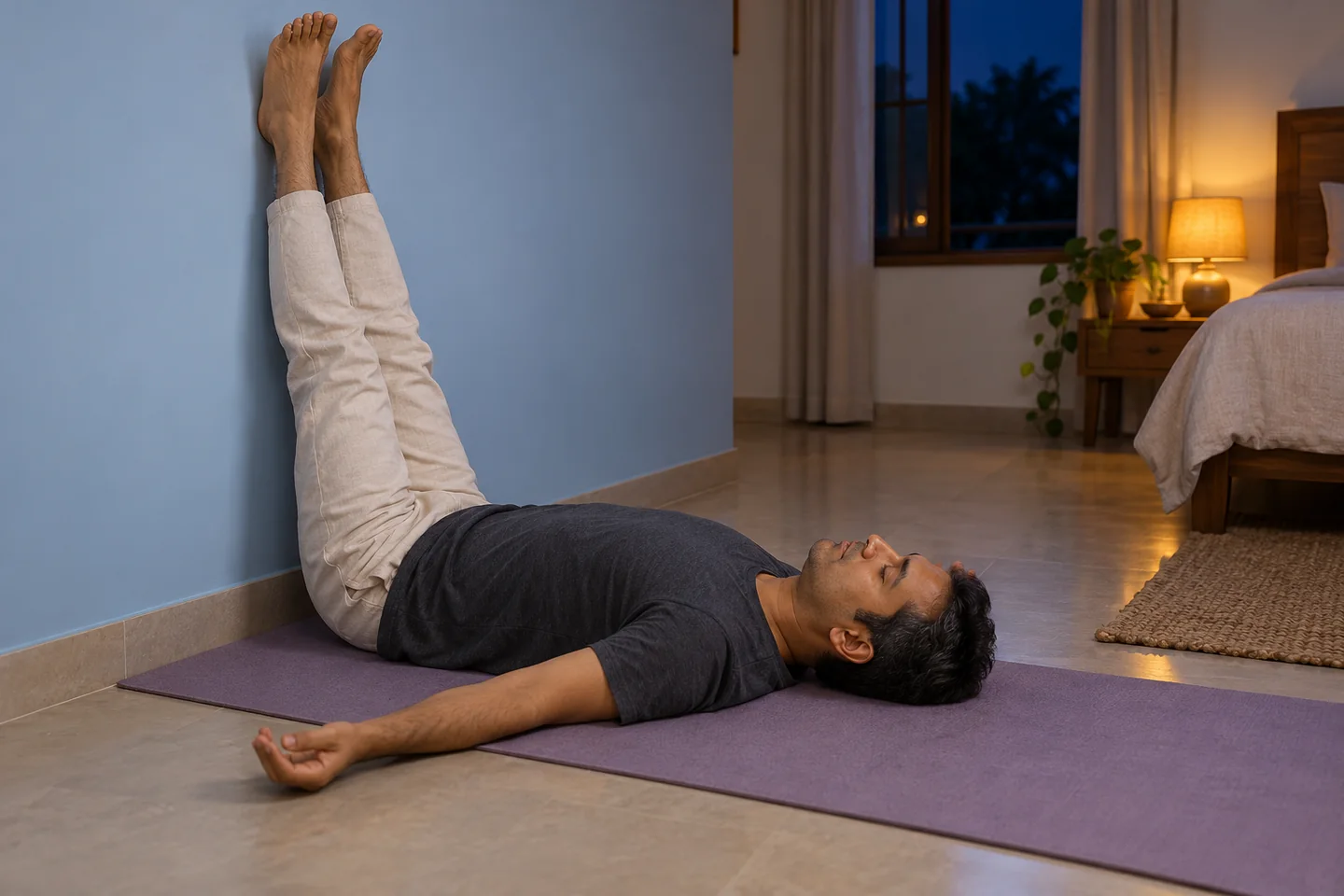
1. Legs-Up-the-Wall (Viparita Karani)
Legs-Up-the-Wall is our top pick among yoga poses for better sleep because it’s fully supported, easy for beginners and very calming.
Your legs rest on a wall while your back rests on the floor. Many teachers use it as a wind-down pose at the end of the day. If you’ve been on your feet all day, as a nurse, teacher or retail worker, you may find it eases tired, heavy legs too.
Step-by-step guide:
- Sit sideways with one hip touching a wall (or your headboard).
- Swing your legs up the wall as you lower your back to the floor.
- Shuffle your hips as close to the wall as feels comfortable.
- Rest your arms by your sides, palms up.
- Close your eyes and slow your breath.
Duration: 3 to 5 minutes, or about 20 to 30 slow breaths.
Modifications and props: If your hamstrings are tight, move your hips farther from the wall and bend your knees a little. A folded blanket under your hips gives a gentle lift, and a small pillow under your head helps your neck relax.
Who should avoid it: If you have glaucoma or other eye pressure problems, a heart condition or uncontrolled blood pressure, check with your doctor first. Later in pregnancy, rest on your side instead.
2. Child’s Pose (Balasana)
Child’s Pose folds the body forward and rests the forehead, and many people find that gentle pressure on the forehead soothing.
Step-by-step guide:
- Kneel down. Bring your big toes together and widen your knees to the width of your mat.
- Sit your hips back toward your heels.
- Walk your hands forward and lower your chest toward the floor.
- Rest your forehead on the mat, a block or a pillow.
- Breathe slowly into your back.
Duration: 1 to 3 minutes, or about 10 deep breaths.
Modifications and props: Place a bolster or pillow lengthwise under your chest and belly. Put a folded blanket between your hips and heels if your knees or ankles feel tight.
Who should avoid it: If you have a knee injury, lie on your back and hug your knees to your chest instead. In pregnancy, keep your knees very wide to make room for your belly.
3. Reclined Bound Angle Pose (Supta Baddha Konasana)
Reclined Bound Angle Pose, often called Reclined Butterfly, releases tension in the hips and pelvis while you lie fully supported. It also opens the chest, so breathing can feel easier.
Step-by-step guide:
- Lie on your back.
- Bring the soles of your feet together and let your knees fall open.
- Place pillows or blocks under each thigh so your inner thighs don’t strain.
- Rest your hands on your belly or by your sides, palms up.
- Feel your belly rise and fall.
Duration: 3 to 5 minutes.
Modifications and props: For a deeper restorative version, lie back on a bolster or two stacked pillows placed along your spine. Loop a belt around your hips and feet if your legs keep sliding.
Who should avoid it: If you have groin or knee pain, add more support under your thighs, or keep your feet flat and knees together. After the first trimester of pregnancy, lie back on a raised bolster rather than flat.
4. Supine Spinal Twist (Supta Matsyendrasana)
A lying twist releases tension in the lower back and hips and helps your body settle before sleep.
Step-by-step guide:
- Lie on your back and hug your knees to your chest.
- Open your arms out wide in a T shape.
- Lower both knees to the right. Turn your head to the left if your neck is comfortable.
- Put a pillow between or under your knees for support.
- Breathe into the left side of your ribs, then switch sides.
Duration: 1 to 2 minutes each side.
Modifications and props: Keep your knees higher toward your chest and fully supported on a pillow so the twist stays gentle.
Who should avoid it: If you have a recent back injury or a disc problem, or you’re pregnant, keep the twist very small or skip it.
5. Happy Baby (Ananda Balasana)
Happy Baby gently stretches the inner thighs and lower back, and it usually feels as easygoing as it looks. Rocking side to side gives your spine a soft massage.
Step-by-step guide:
- Lie on your back and draw your knees toward your armpits.
- Hold the outside edges of your feet, your ankles or the backs of your thighs.
- Point the soles of your feet toward the ceiling.
- Let your lower back rest on the floor.
- Rock gently side to side if it feels good.
Duration: 1 minute.
Modifications and props: Hold the backs of your thighs, or loop a belt around each foot.
Who should avoid it: If you have a knee or hip injury, or you’re pregnant, hug one knee at a time instead.
Which gentle stretches release the day’s tension?
These four floor-based stretches loosen the spine, hamstrings and hips after a long day. Do them on a mat before you move on to the restorative poses.
6. Cat-Cow (Marjaryasana-Bitilasana)
Cat-Cow gently moves the spine and links each movement to a breath, which helps shake off the stiffness and tiredness of the day. It makes a good first pose because it warms up your back without waking you up.
Step-by-step guide:
- Come onto your hands and knees, with wrists under shoulders and knees under hips.
- Inhale and let your belly drop as you lift your chest and tailbone (Cow).
- Exhale and round your back, tucking your chin and tailbone (Cat).
- Move slowly and let your breath set the pace.
Duration: 6 to 10 slow rounds, about 1 minute.
Modifications and props: Put a folded blanket under your knees. If getting on the floor is hard, try a seated version on a chair, rounding and arching your back with your hands on your knees.
Who should avoid it: If you have wrist pain, rest on your forearms. If you have a neck injury, keep your head in line with your spine.
7. Standing Forward Bend, modified (Uttanasana)
A modified Standing Forward Bend relaxes the spine and lets your head and neck hang, which many people find calming. For sleep, keep it soft and supported. You’re not chasing a deep hamstring stretch here.
Step-by-step guide:
- Stand with your feet hip-width apart.
- Bend your knees generously.
- Fold forward from your hips and let your upper body hang.
- Hold opposite elbows and let your head and neck go loose.
- Sway gently side to side if it feels good.
- To come up, bend your knees more and roll up slowly, one vertebra at a time, lifting your head last.
Duration: 1 minute, or 5 to 8 slow breaths.
Modifications and props: Rest your hands on blocks, or rest your forearms on the seat of a chair so your head stays at about hip height. Keep your knees bent the whole time.
Who should avoid it: If you have glaucoma, uncontrolled high blood pressure or a heart condition, avoid head-below-heart poses unless your doctor says they’re fine. If you have low blood pressure, rise very slowly so you don’t get dizzy. If you have a disc problem or sciatica, or you’re pregnant, use the chair version or skip it.
8. Reclining Hand-to-Big-Toe Pose (Supta Padangusthasana)
This pose gently stretches your hamstrings and calves while your back rests on the floor, so it suits legs that feel restless or tight after a day of sitting.
Step-by-step guide:
- Lie on your back with both legs straight or knees bent.
- Loop a strap, belt or towel around the sole of your right foot.
- Lift your right leg toward the ceiling, keeping a soft bend in the knee.
- Hold the strap with both hands and relax your shoulders.
- Switch sides.
Duration: 1 minute each side.
Modifications and props: Keep your other knee bent with the foot on the floor. Use a longer strap so your shoulders can stay down.
Who should avoid it: If you have a hamstring injury, lift your leg only to a light stretch, or skip it.
9. Supported Bridge (Setu Bandhasana with a prop)
Supported Bridge lets your hips rest higher than your heart, and many people find it quietly restful. The prop does the work. You’re not lifting and holding your hips with effort.
Step-by-step guide:
- Lie on your back with knees bent and feet flat, hip-width apart.
- Press into your feet and lift your hips a little.
- Slide a block, firm cushion or folded blanket under your lower back (the sacrum).
- Lower your weight onto the support.
- Let your arms rest by your sides.
Duration: 1 to 3 minutes.
Modifications and props: Use a lower support, such as a folded towel, if the stretch feels strong.
Who should avoid it: If you have neck problems, keep the support low so your neck stays relaxed. If you have uncontrolled high blood pressure or glaucoma, check with your doctor first.
How do you end with final relaxation?
Every bedtime yoga routine should end with Corpse Pose. This is where you stop doing and simply rest, and it gives your mind a clear signal that the day is over.
10. Corpse Pose (Savasana)
Corpse Pose looks easy, but when you do it mindfully it’s one of the deepest relaxation practices in yoga.
Step-by-step guide:
- Lie flat on your back, legs about hip-width apart, and let your feet fall out to the sides.
- Place your arms a little away from your body, palms facing up.
- Tuck your chin slightly so the back of your neck is long.
- Close your eyes and let your body feel heavy, as if it’s sinking into the floor.
- Do a slow body scan. Start with your toes, feet and ankles and let them soften. Move up through your calves, knees, thighs, hips, belly, chest, back, hands, arms, shoulders, neck, jaw, eyes and forehead.
- Let your breath become natural. Don’t control it. Just notice it.
- When thoughts pop up, and they will, notice them and gently bring your attention back to your body or breath.
Duration: 5 minutes or more. It’s fine to fall asleep.
Modifications and props: Put a pillow under your knees if your lower back feels tight and a folded blanket under your head. Cover yourself with a light blanket, because lying still can leave you feeling chilly. An eye pillow or a folded cloth over your eyes blocks out light.
Common mistakes: Fidgeting every few seconds, getting cold, and trying hard to “empty your mind.” Settle in once, stay warm and let thoughts drift past without fighting them.
Who should avoid it: After the first trimester of pregnancy, many care providers advise against lying flat on your back for long periods. Rest on your left side with a pillow between your knees instead.
Also read: What Is Hatha Yoga? Meaning, 9 Benefits, Poses, How It Works
Which routine fits your kind of sleepless night?
Match the poses to the reason you can’t sleep. A stiff back and a racing mind call for slightly different routines. Use this table as a starting point.
| If your night looks like this | Try these poses | Add this breathing |
|---|---|---|
| Your mind races after a stressful workday | Child’s Pose, Legs-Up-the-Wall, Corpse Pose with body scan | 4-7-8 breathing |
| Your back and hips are stiff after hours at a desk or driving | Cat-Cow, Supine Twist, Supported Bridge | Slow belly breathing |
| Your legs feel tired or restless after standing all day | Legs-Up-the-Wall, Reclining Hand-to-Big-Toe | Anulom Vilom |
| You’re too wound up to lie still | Standing Forward Bend (modified), Cat-Cow, then Reclined Butterfly | Humming Bee Breath |
| You wake at 3 a.m. and can’t drift off again | Corpse Pose in bed with body scan | Breath counting |
Which breathing exercises help you fall asleep faster?
Slow breathing with a longer exhale is a simple, low-risk way to help your mind calm down before sleep. In yoga, breath practice is called pranayama. Pair these techniques with your poses, or do them on their own in bed. Research on each specific technique is limited, so notice what works for you.
4-7-8 breathing. Breathe in quietly through your nose for a count of 4, hold for a count of 7, then breathe out slowly through your mouth for a count of 8. Repeat four times. If you’re new to it, start with a gentler pattern: in for 4, out for 6, with no hold. Skip the hold if you’re pregnant or have high blood pressure, a heart condition or a lung condition.
Anulom Vilom (alternate nostril breathing). Sit comfortably. Close your right nostril with your right thumb and breathe in through the left. Close the left nostril with your ring finger, release your thumb and breathe out through the right. Breathe in through the right, switch, and breathe out through the left. That’s one round. Do 5 to 10 slow rounds without holding your breath. Skip it if your nose is blocked.
Humming Bee Breath (Bhramari). Breathe in through your nose. As you breathe out, make a soft, steady hum with your mouth closed. Repeat five to seven times. Many people find the gentle vibration calming. Skip it if you have an ear infection.
Breath counting. Lie in Corpse Pose and count each exhale from 1 to 10, then start again at 1. If you lose count, simply begin again. Keep going until you drift off.
Save Kapalabhati (skull-shining breath) and Bhastrika (bellows breath) for the morning. Both are fast and energizing.
What is a simple 15-minute bedtime yoga routine?
This 15-minute bedtime yoga routine moves from gentle stretching to complete stillness: Standing Forward Bend, Cat-Cow, Child’s Pose, leg stretches, a twist, Supported Bridge, Legs-Up-the-Wall and Corpse Pose. Follow the steps in order.
| Step | Pose | Time | What to focus on |
|---|---|---|---|
| 1 | Standing Forward Bend (modified) | 1 minute | Knees bent, head heavy, roll up slowly |
| 2 | Cat-Cow | 1 minute | Match each movement to one breath |
| 3 | Child’s Pose | 2 minutes | Rest your forehead and breathe into your back |
| 4 | Reclining Hand-to-Big-Toe | 2 minutes (1 per side) | Relax your shoulders, keep a soft knee |
| 5 | Supine Spinal Twist | 2 minutes (1 per side) | Knees supported, slow breath |
| 6 | Supported Bridge | 1.5 minutes | Let the prop hold your weight |
| 7 | Legs-Up-the-Wall | 2.5 minutes | 4-7-8 breathing or long exhales |
| 8 | Corpse Pose with body scan | 3 minutes | Relax each body part from feet to head |
| Total | 15 minutes |
Short on time? Try this 5-minute version in bed:
- Child’s Pose on the mattress: 1 minute
- Supine Spinal Twist: 1 minute each side
- Legs up against the headboard: 1 minute
- Corpse Pose with breath counting: 1 minute, or until you fall asleep
Got more time? Try a 25-minute version. Add Reclined Butterfly (5 minutes) and Happy Baby (1 minute) after the twist, then stay in Corpse Pose for 6 minutes instead of 3.
Also read: The Simple 10-Minute Morning Yoga Routine For Energy 2026
What exercise can help you fall asleep quickly?
At bedtime, the most practical option is a slow relaxation sequence: a few restorative yoga poses, slow breathing and a body scan in Corpse Pose. Vigorous exercise can support sleep too, but it’s better earlier in the day. NHS guidance suggests exercising regularly during the day, but not within four hours of bedtime.
| Type of exercise | Best time | How it may help sleep |
|---|---|---|
| Gentle bedtime yoga and breathing | Last 20 to 30 minutes before bed | Helps you wind down right before sleep |
| Regular yoga practice | A few times a week | Linked with better sleep quality over several weeks |
| Walking, cycling, swimming, strength training | Morning to early evening | Builds healthy tiredness and supports overall sleep |
| Intense workouts (HIIT, running, hot yoga) | At least four hours before bed | Can leave you alert if done too late |
How does yoga compare with other exercise? In the 2025 network meta-analysis described earlier, yoga ranked ahead of walking, resistance training, aerobic exercise and traditional Chinese exercise such as tai chi for sleep quality in people with sleep problems.
Keep two details in mind: the top-ranked yoga was higher intensity than a bedtime routine, and its lead over walking was narrow. Regular daytime activity of almost any kind is worth doing, and gentle yoga at night is a separate wind-down habit.
On a night when you need to drop off fast, use the 5-minute in-bed version above and finish with breath counting.
How can you increase deep sleep naturally?
You can support deep sleep naturally by keeping a regular sleep schedule, staying active during the day, getting morning daylight, cutting back on caffeine and alcohol, keeping your bedroom cool and dark, and winding down with a calming routine such as bedtime yoga or Yoga Nidra.
Deep sleep, also called slow-wave sleep, is the most restful stage of sleep. You get most of it in the first half of the night. During deep sleep, your breathing and heart rate slow down, and this stage is thought to play an important part in physical recovery.
Habits that support good sleep, including deep sleep:
- Keep the same sleep and wake times, even on weekends and even after a bad night. A steady rhythm helps your body clock.
- Move during the day. Regular physical activity is linked with better sleep quality.
- Get morning light. Daylight early in the day helps set your body clock.
- Watch the caffeine and alcohol. NHS guidance suggests avoiding tea, coffee and alcohol for at least six hours before bed. Alcohol may make you drowsy at first, but it can disturb sleep later in the night.
- Avoid big late meals. Eat dinner a few hours before bed if you can.
- Keep your room cool, dark and quiet. Blackout curtains, an eye mask or earplugs can help.
- Wind down the same way each night. Deep sleep yoga practices, such as a short restorative sequence followed by Yoga Nidra, can help you move from alert to relaxed.
A caveat: most yoga research measures overall sleep quality, not deep sleep on its own. There isn’t strong evidence yet that yoga specifically increases deep sleep. The research does suggest it can improve how well people sleep overall.
What are the best tips for bedtime yoga?
Start your yoga about 20 to 30 minutes before bed, dim the lights, wear comfortable clothes, put your phone away and practice at the same time every night.
When should you do yoga before bed?
The NHS recommends winding down for at least an hour before bed. Use the first part of that hour for quiet things like a bath or reading, then start your yoga about 20 to 30 minutes before you plan to sleep. Practice for 10 to 20 minutes.
Leave about two hours after a large dinner, because folding and twisting on a full stomach is uncomfortable.
How long should you hold each pose? Johns Hopkins Medicine suggests one to two minutes while breathing deeply, and Harvard Health Publishing suggests three to five minutes for restorative poses. Start with one to two minutes and stay longer in the poses you enjoy.
Consistency matters more than length. A few minutes every night beats one long session once a week, and in research, the benefits showed up over 8 to 16 weeks of regular practice.
How should you set up your space?
Dim the lights. Bright light, especially from screens, can keep you alert, so switch to a lamp. Wear loose, soft clothes you could sleep in. Put your phone on silent and out of reach before you start.
Keep the room cool and quiet, and have a light blanket ready for Corpse Pose. Keep your pillows, blanket and a belt within reach so you don’t have to get up halfway through.
Some sleep experts, including Johns Hopkins Medicine, suggest keeping the bedroom for sleep. If you have the space, do your main routine in another room, then finish with one or two poses in bed.
What daily habits make bedtime yoga work better?
- Go to bed and wake up at about the same time every day.
- Cut caffeine from early afternoon. Coffee, strong tea and energy drinks can affect sleep for hours.
- Don’t force flexibility. A sleep routine should feel easy and pleasant.
- Keep a simple sleep diary for two weeks. Note when you went to bed, roughly how long it took to fall asleep and how you felt the next day, so you can see what’s working.
- Save active yoga for earlier in the day and keep the evening practice slow.
Which yoga poses should you avoid before bed?
Avoid fast, heating or energizing yoga before bed, including Sun Salutations, deep backbends, strong inversions and energizing breathwork. These raise your heart rate and alertness, which is the opposite of what you want at 10 p.m.
| Avoid before bed | Why | Better time |
|---|---|---|
| Sun Salutations and fast vinyasa flows | Raise heart rate and body heat | Morning or afternoon |
| Power yoga and hot yoga | Vigorous and warming | Earlier in the day |
| Deep backbends (Wheel, Camel) | Energizing and demanding | Daytime, with a teacher |
| Headstand, Shoulderstand, Plow | Load the neck, need warm-up and skill | Daytime, with a teacher |
| Kapalabhati, Bhastrika | Fast, energizing breathing | Morning |
| Long standing balances | Effortful and alerting | Daytime |
Some articles recommend Plow Pose (Halasana) for sleep. It puts strong pressure on the neck, so we don’t recommend it for beginners practicing alone at night.
What are the benefits of yoga poses for better sleep?
The main benefits of yoga poses for better sleep are less stress, less muscle tension, a calmer mind and a steady bedtime routine. Research suggests these may add up to better sleep quality over time.
- May help you fall asleep more easily. Slow breathing and stillness make it easier to rest.
- May reduce night waking. Studies of regular yoga practice have reported better sleep quality scores, and those scores include how often people wake up.
- May lower stress. In the 2012 US survey reported by NCCIH, over 85% of people who did yoga said it reduced their stress.
- Eases muscle tension in the hips, back and shoulders.
- Quiets racing thoughts by giving your mind a calm task.
- Builds a bedtime ritual that your body can start to link with sleep.
- Low cost and generally low risk. You only need a mat and a few pillows, and the 2020 BMC Psychiatry review found no serious side effects linked to yoga in the studies it covered.
- No medication involved. A gentle routine can sit alongside any treatment your doctor recommends.
- Better days. Better rest can help your mood, focus and energy.
Think of bedtime yoga as a habit rather than a one-night remedy. The benefits build with regular practice.
Yoga poses for better sleep vs Yoga Nidra: what’s the difference?
Yoga poses for better sleep use gentle physical postures to release tension, while Yoga Nidra is a guided relaxation practice you do lying completely still in Corpse Pose. Both can be part of your evening. Many people do a few poses first and then a short Yoga Nidra.
Yoga Nidra is often called “yogic sleep.” A teacher or recording guides you through stages: setting an intention, moving your awareness through the body, noticing your breath and resting in awareness. You stay awake but deeply relaxed. It doesn’t replace sleep.
| Feature | Yoga poses for better sleep | Yoga Nidra |
|---|---|---|
| What it is | Gentle postures with slow breathing | Guided relaxation and body awareness |
| Body position | Changes from pose to pose | Lying still in Corpse Pose |
| Typical length | 10 to 20 minutes | About 20 to 45 minutes |
| Main focus | Releasing physical tension | Deep mental and physical relaxation |
| Equipment | Mat, pillows, belt | Mat or bed, blanket, guidance |
| Easy to learn alone? | Yes, from clear instructions | Easier with a trained guide at first |
| Best for | Stiff bodies and restless energy | Busy minds and stress |
For yoga teachers who want to go deeper: Yoga Nidra is a core part of our Advanced TTC 300-Hour Integrated Restorative Yoga (Including Yoga Nidra, Chakra Sadhana, and Prana Vidya Intensive). Explore the 300-hour yoga teacher training in Goa.
Who should not do these poses? Precautions and contraindications
Most healthy adults can practice gentle bedtime yoga safely, but some people should check with a doctor first or modify certain poses. Each pose above lists who should avoid it. The general rules below apply to the whole practice. Listen to your body and never push into pain.
Talk to your doctor before you start if you:
- are pregnant. After the first trimester, avoid lying flat on your back for long periods, deep twists and long breath holds. Resting on your side is a good option.
- have a back, neck, hip or knee injury, or have had recent surgery.
- have high or low blood pressure, especially if it isn’t well controlled. Take care with any pose where your head is below your heart, and rise slowly.
- have glaucoma or other eye pressure problems. Ask before doing any head-below-heart pose.
- have a heart or lung condition. Avoid holding your breath.
- snore loudly, stop breathing in your sleep or feel very sleepy during the day. These can be signs of sleep apnea. Yoga doesn’t treat sleep apnea, so please see a doctor.
When should you see a doctor about sleep?
See your doctor (in the UK, your GP) if you have trouble sleeping at least three nights a week for three months or more, if changing your sleep habits hasn’t helped, or if poor sleep makes it hard to cope with daily life.
You may have chronic insomnia. The American College of Physicians recommends cognitive behavioral therapy for insomnia (CBT-I) as the initial treatment for chronic insomnia in all adults, and the NHS may refer people with insomnia to a therapist for cognitive behavioural therapy. Yoga can support good sleep habits, but it shouldn’t replace medical care.
Conclusion: start tonight and keep it simple
You don’t need a perfect body or a long class to sleep better. A few yoga poses for better sleep, practiced slowly for 10 to 20 minutes each night, can help you let go of the day and settle into rest. Start with Legs-Up-the-Wall, Child’s Pose, a gentle twist and Corpse Pose, add slow breathing such as 4-7-8 or Anulom Vilom, and give the habit a few weeks.
If your sleep problems continue, or you notice signs of sleep apnea, please see a doctor. Yoga works best as part of healthy sleep habits, not as a replacement for medical care.
Ready to study restorative yoga in depth? Our advanced 300-hour program is a residential, 43+2 day teacher training in Colva, South Goa, taught in English. It’s an advanced course, not a beginner retreat, and it’s open to applicants aged 21 to 60 who have completed a 200-hour TTC or an equivalent qualification. The next scheduled batch runs from 13 December 2026 to 26 January 2027. Under our Gift-it-Forward model, no payment is required to apply or to participate. After completing the program, participants may voluntarily support the Gift-it-Forward initiative to help future aspirants, with no obligation to contribute.
Apply for the 300-hour program
New to yoga teacher training? Our planned 200-hour program is expected around mid-2027. Have a question first? Contact the Inteyoga team or message us on WhatsApp at +91 935-473-7240.
About Inteyoga
Founder-Director: Dr. Ashutosh, MBBS, M.Sc. (Yoga), Yoga Master Level 6 (Yoga Certification Board, Ministry of AYUSH, Government of India), Swami Krishnananda Yoga Vidyapeeth and Inteyoga, Colva, South Goa.
Inteyoga (Swami Krishnananda Yoga Vidyapeeth) is managed by Inteyoga Shala LLP and is registered with Yoga Alliance as a Registered Yoga School (RYS 200, RYS 300 and RYS 500). Address: Plot No. 6, Novo Vaddo, Sernabatim, Colva, Salcete, Goa 403708, India. Email: info@inteyoga.org.
Medical disclaimer
This article is for general education only. It isn’t medical advice and doesn’t replace diagnosis or treatment from a qualified healthcare professional. Yoga may help some people relax and sleep better, but it doesn’t cure any condition. Talk to your doctor before starting a new practice, especially if you’re pregnant, have an injury, have recently had surgery, or have high or low blood pressure, glaucoma, a heart or lung condition or a sleep disorder. Stop any pose or breathing exercise that causes pain, dizziness or discomfort.
Frequently asked questions (FAQ)
Can I do yoga in bed?
Yes. Restorative poses such as Child’s Pose, Reclined Butterfly, Supine Twist, Happy Baby and Corpse Pose work well on a firm mattress. You can also rest your legs against the headboard as a simple version of Legs-Up-the-Wall. A soft mattress gives less support than the floor, so keep the poses gentle and avoid anything that loads your neck or needs balance.
Which yoga is best for sleep?
For bedtime, gentle Hatha yoga, restorative yoga and Yoga Nidra suit most people best. Among single poses, Legs-Up-the-Wall, Child’s Pose and Corpse Pose are some of the most widely recommended because they’re restful and easy for beginners. Skip fast styles such as power, hot or vinyasa yoga at night. Try a few poses for a week and keep the ones that leave you calmest.
Can yoga cure insomnia?
No. Yoga can’t cure insomnia, and nobody should promise that it will. Research suggests regular yoga may improve sleep quality and reduce insomnia symptoms for some people. Chronic insomnia, lasting three months or more, needs medical attention, and guidelines in the US recommend cognitive behavioral therapy for insomnia (CBT-I) as the first treatment. Yoga works best as a support alongside proper care.
How long should I hold yoga poses before bed?
Hold most bedtime poses for one to three minutes. Fully supported restorative poses, such as Reclined Butterfly and Legs-Up-the-Wall, can be held for three to five minutes. Stay in Corpse Pose for five minutes or more. Longer holds give you time to settle. Breathe slowly through your nose throughout, and come out of any pose that hurts.
How long does it take for yoga to improve sleep?
Some people feel calmer after their very first session, but measurable changes in sleep quality usually take longer. In research, the clearest benefits came from programs lasting 8 to 16 weeks. A 2025 analysis ranked higher-intensity yoga, twice a week for 8 to 10 weeks in sessions of 30 minutes or less, as the top approach. Short, regular practice matters more than occasional long sessions.
Can yoga help if I wake up in the middle of the night?
It may. If you wake at night and your mind starts racing, stay in bed, lie in Corpse Pose and try breath counting or a slow body scan from your toes to your head. These keep your body still and give your mind a calm task. If night waking happens most nights for months, talk to your doctor.
Can I do yoga instead of taking sleeping pills?
Don’t stop or change any prescribed sleep medication without talking to your doctor. Yoga is a habit you can add alongside your treatment, and many people use it as part of a wider wind-down routine. Your doctor can help you choose the right treatment plan, which for chronic insomnia usually starts with cognitive behavioral therapy for insomnia (CBT-I).