
Quick Answer
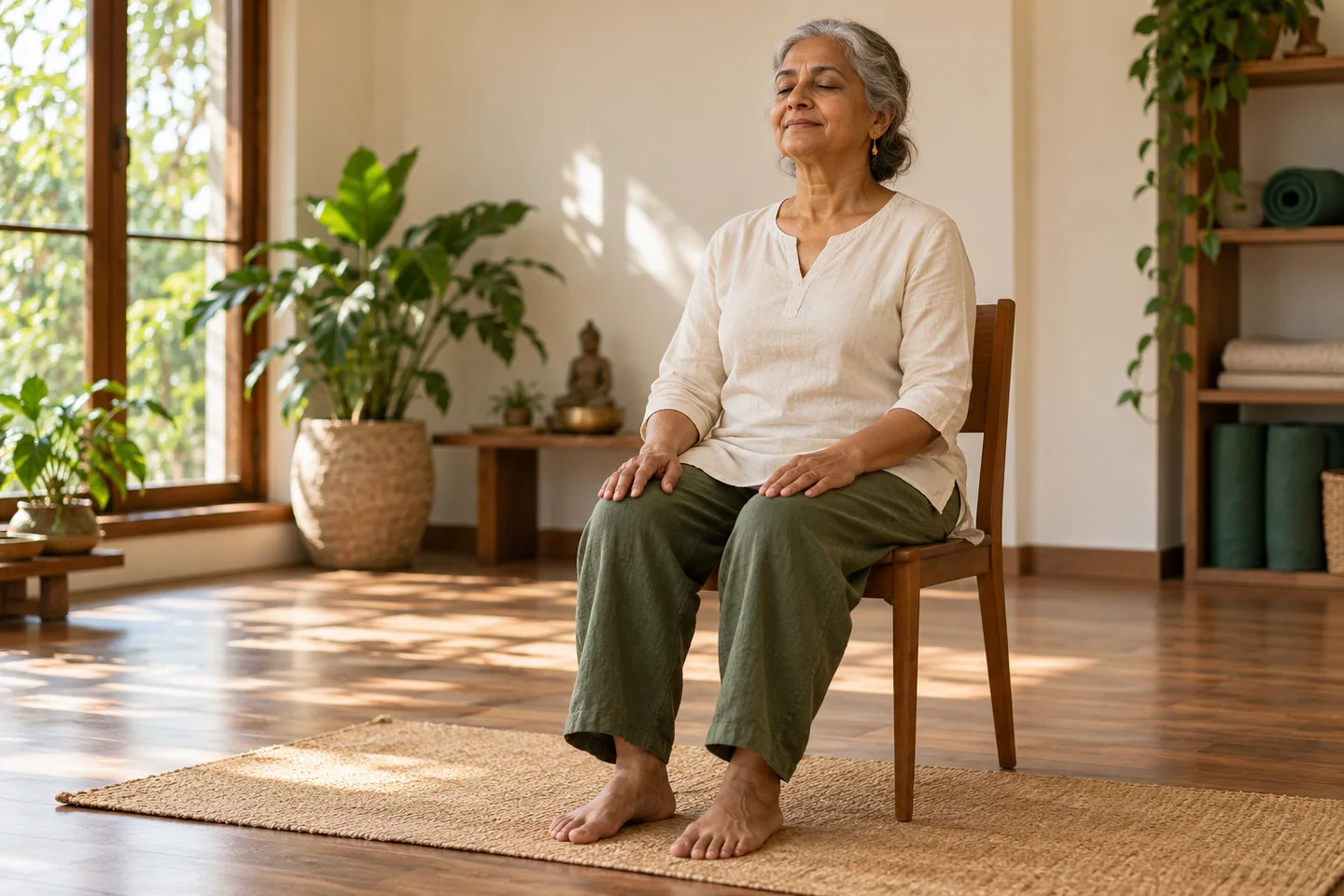
Senior yoga is a gentle, adapted form of yoga for adults aged about 60 and over. It uses slow movements, chair- and wall-supported poses, props, simple breathing and guided relaxation to work on balance, flexibility, strength and calm, while respecting age-related changes in joints, bones, blood pressure and mobility.
Key takeaways
- Senior yoga adapts the pose to your body, using chairs, walls and props.
- The strongest research support is for small gains in balance and moderate gains in mobility.
- Chair yoga is the safest starting point if your balance is unsteady.
- Two or three sessions a week fits US and UK activity guidance for older adults.
- Some conditions, such as glaucoma, osteoporosis or a slipped disc, need pose changes. Talk to your doctor first.
Key Takeaways
- Senior yoga is yoga adapted for older adults, usually people aged 60 and over. It keeps the three core parts of classical yoga: postures (asanas), breathing (pranayama) and relaxation. What changes is how you do them. Poses are shorter, slower and supported, and props take the place of strain.
- Senior yoga works by gently loading your muscles, moving your joints through a comfortable range, training balance with support close by, and using slow breathing and rest to help you relax. Each part of a class targets a common change that comes with age.
- Research suggests senior yoga can help with balance and mobility, and may ease some joint and back pain, support better sleep and lower stress. It also builds leg strength and offers social contact. The evidence is strongest for balance, mobility and low-back pain. For other outcomes it is promising but still limited, and we say which is which below.
Fewer than one in ten older Americans do yoga. In 2022, just 8% of US adults aged 65 and over practised yoga, compared with 21% of adults aged 18 to 44, according to the CDC’s National Center for Health Statistics. The age group with some of the most to gain is the least likely to try it.
That gap matters, because senior yoga was designed for exactly this group. It is yoga slowed down and supported, so you can practise on a chair, beside a wall or on a mat. You don’t need to touch your toes, and you don’t need to get down on the floor.
The need is real on both sides of the Atlantic. The CDC reports that more than one in four Americans aged 65 and over fall each year (National Safety Council summary of CDC data). In the UK, coverage of NICE’s quality standard on falls puts the figure at about one in three people over 65 (RCNi), and the UK Chief Medical Officers say falls are the main reason older people are taken to A&E.
The group is also growing. The US Census Bureau counted 61.2 million Americans aged 65 and over in 2024, 18% of the population. The 2021 Census for England and Wales counted 11.1 million people aged 65 and over, or 18.6%.
This guide explains what senior yoga is, how it works, what the research does and doesn’t show, five safe poses to start with, and how often to practise. It is written for older beginners, for adult children helping a parent, and for yoga teachers who want to teach this age group well.
New to yoga? Start with our plain-English guide to Hatha yoga, the classical style most gentle classes for older adults are built on.
What Is Senior Yoga?
Senior yoga is yoga adapted for older adults, usually people aged 60 and over. It keeps the three core parts of classical yoga: postures (asanas), breathing (pranayama) and relaxation. What changes is how you do them. Poses are shorter, slower and supported, and props take the place of strain.
Put simply, a regular class asks your body to fit the pose. Senior yoga makes the pose fit your body.
What Does Senior Yoga Mean?
The word yoga comes from the Sanskrit root yuj, usually translated as “to join” or “to unite”. In yoga traditions it refers to bringing body, breath and mind together. Senior yoga applies that idea to an ageing body, safely and without hurry.
There is no single official age cut-off. US falls data from the CDC and the UK Chief Medical Officers’ older-adult guidance both use 65 and over, while many classes welcome anyone over 60. Your health matters more than your birthday. A fit 75-year-old may enjoy a gentle Hatha class, while a 62-year-old recovering from knee surgery may be better off in chair yoga.
Senior yoga is not a separate tradition. It is classical Hatha yoga applied to the needs of older people. The US National Center for Complementary and Integrative Health (NCCIH) suggests older adults begin with a class described as “gentle yoga” or “seniors yoga”, and names chair yoga as an even gentler option for people with limited mobility.
What Are the Core Characteristics of Senior Yoga?
Seven features set yoga for seniors apart from a standard class:
- A slow pace. Fewer poses, held for a few breaths, with rest in between.
- Support everywhere. Chairs, walls, blocks, straps, bolsters and blankets are standard kit.
- Low impact. No jumping, fast flows or heated rooms.
- Careful transitions. You move slowly between lying, sitting and standing to avoid feeling dizzy.
- Natural breathing. Relaxed breaths, with no long breath-holds.
- A variation for every pose. You choose the version that suits your body that day.
- A whole-person focus. Balance, strength, joint comfort, calm and social contact all count.
How Is Senior Yoga Different From Regular Yoga?
The main differences are pace, support, intensity and how closely the teacher watches. Many studio classes assume healthy joints and the ability to get down to the floor and back up quickly. Senior yoga assumes neither.
| Regular yoga class | Senior yoga class | |
|---|---|---|
| Pace | Often flowing, pose to pose | Slow, with pauses |
| Floor work | Usually expected | Optional; many classes stay on chairs |
| Back-bends and inversions | Common | Small, supported or skipped |
| Props | Optional | Used freely |
| Health check | Varies | Usually asked before the first class |
| Class size | Can be large | Usually small |
How Does Senior Yoga Work?
Senior yoga works by gently loading your muscles, moving your joints through a comfortable range, training balance with support close by, and using slow breathing and rest to help you relax. Each part of a class targets a common change that comes with age.
| What changes with age | What senior yoga trains | What you actually do |
|---|---|---|
| Leg muscles weaken | Functional strength | Slow sit-to-stands, supported lunges, Warrior poses |
| Joints stiffen | Range of motion | Small, repeated joint circles and gentle stretches |
| Balance declines | Steadiness | Standing poses with a wall or chair within reach |
| Posture rounds forward | Body awareness | Tall-spine poses such as Mountain pose and gentle chest openers |
| Stress and poor sleep creep in | Relaxation | Slow nasal breathing, Shavasana, Yoga Nidra |
| Social circles shrink | Routine and company | A regular small-group class |
The principle is slow, safe progression. Take Tree pose. In week one you might hold a chair with both hands. A few weeks later, one hand. Later still, just your fingertips. Your body adapts gradually, and you never need to risk a fall to get there.
What Are the Benefits of Senior Yoga?
Research suggests senior yoga can help with balance and mobility, and may ease some joint and back pain, support better sleep and lower stress. It also builds leg strength and offers social contact. The evidence is strongest for balance, mobility and low-back pain. For other outcomes it is promising but still limited, and we say which is which below.
There is a wider point too. The UK Chief Medical Officers’ 2019 guidelines say regular physical activity of any kind reduces the chance of falls and depression by up to 30%, and joint and back pain by up to 25%. The same guidance lists yoga as one way to build strength. Senior yoga is a low-impact way to get some of that activity.
Does Senior Yoga Improve Flexibility and Balance?
The best evidence is for balance and mobility. A 2016 systematic review and meta-analysis in Age and Ageing (Youkhana et al.) pooled six trials with 307 people aged 60 and over. Yoga produced a small improvement in balance and a medium improvement in physical mobility. Gains in flexibility are commonly reported by students, but they have been studied less in older adults.
There is an important limit. The review’s authors said more research is needed to show whether yoga directly prevents falls. Think of yoga as one part of a fall-prevention plan, alongside walking, strength work and a check-up with your doctor.
What better balance and mobility can look like day to day:
- Turning to check your blind spot while driving.
- Reaching a high kitchen shelf without grabbing the counter.
- Stepping off a curb (or kerb) with more confidence.
- Getting up from a low sofa with less push from your arms.
Can Senior Yoga Help With Arthritis and Chronic Pain?
It may. Studies suggest gentle yoga can ease some knee arthritis symptoms and chronic low-back pain, alongside medical care. A 2018 meta-analysis of 13 trials with 1,557 people with knee osteoarthritis or rheumatoid arthritis, summarised by NCCIH, found regular yoga may reduce knee arthritis symptoms and improve physical function.
For chronic low-back pain, the American College of Physicians’ 2017 guideline advises starting with non-drug treatments such as exercise, and includes yoga among the recommended options, based on low-quality evidence.
A 2018 review by the US Agency for Healthcare Research and Quality looked at eight yoga trials (1,466 people) and found improvements in pain and function for up to 12 months, similar to exercise. Both are summarised by NCCIH.
Pain is a common reason older people try yoga. In the CDC’s 2022 survey, 27.2% of US yoga practitioners aged 65 and over said they used yoga to treat or manage pain. Yoga should sit alongside your doctor’s or physical therapist’s treatment, not replace it. New, severe or worsening pain needs a medical assessment first.
Does Senior Yoga Help With Stress and Sleep?
It may. NCCIH reports that some studies link yoga with improvements in physical or psychological signs of stress, and that some research suggests yoga may improve sleep in several groups, including older adults.
The findings are not fully consistent, and evidence for clinical anxiety disorders and depression is still preliminary. If you have ongoing insomnia, anxiety or low mood, speak to your doctor, as effective treatments exist.
Many people find slow practices such as Bhramari (humming breath), Shavasana and Yoga Nidra relaxing before bed.
What Other Benefits Can Older Adults Expect?
- Stronger legs for everyday life. Practising sit-to-stands and supported standing poses trains the muscles you use for stairs, standing up and carrying shopping.
- More awareness of posture and breathing. Tall-spine poses encourage you to notice slouching and breathe more fully.
- Possible brain benefits, not yet proven. A small 2015 NCCIH-funded study compared 14 long-term yoga practitioners with 14 physically active people who didn’t do yoga. The usual age-related difference in brain grey matter did not appear in the yoga group. Because the study was small and observational, it cannot show that yoga caused the difference.
- Company and routine. A weekly class offers a reason to get out, familiar faces and something to look forward to.
- Confidence. Feeling steadier can make it easier to keep doing everyday activities you enjoy.
Which Type of Yoga Is Best for Seniors?
The safest types of yoga for most seniors are chair yoga, restorative yoga, water (aqua) yoga and gentle Hatha yoga. Which one suits you depends on your mobility, health and goals. If you’re a complete beginner or your balance is unsteady, start with chair yoga.
What Is Chair Yoga for Seniors?
Chair yoga is yoga done sitting on, or holding on to, a sturdy chair. You never have to get down to the floor, so the risk of falling stays low. It suits beginners, people with limited mobility, wheelchair users and people recovering from surgery once their doctor agrees. Chair yoga is often offered at senior centers and YMCAs in the US, and at community and leisure centres in the UK.
What Is Restorative Yoga?
Restorative yoga uses bolsters, blankets and blocks to hold you in fully supported, restful poses for several minutes at a time. Many people use it for relaxation, rest and gentle recovery. Read more in our guide: What is restorative yoga?
What Is Water Yoga (Aqua Yoga)?
Water yoga is gentle yoga practised standing in a warm, shallow pool. The water supports part of your body weight, which many people with sore knees, hips or backs find more comfortable, while still challenging balance. Research specific to water yoga is limited. You’ll need pool access and a trained instructor, and you should check with your doctor first if you have a heart condition, open wounds or an infection.
What Is Gentle Hatha Yoga?
Gentle Hatha yoga is the classical, slow-paced style that most yoga for older adults is built on. It combines simple postures, breathing and relaxation, and suits active seniors who want to work on strength and balance. Learn more: What is Hatha yoga?
Which Other Yoga Styles Work for Older Adults?
- Iyengar-style (prop-based) yoga: precise alignment with blocks, belts and chairs, which many people with stiff joints find helpful. See What is Iyengar yoga?
- Yoga Nidra: guided relaxation done lying still or reclined.
- Styles to skip as a beginner: Power yoga, Ashtanga and hot or Bikram yoga are fast or heated and usually too demanding for older beginners. Here’s why: Bikram yoga safety.
Senior Yoga Types Compared
| Yoga Type | Best For | Difficulty Level |
|---|---|---|
| Chair Yoga | Limited mobility / Beginners | Very Easy |
| Yoga Nidra | Relaxation and rest | Very Easy |
| Restorative Yoga | Stress relief & Chronic pain | Easy |
| Water (Aqua) Yoga | Sore joints, arthritis | Easy |
| Iyengar-style (props) | Stiff joints, posture | Easy to Moderate |
| Hatha Yoga | Active seniors wanting strength | Moderate |
5 Easy and Safe Yoga Poses for Seniors
These five yoga poses for seniors work on posture, balance, spinal mobility, leg strength and relaxation. Hold each one for 3 to 5 slow breaths. Keep a chair or wall within reach, and stop straight away if you feel sharp pain or dizziness.
1. How Do You Do Mountain Pose (Tadasana)?
Why it helps: posture and body awareness.
- Stand behind a sturdy chair, feet hip-width apart, hands resting lightly on the chair back.
- Spread your weight evenly through both feet.
- Lengthen your spine and let your shoulders drop away from your ears.
- Breathe slowly through your nose for five breaths.
Safety tip: keep your knees soft, not locked. If standing is hard, do it seated with your feet flat on the floor.
2. How Do You Do Tree Pose (Vrikshasana) Safely?
Why it helps: balance and ankle strength.
- Stand side-on to a wall with one hand flat against it.
- Shift your weight onto the leg nearest the wall.
- Rest the other foot against your ankle, toes still on the floor, or on your calf.
- Hold for 3 to 5 breaths, then switch sides.
Safety tip: never press your foot into the side of your knee. Keep the wall hand in place until your teacher agrees you’re ready to lighten it.
3. How Do You Do Seated Cat–Cow (Marjariasana–Bitilasana)?
Why it helps: gentle spinal movement.
- Sit near the front of a chair, feet flat, hands on your knees.
- Breathe in: gently lift your chest and look slightly up (Cow).
- Breathe out: gently round your back and drop your chin (Cat).
- Repeat 5 to 8 times, moving with your breath.
Safety tip: keep the movement small if you have osteoporosis or a disc problem, and ask your doctor or physical therapist which range is safe for you.
4. How Do You Do Chair-Supported Warrior II (Virabhadrasana II)?
Why it helps: leg strength and hip mobility.
- Sit sideways on a chair so your right thigh rests on the seat.
- Stretch your left leg back, foot flat and turned slightly in.
- Open your arms to shoulder height and look over your right hand.
- Hold for 3 to 5 breaths, then switch sides.
Safety tip: keep your front knee over your ankle, not past your toes. Lower your arms whenever your shoulders get tired.
5. How Do You Do Supported Corpse Pose (Shavasana)?
Why it helps: rest and relaxation.
- Lie on a mat with a pillow under your head and a rolled blanket under your knees.
- Let your arms rest slightly away from your body, palms up.
- Close your eyes and breathe naturally for 5 to 10 minutes.
- To finish, roll onto your side and come up slowly through sitting.
Safety tip: if lying flat is uncomfortable, or you have reflux or breathing problems, relax reclined in an armchair instead. Always get up slowly.
Which Other Poses Are Good for Older Adults?
| Pose | Senior-friendly version | Main purpose |
|---|---|---|
| Utkatasana (Chair pose) | Slow sit-to-stand from a chair | Thigh strength |
| Seated gentle twist | Turn from the waist, one hand on the chair back | Spinal movement |
| Setu Bandhasana (Bridge) | Low lift with a block under the hips | Hip and back strength |
| Viparita Karani (Legs on chair) | Calves resting on a chair seat | Rest |
| Balasana (Child’s pose) | Chest on a bolster, or forehead on your arms at a table | Back release |
Gentle breathing to try: belly (diaphragmatic) breathing, Nadi Shodhana (alternate-nostril breathing without breath-holding) and Bhramari (humming bee breath).
Many teachers advise against forceful practices such as Kapalbhati and Bhastrika, and against breath retention (kumbhaka), for people with high blood pressure, heart disease, glaucoma or a hernia, unless their doctor agrees.
How Do You Practise Senior Yoga?
You practise senior yoga by joining a gentle class, or following a routine you learned from a qualified teacher, two or three times a week, always moving slowly with support nearby. Here’s what a class usually looks like, how to begin and how to practise safely at home.
What Happens in a Typical Senior Yoga Class?
Most senior yoga classes last 45 to 60 minutes. They move from gentle warm-ups to supported poses and finish with guided relaxation. The rhythm follows classical Hatha yoga: prepare, move, breathe, rest.
- Check-in (3 to 5 minutes): the teacher asks about pain, new medication, recent falls or surgery.
- Breath awareness (5 minutes): seated belly breathing to settle in.
- Joint warm-ups (10 minutes): small movements for fingers, wrists, shoulders, neck, ankles and knees, often drawn from the classical Sukshma Vyayama or Pawanmuktasana series.
- Standing and balance work (10 to 15 minutes): poses beside a chair or wall.
- Seated or floor work (10 minutes): gentle stretches and twists on a chair or mat.
- Pranayama (5 minutes): simple breathing such as alternate-nostril breathing.
- Relaxation (5 to 10 minutes): Shavasana or a guided Yoga Nidra.
How Do You Start Senior Yoga?
You can start senior yoga safely in five steps:
- Talk to your doctor or GP. Mention your conditions and medicines, and ask which movements to avoid.
- Pick a gentle style. Start with chair yoga if your balance is unsteady or getting off the floor is hard. Otherwise, try gentle Hatha.
- Find a qualified teacher. Look for experience with older adults (see the checklist in “How Do You Teach Senior Yoga?”).
- Gather a few props. A sturdy chair without wheels, a non-slip mat, two blocks (thick books work), a strap (a dressing-gown belt works), a firm cushion and a blanket.
- Start small and keep it regular. Begin with 20 to 30 minutes, two or three times a week. Add time only once it feels comfortable.
Can Seniors Do Yoga at Home or Online?
Yes. Once you’ve learned the safe basics from a qualified teacher, home and online practice can work well. Set up near a wall or sturdy chair, on a non-slip floor, with good light and your phone within reach. Avoid new or difficult poses when you’re on your own.
If you live alone and have fallen before, stick with chair-based routines. Online classes help if you can’t get to a studio, but choose ones where the teacher clearly shows chair versions. For a short daily habit, our 10-minute morning yoga routine can be done mostly seated with a few simple changes.
Senior Yoga Examples and Real-Life Routines
Here are three sample yoga routines for seniors, from 10 to 30 minutes, built only from the safe poses in this guide. Each one comes with the everyday situation it suits. Check with your doctor first and skip anything that hurts.
Example 1: What Does a 15-Minute Morning Chair Yoga Routine Look Like?
Suits: mornings when you wake up stiff and slow to get moving.
| Step | Practice | Time |
|---|---|---|
| 1 | Seated belly breathing | 2 min |
| 2 | Neck, shoulder, wrist and ankle circles | 3 min |
| 3 | Seated Cat–Cow (8 rounds) | 2 min |
| 4 | Seated gentle twist, both sides | 2 min |
| 5 | Chair-supported Warrior II, both sides | 3 min |
| 6 | Seated Mountain pose + Bhramari (5 rounds) | 3 min |
Best for: beginners, stiff mornings and limited mobility.
Example 2: What Does a 30-Minute Balance and Strength Session Include?
Suits: feeling a little unsteady on stairs or uneven pavements and wanting stronger legs.
| Step | Practice | Time |
|---|---|---|
| 1 | Standing joint warm-ups, holding a chair | 5 min |
| 2 | Mountain pose with chair support | 2 min |
| 3 | Slow sit-to-stand (Chair pose), 5 to 8 times | 4 min |
| 4 | Wall-supported Tree pose, both sides | 4 min |
| 5 | Chair-supported Warrior II, both sides | 4 min |
| 6 | Low supported Bridge on the mat (optional) | 3 min |
| 7 | Alternate-nostril breathing | 3 min |
| 8 | Supported Shavasana | 5 min |
Best for: active seniors working on steadier walking and stronger legs.
Example 3: What Is a Good 10-Minute Bedtime Yoga Routine for Seniors?
Suits: evenings when your mind is busy and you find it hard to wind down.
| Step | Practice | Time |
|---|---|---|
| 1 | Legs resting on a chair (Viparita Karani variation) | 3 min |
| 2 | Slow belly breathing with a longer out-breath | 3 min |
| 3 | Supported Shavasana or a short Yoga Nidra | 4 min |
Best for: winding down in the evening. Skip the legs-on-chair step if you have glaucoma or uncontrolled blood pressure.
How Can You Fit Senior Yoga Into Everyday Life?
You don’t always need a mat. A few small habits add up:
- Stand tall (Mountain pose) while waiting in line at the pharmacy or in the queue at the post office.
- Take three slow breaths before getting out of bed, then sit up slowly.
- Do five sit-to-stands from a dining chair during a TV ad break.
- Roll your shoulders and ankles after a long car ride or flight.
- Practise one-handed Tree pose at the kitchen counter while the kettle boils.
How Many Times a Week Should a Senior Do Yoga?
Most seniors can start with yoga two or three times a week, for 20 to 45 minutes, then build towards three or more days if it feels good. That fits official advice in the US, UK and internationally:
- World Health Organization (2020): adults aged 65 and over should do varied activities that combine balance, coordination and strength on at least three days a week to help prevent falls (University of Sydney summary).
- UK Chief Medical Officers (2019): older adults should build strength on at least two days a week and do balance activities on at least two days a week, alongside 150 minutes of moderate activity over the week. The guidance lists yoga as a strength activity (GOV.UK).
A regular yoga practice can cover part of that, alongside walking.
| Your level | Sessions per week | Length | Focus |
|---|---|---|---|
| Complete beginner | 2 | 20–30 min | Chair yoga, breathing, relaxation |
| After 4–8 weeks | 3 | 30–45 min | Add standing balance and strength |
| Regular practitioner | 3–5 | 30–60 min | Full gentle Hatha class + short daily breathing |
What Does a Beginner’s Weekly Senior Yoga Plan Look Like?
Here is a simple template from the Inteyoga Editorial Team:
| Day | Practice | Time |
|---|---|---|
| Monday | Gentle yoga class or Example 2 routine | 30–45 min |
| Tuesday | Comfortable walk | 20–30 min |
| Wednesday | Example 1: morning chair yoga | 15–30 min |
| Thursday | Walk + 5 minutes of belly breathing | 20–30 min |
| Friday | Chair yoga class or home routine | 30–45 min |
| Saturday | Light activity: gardening, stairs, housework | As comfortable |
| Sunday | Rest + Example 3: bedtime relaxation | 10–15 min |
Little and often usually works better than long and rare. Adjust the plan with your doctor if you have a heart, lung, bone or joint condition.
Is Senior Yoga Safe? Who Should Avoid Certain Poses?
Senior yoga is generally considered safe when taught by a qualified teacher, but people with certain conditions need to avoid or change some poses. NCCIH says yoga is generally considered safe for healthy people when practised properly under a qualified instructor. Sprains and strains are the most common injuries, and serious injuries are rare. NCCIH advises older adults and people with health conditions to talk to both their health care provider and their yoga teacher before starting.
Research from the University of Southern California, carried out with NCCIH, measured the physical demands of 22 poses in older adults and linked some problems to excessive back-bending in the lower spine. That is one reason senior yoga keeps back-bends small and supported.
The table below lists general cautions widely used when teaching older adults. It is not a medical assessment. Your doctor’s or physical therapist’s advice always comes first.
| Condition | Usually avoided | Safer approach |
|---|---|---|
| Slipped (herniated) disc or sciatica | Deep forward bends, toe-touching, rounding the back under load, sit-up-style moves, deep or quick twists | Neutral spine and gentle supported poses, only as approved by your doctor or physical therapist (physiotherapist) |
| High blood pressure | Headstands, shoulder stands, long head-down poses, breath-holding, straining, Kapalbhati | Seated and standing poses, relaxed breathing |
| Low blood pressure | Getting up quickly from lying or bending | Slow transitions; pause seated before you stand |
| Osteoporosis or low bone density | Deep forward bends, loaded spinal rounding, deep twists | Upright spine, standing balance work, gentle range |
| Glaucoma | Inversions and head-below-heart poses | Seated work; ask your eye specialist before any leg-raised pose |
| Heart disease | Breath-holding, straining, long intense holds | Short holds, steady breathing, your doctor’s approval |
| Hip replacement | Movements your surgeon has restricted, such as deep hip bending or crossing the legs | Chair-based work within your surgeon’s limits |
| Knee replacement or knee arthritis | Kneeling, deep squats | Sit-to-stand to a high seat, cushions under the knees |
| Vertigo or dizziness | Quick level changes, sudden head turns | Slow transitions, stay seated longer |
| Diabetes | Practising on an empty stomach if you are prone to low blood sugar | Follow your diabetes plan, keep a snack nearby, protect your feet |
| Hernia | Forceful breathing, strong core crunches | Gentle breathing, supported poses |
| Recent surgery or illness | Any practice before clearance | Wait for your doctor’s approval |
Stop straight away and get medical help if you feel chest pain, severe breathlessness, sudden dizziness, numbness, tingling down a leg or sharp joint pain. In an emergency, call 911 in the US or 999 in the UK.
How Do You Teach Senior Yoga?
To teach senior yoga well, screen each student’s health, plan slow and supported sequences, offer a variation for every pose, and put safety ahead of performance. This section is for yoga teachers, care-home activity leads and fitness professionals.
What Are the Steps to Teach Senior Yoga Safely?
- Get proper training. Complete a recognised yoga teacher training, then study anatomy, ageing and contraindications in more depth.
- Screen before the first class. Ask about heart and blood pressure, bone density, joint replacements, disc problems, diabetes, eyesight, recent falls, surgery and medicines.
- Prepare the room. Sturdy chairs without wheels, non-slip mats, clear wall space, good light, water and a clear path with no trip hazards.
- Keep classes small. Fewer students means you can watch everyone and step in quickly.
- Use a predictable structure. Check-in, breath, joint warm-ups, supported standing work, seated or floor work, pranayama, relaxation. Students settle more easily when they know what’s coming.
- Teach every pose at three levels. A chair version, a supported standing version and a fuller version. Let students choose without pressure.
- Cue clearly and slowly. Speak up, face the group, demonstrate and use plain words. Allow extra time for transitions, especially getting up from the floor.
- Watch, ask and adapt. Check in often (“Any pain? Any dizziness?”). Know your emergency plan and keep a contact number for each student.
What Mistakes Should Senior Yoga Teachers Avoid?
- Teaching a regular class “just slower” instead of truly adapting it.
- Encouraging deep forward bends or twists for students with osteoporosis or disc problems.
- Using long breath-holds or forceful breathing with students who have high blood pressure.
- Rushing people from lying to standing, which can cause dizziness.
- Physically pushing a student deeper into a pose.
- Offering advice that strays into treating medical conditions. A yoga teacher is not a yoga therapist or a clinician.
How Do You Choose a Good Senior Yoga Teacher?
- Completed a recognised teacher training, such as a course at a school registered with Yoga Alliance, and holds a professional credential such as Yoga Alliance RYT 200 or a Yoga Certification Board (Ministry of AYUSH, India) certificate
- Has experience with older adults
- Asks about your medical history before the first class
- Uses chairs, walls and props freely
- Keeps classes small
- Explains why a pose is done, not just how
- Makes it easy to say “this hurts” or “I need a rest”
Yoga Alliance and the Yoga Certification Board are different systems with different requirements, so ask what a teacher’s credential involves. If you want yoga as part of managing a health condition, look for a yoga therapist certified by the International Association of Yoga Therapists (C-IAYT) and keep your doctor involved.
Where Can You Train to Teach Restorative and Senior-Friendly Yoga?
Teaching older adults well takes a solid grounding in anatomy, contraindications and restorative methods. For experienced teachers, Inteyoga offers the Advanced TTC 300-Hour Integrated Restorative Yoga (Including Yoga Nidra, Chakra Sadhana, and Prana Vidya Intensive) in Colva, South Goa, India.
The advanced 300-hour programme is a residential training taught in English. It runs for 43 training days plus an arrival day and a departure day (43+2 days). Applicants should be aged 21 to 60 and must have completed a 200-hour yoga teacher training course (TTC 200) or an equivalent qualification. It is an advanced teacher training programme, not a beginner retreat and not a specialist senior-yoga certification.
Inteyoga is registered with Yoga Alliance as a Registered Yoga School (RYS 200, RYS 300 and RYS 500). The 300-hour programme follows a Gift-it-Forward model: no payment is required to apply or to participate, and after completing the programme participants may voluntarily support future aspirants, with no obligation to contribute.
See the 300-hour yoga teacher training in Goa page for the full programme, read the Inteyoga FAQ, or apply through the application form.
Teacher training prepares graduates to teach yoga. It does not qualify anyone to diagnose or treat medical conditions.
Senior Yoga vs Chair Yoga: What Is the Difference?
Senior yoga is the broad category of yoga adapted for older adults. Chair yoga is one type of senior yoga in which every pose is done sitting on, or holding on to, a chair. Senior yoga can include standing, mat and floor work. Chair yoga keeps everyone off the floor.
| Feature | Senior yoga | Chair yoga |
|---|---|---|
| What it is | Yoga adapted for adults about 60+ | Yoga done sitting on or holding a chair |
| Positions | Standing, seated, mat and floor | Seated, or standing with chair support |
| Getting down to the floor | Sometimes, with help and props | Never |
| Balance challenge | Low to moderate | Very low to low |
| Strength building | Moderate | Light to moderate |
| Best for | Reasonably mobile seniors | Limited mobility, high fall risk, wheelchair users, after surgery |
| Props | Mat, chair, wall, blocks, strap, bolster | Sturdy chair; sometimes a strap or blocks |
| Typical starting point | Once you have some basic confidence | A good first step for complete beginners |
Which should you choose? If you can get down to the floor and back up without help, and you walk without an aid, a gentle yoga class for older adults is a good fit. If either is hard, start with chair yoga and progress when your teacher agrees. Plenty of people switch between the two depending on how they feel that day.
How does senior yoga compare with tai chi or Pilates? All three can help with balance and strength. Tai chi is a flowing, standing practice, and Pilates focuses on core strength. Yoga adds breathing practices and deep relaxation. The best choice is usually the one you enjoy enough to keep doing.
Conclusion: Is Senior Yoga Right for You?
For many adults over 60, yes. Senior yoga is a gentle, supported way to work on balance, mobility and relaxation, with research support for small to moderate gains. It fits the pose to your body, whether you’re on a chair, beside a wall, in a pool or on a mat. The evidence is clearest for balance, mobility and low-back pain, with early, promising findings for sleep, stress and joint comfort.
If you’re ready to begin, keep it simple. Talk to your doctor, try chair yoga or gentle Hatha, learn the five safe poses in this guide and practise two or three times a week.
Are you a yoga teacher who wants to deepen your restorative teaching? Explore Inteyoga’s advanced 300-hour programme in South Goa. The next batch runs from 13 December 2026 to 26 January 2027, and later 2027 dates are listed on the programme page. When you’re ready, apply through the application form. If you haven’t completed a 200-hour training yet, see the planned 200-hour programme, expected around mid-2027. For questions, email info@inteyoga.org or message +91 935-473-7240 on WhatsApp.
About the Author
Author: Inteyoga Editorial Team. This guide was prepared by the editorial team at Inteyoga (Swami Krishnananda Yoga Vidyapeeth), managed by Inteyoga Shala LLP, Plot No. 6, Novo Vaddo, Sernabatim, Colva, Salcete, Goa 403708, India. Inteyoga is registered with Yoga Alliance as a Registered Yoga School (RYS 200, RYS 300 and RYS 500). Learn more about Inteyoga.
Founder-Director: Dr. Ashutosh, MBBS, M.Sc. (Yoga), Yoga Master Level 6 (Yoga Certification Board, Ministry of AYUSH, Government of India), Swami Krishnananda Yoga Vidyapeeth and Inteyoga, Colva, South Goa. Meet Dr. Ashutosh.
How We Wrote This Guide
- Health and statistical claims link to government bodies, official guidelines or peer-reviewed research, including the CDC, NCCIH, the WHO, the UK Chief Medical Officers, the ONS and the US Census Bureau.
- Where the evidence is limited, we say so, for example on yoga and fall prevention.
- Pose instructions follow classical Hatha yoga, adapted for older bodies.
Safety Note and Medical Disclaimer
This article is for general education only and is not medical advice. Yoga does not diagnose, treat or cure any condition and is not a substitute for medical care.
Please talk to your doctor or GP before starting any new exercise or yoga practice, especially if you are pregnant or have high or low blood pressure, glaucoma, osteoporosis, a slipped disc, heart disease, a joint replacement, recent surgery or any long-term condition. Stop and seek medical help if you feel pain, dizziness, chest discomfort or breathlessness.
Frequently Asked Questions About Senior Yoga (FAQ)
Can a 70-Year-Old Start Doing Yoga?
Yes. A 70-year-old can usually start yoga safely if it is adapted and taught by a qualified teacher. A 2016 meta-analysis in Age and Ageing found yoga improved balance and physical mobility in people aged 60 and over. Begin with chair yoga or a gentle senior class two or three times a week, and check with your doctor first if you have heart, blood pressure, bone or joint problems.
What Is the Best Type of Yoga for Seniors?
For most older adults, chair yoga is the best place to start, especially with limited mobility or unsteady balance. Gentle Hatha yoga suits active seniors who want more strength work. Restorative yoga focuses on rest and relaxation, and water yoga is gentler on sore joints. Avoid fast or heated styles such as Power, Ashtanga or Bikram unless you are experienced and your doctor agrees.
How Often Should Seniors Do Yoga?
Most seniors do well with two or three sessions a week, 20 to 45 minutes each, building towards three or more days. The WHO recommends balance and strength activities on at least three days a week for adults over 65, and the UK Chief Medical Officers advise strength and balance work on at least two. Senior yoga can count towards both, alongside walking.
What Age Is Senior Yoga For?
Senior yoga is usually aimed at adults aged 60 and over, while US and UK public health guidance for older adults generally starts at 65. Age alone doesn’t decide it. A 55-year-old with arthritis may prefer a senior class, while a fit 70-year-old may enjoy a gentle mixed-age class. Choose based on your health, mobility and comfort rather than your birthday.
Can an 80-Year-Old Start Yoga?
Yes, many people start yoga in their 80s. The safest way in is chair yoga or a small senior class where the teacher can keep a close eye on you. Focus on breathing, gentle joint movements, supported balance and relaxation. Talk to your doctor first, especially about bone density, blood pressure, heart health and any joint replacements, and always get up from the floor slowly.
Is Chair Yoga as Good as Regular Yoga for Seniors?
Chair yoga offers many of the same elements, including gentle stretching, breathing, relaxation and some strength work, with far less risk of falling. It is ideal for beginners, people with limited mobility and anyone who finds the floor difficult. Regular senior yoga adds more balance and strength challenge. Many people start with chair yoga and add standing poses as their confidence grows.
Can Senior Yoga Help With Arthritis?
It may. A 2018 meta-analysis of 13 trials with 1,557 people, summarised by NCCIH, found that regular yoga may reduce knee arthritis symptoms and improve physical function. Gentle movement, props and supported poses suit stiff joints well. Yoga should add to your doctor’s treatment plan, not replace it, and a joint that is hot, swollen or very painful needs rest and medical advice.
Can Yoga Prevent Falls in Older Adults?
Yoga can improve balance and mobility, two important fall-risk factors, but research has not yet shown that it directly reduces falls. The 2016 Age and Ageing review called for more studies on this point. For the best protection, combine senior yoga with strength work, regular walking, a home safety check, an eye test and a medication review with your doctor or GP.
Is Yoga Better Than Walking for Seniors?
Neither is better; they do different jobs. Walking is good for your heart, lungs and stamina. Yoga adds what walking trains less: balance, flexibility, joint range and relaxation. The UK Chief Medical Officers recommend both aerobic activity and strength and balance work for older adults. A simple plan is to walk on most days and add senior yoga two or three times a week.
Where Can I Find Senior Yoga Classes Near Me?
In the US, check local senior centers, YMCAs, community colleges, hospital wellness programmes and studios that list “gentle” or “chair” classes. In the UK, try community centres, leisure centres and your local Age UK, which can point you to exercise classes in your area. Before booking, ask whether the teacher has experience with older adults and whether chairs and props are provided.