
Quick Answer
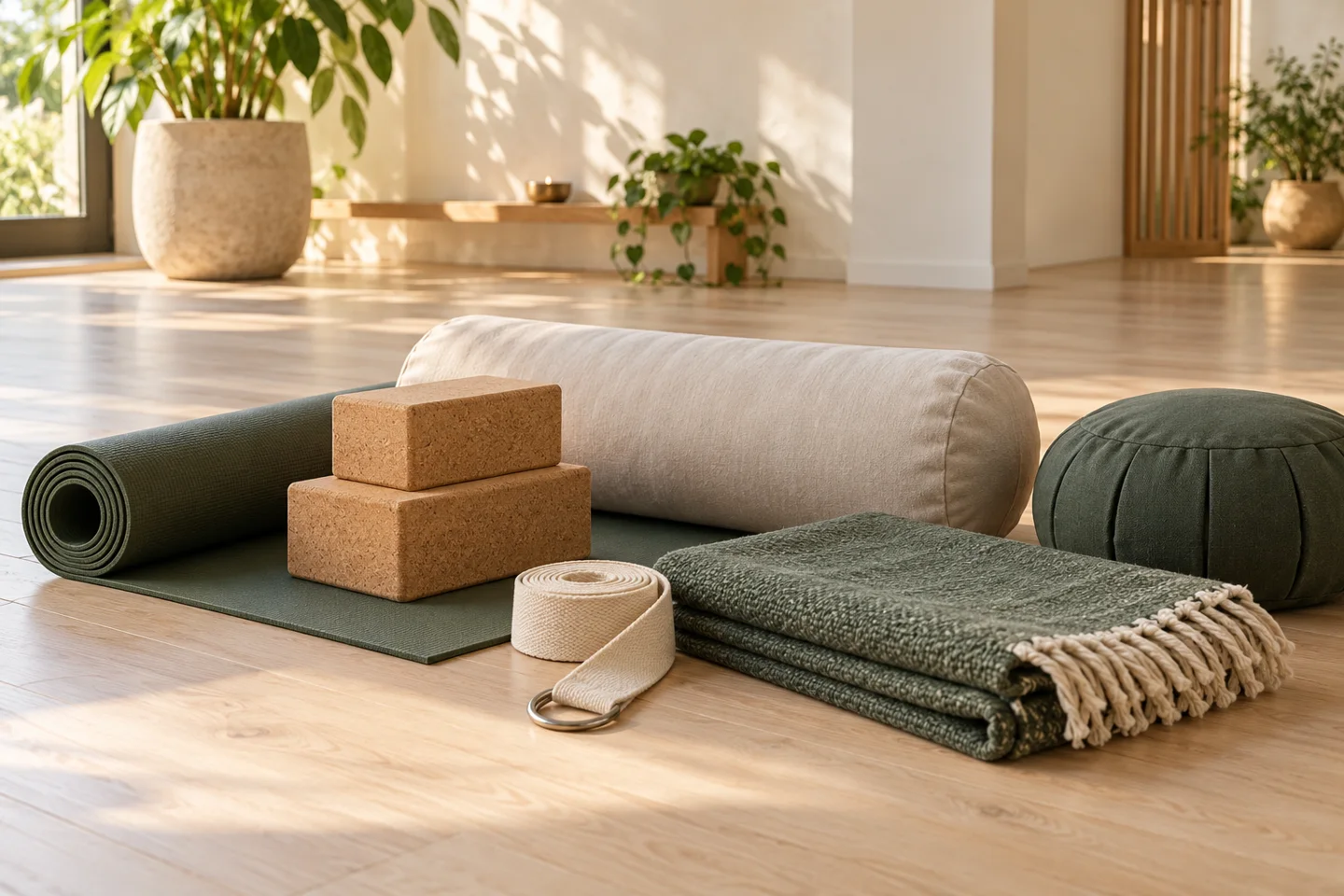
Eco-friendly yoga props are yoga tools made from natural, renewable or recycled materials instead of PVC or virgin foam. The main ones are a natural rubber, cork or jute mat, cork blocks, an organic cotton strap, a buckwheat-filled cotton bolster, a cotton or wool blanket, a meditation cushion and a cork yoga wheel, all built to cut plastic waste.
Key Takeaways
- Four props cover most beginners: a natural mat, two cork blocks, a cotton strap and a blanket.
- Cork is a standout material: the tree is not felled, and the bark regrows between harvests, roughly every nine years.
- Soft PVC is the one to question: it can contain up to 50% plasticisers by weight.
- Natural rubber is known for strong grip, but skip it if you have a latex allergy.
- Look for labels: GOTS for organic textiles, FSC for wood and cork, OEKO-TEX for fabrics tested for harmful substances.
You press your hands, knees and sometimes your face into your yoga mat several times a week. Yet most of us have never checked what it is made of.
For many mats and blocks, the answer is plastic: PVC, EVA foam and polyester. They do the job. Then they crack, crumble and end up in landfill, where they do not meaningfully break down.
There is a better way to kit out your practice. This guide covers eco-friendly yoga props names and uses: what each prop is called, how to use it in real poses, which natural materials it is made from, and how to buy well, whether you live in Austin, Manchester or Mumbai.
Yoga is not a niche hobby any more. In the US, adult yoga use rose from 5% in 2002 to 15.8% in 2022, according to the National Center for Complementary and Integrative Health (NCCIH). In England, Sport England’s Active Lives survey (2019 release) reported that yoga and Pilates were continuing to grow in popularity (Sport England). More people on mats means more mats eventually thrown away, so choosing well matters.
Not sure which props you actually need? Start with the beginner kit below. If you teach, Inteyoga’s Advanced TTC 300-Hour Integrated Restorative Yoga (Including Yoga Nidra, Chakra Sadhana, and Prana Vidya Intensive) covers the safe use of props and modifications. Explore the 300-hour programme.
Why Trust This Guide?
This guide is prepared by the Inteyoga Editorial Team. Inteyoga (Swami Krishnananda Yoga Vidyapeeth) in Sernabatim, Colva, South Goa, is registered with Yoga Alliance as a Registered Yoga School (RYS 200, RYS 300 and RYS 500).
Every statistic here links to its original source, including the US National Institutes of Health, the US EPA and the Mayo Clinic. We do not accept payment from any brand mentioned. You will find the full source list at the end.
What Are Eco-Friendly Yoga Props?
Eco-friendly yoga props are yoga tools made from natural, renewable, biodegradable or recycled materials rather than virgin plastic. Common materials include cork, natural rubber, jute, organic cotton, hemp, wool, responsibly sourced wood, buckwheat hulls and kapok.
A yoga prop is anything that helps you hold a pose more safely, comfortably or precisely. A block brings the floor closer. A strap lengthens your reach. A bolster lets your body rest without effort.
B.K.S. Iyengar is widely credited with popularising props such as blocks, belts and bolsters so that more people could work in a pose (read our Iyengar Yoga guide). Natural props have a much longer history. The Bhagavad Gita (6.11) describes a meditation seat of kusha grass, covered with a deerskin and then a cloth, laid on clean, firm ground. A cotton rug or jute mat sits in that same tradition.
What Makes a Yoga Prop Truly Eco-Friendly?
A prop deserves the label when it passes most of these five checks:
- Renewable source: the raw material regrows, as cork bark, rubber latex and cotton do.
- No PVC: and no added phthalate plasticisers.
- Long life: it lasts years, not months.
- A plan for the end: it can biodegrade, be composted, recycled or repaired.
- Fair production: clear sourcing and decent working conditions.
“Natural” is not enough on its own. A natural block that falls apart in six months can create more waste than a durable recycled one.
Why Do Eco-Friendly Yoga Props Matter?
Eco-friendly yoga props matter because most standard props are made from plastics that are hard to recycle, and some contain additives many people would rather not press their skin against every day.
Three reasons stand out:
- What goes into PVC. PVC is rigid by nature. To make a soft, sticky mat, manufacturers add plasticisers. A briefing from the Lowell Center for Sustainable Production notes that PVC products may contain up to 50% plasticisers by weight, most often phthalates (Lowell Center). The US EPA says it is concerned about phthalates because of their toxicity and widespread exposure, while noting that no causal link to human health effects has been established (US EPA).
- Where props end up. Foam blocks and PVC mats do not meaningfully biodegrade. Cork, cotton, jute and wool can return to the soil.
- Practice and values. The first of yoga’s ethical principles is ahimsa, or non-harm. Many students want their kit to reflect that too.
Swapping your props will not fix the planet. It is, though, an easy way to cut plastic from a habit you repeat every week.
What Are the Most Common Props Used in Yoga?
The most common props used in yoga are the mat, blocks, strap, bolster and blanket. Many studios also keep meditation cushions, eye pillows, sandbags, a wall and chairs. You can find every one of them as sustainable yoga gear made from cork, natural rubber, organic cotton, hemp, wool, wood or buckwheat.
What Are the Best Props for Yoga?
The best props for yoga suit your style of practice and are built to last: a natural rubber or cork mat, two cork blocks, an organic cotton strap, a cotton bolster and a cotton or wool blanket. Add a buckwheat cushion if you meditate, and a cork wheel later if you work on backbends with a teacher.
“Best” also means non-toxic yoga equipment you will still use in five years, not the cheapest set you replace every January.
What Are Some Basic Yoga Props?
The four basic yoga props are the mat, block, strap and blanket. Together, they cover almost every modification in a beginner class. The mat gives grip, the block brings the floor closer, the strap extends your reach, and a folded blanket adds height and padding.
What Are the 7 Types of Yoga, and Which Props Does Each Use?
The seven types of yoga most often listed are Hatha, Vinyasa, Ashtanga, Iyengar, Bikram (hot) yoga, Yin and Restorative yoga. There is no single official list, and Kundalini and Power Yoga appear on many versions. Each style leans on props in its own way:
| Yoga Type | Focus | Eco-Friendly Props Used Most | Learn More |
|---|---|---|---|
| Hatha Yoga | Posture, breath and balance at a steady pace | Natural rubber mat, cork blocks, cotton strap, blanket | What Is Hatha Yoga? |
| Vinyasa Yoga | Breath-led, flowing sequences | Grippy natural rubber or cork mat, cotton towel, blocks | What Is Vinyasa Yoga? |
| Ashtanga Yoga | A set series practised in order | Natural rubber mat, cotton rug on top for sweat | What Is Ashtanga Yoga? |
| Iyengar Yoga | Precise alignment, longer holds | Cork blocks, cotton straps, blankets, bolsters, wooden props, chairs | What Is Iyengar Yoga? |
| Bikram / Hot Yoga | A fixed sequence in a heated room | Natural rubber mat with an organic cotton towel or rug | What Is Bikram Yoga? |
| Yin Yoga | Long, passive floor holds | Bolsters, blocks, blankets | — |
| Restorative Yoga | Full-body support for rest | Bolsters, blankets, eye pillows, sandbags, blocks | What Is Restorative Yoga? |
In classical teaching, yoga also has wider paths, such as Raja, Hatha, Jnana, Karma and Bhakti Yoga. Inteyoga studies them together as one integrated discipline (About Inteyoga). Props mainly serve the physical side: asana, pranayama and relaxation.
Eco-Friendly Yoga Props Names and Uses: The Complete List
There are 12 eco-friendly yoga props worth knowing: the mat, block, bolster, strap, meditation cushion, yoga wheel, blanket, eye pillow, towel, sandbag, wedge and knee pad. The table shows each prop’s sustainable material, what it is for, and its “Eco-Friendly Why”: the reason it beats the standard plastic, PVC or foam version.
| # | Prop Name | Sustainable Material | Main Use | Eco-Friendly Why |
|---|---|---|---|---|
| 1 | Eco-friendly yoga mat | Natural rubber, jute, cork-on-rubber, organic cotton | Grip and cushioning for every pose | PVC-free; natural materials can biodegrade |
| 2 | Cork yoga block | Cork oak bark | Stability and alignment in seated and standing poses | Tree is not felled; replaces petroleum-based EVA foam |
| 3 | Organic cotton yoga bolster | Cotton or hemp cover; buckwheat, kapok or cotton fill | Supports the body in restorative poses | Plant fibres instead of polyester; washable and refillable |
| 4 | Organic cotton yoga strap | Organic cotton or hemp | Extends your reach in stretches and binds | Plant fibre instead of nylon or polyester |
| 5 | Buckwheat meditation cushion (zafu and zabuton) | Buckwheat hulls or kapok; cotton cover; solid bamboo benches | Raises the hips for meditation and breathwork | Crop by-product fill instead of foam |
| 6 | Cork yoga wheel | Cork shell on a wooden or recycled core | Opens the chest and spine; balance work | Less virgin ABS plastic and synthetic padding |
| 7 | Yoga blanket | Cotton, wool, recycled cotton | Padding, height and warmth | Natural fibre instead of acrylic fleece |
| 8 | Eye pillow | Organic cotton or linen; flaxseed, lavender | Covers the eyes in Savasana and Yoga Nidra | Seed fill instead of plastic beads |
| 9 | Yoga towel | Organic cotton, recycled polyester | Absorbs sweat and adds grip | Natural or recycled fibre instead of virgin microfibre |
| 10 | Sandbag | Cotton canvas; sand or grain | Gentle, grounding weight | Simple natural materials; refillable |
| 11 | Wooden wedge | FSC-certified wood or cork | Lifts the heels or wrists | Durable natural material instead of foam |
| 12 | Knee pad | Cork top, natural rubber base | Cushions knees and elbows | PVC-free, plant-based layers |
The 6 Core Eco-Friendly Yoga Props (With Step-by-Step Poses)
These six props cover most of what students need. For each one, you get the material breakdown, the Eco-Friendly Why and a simple guide to using it in real poses.
1. Eco-Friendly Yoga Mats (Natural Rubber, Cork and Jute)
Material: natural rubber, cork-topped rubber, jute or organic cotton | Use: a stable, non-slip base for every pose
An eco-friendly yoga mat is a PVC-free mat made from natural rubber, cork, jute or organic cotton that gives you grip and cushioning for your whole practice. It is the one prop almost everyone owns, so it is the one most worth getting right.
What it is made of:
- Natural rubber: made from latex tapped from the rubber tree (Hevea brasiliensis), and known for strong grip. Jade Yoga, for example, states that its mats contain no PVC, EVA or synthetic rubber (Jade Yoga).
- Cork-on-rubber: a thin cork layer over a rubber base. Cork-topped mats are often marketed for sweaty practice because cork stays grippy when slightly damp.
- Jute: a woven plant fibre, usually bonded to a rubber or other backing. It is firm and textured, with little cushion. Check what the backing is.
- Organic cotton rug: the traditional Indian option, often called a dhurrie. It is washable and folds into a suitcase.
Thickness: many standard mats are about 4 mm (roughly 3/16 inch). Thicker mats of 5–6 mm (about 1/4 inch) give more knee cushioning, and travel mats are often 1.5–2 mm (about 1/16 inch).
Eco-Friendly Why: many standard sticky mats are PVC, which may contain up to 50% plasticisers by weight (Lowell Center). A biodegradable yoga mat made from rubber, jute or cotton avoids PVC altogether and comes from plants that regrow.
How to Use It: Downward-Facing Dog (Adho Mukha Svanasana)
- Roll the mat out on a flat floor.
- Start on your hands and knees, wrists under shoulders and knees under hips.
- Spread your fingers wide and press the whole palm into the mat, especially the base of your index finger.
- Tuck your toes, lift your hips up and back, and keep your knees bent if your hamstrings are tight.
- Hold for five breaths, then lower your knees.
Good to know:
- A new rubber mat can smell for a few days. Air it in the shade, never in direct sun.
- Hands slipping on cork? Mist your palms lightly with water.
- Allergic to latex? Skip natural rubber. Choose cork-on-TPE, jute or a cotton rug.
2. Cork Yoga Blocks
Material: cork oak bark | Use: stability and alignment in seated and standing poses
A cork yoga block is a firm brick made from cork oak bark that brings the floor up to meet you, so you can keep good alignment while your flexibility develops.
What it is made of: cork is the outer bark of the cork oak (Quercus suber). It is stripped by hand, and the tree grows a new layer. The first harvest usually comes at about 25 years old, then roughly every nine years, giving around 15 harvests over about 150 years (Trees and Shrubs Online). The bark is ground into granules and pressed into blocks. A common block size is about 23 × 15 × 10 cm (9 × 6 × 4 inches).
Eco-Friendly Why: many standard blocks are EVA foam, a petroleum-based plastic that does not biodegrade and can compress over time. Cork is renewable, the tree stays alive, and the block is denser, so it is less likely to wobble under your hand.
How to Use It: Triangle Pose (Trikonasana)
- Stand with your feet about one leg-length apart. Turn your right foot out 90° and your left foot in slightly.
- Stand the block on its tallest side, just outside your right foot.
- Reach your arms out at shoulder height, stretch forward over your right leg, then tilt down.
- Rest your right hand on the block, not on your shin. Keep both sides of your waist long.
- Reach your left arm up and, if your neck is comfortable, look towards your hand. Hold for five breaths, then switch sides.
How to Use It: Seated Forward Bend (Paschimottanasana)
- Sit on the edge of one block with your legs straight out. This tips the pelvis forward and makes it easier to keep a long lower back.
- Place a second block on your shins or just past your feet.
- Breathe in and lengthen your spine. Breathe out and fold from the hips, not the waist.
- Rest your hands, or your forehead, on the second block.
- Stay for five to eight slow breaths, then roll up gently.
Teacher’s tip: if you find yourself rounding your back to reach the floor, start with the block at its full height. Lower it gradually over weeks as the pose allows.
3. Organic Cotton Yoga Bolsters
Material: organic cotton or hemp cover; buckwheat hull, kapok or cotton batting fill | Use: full-body support in restorative poses
An organic cotton yoga bolster is a firm, long cushion that supports your body so your muscles can relax. It is central to restorative yoga and is often used in Yoga Nidra.
What it is made of:
- Cover: organic cotton (ideally GOTS-certified) or hemp canvas, with a zip so you can wash it.
- Buckwheat hulls: the husks left after buckwheat is milled. Firm, mouldable and breathable.
- Kapok: a light, silky fibre from the seed pods of the kapok tree. Softer and springier.
- Cotton batting: layered cotton. Firm and fully natural.
Eco-Friendly Why: many standard bolsters contain polyester fill, a plastic fibre made from oil. Plant fills are renewable, and many bolsters can be topped up rather than thrown out.
How to Use It: Reclining Bound Angle (Supta Baddha Konasana)
- Lay the bolster lengthways on your mat and sit with your lower back against its short end.
- Bring the soles of your feet together and let your knees fall open. Slide a block or folded blanket under each thigh if your hips feel strained.
- Lower your back slowly onto the bolster. Add a folded blanket under your head if your chin tips up.
- Rest your arms by your sides, palms up.
- Stay for three to ten minutes, breathing slowly. Roll to one side to come up.
How to Use It: Supported Child’s Pose (Balasana)
- Kneel with your big toes touching and your knees wide.
- Place the bolster lengthways between your knees.
- Fold forward and rest your chest and belly on it.
- Turn your head to one side, and switch halfway through.
- Stay for two to five minutes.
Real-life use case: after a long day at a desk, a few minutes in Supported Child’s Pose is a simple way to slow down in the evening. For a full sequence, see our Restorative Yoga guide.
4. Organic Cotton Yoga Straps and Belts
Material: organic cotton or hemp webbing with a metal D-ring or cinch buckle | Use: extending your reach in stretches and binds
An organic cotton yoga strap is a long woven belt with a buckle that extends your reach, so tight muscles do not pull your spine out of line.
What it is made of: the band is woven from organic cotton or hemp and is commonly sold in lengths of about 1.8 to 3 metres (roughly 6 to 10 feet). The metal buckle lasts for years.
Eco-Friendly Why: many standard straps are nylon or polyester, both plastic fibres. Cotton and hemp come from plants and can break down at the end of their life. In one study, cotton fabric buried in tropical forest soil had completely broken down within six weeks in the rainy season (Chulalongkorn University, 2014). Breakdown is slower in cooler, drier conditions.
How to Use It: Reclining Hand-to-Big-Toe Pose (Supta Padangusthasana)
- Lie on your back with both legs straight.
- Bend your right knee and loop the strap around the ball of your right foot.
- Hold one end in each hand and straighten your right leg towards the ceiling.
- Keep your left leg pressing down and your hips level. Walk your hands up the strap only as far as feels comfortable.
- Hold for five to ten breaths, then switch legs.
How to Use It: Seated Forward Bend With a Strap
- Sit tall with your legs straight. Sit on a folded blanket if your lower back rounds.
- Loop the strap around the soles of both feet.
- Hold the strap with both hands, elbows soft.
- Breathe in to lengthen. Breathe out and fold from the hips, walking your hands down the strap.
- Stop when your back starts to round. Hold for five to eight breaths.
Real-life use case: people with tight hamstrings, such as many runners and cyclists, often find a strap makes seated forward bends workable without straining.
Good to know: let the strap guide you; never yank it. Wash it cold and hang it to dry.
5. Buckwheat and Bamboo Meditation Cushions (Zafus and Zabutons)
Material: buckwheat hull or kapok fill in an organic cotton cover; solid bamboo for meditation benches | Use: raising the hips for seated meditation and breathwork
A meditation cushion, or zafu, lifts your hips above your knees so your spine can stay upright with less strain. A zabuton is the flat, wider mat that sits underneath to cushion your knees and ankles.
What it is made of:
- Buckwheat hulls: mould to your sitting bones and stay firm through long sittings. You can add or remove hulls to change the height.
- Kapok: lighter and softer, if you prefer a plump seat.
- Cotton cover: organic cotton or hemp, ideally removable.
- Bamboo: solid bamboo is used for kneeling meditation benches. Be wary of “bamboo fabric” covers, though: they are usually viscose, a chemically processed fibre, so they are less green than they sound.
Eco-Friendly Why: many standard cushions use polyurethane foam or polyester fill. Buckwheat hulls are a by-product of a food crop, and the whole cushion can be emptied, washed and refilled.
How to Use It: Seated Alternate Nostril Breathing (Nadi Shodhana)
- Place the zabuton on the floor and the zafu on top, towards its back edge.
- Sit on the front third of the zafu so your pelvis tips slightly forward.
- Cross your legs, or kneel with the cushion between your heels. Your knees should sit lower than your hips.
- Rest your left hand on your knee and bring your right hand into Nasika Mudra.
- Keep your spine tall and breathe slowly through alternate nostrils for three to five minutes.
Real-life use case: if you sit for meditation before work, a firm buckwheat zafu can make the posture steadier, so your attention goes to the breath rather than to aching knees.
Good to know: keep buckwheat cushions dry. In humid weather, air them in the shade every few weeks.
6. Cork Yoga Wheels
Material: cork outer shell on a wooden or recycled core | Use: opening the chest and spine, and balance training
A cork yoga wheel is a round, hollow prop you lie over or roll along to open your chest, stretch the front of your body and practise balance.
What it is made of: a cork outer layer for grip and cushioning, over a core of wood or recycled material. Some wheels mix cork with wood and ABS plastic, so read the full material list (Sustainable Jungle).
Eco-Friendly Why: many standard wheels are an ABS plastic shell with synthetic TPE padding. A cork wheel uses a renewable surface and less virgin plastic.
How to Use It: Gentle Chest Opener
- Sit on your mat with your knees bent and the wheel behind you, touching your lower back.
- Cup the back of your head with your hands, elbows pointing forward.
- Press your feet down and roll back slowly until the wheel sits under your upper back, between your shoulder blades.
- Let your chest open while your hands keep supporting your neck.
- Stay for three to five breaths, then roll forward slowly.
Good to know: get comfortable with blocks and straps before you try a wheel. Avoid wheel backbends if you have a back injury or are pregnant, unless your doctor and a qualified teacher approve.
Other Eco-Friendly Yoga Props Worth Knowing
Six more props round out a sustainable kit: the blanket, eye pillow, towel, sandbag, wedge and knee pad.
- Yoga blanket (cotton or wool): fold it under your hips in a cross-legged seat, under your shoulders in Shoulder Stand (only with trained instruction), or over your body in Savasana and Yoga Nidra.
- Eye pillow (organic cotton or linen, flaxseed fill): rest it over your eyes in Savasana, Yoga Nidra and Legs-up-the-Wall (Viparita Karani).
- Yoga towel (organic cotton or recycled polyester): lay it over your mat in hot, Power or Vinyasa classes for grip and hygiene.
- Sandbag (cotton canvas with sand or grain): drape it across your thighs in Reclining Bound Angle, or over your shins in Savasana, for a grounding weight.
- Wooden wedge (FSC-certified wood or cork): slip it under your heels in a Garland Squat (Malasana) or under your wrists in Downward Dog.
- Knee pad (cork top, natural rubber base): place it under your back knee in Low Lunge (Anjaneyasana) or Cat-Cow.
Which Natural Materials Are Used in Sustainable Yoga Props?
The main natural materials in sustainable yoga props are cork, natural rubber, jute, organic cotton, hemp, wool, wood, buckwheat hulls and kapok. Each has its own strengths and trade-offs, so the right one depends on the prop and on you.
| Material | Where It Comes From | Used In | Strengths | Watch Out For |
|---|---|---|---|---|
| Cork | Bark of the cork oak (Quercus suber) | Blocks, mats, wheels, knee pads | Firm, light, grippy; tree is not felled | Can dent; heavier than foam |
| Natural rubber | Latex from the rubber tree | Mats, mat bases | Strong grip and cushioning | Latex allergy; new-mat smell; keep out of sun |
| Jute | Jute plant fibre | Mat surfaces | Renewable, textured, firm | Rough on bare skin; little cushion |
| Organic cotton | Cotton grown without synthetic pesticides | Straps, blankets, covers, rugs | Soft, washable, breathable | Look for GOTS certification |
| Hemp | Hemp plant fibre | Straps, bolster covers | Strong and durable | Stiff at first |
| Wool | Sheep’s fleece | Blankets | Warm, dense, holds its shape | Not vegan; needs gentle washing |
| Wood | Managed forests | Blocks, wedges, wheels | Long-lasting and stable | Hard edges; check for FSC |
| Buckwheat hulls | Husks of buckwheat seeds | Bolsters, zafus | Firm, mouldable, breathable | Heavier; keep dry |
| Kapok | Seed fibre of the kapok tree | Bolsters, zafus | Light, soft, plant-based | Flattens over time |
Why cork stands out: Portugal produces about half the world’s cork, and cork oaks there are protected by law (University of Washington Botanic Gardens). Harvesting the bark does not kill the tree, so cork is one of the most renewable prop materials available.
A word on latex: a latex allergy is a reaction to proteins in natural rubber. Symptoms range from itchy skin and hives to, rarely, anaphylaxis (Mayo Clinic). If you are allergic, choose cork-on-TPE, jute or cotton.
Buying Guide: What to Look For in Eco-Friendly Yoga Props
Before you buy, check four things: the full material list, a trusted certification, how durable the prop is, and what happens to it when you are done with it. “Eco” on the packaging is a marketing claim, not proof.
Which Certifications Should You Check?
The three certifications that matter most for sustainable yoga gear are GOTS for organic textiles, FSC for wood and cork, and OEKO-TEX for fabrics tested for harmful substances.
| Certification | What It Confirms | Look for It On |
|---|---|---|
| GOTS (Global Organic Textile Standard) | The fibre is organic, and processing meets environmental and social criteria | Cotton straps, bolster covers, blankets, cushion covers, rugs |
| FSC (Forest Stewardship Council) | Wood or cork comes from responsibly managed forests | Cork blocks, cork mats, wooden blocks, wedges, wheels |
| OEKO-TEX STANDARD 100 | The fabric has been tested for harmful substances (this is not the same as organic) | Towels, straps, covers |
| Certified B Corp | The company as a whole meets social and environmental standards | Brand level, not individual products |
How Do You Balance Durability and Biodegradability?
The greenest prop is a natural one that also lasts, because a prop you replace every year creates more waste than one you keep for a decade. The two goals do not always line up:
- Natural is not automatically long-lasting. A thin, cheap jute mat may wear out quickly; a dense natural rubber mat can last much longer.
- Recycled can be a fair middle ground. A recycled-foam block will not biodegrade, but it reuses existing plastic and can last for years.
- Single-material props are easier to dispose of. A 100% cork block or 100% cotton strap is simpler to compost or recycle than cork glued to foam.
- Repairable and refillable wins. A bolster with a washable cover and refillable buckwheat can outlive a sealed one.
Rule of thumb: natural first, built to last second, recycled third. Avoid virgin PVC where you can.
Quick Pre-Purchase Checklist
- Match your practice. Restorative and Yin need bolsters and blankets; Hatha and Iyengar need blocks and straps; dynamic classes need a grippy mat and towel.
- Read the full material list. Look for 100% cork, 100% organic cotton, or a stated recycled percentage.
- Check for certification. GOTS, FSC or OEKO-TEX.
- Test the feel. A block should not wobble. A buckle should hold without slipping.
- Ask about end of life. Can it be composted, recycled, refilled or repaired?
- Check for allergies. Natural rubber contains latex.
- Buy fewer, better props. Two cork blocks and a cotton strap cover most beginners.
Which Eco-Friendly Yoga Brands Are Worth Looking At?
Brands known for eco-friendly yoga props include Manduka, Jade Yoga, Liforme and Complete Unity Yoga, plus India-based makers such as Shakti Warrior. The details below are as published by each brand or by an independent reviewer; check the current product page before buying.
| Brand | Known For | Eco Credentials (as Published) |
|---|---|---|
| Manduka | Cork and recycled-foam blocks, mats, straps | 100% cork blocks, and blocks made of 50–75% recycled EVA foam; a mat downcycling and donation programme (Sustainable Jungle) |
| Jade Yoga | Natural rubber mats | No PVC, EVA or synthetic rubber; made in the USA; plants a tree for every mat sold through Trees for the Future (Jade Yoga) |
| Liforme | Mats and yoga pads | A Certified B Corp; PVC-free pads with a natural rubber base (Sustainable Jungle) |
| Complete Unity Yoga | Mats, blocks, blankets, cushions | Jute and natural rubber mats, cork blocks, 100% cotton blankets, buckwheat-filled cotton cushions (Sustainable Jungle) |
| Shakti Warrior (India) | Blocks, straps, meditation cushions | Single-material cork blocks and organic cotton straps; cork-fabric cushions with buckwheat fill (Sustainable Jungle) |
Shopping local? Second-hand blocks and bolsters are often the lowest-impact choice of all. Cork and wood clean up well.
Inteyoga is not affiliated with any brand named here and earns no commission.
What Are the Benefits of Eco-Friendly Yoga Props?
The main benefits of eco-friendly yoga props are steadier support, good grip, no PVC, a longer working life and less waste. Here are the eight that matter most:
- Steadier support. Cork and wooden blocks are denser than foam, so they shift less under load.
- Good grip. Cork and natural rubber surfaces are designed to hold well during practice.
- No PVC. Natural props avoid the plasticisers used to soften PVC.
- Breathable fabrics. Cotton, hemp and wool let heat escape during long holds.
- Adjustable fill. Buckwheat and kapok bolsters can be topped up or reduced.
- A natural end of life. Cork, cotton, jute and wool can break down.
- Durability. Well-made cork and wooden props can last for many years with care.
- Values in practice. Kit that does less harm fits the yogic principle of ahimsa.
Want to learn props the way teachers do? Inteyoga’s advanced 300-hour programme covers restorative yoga, Yoga Nidra and the safe use of props in a residential setting in South Goa. Read about the 300-hour training or apply here.
Traditional vs Eco-Friendly Yoga Props: What Is the Difference?
Traditional yoga props are mostly PVC, EVA foam and polyester, which come from fossil fuels and do not meaningfully biodegrade.
Eco-friendly yoga props use cork, natural rubber, jute, organic cotton, hemp and wood, which are renewable and can break down at the end of their life. Traditional props tend to be lighter and cheaper upfront. Eco-friendly props usually cost more but leave far less behind.
Comparison Table: Traditional PVC and Foam Props vs Eco-Friendly Props
| Factor | Traditional PVC / Foam Props | Eco-Friendly Props |
|---|---|---|
| Raw materials | PVC, EVA foam, polyurethane, polyester, nylon, ABS plastic (fossil-fuel based) | Cork, natural rubber, jute, organic cotton, hemp, wool, wood, buckwheat, kapok (renewable) |
| Health concerns | Soft PVC may contain up to 50% plasticisers by weight, mostly phthalates (Lowell Center); the US EPA has flagged phthalate toxicity and widespread exposure (US EPA) | Generally PVC-free and plasticiser-free; natural rubber contains latex, a known allergen |
| Impact when disposed of | According to Health Care Without Harm, a health-sector campaign group, PVC’s chlorine can form hydrogen chloride gas and contribute to dioxins when burned in poorly controlled fires or incinerators (Health Care Without Harm) | Plant materials return to the soil; no chlorine |
| Biodegradability | Does not meaningfully biodegrade | Cotton fabric broke down within 6 weeks in tropical rainy-season soil in one study (Chulalongkorn University, 2014); cork, jute and wool also biodegrade |
| Durability | Foam blocks can compress; cheap PVC mats may crack or flake | Cork and wooden blocks are dense and hard-wearing; rubber mats last longer when kept out of sun |
| Grip | Good when new; can turn slippery with sweat | Cork and natural rubber are chosen for grip |
| Stability | Foam can compress and wobble | Dense and firm |
| Weight | Lighter and easier to carry | Heavier (cork blocks, rubber mats) |
| Repair and refill | Rarely possible | Covers washable; buckwheat and kapok refillable |
| Upfront cost | Usually lower | Usually higher |
| Best for | Travel, occasional use, tight budgets | Regular home practice, teachers, restorative work |
How Long Do Eco-Friendly Yoga Props Last, and How Do They Biodegrade?
How long a prop lasts depends on its build quality, how often you practise and how you store it; there is no independent standard for prop lifespans, so treat brand lifespan claims with caution. What you can control is care, and what happens at the end.
| Prop | Durability With Regular Use | What Happens at End of Life | Standard Version |
|---|---|---|---|
| Natural rubber mat | Lasts longer when wiped gently and kept out of sun | Biodegrades slowly; cut it into kneeling pads or garden mats first | PVC mat: does not meaningfully biodegrade |
| Cork or cork-on-rubber mat | Cork top can wear where hands and feet press | Cork layer biodegrades; separate any synthetic base | PVC or TPE mat |
| Jute mat | Depends heavily on weave density | Jute biodegrades; check the backing | PVC mat |
| Organic cotton rug | Washable and hard-wearing | Cotton biodegrades; reuse it as a rug or throw first | Polyester rug |
| Cork block | Dense; small dents do not affect use | Biodegrades; can be ground and recycled | EVA foam block: does not biodegrade |
| Wooden block | Very hard-wearing | Biodegrades; easy to repurpose | Foam block |
| Cotton or hemp strap | Strong; buckle outlasts the band | Fabric composts; buckle can be reused or recycled | Nylon or polyester strap |
| Cotton bolster, buckwheat fill | Cover washable; fill can be refreshed | Cover composts; hulls can go on the compost heap | Polyester-filled bolster |
| Buckwheat zafu | Refillable | Hulls and cover compost | Foam cushion |
| Cork yoga wheel | Depends on core material | Cork shell biodegrades; core depends on material | ABS plastic wheel |
Which Eco-Friendly Yoga Props Does a Beginner Need?
A beginner needs just four eco-friendly yoga props: a natural mat, two cork blocks, an organic cotton strap and a cotton blanket. Add a bolster and a meditation cushion once you know you enjoy slower, restorative or meditative practice.
| Kit Level | Props | Why |
|---|---|---|
| Starter (must-have) | Natural rubber, cork or jute mat; 2 cork blocks; cotton strap; cotton blanket | Covers almost every beginner pose and modification |
| Restorative add-on | Buckwheat or kapok bolster; flaxseed eye pillow; sandbag | Supports long, passive holds and Yoga Nidra |
| Meditation add-on | Zafu and zabuton | Comfortable upright sitting for breathwork and meditation |
| Later, if needed | Cork wheel, wooden wedge, knee pad, yoga towel | Specific needs: backbends, wrists, knees, sweat |
Practising in a small apartment or flat? A cork block, a cotton strap and a folded blanket all fit in one drawer. A 4 mm mat rolls tightly and can store upright behind a door.
Not ready to buy anything yet? Use what you already have. A folded bath towel or cotton sheet works as a blanket. A firm sofa cushion can stand in for a bolster. A dressing-gown belt makes a decent strap, and a sturdy hardback book can replace a block. Reusing what you own is the greenest option of all.
How Do You Clean and Care for Natural Yoga Props?
Clean natural yoga props gently with mild soap and water, and dry them out of direct sunlight, so they last as long as possible. Harsh cleaners and heat can wear natural materials out faster than practice does.
- Cork blocks and mats: wipe with a damp cloth and a drop of mild soap. Air-dry. Do not soak.
- Natural rubber mats: wipe after every session. Once a week, use water with a little mild soap, unless the brand says water only. Keep out of direct sun, which can dry and crack rubber.
- Cotton straps, blankets and rugs: machine-wash cold on a gentle cycle and hang to dry.
- Bolsters and zafus: wash the cover only. Keep buckwheat and kapok dry, and air them in the shade every few months.
- Wool blankets: spot-clean or hand-wash in cool water with wool detergent; dry flat.
- Wooden props: wipe clean, and oil lightly if the surface looks dry.
Humid climate tip: whether it is a Florida summer, a damp British winter or the Goan monsoon, store natural props in a dry, airy spot off the floor. Damp cotton and buckwheat can grow mould.
Common Mistakes to Avoid With Eco-Friendly Yoga Props
The most common mistakes are buying too much at once, trusting “eco” labels without reading the materials, and using props to force a pose instead of supporting it.
- Falling for greenwashing: a “natural” block may be mostly foam with a thin cork skin. Read the breakdown.
- Forgetting about allergies: natural rubber contains latex.
- Using the wrong block height: start tall and lower the block only as the pose allows.
- Pulling hard on the strap: let it guide you, and ease in with your breath.
- Binning props too soon: a flat bolster can usually be refilled, and a frayed strap can become a blanket tie.
- Skipping guidance on advanced props: wheels and supported inversions need a trained teacher.
Safety Notes: Who Should Take Extra Care With Yoga Props?
Props can make many poses more accessible, but some health conditions call for a doctor’s advice and a qualified teacher before certain poses.
- Pregnancy: bolsters and blankets can help, but avoid deep wheel backbends, and ask your doctor or midwife before lying flat on your back for long periods later in pregnancy.
- High or low blood pressure, glaucoma or heart conditions: take care with inversions such as Shoulder Stand, even with blankets, and ask your doctor first.
- Recent surgery or injury: check with your doctor before using props to stretch or load the area.
- Spinal problems: do not roll over a yoga wheel unless a health professional has cleared you.
- Latex allergy: avoid natural rubber mats and bases.
How Are Props Taught at Inteyoga?
At Inteyoga, the safe use of props and modifications is part of the teaching methodology in the advanced 300-hour programme, a residential teacher training in South Goa, India, with a restorative focus.
The programme’s full name is the Advanced TTC 300-Hour Integrated Restorative Yoga (Including Yoga Nidra, Chakra Sadhana, and Prana Vidya Intensive). Its curriculum includes restorative yoga, Yoga Nidra and the safe use of props and modifications (course page).
Key details:
- 43+2 days: 43 training days, plus one arrival day and one departure day
- Residential, in Sernabatim, Colva, South Goa
- Taught in English
- Eligibility: a completed 200-hour yoga teacher training (TTC 200) or equivalent qualification, and age 21–60 years
- It is an advanced teacher training programme, not a beginner retreat
- Gift-it-Forward: there is no payment required to apply or to participate. After completing the programme, participants may voluntarily support the Gift-it-Forward initiative to help future aspirants, with no obligation to contribute (how it works)
- Next batch: 13 December 2026 – 26 January 2027. For later dates and availability, see the course page
New to teacher training? Inteyoga’s planned 200-hour programme is expected in approximately mid-2027.
The Arrival Guide includes a yoga mat on its packing list, so this guide is a good place to start choosing one.
Founder-Director: Dr. Ashutosh, MBBS, M.Sc. (Yoga), Yoga Master Level 6 (Yoga Certification Board, Ministry of AYUSH, Government of India), Swami Krishnananda Yoga Vidyapeeth and Inteyoga, Colva, South Goa. Meet the teacher.
Final Thoughts: Choose Props That Support You and the Planet
Once you know the eco-friendly yoga props names and uses, building a kit that is steady, comfortable and kinder to the earth gets simple. Start with a biodegradable yoga mat, two cork blocks, a cotton strap and a blanket. Add a buckwheat bolster, a zafu and an eye pillow when your practice turns towards rest and meditation.
Buy fewer, better props. Choose sustainable yoga gear and non-toxic yoga equipment with GOTS, FSC or OEKO-TEX labels. Look after it, and it will serve your practice for years.
Want to learn to teach with props, restorative yoga and Yoga Nidra? Explore Inteyoga’s 300-hour yoga teacher training in Goa. The next batch runs from 13 December 2026 to 26 January 2027.
Apply for the 300-hour programme · Read the FAQs · Email: info@inteyoga.org · WhatsApp: +91 935-473-7240
About the Author
Author: Inteyoga Editorial Team. The Inteyoga Editorial Team prepares educational content for Inteyoga (Swami Krishnananda Yoga Vidyapeeth), Plot No. 6, Novo Vaddo, Sernabatim, Colva, Salcete, Goa 403708, India. Inteyoga is managed by Inteyoga Shala LLP and is registered with Yoga Alliance as a Registered Yoga School (RYS 200, RYS 300 and RYS 500). About Inteyoga.
How We Researched This Guide
We reviewed the top-ranking guides on eco-friendly and sustainable yoga props, then checked factual claims against primary or expert sources: the US National Institutes of Health, the US EPA, the Mayo Clinic, university research on cork and cotton, and the official certification bodies (GOTS, FSC and OEKO-TEX).
Brand details reflect what each brand or an independent reviewer published at the time of writing. Where reliable data does not exist, such as standard lifespans for yoga props, we say so rather than estimate.
Safety Note and Medical Disclaimer
This article is for general education and is not medical advice. Yoga props can reduce strain in many poses, but they do not replace guidance from a qualified teacher or your doctor. If you are pregnant, recovering from surgery or injury, or have high or low blood pressure, glaucoma, a heart condition, a spinal problem or a latex allergy, speak to your doctor before starting a new practice or using a new prop.
Frequently Asked Questions About Eco-Friendly Yoga Props (FAQ)
What Are the Names of Eco-Friendly Yoga Props?
The main eco-friendly yoga props are the natural rubber, cork or jute mat, cork block, organic cotton strap, bolster, cotton or wool blanket, meditation cushion (zafu), eye pillow, cork yoga wheel, organic cotton towel, sandbag, wooden wedge and cork knee pad. Each one uses natural, renewable or recycled materials instead of PVC or virgin foam.
What Is the Most Eco-Friendly Material for Yoga Props?
Cork is one of the most eco-friendly materials for yoga props. It comes from the bark of the cork oak, which is stripped roughly every nine years without felling the tree. Cork is renewable, firm and biodegradable. Organic cotton, hemp and jute are also strong choices for straps, covers and mats.
Are Cork Yoga Blocks Better Than Foam Blocks?
For stability and sustainability, cork usually wins. Cork blocks are denser, so they are less likely to wobble under your hands, and they biodegrade at the end of their life. Foam blocks are lighter, softer and cheaper, which can suit travel or tender knees. For regular home practice, many practitioners choose cork.
Is a Cork Yoga Mat Worth It?
A cork yoga mat can be worth it if you sweat a lot or practise hot or Vinyasa yoga, because cork-topped mats are designed to stay grippy when slightly damp, and cork is renewable. It usually costs more than a PVC mat, and the cork surface can wear where your hands and feet press.
Are TPE Yoga Mats Eco-Friendly?
TPE (thermoplastic elastomer) mats are a middle ground. They are PVC-free, light and usually cheaper than natural rubber, and they can suit people with a latex allergy. But TPE is still a synthetic plastic that does not biodegrade. If natural rubber, cork or jute works for you, those are the greener choice.
Are Natural Rubber Yoga Mats Safe?
Natural rubber yoga mats are suitable for most people and provide good grip without PVC. However, natural rubber contains latex proteins that can trigger allergic reactions in people with a latex allergy. If that applies to you, choose a cork-topped TPE mat, a jute mat or an organic cotton yoga rug instead.
What Is a Yoga Bolster Filled With?
Eco-friendly yoga bolsters are usually filled with buckwheat hulls, kapok fibre or cotton batting, inside an organic cotton or hemp cover. Buckwheat feels firm and mouldable; kapok is lighter and softer. Many standard bolsters use polyester fill. Choose a bolster with a removable, washable cover.
Do Eco-Friendly Yoga Props Wear Out Faster?
Not when they are well made. Cork and wooden blocks are dense and hard-wearing, while foam blocks can compress over time. Natural rubber mats can deteriorate if left in sunlight or cleaned with harsh products, so store them in the shade and wipe them gently. Cotton covers and buckwheat fills can be washed and refreshed.
How Do I Clean an Eco-Friendly Natural Rubber Yoga Mat?
Wipe it after each session with a soft, damp cloth. Once a week, use water with a little mild soap, or follow the brand’s advice, as some recommend water only (Jade Yoga care note). Avoid alcohol, essential-oil sprays, harsh cleaners and soaking. Dry it flat in the shade and roll it only when fully dry.
Can You Recycle an Old Yoga Mat?
Yoga mats are often not accepted in household recycling, so check your local council or city rules first. Before binning one, give it a second life: cut it into kneeling pads for gardening, drawer liners or pet mats, or donate it if it is still usable. Some brands also run take-back or downcycling schemes for old mats.
Which Yoga Props Are Essential for Beginners?
Beginners need a mat, two blocks, a strap and a blanket. These four cover nearly every modification in a beginner class. Choose a natural rubber or cork mat, cork blocks, an organic cotton strap and a cotton blanket. Add a bolster later if you enjoy restorative yoga or Yoga Nidra.
Do I Need Yoga Props to Practise at Home?
You do not strictly need props, but they can make home practice more comfortable and help you work within your range, especially without a teacher to guide you. A mat and two blocks are the most useful starting point. Household items such as a firm cushion, a belt and a folded towel also work.
Can I Make Eco-Friendly Yoga Props at Home?
Yes. A folded cotton blanket or sheet works as a yoga blanket, a firm cushion can replace a bolster, a cotton belt or scarf can act as a strap, and a sturdy hardback book can stand in for a block. Reusing what you already own is the lowest-waste option there is.
What Are the 7 Types of Yoga?
The seven types of yoga most often listed are Hatha, Vinyasa, Ashtanga, Iyengar, Bikram (hot) yoga, Yin and Restorative yoga. There is no single official list, and Kundalini and Power Yoga also appear on many. Iyengar, Yin and Restorative yoga tend to use the most props, especially blocks, straps, bolsters and blankets.