Quick Answer
Iyengar Yoga is a form of Hatha Yoga developed by B.K.S. Iyengar (1918 to 2014) in Pune, India. It focuses on precise body alignment, careful sequencing of poses and longer holds. Props such as blocks, belts, blankets and chairs help students of any age or ability practice safely. Its philosophy rests on Patanjali’s eight limbs of yoga.
Key Takeaways
- Iyengar Yoga is named after its founder, B.K.S. Iyengar, and only certified teachers may use the name for their classes.
- Its three pillars are alignment, sequencing and timing.
- Props make poses reachable for stiff beginners, older adults and people working around limitations.
- Research on yoga for chronic low back pain is encouraging but shows modest effects, so yoga should support medical care, not replace it.
- Beginners can start safely with standing poses, while inversions such as Headstand should be learned in person.
Walk into an Iyengar Yoga class and you notice the equipment first. Blocks, belts, blankets, bolsters and even metal folding chairs line the wall. Then you notice the pace. Nobody rushes, and the teacher may stop the whole room to move one student’s back foot by an inch. So, what is Iyengar Yoga, and why do so many teachers recommend it as a foundation for a safe, lifelong practice?
This guide explains what Iyengar Yoga is, where it came from, how the method works and which props you will use. It covers the benefits and the research behind them, compares Iyengar Yoga with Hatha, Vinyasa and Ashtanga, and lists poses to learn first. You will also find safety notes, best practices and advice on finding a certified teacher.
Want to see how alignment, anatomy and classical yoga fit into a complete training path? Explore our yoga teacher training courses in Goa.
What Does Iyengar Mean?
“Iyengar” is a South Indian family and community name, and Iyengar Yoga is the method named after B.K.S. Iyengar, who carried that name. The word says nothing about poses or breathing. It tells you whose teaching the method follows.
What Does the Name Iyengar Mean?
Iyengar is the English spelling of the Tamil word Aiyangar, also written Ayyangar. Its origin is debated. One common explanation links it to “ayya,” a Tamil term of respect related to the Sanskrit word arya (“noble”), joined to a suffix that also signals respect.
The initials in B.K.S. Iyengar follow a South Indian naming pattern. B stands for Bellur, his home village in Karnataka. K stands for Krishnamachar, his father’s name. S stands for Sundararaja, his own given name. Iyengar is his family’s community name.
What Does Iyengar Yoga Mean?
Iyengar Yoga is the system of yoga taught by B.K.S. Iyengar. It teaches postures (asana) and breathing practice (pranayama) with close attention to detail, structure and safety. In every pose, it asks one question: is the body placed correctly?
Unlike “Hatha” or “Vinyasa,” the name does not describe a technique. It describes a lineage, and the name is protected. According to the Iyengar Yoga National Association of the United States (IYNAUS), only Certified Iyengar Yoga Teachers (CIYTs) may describe their teaching as Iyengar Yoga.
What Style of Yoga Is Iyengar?
Iyengar Yoga is an alignment-based style of Hatha Yoga. It belongs to the family of physical, posture-focused yoga. What sets it apart is that it is static rather than flowing, and it relies heavily on props and detailed instruction.
On a scale of yoga styles, Iyengar Yoga uses still holds rather than continuous flow. Its intensity is moderate and rises with experience. Its focus is structure, precision and awareness. The philosophy has a spiritual side, but most classes center on the body.
B.K.S. Iyengar described yoga as an art, a science and a philosophy, not only a form of exercise. That is why an Iyengar class can feel like a workshop: you learn how your body works as you move it.
What Is So Special About Iyengar Yoga? Key Characteristics
Iyengar Yoga stands out for combining precise teaching, systematic use of props and a long, formal teacher certification process. Other styles share one or two of these traits. Iyengar Yoga brings them together.
| Key Characteristic | What It Looks Like in Practice |
|---|---|
| Detailed verbal instruction | Teachers give specific cues for feet, legs, spine, arms and head |
| Demonstration | The teacher shows a pose, often on a student, to highlight one point |
| Props as standard equipment | Blocks, belts, blankets, bolsters, chairs and wall ropes appear in most classes |
| Static, long holds | Poses are held, observed and refined rather than flowed through |
| Emphasis on inversions | Supported Headstand and Shoulderstand are central once students are ready |
| Adaptable practice | The same pose can be modified for injury, age, fatigue or stiffness |
| Standardized certification | Teachers train and are assessed over several years, and the name is protected |
| Quiet classroom | Little or no music, so students can hear instructions and stay attentive |
The certification point matters. In many styles, anyone can put the style’s name on a class. In Iyengar Yoga, the title is earned, so a beginner class in London, New York or Pune follows the same core approach.
Origins and History: Who Started Iyengar Yoga?
B.K.S. Iyengar started Iyengar Yoga. He was an Indian yoga teacher and author who helped bring yoga to the Western world. According to Encyclopaedia Britannica, he was born on 14 December 1918 in Bellur, Karnataka, and died in Pune on 20 August 2014, aged 95.
He was a sickly child. Obituaries published at his death describe early illnesses that included malaria, typhoid and tuberculosis. As a teenager, he went to Mysore to learn yoga from his brother-in-law, T. Krishnamacharya, who is often called the father of modern yoga. His health improved with practice, and in 1937, at age 18, Krishnamacharya sent him to Pune to teach.
Iyengar’s own body was stiff and weak at the start, so he had to find ways to make poses possible. That early struggle shaped his lifelong interest in props, precision and adapting yoga to each student.
Key Moments in B.K.S. Iyengar’s Life
| Year | Event |
|---|---|
| 1918 | Born on 14 December in Bellur, Karnataka, India |
| 1930s | Learns yoga from T. Krishnamacharya in Mysore as a teenager |
| 1937 | Moves to Pune, aged 18, to teach yoga |
| 1952 | Meets the violinist Yehudi Menuhin, who becomes his student |
| 1954 | Teaches in Switzerland at Menuhin’s invitation |
| 1956 | Makes his first visit to the United States |
| 1966 | Publishes Light on Yoga, his best-known book |
| 1975 | Opens the Ramamani Iyengar Memorial Yoga Institute (RIMYI) in Pune, named after his late wife |
| 1991 | Receives the Padma Shri from the Government of India |
| 2002 | Receives the Padma Bhushan |
| 2004 | Named one of Time magazine’s 100 most influential people |
| 2014 | Receives the Padma Vibhushan and dies on 20 August in Pune |
His books are still standard reading for yoga students. Besides Light on Yoga, they include Light on Pranayama (1981), Light on the Yoga Sutras of Patanjali (1993) and Light on Life (2005).
His family now runs RIMYI in Pune. According to Iyengar Yoga (UK), his son, Prashant Iyengar, and his granddaughter, Abhijata Sridhar Iyengar, are directors. His daughter, Geeta S. Iyengar, taught there until her death in December 2018 and is known especially for her work on yoga for women.
What Are the Roots of Iyengar Yoga?
Iyengar Yoga has two roots: classical Hatha Yoga and the Yoga Sutras of Patanjali. The physical practice comes from the Hatha tradition. The philosophy comes from Patanjali’s eight limbs of yoga, which in the classical sense are also called Ashtanga Yoga.
The eight limbs are:
- Yama: ethical restraints, such as non-harming and truthfulness
- Niyama: personal observances, such as discipline and self-study
- Asana: posture
- Pranayama: regulation of the breath
- Pratyahara: drawing the senses inward
- Dharana: concentration
- Dhyana: meditation
- Samadhi: complete absorption
Most Iyengar classes start with asana. The other limbs still matter, but B.K.S. Iyengar taught that the body is the most accessible place to begin. When you hold Triangle Pose and notice your back knee drifting, you are already practicing concentration. Over time, the postures lead into the rest of the path.
Iyengar Yoga also shares a family tree with other modern styles. K. Pattabhi Jois, who developed Ashtanga Vinyasa Yoga, also studied with Krishnamacharya. That is why the two methods share many poses but feel very different in practice.
Also read: What Is Raja Yoga (Meditation)? Meaning, 8 Limbs & Benefits
What Is the Iyengar Method and How Does It Work?
The Iyengar method trains awareness through the body: you place each part correctly, hold the pose steadily, observe what happens and refine it. Repeated over weeks and months, this cycle builds strength, mobility and concentration together.
Each pose follows a loop:
- Instruct: the teacher gives one or two clear cues.
- Place: you arrange the body, using props if needed.
- Stabilize: you find a steady base before going further.
- Hold: you stay long enough to feel the effect.
- Observe: you notice which areas are working and which have gone dull or collapsed.
- Refine: the teacher adds the next cue, and the loop begins again.
The method also works in layers over a longer period. Early classes build a base in standing poses. Later, students add forward bends, twists, backbends and supported inversions.
Breathing practice comes once the body can sit or lie steadily. Because each layer depends on the one before it, progress in Iyengar Yoga tends to be slow but lasting.
What Are the 10 Core Principles of Iyengar Yoga?
The 10 core principles of Iyengar Yoga begin with its three pillars, alignment, sequencing and timing, and extend to precision, stability, adaptation, progression, awareness, breath and regular practice. Together, they explain why the method feels consistent from class to class.
1. Alignment: How Is the Body Placed?
Alignment means arranging the body so that bones, joints and muscles work together without strain. You may hear cues like “lift the inner arch of the foot” or “turn the back thigh in.” The aim is balance between the left and right sides, the front and back of the body, and effort and ease.
2. Sequencing: In What Order Are Poses Taught?
Sequencing is the order of poses in a class. Iyengar teachers plan each sequence so that one pose prepares the body for the next. Standing poses, for example, often come before seated forward bends because they open the hips and hamstrings first. Teachers also change sequences for fatigue, stiffness or a recent injury.
3. Timing: How Long Are Poses Held?
Timing is how long you stay in a pose. A beginner might hold a standing pose for 20 to 30 seconds, while experienced students may stay for a minute or more. Supported poses, such as a supported bridge on a bolster, can last several minutes. Longer holds give you time to observe and adjust.
4. Precision
Small details change the whole pose. The angle of a foot or the turn of an upper arm affects how everything above it works, so Iyengar Yoga treats these details as the core of practice, not as fine-tuning.
5. Stability Before Depth
A steady, well-built pose comes first, and range of motion comes later. A shallow pose with sound alignment is valued more than a deep pose that collapses.
6. Adaptation to the Individual
Every body is different, so the pose adapts to the student. Supports, wall work and modified versions let people with different needs practice the same pose safely.
7. Progression From Simple to Complex
Students learn standing poses before inversions, and inversions before advanced backbends. Each stage prepares the body and mind for the next.
8. Awareness in Action
Holding a pose while watching the whole body trains the attention that Patanjali calls dharana, or concentration. This is why Iyengar practitioners often describe the poses as meditation in action.
9. Breath Follows a Stable Body
Formal pranayama is usually taught after students have a steady base in asana. A calm, stable body makes controlled breathing easier to learn and safer to practice.
10. Regular Practice (Abhyasa)
Patanjali names abhyasa, steady and sincere practice over time, as a condition for progress. B.K.S. Iyengar kept up a daily practice until shortly before his death and encouraged students to build a home practice alongside classes.
What Props Are Used in Iyengar Yoga?
Iyengar Yoga uses props such as blocks, belts, blankets, bolsters, chairs and the wall to support the body in each pose. B.K.S. Iyengar designed many of these props. They help beginners reach a pose safely and help advanced students go deeper with control.
| Prop | What It Does | Common Example |
|---|---|---|
| Sticky mat | Gives grip so feet and hands do not slide | All standing poses |
| Block | Brings the floor closer when reach is limited | Hand on a block in Utthita Trikonasana (Triangle Pose) |
| Belt (strap) | Extends your reach and holds limbs in place | Belt around the feet in Paschimottanasana (Seated Forward Bend) |
| Blanket | Adds height and padding, and protects the neck | Folded blankets under the shoulders in Salamba Sarvangasana (Supported Shoulderstand) |
| Bolster | Supports the back, chest or legs in resting poses | Supported Setu Bandha Sarvangasana (Bridge Pose) |
| Chair | Supports the spine in backbends and inversions | Chair Sarvangasana or Viparita Dandasana over a chair |
| Wall | Gives feedback and support for balance | Back against the wall in Vrksasana (Tree Pose) |
| Wall ropes | Provide traction and support in some studios | Rope-supported inversions under a teacher’s guidance |
| Sandbag | Adds gentle weight to help muscles release | Sandbag on the thighs in reclining poses |
People often ask whether props make yoga “easier.” They make poses more accessible, and they also make the work more honest. When a block removes the struggle to reach the floor, you can pay attention to length in the spine, steady legs and calm breath. The standard stays the same; the props help you reach it.
What Happens in an Iyengar Yoga Class?
A typical Iyengar Yoga class is a teacher-led, step-by-step lesson that moves from simple to more complex poses and ends in rest. Classes often last 60 to 90 minutes.
A beginner class often follows this order:
- Arrival and centering: a short pause, sometimes with a chant or quiet sitting.
- Warm-up: simple poses such as Tadasana (Mountain Pose) and Adho Mukha Svanasana (Downward-Facing Dog).
- Main teaching: a group of poses built around one theme, such as standing poses or forward bends.
- Demonstration: the teacher shows a pose to point out one detail.
- Practice and correction: students try the pose while the teacher walks the room and adjusts.
- Cooling down: gentle seated poses or supported inversions, if appropriate.
- Savasana (Corpse Pose): several minutes of complete rest, which ends almost every class.
Expect the teacher to talk a lot. B.K.S. Iyengar was known for detailed, almost nonstop instruction, and students often pause between poses to listen. The class is not designed to make you sweat, although some poses are strong and demanding.
Many teachers ask students to wear fitted clothing, often shorts, so they can see knee and leg alignment. You do not need to bring props to a studio class, because most Iyengar studios provide them.
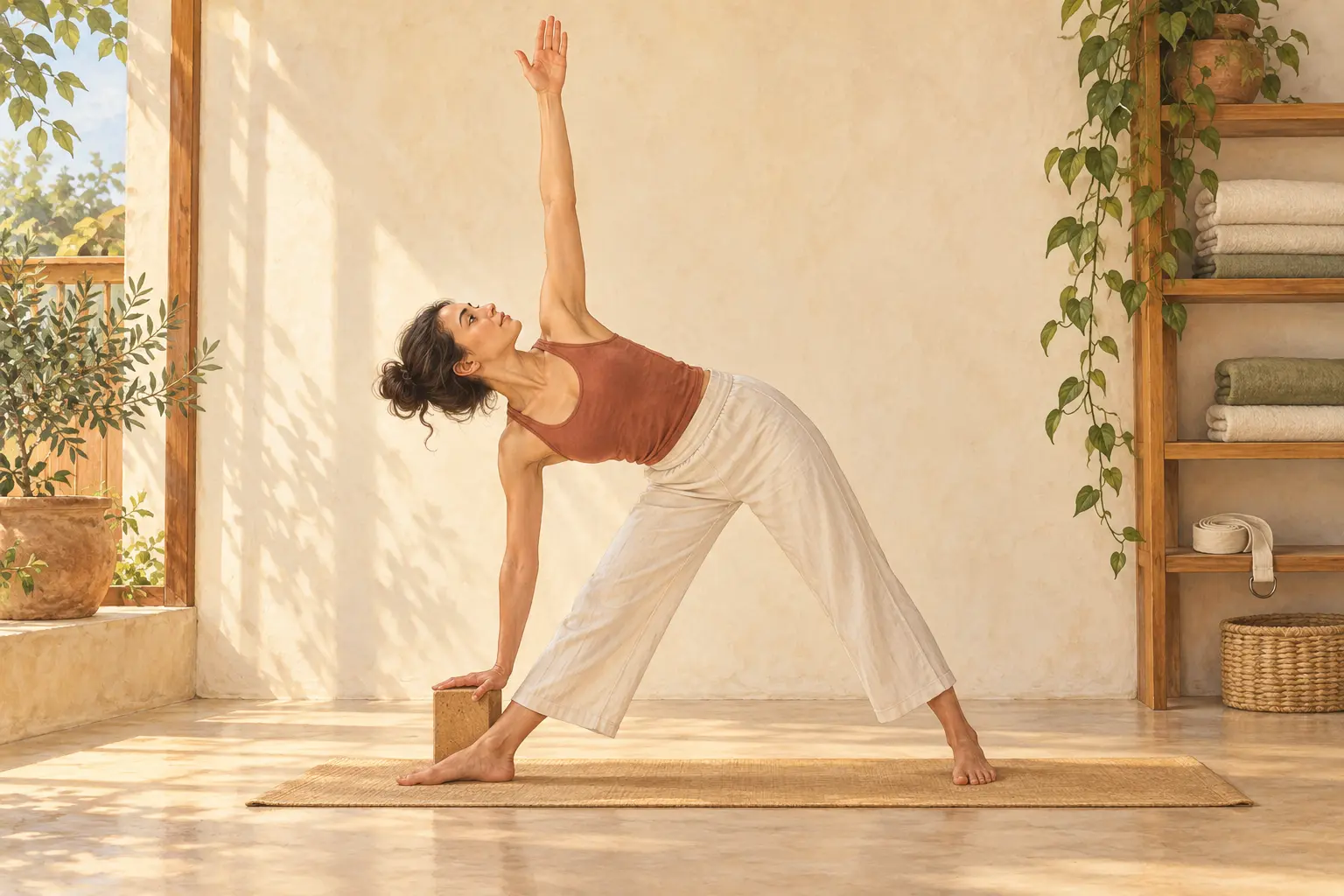
Example: How Is Triangle Pose Taught in Iyengar Yoga?
Utthita Trikonasana (Extended Triangle Pose) shows the Iyengar method clearly, because the teacher builds it one instruction at a time. Here is a simplified version of how a beginner class might teach it, with the student standing with the back to a wall and a block nearby.
- Set the base. Step the feet about one leg-length apart. Turn the right foot out 90 degrees and the left foot in slightly. Line up the right heel with the left arch.
- Firm the legs. Lift the kneecaps and tighten the thigh muscles. Keep both legs straight without locking the knees.
- Extend before you bend. Stretch the arms out to the sides at shoulder height, and lengthen the trunk toward the right foot before you tilt.
- Tilt from the hips. Take the trunk sideways to the right, and place the right hand on a block beside the shin, not on the knee.
- Turn the chest. Use the wall as feedback, and roll the left side of the chest back so the trunk faces forward rather than down.
- Reach and look. Stretch the left arm up in line with the right arm. Turn the head to look up only if the neck feels comfortable.
- Hold and observe. Stay for 20 to 30 seconds, and notice whether the back leg is still active and the chest still open.
- Come up and repeat. Press into the feet, rise on an inhalation, and repeat on the left side.
The teacher does not rush the student toward the floor, and there is no music to keep pace with. Each cue fixes one part of the pose before the next one is added. A full Iyengar class works the same way, pose after pose.
Is Iyengar Yoga OK for Beginners?
Yes. Iyengar Yoga is well suited to beginners. The slow pace, clear instructions and props let new students learn each pose safely before moving on. Many teachers of other styles recommend a few Iyengar classes as a foundation.
Beginners benefit in several ways. Detailed cues build good habits from the first class. Props meet you where you are, so a block or belt keeps a pose safe if your hamstrings are tight. Because the class moves pose by pose, you can follow along without guessing. And Iyengar teachers watch closely, so they correct mistakes early.
Iyengar Yoga also suits people who think they are “not flexible enough for yoga.” Flexibility is not a requirement. You build it, and the props make that process steady.
Who Is Iyengar Yoga Best For?
Iyengar Yoga is best for people who want to learn yoga carefully and in depth, including people who need a practice that adapts to their body. Beyond beginners, it suits several groups well:
- Older adults, because supported poses and chairs help them keep moving with less strain.
- People with stiffness, because long, supported holds let tight areas open gradually.
- Desk workers, because standing poses and attention to the spine can counter long hours of sitting.
- People returning after an injury, once a doctor or physiotherapist has cleared them, because adapted poses can ease the return to movement.
- Detail-oriented learners who want to understand why a pose works, not just copy it.
- Yoga teachers, because the method trains you to observe bodies and give precise cues in any style.
- Students of faster styles, since Vinyasa and Ashtanga practitioners often take Iyengar classes to refine technique.
Iyengar Yoga may suit you less if you want a fast, sweaty, music-filled workout. Many students do both kinds of practice.
Which Iyengar Yoga Poses Should Beginners Learn First?
Beginners in Iyengar Yoga usually start with standing poses, a few simple seated poses and Savasana. These build strength, balance and body awareness before more complex poses such as inversions are introduced.
Here are eight common beginner poses and how props are often used:
| Pose (Sanskrit) | English Name | Common Prop | What It Teaches |
|---|---|---|---|
| Tadasana | Mountain Pose | Block between the thighs | Standing tall with even weight on both feet |
| Vrksasana | Tree Pose | Wall behind the back | Balance and steady focus |
| Utthita Trikonasana | Extended Triangle Pose | Block under the lower hand | Leg strength and side-body length |
| Virabhadrasana II | Warrior II | Back heel to the wall | Strong legs and open chest |
| Adho Mukha Svanasana | Downward-Facing Dog | Block under the head | Long spine and stable shoulders |
| Dandasana | Staff Pose | Folded blanket under the hips | Upright sitting posture |
| Setu Bandha Sarvangasana (supported) | Supported Bridge Pose | Bolster or block under the pelvis | Gentle chest opening and rest |
| Savasana | Corpse Pose | Blanket under the head | Complete physical and mental rest |
The same pose can look very different from one student to the next. One person may need a block under the hand in Triangle while another reaches the floor easily. Both are doing the pose correctly if the alignment is sound.
Also read: What Is Yoga Tree Pose (Vrikshasana)? 8 Easy Steps, Tips & Benefits
Which Asana Is the Queen of Yoga?
Salamba Sarvangasana (Supported Shoulderstand) is widely known as the queen, or mother, of asanas. In Light on Yoga, B.K.S. Iyengar called it the mother of asanas. Its partner pose, Salamba Sirsasana (Supported Headstand), is often called the king of asanas.
Within the tradition, Headstand is described as active and energizing and Shoulderstand as calming and nourishing. In many Iyengar sequences, students practice Shoulderstand after Headstand.
Iyengar teachers set up Shoulderstand with folded blankets under the shoulders so that the neck keeps its natural curve. Beginners often learn a supported version on a chair first. Because it is an inversion, it is not suitable for everyone. Read the safety section below before you try it, and learn it in person.
What Are the Top 10 Benefits of Iyengar Yoga?
The main benefits of Iyengar Yoga include better posture, strength, flexibility, balance and focus. Research also suggests yoga may bring small improvements for people with chronic low back pain. As with any exercise, results vary from person to person.
These are ten benefits commonly linked with the practice, with the evidence noted where it exists:
- Better posture and body awareness. Constant attention to alignment shows you how you stand, sit and move, and those habits can carry into daily life.
- Strength and stability. Long holds in standing poses work the legs, hips and core.
- Gradual flexibility. Props let you work at the edge of your range without forcing it, and range of motion often improves over time.
- Improved balance. Poses like Tree and Warrior II train balance and coordination.
- Possible help with chronic low back pain. A Cochrane review of yoga in general and two trials of Iyengar Yoga reported modest improvements in pain and function (see the research section below).
- Focus. Holding a pose while following precise cues trains concentration.
- Rest. Supported poses and Savasana are built into most classes and give the body time to slow down.
- Low-impact movement. There is no jumping, so the practice is gentle on the joints when taught well.
- Patience and self-discipline. Learning poses step by step builds the habit of steady effort.
- A foundation for other styles. Students who learn alignment in Iyengar Yoga often carry it into Vinyasa, Ashtanga or Yin practice.
Also read: What Is Therapy Yoga? Meaning, 8 Uses, Benefits & How It Works
Which Yoga Has the Most Benefits?
No single style of yoga has the most benefits for everyone. The best style is the one that matches your goals and that you will practice regularly. Different styles emphasize different results.
| Your Main Goal | Styles That Often Fit |
|---|---|
| Learning safe technique and alignment | Iyengar Yoga |
| Building stamina and heat | Ashtanga, Vinyasa or power yoga |
| Deep relaxation | Restorative yoga or Yoga Nidra |
| Long, slow stretching | Yin Yoga |
| A balanced, general practice | Classical Hatha Yoga |
| Meditation and inner study | Raja Yoga or Jnana Yoga |
Many people combine styles. An Iyengar class once a week can sharpen technique, while a Vinyasa class adds cardio. How often you practice matters more than the label on the class.
What Does the Research Say About Iyengar Yoga?
Research on yoga for chronic low back pain is the strongest area of evidence, and it shows small to modest benefits. Studies of Iyengar Yoga specifically are fewer and smaller.
- Cochrane systematic review, 2022. Wieland and colleagues reviewed 21 trials with about 2,200 participants. Compared with no exercise, yoga led to small improvements in pain and back function at three and six months that the authors judged not clinically important. Yoga worked about as well as other back-focused exercise for function. Yoga participants were slightly more likely to report adverse events, mostly short-lived increases in back pain.
- Williams and colleagues, 2009 (Spine). Researchers randomly assigned 90 adults with chronic low back pain to 24 weeks of Iyengar Yoga or to standard medical care. The yoga group reported greater reductions in functional disability, pain intensity and depression. Six months later, the differences were still statistically significant, though slightly smaller.
- Williams and colleagues, 2005. An earlier 16-week trial by the same group reported reduced pain intensity, disability and pain medication use with Iyengar Yoga.
- American College of Physicians guideline, 2017. The ACP lists yoga among the non-drug treatments clinicians may consider for chronic low back pain. The guideline covers yoga in general, not only Iyengar Yoga.
How Many People Practice Yoga?
According to the CDC’s National Center for Health Statistics (NCHS Data Brief No. 501, June 2024), 16.9% of US adults practiced yoga in 2022. Among them, 28.8% said they used yoga to treat or manage pain, and 57.4% practiced meditation as part of yoga.
What Are the Limits of the Evidence?
Yoga studies have real limits. Participants know whether they are doing yoga, so trials cannot be fully blinded. Many studies are small, and classes in research settings may differ from a typical studio class.
For these reasons, we describe Iyengar Yoga as something that may help with certain conditions, not as a cure or a replacement for medical care. If you have a health condition, talk with your doctor before you start.
How Is Iyengar Yoga Different From Other Yoga?
Iyengar Yoga differs from most other yoga mainly in how it is taught: slowly, with precise cues, props and protected teacher certification. The poses are largely the same ones you find in other styles. The method is what changes.
What Is the Difference Between Iyengar Yoga and Normal Yoga?
“Normal yoga” usually means a general class at a gym or studio, often a gentle Hatha or Vinyasa class. Here is how a typical Iyengar class compares:
| Feature | Typical General Yoga Class | Iyengar Yoga Class |
|---|---|---|
| Teaching | Teacher calls out poses and students follow | Teacher explains, demonstrates and corrects each pose |
| Props | Optional or not provided | Provided and used in most poses |
| Pace | Often continuous | Pose by pose, with pauses |
| Teacher qualification | Varies widely | Certified through years of training and assessment |
| Goal of a pose | Getting into the shape | Understanding and refining the shape |
The next three sections compare Iyengar Yoga with Hatha, Vinyasa and Ashtanga.
Iyengar Yoga vs Hatha Yoga: What Is the Difference?
Iyengar Yoga is one specific method within the wider Hatha Yoga tradition. Hatha Yoga is the umbrella term for physical yoga practice. Iyengar Yoga is a defined system inside it, with its own focus on alignment, props and long holds.
| Feature | Hatha Yoga | Iyengar Yoga |
|---|---|---|
| What it is | A broad tradition of physical yoga practice | A specific method developed by B.K.S. Iyengar |
| Origins | Classical texts such as the Hatha Yoga Pradipika, usually dated to the 15th century | Developed from the 1930s onward; RIMYI founded in 1975 |
| Pace | Usually slow to moderate | Slow and methodical, with pauses for instruction |
| Props | Sometimes used | Central to the method |
| Pose holds | Varies by teacher | Long, with focus on timing |
| Teacher training | Varies widely by school | Multi-year CIYT certification; the name is protected |
| Best for | General practice and relaxation | Learning precise alignment and safe technique |
Every Iyengar class is a Hatha class, but not every Hatha class is Iyengar. A “Hatha” class on a schedule could be gentle, strong, breath-focused or meditative. An “Iyengar” class with a certified teacher tells you what method to expect.
Also read: What Are the Six Limbs of Hatha Yoga? 6 Powerful Stages
What Are the Key Differences Between Iyengar Yoga and Vinyasa Yoga?
The main difference is movement: Iyengar Yoga holds poses still to refine them, while Vinyasa Yoga links poses in a continuous, breath-led flow. Both can be excellent, but they train different things.
| Feature | Iyengar Yoga | Vinyasa Yoga |
|---|---|---|
| Pace | Slow, with long holds | Flowing, often fast |
| Sequence | Planned by the teacher and adapted to students | Changes from class to class, often creative |
| Pose holds | Often 30 seconds to several minutes | Often a few breaths |
| Props | Used heavily | Sometimes |
| Instruction | Detailed alignment cues and corrections | More general cues, with focus on breath and movement |
| Music | Rarely | Common |
| Cardio effect | Low to moderate | Moderate to high |
Choose Iyengar Yoga when you want to understand each pose, and Vinyasa when you want rhythm and a more active workout. Many students find that Iyengar training makes their Vinyasa practice safer.
What Is Iyengar Yoga vs Ashtanga?
Iyengar Yoga and Ashtanga Vinyasa Yoga share a teacher, T. Krishnamacharya. Ashtanga follows fixed, vigorous sequences, while Iyengar Yoga uses flexible, prop-supported sequences with long holds.
| Feature | Iyengar Yoga | Ashtanga Vinyasa Yoga |
|---|---|---|
| Founder | B.K.S. Iyengar | K. Pattabhi Jois |
| Sequence | Varies by class and student needs | Fixed series practiced in the same order |
| Pose holds | Long and variable | Usually five breaths |
| Movement between poses | Pauses | Linking movements (vinyasas) |
| Props | Central | Rarely used |
| Heat and intensity | Moderate | High |
| Typical student | Wants precision and adaptation | Wants discipline, stamina and a set routine |
Also read: Ashtanga Yoga Primary Series: Poses, Benefits & How to Start
What Are the 7 Types of Yoga?
There is no single official list of seven types of yoga. People usually mean one of two things: the classical paths of yoga, or the modern styles on studio schedules.
The classical paths describe different routes to the same goal. Lists vary, but they often include Raja Yoga (meditation), Hatha Yoga (body and breath), Jnana Yoga (knowledge), Karma Yoga (selfless action), Bhakti Yoga (devotion), Mantra Yoga (sacred sound) and Kundalini Yoga (energy). These are paths, not workout styles.
Modern studio styles are what most people mean today. Here are seven common ones and where Iyengar Yoga fits:
| Style | Pace | Main Focus |
|---|---|---|
| Hatha | Slow to moderate | General balance of poses and breath |
| Iyengar | Slow | Alignment, props and long holds |
| Ashtanga | Fast | Fixed series, strength and stamina |
| Vinyasa | Moderate to fast | Flowing sequences linked to breath |
| Yin | Very slow | Long, passive holds |
| Restorative | Very slow | Full rest using props |
| Kundalini | Varies | Breath, movement, sound and meditation |
Also read: What Is Kundalini Yoga? Meaning, Benefits & 8 Easy Poses for Beginners
Is Iyengar Yoga Hard, and Which Is the Hardest Type of Yoga?
Iyengar Yoga is gentle in pace but can be demanding in effort and focus. It rarely leaves people breathless, yet holding a standing pose for a minute while following five precise cues takes real strength and concentration.
Long holds work the muscles more than most people expect, and the precision leaves no room for a drifting mind. Progress is steady rather than fast, which takes patience, and advanced poses such as long inversions and deep backbends are physically intense.
On the other hand, props reduce strain and clear teaching tells you what to do next, so beginners can start right away. Advanced students can keep refining the same poses for decades.
Which Is the Hardest Type of Yoga?
There is no official ranking. Ashtanga Vinyasa Yoga, especially its advanced series, is often described as one of the most physically demanding styles, and hot yoga and fast power yoga classes have a similar reputation.
“Hard” also means different things. Ashtanga tests stamina, Yin Yoga tests patience and advanced Iyengar Yoga tests precision and concentration. The hardest style for you is usually the one that challenges your weakest area.
What Is the Gentlest, Calmest and Easiest Type of Yoga?
Restorative yoga is generally the gentlest, Yoga Nidra is often considered the calmest, and chair yoga or a slow beginner class is usually the easiest to start. Each answers a slightly different need.
What Is the Gentlest Type of Yoga?
Restorative yoga is the gentlest. You rest in a few fully supported poses for several minutes each, with bolsters and blankets doing most of the work, so there is almost no muscular effort.
What Is the Calmest Form of Yoga?
Yoga Nidra is often considered the calmest. You lie still in Savasana while a teacher guides your attention through the body and breath. Yin Yoga, with its quiet, long holds, is another calm option.
Also read: What Is a Yoga Nidra? Meaning, Benefits, How It Works & 8 Easy Stages
Which Yoga Is the Easiest?
Chair yoga is often the easiest for people with limited mobility, since many poses are done seated. For most healthy beginners, a slow Hatha class or a beginner Iyengar class is easy to follow because poses are taught one at a time.
Iyengar Yoga is not the gentlest style, since standing poses take real effort. It is, however, one of the easiest styles to learn safely.
Is Iyengar Yoga Safe?
Iyengar Yoga is designed with safety in mind, and its focus on alignment, props and gradual progress lowers many common risks when a qualified teacher leads the class. No exercise is risk-free, though. The 2022 Cochrane review found that people doing yoga for back pain were slightly more likely than non-exercisers to report side effects, mostly brief increases in back pain.
Speak with your doctor first, and tell your teacher, if you have any of the following:
- High or low blood pressure, especially before trying inversions such as Sirsasana (Headstand) or Sarvangasana (Shoulderstand)
- Glaucoma, a detached retina or another eye condition, where head-down positions may not be safe
- Neck or spine problems, including disc injuries
- A heart condition
- Recent surgery or a current injury
- Pregnancy, where a teacher trained in prenatal yoga should guide you
- Osteoporosis, where some forward bends and twists may need changes
The Iyengar tradition also commonly advises women to avoid inversions during menstruation and to follow a gentler sequence on those days. Geeta S. Iyengar wrote widely on adapting practice for women.
Three safety rules apply to everyone. Never force a pose: mild stretching is normal, but sharp or shooting pain means stop. Do not learn Headstand or Shoulderstand from a video, because these poses need in-person teaching and the right props. And keep breathing normally, since holding the breath adds tension.
Also read: What Is Sirsasana Yoga? Headstand Meaning, Benefits & Safety
Finding Certified Instruction: How Do You Find an Iyengar Yoga Teacher?
To find an authentic Iyengar Yoga class, look for a Certified Iyengar Yoga Teacher (CIYT) through your national Iyengar Yoga association. Certification takes several years of training and formal assessment, so the title is a reliable sign of quality.
- Check your national association. In the US, this is the Iyengar Yoga National Association of the United States (IYNAUS). In the UK, it is Iyengar Yoga (UK). Most associations list certified teachers by location.
- Ask about the teacher’s level. Certification has several levels, and higher levels reflect more years of training.
- Start with a beginner or “level 1” class. Even if you have done other styles of yoga, the Iyengar approach to basic poses may be new to you.
A class that uses the word “Iyengar” without a certified teacher may be “Iyengar-inspired.” Such classes can still be valuable, but they are not the certified method.
How Can You Start Iyengar Yoga at Home?
You can start a simple, Iyengar-inspired home practice with a mat, a block, a belt and a blanket, but learn the basics from a certified teacher first. Home practice works best for reinforcing what you have learned in class.
Here is a 20-minute starter sequence for healthy beginners. Move slowly, keep your breath smooth and skip any pose that causes pain.
- Tadasana (Mountain Pose), 1 minute. Stand with feet together or hip-width apart. Spread your toes, lift your kneecaps and lengthen your spine.
- Vrksasana (Tree Pose), 30 seconds each side. Stand near a wall for support, and place the sole of one foot on the inner calf or thigh, never on the knee.
- Utthita Trikonasana (Triangle Pose), 30 seconds each side. Rest your lower hand on a block, as in the worked example above.
- Virabhadrasana II (Warrior II), 30 seconds each side. Bend the front knee over the ankle, stretch your arms wide and keep the trunk upright.
- Adho Mukha Svanasana (Downward-Facing Dog), 1 minute. Rest your forehead on a block if it reaches, press the hands down and lift the hips.
- Dandasana (Staff Pose), 1 minute. Sit on a folded blanket with legs straight, press the thighs down and lift the chest.
- Supported Setu Bandha Sarvangasana (Supported Bridge), 3 to 5 minutes. Lie on your back with a block or bolster under the pelvis, and let the chest open and the breath settle.
- Savasana (Corpse Pose), 5 minutes. Lie flat with a folded blanket under your head and let the whole body rest.
The sequence moves from standing poses to seated poses to rest. It leaves out inversions, which should be learned in person.
What Are the Best Practices for Iyengar Yoga?
Good Iyengar practice comes down to a few habits: practice regularly on an empty stomach, prepare your space and props, focus on a few poses at a time and keep notes on what you learn. Avoiding some common mistakes matters just as much.
Best Practices to Follow
- Practice on an empty stomach. Allow about two hours after a light meal, or longer after a heavy one.
- Keep a regular time. Even 15 minutes in the same slot each day builds the habit faster than occasional long sessions.
- Prepare your space. Choose a quiet spot near a clear wall, and set out your mat, block, belt and blanket before you begin.
- Work on a few poses in depth. Choose three or four poses to study each week rather than rushing through many.
- Keep a practice notebook. Write down your teacher’s cues and what you noticed, so each class adds to what you know.
Mistakes to Avoid
- Skipping props out of pride. Props are tools, not crutches, and advanced students use them too.
- Locking the knees. Keep the legs firm without pushing the knee joint back.
- Comparing yourself with others. Bodies differ, and the Iyengar method is built around that.
- Copying the shape instead of listening. The person next to you shows the outline of a pose, but the teacher’s cues explain how it should feel from the inside.
Is Iyengar Yoga Linked to the Iyengar Community?
Iyengar Yoga is named after B.K.S. Iyengar, not after a community, and anyone can practice it regardless of caste, religion or background. No particular belief or heritage is required. Because B.K.S. Iyengar was born into a Sri Vaishnava Iyengar family, many readers also search for facts about the Iyengar community, so here are brief, factual answers.
What Caste Is Iyengar?
Iyengars are a Hindu Brahmin community from South India. They are mainly Tamil-speaking and live mostly in Tamil Nadu, Karnataka and Andhra Pradesh. Religiously, they follow Sri Vaishnavism.
Are Brahmin and Iyengar the Same?
No. Brahmin is a broad category that includes many communities across India, and Iyengars are one of them. Every Iyengar is a Brahmin by tradition, but not every Brahmin is an Iyengar. Iyers, for example, are a different Tamil Brahmin community.
Which God Do Iyengars Follow?
Iyengars worship Vishnu, often as Narayana, together with the goddess Lakshmi (Sri). They follow the Visishtadvaita philosophy taught by the 11th-century teacher Ramanuja and honor the Tamil hymns of the Alvar saints. The community has two main branches, Vadakalai and Thenkalai, which differ on some points of doctrine and custom.
Why Don’t Iyengars Worship Shiva?
Sri Vaishnava theology regards Vishnu as the supreme being, so traditional Iyengar worship focuses on Vishnu alone. This reflects a devotional focus rather than hostility toward other traditions, and practice varies between families.
Can an Iyengar Marry an Iyer?
Yes. Under the Hindu Marriage Act, 1955, Hindus from different communities can legally marry each other. Whether a family follows traditional matchmaking customs is a personal and family choice.
Is Madhavan Iyer or Iyengar?
We could not find a reliable official source that confirms the community of the actor R. Madhavan, so we do not state it here. A person’s community has no connection with the practice of Iyengar Yoga.
How Does Iyengar Yoga Relate to Training at Inteyoga?
Inteyoga is not an Iyengar Yoga institute, and we do not offer certified Iyengar Yoga training. Only Certified Iyengar Yoga Teachers may describe their teaching as Iyengar Yoga, and we state this clearly so you can make an informed choice.
What we share with the Iyengar approach is respect for careful practice. At Inteyoga, yoga is taught as an integrated discipline that includes the body, breath, mind, conduct and daily life. Our training brings together Hatha Yoga, Raja Yoga, Jnana Yoga, and Karma and Bhakti Yoga. Dr. Ashutosh, who personally leads our residential training, draws on Hatha Yoga, Raja Yoga, Ayurveda, applied anatomy and classical Sanskrit sources.
For yoga teachers who want to go further, our current program is the Advanced TTC 300-Hour Integrated Restorative Yoga (Including Yoga Nidra, Chakra Sadhana, and Prana Vidya Intensive). The key facts about the advanced 300-hour program:
- It is fully residential at our center in Colva, South Goa, and taught in English.
- It runs for 43 training days plus 1 arrival day and 1 departure day (43+2 days).
- Applicants need a completed TTC 200 or an equivalent yoga teacher training qualification and must be aged 21 to 60.
- Inteyoga is registered with Yoga Alliance as a Registered Yoga School (RYS 200, RYS 300, RYS 500).
- The next batch runs from 13 December 2026 to 26 January 2027.
- Under our Gift-it-Forward model, there is no payment required to apply or to participate. After completing the program, participants may voluntarily support the Gift-it-Forward initiative to help future aspirants, with no obligation to contribute.
See the full details on our 300-hour yoga teacher training in Goa page. If you are new to teaching, our 200-hour program is planned for approximately mid-2027, and you can join the waitlist on that page.
Conclusion: Is Iyengar Yoga Right for You?
So, what is Iyengar Yoga? It is a precise, alignment-based method of Hatha Yoga created by B.K.S. Iyengar. It uses careful sequencing, longer holds and props to make yoga safe and accessible for most people. Its roots lie in Patanjali’s eight limbs, and its practice starts with the body as a way to train the mind.
Iyengar Yoga suits you if you want to learn yoga properly from the ground up, if you value safety and detail, or if you want to deepen your understanding as a teacher. Look for a Certified Iyengar Yoga Teacher, start with a beginner class and use the props freely.
If you want to take your own study of yoga further, experienced teachers can apply for the advanced 300-hour program starting 13 December 2026. You can also read our FAQ or contact our team with any questions.
About Inteyoga
Inteyoga (Swami Krishnananda Yoga Vidyapeeth) is a residential yoga school in Sernabatim, Colva, South Goa, India, managed by Inteyoga Shala LLP. Inteyoga is registered with Yoga Alliance as a Registered Yoga School (RYS 200, RYS 300, RYS 500). Learn more about Inteyoga and meet our teacher.
Founder-Director: Dr. Ashutosh, MBBS, M.Sc. (Yoga), Yoga Master Level 6 (Yoga Certification Board, Ministry of AYUSH, Government of India), Swami Krishnananda Yoga Vidyapeeth and Inteyoga, Colva, South Goa.
Medical Disclaimer
This article is for general education only. It is not medical advice and does not replace advice from a qualified healthcare professional.
Yoga may not be suitable for everyone. Talk with your doctor before starting a new practice, especially if you are pregnant, have high or low blood pressure, an eye condition, a heart condition, a recent injury or surgery, or any ongoing health concern. Stop any pose that causes pain, dizziness or shortness of breath. A yoga teacher is not a yoga therapist or medical provider, and yoga teacher training does not qualify anyone to diagnose or treat medical conditions.
Frequently Asked Questions (FAQ)
How do you pronounce Iyengar?
Iyengar is usually pronounced “eye-YEN-gar,” with the stress on the middle syllable. In South India, you may hear a slightly softer version of the same sounds. Teachers and students around the world will understand either one, so there is no need to worry about getting it perfect.
Do I need to buy props for Iyengar Yoga?
No. Most Iyengar studios provide props for students. For home practice, a sticky mat, one or two foam or cork blocks, a cotton belt and a firm blanket are enough to begin. You can add a bolster or a folding chair later as your practice grows.
Is Iyengar Yoga spiritual?
Iyengar Yoga is rooted in Patanjali’s Yoga Sutras, which describe a spiritual path. Most classes, however, focus on postures and breath and do not require any belief. Some classes open with a short chant to Patanjali. You can treat the practice as physical training, mental discipline or a spiritual path, depending on your interest.
How often should I practice Iyengar Yoga?
Many beginners start with one or two classes a week. Short home practices of 15 to 20 minutes on other days help you remember what you learned. Regularity matters more than length, and a short, steady practice usually brings more progress than one long session each week.
Is Iyengar Yoga the same as restorative yoga?
No, but the two are related. Restorative yoga uses props to support the body in long, passive resting poses. Iyengar Yoga includes some supported poses like these, but it also includes strong, active standing poses, twists, backbends and inversions. Restorative yoga is mainly about rest, while Iyengar Yoga covers the full range of practice.
Can I learn Iyengar Yoga online?
You can learn a lot online, especially if you already know the basics, and many certified teachers offer live online classes. In-person classes are still best at the start, because teachers can see your alignment and adjust you directly. Inversions such as Headstand should always be learned in person.
What is Light on Yoga?
Light on Yoga is B.K.S. Iyengar’s best-known book. Most sources date its first edition to 1966, although Britannica gives 1965. It explains yoga philosophy and describes the poses step by step, with about 600 photographs of Iyengar himself. Many teachers still use it as a reference text.