
Quick Answer
The best fat burning yoga poses are Sun Salutations (Surya Namaskar), Chair Pose, the Warrior series, Plank, Chaturanga, Boat Pose, Bridge Pose and Bow Pose. They burn more energy because they work large muscles and keep your heart rate up. Practise them as a continuous flow for 30–45 minutes, 4–5 days a week, alongside a calorie-controlled diet.
Key Takeaways
- Most gentle yoga is light exercise, at about 2.3 METs. Fast sun salutations and power yoga can reach moderate-to-vigorous intensity.
- 30 minutes of yoga burns roughly 85–150 kcal for a 70 kg (154 lb) adult, depending on the style.
- One round of Surya Namaskar burns about 13–19 kcal, depending on your weight and pace.
- No pose burns belly fat on its own. Fat loss comes from an overall calorie deficit. Core poses make the midsection stronger.
- Food matters. Yoga works best alongside a mostly whole-food, calorie-controlled diet.
You roll up your mat after class feeling calm and stretched, but barely out of breath. So it’s fair to ask: can yoga actually burn fat, or is it just relaxing? The answer depends on which poses you choose and how you practise them. The right fat burning yoga poses, linked into a brisk flow, can lift your heart rate into the range of moderate-to-vigorous exercise.
That isn’t a marketing line. In a small lab study published in 2011, four rounds of sun salutations raised participants’ heart rates to 90% of their predicted maximum by the final round (Mody, 2011).
It’s a question a lot of people are asking. In the US, 40.3% of adults were living with obesity between August 2021 and August 2023, according to the CDC. In England, 64% of adults were overweight or living with obesity in 2022, and 45% said they were trying to lose weight (NHS England, Health Survey for England 2022).
Maybe you sit at a desk in Chicago all day, or spend two hours a day commuting into Manchester. Either way, this guide puts everything in one place:
- 12 poses, grouped by what they do
- step-by-step alignment cues and hold times
- the real calorie numbers
- a 20-minute home routine
- the eating habits that make it all work
Every health claim links to a named study or public health body, so you can check it yourself.
Want to try it tonight? Jump to the 20-minute fat burning yoga routine.
What Are Fat Burning Yoga Poses?
Fat burning yoga poses are asanas that work large muscle groups, raise your heart rate and are held or repeated long enough to increase the energy your body uses. They don’t melt fat from one spot. They raise your total calorie burn and build strength. Both help you create the calorie deficit that actually reduces body fat.
Three things turn an ordinary pose into a fat burning one:
- Big muscles. Poses that load the thighs, glutes, back and shoulders, such as Chair Pose and Warrior II, use far more energy than a seated stretch.
- Movement. Flowing from pose to pose, as in Surya Namaskar, keeps your heart rate up.
- Time under tension. Holding a strength pose for 30–60 seconds builds muscle. That helps you keep strength while you lose weight.
How you practise matters more than the pose name. Hold a slow Downward Dog for a minute and you burn far less than when you link the same pose into a brisk sun salutation.
Does Yoga Burn Fat? What the Research Says
Yes, yoga can help burn fat, but most gentle yoga counts as light exercise. Dynamic styles such as Surya Namaskar and power yoga reach moderate, and sometimes vigorous, intensity. Fat loss still comes down to energy balance. So yoga works best alongside sensible eating and enough weekly activity.
The most useful studies so far:
| Study | What was tested | Key finding |
|---|---|---|
| Larson-Meyer, 2016, Journal of Physical Activity and Health | 17 studies of yoga’s energy cost | Yoga averaged 3.3 METs (light), but Surya Namaskar met moderate-to-vigorous intensity |
| Mody, 2011, Journal of Bodywork and Movement Therapies | 4 rounds of Surya Namaskar in 6 trained young adults | Heart rate rose to 80–90% of maximum; about 230 kcal in 30 min for a 60 kg person |
| Kloubec, 2014 | Surya Namaskar B in 20 experienced women | About 4.85 METs and 71% of predicted maximum heart rate |
| Lauche et al., 2016, Preventive Medicine | Meta-analysis of 30 trials, 2,173 people | No overall effect on weight, but BMI fell in people with overweight or obesity |
| Asiah et al., 2023, Complementary Therapies in Medicine | Meta-analysis of 15 trials, 1,161 people | Some signals for weight and waist size; evidence quality rated very low to moderate |
The honest bottom line: yoga isn’t a magic fat burner, and many of the studies are small. But dynamic yoga counts towards your weekly exercise. Strength-focused poses also help you keep muscle while you lose fat.
How Does Yoga Support Weight Management?
Yoga can support weight management in three ways: it burns calories while building strength, it has been associated with lower stress and cortisol, and it’s easy to practise consistently. None of these works alone. Together, they can make a calorie deficit easier to create and keep.
Calorie Burn and Strength
Dynamic yoga burns calories during practice, and strength poses build muscle. Sun salutations and power yoga reach moderate intensity. Holds such as Plank, Chair Pose and Warrior II work every major muscle group. That fits the advice from both the CDC and the UK Chief Medical Officers to do muscle-strengthening activity at least twice a week.
Stress and Cortisol Reduction
Yoga practice has been associated with lower levels of the stress hormone cortisol. A 2017 meta-analysis of 42 randomised trials in Psychoneuroendocrinology found something useful. Practices that included yoga postures were linked to lower waking and evening cortisol, a lower resting heart rate and lower fasting blood sugar (Pascoe et al., 2017). The trials varied a lot, so the effect won’t be the same for everyone.
Consistency
Consistency is yoga’s biggest practical advantage, because fat loss comes from months of regular activity, not a single tough session. You need only a mat. It’s low impact. A session can last 10 minutes or 60. For many people, that makes yoga easier to keep up four or five times a week than a high-impact workout.
How Many Calories Do Fat Burning Yoga Poses Burn?
A 70 kg (154 lb) adult burns roughly 85–150 kcal in 30 minutes of yoga, depending on the style. Gentle Hatha sits at the low end. Continuous sun salutations and power yoga sit at the top. Fast, trained Surya Namaskar has been measured even higher.
The figures below use MET values from the 2024 Adult Compendium of Physical Activities. It’s the reference exercise scientists use to estimate the energy cost of activities.
| Yoga style | MET value | Intensity | Approx. kcal in 30 min (70 kg / 154 lb) |
|---|---|---|---|
| Hatha yoga (general) | 2.3 | Light | 85 |
| Vinyasa yoga | 2.7 | Light | 99 |
| Hot yoga | 3.0 | Light–moderate | 110 |
| Surya Namaskar (sun salutations) | 3.5 | Moderate | 129 |
| Power yoga | 4.0 | Moderate | 147 |
| Hatha, high intensity | 8.0 | Vigorous | 294 |
| Fast Surya Namaskar (Mody, 2011, lab-measured) | 7.4 | Vigorous | ~230 kcal for a 60 kg (132 lb) person |
These are estimates. Your own burn depends on body weight, pace, fitness and how long you rest between poses.
In practice: if fat loss is your goal, choose flowing, strength-based practice and keep transitions brisk. A restorative class is great for recovery, but it burns relatively few calories.
How Many Calories Does One Round of Surya Namaskar Burn?
One round of Surya Namaskar burns roughly 13–19 kcal, mainly depending on your body weight and pace. A 2004 study in the Indian Journal of Physiology and Pharmacology measured 13.91 kcal for a single round lasting about 3 minutes 40 seconds (Sinha et al., 2004).
You can estimate your own number with this formula:
kcal per minute = MET × 3.5 × body weight (kg) ÷ 200
| Body weight | kcal per minute | kcal per round (~3.7 min) | kcal for 12 rounds |
|---|---|---|---|
| 60 kg (132 lb) | 3.7 | ~13.5 | ~162 |
| 70 kg (154 lb) | 4.3 | ~15.7 | ~189 |
| 85 kg (187 lb) | 5.2 | ~19.1 | ~229 |
Worked example (70 kg): 3.5 × 3.5 × 70 ÷ 200 = 4.29 kcal per minute. Multiply by 3 minutes 40 seconds and you get about 15.7 kcal per round.
What Does That Mean for Fat Loss? The Nutrition Math
A common rule of thumb is that losing 1 kg (2.2 lb) of body fat takes a deficit of about 7,700 kcal. Real-world loss is often slower, because the body adapts as you lose weight. Still, the rule shows why yoga works best alongside a modest cut in calories. The NHS suggests a safe rate of weight loss of 0.5–1 kg a week.
A realistic day might look like this:
| Source of the deficit | Example | Approx. kcal per day |
|---|---|---|
| Yoga | 12 rounds of Surya Namaskar (70 kg) | ~190 |
| Food | Swap one fizzy drink and one fried snack for water and a piece of fruit | ~300 |
| Total | ~490 kcal |
All figures are estimates. Results vary with body size, age, sex, sleep and how accurately you track food.
What Are the 12 Best Fat Burning Yoga Poses?
The 12 best fat burning yoga poses fall into three groups:
- heat-building standing poses, for a full-body burn
- deep core activators, for the midsection
- metabolic and digestion boosters, for the back and abdomen
Practise poses from all three groups for balanced strength, calorie burn and posture.
Each pose below covers four things: how to get into it safely, how long to hold it, why it helps, and when to modify or skip it.
All 12 Poses at a Glance
| # | Pose (Sanskrit) | Group | Main muscles | Beginner hold | Build up to |
|---|---|---|---|---|---|
| 1 | Sun Salutation (Surya Namaskar) | Heat-building standing | Full body | 3–5 rounds | 10–12 rounds |
| 2 | Chair Pose (Utkatasana) | Heat-building standing | Quads, glutes, core | 15–20 sec | 60 sec × 3 |
| 3 | Revolved Chair (Parivrtta Utkatasana) | Heat-building standing | Obliques, legs | 15–20 sec each side | 45 sec each side |
| 4 | Warrior Series (Virabhadrasana I, II, III) | Heat-building standing | Legs, glutes, shoulders | 15–20 sec each side | 60 sec each side |
| 5 | Crescent Lunge (Ashta Chandrasana) | Heat-building standing | Quads, glutes, hip flexors | 15–20 sec each side | 60 sec + 10 pulses |
| 6 | Plank (Phalakasana) | Deep core activator | Core, shoulders, arms | 15–20 sec | 60 sec × 3 |
| 7 | Four-Limbed Staff (Chaturanga Dandasana) | Deep core activator | Triceps, chest, core | 3 reps, knees down | 10 full reps |
| 8 | Boat Pose (Navasana) | Deep core activator | Abdominals, hip flexors | 15–20 sec | 60 sec, legs straight |
| 9 | Side Plank (Vasisthasana) | Deep core activator | Obliques, shoulders | 15 sec each side | 45–60 sec each side |
| 10 | Bridge Pose (Setu Bandha Sarvangasana) | Metabolic & digestion booster | Glutes, hamstrings, back | 15–20 sec | 60 sec or 15 lifts |
| 11 | Cobra Pose (Bhujangasana) | Metabolic & digestion booster | Back extensors | 15–20 sec | 45 sec × 3 |
| 12 | Bow Pose (Dhanurasana) | Metabolic & digestion booster | Back, glutes, shoulders | 15 sec | 30–45 sec × 3 |
How to progress safely:
- Add 5–10 seconds to each hold every week, or one extra round of sun salutations.
- Keep going until you reach the “build up to” target.
- Only move on when your form stays clean and you can still breathe smoothly through your nose.
Trainers call this progressive overload. In yoga, it’s simply steady practice.
Heat-Building Standing Poses (Full Body Burn)
Heat-building standing poses burn the most energy because they load your largest muscles, the thighs and glutes, while you hold up your full body weight. Sun Salutations, Chair Pose and the Warrior series raise your heart rate quickly. That’s why they open most fat burning yoga sessions.
1. Sun Salutation (Surya Namaskar)
Surya Namaskar is the most effective fat burning yoga sequence because it’s continuous, works the whole body and raises your heart rate fast. It links 12 positions with the breath.
- Step-by-step guide:
- Stand in Prayer Pose (Pranamasana). Keep the feet together, palms at the heart, shoulders stacked over the hips.
- Inhale and sweep the arms overhead, biceps beside the ears. Exhale and hinge from the hips into a forward fold.
- Inhale and step the right foot back into a low lunge. Keep the front knee directly over the front ankle.
- Step back to Plank. Wrists sit under the shoulders, and the body makes one straight line from head to heels.
- Lower knees, chest and chin to the mat. Or lower through Chaturanga with the elbows hugging the ribs.
- Inhale into Cobra. Exhale and lift the hips into Downward Dog, hands shoulder-width apart.
- Step forward, fold, rise and return to Prayer Pose. Repeat leading with the left leg to finish one round.
- Hold time and effort target:
- Beginners start with 3–5 slow rounds.
- Add one round a week until you reach 10–12.
- Aim for a pace where you can breathe through your nose but couldn’t hold a conversation.
- Science behind the burn: Surya Namaskar works almost every major muscle in a continuous loop.
- Sinha et al. (2004) measured about 13.9 kcal per round.
- Mody (2011) recorded heart rates of 80–90% of maximum over four rounds.
- Safety and modifications:
- Keep the knees down in Plank and lower slowly to the floor.
- Avoid fast rounds if you have uncontrolled blood pressure, a heart condition, a wrist injury or a hernia.
- During pregnancy, choose a prenatal sequence instead.
2. Chair Pose (Utkatasana)
Chair Pose burns energy because it holds your quads and glutes, the body’s biggest muscles, under constant load. Think of it as a wall sit without the wall.
- Step-by-step guide:
- Stand with feet hip-width apart, toes pointing forward.
- Bend the knees and sit the hips back as if lowering into a chair. Keep the knees behind the toes and in line with the second toe.
- Raise the arms beside the ears, palms facing in. Keep your weight in the heels.
- Draw the belly in and keep the spine long, leaning forward about 45 degrees.
- Hold time and effort target:
- Beginners hold 15–20 seconds, three times.
- Add 5–10 seconds a week until you can hold 60 seconds, three times.
- For more challenge, sit lower until the thighs are nearly parallel to the floor.
- Science behind the burn: holding big muscles under load demands a lot of energy and lifts the heart rate quickly. Stronger legs also help you hold on to muscle during a calorie deficit.
- Safety and modifications:
- Keep the hands at the chest and sit higher if your shoulders or knees complain.
- Reduce depth if you have knee pain.
- Skip it with an acute knee injury.
3. Revolved Chair Pose (Parivrtta Utkatasana)
Revolved Chair adds a twist to Chair Pose, so it works the obliques and waist as well as the legs.
- Step-by-step guide:
- Come into Chair Pose with palms together at the chest.
- Exhale and twist to the right, hooking the left elbow outside the right thigh.
- Keep the knees level and side by side; don’t let the hips shift.
- Lengthen the spine as you inhale. Twist a little deeper as you exhale.
- Hold time and effort target: beginners hold 15–20 seconds each side. Build to 45 seconds each side by adding 5 seconds a week.
- Science behind the burn: you keep the full leg load of Chair Pose and add trunk rotation, so more muscle works at once.
- Safety and modifications:
- For a gentler twist, keep the palms at the chest without hooking the elbow.
- Avoid deep twists during pregnancy, with a spinal disc problem or after abdominal surgery.
4. Warrior Series (Virabhadrasana I, II and III)
The Warrior series burns energy through deep lunges and balance holds that work the legs, glutes and shoulders together. For more poses like these, see our guide to standing yoga poses.
- Step-by-step guide:
- Warrior I:
- Step the left foot back about 1 metre (3 ft), heel down, toes turned out 45 degrees.
- Bend the right knee over the right ankle.
- Square the hips forward and raise the arms overhead.
- Warrior II:
- Open the hips and chest to the side.
- Turn the back foot parallel to the short edge of the mat.
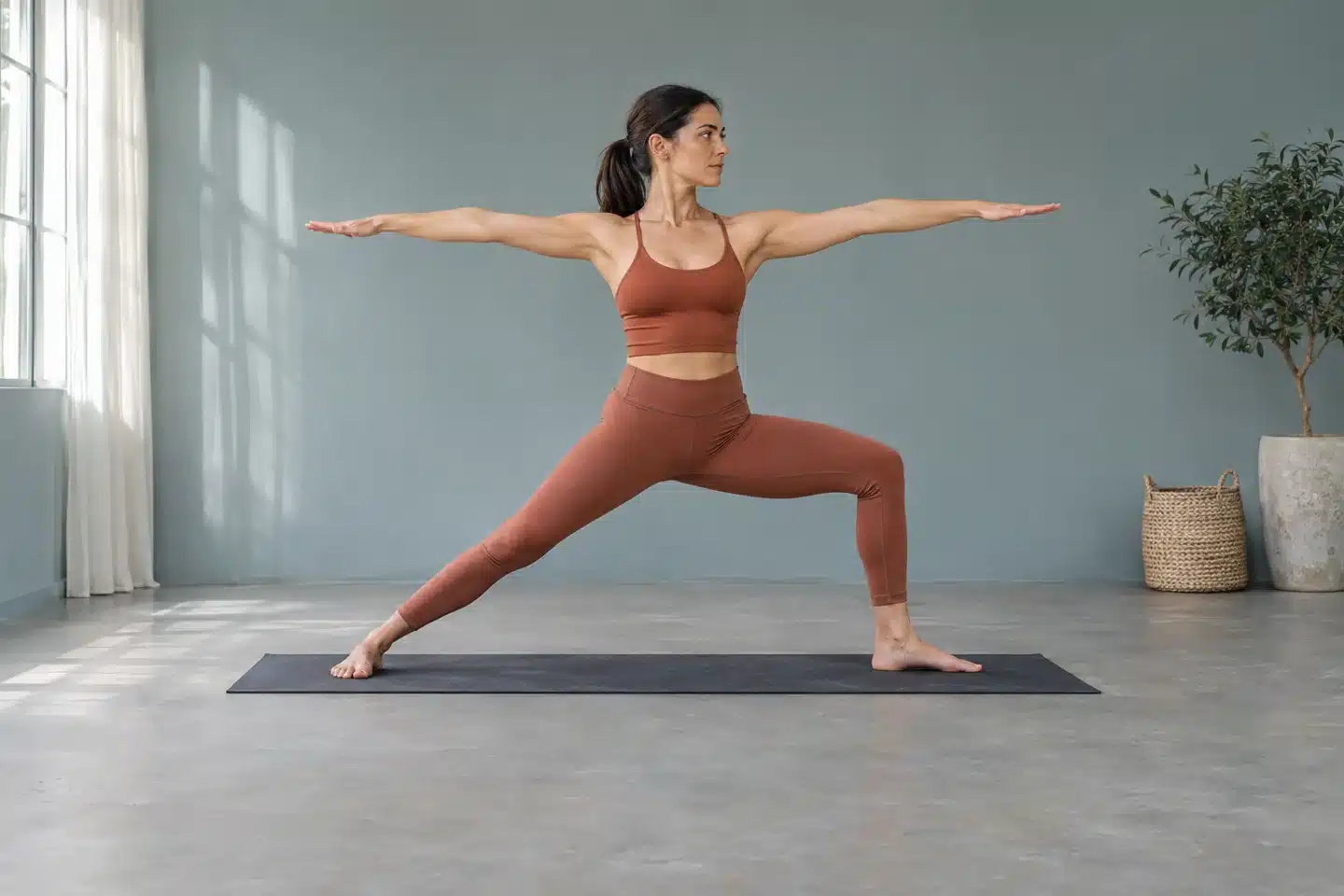
- Stretch the arms out at shoulder height and look over the front hand.
- Warrior III:
- Shift your weight onto the front leg.
- Hinge forward and lift the back leg until your body forms a “T”.
- Keep the hips level.
- Flow from I to II to III, then repeat on the other side.
- Warrior I:
- Hold time and effort target:
- Beginners hold each Warrior for 15–20 seconds per side.
- Build to 60 seconds per side, or flow through all three without a break for 2–3 cycles.
- Science behind the burn: a minute in a deep lunge tires the front thigh and glutes, while the outstretched arms load the shoulders. Warrior III adds balance, which brings in extra stabilising muscles.
- Safety and modifications:
- Shorten your stance if your knees or hips feel strained.
- Keep the front knee tracking over the second toe.
- In Warrior III, rest your fingertips on blocks or a wall.
- Skip Warrior III with uncontrolled blood pressure or a recent ankle injury.
5. Crescent Lunge (Ashta Chandrasana)
Crescent Lunge is a high lunge that strengthens the legs and glutes while stretching the hip flexors that tighten after hours of sitting.
- Step-by-step guide:
- From standing, step the left foot far back onto the ball of the foot, heel lifted.
- Bend the right knee to 90 degrees, knee directly over the ankle.
- Straighten the back leg by pressing the back heel towards the wall behind you.
- Square the hips forward and lift the arms overhead, ribs drawn in.
- Hold time and effort target:
- Beginners hold 15–20 seconds each side.
- Build to 60 seconds on each side.
- Then add 10 small pulses on each side, moving up and down about 5 cm (2 inches).
- Science behind the burn: this is a single-leg strength hold, so each leg carries more of your body weight. The pulses add movement and push your heart rate higher.
- Safety and modifications:
- For an easier version, lower the back knee onto a folded blanket.
- Hold a chair or wall if your balance wobbles.
- Avoid with an acute knee or hip injury.
Deep Core Activators (Belly Fat Special)
Deep core activators strengthen the abdominal wall, obliques and deep stabilising muscles. No pose burns belly fat directly. Plank, Chaturanga, Boat Pose and Side Plank build the muscle underneath. That muscle becomes more visible as your overall body fat comes down.
6. Plank Pose (Phalakasana)
Plank is a full-body strength hold that trains the deep core muscles supporting your spine.
- Step-by-step guide:
- From all fours, step the feet back, hip-width apart.
- Line up your wrists, elbows and shoulders vertically, fingers spread wide.
- Make one straight line from the crown of your head to your heels. No sagging hips, no raised bottom.
- Press the floor away to broaden the upper back. Draw the navel towards the spine and squeeze the thighs.
- Hold time and effort target:
- Beginners hold 15–20 seconds, three times.
- Add 5–10 seconds a week until you reach 60 seconds, three times.
- After that, try shoulder taps or a one-leg Plank.
- Science behind the burn: Plank works the abdominals, shoulders, arms, glutes and legs at the same time. More working muscle means more energy used.
- Safety and modifications:
- Drop to your knees, or come onto your forearms to protect sore wrists.
- A sagging lower back is the most common Plank error, so shorten the hold before you lose the straight line.
- Avoid in late pregnancy.
- With an abdominal hernia or diastasis recti, avoid unless a physiotherapist has cleared you.
7. Four-Limbed Staff Pose (Chaturanga Dandasana)
Chaturanga is a yoga push-up that builds arm, chest and core strength, and it’s the toughest move in a sun salutation.
- Step-by-step guide:
- Start in Plank, then rock forward so your shoulders move slightly past your wrists.
- Bend the elbows straight back, hugging them in to your ribs.
- Lower until the elbows reach about 90 degrees. Keep the shoulders level with the elbows, never below.
- Keep the body in one line, then press back to Plank or flow into Cobra.
- Hold time and effort target:
- Beginners do 3 slow reps with the knees down.
- Build to 10 full reps.
- Then add a 3-second pause at the bottom.
- Science behind the burn: lowering and pressing your own body weight is resistance training. It raises your heart rate during flows and builds upper-body muscle.
- Safety and modifications:
- Keep the knees down, or lower straight to the floor.
- Skip it with a shoulder or wrist injury.
- Never let the shoulders drop below elbow height.
8. Boat Pose (Navasana)
Boat Pose is a core strength hold that trains the abdominals and hip flexors together.
- Step-by-step guide:
- Sit with knees bent and feet flat on the floor.
- Lean back slightly, lift the chest and keep the spine long. Don’t let the lower back round.
- Lift the feet so your shins are parallel to the floor, knees together.
- Reach the arms forward at shoulder height. Straighten the legs into a “V” only if your back stays long.
- Hold time and effort target:
- Beginners hold 15–20 seconds for 2 rounds.
- Build to 60 seconds with straight legs.
- Or add 10 slow lifts between Boat and Low Boat.
- Science behind the burn: Boat Pose makes the abdominals and hip flexors work hard against gravity. It builds strength more than it burns calories, so pair it with sun salutations.
- Safety and modifications:
- Hold the backs of your thighs and keep the knees bent.
- Avoid during pregnancy, with lower back pain or a hernia, or after recent abdominal surgery.
9. Side Plank (Vasisthasana)
Side Plank trains the obliques and shoulders and improves balance. It’s the natural next step once Plank feels steady.
- Step-by-step guide:
- From Plank, shift onto your right hand and roll onto the outer edge of your right foot.
- Keep the right wrist directly under the right shoulder.
- Stack the left foot on top and lift the left arm towards the ceiling.
- Lift the hips so your body forms one straight diagonal line from head to heels.
- Hold time and effort target:
- Beginners hold 15 seconds each side.
- Build to 45–60 seconds each side.
- Then add 10 slow hip dips.
- Science behind the burn: the obliques and the side of your body hold you up against gravity, which also trains them to steady the spine.
- Safety and modifications:
- Lower the bottom knee to the mat, or drop onto your forearm.
- Skip it with a wrist or shoulder injury, and later in pregnancy.
Metabolic & Digestion Boosters (Thyroid Stimulation)
Metabolic and digestion boosters are backbends that strengthen the back and glutes, open the chest, and gently compress and stretch the abdomen. In traditional Hatha Yoga, Bridge, Cobra and Bow are taught as poses that stimulate the throat (thyroid) area and the digestive organs. Their best-supported benefit is strength in the posterior chain, the large muscles along the back of your body.
A clear answer on the thyroid claim: yoga tradition describes chin-lock and backbending poses as stimulating the thyroid gland. Modern research hasn’t shown that any single pose meaningfully raises thyroid hormone levels or metabolic rate. If you have a thyroid condition, yoga can be part of a healthy routine, but it doesn’t replace medical treatment.
10. Bridge Pose (Setu Bandha Sarvangasana)
Bridge Pose strengthens the glutes and hamstrings, the big muscles at the back of the body, and it’s a safe floor-based option for beginners.
- Step-by-step guide:
- Lie on your back with knees bent and feet flat, hip-width apart. Keep the heels about a hand’s length from your hips.
- Rest the arms by your sides, palms down. Keep the knees in line with the hips and ankles so they don’t splay out.
- Press into the feet and lift the hips until your body forms a straight line from shoulders to knees.
- Draw the chest gently towards the chin and keep the neck still.
- Hold time and effort target:
- Beginners hold 15–20 seconds, three times.
- Build to 60 seconds or 15 slow lifts.
- Then try single-leg Bridge.
- Science behind the burn: the glutes are the body’s largest muscle group. Stronger glutes power every standing pose and every walk up the stairs. Yoga tradition also says Bridge stimulates the thyroid. Treat that as traditional teaching, not a proven metabolic effect.
- Safety and modifications:
- Slide a yoga block under your sacrum for a supported version.
- Never turn your head while you’re in the pose.
- Avoid with a neck injury.
- Avoid later in pregnancy unless your doctor or midwife approves.
11. Cobra Pose (Bhujangasana)
Cobra strengthens the back muscles, opens the chest and balances all the forward bending of the core section.
- Step-by-step guide:
- Lie face down, legs together, the tops of your feet pressing into the mat.
- Place your hands under your shoulders, elbows hugging the ribs.
- Inhale, press the pubic bone down and lift the chest using your back muscles, not your arms.
- Keep the elbows soft and the shoulders away from the ears. Look forward with a long neck.
- Hold time and effort target:
- Beginners hold 15–20 seconds, three times.
- Build to 45 seconds, three times.
- Or lift the hands off the mat for a few breaths to work the back harder.
- Science behind the burn: Cobra trains the spinal muscles that hold you upright, which helps if you sit at a desk all day. Yoga tradition says the gentle pressure on the belly aids digestion. The clearest benefit is a stronger, more mobile back.
- Safety and modifications:
- Stay low in Baby Cobra, or come onto your forearms in Sphinx Pose.
- Avoid during pregnancy, after recent abdominal surgery and with an acute back injury.
12. Bow Pose (Dhanurasana)
Bow Pose is a strong backbend that works the back, glutes and hamstrings while opening the chest and the front of the body.
- Step-by-step guide:
- Lie face down with your arms by your sides.
- Bend the knees and reach back to hold the outside of your ankles.
- Keep the knees about hip-width apart, no wider.
- Inhale, kick the feet back into your hands and lift the chest and thighs off the mat. Roll the shoulders back and down.
- Hold time and effort target:
- Beginners hold 15 seconds, 2–3 times.
- Build to 30–45 seconds, three times.
- Or rock gently forward and back on the belly.
- Science behind the burn: Bow Pose works the whole back of the body at once while stretching the abdomen and hip flexors. Yoga tradition describes the pressure on the belly as a massage for the digestive organs.
- Safety and modifications:
- Try Half Bow (one leg at a time), or loop a strap around your ankles.
- Avoid during pregnancy or after recent abdominal surgery.
- Avoid if you have a hernia, lower back pain or uncontrolled high blood pressure.
What Is the Best 20-Minute Fat Burning Yoga Routine?
The best 20-minute fat burning yoga routine has six parts: a short warm-up, 6 minutes of sun salutations, a standing strength block, a core block, a glutes and back block and a cool-down. Rest as little as you can in between. Brisk transitions keep your heart rate up.
New to practising at home? Read our guide on how to start yoga at home first.
| Block | Time | What to do |
|---|---|---|
| 1. Warm-up | 0:00–2:00 | Cat-Cow for 8 breaths, then 4 slow waves from Downward Dog to Plank |
| 2. Sun salutations | 2:00–8:00 | Surya Namaskar, 4–6 rounds (both sides = 1 round), steady pace with the breath |
| 3. Standing strength | 8:00–14:00 | Chair Pose 45 sec → Revolved Chair 20 sec each side → Warrior II 30 sec each side → Crescent Lunge with 10 pulses each side → Chair Pose 45 sec |
| 4. Core block | 14:00–17:00 | Plank 30 sec → 5 Chaturanga (knees down if needed) → Side Plank 20 sec each side → Boat Pose 3 × 20 sec |
| 5. Glutes and back | 17:00–18:30 | Bridge, 10 slow lifts → Bow Pose 2 × 15 sec (Cobra for beginners) |
| 6. Cool-down | 18:30–20:00 | Child’s Pose (Balasana), then Savasana with slow breathing |
How Do You Make the Routine Easier or Harder?
- Beginners:
- Do 3 sun salutations.
- Keep the knees down in Plank and Chaturanga.
- Rest 10 seconds between poses.
- Intermediate: do 6 rounds and cut the rests out of blocks 3 and 4.
- Advanced: add 2 more rounds of sun salutations and repeat block 3 twice. That takes you to about 30 minutes.
Breathe through your nose and match one movement to one breath. If you can’t breathe smoothly, slow down. Holding your breath adds strain, not results.
Short on Time? The 15-Minute Home Routine Checklist
If you only have 15 minutes, this ready-made routine covers warm-up, fat burn, core and cool-down. It fits before work, in a lunch break or while dinner is in the oven.
- Warm-up and burn: 5–10 rounds of Surya Namaskar (beginners start with 5)
- Core: Plank hold, 30 seconds
- Core: Boat Pose, 2 rounds of 20–30 seconds
- Cool-down: Child’s Pose (Balasana), 1–2 minutes of slow breathing
| Step | Pose | Time or reps | Beginner version |
|---|---|---|---|
| 1. Warm-up | Surya Namaskar | 5–10 rounds | 5 slow rounds, knees down in Plank |
| 2. Core | Plank (Phalakasana) | 30 sec | 15–20 sec on the knees |
| 3. Core | Boat Pose (Navasana) | 2 × 20–30 sec | Knees bent, hands behind thighs |
| 4. Cool-down | Child’s Pose (Balasana) | 1–2 min | Knees wide, forehead on a cushion |
Thinking about deeper training? Inteyoga’s 300-hour yoga teacher training in Goa is an advanced residential programme for people who have already completed a 200-hour TTC or an equivalent qualification. It isn’t a beginner retreat.
How Often Should You Do Fat Burning Yoga Poses?
For the best results, practise fat burning yoga poses 4–5 days a week for 30–45 minutes per session. Three days a week is a reasonable minimum. Two public health guidelines set the benchmark:
- The CDC recommends at least 150 minutes of moderate activity a week, plus muscle-strengthening activity on two or more days (CDC).
- The UK Chief Medical Officers’ guidelines, updated in July 2026, keep the same 150-minute recommendation (GOV.UK). They also stress that this isn’t an absolute threshold: some activity is better than none.
| Goal | Days per week | Session length |
|---|---|---|
| More strength and energy | 3 | 20–30 min |
| Fat loss (with a calorie-controlled diet) | 4–5 | 30–45 min |
| Maintaining results | 3–4 | 30 min |
Sample Weekly Fat Burning Yoga Plan
| Day | Session | Time |
|---|---|---|
| Monday | 20-minute fat burning routine + 10 extra sun salutations | 30 min |
| Tuesday | Brisk walk or cycle | 30 min |
| Wednesday | Sun salutations (8–12 rounds) + core block | 35 min |
| Thursday | Gentle Hatha or stretching (recovery) | 20 min |
| Friday | 20-minute routine, advanced version | 30–40 min |
| Saturday | Long walk, hike, swim or sport | 45 min |
| Sunday | Rest or breathing practice | 10–15 min |
That adds up to about 3½ hours a week. It comfortably meets the 150-minute guideline and includes three strength-focused yoga days.
What Are the Benefits of Fat Burning Yoga Poses?
The main benefits of fat burning yoga poses are a higher calorie burn, stronger muscles, more mindful eating, better stress management and a joint-friendly way to stay active. Most of these support fat loss indirectly. They help you move more, keep muscle and stick with healthy habits.
- They count as real exercise when you practise them dynamically. Sun salutations and power-style flows reach moderate intensity, and fast Surya Namaskar has been measured at vigorous intensity (Larson-Meyer, 2016; Mody, 2011).
- They build muscle. Holds such as Chair Pose, Plank and Warrior II count as muscle-strengthening activity under both US and UK guidelines.
- They may support mindful eating. In research on people who lost weight through yoga, participants described more mindfulness, focus and self-esteem (systematic review, PubMed Central).
- They may improve some metabolic markers. The 2023 meta-analysis noted lower total cholesterol and triglycerides with yoga compared with no-exercise controls. The evidence quality was low.
- They can help you manage stress. Slow breathing and steady focus can make stress easier to handle, and stress is a common trigger for comfort eating. Our guide to yoga for stress relief goes deeper.
- They’re low impact. No jumping or running, so most poses suit people who find high-impact cardio hard on the knees.
- They need no kit. A mat and 20 minutes are enough, which makes consistency easier.
- They improve flexibility and posture. The same session that burns calories also loosens tight hips and hamstrings.
- They’re generally safe when adapted. Lauche et al. (2016) reported no intervention-related adverse events across the 30 trials they reviewed.
Fat Burning Yoga Poses vs Cardio: Which Burns More Fat?
Cardio such as running or cycling usually burns more calories per minute. But fat burning yoga poses add strength, flexibility and stress relief that most cardio doesn’t. For fat loss, a plan that uses both tends to work best. The CDC classes jogging as vigorous activity. Most yoga is light, and only dynamic flows reach moderate or vigorous levels.
| Factor | Fat burning yoga poses | Cardio (running, cycling, HIIT) |
|---|---|---|
| Calories per 30 min (70 kg) | ~85–150 kcal; more with fast sun salutations | Usually higher; vigorous cardio burns more per minute |
| Intensity | Light to moderate; dynamic flows can reach vigorous | Moderate to vigorous |
| Muscle strengthening | Yes: holds and bodyweight poses count | Limited, except some HIIT |
| Flexibility and mobility | High | Low |
| Joint impact | Low | Medium to high (running, jumping) |
| Stress and mindful eating | Strong focus on breath and awareness | Indirect |
| Equipment | A mat | Shoes, bike or gym, depending on type |
| Best for | Beginners, joint-sensitive people, building strength and habits | Maximum calorie burn in less time |
Our verdict: if you only have time for one, pick the one you’ll keep doing. For a balanced week, combine 3–4 dynamic yoga sessions with 1–2 cardio sessions. For a wider plan that covers diet and lifestyle, read our full guide to yoga for weight loss.
What Is the Most Dynamic Yoga Style for Burning Fat?
Power yoga and Vinyasa flow are the most dynamic yoga styles for burning fat. Both link poses continuously with the breath and keep your heart rate up. The 2024 Compendium rates power yoga at 4.0 METs and Vinyasa at 2.7 METs, compared with 2.3 for general Hatha.
| Style | What it is | Why it burns more | Best for |
|---|---|---|---|
| Power yoga | Fast, strength-focused, athletic flow | MET rating of 4.0 and long strength holds | Fitness-focused practitioners |
| Vinyasa flow | Poses linked breath by breath, often with sun salutations | Continuous movement; a 2020 study estimated an average of about 7 kcal a minute across a 90-minute class | Anyone who wants variety and a cardio feel |
| Ashtanga | A set sequence built on Surya Namaskar A and B | Repeated sun salutations, measured at about 4.85 METs (Kloubec, 2014) | Disciplined, structured learners |
| Hatha (traditional) | Slower holds, breathwork and relaxation | Lower burn, but builds strength, flexibility and calm | Beginners and recovery days |
Tip: you can make any style more dynamic by shortening rests and adding extra rounds of Surya Namaskar. Power yoga and Hatha aren’t rivals. They’re different tools for different days.
Can You Reduce Belly Fat With Yoga Alone?
Yoga alone can contribute to belly fat loss, but results are more reliable when you pair it with a calorie-controlled diet. No pose spot-reduces fat. When you’re in a deficit, your body draws on fat stores everywhere. Yoga helps in three ways:
- dynamic practice burns calories
- core poses build a firmer midsection
- calmer practice may help you manage stress
Why does stress matter? Some research links stress and cortisol with fat stored around the waist. A 2000 study in Psychosomatic Medicine found that women with more abdominal fat released more cortisol in response to lab stress tasks (Epel et al., 2000). Separately, yoga practice has been associated with lower cortisol (Pascoe et al., 2017).
But these are associations. No trial has shown that yoga reduces belly fat specifically by lowering cortisol. Treat stress management as a helpful support, not a shortcut.
To lose belly fat, combine three things:
- A calorie deficit from sensible eating.
- Whole-body movement, such as sun salutations and brisk walking, to raise your total energy use.
- Core and strength work, such as the core block in the routine above.
How Long Does It Take to See Results From Fat Burning Yoga?
There’s no fixed timeline. Results depend on your starting point, diet, sleep and how often you practise. Many people notice that poses feel easier and holds get longer before they see much change on the scale. If you lose weight at the NHS’s suggested safe rate of 0.5–1 kg a week, losing 5 kg would take roughly 5–10 weeks.
Track more than the scale:
- how long you can hold Plank
- how many sun salutations you can flow through
- your waist measurement
- how your clothes fit
What Should You Eat With Fat Burning Yoga? Sattvic Diet and Hydration
Eat a clean, mostly Sattvic diet in a modest calorie deficit. Build meals around fresh vegetables, fruit, whole grains, pulses, nuts and enough protein. Keep fried, ultra-processed and sugary food to a minimum.
You’ll often hear coaches quote a “70% diet, 30% exercise” rule. It’s a rough rule of thumb, not a scientific figure. The underlying point stands, though: exercise alone rarely outpaces a diet that’s consistently above your energy needs.
What Is a Sattvic Diet?
A Sattvic diet is the traditional yogic way of eating: fresh, simple, minimally processed, mostly plant-based food, eaten calmly and in moderation. It fits naturally alongside a yoga practice. Whole, fibre-rich foods also tend to be filling, which can make a calorie deficit easier to keep.
| Eat more (Sattvic) | Eat less (heavy or processed) |
|---|---|
| Seasonal vegetables and leafy greens | Deep-fried snacks such as crisps, fries and samosas |
| Fresh fruit | Sweets, pastries and fizzy or sugary drinks |
| Whole grains: oats, brown rice, millets, wholemeal bread | White bread and refined-flour products |
| Pulses and lentils (dal, chickpeas, beans), tofu, paneer, yoghurt | Ultra-processed ready meals and takeaways |
| Nuts and seeds in small portions | Alcohol and excess caffeine |
| Herbs and gentle spices: ginger, turmeric, cumin | Large, heavy meals late at night |
How Should You Hydrate for Fat Loss?
Drink water steadily through the day, and consider starting the morning with a glass of lukewarm water, a long-standing Ayurvedic habit. Warm water is easy to drink first thing and can replace a sugary morning drink. Water has no calories. Swapping it for juice, soda or sweetened tea and coffee is one of the simplest ways to cut calories.
Practical tips:
- Drink a glass of lukewarm water after waking and before your yoga session.
- Sip water before and after practice. Avoid gulping large amounts during intense flows.
- Practise on an empty stomach, or 2–3 hours after a large meal.
- Include protein at every meal to support the muscle your poses build. Good options are dal, Greek yoghurt, paneer, eggs, tofu or beans.
- Eat slowly and stop when you’re comfortably full.
- Skip crash diets. Severe restriction drains the energy you need for dynamic practice.
What Common Mistakes Slow Fat Loss in Yoga?
The most common mistakes are:
- practising too gently
- resting too long
- holding the breath
- skipping strength holds
- expecting yoga to cancel out a poor diet
Fix these and a relaxing session becomes an effective one.
- Only doing gentle or restorative classes. Wonderful for recovery, low in calorie burn.
- Long rests between poses. Your heart rate drops each time. Keep transitions smooth.
- Holding the breath. It raises strain and shortens your session. Breathe through the nose.
- Trading form for speed. A sagging Plank or collapsed Chaturanga can strain your back and shoulders.
- Practising once a week. Aim for at least three sessions, ideally four or five.
- Ignoring sleep and food. No routine can outwork a constant calorie surplus.
Are Fat Burning Yoga Poses Safe? Who Should Be Careful
Fat burning yoga poses are safe for most healthy adults when you build up gradually and modify poses as needed. Fast or strenuous practice isn’t right for everyone, though. Speak to your doctor or GP first if any of the following apply to you.
| Condition | What to avoid or change |
|---|---|
| Pregnancy | Avoid Boat Pose, deep twists, lying on the belly and fast flows; choose a prenatal class |
| High or low blood pressure | Avoid fast Surya Namaskar and long head-down poses; move slowly |
| Glaucoma | Avoid Downward Dog and other inversions where the head is below the heart |
| Heart conditions | Get medical clearance first; keep intensity light |
| Recent surgery | Avoid core and abdominal work until cleared |
| Wrist or shoulder injury | Use forearm Plank; skip Chaturanga and Side Plank |
| Knee pain | Reduce depth in Chair Pose and lunges |
| Lower back pain | Skip Boat Pose and Bow Pose; keep Plank on the knees |
Stop straight away if you feel chest pain, dizziness, sharp pain or unusual breathlessness.
Conclusion: Start Your Fat Burning Yoga Practice This Week
Fat burning yoga poses work best as a continuous, strength-focused flow, practised 4–5 times a week alongside sensible eating. Each group does a different job:
- Sun salutations lift your heart rate.
- Chair Pose, the Warrior series, Plank and Boat Pose build strength.
- Bridge, Cobra and Bow balance it all with a strong back.
Be realistic about the numbers. Gentle yoga is light exercise. Dynamic yoga, though, counts towards the 150 weekly minutes recommended by the CDC and UK guidelines, and it covers strength work too. Start with the 15-minute checklist or the 20-minute routine this week. Build up slowly, and track your strength and waist size as well as the scale.
Frequently Asked Questions (FAQ)
Which Yoga Burns the Most Fat?
Power yoga and fast, continuous Surya Namaskar burn the most energy of the common yoga styles. The 2024 Compendium of Physical Activities rates power yoga at 4.0 METs and sun salutations at 3.5 METs, compared with 2.3 for general Hatha. In a 2011 lab study, fast sun salutations reached about 7.4 METs. Among single poses, Chair Pose, Plank and Chaturanga demand the most effort.
Does 30 Minutes of Yoga Burn Fat?
Yes, it contributes. Thirty minutes of yoga burns about 85–150 kcal for a 70 kg (154 lb) adult, depending on the style:
gentle Hatha: about 85 kcal
sun salutations: about 129 kcal
power yoga: about 147 kcal
To see real fat loss, repeat 30-minute sessions 4–5 times a week alongside sensible eating.
Can I Lose Weight by Doing Only Yoga?
You can lose weight with yoga alone if you practise dynamic styles regularly and eat in a calorie deficit. A 2016 meta-analysis of 30 trials found yoga reduced BMI in people with overweight or obesity, though results varied and many studies were small. Gentle yoga on its own burns relatively few calories, so most people do better combining yoga, walking and sensible eating.
What Is the Best Yoga Pose to Lose Belly Fat?
No single pose burns belly fat directly. Boat Pose (Navasana), Plank, Side Plank and Bow Pose (Dhanurasana) are the best for strengthening the abdominal and core muscles. Add sun salutations for calorie burn and a sensible diet for fat loss. As your overall body fat drops, a stronger core helps your midsection look firmer.
Can I Lose 10 kg (22 lb) by Doing Surya Namaskar?
Only as part of a wider plan that includes a calorie deficit. A common rule of thumb puts 1 kg of fat at about 7,700 kcal. Thirty minutes of sun salutations burns roughly 130 kcal for a 70 kg person. The NHS suggests a safe rate of 0.5–1 kg (1–2 lb) a week. At that rate, losing 10 kg would take at least 10–20 weeks, and often longer.
Are Fat Burning Yoga Poses Good for Beginners?
Yes. Almost every fat burning yoga pose has an easier version, such as Plank on the knees, a higher Chair Pose or Boat Pose with bent knees. Start with 3–5 rounds of sun salutations and hold poses for 15–20 seconds. Build up over several weeks, and learn the alignment slowly before you add speed.
Is Yoga Good for Weight Loss After 40 or 50?
Yoga can be a good fit at any age. It’s low impact, and its strength holds count towards the muscle-strengthening activity that both US and UK guidelines recommend for adults. Start with slower Hatha or gentle flows and add sun salutations gradually. If you have blood pressure, heart or joint problems, check with your doctor first.
Is It Better to Do Fat Burning Yoga in the Morning or Evening?
The best time is the one you can stick with. A morning session on an empty stomach suits many people and sets up the day. Evening practice can ease stress, but keep it gentler close to bedtime. Our article on morning vs evening yoga compares both.
Is 15 Minutes of Yoga a Day Enough to Lose Weight?
Fifteen minutes a day is a good start, and it adds up to 105 minutes a week. The CDC and UK guidelines suggest working towards 150 minutes a week, though the UK guidelines stress that any activity is better than none. Add walks or a couple of longer sessions, and make those 15 minutes count with brisk sun salutations.
Does Hot Yoga Burn More Fat?
Hot yoga makes you sweat more, but sweat is water loss, not fat loss. The 2024 Compendium rates hot yoga at 3.0 METs, which is lower than power yoga (4.0) and sun salutations (3.5). So it burns only slightly more than general Hatha (2.3). If you try it, drink plenty of water.