Quick Answer
The main benefits of yin yoga are lower stress, reduced anxiety, fewer sleep problems, better flexibility and joint mobility, and a calmer, more focused mind. Yin yoga holds passive floor poses for about 1 to 5 minutes. Small randomized trials support several of these benefits, but more high-quality research is needed.
Key Takeaways
- Yin yoga is a slow, floor-based style with long, passive holds and relaxed muscles.
- The best evidence so far supports lower stress, less everyday anxiety and fewer sleep problems, mostly from small trials.
- Flexibility, balance and mobility gains come from even smaller studies.
- Yin yoga does not burn belly fat, build muscle or meet U.S. aerobic exercise guidelines on its own.
- It is not a treatment for anxiety disorders, chronic insomnia or pain conditions.
- Two to three sessions a week, for at least four to six weeks, is a realistic starting plan.
- How this guide was prepared
This article was prepared by the Inteyoga Editorial Team at Inteyoga (Swami Krishnananda Yoga Vidyapeeth), a residential yoga school in Colva, South Goa, India. Inteyoga is registered with Yoga Alliance as a Registered Yoga School (RYS 200, RYS 300 and RYS 500). Health statements are linked to peer-reviewed studies, clinical guidelines or U.S. government health sources, and we flag clearly where evidence is limited. - Want to study slow, restorative practice in depth? See how our Advanced TTC 300-Hour Integrated Restorative Yoga (Including Yoga Nidra, Chakra Sadhana, and Prana Vidya Intensive) is structured.
The benefits of yin yoga come from doing something most of us rarely do: staying still on purpose. There are no sun salutations and no sweaty power flow. You fold over a pillow, rest there for three or four minutes, and breathe.
It sounds easy. Then your hips start to talk, and your mind drifts to your inbox, your grocery list, and the text you forgot to answer. Slowly, something lets go.
Slow practices like this are part of a bigger shift. According to the National Institutes of Health (NIH), yoga use among U.S. adults rose from 5% in 2002 to 15.8% in 2022.
This guide explains what the research actually shows about yin yoga, where the evidence is still thin, and how to start safely at home or in a studio. It also answers the questions people search most, from “Does yin yoga reduce cortisol?” to “Can yin yoga reduce belly fat?”
What Is Yin Yoga?
Yin yoga is a slow, floor-based style of yoga where you hold passive poses for roughly 1 to 5 minutes while keeping your muscles relaxed. The long holds place gentle, steady load on connective tissues such as fascia, ligaments and tendons. The stillness also works like a quiet, body-based meditation.
The name comes from the Taoist idea of yin and yang. Yang describes what is active, warm and moving. Yin describes what is still, cool and steady.
Picture a typical week: commuting, desk work, a gym session or run, and screens at night. Almost all of it is yang. Yin yoga is designed to balance that.
Where Did Yin Yoga Come From?
Yin yoga, as a named style, developed in the United States from the late 1970s onward, but long-held postures are much older and appear in both Indian Hatha yoga and Chinese Taoist practices. How to credit its modern origin depends on whom you read.
Most accounts connect three teachers:
- Paulie Zink, a martial artist and Taoist yoga teacher, taught a system that included long, passive floor holds alongside active movement.
- Paul Grilley studied with Zink and built the slow floor postures into a full class, adding anatomy and ideas from Hatha yoga.
- Sarah Powers, one of Grilley’s students, suggested calling these classes “Yin Yoga.”
Grilley’s own Yin Yoga website puts it another way: no one “invented” long, quiet holds, and these teachers re-emphasized a very old way of practicing. That is a useful reminder that modern style names are often newer than the practices behind them.
How Long Are Poses Held in Yin Yoga?
Beginners are commonly advised to hold each yin pose for about 45 seconds to 2 minutes. Experienced students often stay 3 to 5 minutes, sometimes longer. A class uses only a handful of poses, and most are seated or lying down.
Between poses, many teachers add a short “rebound.” This is a pause of stillness where you notice how your body feels after the release.
What Are the Three Core Principles of Yin Yoga?
Yin teachers commonly describe three principles: find your edge, stay still, and hold for time.
- Find your edge. Move into the pose until you feel a mild, safe stretch. Never go into pain.
- Stay still. Once you settle, avoid fidgeting or pushing deeper.
- Hold for time. Stay long enough for your body and mind to soften.
Following these three rules is where most of the benefits of yin yoga come from.
What Is the Difference Between Yoga and Yin Yoga?
“Yoga” is a broad tradition that includes breathing, meditation, ethics and many physical styles. Yin yoga is one specific physical style within it, built on long, passive holds with relaxed muscles.
Many yoga classes in the U.S. are active styles such as Hatha, Vinyasa or power yoga. Yin sits at the slowest end of that range.
In an active class, you engage muscles to build heat, strength and balance. In yin, you let gravity and time do the work.
| Feature | Yin Yoga | Hatha Yoga | Vinyasa Yoga |
|---|---|---|---|
| Pace | Very slow | Moderate | Fast and flowing |
| Muscles | Relaxed | Active | Active and continuous |
| Hold time | About 1 to 5 minutes | Several breaths to about a minute | A few breaths or less |
| Body heat | Cooling | Moderate | Warming |
| Main focus | Connective tissue, stillness, mindfulness | Alignment, breath, balance of body and mind | Strength, stamina, breath-linked movement |
| Feels like | A long, quiet stretch | A steady, mindful practice | A dance-like, cardio-leaning session |
A simple comparison: if Vinyasa is a jog, yin yoga is a slow walk with plenty of stops to look around.
What Does Yin Yoga Do to Your Body?
Yin involves sustained postures that load several tissues. It does not isolate fascia or ligaments, and “gentle” is not guaranteed by the style name. The load and comfort depend on position, support, duration and the person.
Some small studies report changes in wellbeing or movement measures, but they do not establish a specific mechanism such as fascial repair, a nervous-system switch or restored joint function. Distinguish an individual’s feeling of comfort from a measured clinical outcome.
What Are the Benefits of Yin Yoga?
The benefits of yin yoga fall into two groups: mental benefits such as lower stress, less anxiety and better sleep, and physical benefits such as improved flexibility, joint mobility and recovery. Here are 12 of them, with an honest note on how strong the evidence is for each.
1. Does Yin Yoga Reduce Stress?
Yes, small randomized trials suggest yin yoga can reduce stress, especially when it is combined with mindfulness.
A randomized controlled trial from Lund University in Sweden tested a five-week program called YOMI, which combined yin yoga with mindfulness and psychoeducation.
The study, published by Hylander and colleagues in Anxiety, Stress & Coping in 2017, found lower perceived stress in a non-clinical group. You can read the original YOMI study abstract.
A 2018 trial studied stressed adults with an average age of 53.5. The group that did yin yoga plus mindfulness showed a clear drop in stress compared with a control group.
Example: If your workday leaves you “wired but tired,” a 20-minute yin session after work is a simple way to switch gears.
Key takeaway: Stress relief is one of the best-supported benefits of yin yoga, and the effect may be stronger when mindfulness is part of the practice.
2. Can Yin Yoga Help With Anxiety?
Yin yoga may help ease everyday anxiety, based on a small number of trials. Staying still with slow breathing can feel settling, even when the mind is busy.
In the 2018 trial published in PLOS One (Daukantaitė and colleagues), 105 moderately to highly stressed adults were split into three groups: yin yoga only, yin yoga plus mindfulness, and a control group.
After five weeks, both yin groups showed significantly greater drops in anxiety than the control group. You can read the full PLOS One trial on yin yoga and stress.
A separate study of 48 women in Latvia, run online during the COVID-19 pandemic, found that 10 weeks of yin yoga lowered state anxiety (anxiety felt in the moment) compared with a control group.
State anxiety also dropped after each session. Trait anxiety, a more stable tendency, did not differ significantly between groups.
A 2026 trial in the Journal of Adolescence studied 120 high school students. A four-week program combining stress-management skills with yin yoga led to large drops in anxiety, depression and stress. Because yin yoga was paired with other skills, the study cannot show how much came from the yoga alone.
Key takeaway: These results are encouraging but early. Yin yoga is not a treatment for anxiety disorders. The U.S. National Institute of Mental Health (NIMH) describes psychotherapy, such as cognitive behavioral therapy, and medication as the main treatments. If you have ongoing anxiety, talk with a licensed health professional.
3. Can Yin Yoga Improve Sleep?
A 2018 five-week Yin trial reported changes in self-reported sleep problems in its study population. This is preliminary evidence, not proof that Yin treats chronic insomnia.
If a short, comfortable practice helps you wind down, it can be an optional activity. Persistent sleep difficulties need assessment. The American Academy of Sleep Medicine guideline recommends multicomponent cognitive behavioural therapy for chronic insomnia; yoga should not displace appropriate care.
4. Does Yin Yoga Improve Flexibility?
Yes. Yin yoga can improve flexibility, and small studies have measured this directly. Holding a stretch for several minutes lets muscles and the tissue around them relax, which often adds range of motion over time.
A six-week study published in the Journal of Orthopedic Research and Rehabilitation followed 24 healthy young adults. Twelve practiced yin yoga twice a week, and twelve did not. The yin group improved on the sit-and-reach test, along with balance and functional mobility.
Part of the gain is likely physical. Part may be your nervous system becoming more comfortable with the stretch, so you can relax into it further.
Key takeaway: Among the physical benefits of yin yoga, flexibility is often the easiest to notice. Regular, gentle holds usually work better than occasional deep stretching.
5. Is Yin Yoga Good for Joint Mobility?
Yin yoga may support joint mobility, especially in the hips, lower back and spine, where most yin poses focus. Long hours in a desk chair or car can leave these areas feeling stiff.
Yin sequences often include hip-focused poses such as Butterfly, Dragon and Shoelace. Loading these areas gently and steadily may help restore comfortable movement. The six-week study above also reported better functional mobility, measured with the Timed Up and Go test.
Key takeaway: Yin yoga is a gentle way to keep stiff joints moving. It should never force a joint past a comfortable range.
6. What Does Yin Yoga Do for Fascia and Connective Tissue?
Sustained postures load more than one tissue, including muscles and connective tissue. A change in perceived stiffness does not show that fascia was repaired, hydrated or remodelled. Evidence from general stretching cannot automatically establish a Yin-specific effect.
No fascial treatment claim is needed to practise comfortably. Use support and an appropriate range, and do not seek ligament strain or persist through pain, tingling or numbness.
7. Can Yin Yoga Improve Balance and Everyday Movement?
Yin yoga may improve balance and everyday movement, according to one small controlled study. In the six-week study of 24 young adults, the yin group did better on balance and movement tests than the control group.
That may seem surprising for a floor-based practice. One possible reason is better body awareness, since you spend minutes noticing each joint and muscle.
Key takeaway: The balance finding is promising, but it comes from a small sample.
8. Does Yin Yoga Help Recovery From Intense Exercise?
Yin yoga can be a useful recovery practice for runners, weightlifters and people who do fast yoga styles, although direct research on athletic recovery is limited. It sits at the opposite end of the spectrum from hard training.
Gentle stretching, relaxed breathing and rest are common parts of recovery routines, and yin yoga combines all three.
Example: A runner training for a half or full marathon might add one 45-minute yin class on a rest day, such as the day after a long run.
Key takeaway: Use yin yoga to balance “yang” training. Avoid long static holds right before sprinting or heavy lifting, because long holds can briefly reduce muscle force.
9. How Does Yin Yoga Build Mindfulness and Focus?
Yin yoga builds mindfulness because each long hold is a chance to notice your breath, body and thoughts without reacting. In a three-minute pose, your mind will wander. Each time you notice and return to the breath, you practice attention.
The YOMI program was built on this link between yin yoga and mindfulness, and the 2017 trial reported improvements in awareness.
Key takeaway: Yin yoga can be an easier doorway into meditation if sitting on a cushion feels impossible.
10. Can Yin Yoga Help You Handle Discomfort and Emotions?
Yin yoga lets you practice staying calm with mild, safe discomfort, a skill many people find useful in daily life. Instead of bailing out of a pose at the first sensation, you learn to breathe and observe.
Some students notice emotions coming up during long hip-opening poses. This is widely described by yin teachers, but research has not explained it. It does not mean anything is wrong. You can always come out of the pose, sit quietly or rest.
Key takeaway: Yin yoga offers a low-pressure space to practice patience and self-awareness.
11. Is Yin Yoga Good Preparation for Breathing Practice and Meditation?
Yes. A yin session leaves many people physically relaxed and mentally quieter, which makes it a natural lead-in to pranayama (yogic breathing), relaxation and meditation. In the Hatha yoga tradition, postures help prepare the body to sit comfortably and breathe with ease.
At Inteyoga, restorative and slow practices are taught in this spirit. They are not only about flexibility. They also prepare students for internal practices such as Yoga Nidra and pranayama.
Key takeaway: If sitting for meditation is hard, try 15 to 20 minutes of yin yoga first.
12. Can Anyone Do Yin Yoga, Including Older Adults?
Most people can try yin yoga, because it needs no strength, speed or experience, and props make each pose adjustable. You can use blocks, bolsters, firm couch pillows or folded blankets.
The 2018 PLOS One trial included adults with an average age of 53.5, which suggests the practice can suit middle-aged and older learners. Anyone with a health condition should still talk to a doctor first.
Key takeaway: Yin yoga meets you where you are. There is no “perfect” version of a pose.
Also read: Best Yoga Classes in Goa: Honest 2026 Guide to Drop-ins & TTC
Does Yin Yoga Reduce Cortisol?
The Yin studies reviewed here do not establish that a Yin class reliably lowers cortisol. The 2018 trial included adrenomedullin and self-reported outcomes; adrenomedullin is not cortisol.
A result from another yoga programme or a general yoga review cannot be assumed to apply to Yin simply because both involve breathing or stillness. Feeling calmer is not a measurement of cortisol, and a lower cortisol reading is not automatically a clinical benefit.
Can Yin Yoga Reduce Belly Fat?
No, yin yoga will not directly burn belly fat. It is a low-intensity practice that burns few calories, and exercise cannot target fat in one specific area.
“Spot reduction” has been tested and not supported. In a 2011 study in the Journal of Strength and Conditioning Research, Vispute and colleagues had 24 adults do abdominal exercises five days a week for six weeks. Their belly fat did not shrink compared with a control group, even though their core endurance improved.
Yin yoga may still play a small supporting role:
- Stress and sleep. Poor sleep and chronic stress can make healthy habits harder. Yin yoga may help with both.
- Consistency. Some people find a calming routine makes it easier to stick with other healthy habits.
If fat loss is your goal: combine a balanced diet with regular aerobic activity and strength training. Use yin yoga for recovery and stress relief, not as your main fat-loss tool.
Does Yin Yoga Build Muscle?
No, yin yoga does not build meaningful muscle. Muscles stay relaxed during yin poses, so there is not enough load to drive muscle growth.
That is by design. Paul Grilley and Sarah Powers have described yin yoga as a complement to more active practice, not a complete fitness program.
If you want strength, try active yoga styles or resistance training. The Physical Activity Guidelines for Americans recommend muscle-strengthening activity on at least 2 days a week. Yin yoga fits well on the other days.
Does Yin Yoga Count as Exercise?
Yin yoga counts as light physical activity and flexibility work, but it does not meet U.S. aerobic or muscle-strengthening guidelines on its own. It is closer to active recovery than a workout.
The Physical Activity Guidelines for Americans, promoted by the Centers for Disease Control and Prevention (CDC), recommend at least 150 minutes of moderate-intensity aerobic activity a week plus 2 days of muscle-strengthening activity. A yin class does not raise your heart rate enough to count toward the aerobic goal.
Many adults fall short. A CDC data brief found that only 24.2% of U.S. adults met both the aerobic and muscle-strengthening guidelines in 2020.
One way to fit yin yoga into a week:
| Day | Example activity |
|---|---|
| Monday | 30-minute brisk walk |
| Tuesday | Strength training (full body) |
| Wednesday | 30-minute bike ride or jog |
| Thursday | 30-minute yin yoga (recovery) |
| Friday | Strength training (full body) |
| Saturday | Hike, swim or active yoga class |
| Sunday | 30- to 45-minute yin yoga and rest |
How Strong Is the Evidence Behind Each Benefit of Yin Yoga?
The 12 topics in this article do not have equivalent scientific support. Some are personal aims, some relate to general stretching research, and a few have been studied in specific Yin programmes. The table is a qualitative reading guide, not a formal GRADE assessment.
| Topic | What the evidence reviewed here can support |
|---|---|
| Stress and wellbeing | Preliminary findings in particular small trials; not a universal treatment claim |
| Sleep | Self-reported outcomes in a specific programme; not proof of chronic-insomnia treatment |
| Mindfulness | Studies combining Yin and mindfulness cannot isolate every component |
| Mobility and flexibility | Small studies and general stretching concepts; do not promise restored joint function |
| Cortisol | The reviewed Yin evidence does not establish a reliable lowering effect |
| Fascia hydration or repair | Not established by the studies reviewed here |
| Meridians and energy | Traditional interpretations, not demonstrated clinical mechanisms |
| Fat loss or disease treatment | Do not infer from stillness, sensation or a course certificate |
Relevant primary studies include the 2018 Yin trial and the 2017 Yin-and-mindfulness trial. Read their population, intervention and limits before applying their results to a class.
Yin Yoga vs Restorative Yoga: What Is the Difference?
Yin yoga and restorative yoga are both slow and floor-based, but their goals differ. Yin yoga uses a mild stretch to gently load connective tissue. Restorative yoga supports the whole body with props so it can rest with little or no stretch.
People mix them up because both use long holds and props. Yet the benefits of yin yoga and restorative yoga are not quite the same.
| Feature | Yin Yoga | Restorative Yoga |
|---|---|---|
| Main goal | Gently load connective tissue and build mindful stillness | Deep rest and relaxation |
| Sensation | Mild to moderate stretch at a safe “edge” | Little or no stretch; the body feels fully supported |
| Typical hold time | About 1 to 5 minutes | Often longer; some poses are held up to about 20 minutes |
| Props | Optional; used to adjust intensity | Central; bolsters, blankets and blocks support the body |
| Poses per class | Usually more poses | Often only a few poses |
| Roots | Taoist yoga, Hatha yoga, and teaching by Paulie Zink, Paul Grilley and Sarah Powers | Iyengar yoga’s use of props and later restorative teachers |
| Best for | Stiffness, a busy mind, balancing active training | Fatigue, stress, recovery days |
| Effort | Low physical effort, moderate mental effort | Very low physical and mental effort |
Which should you choose? Pick yin yoga if you want a gentle stretch and a mental challenge. Pick restorative yoga if you feel exhausted and want to rest. Many people use both.
Also read: Yoga Instructor Course 2026: Best Fees, Certification & Eligibility
What Happens in a Yin Yoga Class?
A yin yoga class usually includes a short settling phase, several long-held floor poses with rebounds, and a final rest. Class length varies by studio, and many classes run about an hour.
A typical structure:
- Settling in (about 5 minutes). You sit or lie down and slow your breathing.
- Long holds (most of the class). You move through a small number of poses, with props and easier options offered.
- Rebounds (30 to 60 seconds each). After each pose, you rest and notice the effects.
- Final relaxation (5 to 10 minutes). You lie in Savasana (corpse pose).
Some teachers share short reflections during holds. Others refer to Traditional Chinese Medicine, which describes meridians as pathways of qi. Some yoga teachers compare these to the nadis of the Hatha yoga tradition. Both are traditional frameworks rather than structures confirmed by modern anatomy.
Is Yin Yoga Difficult?
Yin yoga is physically easy but mentally challenging. You do not need strength, stamina or flexibility to start. The hard part is staying still and quiet for minutes at a time.
Beginners often find the first few classes surprisingly tough because:
- Stillness feels unfamiliar. Many of us rarely spend five minutes without a phone.
- Mild discomfort is part of the practice. Learning the difference between “safe stretch” and “stop now” takes time.
- The mind gets louder. Without movement to focus on, thoughts stand out more.
It gets easier with practice. Start with short holds, use plenty of props, and remember there is no “winning” at yin yoga.
What Are the Best Yin Yoga Poses for Beginners?
Good beginner yin poses include Butterfly, Sphinx, Child’s Pose, Dragon, Caterpillar, Reclining Twist and Supported Bridge. They are simple, easy to prop, and target the hips, spine and hamstrings.
Butterfly
Sit with the soles of your feet together and knees wide, then fold forward gently. Sit on a cushion if your knees are high, and rest your head on a block or bolster. This pose targets the inner thighs, hips and lower back.
Sphinx
Lie on your stomach and prop yourself up on your forearms, elbows under or slightly ahead of your shoulders. This is a gentle backbend for the lower spine. If your lower back complains, slide your elbows farther forward or lie flat.
Child’s Pose
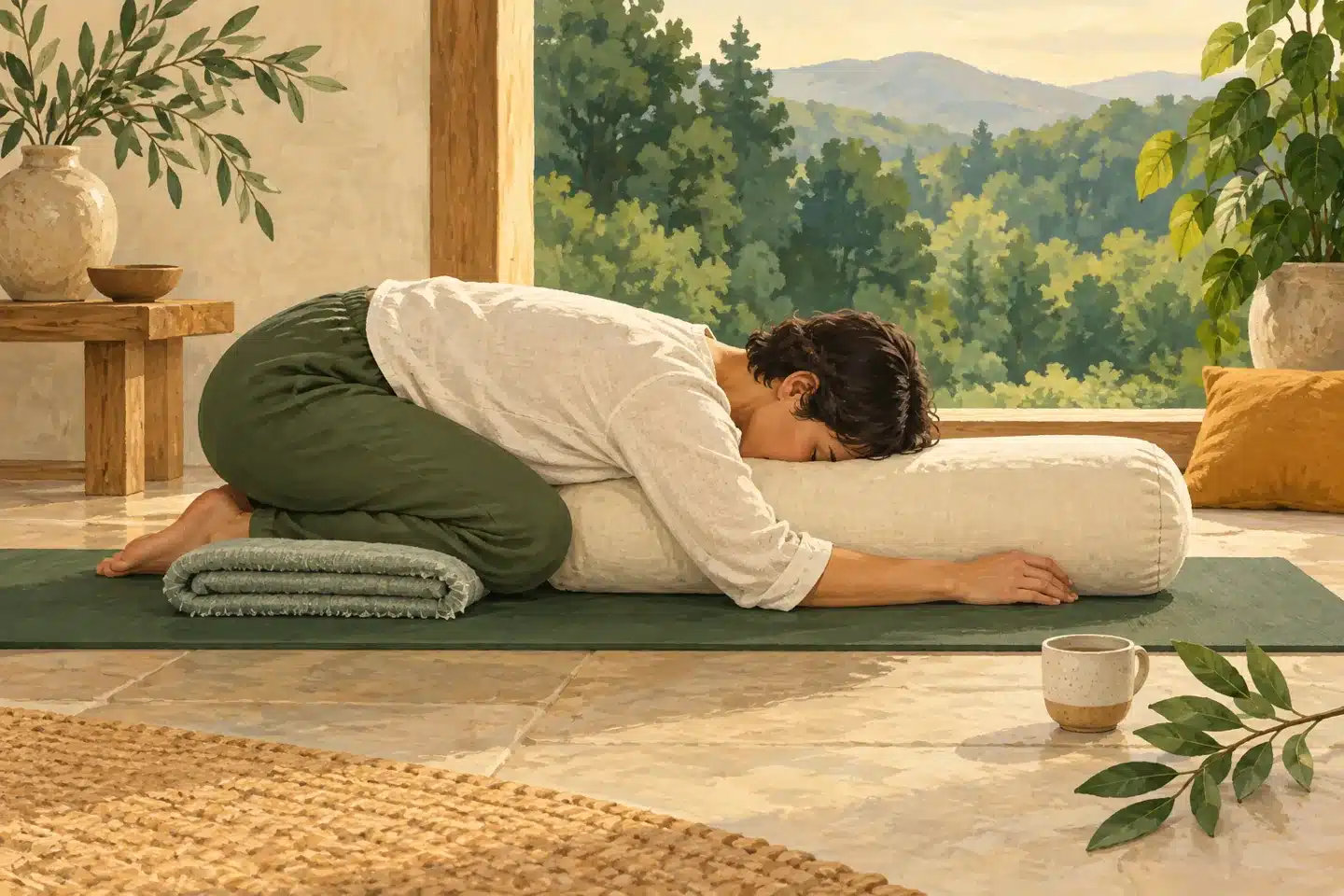
Kneel, bring your big toes together, widen your knees, and fold forward over your thighs or a bolster. It gently stretches the back and hips and is a useful resting pose between stronger holds.
Dragon
Step one foot forward into a low lunge with the back knee on a blanket. Let the hips sink forward without forcing. This targets the front of the back hip and the hip flexors. Switch sides.
Caterpillar
Sit with your legs straight and fold forward, letting your spine round gently. Place a cushion under your knees to ease the hamstrings. If you have osteoporosis or a disc problem, skip rounded folds unless a clinician has cleared them.
Reclining Twist
Lie on your back, draw one knee across your body, and let it rest on a block or pillow. Keep the twist gentle. Switch sides.
Supported Bridge
Lie on your back with knees bent, lift your hips, and slide a block under your sacrum (the flat bone at the base of the spine). Rest your weight on the block and relax.
Inteyoga’s 30-Minute Beginner Yin Yoga Sequence
This home sequence puts the poses above in order.
| Order | Yin pose (common name) | Related Hatha pose (Sanskrit) | Hold time | Helpful prop |
|---|---|---|---|---|
| 1 | Butterfly | Baddha Konasana (bound angle pose) | 3 minutes | Cushion under hips |
| 2 | Sphinx | Salamba Bhujangasana (supported cobra) | 3 minutes | Blanket under hips |
| 3 | Child’s Pose | Balasana | 2 minutes | Bolster under chest |
| 4 | Dragon (each side) | Anjaneyasana (low lunge) variation | 2 minutes per side | Blanket under back knee |
| 5 | Caterpillar | Paschimottanasana (seated forward bend) variation | 3 minutes | Cushion under knees |
| 6 | Reclining Twist (each side) | Supta Matsyendrasana | 2 minutes per side | Block between knees |
| 7 | Supported Bridge | Setu Bandhasana (supported) | 3 minutes | Block under sacrum |
| 8 | Final rest | Savasana (corpse pose) | 5 minutes | Blanket for warmth |
Tip: Add a 30-second rebound between poses. The full sequence then takes about 30 minutes.
How Should You Breathe in Yin Yoga?
Breathe slowly and naturally through your nose, with a soft belly and a slightly longer exhale than inhale. There is no special technique you must master.
Simple guidelines:
- Keep it comfortable. Never force long breaths or hold your breath.
- Let the exhale soften you. Many people find it easier to relax a little further as they breathe out.
- Use the breath as a check-in. If your breath becomes short, jerky or held, you are probably too deep in the pose. Ease off.
- Count if your mind races. Try counting to four on the inhale and five or six on the exhale for a few rounds, then let it go.
Slow breathing often feels calming. That feeling is real, but it does not by itself prove a specific change in your nervous system.
How Can Beginners Start Yin Yoga Safely?
Start with short holds of 1 to 2 minutes, use props generously, stay at a mild stretch, and practice two or three times a week. Yin yoga is gentle, but gentle does not mean you cannot overdo it.
- Gather simple props. A mat, two blocks or thick books, a bolster or firm pillow, and a blanket are enough.
- Choose a quiet time. Evenings work well for many people.
- Warm up lightly. A short walk or a few gentle movements help, especially on a cold day.
- Find your edge. Ease into each pose until you feel a mild stretch. Stop well before pain.
- Stay still and breathe. Breathe slowly through your nose.
- Come out slowly. Joints can feel stiff after long holds.
- Rebound between poses. Rest 30 to 60 seconds and notice how you feel.
- End with rest. Finish with at least five minutes in Savasana.
A Quick Yin Yoga Safety Checklist
Run through this list every time you practice:
- I feel a mild stretch, not sharp or stabbing pain.
- I have no tingling, numbness or “electric” feeling.
- I can breathe slowly and comfortably.
- I am not forcing a joint past its normal range.
- I have props nearby to ease the stretch if needed.
- I will come out of any pose that feels wrong.
What Is the Best Time to Do Yin Yoga?
For many people, the evening works best, because a calm session can help them wind down before bed. Still, the best time is the one you will actually stick with.
| Time of day | Why it works | Tips |
|---|---|---|
| Evening (1 to 2 hours before bed) | Helps you unwind | Keep lights low and skip screens afterward |
| Rest days or after workouts | Balances intense training | Wait until your heart rate settles |
| Morning | Eases stiffness and sets a calm tone | Many people feel stiffer in the morning, so use shorter holds and more props |
| Lunch break | Resets focus during a busy workday | Try 2 or 3 poses for 10 to 15 minutes |
Times to avoid: right after a heavy meal, and right before sprinting, jumping or heavy lifting.
How Many Times a Week Should You Do Yin Yoga?
Two to three sessions a week is a practical goal for most people. The studies in this article used programs of 4 to 10 weeks, with sessions once or twice a week, lasting roughly 50 to 90 minutes.
| Your goal | Suggested routine |
|---|---|
| Stress relief and winding down | 20 to 30 minutes, 3 evenings a week |
| Flexibility and mobility | 30 to 45 minutes, 2 to 3 times a week |
| Recovery from running, lifting or fast yoga | One 45- to 60-minute session on a rest day |
| Preparation for meditation | 15 to 20 minutes before sitting practice |
Short, regular sessions usually beat one long session now and then.
Is It Okay to Do Yin Yoga Every Day?
For most healthy adults, short daily sessions of 15 to 30 minutes are fine. Daily practice can make the calming benefits of yin yoga more consistent.
To keep daily practice safe:
- Rotate your focus. Work the hips one day and the spine or shoulders the next.
- Keep holds moderate. Save longer holds for two or three sessions a week.
- Balance it out. Pair yin yoga with strength training and aerobic activity.
- Check in first. If you are hypermobile, pregnant or recovering from injury, talk to your doctor and a qualified teacher before practicing daily.
How Long Does It Take for Yin Yoga to Work?
Many people feel calmer after a single session. Changes in stress, sleep and flexibility in the research appeared after about 4 to 6 weeks of regular practice. Any lasting change in tissue stiffness is likely to take longer.
| Timeframe | What you may notice | Where this comes from |
|---|---|---|
| After one session | Calmer mood, looser feeling, less in-the-moment anxiety | The Latvian study found state anxiety dropped after each session |
| 4 to 5 weeks | Less stress and anxiety, fewer sleep problems | The Swedish trials (5 weeks) and the adolescent trial (4 weeks) |
| 6 weeks | Better flexibility, balance and mobility | The six-week study of 24 young adults |
| 10 weeks | Lower state anxiety compared with controls | The 10-week online study |
| Several months | Possible changes in tissue stiffness | Stretching research on repeated loading over time |
Tip: Track one simple thing, such as how long it takes you to fall asleep or how far you reach in a forward fold.
Who Should Not Practice Yin Yoga?
People who are pregnant or have very flexible (hypermobile) joints, a recent injury or surgery, osteoporosis, glaucoma, uncontrolled blood pressure, heart conditions or nerve symptoms should not start yin yoga without medical advice and modifications. Long holds still place load on the body.
- Pregnancy. Avoid deep stretches, and ask your obstetric provider which positions are safe as pregnancy progresses. Choose a teacher trained in prenatal yoga.
- Hypermobility. If your joints already bend easily, you may not need more range of motion. Focus on stability, use props to limit depth, and avoid cues to “go deeper.”
- Recent injury or surgery. Wait for medical clearance and avoid loading the injured area.
- Osteoporosis or low bone density. Avoid deep, rounded forward folds and strong twists unless your clinician says otherwise.
- Glaucoma, high blood pressure or heart conditions. Avoid long holds with your head below your heart, and never hold your breath.
- Nerve symptoms. Tingling, numbness or shooting pain means come out of the pose right away.
- Trauma history. Stillness can sometimes bring up difficult feelings. Ordinary restlessness is common, but flashbacks, feeling detached from your body, or panic are signs to stop and seek support from a qualified mental health professional. A trauma-informed teacher can also help, and keeping your eyes open may feel safer.
Also read: Best Yoga Teacher Training Abroad: How to Verify a School in 2026
What Are the Most Common Yin Yoga Mistakes?
The most common mistakes are pushing too deep, holding through pain, skipping props and rushing out of long holds.
- Chasing the “Instagram version” of a pose. How it feels matters more than how it looks.
- Holding through pain. Mild discomfort is fine. Sharp pain is not.
- Skipping props. Props are not cheating. They let you stay longer with less strain.
- Holding too long, too soon. Start with 1 to 2 minutes and build up over weeks.
- Rushing out of poses. Exit slowly, then rest for a short rebound.
- Doing only yin. Yin yoga works best alongside strength and active movement.
How Does Inteyoga Approach Slow, Restorative Practice?
Inteyoga teaches an integrated approach that combines Hatha yoga, Raja yoga and restorative practice with Yoga Nidra, Chakra Sadhana and Prana Vidya. Our current program is not a yin yoga certification, but it shares the same emphasis on slowness, awareness and deep rest.
Inteyoga, also known as Swami Krishnananda Yoga Vidyapeeth, is a residential yoga school in Colva, South Goa, India, managed by Inteyoga Shala LLP. It is registered with Yoga Alliance as a Registered Yoga School (RYS 200, RYS 300 and RYS 500). Our founder-director is Dr. Ashutosh.
Our current course is the Advanced TTC 300-Hour Integrated Restorative Yoga (Including Yoga Nidra, Chakra Sadhana, and Prana Vidya Intensive).
- Duration: 43 training days plus 1 arrival day and 1 departure day (43+2 days, 45 days total).
- Format: Residential, taught in English, in Colva, South Goa.
- Level: An advanced yoga teacher training program, not a beginner retreat.
- Eligibility: A completed 200-hour TTC or an accepted equivalent is required for the advanced programme. Confirm current age and suitability criteria with admissions.
- Gift-it-Forward model: There is no payment required to apply and no payment required to participate. After completing the program, participants may voluntarily support the Gift-it-Forward initiative to help future aspirants. There is no obligation to contribute.
- Confirmed batches: 13 Dec 2026 to 26 Jan 2027; 5 Feb 2027 to 21 Mar 2027; 24 May 2027 to 7 Jul 2027; 16 Jul 2027 to 29 Aug 2027; 7 Sep 2027 to 21 Oct 2027; and 1 Nov 2027 to 15 Dec 2027.
Traveling from the U.S. or another country? The program is a short-term yoga program for personal growth and deeper yogic study, and participants receive a participation or completion certificate rather than an academic degree, diploma or government-recognized professional qualification. International participants attend under the Indian e-Tourist Visa route, subject to nationality-specific eligibility and current Government of India rules. Check the official Indian e-Visa website before applying, and read our arrival guide for Colva when planning your trip.
A teacher training course is not yoga therapy. Completing a 200-hour or 300-hour training does not qualify anyone to treat medical or mental health conditions.
If you do not yet hold a 200-hour qualification, our next 200-hour program is planned for approximately mid-2027. Dates, pricing and curriculum are not yet confirmed; updates will appear on our 200-hour yoga teacher training in Goa page.
You can also learn more about Dr. Ashutosh or read our frequently asked questions about Inteyoga’s courses.
Conclusion: Are the Benefits of Yin Yoga Worth It?
For most people, yes. The benefits of yin yoga include lower stress, less anxiety, fewer sleep problems, better flexibility and a calmer, more focused mind. Small randomized trials support the mental benefits, and smaller studies support the physical ones.
Be clear about its limits. Yin yoga will not burn belly fat, build muscle or replace your weekly cardio, and it does not replace medical or psychological care. It works best as the “rest and reset” part of a balanced routine.
Start small. Try the 30-minute sequence above two or three times a week. Use props, respect your edge, and give it at least a month.
If slow, restorative practice speaks to you and you already hold a 200-hour qualification, explore our residential training in South Goa. Read the full details of the Advanced TTC 300-Hour Integrated Restorative Yoga (Including Yoga Nidra, Chakra Sadhana, and Prana Vidya Intensive), or contact us at info@inteyoga.org or on WhatsApp at +91 935-473-7240.
About Inteyoga
Inteyoga (Swami Krishnananda Yoga Vidyapeeth) is a residential yoga school at Plot No. 6, Novo Vaddo, Sernabatim, Colva, Salcete, Goa 403708, India, managed by Inteyoga Shala LLP. It is registered with Yoga Alliance as a Registered Yoga School (RYS 200, RYS 300 and RYS 500). This article was prepared by the Inteyoga Editorial Team. Our founder-director is Dr. Ashutosh, MBBS, M.Sc. (Yoga), Yoga Master Level 6 (Yoga Certification Board, Ministry of AYUSH, Government of India).
Editorial standards: We base health information on peer-reviewed studies, clinical guidelines and government health sources. We do not publish invented testimonials, quotes or promised outcomes, and we review this article periodically as new research appears.
Medical Disclaimer
This article is for general education only and is not medical advice. Yin yoga is not a treatment for any disease or mental health condition, and it does not replace care from a doctor, psychologist or other licensed professional. The research cited here is early and based on small groups, and results vary from person to person. Talk to your doctor before starting a new practice, especially if you are pregnant or have a heart condition, high or low blood pressure, glaucoma, osteoporosis, hypermobile joints, a recent injury or surgery, or a diagnosed mental health condition. Stop any pose that causes pain, tingling or numbness.
Frequently Asked Questions About the Benefits of Yin Yoga (FAQ)
Is Yin Yoga Good for Lower Back Pain?
Yin yoga may ease back stiffness from long hours of sitting, but it is not a proven treatment for back pain. NCCIH reports that yoga in general may have a small benefit for low-back pain. Choose gentle poses like Sphinx and Child’s Pose, avoid deep twists, and see a doctor or physical therapist if pain is sharp, spreading or lasting.
Can You Do Yin Yoga at Home Without Props?
Yes. You can practice yin yoga at home with everyday items. Use firm couch pillows instead of a bolster, thick books instead of blocks, and a folded towel or blanket for padding. A carpeted floor or any non-slip mat works. Props make poses more comfortable, so use them freely, especially as a beginner.
Should Yin Yoga Hurt?
No. Yin yoga should feel like a mild to moderate stretch, never sharp pain. Some discomfort is normal, especially in long hip poses, but you should be able to breathe slowly and stay relaxed. Tingling, numbness, burning or shooting pain are warning signs. Come out of the pose slowly and use props or an easier version next time.
Is Yin Yoga the Same as Stretching?
Not exactly. Yin yoga uses static stretching, but it adds much longer holds, relaxed muscles, slow breathing and mindful attention. Typical stretching routines hold a stretch for shorter periods and target one muscle at a time. Yin yoga holds poses for several minutes, focuses on the hips, spine and connective tissue, and also trains focus and calm.
Is Yin Yoga Religious?
No. Yin yoga is not a religion, and you do not need to hold any belief to practice it. The style draws on ideas from Taoism, Traditional Chinese Medicine and the Hatha yoga tradition, and some teachers mention meridians or energy. Many U.S. classes present yin yoga as a physical and mindfulness practice open to people of any background.
Can You Learn Yin Yoga Online, or Do You Need a Teacher?
You can start yin yoga online. A study of 48 women in Latvia found that a 10-week online yin program reduced state anxiety compared with a control group. Still, an in-person teacher can adjust props, spot risky positions and help if you are hypermobile, pregnant or managing an injury. A few live classes first can make home practice safer.
Is Yin Yoga Better Than Pilates?
Neither is better; they do different jobs. Pilates is an active method that builds core strength, control and posture through controlled movement. Yin yoga is passive and focuses on relaxation, flexibility and connective tissue. Many people combine them, using Pilates for strength and yin yoga for recovery and stress relief.