
Quick Answer
The best platforms for teaching yoga online in 2026 depend on how you teach. Zoom is a popular choice for live group classes. YouTube and Instagram Live are best for free reach. Marvelous, OfferingTree and Momence handle bookings and payments. Teachable and Thinkific suit self-paced courses. Many teachers combine two tools.
Key Takeaways
- Select software according to live classes, recorded courses, bookings and payment needs.
- Zoom Basic has a 40-minute meeting limit; its current USD Pro list price is $16.99 per user monthly, or $14.16 per user per month billed annually.
- Count subscriptions, processing, platform and usage fees, equipment and insurance.
- The BLS figure is for a broad fitness occupation, not a yoga-specific or self-employed income estimate.
- Check screening, accessibility, recording consent and the actual insurance terms for online teaching.
Substantive pricing update: 30 September 2026.
In 2022, 16.9% of US adults practiced yoga at some point in the year, according to the CDC’s National Center for Health Statistics. A separate NIH analysis found that yoga use among American adults roughly tripled between 2002 and 2022. That is a large pool of potential students, and online classes let you reach them wherever they live.
If you teach yoga, choosing from the best platforms for teaching yoga online is one of the first business decisions you will make. The platform decides how students book, how you get paid, how clearly they hear your cues, and whether a class ends at the 40-minute mark because you forgot to upgrade. It is worth getting right.
This guide compares the options US teachers use most in 2026: live video tools, social media, yoga business software, course platforms and teacher marketplaces. You will also find real 2026 prices, a setup checklist, US pay data, a safety section and a simple way to pick your own setup.
How We Researched This Guide
The comparison uses providers’ own pages for the specific prices described below. Zoom, Teachable, Thinkific and Marvelous pricing were checked on 30 September 2026. These are dated snapshots, not guaranteed quotes for every country, account or plan.
Where current prices were not independently confirmed, this guide directs you to the provider. Confirm currency, billing term, tax, processing, platform and usage charges before purchasing. A provider’s promotional comparison is not independent evidence of a competitor’s fees.
What Are the Best Platforms for Teaching Yoga Online?
Video tools run live sessions; course platforms organise recorded learning; booking and studio tools manage the business around classes. Compare the specific features and plan limits you need.
| Platform | Use to investigate | Pricing check |
|---|---|---|
| Zoom | Live video meetings | Official pricing: Basic 40-minute meetings; Pro USD $16.99 monthly or $14.16/month billed annually |
| Google Meet | Live video meetings | Check current account and meeting limits |
| YouTube / Instagram / Facebook | Public video and live distribution | Check streaming eligibility, audience controls and monetisation rules |
| Marvelous | Classes, content and business tools | Official pricing lists Essentials at $79/month; compare inclusions |
| OfferingTree | Website, scheduling and business tools | Request current pricing and compare the intended plan |
| Momence / Mindbody | Studio and event operations | Obtain a written quote, including transaction and other fees |
| Teachable | Structured recorded courses | Official pricing: Starter $39 monthly or $29/month billed annually, plus 7.5% transaction fee and applicable other charges |
| Thinkific | Courses and communities | Official pricing: currency and billing term vary; check payment-processing and third-party gateway fees |
| Ruzuku | Structured courses | Check the current plan, live-session integration and fees |
| Graphy / TagMango | Creator and community products | Verify payment methods, seller eligibility and current fee terms for your location |
These are options to investigate, not a universal ranking. Trial the booking and student experience before migrating your business.
How Do You Choose the Right Platform to Teach Yoga Online?
When you compare the best platforms for teaching yoga online, match each one to how you teach, who you teach and how you get paid. Start with your teaching format, then look at payments, video quality and total cost. Features you never use only add cost and confusion.
Before you pick a tool, answer these eight questions:
- Will you teach live, recorded, or both? Live classes need a video call tool. Recorded classes need a course or video library platform.
- Will you teach groups or one-on-one? Private sessions need scheduling. Group classes need a timetable and a waitlist.
- Where do your students live? Students in the US usually pay by card or PayPal. Students in India often prefer UPI.
- Do you need a website? Some platforms include a website builder. Others expect you to already have one.
- How much can you spend each month? Count the subscription, card processing fees and any platform fees.
- Do you own your student list? You should be able to export student emails, so you can switch tools without losing people.
- Can students join easily on a phone? Some join from a phone or tablet set on the floor next to their mat.
- Is support fast? When a class starts in five minutes and a link breaks, you need help quickly.
Time zones matter more than most new teachers expect. If you live in Denver and most of your students are on the East Coast, a 6 p.m. Mountain Time class starts at 8 p.m. Eastern. Pick a platform that shows class times in each student’s local time zone, or state the time zone clearly in every listing.
A practical rule: start with the smallest setup that works. Adding a tool later is easy. Leaving a complex system after you have built your business on it is much harder.
Which Video Call Platforms Work Best for Live Yoga Classes?
Among the best platforms for teaching yoga online for live classes, Zoom is one of the most widely used, with Google Meet as a simple alternative. Both let you see students, talk to them and correct them in real time. That two-way contact is what makes a live class feel close to a studio class.
Is Zoom Still the Best Platform for Live Yoga Classes?
Zoom can support live group or private classes when its meeting limits, accessibility and student experience suit your needs.
The official Zoom pricing page checked on 30 September 2026 lists Basic meetings at 40 minutes and up to 100 participants. This is a per-meeting limit, not only a rule for groups of three or more.
The USD Pro list price is $16.99 per user per month billed monthly, or $14.16 per user per month billed annually. Pro lists meetings up to 30 hours, 100 participants and 10 GB cloud storage per user. Prices, tax and offers may differ by location and account.
Test microphone quality, camera placement, captions and meeting security. Seeing a student on camera does not ensure that every movement or safety concern is visible. Obtain appropriate recording consent and check whether separate scheduling or payment software is needed.
Is Google Meet Good Enough for Yoga Classes?
Google Meet works for small, simple classes, especially if you and your students already use Google accounts. It opens in a browser, so laptop users do not need to install anything.
It has fewer teaching extras than Zoom, and free personal accounts have time limits on group calls. Check Google’s current limits before you plan a full-length class. For private one-on-one sessions or a short breathing practice, Meet is often enough.
Can You Teach Yoga on YouTube, Instagram and Facebook?
Yes. Social platforms are excellent for reaching new students for free, but they are weaker for earning money directly. Many teachers use them to build trust, then invite viewers to paid live classes or courses.
Is YouTube a Good Platform for Teaching Yoga Online?
YouTube is one of the best free platforms for teaching yoga online because of its huge audience and strong search visibility. Bookinglayer, citing Statista, puts YouTube at about 2.5 billion users. Your videos stay on your channel, so one good class can keep bringing viewers for years.
YouTube also supports live streaming, and you can set a live stream to private so only people you choose can watch.
YouTube works best for short beginner routines that answer common searches, such as “yoga for lower back stiffness” or “10-minute morning stretch.” Breathing and relaxation practices do well too. So does a free sample class that links to your paid offer.
The limits are real. You need a large audience before ad income means much, and you cannot see or correct viewers during a recorded video.
Should You Use Instagram Live or Facebook Live for Yoga Classes?
Instagram Live and Facebook Live work best for short, free sessions that grow your audience. Followers get a notification when you go live, which gives each session a small engagement boost.
Instagram Live has one big limit: you cannot restrict who watches. Anyone who follows you can join, which makes it a poor fit for paid classes. It is a good fit for a 15-minute lunchtime yoga break, a short guided meditation or a live Q&A.
Save your best live sessions as posts or Reels. A 30-second clip of one pose, one breath practice or one cue often reaches more people than a full class.
Which All-in-One Yoga Business Platforms Are Worth It?
All-in-one tools become some of the best platforms for teaching yoga online once you run regular classes and spend hours each week on bookings, payments and reminders. They put your schedule, payments, memberships and video library in one place, so students can book and pay without texting you.
Is Marvelous a Good Platform for Yoga Teachers?
Marvelous offers tools for classes, content and a teaching business. Its official pricing page lists Essentials at $79/month in the snapshot checked on 30 September 2026. Compare the current plan limits, required integrations and payment processing before purchasing.
Is OfferingTree Good for Solo Yoga Teachers?
OfferingTree is an option to compare for scheduling, a website and related business needs. Use its official pricing page or a written quote rather than an unverified $29–$35 range from a competitor comparison. Confirm which features and fees apply to your proposed account.
When Does Momence Make Sense?
For Momence, obtain a current written proposal covering the features you need and all subscription, processing, platform and other charges. Do not treat a competitor’s claimed 2.5%–5% fee range as verified current pricing.
Is Mindbody Worth It for Online Yoga?
Mindbody may be relevant to a studio operation with scheduling, staff and other business needs. Request the actual current package, onboarding, payment and cancellation terms. Whether it is suitable or expensive depends on that proposal and your needs.
Which Course Platforms Work Best for Self-Paced Yoga Programs?
Course platforms organise a structured programme of videos, text, worksheets or assessments. They do not guarantee sales or recurring income. Compare course design, accessibility, learner support, payments, export and any live-session integration.
Is Teachable Good for Yoga Courses?
Teachable supports structured digital courses. Its official pricing page checked on 30 September 2026 lists Starter at $39 monthly or $29/month billed annually, with a 7.5% transaction fee. The page describes conditional zero platform transaction fees for higher plans using specified payment gateways; standard processing and other applicable charges can remain. Verify the plan and seller-country terms.
Is Thinkific Better Than Teachable for Yoga Teachers?
Thinkific and Teachable have different plan features and fee terms. Compare the specific course, design, community and live-session needs rather than assuming one is universally better. Thinkific’s official pricing page shows location-dependent currency and billing options, payment processing and potential additional third-party gateway fees. The old “from $49 with no transaction fees” description should not be treated as a current universal quote.
When Should You Choose Ruzuku?
Ruzuku suits teachers who want a simple course with live Zoom sessions built in. It advertises built-in Zoom, zero transaction fees and an easy setup.
Ruzuku publishes its own platform comparison, so read its claims with that in mind. Try the free trials of two or three course tools before you commit.
What Are the Best Platforms for Teaching Yoga Online From India?
For teachers based in India, including those who teach US students, the best setup often combines Zoom for live classes with an Indian creator platform, such as Graphy or TagMango, for payments and courses.
Students in India expect to pay by UPI, and many global platforms support it poorly. If a student cannot pay the way they are used to, they often leave the checkout page, so test the full checkout on a phone before you launch.
Is Graphy Good for Indian Yoga Teachers?
Graphy is a no-code creator platform that handles Indian and international payments in one place. Its product listing says it supports UPI, cards, net banking, wallets, Stripe and PayPal, with country-specific pricing. You can also run live classes, build a course website and publish Android and iOS apps.
That makes Graphy a practical pick for a teacher in India with students in both India and the US.
Is TagMango Good for Yoga Communities?
TagMango focuses on courses, memberships and community, which suits teachers who run ongoing groups. It offers Zoom-integrated workshops, live attendance marking, memberships and one-on-one consultations, and its checkout supports UPI, cards, net banking and wallets.
A monthly membership for a morning pranayama group fits TagMango’s model well. If you are registered for GST, check whether the platform creates GST-ready invoices, and ask a qualified accountant about the tax rules for selling classes abroad.
Should You Join a Yoga Teacher Marketplace?
A marketplace can help you find your first online students without building a brand from scratch. You list your classes on a shared site, and the site brings students to you.
Live Yoga Teachers is one example. It gives each teacher a personal page and a dashboard for bookings, and it advertises live online classes from £5 each (about $6) across styles such as Hatha, Yin, Iyengar and breathwork.
The upside is that students already visit the site, booking and payments are handled for you, and you can test demand before paying for your own tools.
The downside is less control over pricing and branding. Students may stay loyal to the marketplace instead of to you, and you compete with many teachers on the same page.
A marketplace is a reasonable place to start. Over time, it usually pays to build your own email list and website as well.
What Are the Benefits of the Best Platforms for Teaching Yoga Online?
The main benefits are wider reach, flexible hours, lower overhead and less admin work. A good platform takes care of links, reminders and payments so you can focus on teaching.
- You can reach students anywhere. Someone in Boston, Denver and San Diego can take the same class.
- Your schedule is flexible. You can teach a 6 a.m. class for early risers on the East Coast and an evening class for the West Coast.
- Overhead is lower. You do not need to rent studio space for every class.
- Content can be reused. A recorded class keeps helping students long after the live session ends.
- Records are easier. Booking tools track attendance, payments and health forms.
- Access improves for some students. People who cannot get to a studio can still practice with guidance.
- Hybrid teaching becomes possible. Many teachers mix in-person classes, retreats and online sessions.
The platform extends your reach. Whether students stay depends on your teaching.
Best Platforms for Teaching Yoga Online vs Online Yoga Class Apps: What Is the Difference?
Platforms for teaching yoga online are tools teachers use to run and sell their own classes. Online yoga class apps are subscription services where students watch classes made by the app. Search results often mix the two, which confuses new teachers.
Apps such as Glo, Alo Moves, Down Dog and Yogaia are built for students. They offer ready-made class libraries, and as a teacher you usually cannot post your own classes there unless the company hires you.
Teaching platforms such as Zoom, Marvelous, OfferingTree and Teachable give you control over your own classes, prices and students.
| Feature | Platforms for teaching yoga online | Online yoga class apps |
|---|---|---|
| Main user | Yoga teachers and studios | Yoga students |
| Who creates the classes | You, the teacher | The app’s hired teachers |
| Who sets the price | You | The app |
| Who owns the student relationship | You | The app |
| Examples | Zoom, YouTube, Marvelous, OfferingTree, Teachable | Glo, Alo Moves, Down Dog, Yogaia |
| Income for teachers | Paid directly by your students | Salary or contract, if hired |
| Best for | Building your own teaching business | Practicing at home |
If you want to teach and earn, choose a teaching platform. Student apps are still useful for your own practice, and for studying how experienced teachers cue and structure a class.
Where Do Students Find Yoga Teachers and Classes Online?
Students usually find yoga teachers through teacher directories, yoga websites, class apps and YouTube. Knowing where they look helps you decide where to list yourself.
What Is the Best Website to Find Yoga Teachers?
The Yoga Alliance directory is one of the most trusted websites for finding a registered yoga teacher. Students can search it and read what each credential means, such as RYT 200, E-RYT 200 and RYT 500. Yoga Alliance says it supports a global community of more than 100,000 yoga teachers and schools.
In India, the Yoga Certification Board (YCB), which operates under the Ministry of Ayush, publishes a public list of certified yoga professionals. Each entry shows the person’s name, certificate number and certification level, so students can confirm a teacher’s YCB certificate before they book.
Teacher marketplaces, covered earlier in this guide, are a third option when students want to book right away. If you teach, keep your directory profiles complete, and list your style, the languages you teach in and your class times with the time zone.
What Are the Top 10 Yoga Websites?
There is no official ranking, but these ten websites are widely used for yoga learning, practice and credentials. They serve different needs, so we grouped them by what each one does best rather than by traffic.
| # | Website | What it offers | Best for |
|---|---|---|---|
| 1 | Yoga Alliance | Teacher and school credentials, plus a searchable directory | Checking a teacher or school |
| 2 | Yoga Certification Board (Ministry of Ayush) | Government-backed certification levels and a list of certified professionals | Indian certification |
| 3 | Yoga Journal | Articles on poses, philosophy and practice | Reading and self-study |
| 4 | Yoga International | In-depth yoga education from beginner to advanced level | Deeper learning |
| 5 | Yoga With Adriene (YouTube) | Free classes from one of the most popular online teachers | Beginners at home |
| 6 | Glo | Yoga, Pilates and meditation classes, with a free trial | Varied on-demand practice |
| 7 | Alo Moves | Paid on-demand classes from well-known teachers | Premium home practice |
| 8 | Down Dog | App-generated flows that change every session | Personalized routines |
| 9 | Yogaia | Paid and free live and on-demand classes | Budget-friendly variety |
| 10 | Habuild | Live group yoga classes run from India | Daily habit building |
For teachers, studying how these sites structure classes, cues and beginner content is a free way to sharpen your own online teaching.
What Is the Best Indian App for Yoga?
For daily live group classes, Habuild is one of the most popular Indian choices. For a short routine designed by the government, the Ministry of Ayush’s Y-Break app is a trusted free option. The better fit depends on whether you want live accountability or a quick break during the workday.
Habuild was founded in 2020 by IIT alumni Saurabh Bothra, Trishala Bothra and Anshul Agrawal. It runs live classes and uses WhatsApp for reminders and habit tracking, and it reports more than 1 crore (10 million) members.
Ahead of the International Day of Yoga 2026, the Morarji Desai National Institute of Yoga (MDNIY), part of the Ministry of Ayush, signed an MoU with Habuild for a nationwide digital yoga initiative.
Y-Break is a five-minute yoga protocol for working professionals. It combines asanas, pranayama and dhyana (meditation) and was developed by MDNIY. In 2024, the Ayush Ministry reported that about 8.7 lakh (870,000) government officials had completed the Y-Break course on the iGOT Karmayogi platform.
How Much Does Saurabh Bothra Charge?
Saurabh Bothra teaches through Habuild, so what you pay is a Habuild membership, not a personal fee. Habuild’s 2026 pages mention a 14-day free trial and free challenges, and describe the annual membership as about ₹11 per day.
For international buyers, including US students, Habuild’s checkout pages showed discounted prices of $39 for three months and $59 for six months in 2026. Prices and offers change often, so check the current plans on habuild.in before you join.
What Does It Cost to Teach Yoga Online in 2026?
Calculate the cost of the actual plans you intend to buy. A universal $13–$95 monthly setup estimate is unreliable when plan prices, country, billing terms and charges vary.
| Cost item | What to check |
|---|---|
| Subscriptions | Monthly price versus annual commitment and renewal terms |
| Payments | Processing, platform, gateway, usage and currency charges |
| Delivery | Meeting duration, storage, participant limits and required integrations |
| Operations | Website, scheduling, mailing and support needs |
| Other expenses | Insurance, equipment and any music-licensing requirements |
Check the dated examples above and obtain current quotes for the rest. Add the full cost before comparing providers; a zero platform commission does not mean that payment processing is free.
Can You Get Paid to Teach Yoga Online?
Yes. Many teachers earn money teaching yoga online through live classes, private sessions, courses and memberships. What you earn depends on your training, your niche, the size of your audience and how consistently you teach and market your classes.
How Do Yoga Teachers Earn Money Online?
Many online yoga teachers combine two or three income streams instead of relying on one. The most common are:
- Drop-in live classes paid per session
- Class packs and monthly memberships that reward regular students
- Private one-on-one sessions, which usually pay more per hour than group classes
- Self-paced courses you record once and sell many times
- Workshops on a single theme, such as pranayama or Yoga Nidra
Here is a simple, hypothetical example of the math. Say you charge $15 for a live drop-in class and eight students join. That is $120 before fees.
Teach four of those classes a week and add two private sessions, and you have a small but real online income. Your own numbers will depend on your prices, your costs and how many students you keep.
To set your price, look at online teachers with similar training and experience, and check what students in your target market usually pay. Then add up your software, card and platform costs so every class covers them.
What Is the Average Pay for a Yoga Teacher?
In the US, the Bureau of Labor Statistics reports a median annual wage of $47,160 (May 2025) for fitness trainers and instructors, the job category that includes yoga teachers.
Half of workers in the category earned more than that and half earned less. The BLS also notes that many people in this field work part-time or variable schedules, and it projects 7% job growth from 2025 to 2035, with about 68,000 openings a year.
Salary data for India is thinner. AmbitionBox estimates based on small samples show yoga instructors at Cult.fit earning about ₹2.5 to ₹5.3 lakh a year and at Sarva Yoga about ₹2.3 to ₹5.9 lakh a year. These figures cover employed instructors, not independent teachers who run their own online classes and whose income varies widely.
What Is the Highest Salary for a Yoga Teacher?
According to BLS data for May 2025, the top 10% of US fitness trainers and instructors earned more than $83,100 a year, while the lowest 10% earned less than $28,800.
In India, AmbitionBox shows freelance yoga instructors working through Freelancer.com reporting about ₹2.4 to ₹7.8 lakh a year. The highest earners in yoga usually do not depend on one salary.
They build their own business with private clients, corporate programs, retreats, courses or teacher trainings. No income is guaranteed at any level, so treat all of these figures as a guide.
Which Country Is Best for Yoga Teachers?
There is no single best country. It depends on whether your goal is deeper training or higher pay.
For training and depth, India, where yoga originated, has many residential teacher trainings in traditional settings. Fees vary widely by school, so compare current official prices rather than relying on averages.
For pay, higher-wage markets such as the United States usually pay more, and sources citing BLS data place New York, California, Massachusetts, Washington and Colorado near the top for fitness instructor wages.
For online teaching, your location matters less: a teacher in India can teach students in the US, UK or Australia by scheduling around their time zones.
If you plan to teach in person abroad, check that country’s visa and work permit rules first.
How Do You Set Up Your Space to Teach Yoga Online?
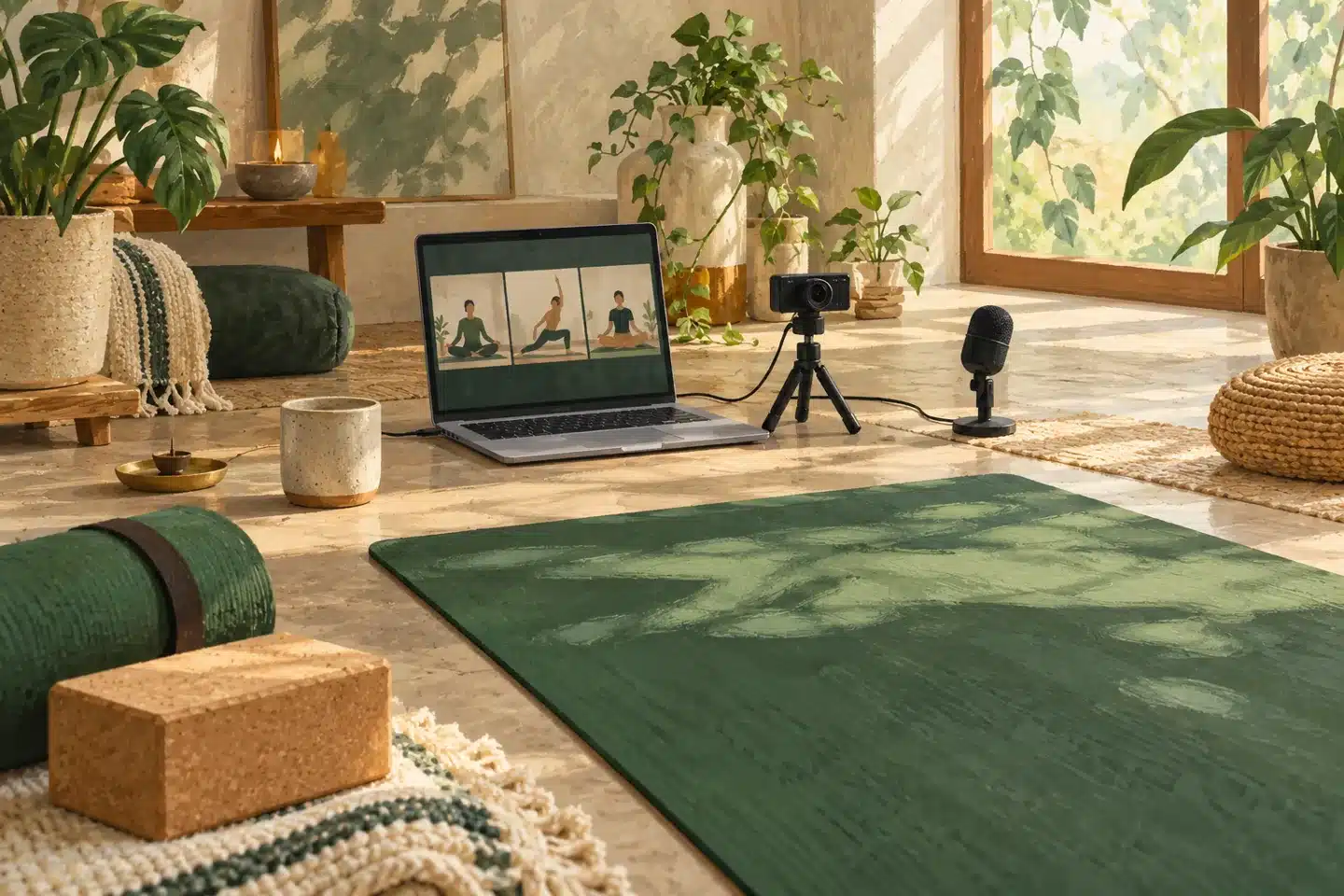
A clear camera view, clean sound and good light matter more than expensive gear. Even the best platforms for teaching yoga online cannot fix a dark room or a muffled microphone. Students must be able to see your whole body and hear your cues without straining.
Follow these steps before your first class:
- Choose a quiet space. Pick a room with little echo and few interruptions.
- Frame your full body. Place the camera so students see you from head to toe in standing and lying poses.
- Light yourself from the front. Face a window or use a soft light, and avoid a bright window behind you.
- Use a separate microphone. A small wireless clip-on mic makes your cues much clearer than a laptop mic.
- Test your internet. Use a wired connection if you can, and close other apps that use bandwidth.
- Add a second screen. A laptop or tablet in front of you lets you watch students while you teach.
- Send a props list. Tell students what they need ahead of time, and suggest home swaps such as a belt for a strap or couch cushions for a bolster.
- Run a practice class. Teach a short test session to a friend and ask for honest feedback on sound and view.
Checklist for your first live class:
- Platform link tested and shared
- Health form or intake questions collected
- Camera shows your full body
- Microphone charged and tested
- Lighting checked
- Props list sent to students
- Recording consent requested, if you plan to record
- Backup plan ready if the connection drops
How Do You Keep Online Yoga Students Safe?
Whichever of the best platforms for teaching yoga online you choose, you keep students safe with health screening, clear verbal cues, simple options for every pose and the right insurance. You cannot give hands-on adjustments through a screen, so your words and demonstrations have to do more of the work.
Research on video-based exercise is encouraging, though still growing. A 2025 systematic review and meta-analysis in Clinical Rehabilitation looked at 22 trials of exercise and rehabilitation delivered by videoconference.
It found no significant difference in minor, moderate or major adverse events compared with in-person programs, and events were uncommon in both groups.
Smaller pilot studies of tele-yoga have also reported no serious adverse events. These studies involved supervised programs, so the results may not apply to every class.
Several organizations have similar names. Yoga Alliance (based in the US), Yoga Alliance Professionals and Yoga Alliance International are separate organizations, and Yoga Alliance states that it is not affiliated with Yoga Alliance Professionals or the national Yoga Alliance groups in the UK, Canada and Australia. We name each one below so their guidance is not confused.
Build these habits into every online class:
- Screen students before class. Ask about injuries, surgeries, pregnancy, blood pressure, heart conditions and eye conditions such as glaucoma.
- Keep groups manageable. Yoga Alliance Professionals, a UK-based membership body, suggests keeping online class sizes similar to your in-person classes so you can still watch everyone.
- Cue clearly. Use direction words such as “right foot forward” and “gaze down” so students can follow without looking at the screen.
- Offer options. Give easier and harder versions of poses, and remind students they can rest at any time.
- Ask before recording. The Code of Practice of Yoga Alliance International, another registry, asks teachers to get written consent before audio or video recording.
- Check your insurance. Confirm that your liability policy covers online teaching, including students who join from other states or countries.
- Keep records. Track attendance and health forms the same way you would for studio classes.
- Stay within your scope. Yoga Alliance’s own Scope of Practice asks members to teach only in areas where they have the right training and competence.
A yoga teacher is not a yoga therapist or a doctor, and a teacher training does not qualify anyone to treat medical conditions. If a student has a health concern, ask them to talk to their doctor before they join.
Which of the Best Platforms for Teaching Yoga Online Should You Choose?
Pick your platform by starting with your main goal. Use the guide below to find a starting point, then add tools only when you need them.
| Your main goal | Start with | Add later |
|---|---|---|
| Test online teaching for free | Instagram Live or YouTube | Zoom Pro for paid classes |
| Run paid weekly live classes | Zoom Pro | OfferingTree or Marvelous for bookings |
| Teach private one-on-one sessions | Zoom or Google Meet with a scheduling tool | A membership or package system |
| Sell a self-paced course | Teachable, Thinkific or Ruzuku | Live Q&A calls on Zoom |
| Build an on-demand video library | Marvelous | Memberships and a mobile app |
| Sell mostly to students in India | Graphy or TagMango with Zoom | International payment options |
| Find students without marketing | A marketplace like Live Yoga Teachers | Your own website and email list |
| Run a hybrid studio with events | Momence or Mindbody | Online video tools |
How Can You Score Platforms Before You Decide?
Score each platform from 1 to 5 on six factors, then add up the totals. This keeps you focused on what matters for your teaching instead of on marketing claims.
| Factor | Question to ask | Score (1 to 5) |
|---|---|---|
| Teaching fit | Does it support how I teach, live or recorded? | |
| Student ease | Can a beginner join from a phone in two taps? | |
| Payments | Does it accept the payment methods my students use? | |
| Total cost | What is the full monthly cost, including fees? | |
| Data ownership | Can I export my student list at any time? | |
| Support | Can I get help quickly before a class? |
As a rule of thumb, a platform scoring 24 or more out of 30 is likely a strong fit. Under 18 suggests you should keep looking or pair it with another tool. This is our own planning tool, not an industry standard.
How Do You Become a Certified Yoga Teacher?
To become a certified yoga teacher, complete a recognized teacher training, then register or certify with a recognized body. Two systems come up most often.
Yoga Alliance is a US-based nonprofit membership organization that registers teachers (RYT) and schools (RYS), and it says its credential is recognized worldwide.
The Yoga Certification Board (YCB) works under India’s Ministry of Ayush and certifies individual yoga professionals by level. They are different systems, not equivalents.
| Yoga Alliance | Yoga Certification Board (YCB) | |
|---|---|---|
| What it is | US-based nonprofit membership registry | Certification body under India’s Ministry of Ayush |
| Who it credentials | Teachers (RYT 200, RYT 500, E-RYT) and schools (RYS 200, RYS 300, RYS 500) | Individual professionals by level; it also accredits institutions |
| How you qualify | Complete training at a Registered Yoga School, then apply | Through YCB-accredited training and assessment, per YCB guidelines |
| Ongoing requirements | Annual dues and continuing education every three years | See current YCB rules |
| Clinical scope | Does not make a teacher a yoga therapist | Yoga therapy is a separate YCB category |
What Are the Steps to Become a Certified Yoga Teacher?
- Build a steady personal practice. Many trainings recommend some prior experience, so check each school’s eligibility rules.
- Choose a Registered Yoga School. For Yoga Alliance registration, pick a 200-hour training at a school registered as an RYS 200. The Yoga Alliance School Directory lists these schools.
- Complete the full training at one school. Yoga Alliance says all 200 hours must come from the same school, and hours from different trainings cannot be combined.
- Register as an RYT 200. Yoga Alliance lists a one-time $50 application fee and $65 in annual dues. To stay registered, you follow its Code of Conduct and complete continuing education every three years.
- Or certify with YCB in India. YCB’s guideline for yoga professionals lists education and training levels including Yoga Protocol Instructor, Yoga Wellness Instructor, Yoga Teacher & Evaluator and Yoga Master, with yoga therapy certifications in a separate category.
- Keep learning. Many teachers later add an advanced 300-hour training to deepen their skills. Completing extra hours does not by itself give you an RYT 500 credential; you apply for it separately under Yoga Alliance’s current rules.
Can I Teach Yoga Without a Certificate?
In many places, no law requires a certificate to teach yoga, but studios, insurers and students commonly ask about your training. Most online platforms do not check certificates either, so the responsibility sits with you.
Teaching without proper training may raise the risk of injury to students, and it can make insurance and studio work harder to get. Rules differ by state and country, so check what applies where you live and where your students are. A recognized certificate is the simplest way to show students you have trained properly.
What Can Yoga Teacher Training Give You That No Platform Can?
Platforms deliver your classes, but teacher training builds the skills that make those classes safe and worth coming back to. Clear cueing, sequencing, anatomy awareness, breathwork and the ability to adapt poses are what students return for.
This matters even more online. Even the best platforms for teaching yoga online only carry your voice and image. You cannot walk around the room or offer a hands-on adjustment, so you have to spot alignment problems through a screen and correct them with words. That skill comes from deep study and supervised practice.
At Inteyoga, we train teachers at Swami Krishnananda Yoga Vidyapeeth in Colva, South Goa, India. Inteyoga is registered with Yoga Alliance as a Registered Yoga School (RYS 200, RYS 300 and RYS 500).
Our current course is the Advanced TTC 300-Hour Integrated Restorative Yoga (Including Yoga Nidra, Chakra Sadhana, and Prana Vidya Intensive). It is a residential program taught in English, and it runs for 43+2 days: 43 training days plus one arrival day and one departure day.
Applicants for the advanced programme must have completed at least a 200-hour TTC or an accepted equivalent. Confirm current age and suitability criteria with admissions. It is advanced teacher training, not a beginner retreat.
Confirmed batches for the 300-hour program:
- December 13, 2026 to January 26, 2027
- February 5 to March 21, 2027
- May 24 to July 7, 2027
- July 16 to August 29, 2027
- September 7 to October 21, 2027
- November 1 to December 15, 2027
The program follows our Gift-it-Forward model. No payment is required to apply or to participate. After completing the program, participants may voluntarily support future aspirants, with no obligation.
For students traveling from the US or elsewhere: this is a short-term yoga program for personal growth and deeper yogic study, lasting 45 days in total. Participants receive a participation or completion certificate, not an academic degree, diploma or government-recognized professional qualification. International participants use the Indian e-Tourist Visa route, subject to nationality-specific eligibility and current Government of India rules. The official Indian e-Visa website lists attending a short-term yoga program as a permitted e-Tourist Visa purpose, so check the current conditions there before you apply. Our arrival guide covers the practical details of getting to Colva.
Restorative practices, Yoga Nidra and pranayama are taught largely through verbal guidance, which makes them a natural fit for online classes. Our training is led by our founder-director, Dr. Ashutosh, who holds an MBBS and an M.Sc. in Yoga.
If you want to deepen your teaching before you go online, explore the Advanced TTC 300-Hour Integrated Restorative Yoga (Including Yoga Nidra, Chakra Sadhana, and Prana Vidya Intensive) in Goa. If you are just starting out, our 200-hour yoga teacher training in Goa is planned for approximately mid-2027, with dates still to be confirmed. You can also review all course details and fees in one place.
Conclusion: Which Is the Best Platform for Teaching Yoga Online?
Choosing among the best platforms for teaching yoga online comes down to your teaching format, your students and your budget. Zoom is a strong default for live group classes. YouTube and Instagram help you reach new students for free. Marvelous, OfferingTree and Momence make bookings and payments easier. Teachable, Thinkific and Ruzuku support self-paced courses. In India, Graphy and TagMango help you accept UPI payments.
Start with a simple setup, keep your student list in your own hands and put safety first in every class. No platform can replace strong teaching skills. Clear cues, thoughtful sequencing and real care for each student are what turn online viewers into regular students.
Ready to take the next step? Apply through our booking page or read our frequently asked questions about eligibility, dates and the Gift-it-Forward model. You can also email info@inteyoga.org or send a WhatsApp message to +91 935-473-7240.
Safety Note and Medical Disclaimer
This article is for general information only and is not medical advice. Yoga carries some risk, especially for people who are pregnant, recovering from surgery or injury, or living with high or low blood pressure, glaucoma or heart conditions. Please talk to a qualified doctor before starting a new yoga practice.
About the Author
Inteyoga Editorial Team. This guide was written by the Inteyoga Editorial Team at Swami Krishnananda Yoga Vidyapeeth, Colva, South Goa, India. Inteyoga is managed by Inteyoga Shala LLP. Our founder-director is Dr. Ashutosh, MBBS, M.Sc. (Yoga), Yoga Master Level 6 (Yoga Certification Board, Ministry of AYUSH, Government of India). Read what past participants say on our testimonials page.
Address: Plot No. 6, Novo Vaddo, Sernabatim, Colva, Salcete, Goa 403708, India.
Frequently Asked Questions (FAQ)
Which Platform Is Best for Online Yoga Classes?
It depends on whether you teach or practice. Among the best platforms for teaching yoga online, the most practical setup for teachers is usually Zoom for the live class plus a booking tool such as OfferingTree or Marvelous for payments. For students who only want to practice, a ready-made class app such as Glo, Down Dog or Yogaia is simpler, because the classes are already made for you.
What Is the Best App for Yoga Teachers?
There is no single best app, because teachers need apps for different jobs. The Zoom mobile app lets you run or join a class from your phone. For bookings on the go, choose a business platform with a mobile app for you and your students. Several 2026 software comparisons note that stronger studio platforms add a branded member app. Test the free trial first.
Where Can I Teach Yoga Online?
You can teach on your own through video calls and social media, or teach with others. Options include teacher marketplaces, online studios and apps that hire teachers, company wellness programs for remote teams, and schools or colleges that run virtual classes. Many teachers mix two or three of these. Start where your current students already are, then expand one step at a time.
How Do I Get My First Online Yoga Students?
Start with people who already know you. Invite past in-person students, friends and coworkers to a free or low-cost intro class, and ask happy students to refer a friend. Post short practice clips on Instagram or YouTube with a clear link to book. List yourself in teacher directories, and collect email addresses from day one so you can reach students directly.
Do I Need Liability Insurance to Teach Yoga Online in the US?
Yes, you should have it. Accidents are less likely online but can still happen at home. Yoga Alliance Professionals, a UK-based body, says teachers need insurance to teach online and should confirm with their insurer that the policy covers it. US policies differ, so ask your insurer directly. Ask specifically about livestreamed classes, recorded classes and students who join from other states or countries.
Who Is the Best Yoga Teacher Online?
There is no single best online yoga teacher, because the right teacher depends on your style, level and language. According to Yogaia, some of the most popular online teachers with large audiences are Adriene Mishler (Yoga With Adriene), Kassandra Reinhardt and Tim Senesi. Look for proper training, clear safety cues, easier options for poses and a teaching voice you enjoy.
Who Is the Best Yoga Teacher in India?
India has no single best yoga teacher. T. Krishnamacharya (1888 to 1989) is often described as the father of modern yoga, and his students included B.K.S. Iyengar, founder of Iyengar Yoga, and his own son, T.K.V. Desikachar. Today, many respected teachers also teach online through live classes and apps. For your own practice, choose a teacher who is properly trained, for example certified by YCB or registered with Yoga Alliance.
Should I Record My Online Yoga Classes?
Recording helps students who miss a live class, and it can grow into an on-demand library you sell later. Get consent first, as explained in the safety section. To protect privacy, many teachers record only their own video, ask students to turn off cameras during recording, and delete raw files they do not need.