
Quick Answer
A restorative yoga teacher training is a course that prepares teachers to teach restorative yoga, a slow prop-supported practice held for long durations.
Training covers prop setup, sequencing, timing, anatomy, contraindications, and the language and touch used to guide deep rest. It is usually taken after a 200-hour foundation training.
Key Takeaways
- Restorative yoga is not gentle yoga and not Yin. The props hold the body so no stretch is required.
- Formats vary enormously. Weekend courses, 30 to 50 hour modules, and restorative content inside a 300-hour advanced training all get sold under one name.
- There is no official minimum number of hours for a restorative specialty. Anyone who says otherwise is describing market habit.
- The research is thinner than the marketing. Most nervous system claims go well past what the studies show.
- Teaching it well is mostly about restraint. Fewer poses, longer holds, less talking, better props.
- At Inteyoga, restorative work sits inside the Advanced TTC 300-Hour Integrated Restorative Yoga (Including Yoga Nidra, Chakra Sadhana, and Prana Vidya Intensive).
Most teachers come to a restorative yoga teacher training after the same kind of frustration. You have a student who cannot do your Tuesday class any more. Or never could. Someone recovering from illness. Someone in their seventies. Someone who cries in savasana and cannot say why.
You know that lying them over a bolster for twelve minutes would probably help. You just do not know how to build a whole class around it, how long is long enough, or what to do when those twelve minutes turn uncomfortable.
Restorative yoga looks simple from outside. That is exactly why it gets taught badly. Put someone on props and leave them there and you have given them a nap, not a practice. Teaching it well takes a specific set of skills, and a general 200-hour course develops almost none of them.
This guide covers what a restorative yoga teacher training actually teaches, the formats it comes in, what the research does and does not support, how it differs from Yin, Yoga Nidra and yoga therapy, and how to spot a substantial course. Inteyoga’s own advanced programme, built around restorative practice, comes near the end.
New to advanced training? Inteyoga teaches restorative practice inside a full residential programme. See the 300-hour course and current dates.
What Is a Restorative Yoga Teacher Training?
A restorative yoga teacher training is a course that prepares teachers to lead restorative yoga: a practice where props fully support the body in a small number of positions, each held for five to twenty minutes.
The training is not about learning more shapes. There are maybe a dozen core restorative positions, and most teachers use six or seven regularly. What takes training is everything around the shape. How high the bolster sits.
Whether the head tips back or stays level. How you know a student has actually let go rather than politely holding still. When to end a hold that has stopped working. What to say, and how much less of it than you think.
What Is Restorative Yoga?
Restorative yoga is a practice of supported, passive positions held long enough that the muscles stop working. Props carry the load so the body has nothing to hold.
That is the whole distinction, and it is worth being exact about. In most yoga, including gentle and Yin styles, the body is doing something. Holding a shape. Tolerating a stretch.
Managing effort. In restorative yoga it is meant to do nothing. If a student feels a stretch, the setup usually needs more support, not less.
Sessions are quiet, warm and slow. A full class might have four or five positions in ninety minutes.
Where Did Restorative Yoga Come From?
The origins are usually traced to B.K.S. Iyengar’s therapeutic use of props. The practice as taught in the West is widely credited to Judith Hanson Lasater, who studied with Iyengar and wrote about supported poses from the 1990s onwards.
That is the standard account and it is broadly reasonable. Hold it loosely, though. Supported and reclining practices existed in Indian traditions long before the twentieth century, and pinning a whole style on one or two names usually flattens a messier history.
If a school teaches restorative yoga as though it were invented in California in 1995, that is marketing, not history.
What Does a Restorative Yoga Teacher Training Include?
Most courses cover prop setup and adaptation, sequencing and timing, relevant anatomy and contraindications, use of voice and silence, hands-on assists and consent, and adapting sessions for different groups. Longer programmes add breath practices, meditation, Yoga Nidra and the philosophy the practice sits inside.
Who Is a Restorative Yoga Teacher Training For?
It is aimed mainly at teachers who already hold a foundation qualification and want to add restorative work to what they offer.
Do You Need a 200-Hour Certificate First?
For most training, yes. Schools expect a completed 200-hour yoga teacher training before admitting you, because the material assumes you already know how to run a room, cue safely and handle a mixed group.
Some short courses accept anyone. Whether that helps depends on what you want. As personal study it is fine. As preparation to teach, a weekend course taken with no teaching background leaves gaps you may not spot until a student gets hurt or upset.
Inteyoga’s advanced programme requires a completed 200-Hour Yoga Teacher Training Course (TTC 200) or an equivalent qualification.
Who Benefits Most?
Teachers working with older adults, with people managing chronic illness, in hospital or hospice settings, in corporate wellbeing, or with anyone whose life has no room for a strong physical practice right now.
Prenatal and postnatal teachers use restorative work heavily. So do teachers whose own bodies are asking for something different.
There is a quieter group too. Experienced teachers who have taught vigorous classes for a decade and are done with them.
What Formats Does Restorative Yoga Teacher Training Come In?
Restorative training is sold in several formats with no shared standard between them. Read the hours and the syllabus, not the name.
| Format | Typical shape | What it suits |
|---|---|---|
| Weekend workshop | Two to three days, little or no certification | Personal interest, a first look |
| Short specialty course | Roughly 20 to 50 hours, standalone | Adding restorative classes to an existing schedule |
| Continuing education module | Variable hours, often logged towards Yoga Alliance CE | Registered teachers maintaining registration |
| Restorative content inside a 300-hour advanced training | Integrated across a full advanced programme | Teachers wanting depth and an advanced credential together |
| Online self-paced course | Variable, no in-person practicum | Theory and revision; weak for hands-on skills |
No official rule sets a minimum number of hours for a restorative specialty. Providers use very different formats, and a 30-hour course from one school can cover more than a 50-hour course from another. Compare syllabi.
Which Format Should You Choose?
If you already teach regularly and want to add restorative classes soon, a standalone specialty course is the efficient option.
If you want restorative work to become the centre of what you do, an advanced programme that ties it to pranayama, meditation and Yoga Nidra gives you far more to build on, and those hours count towards the 500-hour pathway.
Online study has one obvious limit. Prop setup is a hands-on skill. You cannot learn to read a supported body over video.
What Does the Curriculum Cover?
A good restorative curriculum spends most of its time on setup, timing and observation, because those are the parts that go wrong.
Props and Setup
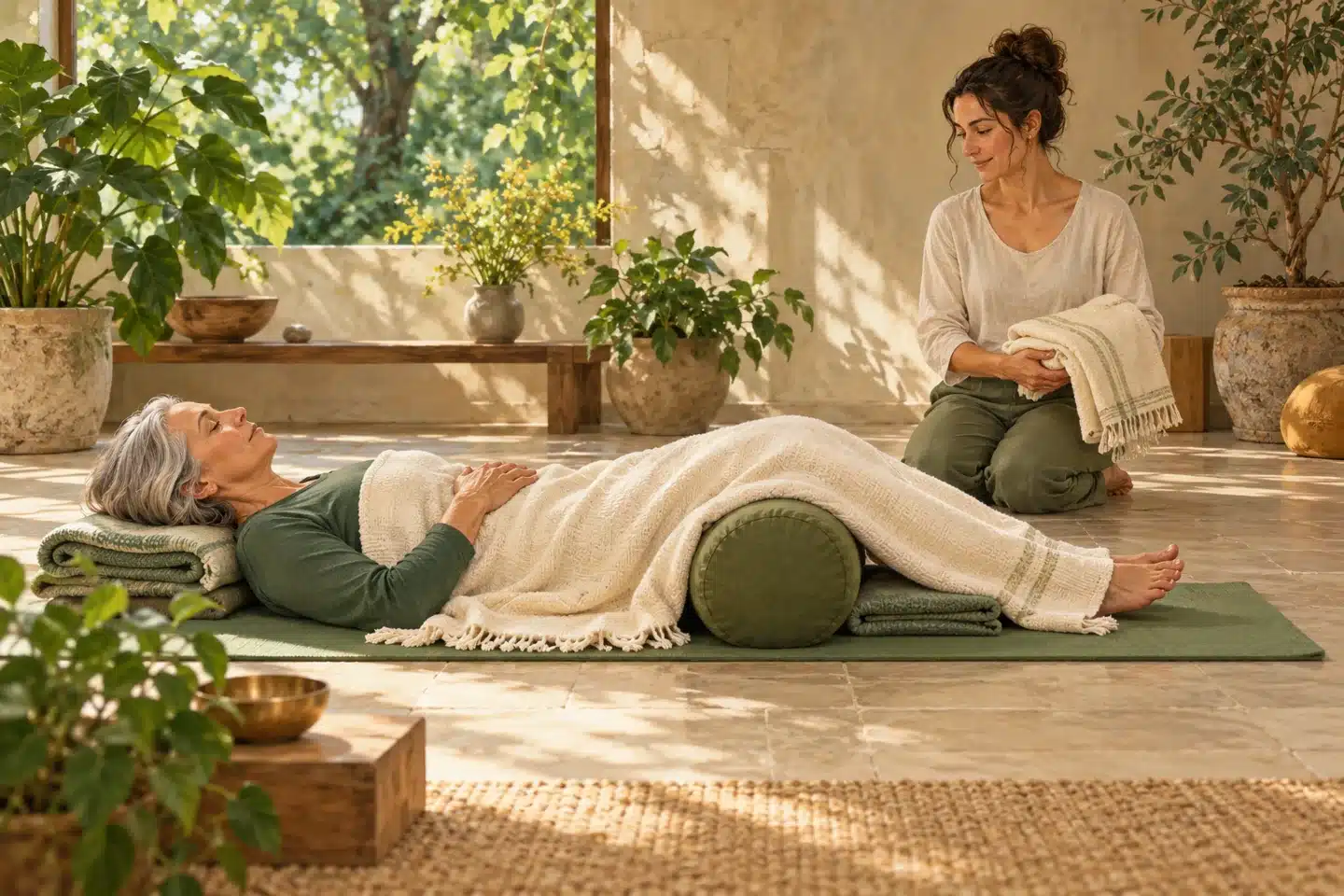
You learn each core position and, more usefully, several variations of each. A supported reclining twist for a tall person with tight shoulders looks nothing like the same twist for a short person after surgery.
Training covers bolster height, blanket folds, block angles, wall use and chair variations, plus how to get the same effect with whatever props a studio actually owns.
Sequencing and Timing
Restorative sequencing runs on different logic to a flow class. There is no warm-up in the usual sense. Transitions matter more than they look.
The order tends to move from more supported to less, or from grounding to opening, depending on the intention. You learn how long to hold, when a hold has stopped working, and what to do when one person is settled and another is fidgeting.
Anatomy and Contraindications
The relevant anatomy is not muscular. It is pressure, circulation, breathing mechanics and joint position under long passive load.
Which positions are unsuitable in later pregnancy, with glaucoma, with uncontrolled blood pressure, with reflux, after abdominal surgery. Long holds change the risk profile of a position considerably, and this is where a general 200-hour training has nothing useful to say.
Language, Silence and Touch
Restorative teaching is mostly about talking less. Training covers cueing that lets people settle rather than perform, when to stop speaking, how to give assists that do not startle, and how to ask for and record consent to touch. Consent is a skill with a method, not a box you tick at the start of class.
Working With What Comes Up
Long stillness brings things up. Restlessness, irritation, boredom, tears, memories. Good training prepares you: what to say, what not to say, when to leave someone alone, and where the line sits between something you can hold in a class and something that needs a referral.
What Does the Evidence Actually Say About Restorative Yoga?
This section exists because most writing about restorative yoga overstates the science badly, and teachers repeat those claims to students in good faith.
Here is a fair summary. Research on yoga in general is reasonably extensive. Bodies such as the US National Center for Complementary and Integrative Health describe evidence that yoga may help with stress, sleep quality and some measures of wellbeing, while noting the evidence is mixed and much of it comes from small studies.
Research specifically on restorative yoga, as a distinct style, is much thinner. The trials that exist tend to be small, short, and hard to blind.
That does not mean the practice does not work. It means the honest position is that it may help, many people report feeling calmer and sleeping better, and we do not have strong clinical evidence for specific therapeutic claims.
Claims commonly made that are not supported at the level people state them:
That restorative yoga “activates the parasympathetic nervous system”. A slower breath or lower heart rate during practice does not prove which branch of the nervous system switched on.
That it “lowers cortisol”. Cortisol swings with time of day, sleep and the individual. A single-session change in a small study is not a general claim.
That it “improves vagal tone”. Heart rate variability changing is not the same as vagal tone improving.
That it “resets” or “regulates” the nervous system. That is a metaphor being sold as a mechanism.
That it treats anxiety, insomnia, depression, trauma or burnout. It does not. Established treatments exist for all of those, and this is not one of them.
What you can say to a student without stretching anything: this practice is designed to let the body rest with minimal effort, many people find it calming, some small studies have reported better self-rated stress and sleep, and the evidence base is still limited. That sentence will not lose you a single student, and it will not get you into trouble.
Any training that teaches you to make the stronger claims is teaching you something you should not repeat.
What Are the Benefits of a Restorative Yoga Teacher Training?
The main benefits of a restorative yoga teacher training are a genuinely different teaching skill set, access to students a strong physical class cannot serve, more sustainable teaching work, and a clearer sense of what yoga can honestly claim.
You become able to teach people you currently turn away. Older adults, people mid-treatment, people in acute stress, people recovering from surgery. Most general teachers have no confident offering for any of them.
Your general teaching improves too, often in ways you did not expect. Teachers who train in restorative work tend to talk less in every class, hold savasana properly instead of cutting it short, and get much better at watching a room rather than performing at it.
It gives you something distinctive. Restorative classes, private sessions and workshops are easier to fill than another vinyasa slot in a crowded timetable, particularly in corporate and wellbeing settings.
It is also easier on your body. Teachers who have demonstrated strong sequences for years often find restorative work extends how long they can keep teaching at all.
And there is the part nobody advertises. You get a lot of rest during the course. If you arrived burnt out, that matters more than it sounds.
One caveat. Restorative yoga is a slower sell than it looks. Some students find long stillness genuinely difficult and do not come back, and a restorative class rarely fills as fast as a heated one. Building an audience takes patience.
Want to see how this is taught in practice? Inteyoga’s advanced programme runs restorative work alongside Yoga Nidra, Chakra Sadhana and Prana Vidya. Browse the full course listing or ask a question before you apply.
Restorative Yoga Teacher Training vs Yin Yoga Teacher Training
These two get confused constantly, including by teachers who trained in one of them. They look similar and rest on opposite intentions.
| Factor | Restorative yoga teacher training | Yin yoga teacher training |
|---|---|---|
| Core intention | Full support so the body does nothing | Deliberate, tolerable load on connective tissue |
| Sensation in the pose | Little or none by design; stretch means add support | A distinct but manageable stretch |
| Prop use | Extensive; props are the practice | Moderate; props modify but do not remove effort |
| Typical hold | 5 to 20 minutes | 3 to 5 minutes, sometimes longer |
| Poses per class | Usually four to six | Usually six to twelve |
| Body position | Fully supported, often reclining | Mostly floor-based, seated or prone |
| Anatomical focus | Pressure, circulation, breathing under passive load | Connective tissue, joint compression and tension |
| Suits students who | Need rest, are unwell, are depleted, cannot exert | Want stillness but still want to feel something |
| Teaching challenge | Reading stillness, knowing when to stop | Judging load without pushing |
| Common misconception | That it is savasana with props | That it lengthens ligaments, which is not established |
The practical answer: train in restorative if you want to work with depleted or unwell people. Train in Yin if you want to offer a slow practice to reasonably well students who still want sensation.
Many teachers eventually do both. Taking them together in one short course usually means neither gets taught properly.
Restorative Yoga Teacher Training vs Yoga Nidra Teacher Training
Closer relatives than Yin, and often taught together, but they build different skills.
| Factor | Restorative yoga teacher training | Yoga Nidra teacher training |
|---|---|---|
| What you teach | Physical positions supported by props | A guided verbal practice, usually in one position |
| Student’s body | Moves between several supported setups | Stays in one position, usually supine |
| Core teaching skill | Prop setup, observation, timing | Script construction, pacing, voice, sequencing attention |
| Primary tool | Bolsters, blankets, blocks, walls | Your voice |
| Silence | Long stretches of it | Continuous guidance |
| Typical length | 60 to 90 minutes | 20 to 45 minutes |
| Physical adaptation skill needed | High | Low, beyond one comfortable position |
| Works online | Poorly | Reasonably well |
| Overlap | Both work with long stillness and deep rest | Both work with long stillness and deep rest |
The two combine well. A restorative sequence followed by Yoga Nidra is a coherent session, and plenty of teachers offer exactly that.
If you can only train in one and you want to teach in person, restorative gives you the harder skill to acquire. If you want to teach online or produce recordings, Yoga Nidra travels better.
Inteyoga teaches both inside the same advanced programme, which is part of why it runs as long as it does.
Restorative Yoga Teacher Training vs Yoga Therapy Training
This distinction matters legally and ethically, and it is the one most often blurred in marketing.
| Factor | Restorative yoga teacher training | Yoga therapy training |
|---|---|---|
| What it qualifies you to do | Teach restorative and general classes | Work therapeutically with individuals, within a defined scope |
| Typical length | Weekend to a few hundred hours | Much longer, commonly 800+ hours over several years |
| Prerequisite | Usually a 200-hour training | Usually a 200-hour training plus teaching experience |
| Credentialing body | Yoga Alliance registry at school and teacher level | Separate bodies such as the International Association of Yoga Therapists |
| Clinical content | Contraindications and safe adaptation | Assessment, case management, working alongside healthcare providers |
| Can you treat conditions? | No | Within a defined scope, and still not instead of medical care |
| Language you can use | Restorative, supportive, adaptive | Therapeutic, within scope |
Completing a restorative yoga teacher training, or a 300-hour advanced training, does not make you a yoga therapist. It does not qualify you to treat medical or psychological conditions, design treatment for a diagnosis, or tell anyone to change their medical care.
You can teach a supportive practice that a person with a condition attends. That is different from treating the condition, and being clear about the difference protects you as much as them.
If you want to work therapeutically with individuals, read the standards published by the International Association of Yoga Therapists rather than assuming a specialty course covers it.
How Do You Choose a Restorative Yoga Teacher Training?
Work through this before you pay anyone. It takes an afternoon.
Read the full syllabus, not the sales page. Count the hours given to practical setup versus theory.
Check the contact hours and whether any of it is in person. Prop skills need hands.
Ask how many positions are taught and how many variations of each. Depth beats a long list.
Ask whether you will teach and be observed. Watching demonstrations is not the same as being corrected.
Look at how contraindications are handled. If pregnancy, glaucoma, hypertension and recent surgery are missing, the syllabus is incomplete.
Check how the school talks about the nervous system. Overclaiming in the marketing usually means overclaiming in the teaching.
Find out who the trainer is, what they trained in, and whether they teach restorative classes themselves.
Ask about group size, especially for hands-on work.
Check whether the hours count towards Yoga Alliance continuing education if that matters to you.
Ask what props you will need afterwards and what equipping yourself costs.
Get refund and deferral terms in writing.
Ask to speak to someone who took the course last year.
Inteyoga’s FAQ page and faculty page answer several of these. Anything left can go by email or WhatsApp before you apply.
What Mistakes Do Teachers Make With Restorative Yoga?
Not using enough props. The most common error by a distance. New restorative teachers under-prop consistently, leaving students in a mild stretch and wondering why nobody settles.
Talking through the whole class. If you are speaking during minute nine of a twelve-minute hold, you are teaching something else. Silence is part of the method and it takes nerve to leave it there.
Sequencing too many poses. Six positions in ninety minutes is already a lot. Cramming in ten turns the class into slow vinyasa.
Cutting holds short. Two minutes is not restorative. The settling people describe happens later than most teachers are comfortable waiting.
Making claims about the nervous system. Covered above, but it belongs here too. It is the easiest way for a well-meaning teacher to mislead a room.
Ignoring temperature. Bodies cool fast when they stop working. A student who gets cold at minute eight has left the practice, whatever their face says.
Treating it as easy to teach. Restorative classes look like nothing is happening. That is exactly why the teaching has to be precise.
Is Restorative Yoga Safe for Everyone?
Restorative yoga is one of the gentler practices available and suits many people who cannot manage a general class. It is still not universally appropriate, and long holds change the picture in ways short holds do not.
Talk to a qualified healthcare professional, and tell your teacher, if any of these apply:
Pregnancy. Prolonged supine positions and some supported twists and backbends need modification, and guidance varies by stage and circumstances.
Glaucoma or other conditions affecting eye pressure. Positions with the head below the heart may not be suitable.
Uncontrolled high or low blood pressure. Long inverted or semi-inverted positions can affect how you feel on standing.
Acid reflux or hiatus hernia. Reclining and supported backbends may make symptoms worse.
Recent surgery, particularly abdominal, spinal or joint.
Acute disc injury or acute spinal pain, where sustained passive positions may not be advisable.
Vertigo or inner-ear conditions, where slow transitions still matter.
A current mental health condition. Extended stillness can bring difficult material up, which is worth discussing with your treating clinician.
What If Stillness Brings Something Difficult Up?
Long, quiet, supported practice is usually restful. Sometimes it is not. Some people find that being still with nothing to do brings up restlessness, irritation, sadness or memories they were not expecting.
This is not a failure of the practice or of the person. As a teacher, say so out loud at the start. Make it explicit that students can open their eyes, come out of a position, sit up or leave whenever they want. Do not assume everyone in the room finds stillness safe.
Ordinary discomfort during deep rest is different from a trauma response. Knowing the difference, and knowing that recognising it is not the same as treating it, is part of what good training gives you.
What Can You Do After the Training?
Add restorative classes to a studio schedule. Often easier to pitch than another dynamic class, because it fills a gap in most timetables.
Teach privately. Restorative work suits one-to-one sessions well, and private clients are usually the people who need it most.
Run workshops. A two-hour restorative and Yoga Nidra workshop is one of the more reliably attended formats in yoga, especially in winter and around stressful times of year.
Work in wellbeing settings. Corporate programmes, care homes, community health projects and retreat centres all want teachers who can run a session that does not require anyone to be fit.
Support other populations. Prenatal, postnatal, senior and chronic illness teaching all lean on restorative skills.
If your training formed part of an advanced programme, you may also be working towards advanced individual registration with Yoga Alliance.
Completing 200-hour and 300-hour training covers the training component. RYT 500 is a separate application with its own current criteria and fee. There is no such thing as an RYT 300, whatever you may have read.
What Props Do You Need to Teach?
You can start with less than you think, but not with nothing. A realistic minimum for a class of ten:
| Prop | Rough quantity per ten students | Note |
|---|---|---|
| Bolsters | 10 | The one item with no good substitute; firm and rectangular is most versatile |
| Blankets | 30 | Three each is not excessive; folded blankets do most of the fine adjustment |
| Blocks | 20 | Two each, for height under bolsters and knees |
| Straps | 10 | For binding legs and securing setups |
| Eye pillows | 10 | Optional, but they change the quality of a hold noticeably |
| Chairs | 2 to 4 | For supported forward folds and students who cannot get to the floor |
| Wall space | Clear run of about 3 metres | For legs-up-the-wall variations |
Blankets are the item most studios under-stock and the item you will use most. If you are building a kit slowly, buy blankets before anything except a bolster.
Restorative Yoga Teacher Training With Inteyoga
Inteyoga (Swami Krishnananda Yoga Vidyapeeth), managed by Inteyoga Shala LLP, teaches restorative practice inside its advanced programme rather than as a short standalone module.
The course is the Advanced TTC 300-Hour Integrated Restorative Yoga (Including Yoga Nidra, Chakra Sadhana, and Prana Vidya Intensive), run residentially in Colva, South Goa.
| Detail | Information |
|---|---|
| Programme | Advanced TTC 300-Hour Integrated Restorative Yoga (Including Yoga Nidra, Chakra Sadhana, and Prana Vidya Intensive) |
| Duration | 43 training days + 1 arrival day + 1 departure day (43+2 days, 45 days total) |
| Format | Residential |
| Medium | English |
| Eligibility | Completed TTC 200 or equivalent yoga teacher training qualification |
| Age | Confirm current age and suitability criteria with Inteyoga admissions |
| Yoga Alliance | Registered with Yoga Alliance as a Registered Yoga School (RYS 200, RYS 300, RYS 500) |
| Model | Gift-it-Forward. No payment required to apply, no payment required to participate |
| Location | Plot No. 6, Novo Vaddo, Sernabatim, Colva, Salcete, Goa 403708, India |
| info@inteyoga.org | |
| WhatsApp / phone | +91 935-473-7240 |
Restorative work sits alongside Yoga Nidra, Chakra Sadhana and Prana Vidya rather than being taught in isolation. That is deliberate. The physical practice and the practices of attention that follow it are hard to teach well apart.
Which Batches Are Confirmed?
| Batch | Dates |
|---|---|
| 1 | 13 Dec 2026 – 26 Jan 2027 |
| 2 | 5 Feb 2027 – 21 Mar 2027 |
| 3 | 24 May 2027 – 7 Jul 2027 |
| 4 | 16 Jul 2027 – 29 Aug 2027 |
| 5 | 7 Sep 2027 – 21 Oct 2027 |
| 6 | 1 Nov 2027 – 15 Dec 2027 |
How Does Gift-it-Forward Work?
Inteyoga currently follows a Gift-it-Forward model for this programme. There is no payment required to apply. There is no payment required to participate.
After completing the programme, participants may voluntarily support the Gift-it-Forward initiative to help future aspirants. There is no obligation to contribute.
Read participant testimonials if you want to hear from people who have done it.
If you do not hold a 200-hour qualification yet, Inteyoga’s next 200-hour programme is planned for approximately mid-2027, dates still to be confirmed. Current information is on the 200-hour yoga teacher training in Goa page.
Frequently Asked Questions (FAQ)
Do I Need a 200-Hour Certificate Before a Restorative Yoga Teacher Training?
For most courses, yes. Schools generally require a completed 200-hour yoga teacher training, because the material assumes you already know how to run a class safely. Some short workshops accept anyone, which is fine for personal interest, but taking one with no teaching background leaves gaps you may not notice until something goes wrong in a room.
How Long Is a Restorative Yoga Teacher Training?
There is no fixed length. Formats range from weekend workshops to short specialty courses of roughly 20 to 50 hours, up to restorative content taught inside a full 300-hour advanced programme. No official body sets a minimum for a restorative specialty, so compare syllabi rather than hour counts when you decide.
Is Restorative Yoga the Same as Yin Yoga?
No. Restorative yoga supports the body fully with props so it does nothing, and any stretch sensation usually means the setup needs more support. Yin yoga applies a deliberate, tolerable load to connective tissue and expects a distinct stretch. Holds are longer in restorative practice, and fewer positions are used per class.
Can I Learn to Teach Restorative Yoga Online?
Partly. Theory, sequencing principles and philosophy transfer reasonably well. Prop setup does not. Judging bolster height for a particular body, or reading whether someone has actually released, needs you in the room. If you train online, plan to supplement it with in-person practice before you teach.
Does Restorative Yoga Activate the Parasympathetic Nervous System?
That claim goes further than the evidence supports. People commonly report feeling calmer, and some small studies have reported better self-rated stress and sleep. But a slower breath or lower heart rate during practice does not prove which branch of the nervous system is doing what. Describe what the practice is designed to do rather than claiming a mechanism.
Can Restorative Yoga Treat Anxiety or Insomnia?
No. Restorative yoga is not a treatment for any diagnosed condition, and established medical and psychological treatments exist for both. Some people find the practice supportive alongside their care. Teachers should not present it as a substitute, and anyone managing a condition should keep their healthcare provider involved.
Does a Restorative Yoga Teacher Training Make Me a Yoga Therapist?
No. Yoga therapy is a separate field with longer training and its own credentialing bodies, including the International Association of Yoga Therapists. A restorative specialty, or a 300-hour advanced training, qualifies you to teach a supportive practice. It does not qualify you to assess, treat or manage a medical or psychological condition.
How Many Props Do I Need to Start Teaching Restorative Yoga?
For a class of ten, plan on ten bolsters, around thirty blankets, twenty blocks and ten straps, plus a couple of chairs and clear wall space. Blankets are the item studios most often under-stock and the one you reach for constantly. If you are building a kit slowly, start with a bolster and blankets.