


Quick Answer
Comparing private vs group yoga classes starts with the kind of learning support you want. A one-to-one lesson can reserve time for your questions and an agreed focus. A group class offers a shared lesson with other participants. Compare the actual teacher, opportunities for feedback, access arrangements and booking terms before deciding.
Key Takeaways
- Begin with a purpose. Name what you want help understanding before choosing a booking format.
- Check the teaching arrangements. Individual attention, questions and feedback should be discussed rather than assumed.
- Compare real offers. Session length, travel, cancellation terms and included support matter alongside the advertised price.
- Ask about access. Room setup, communication and participation options are relevant in either format.
- Keep consent separate. Paying for a private lesson does not give blanket permission for touch or recording.
- Make a proportionate commitment. Choose an initial booking that answers your question without committing beyond what you need.
Imagine two invitations. One offers a place in a weekly class. The other offers an hour with a teacher on your own. The private appointment sounds more personal, while the group class sounds easier to join. Yet neither description tells you whether you will understand the teaching, feel comfortable asking a question or be able to attend consistently.
The format is one part of that decision. A thoughtful comparison looks beyond the number of mats in the room to what happens during the lesson. This guide provides practical questions, comparison tables and clearly labelled hypothetical examples to help you make that assessment. It does not rank individual providers or promise that one format produces better health or learning outcomes.
Private vs group yoga classes at a glance
For this comparison, a private lesson means one student working with one teacher. A group class means several students participating in a shared lesson. Providers may use those labels differently: a “private class” might also mean a booking for a couple, family or closed group. Confirm who will attend before comparing the offers.
A one-to-one arrangement gives the teacher and student a setting in which to agree an individual focus. Whether that happens depends on the service being offered. A private appointment could still follow a prepared sequence with limited discussion. A group class could include a careful introduction, opportunities for questions and several ways to participate.
| Feature | One-to-one lesson | Group class |
|---|---|---|
| Who participates | You and the teacher, if genuinely one-to-one | Several students following a shared lesson |
| Main planning question | Can the session address your stated purpose? | Does the shared lesson match what you want to learn? |
| Questions and feedback | Ask how time for these will be organised | Ask when and how individual questions are handled |
| Scheduling | Agree an available appointment | Check the published timetable and booking rules |
| Learning alongside others | Limited unless the booking includes other students | Other participants share the session; interaction varies |
| Cost comparison | Check the complete quote and inclusions | Check the single-class or package terms |
| Access arrangements | Confirm the actual venue and teaching setup | Confirm the venue, room capacity and available options |
Treat the table as a guide to questions, not a guarantee about quality. A label cannot establish the teacher’s competence or the suitability of the practices for an individual.
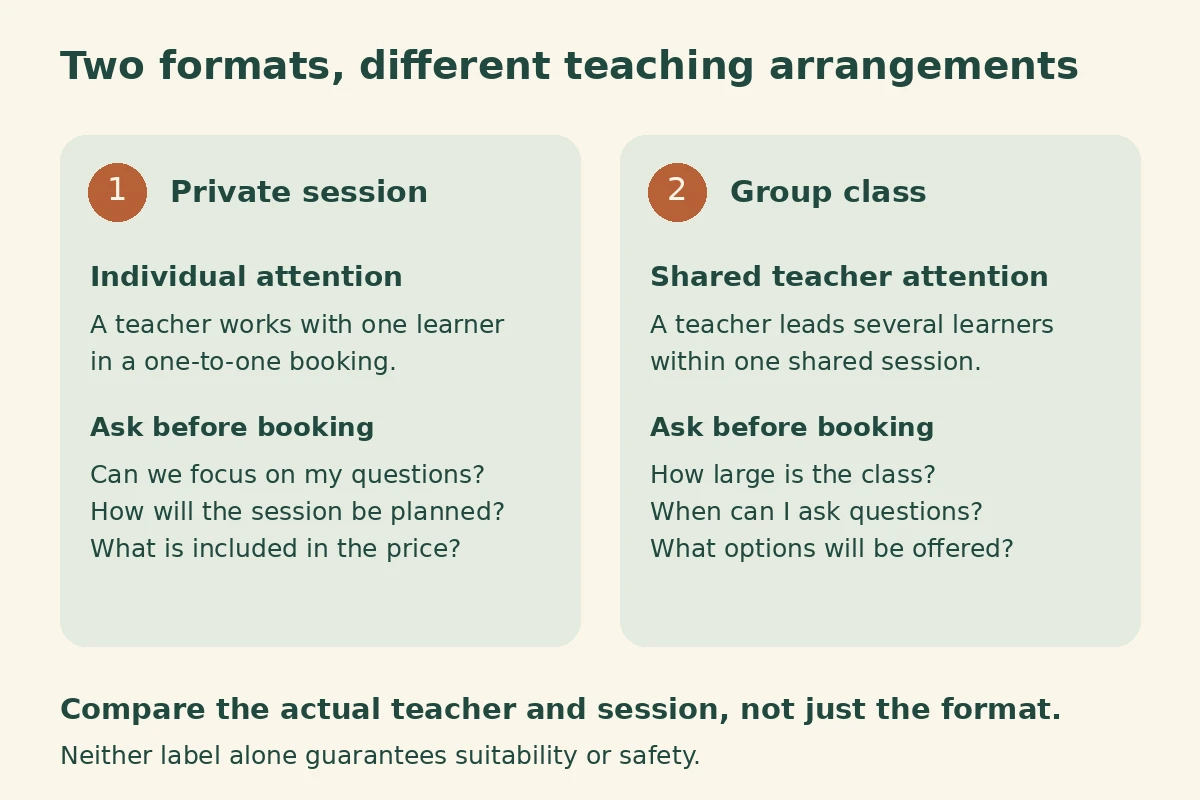
The useful distinction is how teaching time is organised. In a group, the teacher has responsibilities to several people. In a one-to-one lesson, you can ask whether the appointment will centre on a particular learning need. Neither arrangement makes every other question disappear.
What do you want the lesson to help you understand?
Write your purpose in one or two sentences. “I want to learn yoga” is a reasonable starting point, but it is broad enough to fit almost any advertisement. A more specific purpose helps you ask a provider a question they can answer.
For example, you might want an introduction to the vocabulary used in beginner classes. You may want time to ask about several instructions you have heard but do not understand. Or you may simply want a regular shared class with a teacher whose explanations you can follow.
Keep the purpose within the service you are considering. Asking for an explanation of a movement instruction is different from asking a yoga teacher to diagnose a symptom. Booking an individual appointment does not change that professional boundary.
A useful enquiry could be: “I am new to classes and want time to understand the basic instructions and how to ask for options. Would your beginner group provide that, or would you suggest an individual introduction?” This invites an explanation of the actual teaching arrangement rather than a sales comparison between two labels.
If you are already attending a class, identify the unanswered question. “I want someone to watch everything I do” may be difficult to translate into a clear lesson. “I would like to understand the two options offered in this transition” gives the teacher a more defined starting point.
You can also decide that a shared lesson is exactly what you want. There is no requirement to work through private sessions before participating in a beginner group. Ask what prior experience the particular class assumes, and whether its introduction matches your needs. Inteyoga’s guide to what to expect at your first yoga class covers arrival and first-session preparation separately.
How will questions and feedback work?
“Personal attention” sounds reassuring, but it can mean several things. Ask what it means in the service you are considering.
In a private lesson, will you agree the focus beforehand? Is there time to pause for an explanation? Will the teacher ask you to describe what you understood? Does the appointment include a short summary, or is all discussion contained within the booked time? These details are useful even when you only intend to book once.
In a group, ask how students can request clarification. There may be a question period, a brief conversation before class or another arrangement. Find out what is available without assuming that the teacher can hold a separate discussion while simultaneously guiding everyone else.
Consider how you prefer to receive an explanation. You might want words, a demonstration, a different viewing angle or an opportunity to repeat the instruction back. You can communicate that preference without needing to label yourself as a particular “learning type”.
A practical question is: “If I do not understand an instruction, what would you like me to do?” The answer can reveal more than a promise that the class is suitable for everyone.
Feedback should also be connected to a purpose. An explanation of why an option is being offered can be more useful than a stream of corrections without context. Ask whether the teacher can explain the aim of the activity and how the available choices relate to it.
You remain free to ask for words rather than touch. An individual session does not require hands-on adjustments, and a group setting does not remove the possibility of discussing your preference. If unfamiliar wording is your main difficulty, the guide to yoga class cues offers examples of questions you can take to a teacher.
Finally, distinguish attention from expertise. A teacher having more time with one student does not demonstrate competence in every subject that student may raise. The quality and limits of the explanation still matter.
What kind of shared or individual setting suits you?
Think about the setting in which you would be willing to participate and ask a question. Preferences differ, and you do not need to justify yours by claiming that one environment is universally better.
You might enjoy arriving at a familiar group, following a shared lesson and hearing an explanation prompted by another student’s question. You might prefer an appointment where you can discuss your uncertainty without other students present. Both are reasonable preferences to explore.
A group class is not automatically a social gathering. Some lessons leave little time for conversation, while others include introductions or discussion. If learning alongside people is important to you, ask how the session is organised rather than assuming that a room with several students will create the interaction you want.
Similarly, “private” describes the booking arrangement, not necessarily the privacy of the venue. An individual lesson could take place in a shared studio, a room through which other people pass or a space with windows onto a public area. Ask about the actual setting if privacy matters to you.
For a home visit, agree practical arrangements in advance: where the lesson will happen, who else will be present, what equipment is needed and how the teacher will enter and leave. These are ordinary planning questions. A one-to-one lesson does not need to take place at home if you prefer an established teaching venue.
If you want to attend with a friend, ask whether a paired session is offered and how the teacher would handle different questions. A two-person booking is not the same as two simultaneous individual lessons. Agree a shared purpose or ask how time would be divided.
Keep your decision flexible. You are choosing an arrangement for a particular stage of learning, not declaring a permanent identity as a “group person” or a “private student”. What matters is whether the proposed setting supports the participation you want now.
Can the actual arrangement meet your access needs?
Access is a practical conversation about the venue, teaching and communication. It is relevant to both private and group lessons.
Begin with the details that affect whether you can take part. These might include stairs, a lift, seating, the distance from the entrance, the availability of props, the teaching language, audibility or the way demonstrations are presented. Ask specific questions that the provider can check.
For instance, “Is the room accessible?” can be interpreted in several ways. “Is there a step-free route from the entrance to the teaching room and toilet?” asks for concrete information. “Can the instructions be heard clearly?” is less specific than explaining that you need the teacher to face you when speaking.
| Area to discuss | A specific question |
|---|---|
| Entering the venue | “What steps or stairs are on the route to the room?” |
| Seating and equipment | “What seating and props are available, and can you confirm them before I book?” |
| Hearing instructions | “Can we discuss where I should be positioned to hear the teaching?” |
| Seeing demonstrations | “How are demonstrations shown when students face different directions?” |
| Communication | “Which language is used, and can I ask for an instruction to be repeated?” |
| Participation options | “How do you handle a student who needs to pause or use an alternative?” |
A smaller class may create a different arrangement, but “small” is not a specification. Ask how many participants are expected and how the room is used. An individual booking also needs an appropriate space and a teacher able to discuss the relevant arrangements.
You can share the practical information needed for planning without disclosing unrelated personal details. If the provider needs further information, ask why it is needed and how it will be handled. Health-related suitability questions may require advice from your healthcare professional as well as a discussion with the teacher.
Do not rely on a private booking as a substitute for that advice. The US National Center for Complementary and Integrative Health recommends asking about an instructor’s training and experience and cautions against delaying healthcare for a medical problem. Those considerations apply whichever class format you choose. NCCIH: Yoga – Effectiveness and Safety.
What are you paying for, and what can you commit to?
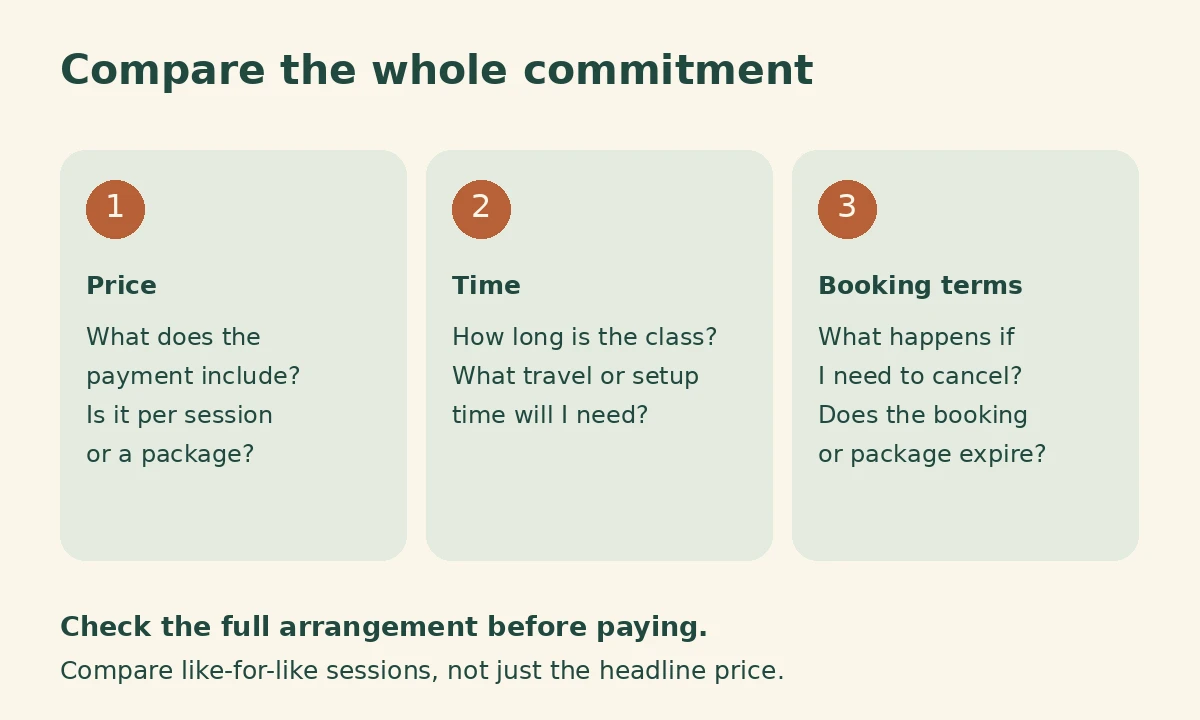
Compare the actual offers available to you. A general price range from another city or an unrelated style may tell you little about the service you are considering.
Request a complete quote for the private appointment and the relevant group option. Check the session length, venue, equipment, travel charges, taxes or booking fees where applicable. Ask whether a quoted price is per person, per appointment or for a fixed group.
For a package, work out what you would pay and what you could realistically attend. If a pass contains ten sessions but only six fit your calendar before it expires, dividing the price by ten does not describe your likely cost per attended session. This is a planning calculation, not a reason to assume you will miss classes.
Use two separate figures: the total commitment and the cost for the sessions you reasonably expect to use. Then consider whether that commitment is comfortable for you. A lower advertised unit price can still require more spending upfront than you intended.
| Detail | What to confirm before paying |
|---|---|
| Session length | Start and finish times, including any discussion |
| Included support | Whether notes, follow-up questions or other materials are included |
| Venue and travel | Exact location and any additional travel charge |
| Package rules | Number of sessions, expiry and whether bookings transfer |
| Cancellations | Notice period and charges if you or the teacher cancels |
| Scheduling | Available appointments or class spaces you can actually use |
| Equipment | What is supplied and what you need to bring |
Ask for unclear terms in writing before purchasing. A private appointment may be offered only at certain times, and a group timetable may change. Verify the arrangements that matter to your decision rather than treating flexibility as an automatic feature of either format.
Also consider the time around the lesson. Travel, changing, arranging care responsibilities and returning to work can affect whether a booking fits. An appointment that looks ideal in isolation may be difficult to use regularly. A nearby shared class might fit your week better, or a specific individual appointment might solve a question without creating an ongoing commitment.
There is no universal number of private lessons you need. Agree an initial purpose and a point at which to review it. You can ask whether a single appointment is appropriate before considering a package.
What standards stay the same in both formats?
The number of students does not remove the need for clear boundaries, honest descriptions and consent.
Yoga Alliance’s Scope of Practice permits its members to teach in group, individual and online settings while requiring them to stay within their training and competence. It also requires explicit, informed consent for physical adjustments; earlier permission does not automatically authorise later contact. These are requirements for Yoga Alliance members, not a claim that every teacher worldwide belongs to that organisation. Yoga Alliance Scope of Practice.
Before a lesson, you can ask how the teacher handles touch, photographs and recordings. State your preferences clearly. “Please use verbal explanations rather than hands-on adjustments” is a complete and practical request. Paying for concentrated attention does not oblige you to accept every form of attention.
A private lesson also does not automatically become yoga therapy, medical treatment or psychological care. Ask what service is actually being offered and which qualifications support it. If a provider describes a specialised service, evaluate that description separately from the fact that it is one-to-one.
Look for a straightforward answer when a question falls outside the teacher’s expertise. A willingness to acknowledge limits can be useful information. Promises to solve every concern through a particular package deserve careful scrutiny, especially when they go beyond what the provider is qualified to offer.
For more detailed discussion of participation choices, see Inteyoga’s guide to consent in yoga classes. Here, the essential point is that the format should support clear communication, not replace it.
This article is a learning-format comparison, not medical advice. For individual health concerns, seek advice from an appropriately qualified healthcare professional; this comparison cannot determine which practice is suitable for you.
Three hypothetical choices, with different priorities
These examples are fictional decision exercises, not student testimonials or predictions of results.
A beginner wants a regular shared lesson
The student wants an introduction to common class instructions and a time they can attend each week. They enjoy learning alongside others and have no particular request for an individual appointment.
A sensible next step is to ask the group provider what the beginner class assumes, how questions are handled and what the first booking involves. The student can compare that answer with their purpose. There is no need to purchase private lessons merely because they have never attended yoga before.
A student has one persistent question
The student attends a group but remains unsure about a particular instruction. A brief conversation after class has not been enough to explain it, and the teacher offers individual appointments.
The student can ask whether one appointment could focus on that question, what preparation would help and what the fee includes. They can also ask whether there is another suitable opportunity within the group programme. The decision is about the time and format needed for this question, not an assumption that all future learning must be private.
Two friends want to learn together
The friends prefer a shared booking but have different schedules and different questions. They are considering a paired appointment because the advertised time appears convenient.
Before booking, they can agree what they want from the lesson and ask the teacher whether that combined purpose is realistic. They should confirm the total price, cancellation arrangements if one person cannot attend and whether the session remains appropriate for both. A paired lesson can be considered on its own terms rather than treated as discounted individual teaching.
Make the decision with a short written brief
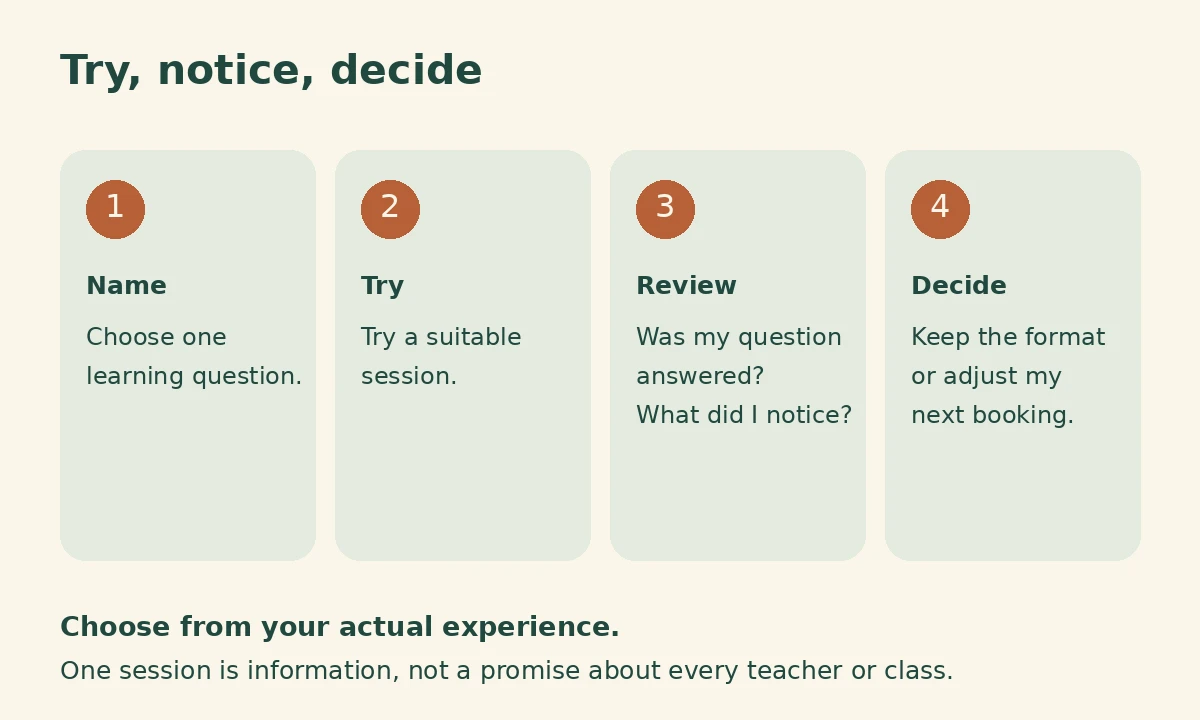
Bring the comparison together in a few lines. You do not need a complicated scoring system or a permanent choice.
Write down your main learning purpose, the practical requirements that must be met and the amount of time and money you are willing to commit. Then record what each provider has actually confirmed. Leave unanswered points marked as questions.
A useful brief might read: “I want to understand the instructions used in a beginner class. I can attend Tuesday evenings. I need a clear view of demonstrations and a way to ask questions. I would like to try one session before buying a package.”
Send the same core questions to the options you are seriously considering. This makes their answers easier to compare. A helpful response should address your request rather than simply repeat that a service is personal, welcoming or suitable for all.
After the initial lesson, return to the purpose you wrote. Did you receive the explanation or introduction you wanted? Are any practical arrangements still unclear? Is another booking appropriate, or do you have enough information for now? This is a review of the agreed service, not a test you must pass as a student.
When comparing private vs group yoga classes, choose the clearest fit between your purpose and the actual teaching arrangement. Individual attention can be valuable when its purpose is understood; a shared class can be a thoughtful choice when its structure suits you. The most useful next step is often a precise question before a larger commitment.
Inteyoga’s educational resources encourage careful enquiry about how yoga is taught and learned. You can read more about the school’s approach on About Inteyoga and the teaching background of Dr. Ashutosh, its founder and principal teacher. This guide compares learning formats generally and does not announce a private-lesson or drop-in service at the school.
Sources
- Yoga Alliance: Scope of Practice – teaching settings, professional competence and consent requirements for its members.
- National Center for Complementary and Integrative Health: Yoga – Effectiveness and Safety – questions about instructor experience and the distinction between yoga participation and healthcare.
The comparison tables, booking questions and fictional examples are practical editorial tools. They are not a validated assessment or evidence that one class format produces superior outcomes.
Frequently asked questions (FAQ)
Are private yoga classes better than group classes for beginners?
Neither format is automatically better for every beginner. A suitable group can provide an introduction within a shared lesson, while a one-to-one appointment can reserve time for a specific question. Ask what prior experience is expected and how explanations and feedback will work.
Private vs group yoga classes: what is the main difference?
A one-to-one private lesson involves one student and a teacher; a group class involves several students in a shared lesson. Providers may also call a closed-group booking private. Confirm who attends and how the session will be organised before comparing the labels.
How many private yoga lessons should I book?
There is no universal required number. Explain your purpose, ask whether an initial appointment can address it and agree when to review the arrangement. Check package terms before committing. A specific unanswered question does not necessarily require an ongoing series of individual lessons.
Can I combine private lessons with group yoga classes?
You can consider both if the providers offer them and the arrangements fit your purpose, schedule and budget. Ask how an individual appointment would relate to the group teaching. Confirm any separate fees or expectations rather than assuming that follow-up support is included.
Does a private yoga lesson include hands-on adjustments?
Ask the teacher what the lesson includes and state your preference. A private booking is not blanket permission for touch. Yoga Alliance requires its members to obtain explicit, informed consent for physical adjustments. You can request verbal explanations or demonstrations instead.
Is a private yoga class the same as yoga therapy?
No. One-to-one describes the teaching format, not a clinical qualification or treatment service. Ask what service the provider offers and what training supports it. Seek appropriate healthcare advice for individual medical concerns rather than assuming that a private booking addresses them.