
Quick Answer
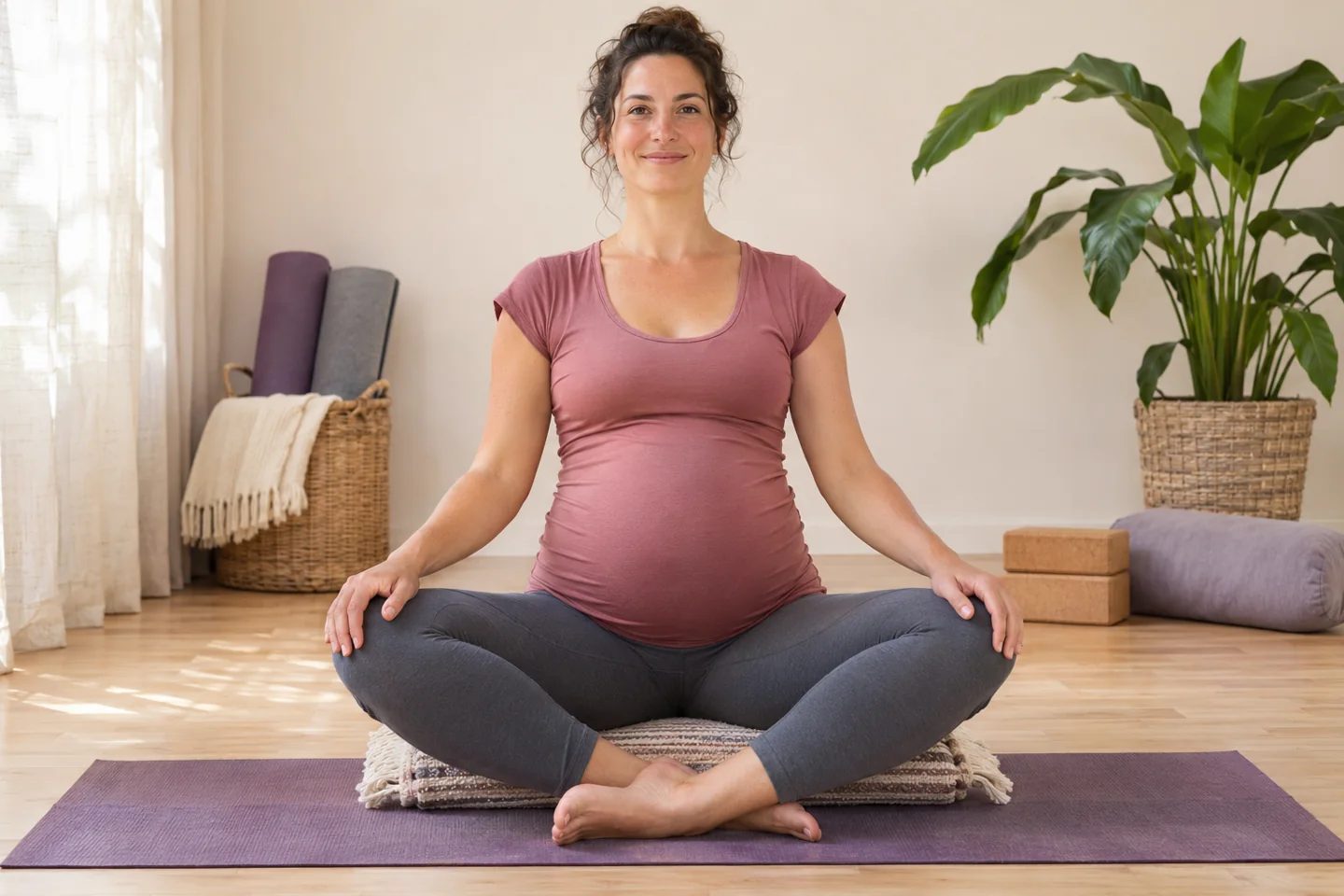
Prenatal yoga is a gentle form of yoga adapted for pregnancy. It combines modified postures, slow breathing (pranayama), relaxation and meditation to help with common discomforts and prepare the body and mind for birth. Classes use props for support and avoid deep twists, lying on the belly and overheating. In the UK it is often called antenatal or pregnancy yoga.
Key Takeaways
- Prenatal yoga is a style of yoga designed for pregnant women. It brings together gentle movement, breathing and relaxation. It is slower and more supported than a general class, and it leaves out poses that aren’t suitable in pregnancy. A typical session mixes modified postures (asanas), slow breathing (pranayama), guided relaxation and meditation.
- Prenatal yoga is slower and more supported than regular yoga, and it leaves out poses that put pressure on the belly. Regular classes can be intense and often focus on strength, flexibility or flow.
- Prenatal yoga is practised during pregnancy to prepare for birth. Postnatal yoga is practised after delivery to support recovery. Both are gentle, but their timing and goals differ.
It’s 3 a.m. You’re 24 weeks pregnant, your lower back aches, and you’ve rolled over for the fifth time trying to get comfortable. Your midwife mentioned pregnancy yoga at your last appointment. A friend from your antenatal group says it helped her feel calmer before the birth. But you’ve never done yoga, and you want to know it’s safe.
So, what is prenatal yoga, and is it right for you?
This guide explains what happens in a class, what the research shows (and doesn’t), which poses suit each trimester, and what to avoid. Health claims link to named sources, including the NHS in the UK and the American College of Obstetricians and Gynecologists (ACOG) in the US.
Key takeaways
- Prenatal yoga is designed for pregnancy, with modified poses and plenty of support.
- Research links it with lower anxiety, and possibly shorter labour, but the overall quality of evidence is low.
- UK and US guidance both recommend around 150 minutes of moderate activity a week for most pregnant women. Yoga can count toward this.
- Skip hot yoga, belly-down poses, deep twists and long periods lying on your back.
- Get approval from your OB-GYN, GP or midwife before you start.
Safety first: Talk to your OB-GYN, GP or midwife before starting prenatal yoga. This article is for education only and isn’t a substitute for medical advice.
You can learn about Inteyoga’s founder-director on the Meet Dr. Ashutosh page.
Why You Can Trust This Guide
- Written by the Inteyoga Editorial Team. Inteyoga is registered with Yoga Alliance as a Registered Yoga School (RYS 200, RYS 300 and RYS 500) and is based in Colva, South Goa, India.
- Checked against official guidance from the NHS, the UK Chief Medical Officers, ACOG and Mayo Clinic.
- Based on peer-reviewed research, including meta-analyses published in 2022 and 2025. Where studies disagree, we say so.
- Cautious by design. Prenatal yoga supports medical care; it never replaces it.
What Is Prenatal Yoga?
Prenatal yoga is a style of yoga designed for pregnant women. It brings together gentle movement, breathing and relaxation. It is slower and more supported than a general class, and it leaves out poses that aren’t suitable in pregnancy. A typical session mixes modified postures (asanas), slow breathing (pranayama), guided relaxation and meditation.
The aim isn’t flexibility or fitness records. It’s comfort, steadiness and feeling prepared for birth.
Prenatal means “before birth.” In the US you’ll often see it called prenatal yoga or pregnancy yoga. In the UK it’s usually antenatal yoga, and in India sometimes garbha yoga. All of these describe yoga adapted for pregnancy.
Most prenatal classes draw on Hatha Yoga, which works with posture, breath and relaxation. Many also include practical labour preparation, such as upright positions and breathing you can use during contractions.
In short, prenatal yoga is yoga built around the safety of two people: you and your baby.
Who Is Prenatal Yoga For?
Prenatal yoga suits pregnant women with an uncomplicated pregnancy whose doctor or midwife has cleared them to exercise. You don’t need any yoga experience. Beginners are welcome, and regular practitioners can learn how to adapt their usual routine.
It’s also useful background for yoga teachers, doulas, midwives and physiotherapists who support pregnant clients.
How Is Prenatal Yoga Different From Regular Yoga?
Prenatal yoga is slower and more supported than regular yoga, and it leaves out poses that put pressure on the belly. Regular classes can be intense and often focus on strength, flexibility or flow.
| Feature | Regular Yoga | Prenatal Yoga |
|---|---|---|
| Intensity | Can be vigorous and physically demanding | Gentle, with frequent rests |
| Main goal | Strength, flexibility, fitness, meditation | Comfort, safety, preparation for birth |
| Pace | Gentle to very fast (power or vinyasa) | Slow and steady |
| Props | Optional | Blocks, bolsters, blankets and chairs in most poses |
| Belly pressure | May include poses that press on the abdomen | Poses that press on the abdomen are left out |
| Lying on the belly | Common (Cobra, Locust, Bow) | Avoided |
| Lying flat on the back | Common | Kept to a few minutes, especially after 16 weeks |
| Twists | Deep, closed twists | Gentle, open twists of the upper back |
| Inversions | Often included | Generally left out |
| Breathing | May include forceful breathing and breath-holding | Slow breathing, no breath-holding |
| Room temperature | Sometimes heated (hot yoga) | Kept cool and well ventilated |
| Stretching | Full range | Well within a comfortable range |
| Teacher training | General yoga training | Ideally prenatal-specific training |
Can you keep going to your usual class while pregnant? Possibly, if you were already practising, your teacher knows you’re pregnant and your doctor or midwife agrees. For beginners, a dedicated prenatal class is the safer choice.
Prenatal Yoga vs Postnatal Yoga: What’s the Difference?
Prenatal yoga is practised during pregnancy to prepare for birth. Postnatal yoga is practised after delivery to support recovery. Both are gentle, but their timing and goals differ.
| Feature | Prenatal Yoga | Postnatal Yoga |
|---|---|---|
| When | During pregnancy | After birth, once your doctor or midwife clears you (usually after your postnatal check in the UK or postpartum visit in the US) |
| Main goal | Comfort and preparation for labour | Recovery and rebuilding strength |
| Core work | No pressure on the belly | Gradual rebuilding, with care for abdominal separation (diastasis recti) |
| Pelvic floor | Awareness, gentle engagement and relaxation | Gradual strengthening after birth |
| Typical focus | Hips, pelvis, lower back, breathing for labour | Core, pelvic floor, neck and shoulders |
Put simply, prenatal yoga helps you prepare for birth and postnatal yoga helps you recover afterwards. Check with your doctor or midwife before starting either.
How Does Prenatal Yoga Work?
Prenatal yoga combines three things: gentle movement for the body, slow breathing and relaxation. Each one addresses a common pregnancy challenge.
- Movement: gentle strengthening supports your legs, hips and back as your body changes. Light stretching can ease stiffness.
- Breathing: slow, steady breathing gives you a practised tool for staying calm, including during labour.
- Relaxation: guided rest and meditation give you regular time to unwind. Studies link prenatal yoga with lower anxiety (see the research below).
One more thing to know. Hormonal changes in pregnancy can make joints and ligaments more lax. That’s one reason prenatal teachers keep stretches comfortable rather than deep. UK health advice also suggests stretching only within a comfortable, normal range.
What Are Prenatal Yoga Exercises?
Prenatal yoga exercises fall into five types: gentle postures, breathing, pelvic floor work, mobility movements and relaxation.
| Type of Exercise | Examples | What It Involves |
|---|---|---|
| Postures (asanas) | Cat-Cow, Butterfly Pose, supported squat | Gentle strength and mobility work with props |
| Breathing (pranayama) | Belly breathing, Nadi Shodhana, Bhramari | Slow breathing with no breath-holding |
| Pelvic floor exercises | Gently lifting the pelvic floor on an out-breath and releasing it on an in-breath | Awareness of how to both engage and relax these muscles |
| Mobility movements | Neck and shoulder rolls, hip circles, ankle rotations | Easing stiffness from sitting or standing |
| Relaxation and meditation | Side-lying relaxation, Yoga Nidra, guided visualisation | Rest and a quieter mind |
A balanced session includes a little of each, not only postures.
What Does a Prenatal Yoga Class Involve?
A typical prenatal yoga class lasts 45–60 minutes and moves slowly from breathing to movement to rest. Formats vary, but many look like this:
- Check-in: the teacher asks how many weeks pregnant you are and whether anything hurts.
- Breathing: a few minutes of seated breath work to settle in.
- Warm-up: gentle neck, shoulder, wrist and hip movements, often on hands and knees.
- Standing poses: supported warrior poses, wide stances and squats, often near a wall or chair.
- Hip and pelvic floor work: seated and kneeling poses with props.
- Relaxation: side-lying rest with pillows, sometimes with guided meditation or Yoga Nidra.
Expect plenty of props. Bolsters, blocks, blankets and chairs make each pose accessible at every stage.
When Should You Start Prenatal Yoga?
You can start prenatal yoga at any stage of an uncomplicated pregnancy once your doctor or midwife agrees. The NHS says that if you’re not used to exercising, pregnancy can be a good time to begin, starting with about 10 minutes a day. The UK Chief Medical Officers recommend that women who weren’t active before pregnancy build up gradually from 10-minute bouts.
- Already doing yoga? You can usually carry on with prenatal modifications. Tell your teacher you’re pregnant.
- Complete beginner? Gentle breathing and relaxation are an easy way in. Some prenatal classes only accept students from around 12–14 weeks. That’s a class policy, not a medical rule.
- Starting late? It’s not too late. Even in the third trimester, breathing, supported positions and relaxation can be useful.
Your OB-GYN or midwife knows your pregnancy, so they’re the best person to say when it’s right for you to start.
How Do You Practise Prenatal Yoga in Each Trimester?
Your practice should change as your pregnancy progresses, because your energy, balance and bump change.
| Trimester | Months | Weeks | Main Focus | What to Adjust | Discomforts It May Help With |
|---|---|---|---|---|---|
| First | 1–3 | 1–13 | Breathing, rest, gentle mobility | Skip strong core work, hot rooms and intense flows; rest when tired or unwell | Stress and tiredness |
| Second | 4–6 | 14–27 | Strength around the hips and pelvis, posture, flexibility | Keep time flat on your back to a few minutes; avoid belly-down poses; widen your stance | Lower back ache, stiffness |
| Third | 7–9 | 28–40 | Labour preparation, relaxation, comfort | Use a wall or chair for balance; shorter holds; rest on your side | Hip and pelvic discomfort, restless nights |
First Trimester (Months 1–3): Is Prenatal Yoga Safe in the First Trimester?
For most uncomplicated pregnancies, gentle prenatal yoga is generally considered safe in the first trimester once your doctor or midwife agrees. The focus is breathing and rest rather than effort. Many women feel exhausted or nauseous in these weeks, so 10–15 minutes of breathing, light movement and rest is plenty.
Second Trimester (Months 4–6)
Many women find the second trimester the easiest time to build a regular routine, because energy often returns. Cat-Cow (Marjariasana–Bitilasana), supported squats and wide standing poses work the hips, legs and back.
It’s also a good time to practise labour breathing. The NHS advises avoiding exercises that involve lying on your back for more than a few minutes, especially after 16 weeks. The weight of the bump can press on a major blood vessel and make you feel dizzy.
Third Trimester (Months 7–9)
In the third trimester, prenatal yoga shifts toward comfort, relaxation and preparing for labour. Supported Butterfly Pose (Baddha Konasana), supported squats, hip circles and hands-and-knees positions are common. Slow breathing and side-lying rest give you techniques you can use during contractions.
Your centre of gravity has moved forward, so use a wall or chair in standing poses, and rest whenever you need to.
What Are the Safest Prenatal Yoga Poses for Beginners?
The safest prenatal poses are stable, supported and easy to modify. These eight appear in many prenatal classes. Move slowly, and stop if anything feels wrong.
- Cat-Cow Stretch (Marjariasana–Bitilasana). On hands and knees, gently round and then lengthen your spine with the breath. Many women find it eases lower back stiffness. All trimesters. For more back-friendly movement, see yoga for back pain: 12 poses and routines.
- Butterfly Pose (Baddha Konasana). Sit with the soles of your feet together and blocks under your knees. It’s a gentle hip opener. All trimesters. If you have pelvic girdle pain, keep your knees closer together, or skip it if it hurts.
- Supported Squat (Malasana). Squat with a block or bolster under your hips. It lets you practise a supported squatting position that some women use in labour. Second and third trimesters. Check with your midwife first if you have a low-lying placenta or a risk of preterm labour.
- Mountain Pose (Tadasana). Stand tall with your feet hip-width apart and your weight even. It builds posture awareness as your bump grows. All trimesters.
- Warrior II (Virabhadrasana II). A wide, steady stance for leg strength. Keep your front knee over your ankle and use a wall for balance. All trimesters, with shorter holds later.
- Wide-Knee Child’s Pose (Balasana). Knees wide to make room for the bump, forehead on a bolster. A restful pause between poses. All trimesters.
- Extended Triangle (Utthita Trikonasana) With a Block. Lengthens the side body. Keep your chest open rather than reaching for the floor. All trimesters.
- Side-Lying Relaxation (Side-Lying Savasana). Rest on your side with a pillow between your knees and under your head. Many teachers suggest the left side. It replaces lying on your back for final relaxation. Especially from the second trimester.
A simple rule to remember: if a pose squeezes your belly, strains your lower back or makes you dizzy, skip it for today.
Which Breathing Techniques Are Safe During Pregnancy?
The safest prenatal breathing techniques are slow, smooth and never forced.
| Technique | How to Do It | Why Women Use It | Safety Note |
|---|---|---|---|
| Belly breathing | Breathe slowly into the belly and ribs, with the out-breath slightly longer than the in-breath | Many women find it calming, including during labour | Suitable in all trimesters |
| Alternate Nostril Breathing (Nadi Shodhana) | Breathe in through one nostril and out through the other, switching sides | Traditionally used to settle the mind | Practise without holding the breath |
| Humming Bee Breath (Bhramari) | Breathe out slowly while humming softly | Many people find the gentle sound soothing | Stop if you feel light-headed |
| Soft Ujjayi | A gentle “ocean sound” breath through the nose | Helps you keep a steady rhythm in poses | Keep it soft, never strained |
Prenatal classes generally leave out forceful techniques such as Kapalabhati (skull-shining breath) and Bhastrika (bellows breath), and any breath-holding (kumbhaka). These involve strong abdominal contractions or holding the breath, which isn’t recommended in pregnancy.
How Do You Practise Prenatal Yoga at Home or in Class?
You can practise prenatal yoga in a class or at home. Beginners usually do best starting with a qualified teacher and then adding short home sessions.
- Class or home: a class gives you guidance and correction. Home practice adds convenience. Many women combine the two.
- Timing: practise on a light stomach, ideally a couple of hours after a large meal, at a time of day when you usually feel your best.
- Clothing: wear soft, breathable clothes that don’t squeeze your bump. Practise barefoot on a non-slip mat.
- Props: keep a bolster or two firm pillows, two blocks, a blanket and a sturdy chair within reach.
- Session shape: begin with breathing and a warm-up, move into a few poses, and finish with at least five minutes of rest.
- Keep notes: jot down how you feel after each session and mention anything unusual at your next antenatal appointment.
A 10-Minute Prenatal Yoga Routine You Can Do at Home
This short routine is a gentle starting point for most women with an uncomplicated pregnancy. Check with your doctor or midwife first. You’ll need a mat, two pillows and a chair.
- Seated breathing (2 min): sit on a cushion and take slow belly breaths.
- Neck and shoulder rolls (1 min): five slow circles each way.
- Cat-Cow (1 min): eight slow rounds, moving with the breath.
- Hip circles on hands and knees (1 min): slow circles in both directions.
- Chair-supported Warrior II (2 min): 30 seconds per side, twice.
- Butterfly Pose with blocks (1 min): sit tall and breathe slowly.
- Side-lying relaxation (2 min): rest on your side with pillows.
There’s no official “dose” of prenatal yoga. Most women practise a few times a week, and yoga can count toward the 150 minutes of weekly activity recommended in the UK and US.
Real-Life Examples: How Women Use Prenatal Yoga
Prenatal yoga tends to be most useful when it fits a real need in your day. The scenarios below are illustrations, not medical advice or case studies.
| Situation | What May Help | Why |
|---|---|---|
| Desk job, lower back stiff by mid-afternoon | A couple of minutes of Cat-Cow and hip circles during a break | Gentle movement after long periods of sitting |
| Restless nights in the third trimester | Slow belly breathing, then side-lying relaxation before bed | A calm, familiar routine before sleep |
| First pregnancy, nervous about labour | A weekly prenatal class plus a few minutes of daily breathing practice | Practising breathing techniques you can use in labour |
| Experienced yoga practitioner, newly pregnant | Continue, but swap closed twists, belly-down poses and inversions for prenatal versions | Keeps the habit while removing unsuitable poses |
| Hip discomfort late in pregnancy | Supported, gentle positions such as hands-and-knees rocking | Comfortable positions that take pressure off the hips |
If any pain is sharp, sudden or getting worse, stop and contact your doctor or midwife rather than trying to stretch it out.
What Does Prenatal Yoga Do for You? 10 Key Benefits
Research suggests prenatal yoga may reduce anxiety and may shorten labour, but the quality of evidence is generally low and results vary between studies. Emotional wellbeing in pregnancy matters: NHS England reports that perinatal mental health problems affect up to 20% of women.
Two recent meta-analyses give the clearest picture:
| Study | What It Found | Limitations |
|---|---|---|
| Corrigan et al., 2022, BMC Pregnancy and Childbirth (29 studies, 2,217 women) | Lower anxiety, depression and perceived stress; labour about 118 minutes shorter on average; higher odds of vaginal birth (about 2.6 times); better pain tolerance in labour | Evidence quality rated low to very low |
| Çuvadar et al., 2025, International Journal of Yoga (7 randomised trials) | Significant reduction in anxiety | No statistically significant effect on depression or stress; small number of trials |
The overall message: prenatal yoga appears helpful for anxiety, while the effects on depression, stress and birth outcomes are less certain. Yoga can support, but not replace, medical and psychological care. If you’re struggling with low mood or anxiety, talk to your doctor or midwife.
10 Key Benefits of Prenatal Yoga
- May ease back and pelvic discomfort. NHS Lanarkshire notes that exercise in pregnancy can help prevent low back pain and pregnancy-related pelvic girdle pain.
- Helps you adjust to a changing body. Standing poses build awareness of posture as your centre of gravity shifts.
- Builds strength. UK guidance recommends muscle-strengthening activity twice a week during pregnancy, and gentle yoga is one way to include it.
- Teaches pelvic floor awareness. You learn to both engage and relax these muscles.
- Counts toward your weekly activity. UK guidance lists yoga among examples of moderate-intensity activity for pregnant women.
- May reduce anxiety. Both meta-analyses above found lower anxiety in yoga groups.
- May support better sleep. Some small studies have reported better sleep quality, though evidence is limited. Our article on yoga poses for better sleep covers relaxing bedtime practice.
- Gives you practical tools for labour. You practise breathing and upright positions, such as supported squats and hands-and-knees, that you can use during contractions.
- May be linked with shorter labour. The 2022 meta-analysis found shorter labour and higher odds of vaginal birth in yoga groups. This is a possibility, not a promise, and depends on many medical factors.
- Offers time for yourself and a chance to connect. Group classes are a chance to meet other expectant parents, and regular practice gives you protected time to slow down.
What to Avoid in Pregnancy Yoga
In pregnancy yoga, avoid anything that presses on the abdomen, strains your back, risks a fall or makes you overheat. Mayo Clinic advises bending from the hips rather than the back, and avoiding lying on the belly or back, deep forward or back bends, and twists that compress the abdomen.
| Avoid | Examples | Safer Alternative |
|---|---|---|
| Belly-down poses | Cobra, Locust, Bow | Cat-Cow on hands and knees |
| Lying flat on your back for more than a few minutes (especially after 16 weeks) | Savasana on the back, supine leg work | Side-lying rest or a propped incline |
| Deep, closed twists | Revolved Triangle, Revolved Chair | Gentle open twist of the upper back |
| Deep backbends | Wheel, full Camel | Supported chest opener on a bolster |
| Inversions | Headstand, Handstand | Supported Child’s Pose |
| Strong core work | Boat Pose, crunches, sit-ups | Gentle, breath-led pelvic floor work |
| Jumping and fast flows | Jump-backs, quick vinyasa | Step slowly between poses |
| Hot yoga | Bikram or heated studios | A cool, well-ventilated room |
| Forceful breathing | Kapalabhati, Bhastrika, breath-holding | Slow belly breathing |
The NHS and ACOG both advise skipping hot yoga during pregnancy because of the risk of overheating.
What not to do, at a glance: skip hot yoga completely; don’t stay on your back for more than a few minutes or lie on your belly; and avoid deep twists. Check with your OB-GYN, GP or midwife before you begin.
Is Prenatal Yoga Safe? Important Safety Guidelines
For most women with an uncomplicated pregnancy, prenatal yoga is considered safe when it’s well taught and approved by a doctor or midwife. UK and US guidance are closely aligned: most pregnant women should aim for at least 150 minutes of moderate-intensity activity a week. That’s the advice of ACOG in the US and the UK Chief Medical Officers in the UK. Yoga can count toward it.
Before your first session, speak to your OB-GYN, GP or midwife. They know the details of your pregnancy and can confirm whether prenatal yoga is right for you.
Important Safety Guidelines for Prenatal Yoga
- Use the talk test. NHS guidance describes moderate activity as being able to talk but not sing. If you can’t speak in full sentences, ease off.
- Drink water before, during and after each session.
- Get up slowly. Roll onto your side, then push up with your hands. Stand gradually to avoid dizziness.
- Practise on a stable, non-slip surface with nothing nearby to trip over.
- Work at today’s level. Your capacity changes week to week, so don’t chase your pre-pregnancy practice.
- Re-check as pregnancy goes on. Conditions can develop later, so confirm at your antenatal appointments that yoga is still suitable.
- Stop if you feel pain or notice any warning sign below.
Who Should Talk to a Doctor Before Practising?
ACOG advises that exercise may not be safe with certain conditions. Don’t start prenatal yoga without medical clearance if you have:
- Certain heart or lung conditions
- A weak cervix or a cervical stitch (cerclage)
- Placenta previa (low-lying placenta) later in pregnancy
- Ongoing vaginal bleeding
- Preterm labour, or your waters have broken
- Preeclampsia or pregnancy-related high blood pressure
- Severe anaemia
- A twin or multiple pregnancy with risk factors for preterm labour
Warning Signs: Stop and Call Your Doctor or Midwife
- Vaginal bleeding or fluid leaking
- Regular, painful contractions
- Dizziness, feeling faint or a headache
- Chest pain, or feeling short of breath before you start exercising
- Calf pain or swelling
- Muscle weakness that affects your balance
- Your baby moving less than usual
In the UK, contact your midwife or maternity unit straight away. In the US, call your OB-GYN or labor and delivery unit. In an emergency, dial 999 (UK) or 911 (US).
Above all, listen to your body. Pregnancy isn’t the time to push through discomfort.
How Do You Choose a Qualified Prenatal Yoga Teacher?
Choose a teacher with prenatal-specific training who asks about your health before class and offers alternatives for every pose. Use this checklist:
- Has completed a yoga teacher training, such as one from a Yoga Alliance Registered Yoga School (RYT 200 or above)
- Has additional pregnancy-specific training. In the US, one option is Yoga Alliance’s Registered Prenatal Yoga Teacher (RPYT) credential. It requires a 200-hour training, an 85-hour prenatal training with a Registered Prenatal Yoga School and 30 hours of prenatal teaching. In the UK, ask which pregnancy yoga qualification the teacher holds and which organisation awarded it.
- Understands the physical changes of pregnancy
- Asks how many weeks pregnant you are and about any health conditions
- Offers props and an alternative for every pose
- Never pushes you into deep stretches or twists
- Keeps the room cool and lets you rest whenever you need
- Encourages you to follow your doctor’s or midwife’s advice
Are you an experienced yoga teacher looking to deepen your understanding of restorative practice? Inteyoga offers the Advanced TTC 300-Hour Integrated Restorative Yoga (Including Yoga Nidra, Chakra Sadhana, and Prana Vidya Intensive). It is a residential programme in Goa, taught in English, for applicants aged 21–60 who have completed a 200-hour yoga teacher training or equivalent. You can apply through the application form. If you’re new to teaching, read about Inteyoga’s planned 200-hour programme, expected around mid-2027.
Conclusion: Is Prenatal Yoga Right for You?
So, what is prenatal yoga? It’s a gentle, adapted practice that helps many pregnant women stay comfortable, calm and prepared for birth. It combines modified poses, safe breathing and relaxation. Research links it with lower anxiety and possibly shorter labour, though the evidence is still developing. The basics are simple: get your doctor’s or midwife’s approval, use props, skip unsuitable poses, and listen to your body.
You don’t need to be flexible or experienced to start. You need the go-ahead, a few pillows, and the patience to move a little more slowly than usual.
Want to explore yoga study in more depth? See Inteyoga’s courses or read the Inteyoga FAQ.
Frequently Asked Questions (FAQ)
What Is Prenatal Yoga in Simple Words?
Prenatal yoga is yoga made suitable for pregnancy. It uses gentle poses, slow breathing and relaxation to help with common discomforts such as back stiffness and stress. Poses are adapted with props, and anything that presses on the belly, overheats the body or risks a fall is left out. It also gives you breathing and positions to use in labour.
Is Antenatal Yoga the Same as Prenatal Yoga?
Yes. Antenatal yoga is the term more common in the UK, and prenatal yoga is more common in the US. Both describe yoga adapted for pregnancy, with modified poses, breathing and relaxation. You may also see it called pregnancy yoga. Whatever the name, look for a class designed specifically for pregnant women and taught by someone with pregnancy-specific training.
How Often Should I Do Prenatal Yoga?
There’s no official prenatal yoga schedule. UK and US guidance recommend around 150 minutes of moderate activity a week for most pregnant women, spread across the week. Yoga can make up part of that, alongside activities such as walking or swimming. In the 2022 meta-analysis, programmes with 12 or more sessions showed stronger results. Stop if you feel tired, dizzy or unwell.
Can Beginners Do Prenatal Yoga?
Yes. Prenatal yoga is designed for women with no yoga experience. Classes move slowly, use plenty of props and offer easier options for every pose. Tell your teacher you’re a beginner and how many weeks pregnant you are. A dedicated prenatal class is a better starting point than a general or fast-paced one.
Can Prenatal Yoga Lead to a Normal Delivery?
Prenatal yoga may be associated with a higher chance of vaginal birth, but it can’t guarantee one. A 2022 meta-analysis of 29 studies found about 2.6 times higher odds of vaginal birth and labours nearly two hours shorter in yoga groups. The evidence quality was rated low, and how you give birth depends on many medical factors.
Can Prenatal Yoga Help With Gestational Diabetes?
Regular moderate exercise during pregnancy may help prevent and manage gestational diabetes, and yoga can count toward your weekly activity. If you’ve been diagnosed, follow your care team’s treatment plan, monitor your blood sugar as advised, and ask whether you should keep a snack nearby during exercise. Yoga can support treatment but doesn’t replace it.
Is Prenatal Yoga Enough Exercise During Pregnancy?
It can be part of your weekly activity, but variety helps. UK guidance lists yoga as a moderate-intensity activity, though a slow, restorative prenatal class may feel lighter than that. Use the talk test to judge effort. Many women combine prenatal yoga with brisk walking, swimming or a stationary bike, plus muscle-strengthening activity twice a week.