
Quick Answer
Flexibility exercises are stretches and range-of-motion movements that lengthen your muscles and tendons so your joints move more freely. Good examples are the hamstring stretch, hip flexor lunge, cat-cow, chest stretch and child’s pose. The ACSM recommends stretching your major muscle groups at least 2 to 3 days a week, holding each stretch for 10 to 30 seconds (30 to 60 seconds for older adults).
Key Takeaways
- When flexibility drops, everyday movement gets harder. Muscles feel stiff, posture can slip, and joints may not move through their full range the way they used to.
- Regular flexibility exercises can give you a wider range of motion and may support better posture, balance and easier everyday movement. Here’s what the evidence says.
- Flexibility is the ability of a joint, and the muscles and tendons around it, to move through its full, pain-free range of motion. The ACSM treats flexibility exercise as one part of a complete adult fitness programme, alongside aerobic, resistance and neuromotor (balance and coordination) exercise.
Try this right now. Stand up, keep your knees straight, and reach for your toes.
If your fingertips stopped somewhere around your shins, you’re in good company. Hours at a desk in London, a long commute in New Jersey, an evening on the sofa: modern life keeps our hips bent and our shoulders rounded, and our muscles adapt. One day you bend to tie a shoe, feel the back of your legs pull, and wonder when that started.
The good news? Flexibility exercises can help you win back lost range of motion at almost any age, and you can start with just 10 minutes a day. You don’t need to be naturally bendy, own fancy kit, or spend an hour on a mat.
This guide comes from Inteyoga (Swami Krishnananda Yoga Vidyapeeth) in Colva, South Goa. We’re registered with Yoga Alliance as a Registered Yoga School (RYS 200, RYS 300 and RYS 500). Every recommendation below is checked against guidance from the American College of Sports Medicine (ACSM), the NHS and Mayo Clinic, plus peer-reviewed research, and every source is linked.
Inside, you’ll find 15 stretches grouped by body area, a copy-and-save 10-minute routine, five simple ways to test your flexibility at home, advice for older adults and anyone with a stiff back, and a free 7-day tracker.
Flexibility Exercises: Key Facts at a Glance
| Question | Evidence-based answer | Source |
|---|---|---|
| How often should you stretch? | At least 2–3 days a week; daily brings bigger gains | ACSM position stand, 2011 |
| How long should you hold a stretch? | 10–30 seconds for most adults; 30–60 seconds for older adults | ACSM, 2011 |
| How much stretching per muscle? | About 60 seconds in total, split into 2–4 holds | ACSM, 2011 |
| Which stretching type works best long term? | Static and PNF stretching produced greater range-of-motion gains than dynamic or ballistic stretching | Konrad et al., 2024 (77 studies) |
| Does flexibility improve at any age? | Gains from regular static stretching were not moderated by age or sex | Sports Medicine meta-analysis, 2024 |
| Do you lose it if you stop? | Partly; range drops back somewhat after 2–6 weeks without stretching | Detraining review, 2024 (13 studies, 556 people) |
| What about over-65s? | Activities for strength, balance and flexibility on at least 2 days a week | NHS guidelines |
New to stretching? Start with our guide on how to start yoga at home, then come back for the routine below.
Why Does Flexibility Matter? What Happens When You Lose It
When flexibility drops, everyday movement gets harder. Muscles feel stiff, posture can slip, and joints may not move through their full range the way they used to.
Most people don’t notice it happening. It creeps in over years, then shows up in small moments: struggling to check your car’s blind spot, groaning as you get up off the floor, or feeling your hamstrings complain on the stairs.
What Are the Signs of Poor Flexibility?
- Stiffness after sitting or sleeping that eases only once you start moving
- Struggling with simple reaches, like touching your toes or reaching a high shelf
- A tight lower back by the end of the working day
- Rounded shoulders and a forward head after long hours on a laptop or phone
- One side tighter than the other, especially in the hips or shoulders
What Problems Can Low Flexibility Cause?
| Problem | How low flexibility may play a part |
|---|---|
| Lower back stiffness | Tight hamstrings and hip flexors are often thought to affect how the pelvis and lower back move, though research on this link is mixed |
| Posture habits | Short chest and hip flexor muscles are commonly linked with rounded shoulders and a tilted pelvis |
| Reduced range of motion | Mayo Clinic notes that range gained through stretching can decrease again if you stop |
| Harder daily tasks | Bending, reaching, twisting and getting up from the floor all need adequate range |
What about injuries? Here we want to be straight with you. Many people stretch “to avoid injury”, but the ACSM states that a link between flexibility and fewer musculoskeletal injuries has not been substantiated, and Mayo Clinic notes that stretching won’t prevent overuse injuries. Mayo Clinic does point out that uneven flexibility between your left and right sides may be a risk factor for injury. So the goal isn’t to be bendy. It’s to be balanced.
Why Do We Lose Flexibility?
Long hours of sitting, repetitive movement and ageing all play a part. Muscles adapt to the positions we spend the most time in, and connective tissue tends to become stiffer with age. That’s one reason the NHS recommends flexibility work as part of regular activity for older adults.
What Are the Benefits of Flexibility Exercises?
Regular flexibility exercises can give you a wider range of motion and may support better posture, balance and easier everyday movement. Here’s what the evidence says.
| Benefit | What the research shows |
|---|---|
| Greater range of motion | The best-supported benefit. A 2024 Sports Medicine meta-analysis found a large positive effect of regular static stretching on flexibility in adults |
| Balance and postural stability | The ACSM reports flexibility training helps improve balance and postural stability in most adults |
| Easier daily activities | Mayo Clinic lists a better ability to do daily activities among the possible benefits of better flexibility |
| Joint range | Better flexibility may help joints move through their full range of motion (Mayo Clinic) |
| Muscle blood flow | Mayo Clinic lists increased muscle blood flow as a possible benefit |
| Sports flexibility | In a small 2016 study of 26 male college athletes, those who added yoga twice a week for 10 weeks improved sit-and-reach and shoulder flexibility and balance, while the comparison group did not (Polsgrove et al.) |
| Feeling calmer | Many people find slow stretching with long exhales relaxing. See our guide to yoga for stress relief |
A more recent small study points the same way. In a 2025 quasi-experimental trial with 28 university athletes, the group that added two 60-minute yoga sessions a week for 12 weeks improved their sit-and-reach score by 2.1 inches (about 5.3 cm), while the comparison group showed little or no change (Choudhary et al., 2025). Small studies like these are encouraging, but they aren’t the final word.
What stretching won’t reliably do: replace a warm-up, prevent post-workout soreness (Mayo Clinic says research results are mixed), or guarantee you won’t get injured. For the best results, pair stretching with strength and balance work.
What Is Flexibility?
Flexibility is the ability of a joint, and the muscles and tendons around it, to move through its full, pain-free range of motion. The ACSM treats flexibility exercise as one part of a complete adult fitness programme, alongside aerobic, resistance and neuromotor (balance and coordination) exercise.
Flexibility exercises are the movements that build it. They’re also called stretching or range-of-motion exercises, as Cancer Council Australia describes them.
One thing surprises most people: flexibility is specific to each joint. Loose hamstrings tell you nothing about tight shoulders. That’s why a good stretching routine covers every major muscle group, not just the one that’s bothering you today.
Static vs Dynamic Stretching: What’s the Difference and When Should You Do Each?
Static stretching means holding one position still for 10 to 60 seconds. Dynamic stretching means moving a joint through its range again and again, with control. Do dynamic movements before a workout to warm up, and static stretches afterwards, when your muscles are warm.
| Dynamic stretching | Static stretching | |
|---|---|---|
| What it is | Controlled, repeated movement | Moving into a stretch and holding still |
| Examples | Leg swings, arm circles, hip circles, cat-cow | Hamstring strap stretch, child’s pose, calf stretch |
| When to do it | Before exercise, as part of a warm-up | After exercise, or as a standalone session |
| How long | 8–12 controlled reps per move | 10–30 seconds per hold (30–60 for older adults), 2–4 reps |
| Main role | Prepares the body to move | Builds longer-term flexibility |
| Watch out for | Flinging the limb instead of controlling it | Mayo Clinic notes stretching right before an intense event like sprinting may slightly reduce performance |
What About PNF and Ballistic Stretching?
- PNF stretching (proprioceptive neuromuscular facilitation) sounds complicated but isn’t. You contract the muscle against resistance for 3 to 6 seconds, relax, then ease a little deeper for 10 to 30 seconds. A 2024 review of 77 studies in the Journal of Sport and Health Science found PNF and static stretching produced greater long-term range-of-motion gains than ballistic or dynamic stretching (Konrad et al., 2024). Try it after your first 2 to 4 weeks.
- Ballistic stretching means bouncing into a stretch. Skip it as a beginner. Mayo Clinic warns that bouncing can injure the muscle.
Where Do Yoga Poses for Flexibility Fit In?
Yoga combines static holds, slow flowing movement and attention to the breath, so a single session can include several types of stretching. Hatha Yoga, one of the streams taught at Inteyoga, works with the body and breath together. Mayo Clinic also notes that gentle movement practices such as yoga, Pilates and tai chi can help you become more flexible in specific movements.
Flexibility Exercises for Beginners: How Should You Start?
Start with 5 to 10 minutes of gentle stretching, 3 days a week, holding each stretch for 20 to 30 seconds at a point of mild tension, never pain. A mat, a wall and a strap or bath towel are all the equipment you need.
5 Golden Rules for Beginners
- Warm up first. March on the spot or do the dynamic stretches below for 3 to 5 minutes.
- Aim for tension, not pain. The ACSM describes the right intensity as a feeling of tightness or slight discomfort.
- Breathe slowly. Breathe in through the nose, then soften into the stretch as you breathe out.
- Hold, don’t bounce. Smooth, still holds are safer.
- Stretch both sides. Notice which side is tighter and give it one extra hold.
The 5 Easiest Flexibility Exercises to Start With
Short on time? Begin with these five from the sections below: cat-cow (spine), standing calf stretch (calves), hamstring stretch with a strap (backs of the thighs), doorway chest stretch (chest and shoulders) and child’s pose (lower back and hips). That’s a full-body routine in under five minutes.
How Each Exercise Is Explained
Every stretch in the next three sections follows the same four steps, so you can follow along without guessing:
- Starting position: where your body begins
- The move: exactly what to do
- How to hold it: form cues and what you should feel
- How long: hold time, reps or rounds
Full-Body and Dynamic Stretches: The Best Warm-Up Flexibility Exercises
Dynamic stretches help you warm up and get your joints ready to move. Do these five for 3 to 5 minutes before a workout, a run or a static stretching session. Because they’re moving stretches, “how to hold it” here means staying in control, not staying still.
1. Arm Circles
Targets: shoulders and upper back.
- Starting position: Stand tall, feet hip-width apart, arms out to the sides at shoulder height.
- The move: Draw small circles forward, gradually making them bigger. Then reverse.
- How to hold it: Keep your shoulders down, away from your ears.
- How long: 10 circles forward, 10 backward.
2. Leg Swings
Targets: hamstrings, hip flexors and hips.
- Starting position: Stand side-on to a wall with one hand on it for balance.
- The move: Swing your outside leg forward and back like a pendulum, letting the range grow with each swing. Then face the wall and swing the leg side to side.
- How to hold it: Keep your standing knee soft and your torso tall. Control the swing; never fling the leg.
- How long: 10 front-to-back and 10 side-to-side swings per leg.
3. Hip Circles
Targets: hips and lower back.
- Starting position: Feet a little wider than your hips, hands on hips.
- The move: Draw slow, big circles with your hips, as if you’re tracing the inside of a bowl.
- How to hold it: Keep your head still and knees slightly bent.
- How long: 8 circles in each direction.
4. Cat-Cow (Marjaryasana-Bitilasana)
Targets: the whole spine, neck and core.
- Starting position: On hands and knees, wrists under shoulders, knees under hips.
- The move: Breathe in, drop your belly and lift your chest and tailbone (cow). Breathe out, round your back and tuck your chin (cat).
- How to hold it: Let the breath lead the movement and move slowly.
- How long: 8 to 10 slow rounds.
5. Lunge With a Twist (the “World’s Greatest Stretch”)
Targets: hip flexors, hamstrings, groin, upper back and shoulders. If you only have time for one stretch, this covers a lot of ground.
- Starting position: Step your right foot forward into a lunge, left knee down on a folded blanket, both hands on the floor inside your right foot.
- The move: Lift your right hand and rotate your chest to the right, reaching towards the ceiling. Bring the hand back down.
- How to hold it: Keep your front knee over your ankle and press the back hip gently forward.
- How long: 5 slow rotations per side, pausing for 2 breaths at the top.
Lower-Body Flexibility Exercises: Hamstrings, Hips and Calves
Long hours of sitting often leave the hip flexors, hamstrings and calves feeling tight. Do these five static stretches after a warm-up, a walk or a warm shower.
6. Hamstring Stretch With a Strap
Targets: hamstrings (backs of the thighs). In yoga, this is a version of Supta Padangusthasana.
- Starting position: Lie on your back, legs straight, with a strap, belt or towel looped around your right foot.
- The move: Raise your right leg towards the ceiling, walking your hands up the strap until you feel the back of the thigh stretch.
- How to hold it: Keep the knee as straight as is comfortable and press the left heel away. If your lower back lifts, bend the left knee and put that foot flat.
- How long: 30 seconds, twice per leg.
7. Kneeling Hip Flexor Stretch (Low Lunge)
Targets: hip flexors and the front of the thigh. A useful one for desk workers.
- Starting position: Kneel on your left knee on a folded blanket, right foot forward, knee over ankle.
- The move: Tuck your tailbone slightly and shift your hips forward until the front of your left hip stretches.
- How to hold it: Lift your chest, rest your hands on your front thigh, and don’t arch your lower back.
- How long: 30 seconds, twice per side.
8. Figure-Four Glute Stretch
Targets: glutes and outer hips.
- Starting position: Lie on your back, knees bent, feet flat.
- The move: Cross your right ankle over your left thigh. Lift your left foot and draw the left thigh towards your chest.
- How to hold it: Keep your head and shoulders relaxed on the floor and gently press the right knee away from you.
- How long: 30 seconds per side.
9. Butterfly Stretch (Baddha Konasana)
Targets: inner thighs, groin and hips.
- Starting position: Sit tall on a folded blanket with the soles of your feet together and knees falling out to the sides.
- The move: Hold your feet and lengthen up through your spine. Hinge forward slightly from the hips if it feels comfortable.
- How to hold it: Let gravity lower your knees. Never push them down.
- How long: 30 to 60 seconds.
10. Standing Calf Stretch
Targets: calves and Achilles tendon. Handy after a run or a long day on your feet.
- Starting position: Face a wall with both hands on it at shoulder height.
- The move: Step your left foot back about a stride, leg straight, heel down. Bend your right knee and lean towards the wall.
- How to hold it: Point the back foot straight ahead and keep the heel on the floor.
- How long: 30 seconds, twice per side.
Bonus: if the fronts of your thighs feel tight, add a standing quad stretch. Hold your ankle behind you with your knees together, holding a chair for balance.
Upper-Body Flexibility Exercises: Shoulders, Neck and Back
These stretches target the chest, shoulders, neck and back, areas that often feel tight after long hours on laptops and phones. You can do several of them sitting at your desk.
11. Neck Rotation and Side Stretch
Targets: neck and upper shoulders.
- Starting position: Sit upright with shoulders relaxed, looking straight ahead.
- The move: Slowly turn your head towards one shoulder, come back to centre, then turn the other way. Next, tilt one ear towards your shoulder while gently holding the opposite shoulder down.
- How to hold it: Move slowly. Never force the range.
- How long: 3 rotations each side with a 5-second hold, then 3 side tilts each side. This follows the NHS flexibility routine.
12. Cross-Body Shoulder Stretch
Targets: back of the shoulder and upper back.
- Starting position: Stand or sit tall.
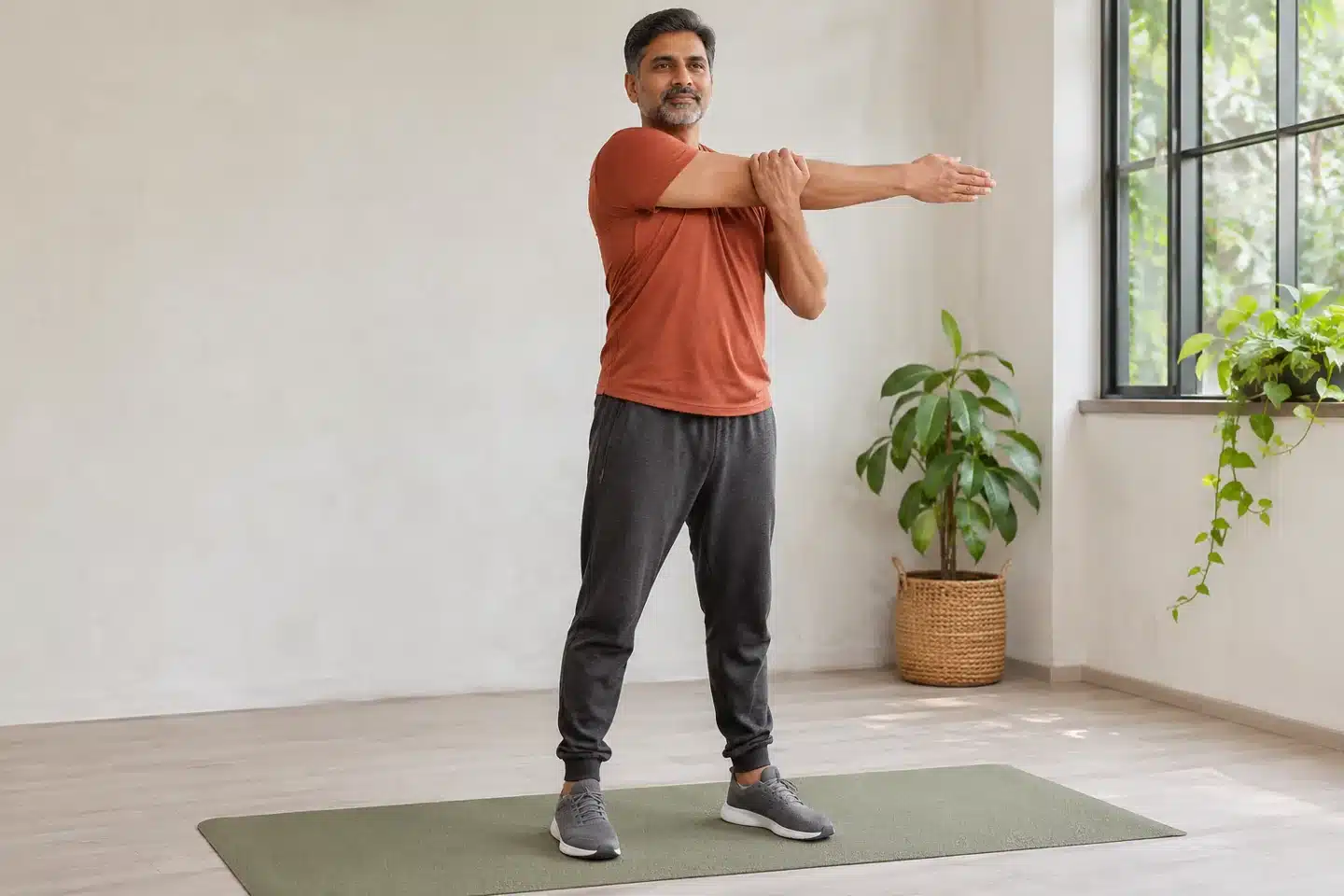
- The move: Bring your right arm across your chest at shoulder height and use your left forearm to draw it closer.
- How to hold it: Keep the right shoulder down, away from your ear.
- How long: 30 seconds per side.
13. Doorway Chest Stretch
Targets: chest and fronts of the shoulders.
- Starting position: Stand in a doorway with your forearms on the frame, elbows at shoulder height.
- The move: Step one foot forward until you feel your chest open.
- How to hold it: Keep your ribs down so your lower back doesn’t arch.
- How long: 30 seconds, twice.
14. Child’s Pose (Balasana)
Targets: lower back, hips and shoulders.
- Starting position: Kneel with your big toes together and knees wide.
- The move: Sit your hips back towards your heels and walk your hands forward. Rest your forehead on the mat or a block.
- How to hold it: Breathe slowly and let your shoulders soften.
- How long: 30 to 60 seconds, or up to 2 minutes as a cool-down.
15. Supine Spinal Twist
Targets: lower and middle back, outer hips.
- Starting position: Lie on your back and hug your right knee to your chest.
- The move: Guide the right knee across your body to the left, arms out wide. Turn your head to the right if your neck is comfortable.
- How to hold it: Keep both shoulders heavy on the floor. Stop before the shoulder lifts.
- How long: 30 seconds per side.
Want more yoga poses for flexibility? Try our 12 basic yoga poses for flexibility or the full yoga for flexibility guide.
Daily 10-Minute Flexibility Routine
This 10-minute stretching routine starts with 3 minutes of dynamic moves, then spends 7 minutes on static holds for the major muscle groups. It uses only the stretches above, needs nothing more than a strap or towel, and works in the morning or the evening.
| Time | Exercise (number above) | How long | Area |
|---|---|---|---|
| 0:00–1:00 | Arm circles (1) + hip circles (3) | 30 seconds each | Shoulders, hips |
| 1:00–2:00 | Leg swings (2) | 10 swings each leg | Hamstrings, hips |
| 2:00–3:00 | Cat-cow (4) | 8 slow rounds | Spine |
| 3:00–4:00 | Standing calf stretch (10) | 30 seconds each side | Calves |
| 4:00–5:00 | Doorway chest stretch (13) + cross-body shoulder (12) | 30 sec + 15 sec each side | Chest, shoulders |
| 5:00–6:00 | Kneeling hip flexor stretch (7) | 30 seconds each side | Hip flexors |
| 6:00–7:00 | Hamstring stretch with a strap (6) | 30 seconds each leg | Hamstrings |
| 7:00–8:00 | Figure-four glute stretch (8) | 30 seconds each side | Glutes, outer hips |
| 8:00–9:00 | Supine spinal twist (15) | 30 seconds each side | Back |
| 9:00–10:00 | Child’s pose (14) with slow breathing | 60 seconds | Lower back, calm finish |
Copy-and-Save Version
text
DAILY 10-MINUTE FLEXIBILITY ROUTINE (Inteyoga)
WARM-UP (3 min)
[ ] Arm circles 30s   [ ] Hip circles 30s
[ ] Leg swings 10 each leg
[ ] Cat-cow 8 rounds
STATIC STRETCHES (7 min): mild tension, slow breathing
[ ] Calf stretch 30s each side
[ ] Chest stretch 30s + shoulder stretch 15s each side
[ ] Hip flexor lunge 30s each side
[ ] Hamstring strap stretch 30s each leg
[ ] Figure-four glute stretch 30s each side
[ ] Supine twist 30s each side
[ ] Child's pose 60s
Rule: tension, never pain. Stretch both sides equally.
A simple breathing cue: breathe in through the nose to prepare, and soften into the stretch as you breathe out. If you can’t breathe smoothly, ease off a little.
Interested in deeper study? Inteyoga’s residential training in South Goa brings together Hatha Yoga, Raja Yoga, applied anatomy and classical texts. Explore our courses.
How to Increase Flexibility Fast (Safely)
The quickest safe route is consistency: stretch often, on warm muscles, give each tight muscle about 60 seconds of total hold time, and never force a stretch into pain. There’s no real shortcut, and forcing range raises the risk of a strain.
7 Evidence-Based Ways to Speed Up Your Progress
- Stretch more often. The ACSM says daily stretching brings greater gains than 2 to 3 days a week.
- Always stretch warm. Mayo Clinic suggests 5 to 10 minutes of light walking, jogging or cycling first, or stretching after your workout.
- Hit about 60 seconds per muscle. For example, two 30-second holds or four 15-second holds per major muscle group (ACSM).
- Use PNF stretching. Contract into the strap for 3 to 6 seconds, relax, then ease deeper for 10 to 30 seconds. PNF and static stretching produced the largest long-term range-of-motion gains in the 2024 Konrad review.
- Use the right intensity. The ACSM advises stretching to a feeling of tightness or slight discomfort, not pain.
- Give your tightest area extra time. Add one more hold for the side or muscle that feels stiffest.
- Stay consistent. A 2024 review on detraining found range of motion dropped back partly within 2 to 6 weeks of stopping. Little and often works better than occasional long sessions.
How Long Does It Take to Become More Flexible?
It varies by person, muscle and how consistently you stretch, so there’s no single reliable timeline. In small studies, measurable gains in flexibility appeared after 10 to 12 weeks of twice-weekly yoga. Retesting yourself every four weeks is the best way to see your own progress.
A 4-Week Flexibility Plan
| Week | Sessions | Hold time | Focus |
|---|---|---|---|
| Week 1 | 3 days | 20 seconds × 2 per stretch | Learn the 15 exercises; find mild tension |
| Week 2 | 4 days | 30 seconds × 2 | Full 10-minute routine, smooth breathing |
| Week 3 | 5 days | 30 seconds × 2 | Extra holds for your tightest area |
| Week 4 | 5–7 days | 30 seconds, plus PNF on hamstrings and hips | Contract into the strap 5 sec, relax, ease deeper 20–30 sec |
5 Flexibility Tests You Can Do at Home
Five commonly used flexibility checks are the sit-and-reach, the back-scratch (shoulder reach), trunk rotation, trunk lift and the groin flexibility test. There’s no single official list, and home versions are rough guides rather than clinical measurements. Do them on day one, write down your results and repeat every four weeks.
| Test | What it checks | How to do it | What to record |
|---|---|---|---|
| Sit-and-reach | Hamstrings and lower back | Sit with legs straight, feet against a step. Reach forward slowly and hold for 2 seconds | Distance from fingertips to toes, in inches or cm (minus if short) |
| Back-scratch (shoulder reach) | Shoulders | Reach one hand over your shoulder and the other up your back | Gap or overlap between your middle fingers, each side |
| Trunk rotation | Spine and torso | Stand side-on to a wall, feet still, and rotate to touch the wall behind you | How far along the wall you reach, each side |
| Trunk lift | Back extension | Lie face down and slowly lift your chest a short way | Height of your chin from the floor (keep it gentle) |
| Groin flexibility | Inner thighs and hips | Sit in the butterfly position, heels as close as comfortable | Distance from heels to groin |
Bonus check: sitting-rising. From standing, cross your legs and sit on the floor, then stand up again using as little support as possible. Note how many hands or knees you needed. Skip it if you have knee or hip problems, and keep something stable nearby.
Compare your left and right sides too. Mayo Clinic advises aiming for equal flexibility on both sides, especially if you’ve had an injury.
Flexibility Exercises for Seniors
Older adults can benefit from gentle, supported flexibility exercises at least 2 days a week, holding each stretch for 30 to 60 seconds and using a chair or wall for balance. The NHS advises adults aged 65 and over to do activities that improve strength, balance and flexibility on at least two days a week, and the ACSM recommends 30 to 60 second holds for older adults.
Think of it as support for everyday independence: reaching the top kitchen cupboard, getting in and out of the car, or bending down to the garden bed.
5 Chair-Friendly Flexibility Exercises for Older Adults
| Exercise | How to do it | Hold |
|---|---|---|
| Seated hamstring stretch | Sit near the front of a sturdy chair, one leg straight with the heel on the floor. Hinge forward from the hips with a long back | 30–60 seconds per leg |
| Seated neck rotation | Sit tall and slowly turn your head to each side | 5 seconds × 3 each side |
| Seated spinal twist | Sit tall, feet flat, hold the chair back and gently turn your chest to one side | 30 seconds each side |
| Wall-supported calf stretch | Hands on the wall, one foot back, heel down | 30–60 seconds each side |
| Overhead reach | Sit or stand tall, interlace your fingers and reach up, then lean slightly to each side | 15–30 seconds |
Safety first: move slowly, never bounce, and take care getting up from the floor. If you have osteoporosis, a joint replacement or balance problems, ask your doctor or physiotherapist which movements suit you, especially deep forward bends and twists. The NHS notes that strength, balance and flexibility exercises can help people who are worried about falling feel more confident on their feet.
For more, read our guide to senior yoga and safe poses.
Flexibility Exercises for Back Pain
Gentle stretches may help ease everyday back stiffness, but they are not a substitute for medical assessment or treatment.
Back pain is very common on both sides of the Atlantic. In the US, 39% of adults reported back pain in the past three months in 2019, according to the CDC’s National Center for Health Statistics. In the UK, Versus Arthritis (then Arthritis Research UK) describes low back pain as the leading cause of disability and estimates that about 1 in 6 adults in England have some form of back pain.
The NHS advises staying active, continuing your daily activities where you can, and avoiding long periods in bed. It suggests exercises and stretches may help, with one clear rule: stop if your pain gets worse and see a GP. For pain that doesn’t improve, the NHS lists treatments such as group exercise, physiotherapy and manual therapy.
6 Gentle Stretches for Everyday Back Stiffness
- Knees-to-chest: lie on your back and hug both knees in. Hold for 30 seconds, rocking gently.
- Cat-cow (4): 8 slow rounds to get the spine moving.
- Child’s pose (14): 30 to 60 seconds, with a cushion under your hips if needed.
- Supine spinal twist (15): 30 seconds each side, keeping the twist small.
- Kneeling hip flexor stretch (7): 30 seconds each side.
- Hamstring stretch with a strap (6): your back stays supported on the floor. 30 seconds each leg.
Stop any stretch that increases your pain. Inteyoga’s yoga for back pain guide covers more gentle options.
When to See a Doctor Instead
Following NHS guidance, see a GP or doctor if your back pain:
- doesn’t improve after a few weeks of home care, or stops you doing daily activities
- comes with weight loss you can’t explain, or is worse at night
- comes from the upper back, between the shoulder blades
Get emergency help (999 in the UK, 911 in the US) if back pain comes with numbness, tingling or weakness in both legs, loss of feeling around the genitals or bottom, changes in bladder or bowel control, chest pain, or if it started after a serious accident.
Stretches for Desk Workers: A 3-Minute Office Routine
If you sit for most of the day, a short stretch break every hour or two may help ease neck, shoulder and hip stiffness without leaving your desk. Whether you’re working from home in Birmingham or in an open-plan office in Chicago, the pattern is similar: shoulders round forward, hips stay bent, and the head drifts towards the screen.
| Minute | Stretch | Where |
|---|---|---|
| 0:00–0:45 | Neck rotation and side stretch (11) | Seated |
| 0:45–1:30 | Cross-body shoulder stretch (12) | Seated |
| 1:30–2:15 | Doorway chest stretch (13) | Nearest doorway |
| 2:15–3:00 | Standing hip flexor stretch: stand in a split stance, tuck the tailbone and ease the back hip forward | Beside your desk |
Practical tip: link it to something you already do, such as after every video call or each time you refill your water bottle.
How Often and How Long Should You Stretch?
Do flexibility exercises at least 2 to 3 days a week, and daily if you can. Hold each stretch for 10 to 30 seconds (30 to 60 seconds for older adults) and repeat it 2 to 4 times, for about 60 seconds in total per muscle group. These are the ACSM’s evidence-based recommendations.
| Variable | ACSM recommendation |
|---|---|
| Frequency | At least 2–3 days per week; greater gains with daily practice |
| Intensity | Stretch to a feeling of tightness or slight discomfort, not pain |
| Hold time | 10–30 seconds for most adults; 30–60 seconds for older adults |
| PNF | 3–6 second contraction at 20–75% effort, then a 10–30 second assisted stretch |
| Repetitions | 2–4 per stretch |
| Total volume | About 60 seconds per muscle group per session |
Source: ACSM position stand (Garber et al., 2011), summarised by the University of New Mexico. Mayo Clinic adds that even 5 to 10 minutes of stretching at a time can be helpful.
When Is the Best Time to Stretch?
Stretch when your muscles are warm: after a workout, after a walk or after a warm shower. Use dynamic movements before exercise and static stretches after it. Some people like a short morning routine to ease stiffness; others prefer slow evening holds to wind down. The best time is the one you’ll keep doing. For more, see the best time to do yoga.
How to Cool Down After Flexibility Exercises
Cool down by slowing your breathing, holding one or two restful positions, and getting up slowly.
- Child’s pose (14) for 60 seconds, breathing slowly.
- Knees-to-chest, rocking gently side to side for 30 seconds.
- Lie on your back (Shavasana, the yoga resting pose) for 1 to 2 minutes, letting each breath out be a little longer than the breath in.
- Roll onto your side and press up to sitting slowly.
- Have some water and jot down how you feel in your tracker.
If you’re stretching after a run or a gym session, the static stretches themselves are your cool-down. Just finish with the breathing step.
What Equipment Do You Need for Flexibility Exercises?
You don’t need any special equipment. A non-slip mat and a towel are enough to start. A few inexpensive props can make stretching more comfortable, especially for beginners.
| Equipment | What it does | Best for | Essential? |
|---|---|---|---|
| Yoga mat | Stops slipping, cushions knees and spine | All floor stretches | Recommended |
| Yoga strap or towel | Extends your reach | Hamstring and shoulder stretches, PNF | Recommended |
| Yoga blocks (or thick books) | Brings the floor closer | Child’s pose, forward bends, lunges | Optional |
| Folded blanket or cushion | Pads knees, lifts hips | Low lunge, butterfly, seated stretches | Optional |
| Sturdy chair | Balance and support | Chair stretches, quad stretch | Optional |
| Wall or doorway | Fixed support | Calf and chest stretches | Free |
| Resistance band | Adds light resistance | Shoulder rotations, mobility drills | Optional |
| Foam roller | Some people use it alongside a warm-up (Mayo Clinic) | Calves, quads, upper back | Optional |
Wear loose, comfortable clothes and keep water nearby, as the NHS suggests.
Common Stretching Mistakes and How to Fix Them
Most stretching problems come down to a handful of easy-to-fix habits: bouncing, pushing into pain, holding your breath and stretching cold.
| Common mistake | Why it’s a problem | How to fix it |
|---|---|---|
| Bouncing while stretching | Mayo Clinic warns it can injure the muscle and contribute to tightness | Ease in slowly and hold still |
| Stretching into pain | Mayo Clinic says if it hurts, you’ve pushed too far | Back off until you feel tension, not pain |
| Holding your breath | Makes it harder to relax into the stretch | Breathe slowly and soften as you breathe out |
| Stretching cold muscles | Mayo Clinic notes you may hurt yourself stretching cold muscles | Warm up for 5–10 minutes or stretch after exercise |
| Long static holds before sprinting | May slightly reduce performance (Mayo Clinic) | Dynamic movements before, static stretches after |
| Rounding the back in forward bends | Shifts the stretch away from the hamstrings | Hinge from the hips with a long spine; bend the knees |
| Only stretching one side | Uneven flexibility may be a risk factor for injury (Mayo Clinic) | Stretch both sides; add a hold for the tighter one |
| Skipping your tightest areas | The muscles that need it most don’t improve | Start the routine with your stiffest area |
| Comparing yourself with others | Mayo Clinic notes flexibility genetics differ between people | Track your own progress with the home tests |
| Stretching once in a while | Range can drop back within weeks of stopping | 10 minutes, 3 to 7 days a week |
Who Should Check With a Doctor First?
Talk to your doctor or physiotherapist before you start if any of these apply to you:
- You’re pregnant (your midwife or doctor can advise which positions suit each stage)
- You have a recent injury, strained muscle or recent surgery (Mayo Clinic notes that stretching a strained muscle may cause further harm)
- You have a joint replacement, osteoporosis or a spinal disc problem
- You have high or low blood pressure, glaucoma or a heart condition, especially before trying head-down positions
- You have joint hypermobility, where control and strength usually matter more than extra range
Flexibility Exercises vs Mobility Exercises: What’s the Difference?
Flexibility exercises lengthen your muscles so a joint can be moved further, often passively. Mobility exercises train you to actively control a joint through that range using strength and coordination. You need both: flexibility gives you the range, and mobility helps you use it.
Here’s a simple way to feel the difference. Lying on your back, you might pull your leg up to 90 degrees with a strap. That’s flexibility. Standing, you might only be able to lift it to 60 degrees on your own. That’s closer to mobility.
| Flexibility exercises | Mobility exercises | |
|---|---|---|
| Main goal | Lengthen muscles and tendons | Improve usable, controlled joint range |
| How it works | Mostly passive or held stretches | Active movement under muscle control |
| Examples | Hamstring strap stretch, butterfly, child’s pose | Leg swings, hip circles, cat-cow, lunge with a twist |
| Strength needed | Low | Moderate |
| Best time | After exercise or on its own | Warm-up or on its own |
| Where yoga fits | Longer held poses | Flowing sequences and standing poses |
Which should beginners start with? Both, from day one. Our 10-minute routine opens with mobility moves and finishes with flexibility holds.
Free 7-Day Flexibility Tracker (Printable)
Use this 7-day tracker to follow the 10-minute routine for a week and record how it feels. Print this page or copy the table into your notes app.
| Day | Routine | Extra focus | Done? | How did it feel? (1–5) |
|---|---|---|---|---|
| Day 1 | 10-minute routine + home tests (your baseline) | Hamstrings | ☐ | |
| Day 2 | 10-minute routine | Hip flexors | ☐ | |
| Day 3 | Dynamic warm-up + upper-body stretches | Chest and shoulders | ☐ | |
| Day 4 | 10-minute routine | Calves | ☐ | |
| Day 5 | 10-minute routine | Lower back | ☐ | |
| Day 6 | Lower-body stretches, 2 × 30 seconds each | Glutes and hips | ☐ | |
| Day 7 | 10-minute routine + repeat sit-and-reach | Your tightest area | ☐ |
Final Thoughts: Start Your Flexibility Exercises Today
Flexibility exercises work best when they’re gentle, regular and done on warm muscles. Pick a few stretches from the 15 above, follow the daily 10-minute routine at least three times a week, hold each stretch for around 30 seconds, and retest yourself every four weeks.
You don’t need to touch your toes to start. You just need to start.
If you’d like to go further and study yoga in depth, Inteyoga runs residential teacher training at our centre in Colva, South Goa. Our current advanced programme is the Advanced TTC 300-Hour Integrated Restorative Yoga (Including Yoga Nidra, Chakra Sadhana, and Prana Vidya Intensive).
- The advanced 300-hour programme is a 43+2 day residential training (43 training days plus arrival and departure days), taught in English. Applicants need to have completed a 200-hour yoga teacher training (TTC 200) or an equivalent qualification and be aged 21 to 60. It follows a Gift-it-Forward model: no payment is required to apply or to participate, and after completing the programme participants may voluntarily support the initiative to help future aspirants, with no obligation to contribute. Apply here.
- The planned 200-hour programme is expected around mid-2027. Find out more about the 200-hour programme.
- Have a question first? Read our FAQ, email info@inteyoga.org, or message us on WhatsApp at +91 935-473-7240.
Frequently Asked Questions (FAQ)
What Is Flexibility?
Flexibility is the ability of a joint, and the muscles and tendons around it, to move through its full, pain-free range of motion. The ACSM treats flexibility exercise as one part of a complete fitness programme, alongside aerobic, resistance and balance exercise. Flexibility is specific to each joint, so you can have loose hamstrings but tight shoulders, and regular stretching can improve it at any age.
What Are 5 Examples of Flexibility Exercises?
Five easy examples are the standing calf stretch, the hamstring stretch with a strap, the kneeling hip flexor stretch, the doorway chest stretch and child’s pose. Together they cover your calves, the backs of your thighs, hips, chest and lower back. Hold each one for 20 to 30 seconds per side, breathing slowly, at least two or three times a week.
What Are the Different Types of Flexibility Exercises?
The main types are static stretching (holding still), dynamic stretching (controlled, repeated movement), PNF stretching (contract, relax, then stretch further) and ballistic stretching (bouncing, not advised for beginners). Stretches can also be active, using your own muscles to hold the position, or passive, using gravity, a strap or a partner. Beginners should start with static and dynamic stretching.
What Are the Benefits of Flexibility Exercises?
The best-supported benefit is a greater range of motion. The ACSM reports that flexibility training also helps balance and postural stability in most adults, and Mayo Clinic lists easier daily activities and increased muscle blood flow among possible benefits. Evidence that stretching alone prevents injuries is limited, so combine it with strength and balance training.
What Are the Big 7 Exercises?
There’s no official definition, but in fitness training “the big 7” usually means seven fundamental movement patterns: squat, lunge, hinge, push, pull, rotation (twist) and gait (walking or running). They’re strength and movement patterns rather than stretches, but each one needs adequate flexibility to perform comfortably. Regular stretching helps maintain the range of motion they rely on.
How Can I Train My Flexibility?
Stretch every major muscle group at least 2 to 3 days a week, ideally every day. Warm up for 5 minutes, use dynamic movements before exercise and static stretches after, and hold each stretch for 20 to 30 seconds at mild tension. After a couple of weeks, try PNF stretching. The daily 10-minute routine in this guide is an easy place to start.
What Are 5 Stretches to Improve My Flexibility?
Five stretches that cover most of the body are the hamstring stretch with a strap, the kneeling hip flexor stretch, the butterfly stretch, the doorway chest stretch and the supine spinal twist. They target areas that often feel tight after long periods of sitting. Hold each for 30 seconds, twice per side, at least three times a week.
Which Exercises Improve Flexibility the Most?
A 2024 review of 77 studies (Konrad et al.) found static stretching and PNF stretching produced greater long-term range-of-motion gains than dynamic or ballistic stretching. Dynamic stretches like leg swings and cat-cow are still useful as warm-ups. Mayo Clinic adds that gentle movement practices such as yoga, Pilates and tai chi can help you become more flexible in specific movements.
How Many Days a Week Should I Stretch?
The ACSM recommends flexibility exercises at least 2 to 3 days a week, with greater gains from daily practice. The NHS advises adults aged 65 and over to do strength, balance and flexibility activities on at least two days a week. For most beginners, 10 minutes on 3 to 5 days a week is a realistic starting point.
Is It OK to Do Flexibility Exercises Every Day?
For most healthy people, yes. The ACSM notes that daily stretching brings greater gains than stretching two or three times a week. Keep the intensity gentle, never stretch into pain, and give an area a rest if it feels sore or irritated the next day. If you have a medical condition or injury, check with your doctor first.
Should I Stretch Before or After Exercise?
Do dynamic movements before exercise and longer static stretches after. Mayo Clinic advises warming up for 5 to 10 minutes rather than stretching cold muscles, and notes that stretching immediately before an intense event such as sprinting may slightly reduce performance. After exercise, your muscles are warm and ready for 20 to 30 second holds.
Is It Better to Stretch in the Morning or at Night?
Both can work. A short morning routine can ease the stiffness some people feel after sleep, while slow evening stretches with long breaths out help many people wind down. What matters most is that your muscles are warmed up and that you stretch consistently, so choose the time you’re most likely to stick with.
What Are Some Flexibility Skills?
Flexibility skills are advanced positions that need a high range of motion, such as the front split, middle (side) split, pike fold, straddle or pancake fold, bridge (backbend) and a deep flat-footed squat. They usually take months of steady, progressive training. Build towards them gradually, add strength at the end of your range, and never force a split or backbend.
How Should You Cool Down After Flexibility Exercises?
Finish with one or two restful positions such as child’s pose or knees-to-chest, then lie on your back for 1 to 2 minutes, breathing slowly with a longer breath out than in. Roll onto your side and sit up slowly, then drink some water. After a workout, your static stretches can double as the cool-down.
What Equipment Do You Need for Flexibility Exercises?
You don’t need special equipment. A non-slip mat and a strap or towel cover every stretch in this guide. Optional extras include yoga blocks, a folded blanket for your knees, a sturdy chair for balance, a resistance band and a foam roller. A wall or doorway works well for calf and chest stretches.
What Are the 5 Types of Flexibility Tests?
There’s no single official list, but five commonly used checks are the sit-and-reach (hamstrings and lower back), the back-scratch or shoulder-reach test (shoulders), trunk rotation (spine), trunk lift (back extension) and the groin flexibility test (inner thighs and hips). Home versions are rough guides, not clinical measurements. Test on day one, then every four weeks.
Can You Become Flexible at Any Age?
Yes. A 2024 meta-analysis in Sports Medicine found that the effect of static stretching on flexibility wasn’t moderated by age. Older adults should hold stretches a little longer, around 30 to 60 seconds as the ACSM advises, move slowly, and use a chair or wall for support. Progress may be gradual, but it’s achievable.
Is Yoga Good for Flexibility?
Yoga combines held stretches, flowing movement and slow breathing, so it can train flexibility and balance together. In a small 2016 study in the International Journal of Yoga, college athletes who added yoga twice a week for 10 weeks improved hamstring and shoulder flexibility, while a comparison group did not. Beginners should start with gentle, supported poses.
Do Flexibility Exercises Help With Weight Loss?
Not directly. Stretching is a light activity and isn’t designed for weight loss. It may help indirectly by easing stiffness and making other exercise more comfortable, which can support an active routine. For weight management, combine regular aerobic activity, strength training and diet changes, ideally with advice from a health professional. See our guide to yoga for weight loss.
What Should I Do If I Feel Pain While Stretching?
Ease off straight away. Mayo Clinic says to expect tension while stretching, not pain; if it hurts, you’ve pushed too far. Back off until the discomfort fades, then hold. If pain continues after you stop, or you feel numbness, tingling or pain spreading down a limb, stop stretching that area and see a doctor or physiotherapist.
Can You Stretch Too Much?
It’s possible. Stretching too hard, bouncing, or stretching an already strained muscle can cause harm, as Mayo Clinic notes. People with joint hypermobility may need to focus on control and strength rather than extra range. Warning signs include sharp pain or discomfort that lingers. Stay at mild tension, keep holds within the ACSM ranges, and pair stretching with strength work.
Do Flexibility Exercises Help With Back Pain?
The NHS says exercises and stretches may help with back pain and advises staying active, but to stop if pain gets worse and see a GP. Gentle stretches for the hips, hamstrings and spine may ease everyday stiffness. They don’t replace medical care. Seek urgent help for numbness in both legs, bladder or bowel changes, or pain after a serious accident.